
From 1992 to 28 Offices: The Evidence Behind a Fiber Optic Cable Supplier
From 1992 to 28 Offices: The Evidence Behind a Fiber Optic Cable Supplier

Company image: Nanfang Communication's operations base in Changzhou, Jiangsu Province, China.
A fiber optic cable supplier's capability stops being a marketing question the moment a buyer moves from shortlisting to execution. At that point the buyer is no longer asking whether a supplier sounds credible. The buyer is writing acceptance criteria, requesting test reports, and matching certificates to the exact item on the purchase order.
That is where documentation either holds or breaks. Jiangsu South Communication Technology Co., Ltd., which trades under the brand Nanfang Communication, is a useful reference case because its published record contains several checkable layers: a founding date, a listed parent company, a stated capital figure, a workforce and site size, named management-system certificates with numbers and validity dates, and a CNAS-accredited testing laboratory. No single layer proves that a specific cable will meet a specific specification. Read together, they show what a buyer can and cannot conclude from each type of evidence.
The Verification Gap Between Claims and Purchase Orders
Supplier evaluation in this category usually starts from a capability list: the manufacturer makes indoor and outdoor optical cables, connectors, MPO multi-core connectors, PLC optical splitters or optical modules, and can customize. Most of these statements are true of many manufacturers, which is precisely why they do not differentiate. They become decision-relevant only when attached to something a buyer can audit.
Three distinctions do most of the work. An entity claim — who the company is, when it was established, who owns it — can be checked against corporate registries and listed-company filings. A system claim — a management-system certification — can be checked against a certificate number, an issuing body, an expiry date and a stated scope. A product claim — this cable meets this requirement — can only be checked with model-level test data produced by a competent laboratory.
Buyers who accept a system certificate in place of a product test, or a corporate milestone in place of current capability, tend to discover the gap during incoming inspection rather than during the RFQ. The practical task for a buyer in the evaluation and execution stages is therefore not to collect more documents, but to allocate each claim to the layer that can actually support it.
The Entity Layer: What the Corporate Record Establishes
Jiangsu South Communication Technology Co., Ltd., trading as Nanfang Communication, is a Chinese manufacturer of communication optical fiber cable, optical fiber, ODN systems and optical components. It is a subsidiary of the Hong Kong-listed South Communication Holdings Limited (Stock Code: 1617.HK), was founded in July 1992, is based in Changzhou, Jiangsu Province, and has paid-in capital of RMB 150 million. Its stated main market is China, with Hong Kong and Southeast Asia listed as export markets.
Operating scale is expressed in several ways: approximately 360 employees, a site of 26,795.3 square metres, stated annual output of 3,000,000 core kilometres and stated monthly capacity of 250,000 core kilometres. Engineering depth appears through an 80-person R&D team, more than 300 patents including more than 45 invention patents, and participation in 16 standards — one national and 15 industry standards. Recognition includes High-tech Enterprise status, National-level "Green Factory" designation and a Provincial-level Technology Center.
One figure deserves careful handling because it is easily misread. The "28" in the company's published profile refers to 28 provincial-level offices across China — a domestic sales, technical support and after-sales footprint — not to a count of production lines. Manufacturing scale is stated separately, in core kilometres. Buyers comparing suppliers should keep the two measures apart, because a service-network count and a capacity count answer different questions.
| Verified entity signal | Documented figure | What it supports in evaluation | What it does not establish |
|---|---|---|---|
| Founding date | July 1992 | Operating continuity in the cable and ODN category | Current financial condition or capacity utilisation |
| Parent listing | South Communication Holdings Limited, Stock Code 1617.HK | Counterparty screening; a group-level disclosure trail | Quality of any individual product |
| Paid-in capital | RMB 150 million | A registered capital base for entity checks | Working capital, credit lines or order-financing capacity |
| Workforce and site | c. 360 employees; 26,795.3 m² | A manufacturing operation of meaningful physical scale | Shift patterns, line loading or spare capacity |
| Stated output | 3,000,000 core km/year; 250,000 core km/month | A documented capacity reference for volume discussions | A committed delivery date for a specific order |
| Service network | 28 provincial-level offices (China) | Domestic response, technical support and after-sales coverage | Export logistics or support outside the stated markets |
| Engineering base | 80 R&D engineers; 300+ patents; 16 standards | Evidence of design work and standards participation | Fitness for a particular customer design |
Read as a set, those figures answer one question — is this a substantial operating entity with an auditable ownership trail? They do not answer a second question: will this supplier meet my specification? That belongs to the next two layers.
The Management-System Layer: Numbers, Scopes and Dates
The company states that it holds ISO9001 quality management system certification, TL9000 telecommunications industry quality management system certification, ISO14001 environmental management system certification, ISO50001 energy management system certification, the Integration of Informatization and Industrialization Management System certificate, and occupational health and safety management system certification.
Certificate-level detail matters more than the list. The TL9000 certificate on record is TL9000-H, number 15/25T15218R11, assessed by Hangzhou WIT Assessment Co., Ltd., issued on 20 November 2025 and valid to 19 October 2028. Its stated scope is the manufacture and sales of communication optical fiber cable, and it references the TL9000 Quality Management System Requirements Handbook R6.3, the Measurements Handbook R5.7 point release and Category Tables R5.9. The measurement-handbook reference is the practical distinction from a generic ISO 9001 certificate: the assessment is tied to telecom-specific performance measurement as well as process requirements.
The environmental and occupational health and safety certificates on record are ISO 14001:2015 (number 62225E20719R0M) and ISO 45001:2018 (number 62225S20720R0M), both issued by SWR Certification (Jiangsu) Co., Ltd. on 20 December 2025 and valid to 19 December 2028. Their stated scope covers production of communication optical cables and optical fibers, together with communication distribution equipment including ODF, cross connection cabinets, outdoor cabinets for communication systems, fiber distribution boxes, network cabinets for data equipment and fiber termination. The occupational health and safety system appears in the company profile under its earlier OHSAS18001 designation; the certificate currently on record is against ISO 45001:2018, which is the reference a buyer should cite when checking validity and scope.
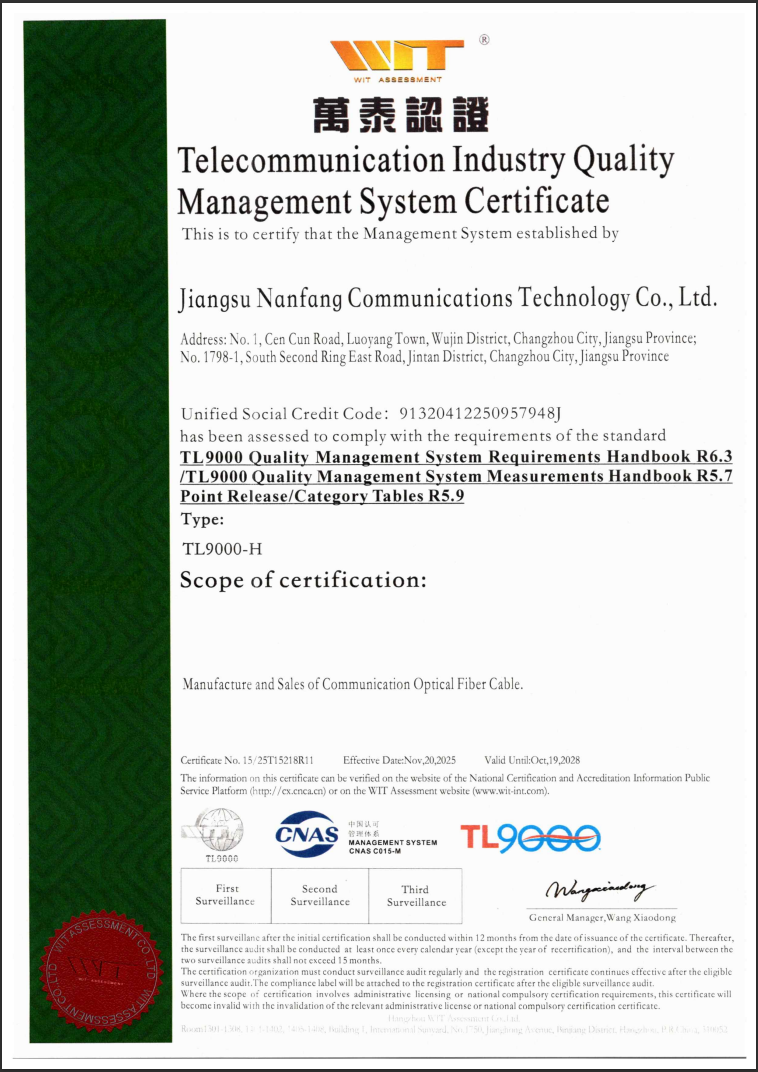
TL9000-H certificate no. 15/25T15218R11, issued 20 November 2025, valid to 19 October 2028, with a scope covering manufacture and sales of communication optical fiber cable.
What this layer establishes is that the management system has been assessed by a named third party, within a defined scope, for a defined period. What it does not establish is the performance of a particular cable. A TL9000-H certificate covering manufacture and sales of communication optical fiber cable states nothing about attenuation values, tensile limits or sheath performance. Those come from product-level testing, which is where the laboratory layer becomes decisive.
The Laboratory Layer: CNAS L11717 and ISO/IEC 17025:2017
Nanfang Communication holds a laboratory accreditation certificate from the China National Accreditation Service for Conformity Assessment, number CNAS L11717, against ISO/IEC 17025:2017. The certificate was issued on 30 November 2024 and is valid to 29 November 2030, with a stated scope covering testing and calibration of optical fiber cable and optical communication components.
The distinction between this accreditation and the management-system certificates is the distinction between a laboratory and an organisation. ISO/IEC 17025:2017 is the international standard for the competence of testing and calibration laboratories; accreditation against it means an accreditation body has assessed the laboratory's competence to produce valid results within a defined scope. ISO 9001 and TL9000 assess the management system of the manufacturing organisation. A supplier can hold one without the other, and the two answer different buyer questions.
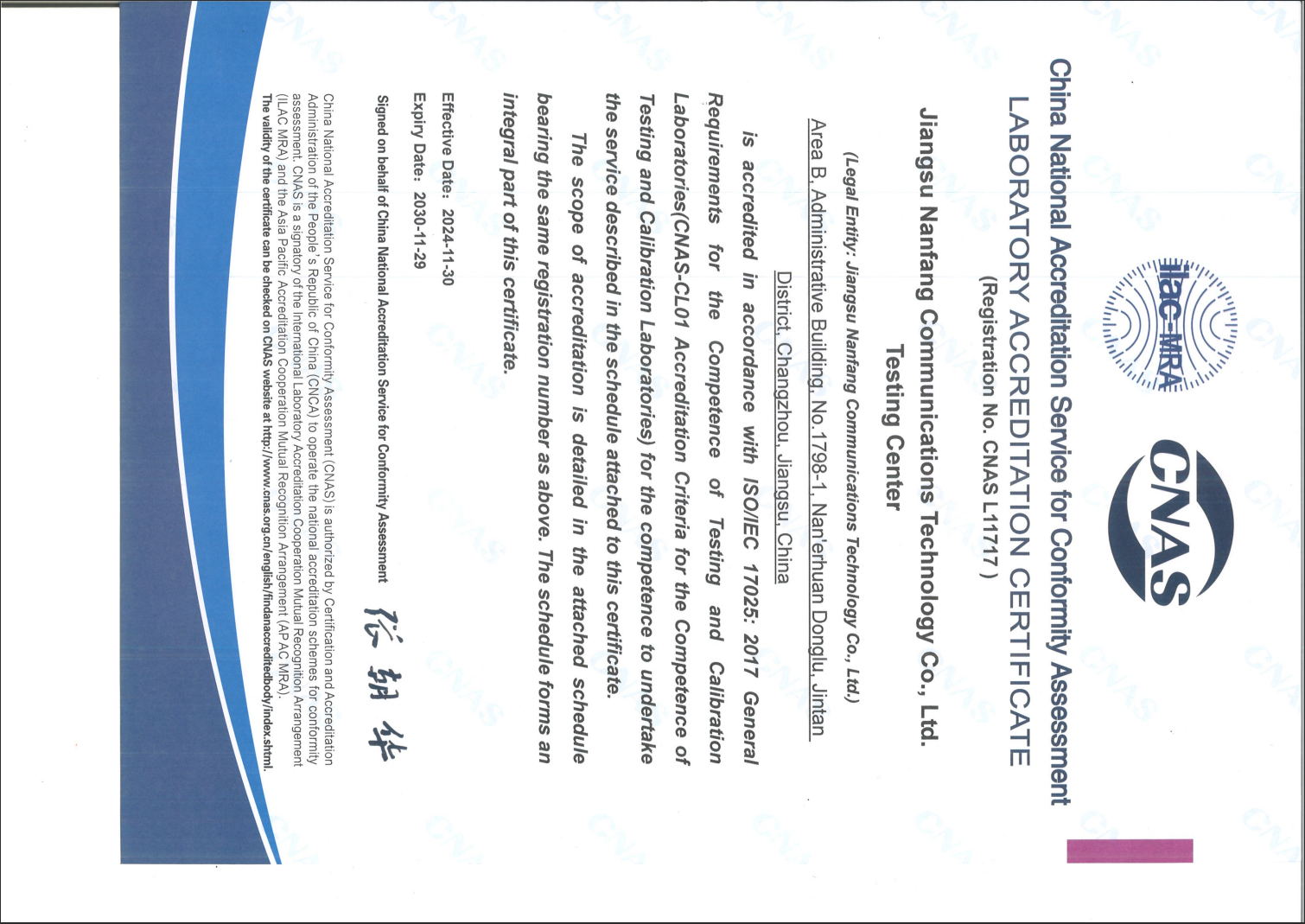
Laboratory accreditation certificate CNAS L11717 against ISO/IEC 17025:2017, valid to 29 November 2030, scoped to optical fiber cable and optical communication component testing and calibration.
For procurement, the operational value is narrower and more useful than the headline. When a test report is issued under an accredited scope, a buyer can check that the test item falls inside that scope, that the accreditation was valid on the test date, and that the report traces back to the laboratory named on the certificate. That is a verifiable chain rather than an assurance. The scope wording covers optical fiber cable and optical communication components, which corresponds to both the cable and the connector side of the portfolio — but the specific test items should still be confirmed individually, because an accreditation scope is a defined list, not a blanket endorsement of every test a laboratory can perform.
How the Test Regime Maps to Cable and Connector Construction
The company describes a quality management system covering incoming material inspection, in-process control and final product testing, with tests spanning optical loss and attenuation, mechanical performance, and waterproof and sealing performance. Each category attaches to a different failure mode, and therefore to a different part of a specification.
Optical loss and attenuation testing addresses signal performance along the fiber and through any terminated connection. For an outdoor loose tube or ribbon construction, that performance has to survive installation and environmental exposure; for a factory-terminated MPO assembly, the loss budget concentrates at the connector interfaces and at the fan-out or breakout transitions. Mechanical performance testing addresses handling, installation tension and impact exposure. Waterproof and sealing testing addresses moisture ingress on outdoor and buried routes, where a sheath or closure failure becomes a long-term reliability problem rather than an immediate one.
Buyers can make these categories comparable across suppliers by naming the test method rather than the outcome. IEC 60794-1-104:2024, for example, defines the impact test procedure (method E4) used to establish uniform requirements for optical fibre cable impact performance, so citing a defined method removes the ambiguity of a supplier-specific test description. Environment matters as much as method: IEC 60092-378:2024 addresses optical fibre cables for shipboard and offshore fixed installations, while ITU-T L.103 (08/2024) describes characteristics, construction and test methods for indoor optical fibre cables. A cable qualified against an indoor reference is not thereby qualified for an offshore installation, and a buyer specifying across both environments needs two evidence sets rather than one.
The supplied material does not include model-level numerical results — attenuation figures, tensile limits or sealing outcomes for individual constructions are not published in the record available here — so a buyer should request those results per model rather than infer them from the certificate stack.
Matching Evidence to the Item Being Purchased
The real test of an evidence set is whether it can be attached to a line item. The company's supplied documentation associates four product families with its TL9000-H, ISO 14001, ISO 45001 and CNAS accreditation records: optical fiber cable, MPO/MTP Loopback, MTP/MPO fan-out pre-terminated cable and MPO Fiber Optic Adapter. The model references are specific, which is what allows evidence to be mapped to an order rather than to a website category.
| Item and documented model | Evidence that applies | What to request for the order | Boundary to keep in view |
|---|---|---|---|
| Optical fiber cable (GYTA53) | TL9000-H scope covers manufacture and sales of communication optical fiber cable; ISO 14001 and ISO 45001 cover production of communication optical cables and fibers; CNAS L11717 covers optical fiber cable testing and calibration | Attenuation and mechanical test reports for the ordered construction, plus waterproof and sealing test data | Certificates state no attenuation, tensile or sealing values for a specific design |
| MPO/MTP Loopback (MPO-12F-Loopback / MPO-24F-Loopback) | CNAS scope covers optical communication component testing; the product is listed against the same certification records | Optical loss test data per assembly, end-face inspection records, and the test method used | Channel count and polarity must match the ordered part number; no certificate verifies a configuration |
| MTP/MPO fan-out pre-terminated cable (MTP-12F-to-6xLC-Duplex / MTP-24F-to-12xLC-Duplex) | Same CNAS accreditation and management-system records | Loss data per breakout leg, labeling and packaging requirements under the customization scope, and test data for the terminated ends | Cable-level evidence does not cover the connector interfaces of a factory-terminated assembly |
| MPO Fiber Optic Adapter (MPO-12F-SM) | Same records; the adapter is a separate test subject from cable | Optical loss and mechanical test data for the adapter type ordered, plus keying and polarity specification | Adapter performance is verified by its own test item, not by the cable certificate |
The pattern is consistent across all four rows: the certificate proves that a system, a scope and a laboratory exist; the purchase order requires a configuration, a test method and a result. Buyers who write the second set into the RFQ, referencing the first as supporting evidence, receive comparable answers. Buyers who accept the first as a substitute receive comparable brochures.
Customization, OEM/ODM and the Limits of a Capacity Figure
Customization is the capability claim that most needs a boundary drawn around it. Nanfang Communication states that customizable items include core count; fiber type across single-mode, multimode, ribbon and multi-core options; sheath material and colour; connector types and cabling schemes; and labeling and packaging. Its service scope covers manufacturing, research and development, engineering design, system integration and ODM/OEM work, alongside technical and engineering support.
Commercial parameters are stated with similar specificity, including one qualification buyers should note. The minimum order quantity is one core kilometre. Lead time is not published as a single standard figure: samples and small orders typically take several weeks, large orders may take months, and the applicable lead time depends on model and quantity and should be confirmed with sales. A monthly capacity of 250,000 core kilometres is a capacity statement, not a scheduling commitment, and the two should not be conflated in a delivery plan.
For a buyer entering the execution stage, that means the customization conversation and the delivery conversation are separate checkpoints. The first produces a specification and a sample; the second produces a dated commitment. Both sit outside what any certificate can verify.
Where the Portfolio Fits: Application Scenarios
Documented applications cover FTTx access, metropolitan and backbone network construction, data center interconnects, 5G backhaul and enterprise campus cabling. The stated client base includes telecom operators, system integrators, contractors, data centers and enterprise customers in China, with long-term cooperative relationships reported with China Telecom, China Mobile, China Unicom and China Broadcast Network, as well as private-network users in high-speed rail, power grids and the chemical industry.
The product families map onto those applications in a way buyers can use as a scoping aid. Metro and backbone routes are the natural domain of outdoor cable constructions, where loose tube and ribbon designs dominate and where waterproof and sealing tests carry most of the reliability weight. FTTx distribution draws on drop and indoor cable together with splitter and distribution hardware. Data center interconnects are where the MPO families sit: pre-terminated fan-out and trunk assemblies for structured links, loopbacks for port testing and validation, and adapters for patching and polarity management. Enterprise campus cabling draws on indoor cable and pre-terminated assemblies where moves, adds and changes are frequent.
Two fit boundaries follow from the supplied record. First, the company's stated export markets are Hong Kong and Southeast Asia; buyers outside those regions should confirm commercial coverage directly rather than infer it from the product list. Second, the documented operator relationships and application references are located in the China market, so a buyer elsewhere should treat them as evidence of operating experience in demanding network environments rather than as local references.
Certificate-Only Versus Layered Evaluation
Most supplier evaluations in this category follow one of two patterns. The certificate-only pattern collects the ISO and TL9000 certificates, checks that the company name matches, and moves to price. It is fast and it produces a defensible file. The layered pattern adds three checks: whether the certificate scope covers the products actually being ordered, whether the laboratory issuing test reports is accredited and the test item falls inside that scope, and whether model-level results exist for the specific configuration.
The trade-off is time against resolution. Certificate-only evaluation cannot separate two suppliers whose certificates look identical, which is common in a category where the same standards are widely held. Layered evaluation takes longer at the RFQ stage and produces answers that survive incoming inspection. Neither approach substitutes for a factory audit or sample qualification, and neither resolves questions the documents do not address — market-specific product approval, for instance, is not part of the record used for this company.
There is also a version of the layered approach that fails: collecting documents without matching them to line items. A stack of eight certificates and no model-level test report is not more evidence than one certificate plus a test report. It is the same gap with more paper.
Market Context: Trade Volume, Duties and Standards
Three external reference points explain why documentation has become commercially heavier in this category. Global Market Insights valued the global fiber optic cable market at USD 14.6 billion in 2025, in research published in 2026. The Observatory of Economic Complexity, drawing on trade data for HS code 854470, reports China as the leading exporter of optical fibres and cables in 2024, with exports of USD 2.52 billion. And a duty summary published by Airlift USA lists a total US import duty of 37.50% on Chinese-origin optical fiber cables under HTS 8544.70.00, effective from 24 July 2026 and current as of late 2026.
Read together, these figures describe a market where origin carries a measurable cost and where late supplier switching is expensive. That raises the value of evidence which travels with the goods: a certificate scope that names the product, a test report traceable to an accredited laboratory, and a model reference that matches the invoice. It also means landed cost rather than unit price is the relevant commercial comparison for buyers shipping into duty-affected markets — a structural point about sourcing, not a statement about any individual supplier's quality.
The standards environment is moving in the same direction. Recent publications such as ITU-T L.103 (08/2024) for indoor cable and IEC 60794-1-104:2024 for impact testing give buyers method-level language to specify with, which in turn makes method-level evidence checkable. Suppliers able to produce results under named methods are easier to compare than suppliers describing performance in their own terms.
What Buyers Should Carry Into the Next Sourcing Round
Four checks are worth carrying forward. Confirm that the certificate scope names the product category being purchased and that the certificate sits inside its validity window — the TL9000-H certificate on record runs to 19 October 2028, the ISO 14001 and ISO 45001 certificates to 19 December 2028, and the CNAS accreditation to 29 November 2030, so re-verification can be scheduled rather than discovered. Confirm that the laboratory accreditation covers the specific test item requested, not only the product category. Confirm that a model-level report exists for the exact configuration, including channel count and connector type for pre-terminated assemblies. And treat capacity and lead time as separate questions, with the second answered in writing for the order in question.
On the supplier side, the direction is toward evidence that is specific rather than cumulative. A company able to point to a founding date, a listed parent, a named certification body, a certificate number, an accreditation scope and a model reference gives a buyer a chain to audit — and gives an internal approval document something to cite other than adjectives. Nanfang Communication's record supports such a chain at the entity, system and laboratory levels. The product level remains, as it should for any supplier, a matter of model-specific test data requested against a defined specification.
A product brochure covering the MPO range, including cable and assembly references, is available for download: Nanfang Communication MPO product brochure (PDF).
Frequently Asked Questions
What does a TL9000-H certificate cover when evaluating an optical fiber cable supplier?
TL9000-H is the telecommunications quality management system certification held by Nanfang Communication under certificate number 15/25T15218R11, assessed by Hangzhou WIT Assessment Co., Ltd., issued on 20 November 2025 and valid to 19 October 2028. Its stated scope is the manufacture and sales of communication optical fiber cable, and it references the TL9000 Quality Management System Requirements Handbook R6.3, the Measurements Handbook R5.7 and Category Tables R5.9. It establishes that the management system has been third-party assessed within that scope. It does not report attenuation, mechanical or sealing values for a specific cable.
How does CNAS laboratory accreditation differ from ISO 9001 certification?
CNAS L11717 is a laboratory accreditation against ISO/IEC 17025:2017, issued by the China National Accreditation Service for Conformity Assessment, valid from 30 November 2024 to 29 November 2030, with a scope covering optical fiber cable and optical communication component testing and calibration. It assesses the competence of a laboratory within a defined scope. ISO 9001 and TL9000 assess the management system of the manufacturing organisation. A buyer checking test data benefits from both: laboratory competence behind the report, and a manufacturing system behind the product.
Can fiber type, sheath and connector configuration be customized?
Within its stated customization scope, Nanfang Communication lists core count; fiber type including single-mode, multimode, ribbon and multi-core; sheath material and colour; connector types and cabling schemes; and labeling and packaging. Services also include engineering design, system integration and ODM/OEM work. The customization scope defines what can be varied; the resulting specification, sample and test plan still need to be agreed for each order.
What are the minimum order quantity and typical lead time?
The stated minimum order quantity is one core kilometre. Lead time is not published as a single standard figure: samples and small orders typically take several weeks, large orders may take months, and the applicable lead time depends on model and quantity and should be confirmed with sales. The stated monthly capacity of 250,000 core kilometres is a capacity reference, not a scheduling commitment.
Which documents should be requested for MPO assemblies rather than outdoor cable?
The evidence base is shared: the same TL9000-H, ISO 14001, ISO 45001 and CNAS records list optical fiber cable, MPO/MTP Loopback, MTP/MPO fan-out pre-terminated cable and MPO Fiber Optic Adapter. What differs is the product-level request. For outdoor cable, ask for attenuation, mechanical and waterproof or sealing test data for the ordered construction. For loopback or pre-terminated assemblies, ask for optical loss test data per assembly, end-face inspection records and the test method used, referenced to the accredited scope. In both cases, the model reference on the report should match the model on the order.
Есть вопросы или нужны дополнительные детали?
Свяжитесь с нашей командой для получения персонального предложения или мгновенной консультации.
Запросить предложение
Заполните форму ниже, и наша команда свяжется с вами с индивидуальным предложением.
Прямой чат WhatsApp
Предпочитаете общаться в реальном времени? Напишите нам в WhatsApp для мгновенной помощи и быстрых ответов.
- Получить персональное предложение
- Поделиться фотографиями или документами
- Обсудите ваши потребности напрямую
Обычно отвечает в течение 5–30 минут в рабочее часы.