
From Compliance Claims to Sign-Off: Coding Equipment Acceptance Criteria
From Compliance Claims to Sign-Off: Coding Equipment Acceptance Criteria
Acceptance criteria for industrial coding equipment are the testable conditions a line must meet — on the buyer's own substrates, at the buyer's own cycle time — before final payment, warranty start and production handover are confirmed. A CE declaration, a management-system certificate or a catalogue IP rating describes what a manufacturer has declared about a product family. It does not describe what one printer will do at one station, on one carton, in one plant climate. Sign-off is where that gap has to be closed in writing rather than in conversation.
This guide converts general compliance language into line-specific criteria for industrial coding and marking equipment, using published DOCOD specifications as worked examples: the IP65 rating on the DOCOD M2000 Series continuous inkjet printer, the IP43 rating on the DOCOD L3000 Series UV laser marking machine, SUS 304 stainless steel cabinet construction, and a 0–45 °C, 30–70% Rh operating envelope. Each criterion is then tied to a purchasing term and to a code test that can actually be run on cartons, plastics, metals, glass, cable and labels.

Quality testing of continuous inkjet printers before shipment — the stage where declared specifications are checked against a physical build.
Why a Compliance Claim Is Not Yet an Acceptance Criterion
Every compliance document has a scope, and the scope is usually narrower than the buyer's reading of it. DOCOD Precision Group Co., Ltd. holds an ISO 9001 certificate numbered 18625Q00281R1M, issued by Guangdong Zhongyu Certification Co., Ltd., valid from 5 September 2025 to 4 September 2028, scoped to the research, development and production of inkjet printers. The parallel ISO 14001 certificate (18625E00147R1M) and ISO 45001 certificate (18625S00131R1M) carry the same issuing body and validity period. These documents confirm that a management system for printer R&D and production has been certified. They say nothing about whether a specific code will be readable after abrasion on a specific carton.
Market-specific registrations narrow the scope further. DOCOD's BIS CRS registration R-41312347 was issued by the Bureau of Indian Standards on 13 October 2025 and runs to 12 October 2027. It covers printers and plotters under the brand codpad, against the standard IS 13252 (Part 1):2010 / IEC 60950-1:2005, for the listed models manufactured at the registered factory address. The M2000 Series CIJ printer appears among the models associated with that registration. For a buyer in India, this is a genuine safety-registration checkpoint; for a buyer in Brazil or Poland, it is context, not a criterion.
The practical lesson is that a claim should be routed through three questions before it enters a purchase order: what exactly is claimed, what scope does the supporting document carry, and what does the claim imply for this line. The table below summarises where each common claim stops.
| Claim type | What it establishes | What it does not establish | Document to request at handover |
|---|---|---|---|
| Management-system certificate (ISO 9001, 14001, 45001) | A certified system for printer R&D and production, with number, issuer and validity dates | Code quality, adhesion, throughput or performance on the buyer's substrate | Certificate copy with scope wording and expiry date |
| Product safety registration (BIS CRS) | Market-specific registration for listed models made at a registered factory | Performance outside that market, or capability beyond the listed models | Registration number, model list and validity period |
| Enclosure IP rating | A declared class of protection against solids and water ingress | Chemical resistance, washdown approval, or behaviour after seal wear | Model-level specification statement plus installation seal inspection record |
| Operating envelope | The declared ambient range in which the equipment is intended to run | Stable output during excursions beyond that range | Datasheet statement plus a logged measurement of the actual install point |
| Speed and print-height figures | A declared capability at a stated configuration | Throughput on the buyer's material with the buyer's code content | Configuration-specific specification plus a timed line trial |
The Four-Part Structure of a Verifiable Acceptance Criterion
A criterion that cannot be measured twice with the same result is not a criterion; it is an intention. Every entry in a sign-off schedule should therefore carry four parts, and each part should be written before the equipment is ordered rather than discovered during the factory test.
- The claim, stated in exact wording and units. Not "high IP protection" but the model and its rated class, for example the IP65 rating stated for the M2000 Series or the IP43 rating stated for the L3000 Series UV laser marker.
- The test method, with the substrate and configuration named. Which carton board, which film thickness, which nozzle specification, which character height, which line speed.
- The pass threshold and the sample plan. The grade or reading that counts as acceptable, how many pieces are examined, and what happens to a piece that falls below it.
- The evidence artifact. The signed record, photograph, verifier report or video acceptance that remains on file after the site team has moved on.
Where any of the four is missing, the item should be flagged as an open point with an owner and a date, not waved through on the strength of the supplier's reputation. This is the mechanism that keeps compliance language from being quietly substituted for a line result.
Enclosure Protection: Reading IP65 and IP43 as Line Conditions
An IP rating has two digits: the first addresses protection against solid objects, the second against water. The important procurement question is not which number is higher, but whether the declared class matches the exposure at the intended installation point. Within the current DOCOD range, the ratings are stated at model level rather than as a family-wide claim: the M2000 Series CIJ printer is specified at IP65, the S300plus and V2000 Series CIJ printers are likewise stated at IP65, the S1000 Series high-speed CIJ printer is stated at IP55, and the L3000 Series 5W UV laser marking machine is stated at IP43, with its model designation recording the rating directly (L3005U-355W-V-IP43).
Those numbers imply different placement decisions. An IP65 cabinet suits a station where dust and directed water are part of normal operation. An IP43 laser cabinet is a splash-limited enclosure: it is a reasonable fit in a clean, dry packaging hall, and a poor fit directly beside an open washdown or a steam-heavy filling head. The L3000 Series is water-cooled and rated at total power consumption of ≤900 W, so the coolant circuit and the cabinet sealing both matter to the acceptance discussion.
A workable acceptance item reads as follows: the installed unit matches the model and rating stated in the order (for example IP65 on an M2000 Series CIJ printer); cabinet, door and printhead cable-entry seals are inspected and photographed at commissioning; the inspection is repeated after the first 30 production days; and any washdown or cleaning practice used on the line is recorded in the handover file so that later seal deterioration can be traced to a documented routine rather than debated after the fact.
Materials and the Operating Envelope: SUS 304, 0–45 °C, 30–70% Rh
Cabinet material is a separate claim from ingress protection, and it should be verified separately. The published specifications for the S1000, S300plus and V2000 Series CIJ printers state SUS 304 stainless steel as the machine material. On the laser side, the L3000 Series UV laser marking machine lists a stainless steel laser host and an aluminium alloy laser controller, while the Venus1 Series laser models are listed with aluminium alloy construction. A buyer specifying SUS 304 should therefore name the model, because the material statement is attached to the model, not to the brand.
The operating envelope is the criterion most often skipped and most often responsible for early disputes. The CIJ and thermal inkjet models in the current specification set — S1000, S300plus, V2000, TX1 and T260E — are stated for a working environment of 0–45 °C and 30–70% Rh. The laser models are stated differently: 0–45 °C ambient temperature with humidity up to 95%, non-condensing, and no vibration. The non-condensing condition, not the headline humidity figure, is the operative constraint for a laser station.
Converting that into a line criterion takes one week of measurement. Log the temperature and relative humidity at the actual mounting point — beside a heat tunnel, under a roof light, next to a washdown drain, inside an unheated warehouse in winter — and compare the recorded range with the declared envelope. Both ends of the 30–70% Rh band are real constraints: the lower bound excludes very dry, cold rooms, and the upper bound excludes humid climates without climate control. If the recorded range falls outside the envelope, the acceptance schedule should either add an environmental control measure or record the deviation as a documented risk, rather than relying on the equipment to compensate.
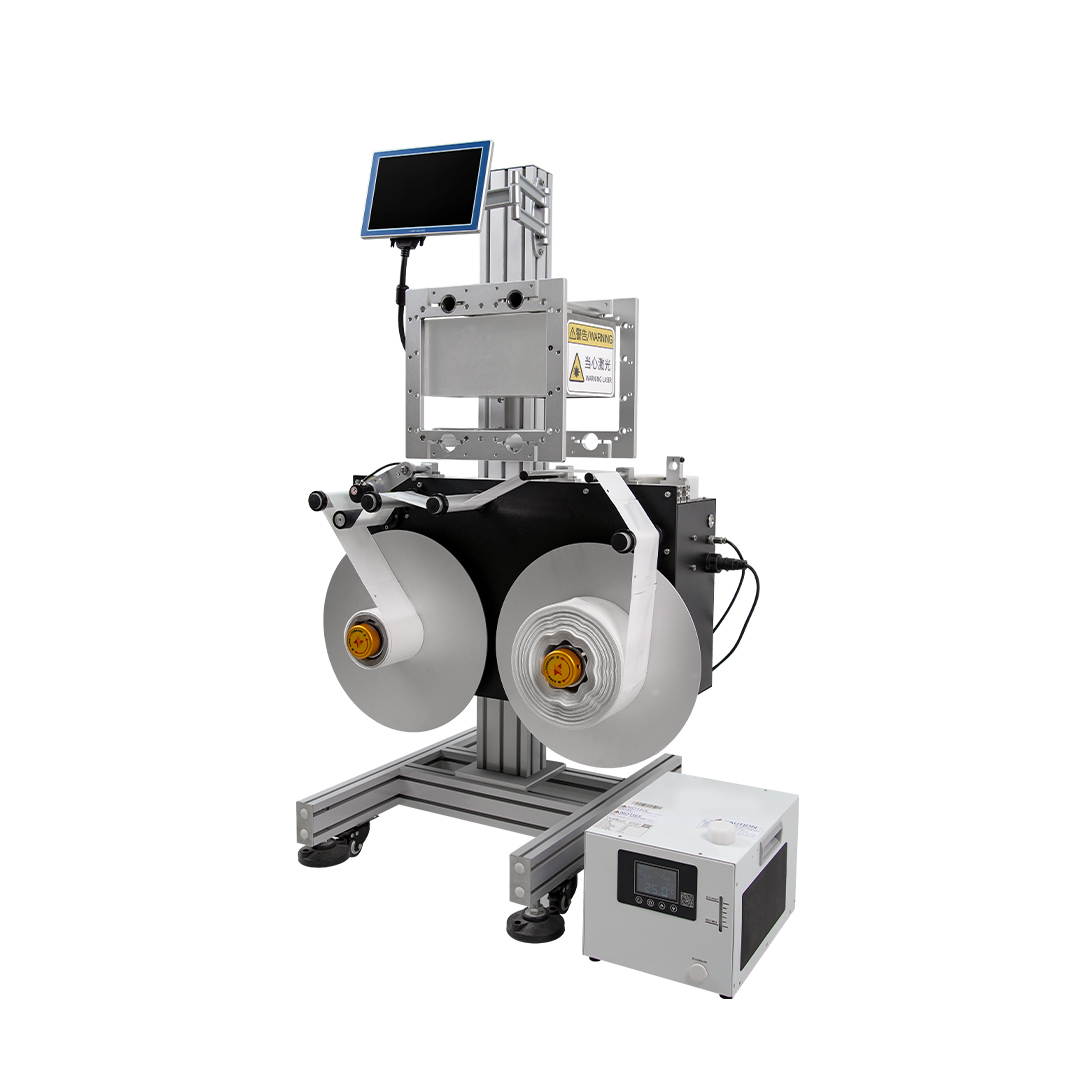
DOCOD L3000 Series 5W UV laser marking machine, specified at IP43 with a stainless steel laser host and a separate controller.
Converting Published Specifications into Measurable Code Tests
A specification becomes an acceptance criterion only when it is restated as a condition on the buyer's own product. The UV laser range offers a clean example. The L3000 Series 5W UV laser marking machine is documented at 29 milliseconds to mark the code 2024/06/18 on PP film at a character width of 20 mm and a character height of 2.8 mm. Positioning accuracy is listed at 0.01 mm, minimum line width at 0.02 mm, and the marking range at a standard 70 × 70 mm with 70–300 mm available as an option.
Restated as purchasing terms, those figures generate four testable items: the full code set must complete inside the line's available cycle window at the agreed character height; positional tolerance must hold across the largest layout the line will actually run; the chosen marking field must cover that layout without re-fixturing; and the smallest legible element must be defined in millimetres rather than described as small. None of those items requires new supplier data — they require the buyer to state the operating point.
Inkjet figures need the same treatment, because they are configuration-specific. The S1000 Series high-speed CIJ printer is documented up to 720 m/min with a 60µ nozzle and up to 960 m/min with a 50µ nozzle at 0.5 mm pitch, with a print height of 2–16 mm and 1–4 print lines at 60µ. The S300plus Series is stated at 384 m/min with a print height of 3–30 mm and 1–5 lines; the V2000 Series at 334 m/min with a print height of 2–16 mm and 1–5 lines. These numbers are not interchangeable across models, and they are not guaranteed on every substrate. A criterion that omits the nozzle, the pitch and the character height leaves the supplier free to select the favourable reading at the factory test.
For the code content itself, the current specification set lists dates and Julian dates, batch and lot numbers, shifts, counters, serial numbers, dynamic barcodes and 2D codes, and database-driven variable data. The V2000 Series lists QRCode, DataMatrix, MicroQRCode, PDF417 and PDF-417 variants among its 2D symbologies; the L3000 Series lists EAN8, EAN13, CODE39, CODE128 and GS1-128 among its barcode options; the TX1 half-inch seamless inkjet printer lists GS1 code, dynamic traceability QR codes, serial numbers, dates, shifts and counters, at up to 300 × 300 DPI and a print height of 1–101.6 mm.
Two external anchors shape how those codes should be specified in 2026 and beyond. GS1 Digital Link, the standard that lets one 2D symbol carry both retail and supply-chain data, is published by GS1 Global, whose material records a retail transition deadline of 31 December 2027. Separately, code-quality grading for verification is conventionally expressed against the ISO/IEC 15415 family for 2D symbols and the ISO/IEC 15416 family for linear symbols. An acceptance criterion should name the symbology, the data set, the verifier used and the grade required — otherwise the word "readable" carries no contractual weight.
Substrate-by-Substrate Test Plan: Cartons, Plastics, Metals and Beyond
The published printing-materials lists for the CIJ range cover carton, plastic, cable, metal, board, pipe, stone, glass, electronic components, auto parts, industrial chemical packaging and medical, food and gift-box packaging. The UV laser range is positioned for metal and non-metal materials, food packaging, PVC pipe, pharmaceutical packaging and flexible circuit boards. The test plan should follow those groups, because each surface fails for a different reason.
| Substrate group | Codes typically applied | What the acceptance test should record |
|---|---|---|
| Cartons and gift boxes (porous board) | Production and expiry dates, batch, GTIN, serial numbers | Dot definition and edge sharpness on porous board, contrast against board colour, rub resistance under the packing routine |
| Plastics: PET, HDPE, PP film | Lot, expiry, 2D traceability codes | Adhesion and smear after handling, contrast on dark or transparent surfaces, laser interaction at the agreed character height |
| Metals and machined parts | Part numbers, serial numbers, DataMatrix | Effect of residual oil film, contrast, permanence after the downstream cleaning step |
| Glass | Dates, batch, serial numbers | Ink adhesion on the specific glass finish, behaviour through any downstream heat treatment |
| Cable, pipe and extruded profile | Meter marks, model information, certification marks, batch | Encoder synchronisation, spacing consistency along the run, legibility on curved and narrow surfaces |
| Labels and flexible film | Variable data, 2D codes, dates | Registration, resolution at small character heights, readability after rewinding or packing |
Two rules keep this table honest. First, every test row should be run with the actual production data set, not a demonstration string, because a date code and a dense 2D code place different demands on the same station. Second, the result should be recorded per substrate and per code type, so that a pass on cartons is never reported as a pass on plastics.
Writing Acceptance Criteria into Purchasing Terms
The sign-off schedule belongs inside the purchase agreement, attached as a technical annex, not left as a separate document held by the engineering team. A workable structure runs from scope to hold point.
| Schedule element | What to write | Hold point |
|---|---|---|
| Exact model and configuration | Full model designation including protection class, nozzle or laser variant, print height and head count | Before order confirmation |
| Environment | Recorded ambient range at the mounting point, compared with the declared envelope | Before installation |
| Substrate sample set | Named substrates, quantities and the production data set to be used | Before factory test |
| Code tests and thresholds | Symbology, verifier, grade required, adhesion and rub results, sample plan | Factory acceptance and site acceptance |
| Evidence pack and open items | Inspection records, photographs, test reports, list of unresolved items with owner and date | Before final payment and warranty start |
DOCOD's documented supply process gives buyers concrete language to attach to those hold points. Standard equipment supply is described as including outgoing inspection, sample printing verification and function test before shipment, with delivery within 15 working days. Production-line integration support is described as including integration testing, sample run and video acceptance before delivery, with a lead time of 20–35 working days. Naming video acceptance as a contractual artifact is useful: it creates a record before the crate is opened, which is exactly the point at which most substrate disputes become difficult to settle.
Where the Evidence Stops: Limits to Record, Not to Argue
Good acceptance criteria state their own boundaries. A published IP rating is a declaration about ingress protection; it is not evidence of resistance to a specific cleaning chemical, and it is not a washdown approval for the buyer's hygiene regime. A stated operating envelope of 0–45 °C and 30–70% Rh describes the conditions in which the equipment is intended to run; it is not a promise of stable output during a heat-tunnel excursion. A laser life statement of 2–3 years is an expectation tied to normal use, not a warranty term that the buyer can assume.
It is equally important not to overstate what certification proves in the other direction. A management-system certificate scoped to the R&D and production of inkjet printers supports a supplier-qualification decision; it does not certify a code grade, an adhesion result or a throughput figure. Buyers who record this boundary in the handover file spend less time later renegotiating claims that were never really made.
Market Direction: What Published Forecasts Can and Cannot Support
Sign-off discipline is becoming more valuable because the category's compliance surface is widening, not because the market is growing in any single measurable line. Published commercial research on coding and marking equipment disagrees materially on size and growth rate depending on scope and base year — Fortune Business Insights, Future Market Insights and Market Research Future publish separate series that cannot be combined into one figure. The direction of travel is widely described as positive; the precise number is not settled by these sources and should not be used to justify a procurement decision on its own.
A more defensible driver sits in the standards layer. GS1 Digital Link is published by GS1 Global with a recorded retail transition deadline of 31 December 2027. For buyers, that converts into a criterion question that belongs in the annex today: can the selected station produce and verify the 2D symbology the supply chain will require, at the character height the packaging allows?
Future Outlook: What Sign-Off Criteria Will Need Next
Two shifts are already visible from the specification side. First, code verification is moving from a spot check to a closed-loop requirement, which is why print-and-verify configurations, inline inspection and reject logic appear in traceability projects across medical packaging, tobacco and electronics. Second, data correctness is becoming as testable as print quality: a code that grades well but carries the wrong serial range is a failure, and the acceptance schedule should say so.
A practical forward-looking clause is therefore worth adding now: the buyer and supplier agree the verification method, the data set and the rejection rule at commissioning, and agree in writing how a future symbology change would be re-tested. That keeps the original acceptance criteria valid when the code standard, not the machine, is what changes.
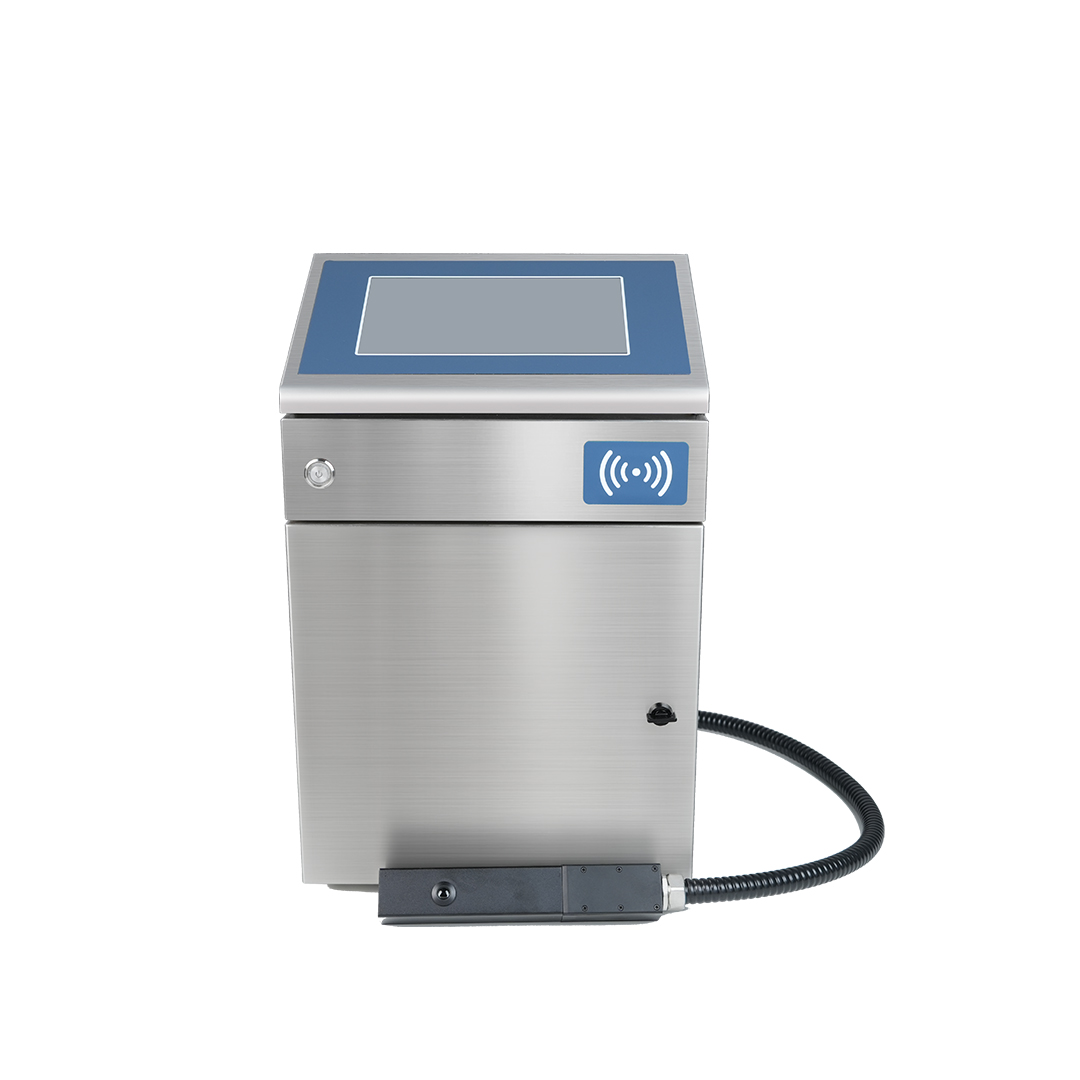
DOCOD S300plus Series CIJ printer: IP65 protection level and SUS 304 stainless steel machine material in the published specification.
Frequently Asked Questions
Does an IP65 rating remove the need for a washdown or cleaning check?
No. IP65 describes a declared class of protection against dust and water ingress. It is not a statement about chemical compatibility with a specific cleaning agent, and it is not an approval of a washdown routine. A buyer should record the cleaning practice in the handover file, inspect cabinet and cable-entry seals at commissioning, and re-inspect them after the first month of production so that any deterioration can be traced to a documented routine.
Which DOCOD models are specified at IP65, and which are not?
In the current published specifications, the M2000 Series CIJ printer, the S300plus Series CIJ printer and the V2000 Series CIJ printer are stated at IP65. The S1000 Series high-speed CIJ printer is stated at IP55. The L3000 Series 5W UV laser marking machine is stated at IP43, recorded in the model designation L3005U-355W-V-IP43. Because the rating is attached to the model rather than the brand, the order document should name the exact model and protection class.
What operating conditions should be verified before installation?
The CIJ and thermal inkjet models in the specification set — S1000, S300plus, V2000, TX1 and T260E — are stated for 0–45 °C and 30–70% Rh. The laser models are stated for 0–45 °C ambient with humidity up to 95%, non-condensing and without vibration. The reliable method is to log temperature and humidity at the actual mounting point for a production week and compare the recorded range with the declared envelope, then record any deviation as a documented risk or add environmental control.
How should GS1 and traceability codes be written into an acceptance test?
Name the symbology, the exact data set, the verifier and the grade required, then run the test with production data rather than a demonstration string. The current specification set lists GS1-128 among the barcode options on the L3000 Series, QRCode, DataMatrix and PDF417 variants on the V2000 Series, and GS1 code plus dynamic traceability QR codes on the TX1. Grading is conventionally expressed against the ISO/IEC 15415 family for 2D symbols and ISO/IEC 15416 for linear symbols; GS1 Digital Link, published by GS1 Global, records a retail transition deadline of 31 December 2027.
Are management-system certificates sufficient evidence for compliance sign-off?
They are necessary context, not sufficient evidence. DOCOD's ISO 9001 certificate 18625Q00281R1M, issued by Guangdong Zhongyu Certification Co., Ltd., is valid to 4 September 2028 and scoped to the R&D and production of inkjet printers; the ISO 14001 and ISO 45001 certificates share the same issuer and validity period. The BIS CRS registration R-41312347 applies to printers and plotters under the brand codpad for the Indian market, valid to 12 October 2027. None of these documents certifies a code grade, an adhesion result or throughput on a buyer's substrate.
Model-level specifications, certificate details and the company's published product range are documented by DOCOD Precision Group Co., Ltd., founded in 2008 and based in Guangzhou, China. Buyers assembling a sign-off schedule can use those published statements as the starting claim and then attach the line-specific test, threshold and evidence artifact described above. The DOCOD corporate brochure (PDF) is available for download and records the wider product and capability context referenced in this guide.
Есть вопросы или нужны дополнительные детали?
Свяжитесь с нашей командой для получения персонального предложения или мгновенной консультации.
Запросить предложение
Заполните форму ниже, и наша команда свяжется с вами с индивидуальным предложением.
Прямой чат WhatsApp
Предпочитаете общаться в реальном времени? Напишите нам в WhatsApp для мгновенной помощи и быстрых ответов.
- Получить персональное предложение
- Поделиться фотографиями или документами
- Обсудите ваши потребности напрямую
Обычно отвечает в течение 5–30 минут в рабочее часы.