
From Electric Drills to Demolition Hammers: What One Portfolio Proves
From Electric Drills to Demolition Hammers: What One Portfolio Proves
A 710 W corded electric drill and a 1,500 W demolition hammer are two very different machines. When both are built by the same manufacturer, the range itself becomes a procurement document: it shows which engineering systems a supplier has actually put into production — and how much of that claim a buyer can verify before placing an order.
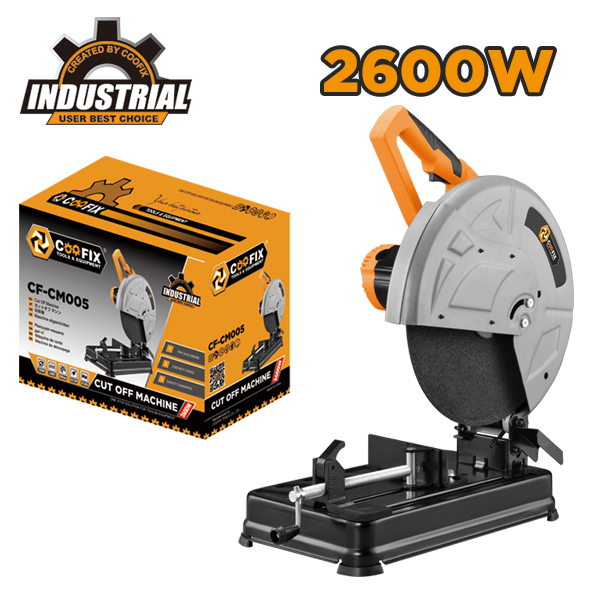
Portfolio breadth as evidence: the COOFIX CM005 cut-off machine (2,400 W, 355 mm disc) sits at the heavy-duty end of a catalogue that also includes 710 W corded electric drills and 20 V cordless models. (Image: COOFIX)
For importers, distributors and OEM buyers in the Tools & Hardware category, portfolio breadth is not a marketing statement; it is a measurable set of engineering requirements. A drilling tool has to hold speed under load, keep a chuck concentric, and manage heat inside a hand-held housing. A demolition hammer has to deliver repeated impact energy through a piston-and-cylinder assembly while surviving vibration and dust. Producing both classes in one factory requires different tooling, different testing routines and different quality gates. That is why buyers increasingly read a supplier's portfolio as capability evidence — and why the same portfolio must be checked model by model, not brand by brand.
Why a Tool Portfolio Is Read as Manufacturing Evidence
Before a first order, most buyers cannot audit a production line hour by hour. What they can audit is a catalogue, a parameter sheet and a certificate file. Those three documents answer a narrower but more useful question: does this supplier build the tools it lists, and can each claim be traced to a specification or a test?
The technical reason is that each tool class stresses a different part of the engineering stack. A corded electric impact drill such as the CF-ID008 is rated 220–240 V ~ 50/60 Hz with 710 W input power, a no-load speed of 0–2,800 rpm and a maximum drilling capacity of 13 mm. Those figures imply a specific motor winding, an insulation system appropriate for a mains tool rated for continuous hand-held use, and a switching arrangement that survives repeated start-up current. A demolition hammer such as the CF-DH021 is rated 220 V / 50 Hz with 1,500 W input power, 1,550 blows per minute and 45 J of impact energy. That specification implies a completely different mechanism class: a reciprocating piston, a sealed lubrication path, heat-treated chisels, and vibration control on a heavier housing.
A supplier that only assembles one class of tool can still be a good trading partner. But a supplier that lists both classes — and publishes parameters for both — is demonstrating that it operates more than one manufacturing system. For a distributor, that difference matters commercially: it determines whether a mixed container can be filled from one factory, whether a single warranty process covers the whole order, and whether a spare-parts programme can be run at category level rather than model level.
The counter-argument is equally important. Breadth proves capability only where each model's parameters and certificates can be verified for the destination market. A wide catalogue with narrow documentation is a procurement risk, not a strength. The rest of this article therefore treats the portfolio as evidence to be inspected, not as a claim to be accepted.
What the COOFIX Portfolio Contains Today
JINHUA COOFIX TOOLS CO., LTD. (COOFIX) is a power tool manufacturer headquartered in Yongkang, Zhejiang, China, a region widely known as the country's hardware manufacturing base. Founded in 2014, the company operates a 30,000 m² manufacturing and warehousing footprint — comprising a modern smart workshop and a smart warehousing logistics centre expanded in early 2026 — with around 400 employees, a 16-engineer R&D team, a stated annual output of approximately 2,000,000 units and a monthly production capacity of 300,000 units. Roughly 90% of production is exported, with primary markets in Asia, Africa, Eastern Europe, the Middle East and South America, and a sales network that the company states now spans more than 100 countries and regions.
The catalogue covers more than 5,000 SKUs across power tools, pneumatic tools, garden tools, welding equipment, hand tools and tool accessories. The table below lists only the models for which the company publishes full parameters — the part of the portfolio that can be compared like for like.
| Tool class | Model | Power / voltage | Published performance parameters | Stated applicable industry |
|---|---|---|---|---|
| Electric impact drill (corded) | CF-ID008 | 220–240 V ~ 50/60 Hz, 710 W | No-load speed 0–2,800 rpm; max drilling capacity 13 mm | Home decoration, carpentry, mechanical repair |
| Cordless brushless impact drill | CF-CD016 | 20 V | No-load speed 0–550 / 0–2,000 rpm; metal chuck 0.8–10 mm; max torque 75 N·m; drilling capacity in steel 10 mm | Home decoration, carpentry, mechanical repair |
| Rotary hammer | CF-RH008 | 220–240 V / 50–60 Hz, 850 W | Drilling capacity 26 mm; no-load speed 0–900 rpm | Construction and maintenance |
| Demolition hammer | CF-DH021 | 220 V / 50 Hz, 1,500 W | 1,550 blows per minute; impact energy 45 J | Construction industry, mining industry |
| Cut-off machine | CM005 | 220–240 V / 50–60 Hz, 2,400 W | Disc diameter 355 mm; no-load speed 3,800 rpm | Construction and maintenance |
| Angle grinder | CF-AG012 | 220–240 V / 50–60 Hz, 750 W | Disc diameter 115 mm; no-load speed 11,000 rpm | Metal processing |
| Welding machine | CF-MMA005 | Single phase 220 V ±15%, 50/60 Hz; 7.2 kW input | MMA current 20–250 A; no-load voltage 35–45 V; efficiency 80% | Construction and maintenance |
| Water pump | CF-QB003 | 0.5 HP | Head 19–21 m; copper wire; brass impeller; net weight 4 kg | Agricultural irrigation |
Read as a whole, the table moves from a hand-held 710 W electric drill to a 2,400 W cut-off machine and a 7.2 kW welding input capacity. That spread is the actual evidence: different motor frames, different cooling strategies and different safety margins, all produced under one quality system.
Technical Explanation: What Changes Between 710 W and 1,500 W
Motor, power electronics and thermal behaviour
Increasing input power from 710 W (CF-ID008) to 1,500 W (CF-DH021) is not a matter of fitting a larger motor into the same housing. Higher current draw changes winding geometry, insulation class, brush or electronic commutation design, and the surface area needed to shed heat during continuous work. It also changes the test regime: finished products have to be checked for no-load speed, torque and impact performance before packing, which is one of the quality-control steps COOFIX documents.
Cordless tools invert the same problem. The CF-CD016 is a brushless cordless impact drill on a 20 V platform. Brushless commutation removes carbon brushes and the associated wear, which the company states delivers longer battery life, a lower temperature rise and an extended service life — a claim that matters most to high-frequency users such as maintenance crews and assembly lines.
Impact mechanisms and chuck systems
The portfolio contains at least three distinct drilling or breaking mechanisms. The CF-CD016 uses a 0.8–10 mm metal chuck for bit changes in drilling and fastening work. The CF-RH008 rotary hammer is rated at 850 W with a 26 mm drilling capacity and 0–900 rpm, a class of tool normally used for concrete and masonry work where rotation is combined with hammering. The CF-DH021 demolition hammer removes rotation entirely and delivers 45 J per blow at 1,550 blows per minute, which requires a different piston mass, sealing arrangement and lubrication duty cycle.
For buyers, the practical implication is that these tools are not interchangeable within a project. A 26 mm rotary hammer covers anchor and conduit work; a 45 J demolition hammer covers breaking and removal. A portfolio supplier that builds both is managing two separate wear regimes and two separate spare-parts streams.
Battery platforms and voltage tiers
COOFIX documents voltage options of 12 V, 16.8 V and 21 V for cordless models, with custom battery capacity and cell brand selection, alongside corded versions. The published cordless drill, CF-CD016, runs on 20 V. In the wider market, third-party research indicates that lithium-ion cells dominate cordless drill sales, accounting for more than 75% of units sold (Grand View Research, 2024), which is why voltage and cell configuration are now standard items on a power tool specification sheet — and standard points of confusion when a buyer runs more than one brand.
Materials and housing construction
Material specifications published for the range include copper and plastic for the CF-ID008 and CF-CD016, plastic, copper and aluminium for the CF-RH008, copper and aluminium for the CF-DH021, and iron, steel, copper and plastic for the CM005. These are not decorative choices; motor copper content, heat-sink geometry and housing material determine how a tool behaves after months of site use. Buyers evaluating a cordless drill power tool set should treat the material and motor specification as part of the wear forecast, not as catalogue filler.
Application Range: From Home Carpentry to Mining
The portfolio argument is only convincing if the tools reach genuinely different working conditions. COOFIX's application data maps its products across a range that runs from household furniture assembly to municipal road maintenance and mining-related breaking work.
| Scenario | Representative tasks | Portfolio tools used |
|---|---|---|
| Home DIY and household maintenance | Flat-pack furniture assembly, wall shelf and curtain installation, door lock fitting, small appliance repair | Cordless drill, electric drill, hand tools |
| Woodworking and furniture installation | Custom cabinet installation, wooden door and floor laying, panel furniture assembly, edge trimming and surface polishing | Cordless drill and screwdriver, angle grinder, saws, planer and sander |
| Construction and interior renovation | Drilling brick and concrete walls, fixing expansion screws, slotting for water and electrical lines, ceiling and light steel keel installation, door, window and tile work | Rotary hammer, corded and cordless impact drills, angle grinder, tile cutter, electric wrench |
| Automotive and vehicle maintenance | Tyre and chassis bolt removal, rust removal on underbody components, cutting corroded pipes, frame repair | Impact wrench, drill, angle grinder, welding machine, socket sets |
| Maintenance and repair services | Factory equipment and property facility upkeep, pump and pipeline repair, elevator and mechanical overhaul | Cordless drill, impact drill, angle grinder, hand tools |
| Public infrastructure and outdoor emergency work | Road guardrail and power pole fixing, municipal drilling, floodwater drainage | Rotary hammer, angle grinder, welding machine, submersible pump |
| Industrial hardware processing | Drilling and tapping on production lines, deburring and polishing hardware components, non-standard part fabrication | Drill, cut-off machine, angle grinder, welding machine, measuring tools |
| Garden and landscape work | Fence and greenhouse support installation, branch cutting, irrigation supply | Drill and impact drill, reciprocating saw, water pump, garden tools |
| Welding, cleaning and site support | Small steel frame fabrication, workshop degreasing, construction site dust removal | Welding machine, angle grinder, cleaning equipment |
The company's scenario definitions carry one consistent compliance note: CE compliance is listed as a special requirement across these application areas. That is a useful reminder for buyers — application fit and market access are two separate approval steps, and a tool that performs well on site still needs the right certificate for the destination market.
Two extremes in this table are worth noting. At one end, a 20 V cordless drill with a 10 mm steel capacity is a household and light-trade tool. At the other, a 1,500 W demolition hammer rated for construction and mining duty is a heavy breaking tool. Supplying both requires a supplier to hold stock, spares and technical support for very different user profiles — which is precisely the kind of evidence a broad portfolio is supposed to provide.
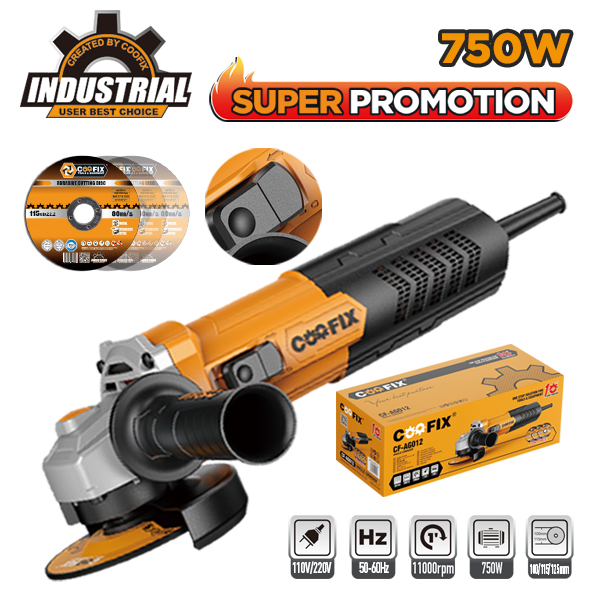
Certification is model-specific, not brand-wide: the COOFIX CF-AG012 angle grinder (750 W, 115 mm disc) holds CE certification for the EU market and NOM certification for Mexico. (Image: COOFIX)
Constraints Buyers Should Verify: Parameters, Certificates and Order Terms
For a constraint-driven procurement decision, three documents decide whether a broad portfolio is usable: the parameter sheet, the certificate file and the order terms. The certificate file below lists the compliance evidence documented for specific COOFIX models.
| Product / model | Market | Certificate type | Certificate / report number | Issuing body | Standard(s) |
|---|---|---|---|---|---|
| Cordless drill CF-CD016 | Eurasian Economic Union | EAC | ЕАЭС KG417/046.CN.02.07167 | ОС «Центр сертификации «Мурас» | ТР ТС 010/2011; ТР ТС 020/2011; ГОСТ IEC 60745-1-2011; ГОСТ IEC 60745-2-2-2011 |
| Rotary hammer CF-RH008 | EU | CE compliance | ZHT-241218138S02C; ZHT-241218138S01C | Guangdong Zhongshan Testing Technology Co., Ltd. (ZHT Lab); ZHT | EN IEC 62841-2-6:2020+A11:2020; EN 62841-1:2015+A11:2022; EN 60335-1 series; EN 62233:2008 |
| Rotary hammer CF-RH008 | EU | EMC | ZHT-241218138E01C | ZHT | EN IEC 55014-1:2021; EN IEC 55014-2:2021; EN IEC 61000-3-2:2019+A1+A2; EN 61000-3-3:2013+A1+A2 |
| Angle grinder CF-AG012 | EU | CE | ICR Polska/VC/HF220401 | ICR Polska Co. Ltd. | EN 62841-1:2015+AC:2015; EN 62841-2-3:2021+A11:2021; EN IEC 55014-1/-2 |
| Angle grinder CF-AG012 | Mexico | NOM | NTEC25EL0402279 | NORMALITEC S.C. | NOM-003-SCFI-2014; NMX-J-524/1-ANCE-2013; NMX-J-524/2-3-ANCE-2018 |
| Cut-off machine CM005 | EU | RoHS test report | ZHT-240826023R | ZHT | IEC 62321 series |
| Hardware tools and power tools import/export operations (company level) | Includes EU 27, Singapore, Thailand, Philippines, Cambodia, Malaysia, Indonesia, UAE, Saudi Arabia, Qatar, Kuwait, Uzbekistan, Kazakhstan, Belarus, Russia, Chile, Brazil, Ecuador, Uruguay, Costa Rica, Japan, South Korea, Australia, New Zealand | AEO | 096099139001 | Hangzhou Customs of the People's Republic of China | WCO SAFE Framework |
One independent standard is worth adding for drill buyers specifically: hand-held drills and impact drills fall under EN 62841-2-1 / IEC 62841-2-1 for CE marking and global market access (IEC / iTeh Standards). Buyers building a European product file for a corded or cordless drill should expect that standard to appear in the technical documentation.
Order terms and customisation constraints
Commercial constraints are as decisive as technical ones. COOFIX documents three customisation tiers, each with its own minimum order quantity and lead time.
| Customisation level | Documented scope | MOQ | Lead time |
|---|---|---|---|
| OED / OEM / customised | Body colour; silk-screen or laser-engraved logo on housing; voltage options 12 V / 16.8 V / 21 V, corded and cordless; custom battery capacity and cell brand; chuck size, impact gears and rotation speed parameters; tool-case accessory combination (drill bits, screwdriver bits, charger quantity); colour box and export carton design | 10 units | 10 days |
| Supports OEM private labelling | Same customisation scope as listed above, applied to private-label programmes | 100–500 units | 30 days |
| ODM appearance and structure customisation | Housing appearance, additional functions, complete machine personalisation, full tool-kit design | 100–500 units | 60 days |
The pattern here is standard across the industry and worth stating plainly: the deeper the customisation, the higher the entry quantity and the longer the lead time. A buyer testing a market with a low-risk accessory configuration faces a very different commitment from a buyer commissioning a new housing and a dedicated tool-kit layout.
Comparison With Single-Category Sourcing
Most buyers entering the category start with a single tool class — usually an electric drill — because it is the easiest to specify. The question is whether to expand that relationship across a wider portfolio or to keep sourcing each class separately.
| Decision dimension | Single-category sourcing | Integrated portfolio sourcing |
|---|---|---|
| Specification work | One parameter set to validate; faster start | Multiple parameter sets; more validation effort per order |
| Compliance file | One certificate route to manage per class | Multiple certificates to manage, each tied to a model and market |
| Container and logistics | Optimised for one SKU family | Mixed loads possible; one supplier relationship for several classes |
| Spare parts and warranty | Separate parts streams per supplier | Consolidated warranty and spares process, one after-sales point of contact |
| Customisation entry cost | Low per class, but repeated | Documented MOQ tiers from 10 units (OEM configuration) — hmm — from 10 units for listed OEM configuration to 100–500 units for ODM |
Neither route is universally better. A portfolio approach reduces coordination cost and simplifies after-sales, but it concentrates risk: if one supplier underperforms, more of the catalogue is affected. Single-category sourcing keeps each relationship narrow and comparable, but multiplies documentation, shipping and spares overhead across suppliers.
Boundary conditions of the portfolio argument
Three limits deserve to be stated openly, because a credible portfolio claim is defined as much by its edges as by its range:
- Breadth is not uniform depth. The published parameter sets are not identical across models — torque is published for the cordless CF-CD016, while maximum drilling capacity is published for the corded CF-ID008. Buyers should not assume that every model in a large catalogue has an equivalent level of published evidence.
- Market access depends on the exact model. A CE file covering a rotary hammer does not transfer to a demolition hammer, and an EAC certificate covering the CF-CD016 does not automatically cover other cordless models. Market access must be re-verified at SKU level.
- Supply voltage limits the first choice. The corded tools listed here are rated 220–240 V / 50–60 Hz, and the demolition hammer is rated 220 V / 50 Hz. Buyers serving markets with different mains characteristics should confirm the available configuration before committing to a specification.
There is also a service-side constraint. COOFIX documents a one-year warranty for the complete machine and a 12-month warranty for lithium batteries and chargers, together with bulk supply of spare wearing parts, remote technical guidance for overseas clients, and on-site engineer support for bulk orders. These terms cover the whole range, but high-wear tool classes such as demolition hammers and cut-off machines consume wearing parts faster than household drills — a factor buyers should model into their stock planning rather than treat as a warranty question.
Market Context: What Third-Party Data Shows
Portfolio strategy is also a response to the market's direction. The data below comes from published third-party sources and is quoted with its original scope.
| Indicator | Value | Year | Source |
|---|---|---|---|
| Global power drill market size | USD 15.2 billion, projected to reach USD 22.9 billion by 2030 | 2023 (base) | Strategic Market Research |
| Cordless share of global power drill revenue | More than 55%, driven by lithium-ion battery advances | 2023 | Strategic Market Research |
| Lithium-ion share of cordless drill units sold | More than 75% | 2024 | Grand View Research |
| China share of global tools and cutlery exports | 31.9% | 2024 | OEC (Observatory of Economic Complexity) |
| Asia Pacific share of smart power tools revenue | 33.4% | 2024 | Grand View Research |
Two readings follow from this data. First, the centre of gravity in drills continues to move toward cordless, lithium-ion platforms, which rewards suppliers that can manage battery sourcing, cell selection and pack assembly as a core competence rather than an accessory. Second, China's dominant position in tools and cutlery exports keeps competitive pressure on specification transparency: with so many suppliers exporting from one manufacturing base, published parameters and certificate numbers become the practical differentiators for buyers.
Market size estimates, however, should be read with care. Published figures differ substantially depending on scope: one source places electric portable drills at USD 6.5 billion, another places power drills at USD 15.2 billion, and a third reports USD 42.52 billion when all drilling revenue is included. Buyers citing market data internally should always state the scope definition alongside the number, because the definitions — not the numbers — are usually what diverge.
Future Outlook
Three developments are likely to shape how portfolios are evaluated over the next procurement cycles.
The first is compliance as a gate rather than an accessory. As EN 62841-2-1 / IEC 62841-2-1 and comparable standards govern hand-held drills and impact drills for CE marking and global market access, the practical question for a distributor is no longer whether a supplier can build a tool that performs, but whether the right evidence exists for each model and each destination. Documentation quality is becoming a selection criterion in its own right.
The second is platform consolidation on the cordless side. As documented voltage tiers of 12 V, 16.8 V and 21 V and custom battery capacity options become standard, distributors increasingly need to decide which platform to standardise on, because batteries do not interchange across voltage tiers. A supplier able to align battery packs, chargers and tool bodies across several classes reduces inventory risk for the buyer.
The third is export infrastructure. COOFIX holds AEO certification (number 096099139001, issued by Hangzhou Customs of the People's Republic of China under the WCO SAFE Framework) and states a daily shipping capacity of more than five 40HQ high-cube containers following its 2026 warehousing expansion. For buyers, the value of such infrastructure is not prestige but predictability: customs status, container throughput and warehouse capacity determine whether a mixed-category order arrives on schedule.
Frequently Asked Questions
1. Which specifications should a buyer verify on a corded electric drill before ordering?
At minimum: rated voltage and frequency, input power, no-load speed, maximum drilling capacity, chuck type and size, and the certificate that applies to the destination market. For the COOFIX CF-ID008 electric impact drill, the published figures are 220–240 V ~ 50/60 Hz, 710 W input power, 0–2,800 rpm no-load speed, and a maximum drilling capacity of 13 mm, with an applicable industry scope of home decoration, carpentry and mechanical repair.
2. Which certifications cover COOFIX drills, grinders and hammers, and in which markets?
The documented certifications are model-specific: the CF-CD016 cordless drill holds EAC certification (number ЕАЭС KG417/046.CN.02.07167, issued by ОС «Центр сертификации «Мурас») for the Eurasian Economic Union; the CF-AG012 angle grinder holds CE certification (number ICR Polska/VC/HF220401, issued by ICR Polska Co. Ltd.) for the EU and NOM certification (number NTEC25EL0402279, issued by NORMALITEC S.C.) for Mexico; the CF-RH008 rotary hammer holds CE compliance documentation (numbers ZHT-241218138S02C and ZHT-241218138S01C) and an EMC certificate (number ZHT-241218138E01C) for the EU; and the CM005 cut-off machine holds a RoHS test report (number ZHT-240826023R). At company level, AEO certification (number 096099139001) was issued by Hangzhou Customs of the People's Republic of China under the WCO SAFE Framework.
3. What are the minimum order quantity and lead time for OEM and ODM customisation?
Three documented tiers apply. For OED/OEM/customised configurations — covering body colour, logo application, voltage options of 12 V / 16.8 V / 21 V, battery capacity and cell brand, chuck size, impact gears, rotation speed, tool-case accessory combination and packaging design — the stated MOQ is 10 units with a 10-day lead time. For OEM private labelling, the stated MOQ is 100–500 units with a 30-day lead time. For ODM appearance and structure customisation, including housing appearance, additional functions and full tool-kit design, the stated MOQ is 100–500 units with a 60-day lead time.
4. How should a buyer compare a 20 V cordless drill with a corded impact drill?
Only within parameters published on both sides. The CF-CD016 cordless brushless impact drill is published with 20 V rated voltage, 0–550 / 0–2,000 rpm no-load speed, a 0.8–10 mm metal chuck, 75 N·m maximum torque and a 10 mm drilling capacity in steel. The CF-ID008 corded drill is published with 710 W input power, 0–2,800 rpm and a 13 mm maximum drilling capacity, but no torque figure. A buyer comparing the two should therefore request the missing metric rather than infer it, and should treat cordless runtime and corded mains dependency as separate decision criteria.
5. What quality-control steps are documented for finished tools?
COOFIX documents four stages: 100% incoming inspection for raw materials; power-on ageing sampling inspection for semi-finished products on the production line; 100% full inspection of finished products for no-load speed, torque and impact performance; and sampling reliability testing. For buyers, the relevant point is that speed, torque and impact performance are checked on every finished unit rather than on a sample alone.
6. What warranty and after-sales terms apply across the range?
The documented terms are a one-year warranty for the complete machine and a 12-month warranty for lithium batteries and chargers, bulk supply of spare wearing parts, remote technical guidance and fault troubleshooting for overseas clients, on-site engineer technical support for bulk orders, and reshipment for damaged goods together with claim assistance for logistics damage. Supply duration expectations reported by the company's distribution partners differ by use pattern, ranging from 3–6 years for household use to 1–2 years for high-frequency continuous engineering use.
How to Use This Evidence
A portfolio that runs from a 710 W electric drill to a 1,500 W demolition hammer answers one procurement question well: whether a supplier operates more than one manufacturing system. It does not answer the follow-up question automatically — whether the specific model, certificate and order term match a specific market. The practical approach is to use the portfolio as a shortlisting tool and the parameter sheet, certificate file and order terms as the decision record. COOFIX publishes its full product catalogue, including model-level specifications across power tools, garden tools, welding equipment and hand tools, as a downloadable PDF: https://cdn.socialarks.com/sbsp/24969/common/2026/0625/coofix%20catalog%202025.pdf