
From Export Claims to Audit Trails: Natural Stone Capability
From Export Claims to Audit Trails: Natural Stone Capability
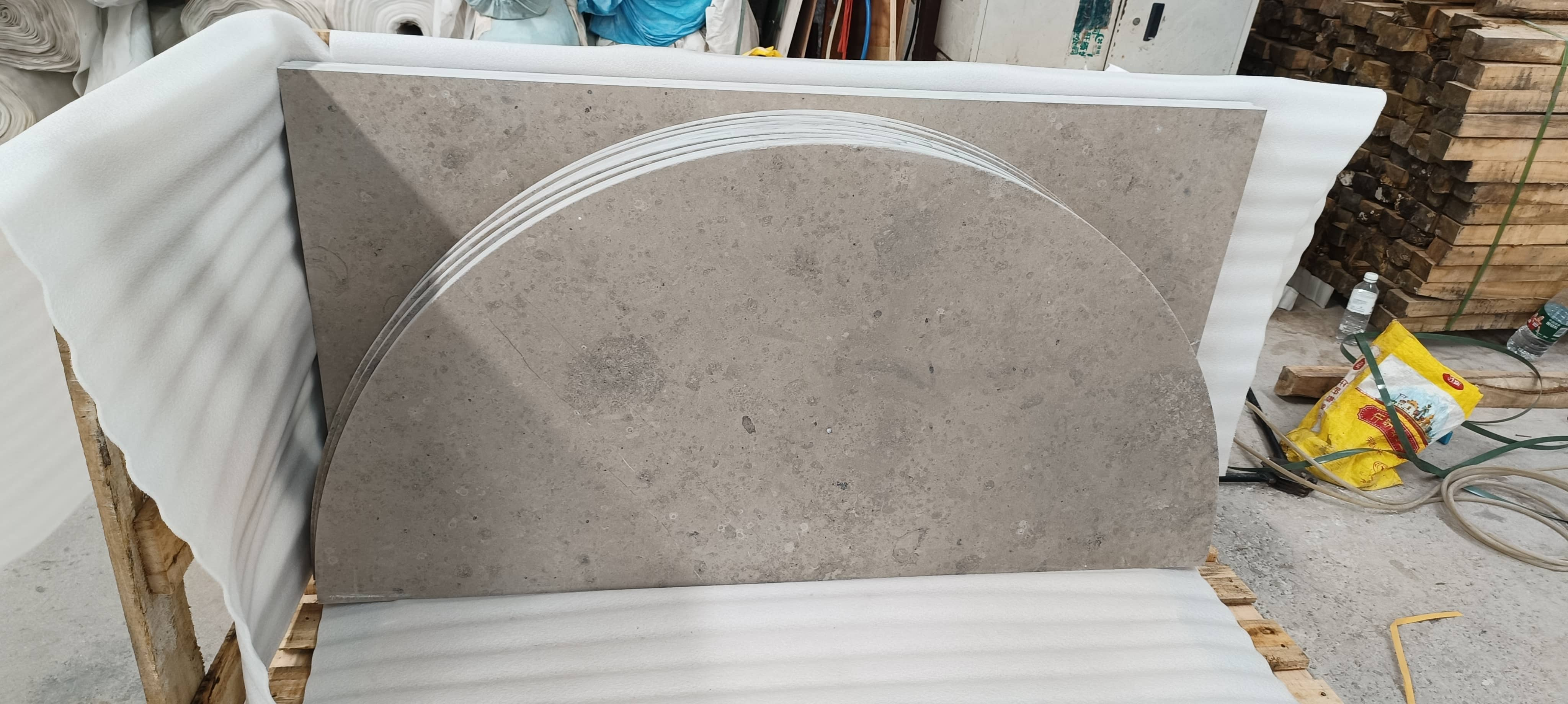
Limestone is verified twice in a project: once as an approved sample, once as a traceable production record. Image: Jura Grey limestone.
Natural stone is bought twice. The first purchase is a promise: a finish, a thickness, a lead time, a price per square metre. The second purchase is a record: the inspection sheet, the packing list, the approved shop drawing, the container number. In a slower trade environment the gap between promise and record could be absorbed by relationships and site visits. In a trade environment shaped by tariff reversals, container-scale logistics and cross-border design teams, that gap is increasingly absorbed by documentation.
The structural backdrop is not in dispute. Trade data compiled by the Observatory of Economic Complexity shows China holding roughly 32% of global exports of building stone under HS 6802 in 2024, making it the largest single exporter in that category. Grand View Research valued the global natural stone market at approximately USD 10.6 billion in 2025. The two figures measure different things — one is a flow of processed material across borders, the other a revenue pool — but together they explain why supplier capability claims have multiplied and why they have become harder to rank.
An audit trail in stone supply is not a certificate and not a brand promise. It is an ordered set of records that lets a buyer reconstruct how a specific block became a specific finished piece, and test each step against an agreed acceptance criterion: which quarry, which block reference, which cutting plan, which finish, which measured dimension, which inspection result, which carton, which container. This article examines how country-level policy, production capacity, export performance and fabrication technology are raising the expected depth of that record — using onyx, travertine, limestone and marble as the working examples.
Why Export Volume No Longer Functions as Proof
A supplier claim of export volume answers a throughput question. It does not answer a control question. Under a single HS heading such as 6802, a container of calibrated floor tiles and a container of hand-carved architectural elements are counted the same way, from suppliers whose operating models range from integrated quarry-to-slab factories to coordinating traders with a partner network. Volume therefore tells a buyer how much material left a country. It does not say who cut it, to what tolerance, who inspected it, or against which reference.
The consequence is that the burden of proof has migrated from the supplier's brochure to the buyer's purchase order. Where a specification names a standard, the claim becomes testable. ASTM C615/C615M-23, the standard specification for granite dimension stone, is a working example of that mechanism: it gives both sides of a transaction a shared definition of what the material is, before price is discussed. Buyers sourcing onyx, travertine, limestone or marble frequently receive quotations that name no equivalent reference at all. That absence — not the price — is where most later disputes begin.
Four Variables That Moved the Evidence Bar
Policy: Tariffs, Suspensions and the Difference Between Them
In October 2025 the United States suspended a 24% retaliatory tariff on selected Chinese stone products. Two words in that sentence carry the procurement weight: selected and suspended. A suspension is a pause, not a repeal, and it applies to defined product lines rather than to a category as a whole. Projects priced during the tariff period were priced against a different cost structure, and any re-evaluation of sourcing now rests on a policy position that can change again.
The practical evidence response is documentary consistency. Country-of-origin statements, HS classification and product descriptions should match across the commercial invoice, the packing list and the customs entry. Where a buyer has split a package between Chinese and non-Chinese suppliers to hedge tariff exposure, the audit trail has to hold two separate document sets with two separate classification logics — and the moment a measure is reinstated, the supplier that can produce a clean, consistent file is the one that costs less to keep.
Capacity: Reconciling Output Claims With Operating Structure
Annual output expressed in containers is a useful disclosure only when it is read beside factory footprint, headcount and the number of production sites involved. A supplier reporting a 20,000 m² facility, 60 employees and annual output of 150 monument containers plus 200 building-material containers is describing a coordinating supply structure rather than a single-hall factory. That model is legitimate and common in the Chinese stone trade. It simply changes the audit questions: not 'how big is your factory', but 'which sites will produce this order, which machines run on it, and which inspection record belongs to which site'.
Capability that sits inside a partner network has to be documented partner by partner. A CNC carving centre operated by a partner is a real capability, and it is also a real dependency: the buyer who has seen the machine list of the actual producing workshop is in a different risk position from the buyer who has seen only a company-level capability statement.
Export Performance: What HS 6802 Data Can and Cannot Tell You
China's 32% share of global building stone exports in 2024 locates the mass of supply. It does not identify a factory. Trade statistics register exporting entities, and the distinction that matters most to a project buyer — integrated manufacturer versus trader — is precisely the distinction that trade data cannot resolve. Factory-level verification, not country-level statistics, is what converts a sourcing shortlist into a procurement decision.
The correct use of trade data is therefore macro. It indicates where capacity clusters, how policy shifts redirect flows, and which sourcing regions are gaining or losing share. It should not be used as a proxy for the capability of any named supplier.
Fabrication Technology: Where Shop Drawings Enter the Record
The most auditable step in custom stonework is the conversion of a design intent into a producible drawing. A design-to-production workflow takes a client sketch or architectural concept and turns it into a shop drawing that states dimensions, radii, edge profiles, joint widths, reinforcement, fixing method and tolerances. Once that drawing is approved and revision-controlled, it becomes the reference against which the finished piece is measured. Without it, 'as per drawing' means nothing, because there is no drawing to be as per.
Technology has changed the front end of that process more than the back end. CNC carving centres make complex profiles repeatable and reduce setting-out error. Hand polishing and hand engraving remain, by their nature, variable operations, and the variance does not disappear because a machine cut the block. A credible fabrication record therefore contains four elements: the approved drawing revision, the setting-out or program reference, a first-article inspection against the drawing, and a finish sample keyed to the same revision.
Material Parameters as Acceptance Criteria
The four materials discussed here share a commercial baseline in this supply range: slabs commonly quoted at 2400 mm and up by 1200 mm and up, with thickness options of 16 mm, 18 mm or 20 mm and custom thickness such as 30 mm available on request. Below that shared baseline, their physical behaviour diverges enough that a single acceptance clause cannot be applied to all four.
| Material | Mohs hardness | Water absorption | Density | Temperature resistance | Standard finishes | Protection |
|---|---|---|---|---|---|---|
| Onyx | 3.0 – 4.0 | 0.1% – 0.3% | — | — | Polished / Honed | Sealing required, Grade A: mandatory anti-fouling and acid-resistant treatment |
| Travertine | 3.0 – 4.0 | 0.4% – 1.0% | 2,300 – 2,500 kg/m³ | -20°C to 150°C | Honed / Polished / Tumbled | Standard sealing, Grade B |
| Limestone | 3.0 – 4.0 | 0.8% – 2.5% | 2,200 – 2,600 kg/m³ | -25°C to 120°C | Honed / Sandblasted / Bush-hammered | High-performance sealing |
| Marble | 3.0 – 5.0 | 0.1% – 0.5% | 2,600 – 2,850 kg/m³ | -15°C to 150°C | Polished / Honed / Acid-washed / Leathered / Antiqued | Grade A sealant, oil and water repellent |
Declared parameters for the four material groups. Where a field is not published, it is marked as such rather than estimated.
Onyx: Translucency and the Sealing Record
Onyx is specified less for exposure than for effect. Its published light transmittance of 20% – 65% is what makes backlit feature walls and panels viable, and it is also the parameter that makes panel matching a documentation issue: a range that wide means adjacent panels must be selected together and recorded together before fabrication, not after installation. Water absorption of 0.1% – 0.3% is low, but the protection requirement is the strictest in the group — Grade A sealing described as mandatory anti-fouling and acid-resistant treatment. In an audit trail, that treatment is a process step with a date and a product reference, and its absence is detectable years later.
Travertine: Cut Orientation as a Recorded Variable
Travertine is offered vein-cut or cross-cut, and the choice changes the face appearance of the finished installation. Density of 2,300 – 2,500 kg/m³ and water absorption of 0.4% – 1.0% sit in the middle of the group, with temperature resistance from -20°C to 150°C and honed-and-filled as the common project finish. Because the cut orientation is a production decision rather than a material property, it has to be written into the order: two shipments of the same travertine, cut differently, will not read as the same floor.
Limestone: The Highest Absorption, the Strictest Exposure Logic
Limestone combines a homogeneous, fine-grained structure with the highest water absorption in this group — 0.8% – 2.5% — and a density of 2,200 – 2,600 kg/m³ that keeps façades lighter than granite at comparable thickness. Temperature resistance of -25°C to 120°C, together with high-performance sealing, is what allows the material to be specified in freeze-thaw environments. For a buyer, absorption is the number that determines whether the sealing specification is a finishing preference or a durability requirement.
Marble: Strength, Finish Range and Interior Priority
Marble carries the widest finish set of the four — polished, honed, acid-washed, leathered and antiqued — alongside bending strength of 10 – 20 MPa, water absorption of 0.1% – 0.5% and density of 2,600 – 2,850 kg/m³. The Grade A oil- and water-repellent sealant specified for kitchen countertops and bathroom vanities is the acceptance point most often skipped in price-led purchasing, and the one most likely to surface as a complaint after handover.

Travertine: the cut orientation, not only the colour, determines whether two shipments read as one installation. Image: Turkey beige travertine.
Application Determines Which Evidence Matters
Material parameters are only half of an acceptance criterion. The other half is where the stone is going. A specification that is adequate for an interior wall can be inadequate for a wet area, a high-traffic floor or a façade exposed to freeze-thaw cycles, and the documents that prove suitability are different in each case.
- Onyx — feature walls, backlit panels, countertops, vanity tops and luxury interior decoration. The governing record is panel matching for translucency plus a dated sealing record.
- Travertine — wall cladding, flooring, façades, bathroom decoration and landscape work. The governing record is cut orientation, selected finish and, for exterior and floor use, the frost and slip requirements written into the specification.
- Limestone — wall cladding, flooring, façades, paving, landscaping and architectural stone. The governing record is water absorption against the sealing specification, and density where façade weight matters.
- Marble — interior decoration, wall cladding, flooring, countertops and custom stone applications. The governing record is finish, bending strength for thin or spanning elements, and the sealant grade for wet-area surfaces.
- General building material — wall cladding, flooring, countertops, vanity tops, staircases, paving, landscaping and monuments, in both interior and exterior positions.
Project specifications in this category commonly list requirements that translate directly into documents: customised size, customised finish, frost resistance, anti-slip surface, low water absorption, consistent colour, easy maintenance, and CE-related documentation where the destination market requires it. Installation method belongs on the same list, because dry hanging, wet installation, ground paving and undermount fixing each impose different tolerances on the finished piece. A supplier that quotes a finish without asking which fixing method will be used is quoting an incomplete specification.
Market Trend Analysis: Value, Trade and Specification Convergence
Three trends are visible in the available data, and each one pushes the evidence standard in the same direction.
Market value reporting is diverging, not converging. Commercial research places the global natural stone market at approximately USD 10.6 billion for 2025, while other commercial estimates for the same period run three to four times higher. The gap is a definitional one: low valuations tend to measure raw dimension stone, high valuations tend to include semi-finished and finished architectural products. For procurement teams this is a practical warning rather than an academic one — headline market value is not a comparable figure across sources and should not be used as a benchmark in price negotiation.
Trade policy has become a recurring variable rather than an event. China's 32% share of HS 6802 exports in 2024 and the October 2025 suspension of a 24% retaliatory tariff on selected Chinese stone products describe a flow that responds quickly to policy. One reading of the combined data is that a suspension lowers a specific landed-cost variable and can shift sourcing decisions back toward Chinese suppliers for U.S.-bound projects; that is an interpretation of trade data, not a realised outcome, and it remains contingent on the measure staying suspended.
Specification language is converging faster than test data. ASTM C615/C615M-23 gives granite dimension stone a shared reference; softer materials are more often traded on trade names, colour names and photographs. The corrective trend is buyer-driven: acceptance criteria written into purchase orders, named test methods, and finish samples retained as contractual references. This is documentation catching up with commercial practice rather than the reverse.
Claim-Based Versus Audit-Trail Evaluation
The shift from claims to records changes what a buyer verifies, not simply how much paperwork is exchanged.
| Dimension | Claim-based evaluation | Audit-trail evaluation |
|---|---|---|
| Capacity | Stated factory size and container output | Named producing sites, equipment list per site, inspection record per site |
| Material identity | Trade name and photograph | Block reference, cut orientation, approved sample retained against the order |
| Finish | Finish named on the quotation | Finish sample keyed to an approved drawing revision |
| Custom geometry | Sketch exchanged by email | Revision-controlled shop drawing with tolerances and fixing method |
| Quality outcome | Supplier self-declaration | Internal QC report plus, where specified, third-party inspection against the drawing |
| Trade compliance | Origin statement on the invoice | Consistent HS classification across invoice, packing list and customs entry |
| Typical failure mode | Discovery at installation | Discovery at document review, before production |
| Cost profile | Lower administrative cost, higher remediation risk | Higher administrative cost, earlier and cheaper correction |
The two models do not differ in honesty; they differ in when an error becomes visible.
Where Documentation Stops Being Useful
An audit trail is a risk instrument, and like every risk instrument it has a cost curve and a coverage limit. Five boundaries are worth stating plainly.
- Administrative cost is real and can exceed the risk. For a single vanity top or a small batch of tiles, a block-to-container documentation chain can cost more than the material. Documentation intensity should scale with exposure, not with habit.
- A coupon is not a slab. Test specimens and small samples cannot represent the vein pattern, clouding or colour movement of a 2400 mm slab. Geological variability is not a documentation defect and cannot be designed out of the record.
- Brand-level documents are not site-level assurance. In a partner-network supply model, a company quality manual does not guarantee the output of any single workshop. The record has to attach to the production site, otherwise it verifies the coordinator rather than the work.
- Self-declared inspection answers a different question from witnessed inspection. An internal QC sheet confirms that a check took place; a third-party report confirms that an independent party saw the result. Projects rarely need both on every line item, but they should know which one they are holding.
- Process verification is not suitability verification. A flawlessly documented limestone can still be the wrong material for a freeze-thaw façade if the absorption and sealing specification was never matched to the exposure. Documentation confirms that what was ordered was delivered; the specification confirms that what was ordered was correct.
There is also a policy boundary. A suspended tariff is not a removed tariff, and a sourcing decision rebuilt on a suspension should carry a documented re-evaluation trigger rather than an assumption of permanence.
SONGJIA as a Case in Partial Documentation
SONGJIA — the trading identity of Xiamen Songjia Trading Co., Ltd., a China-based natural stone specialist supplying international stone importers, contractors, fabricators, designers and private custom clients — is a useful example of how far a published capability record currently goes, and where it stops.
The company's account traces its origins to Longxiang Stonecutter and more than 20 years of accumulated industry experience, and it explicitly does not position itself as a single-factory manufacturer. It supplies tombstones and memorial products, granite and marble slabs, quartzite, limestone, onyx and stone furniture from China, supported by a manufacturing and supply network. Its disclosed operating data includes a 20,000 m² facility, 60 employees, a three-engineer technical team, an export ratio of 100%, and main markets in the EU, the USA and the Middle East, with annual output of 150 monument containers and 200 building-material containers. Its stated core capability is design-to-production integration: converting client sketches, concepts and architectural ideas into accurate, producible shop drawings, then carrying the order through design coordination, production management, quality inspection, packaging and international shipping.
Read as evidence rather than marketing, that combination is internally consistent — a coordinating supplier with a modest headcount and a high container volume is describing a network model, and a network model is exactly where the audit trail must become site-specific. A buyer evaluating SONGJIA for a project should therefore treat the published profile as the first link in the chain, not the chain itself, and request three things the profile does not supply: the specific production sites assigned to the order, the equipment and inspection records belonging to those sites, and the drawing revision control that governs any custom element. The company's stated use of partner factories equipped with CNC carving centres and its own hand polishing and engraving workshops are both verifiable on-site facts rather than documents — which is precisely the category of claim that a site visit, not a certificate, is designed to test.

Marble finishing ranges from polished to antiqued; the finish sample, not the finish name, is the contractual reference. Image: Arabescato Corchia.
Future Outlook
Documentation is becoming the interface between buyer and supplier. As sourcing teams shorten site-visit budgets and lengthen specification documents, the file replaces the flight. Suppliers who can issue a structured evidence pack — site list, drawing control, inspection format, sealing record — will be evaluated faster, which is a commercial advantage that has nothing to do with price.
Machine-readable evidence will matter more than narrative capability. AI-assisted sourcing already summarises supplier profiles at scale, and it rewards facts that are attributable and specific: a named standard, a declared water absorption range, a stated slab dimension, a dated inspection. Statements that cannot be traced are increasingly treated as noise, whichever platform they appear on.
One evidence category is still missing across the industry. Publicly available data currently supports trade-flow analysis and standard reference, but not factory-level verification. Four data points would close most of the gap if they were published: actual monthly slab output per site, quarry ownership documentation, export revenue reported by HS code, and QC inspection pass rates. Until those exist as a matter of routine, buyers will keep substituting site visits and third-party inspection — and the suppliers who publish first will be the ones who are easiest to shortlist.
Fabrication evidence will consolidate around drawings rather than samples. CNC carving and repeatable profiling make geometry verifiable in a way hand-work did not, and the natural home for that verification is the revision-controlled shop drawing. A finish sample confirms a colour direction; a drawing confirms what the machine will cut.
The reasonable expectation for the next cycle is not that claims disappear, but that they become checkable. Policy will keep moving, values will keep being reported on inconsistent definitions, and material behaviour will remain geological. The part of the chain that can be made reliable is the record — and that is where supplier capability is now being read.
FAQ
What is an audit trail in natural stone procurement?
An audit trail is the ordered set of records that lets a buyer reconstruct how a specific block became a specific finished piece and test each step against an agreed criterion. It typically covers block reference, cut orientation, approved shop drawing revision, finish sample, measured dimensions, inspection result, packing list and container reference.
Which documents should a buyer request from a natural stone supplier?
At minimum: the approved drawing revision for any custom element, a retained finish sample, a QC inspection record naming what was measured, the declared material parameters relevant to the application, country-of-origin and HS classification consistent across the invoice and packing list, and the packing list matching the container. For exterior or wet-area applications, the sealing specification should be documented as a process step with a date.
How does the October 2025 U.S. tariff suspension affect buying decisions?
The United States suspended a 24% retaliatory tariff on selected Chinese stone products in October 2025. A suspension is a pause rather than a repeal and applies to defined product lines, so the practical effect is that landed-cost calculations should be documented with an explicit re-evaluation trigger. Buyers should keep country-of-origin and HS classification records consistent so that a change in the measure does not require rebuilding the file.
Which parameters separate onyx, travertine, limestone and marble in an acceptance clause?
Water absorption separates them most clearly: onyx 0.1% – 0.3%, marble 0.1% – 0.5%, travertine 0.4% – 1.0%, limestone 0.8% – 2.5%. Density ranges from 2,200 – 2,600 kg/m³ for limestone to 2,600 – 2,850 kg/m³ for marble; Mohs hardness runs from 3.0 – 4.0 for onyx, travertine and limestone to 3.0 – 5.0 for marble. Protection grades also differ, with onyx requiring mandatory Grade A sealing and travertine using standard Grade B sealing.
How can a buyer verify fabrication capability for carved or custom stonework?
Through the drawing. A design-to-production workflow converts a sketch or concept into a producible shop drawing stating dimensions, radii, edge profiles, joint widths, reinforcement and tolerances. Verification then consists of the approved revision number, the setting-out or program reference, a first-article inspection measured against that drawing, and a finish sample keyed to the same revision.
Does a supplier's export volume prove manufacturing capacity?
No. Trade statistics such as HS 6802 register exporting entities, not factories, and a container of tiles and a container of carved elements are counted identically. Volume indicates throughput; it does not show which site produced the order or who inspected it. Factory-level verification is what distinguishes an integrated manufacturer from a coordinating trader.
What are the limits of documentation-based verification?
Documentation raises administrative cost, which can exceed the risk on small orders; a test coupon cannot represent the veining of a 2400 mm slab; brand-level quality manuals do not guarantee the output of an individual workshop in a partner network; self-declared inspection and witnessed inspection answer different questions; and a complete record confirms that what was ordered was delivered, not that what was ordered was the right specification for the exposure.
Есть вопросы или нужны дополнительные детали?
Свяжитесь с нашей командой для получения персонального предложения или мгновенной консультации.
Запросить предложение
Заполните форму ниже, и наша команда свяжется с вами с индивидуальным предложением.
Прямой чат WhatsApp
Предпочитаете общаться в реальном времени? Напишите нам в WhatsApp для мгновенной помощи и быстрых ответов.
- Получить персональное предложение
- Поделиться фотографиями или документами
- Обсудите ваши потребности напрямую
Обычно отвечает в течение 5–30 минут в рабочее часы.