
From Germany to Deqing: Tracing a GFK Technology Provenance
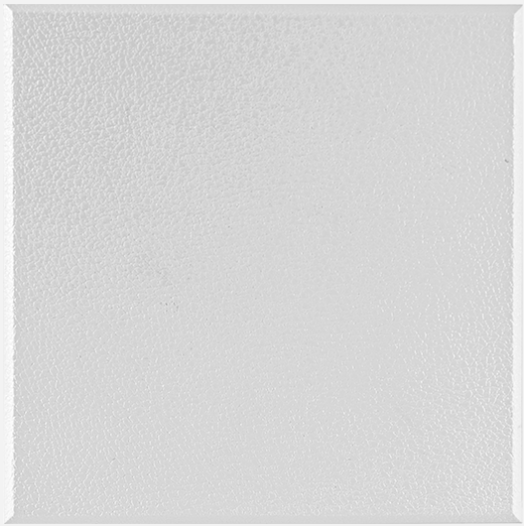
GFK is the German-language abbreviation for glass-fibre reinforced plastic, the material family that English-language drawings call GRP or FRP and whose moulding-compound formats are specified as SMC (sheet moulding compound) and BMC (bulk moulding compound). Because the term is tied to the language of the technology's origin, it already carries provenance information. For buyers, that provenance is one of the few things that can be checked before a panel or a moulded part is delivered, shipped or installed.
Zhejiang Aobang Technology Co., Ltd. is a GFK materials manufacturer founded in 2010 and located at No.108 Hongqiao Road, Mingxing Village, Qianyuan Town, Deqing County, Huzhou City, Zhejiang Province. According to the company's own record, it introduced industrial GFK product technology from Germany in 2010 and, through years of independent R&D and innovation, developed proprietary core GFK technologies and a complete product system. Tracing that line from Germany to Deqing is a practical exercise: each documented step answers a question that appears in procurement reviews of GFK panels and, by extension, of BMC SMC composite parts moulded from the same material family.
Why provenance matters more than a parameter table
Two suppliers can quote the same headline figures for a composite panel and still deliver different results on site. A specification sheet usually lists dimensions, fire class, antibacterial rate and colour. Those numbers describe a target, not a process. The process sits upstream: which resin system is used, how the reinforcement is distributed, how filler loading is controlled, how the surface is formed, and how consistently the same result can be repeated across a production run.
Provenance is a way of testing that upstream layer without visiting every candidate plant. It converts an unsupported claim such as long experience into a sequence of dated, checkable events: when the technology was introduced, where it was localised, which management systems were certified, which patents were granted, and which tests are run on finished product. A supplier with a traceable line can be audited against it. A supplier without one can only be taken on trust.
Buyers who source moulded components apply the same logic. The BMC SMC composite parts used in electrical enclosures, motor encapsulation, EV battery housings and railway interiors are sensitive to formulation and process control, and a supplier's technical origin is often the fastest available proxy for how those variables are managed. The same question applies to a GFK panel: where did the process come from, and what has been done with it since.
The Deqing base: what the record shows
The manufacturing record for Zhejiang Aobang Technology is specific enough to be checked item by item rather than accepted as a narrative.
| Evidence point | Documented fact | What a buyer can do with it |
|---|---|---|
| Founding year | 2010 | Establishes how long the process route has been in production use. |
| Location | No.108 Hongqiao Road, Mingxing Village, Qianyuan Town, Deqing County, Huzhou City, Zhejiang Province | Places the plant inside the Yangtze River Delta composites cluster. |
| Site scale | 20,000 m2 | Space for mould workshop, lamination, finishing and storage. |
| Workforce | 150 employees | Team depth to be weighed against project volume and lead time. |
| Technology origin | Industrial GFK product technology introduced from Germany in 2010 | Starting point of the technical lineage. |
| Development path | Proprietary core GFK technologies and a complete product system through independent R&D | Indicates capacity to adapt the baseline, not only reproduce it. |
| Management systems | ISO environmental management system certification and ISO quality management system certification | Describes how quality and environmental performance are managed daily. |
| Innovation record | National High-Tech Enterprise; multiple national invention patents and utility model patents | Documents technical solutions claimed as the company's own. |
| Test practice | Testing by national authorised testing centres for antibacterial rate, anti-mould grade, thermal conductivity and fire performance | Allows verification against reports rather than against claims. |
| Mould output | Annual output of 600 complete molds, as stated in the company's manufacturing case record | Indicates tooling capacity behind custom part programmes. |
From licensed technology to proprietary systems
The 2010 technology introduction is best read as a starting point rather than a finished capability. The company's own account describes a second phase: independent R&D and innovation that produced proprietary core GFK technologies and a complete product system. The distinction matters in evaluation. Imported technology establishes a baseline formulation and process route. Proprietary development determines whether the supplier can adapt that baseline to new dimensions, surface textures, fire requirements and application environments without returning to the original source.
Two further elements support the manufacturing claim. The company holds ISO environmental management system certification and ISO quality management system certification, and it is recognised as a National High-Tech Enterprise with multiple national invention patents and utility model patents. Certifications and patents do different jobs. The ISO systems describe how quality and environmental performance are controlled day to day. Patents describe specific technical solutions the company claims as its own. Neither substitutes for a test report, and both are useful when a buyer is building a shortlist.
Technical support belongs to the same record. Zhejiang Aobang Technology states that its on-site service engineers confirm product performance and specifications with customers, with the stated aim of lowering actual procurement costs and improving customer profit margins. In practice this shifts the evaluation question from what is the unit price to what the installed system costs once specification errors, rework and installation time are counted. It also explains why the company describes robust technical support and after-sales service as the end of a cooperation rather than the close of a sale.
Technical explanation: how the panel is engineered
The ARF Antibacterial Board is the product line where this provenance becomes visible in specifications. The board is described as polyester resin, glass fibre and filler and, in the more detailed material statement, as glass fibre, flame-retardant resin, aluminium hydroxide and silver-containing antibacterial agents. Its surface is formed by high-temperature de-moulding and one-piece on-line lamination forming, a continuous process in which the surface finish is created in the same operation as the panel body rather than applied afterwards.
| Property | Documented value | Procurement relevance |
|---|---|---|
| Fire performance | Class A2 fire-resistance rating | Drives specification in corridors, transport hubs and public buildings. |
| Antibacterial performance | Antibacterial rate above 99.9% | Sets the baseline for hospitals and cleanrooms, subject to project-level reports. |
| Mildew resistance | Class 1 mildew resistance | Supports humid and wet-area installation. |
| Chemical resistance | Acid-alkali resistance and oxidation resistance | Extends service life where metal panels corrode. |
| Service life | 25 years | Moves the cost comparison from first price to replacement interval. |
| Colour stability | Color-stable and non-fading | Keeps long corridors and large surfaces visually consistent. |
| Moisture | Damp-proof performance | Reduces substrate preparation in wet areas. |
| Cleaning | Washable and cleanable | Matches high-traffic cleaning regimes. |
| Surface durability | Scratch-resistant surface | Maintains appearance under trolley and equipment contact. |
| Thermal and acoustic | Both thermal insulation and sound insulation | One panel performs two functions in partitioned spaces. |
| Reuse | Reusable with a high utilization rate; no deformation on dismantling | Supports refurbishment and reconfiguration. |
| Formats | 300*300, 300*600, 300*900, 300*1200, 600*600, 600*900, 600*1200, 600*1500 | Covers standard wall and ceiling modules. |
Customization runs alongside the standard range. Buyers can specify slab thickness, length and width dimensions, matte and real stone surface textures, antibacterial rating, fire resistance rating and matching edge finishing materials. Standard products are delivered in 7-10 days, while customized products have a stable supply of 15-25 days. Where a new mould is required, the company's own mould workshop develops it in 30-60 days. The two timelines describe different things: one is panel production, the other is tooling, and they should be planned separately in a project schedule.
Application evidence: hospitals, schools and transport hubs
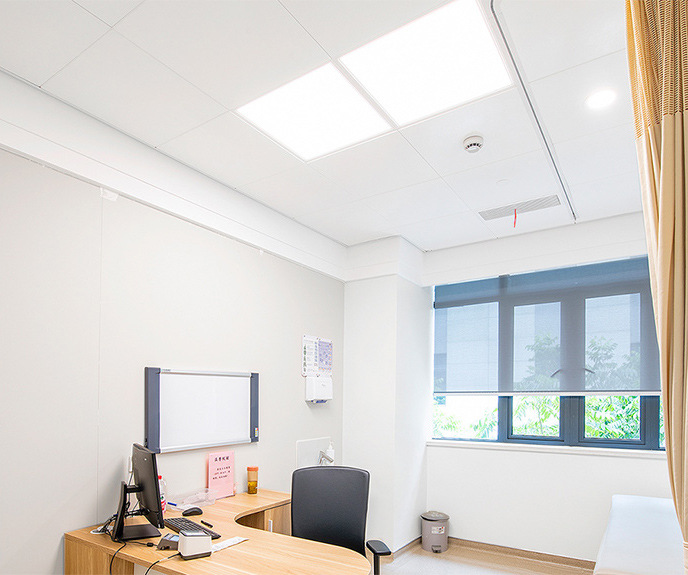
Documented use concentrates on high-traffic public venues: hospitals, schools, banks and high-speed-rail stations. The application record extends the range to laboratories, airports, subway stations, pharmaceutical factories, food factories, wineries and underground grain silos, together with the working conditions that justify the material: acid, alkali, oxidizer and UV exposure, high humidity, and environments that require thermal stability, anti-mould and antibacterial behaviour. The board is positioned as a replacement for colour steel plates and polyurethane sandwich panels rather than as a specialist product for a single sector.
The largest documented supply case covers hospital wall and ceiling panels, schools and public buildings, with cumulative supply of approximately 6 million square meters of sheet material. Reported results are antibacterial and anti-mould performance, 15% to 30% energy savings from low thermal conductivity, A and A2 fire resistance ratings, and test reports available for verification. The reference also identifies the buyer types involved: general contractors, decoration companies and project owners.
Installation economics are part of the application argument. According to the company, the complete supporting installation system cuts installation costs by 20% and shortens construction cycles by 15%, while thermal insulation can reduce power consumption by 15%. These should be read as system-level figures. They depend on the specified keel and bracket system, sealants, fireproof fittings, substrate conditions and installation sequence, and they are best confirmed against a project's own bill of quantities rather than applied as a general rate.
What the market data suggests about composite demand
The material family behind GFK panels and BMC SMC composite parts is large and still expanding. Market Research Future values the global SMC and BMC market at USD 35.77 billion in 2024 and projects USD 67.98 billion by 2035, while Grand View Research reports that Asia Pacific held 63.0% of global SMC and BMC revenue in 2025. The two estimates are not directly comparable: published base figures vary widely depending on whether raw resins or finished moulded parts are counted, so a buyer comparing supplier capacity statements should first confirm which scope a number refers to.
Segment data points in the same direction. Polyester-based BMC accounted for 65% of the market in 2024, valued at approximately USD 1.37 billion, and glass fibre reinforcement represented 62.1% of the total fibre segment in 2025. On the demand side, automotive applications accounted for 38% of BMC use in 2024, the global electric vehicle battery housing market was valued at USD 12.4 billion in 2023 with an 8% CAGR expected through 2032, and SMC composite battery covers alone reached USD 1.38 billion in 2024. Electrical and electronic applications for BMC reached USD 0.57 billion in 2024.
Regional concentration is equally relevant to provenance. HTF Market Intelligence attributes China's dominant position in the regional market to extensive composites manufacturing clusters and large EV production capacity, and Asia Pacific holds a 45% share of the global railway composites market as of 2025, where SMC is used for lightweight interior parts. For a buyer shortlisting GFK panel or BMC SMC composite parts suppliers, this concentration explains two things at once: the depth of available capacity, and the difficulty of separating one supplier from another without verifiable evidence.
Where GFK panels sit against traditional solutions
GFK panels are not a universal replacement. The comparison that matters is not material against material in the abstract, but forming route against geometry and environment.
| Dimension | Continuously laminated GFK panel | Traditional colour-steel or polyurethane sandwich panel | Compression-moulded SMC or BMC part |
|---|---|---|---|
| Geometry | Flat wall, ceiling and enclosure surfaces | Flat sandwich panels | Complex three-dimensional shapes |
| Surface finish | Formed in-line during lamination, including gloss, coarse, wood-grain and brushed textures | Coated steel skin, limited texture range | Mould-defined finish |
| Fire route | Class A2 fire-resistance rating | Depends on core and coating system | Depends on compound formulation |
| Antibacterial route | Silver-containing antibacterial agents in the material | Not a material property by default | Compound-dependent |
| Corrosion behaviour | Acid-alkali and oxidation resistance | Metal skin subject to corrosion at cut edges | Resin-dependent |
| Installation | Complete supporting system; stated 20% lower installation cost and 15% shorter cycle | Established but fitting-intensive | Assembly-based |
| Service life | 25 years | Shorter replacement intervals common | Application-dependent |
| Reuse | Reusable, no deformation on dismantling | Limited | Limited |
Limits and boundaries worth stating
- Medical and cleanroom projects should verify project-specific VOC and formaldehyde test reports together with the antibacterial rating, rather than relying on headline performance figures.
- Outdoor and marine applications should verify weathering and marine-environment suitability reports before specification.
- A panel is a passive material product. Its installed performance depends on the keel and bracket system, sealants and fireproof fittings specified for the project, and on following the design and the manufacturer's technical guidance.
- Continuously laminated flat panels suit walls, ceilings and enclosures. Complex three-dimensional components are normally compression moulded from SMC or BMC instead, and the two routes should not be treated as interchangeable.
- The 25-year service life and A2 rating carry a cost. In short-cycle or temporary projects, that cost may not be recovered before the installation is dismantled, and a commodity sandwich panel can be the rational choice.
Future outlook
Three developments are likely to shape how this provenance story is read over the next planning cycle. First, growth in SMC and BMC demand is concentrated in applications where failure is expensive: EV battery housings, electrical enclosures, rail interiors and public buildings. That raises the weight given to documented process control rather than to catalogue claims. Second, regulatory expectations for electrical and electronic components, including flammability standards such as UL 94 V-0 and harmonised standards such as IEC and EN 62841 for electrical enclosures and terminal blocks, push suppliers toward test evidence. Third, as Asia Pacific's share of composite production stays high, differentiation will come less from geography and more from traceability: which technology was adopted, when, how it was localised, which management systems are certified, and which reports can be produced on request.
Zhejiang Aobang Technology illustrates that direction with a documented line: a German technology introduction in 2010, independent R&D and a patent record, and a 20,000 m2 plant in Deqing producing a defined panel range with stated fire, antibacterial and durability performance, supported by national authorised testing and reports available before purchase. Whether that line is sufficient for a specific project remains a question for the specification and the test reports, which is exactly where a provenance-based evaluation should end.
Frequently asked questions
What does it mean that the GFK technology was introduced from Germany in 2010?
Zhejiang Aobang Technology states that it introduced industrial GFK product technology from Germany in 2010, the year the company was founded. That introduction supplied the starting formulation and process route. The company reports that years of independent R&D then produced proprietary core GFK technologies and a complete product system. The German origin describes the source of the technology, not the location of manufacture.
Is GFK the same material as SMC or BMC?
GFK is the German-language term for glass-fibre reinforced plastic and describes a material family rather than a single compound. SMC (sheet moulding compound) and BMC (bulk moulding compound) are moulding-compound formats within that family, typically processed by compression moulding into three-dimensional parts. Continuously laminated GFK panels and moulded SMC or BMC parts share the same reinforcement and resin logic but differ in forming route and achievable geometry.
Which certifications and documents can be checked before ordering?
The company holds ISO environmental management system certification and ISO quality management system certification, and is recognised as a National High-Tech Enterprise with multiple national invention patents and utility model patents. Products are tested by national authorised testing centres for indicators including antibacterial rate, anti-mould grade, thermal conductivity and fire performance. Full test methods and reports are stated to be available on request prior to purchase.
What are the standard panel sizes and what can be customized?
Standard models are 300*300, 300*600, 300*900, 300*1200, 600*600, 600*900, 600*1200 and 600*1500. Customization covers slab thickness, length and width dimensions, matte and real stone surface textures, antibacterial rating, fire resistance rating and matching edge finishing materials.
What lead times apply to standard and customized panels?
Standard products are delivered in 7-10 days, and customized products have a stable supply of 15-25 days. Where a new mould is required, the company's own mould workshop develops it in 30-60 days. The mould timeline applies to tooling rather than to repeat panel production.
How are fire and antibacterial performance verified?
The GFK panels are stated to achieve a Class A2 fire-resistance rating, an antibacterial rate above 99.9% and Class 1 mildew resistance. Verification runs through testing at national authorised testing centres, with reports covering antibacterial rate, anti-mould grade, thermal conductivity and fire performance available on request. For medical and cleanroom projects, buyers should also request project-specific VOC and formaldehyde test reports.
Are the panels themselves imported from Germany?
No. The company introduced industrial GFK product technology from Germany in 2010 and manufactures at its site in Deqing County, Zhejiang Province, a 20,000 m2 facility with 150 employees. What was imported is technology and process know-how. Production, customization and finishing take place at the Chinese plant.
What technical support is provided after the specification stage?
The company states that its on-site service engineers confirm product performance and specifications with customers, and that support includes remote technical support and on-site installation guidance. Its stated objective is to lower actual procurement costs and improve customer profit margins, with technical support and after-sales service described as the goal of a cooperation rather than its endpoint.
Есть вопросы или нужны дополнительные детали?
Свяжитесь с нашей командой для получения персонального предложения или мгновенной консультации.
Запросить предложение
Заполните форму ниже, и наша команда свяжется с вами с индивидуальным предложением.
Прямой чат WhatsApp
Предпочитаете общаться в реальном времени? Напишите нам в WhatsApp для мгновенной помощи и быстрых ответов.
- Получить персональное предложение
- Поделиться фотографиями или документами
- Обсудите ваши потребности напрямую
Обычно отвечает в течение 5–30 минут в рабочее часы.