
From IP53 to MIL-STD-810G: Reading UMIDIGI Phone Compliance
From IP53 to MIL-STD-810G: Reading UMIDIGI Phone Compliance
Compliance language travels faster than compliance understanding. When a phone is described as IP68 or MIL-STD-810G, buyers in distribution, procurement, and field operations often read the label as one broad durability promise. In practice, each code answers a narrow engineering question under defined test conditions. The distance between what a rating proves and what a buyer assumes it proves is where returns, warranty disputes, and avoidable re-sourcing begin.
The global rugged smartphone market was valued at approximately USD 2.98 billion in 2023 and is projected to reach USD 5.24 billion by 2030, according to Verified Market Research. That trajectory is pulling protection ratings out of the industrial niche and into mainstream purchasing conversations, where the same three characters — IP68 — can appear in a tender document, a distributor listing, and a retail page with three different implied meanings.
UMIDIGI, the smartphone brand operated by Shenzhen Keysmart Technology Co., Ltd. (Keysmart), sells across both the rugged and mainstream segments. That dual portfolio makes it a useful reference case for reading protection levels and military-standard references side by side, and for judging which compliance claim actually matters for a given usage context.
Why a Rating Label Is Not a Purchase Decision
Three recurring misreadings create most of the confusion in this category.
- Ratings are read as absolutes. An ingress protection rating describes performance under a specific test; it is not a permanent material property. Seals, gaskets, and port covers are wear items.
- Standards are read as certificates. MIL-STD-810G is a test-method standard. It defines procedures and environmental conditions rather than issuing a pass or fail mark to a product.
- Ratings are read without context. A protection level only becomes a purchasing criterion when it is matched to the exposure profile of the user — dust, rain, immersion, washdown, vibration, or impact.
The market sizing itself illustrates why precision matters. Independent estimates for this category diverge sharply: Technavio placed the rugged smartphone market at USD 1.27 billion, while Dataintelo estimated USD 18.6 billion for the rugged and outdoor smartphone segment. The spread reflects different inclusion rules — semi-rugged versus ultra-rugged, consumer versus industrial — and it is a practical reminder to check which definition a supplier is using before comparing stated figures.
How IP Codes Are Structured Under IEC 60529
IP ratings follow IEC 60529, the international standard for degrees of protection provided by enclosures. An IP code carries two digits. The first digit addresses protection against solid objects and dust. The second digit addresses protection against water. They are independent measurements, and neither digit implies anything about impact resistance.
| Rating | Solid protection (first digit) | Water protection (second digit) | Where it typically fits |
|---|---|---|---|
| IP53 | 5 — dust-protected; limited ingress that does not interfere with operation | 3 — protected against water spraying | Light everyday exposure; urban carry |
| IP54 | 5 — dust-protected | 4 — protected against water splashing | Daily use with rain, spills, and dusty environments |
| IP68 | 6 — dust-tight | 8 — protected against continuous immersion, under conditions specified by the manufacturer | Rugged, field, and industrial use |
| IP69K | 6 — dust-tight | 9K — protected against close-range high-pressure, high-temperature spray-down | Washdown and heavy industrial environments |
Two structural points follow from that table. First, IP53 and IP54 differ only in the water digit — spray versus splash — while both share the same dust-protected solid rating. Second, moving from IP54 to IP68 is not a single step but a change in both fields: dust-protected becomes dust-tight, and splash resistance becomes continuous immersion resistance.
IP69K is a different mechanism again. It tests resistance to a directed high-pressure, high-temperature jet rather than immersion. As a result, IP68 does not automatically imply IP69K, and IP69K does not automatically imply IP68. They answer different questions, and a specification sheet that lists only one of them has still left something unstated.
Where UMIDIGI's Compliance Evidence Sits
UMIDIGI is the smartphone brand operated by Shenzhen Keysmart Technology Co., Ltd., a Shenzhen-based communications technology company founded in 2012 that runs two businesses: its own brand and ODM/OEM services. The company states a focus on high performance, affordability, and user experience across smartphones, tablets, and wearables, operating from a 10,000 m² facility with 400–500 employees and a 30-engineer R&D team. Its stated export orientation is 100%, with listed markets covering South America, Asia, Africa, the EU, the USA, and Middle Eastern and Western regions.
Within that portfolio, the compliance-relevant evidence sits in two tiers.
Rugged tier: BISON X20
The BISON X20 is the rugged reference device in the lineup, documented with IP68/IP69K protection and MIL-STD-810G compliance. Against the standard rugged smartphone baseline, UMIDIGI documents it as ultra slim and lightweight, with an ultra-large display, ultra waterproof and dustproof construction, ultra drop resistance, and ultra massive power supported by high-efficiency power saving.
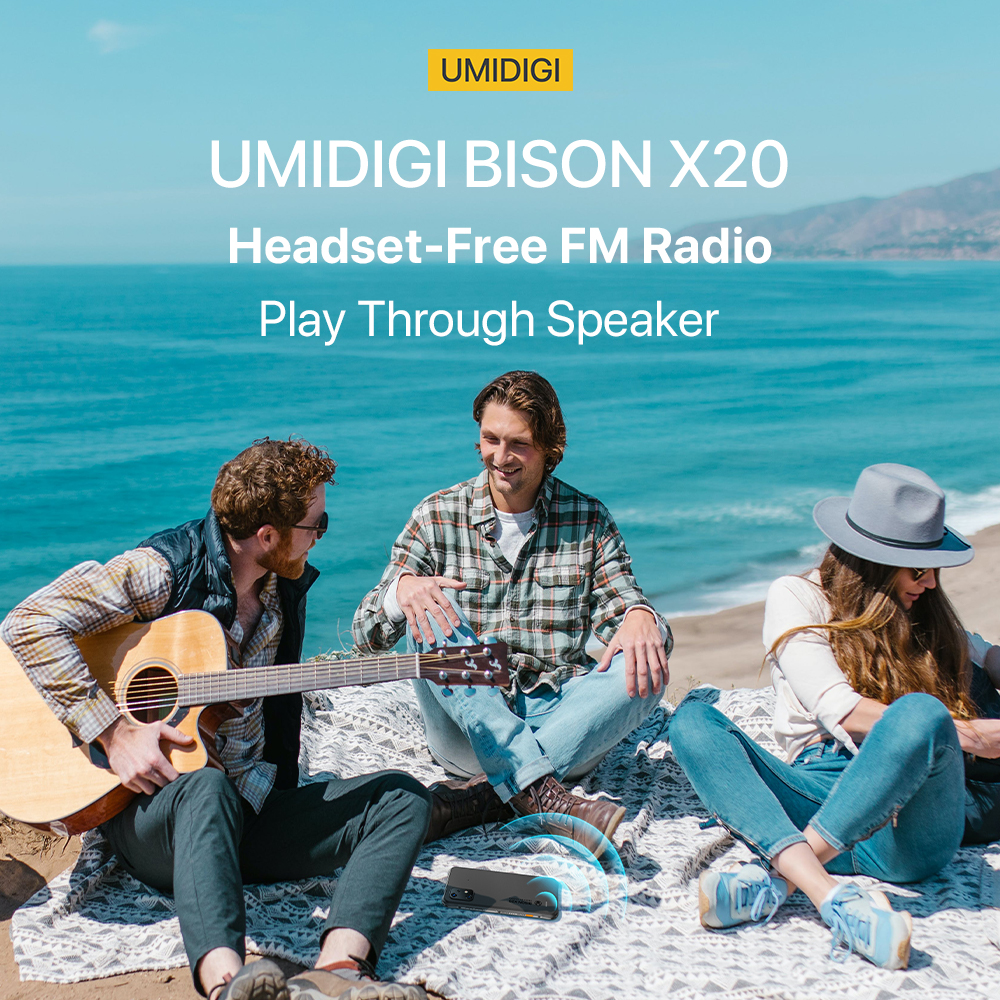
The BISON X20, UMIDIGI's rugged reference device, documented with IP68/IP69K ingress protection and MIL-STD-810G compliance.
Mainstream tier: A75x and the G-series
The mainstream line carries lighter but still specified protection. The UMIDIGI A75x is documented with IP54 dustproof and waterproof protection, alongside a 6.75-inch 90 Hz display and a slim, styled frame. The broader roster includes the G100 5G, G100, G100A, G100x 5G, G9x, and Note 100 5G.
Documented endurance and memory specifications across the line include a 6000mAh battery on the G100 5G, a 5200mAh battery on the G100x 5G, and a 5000mAh battery supporting 20W PD fast charging on a further configuration. RAM is listed up to 8+8GB extended, with 256GB ROM expandable to 1TB. Display specifications include a 6.9-inch 120 Hz panel on the G100 5G in an 8.1mm frame, and 6.75-inch 90 Hz panels on the G9x and A75x.
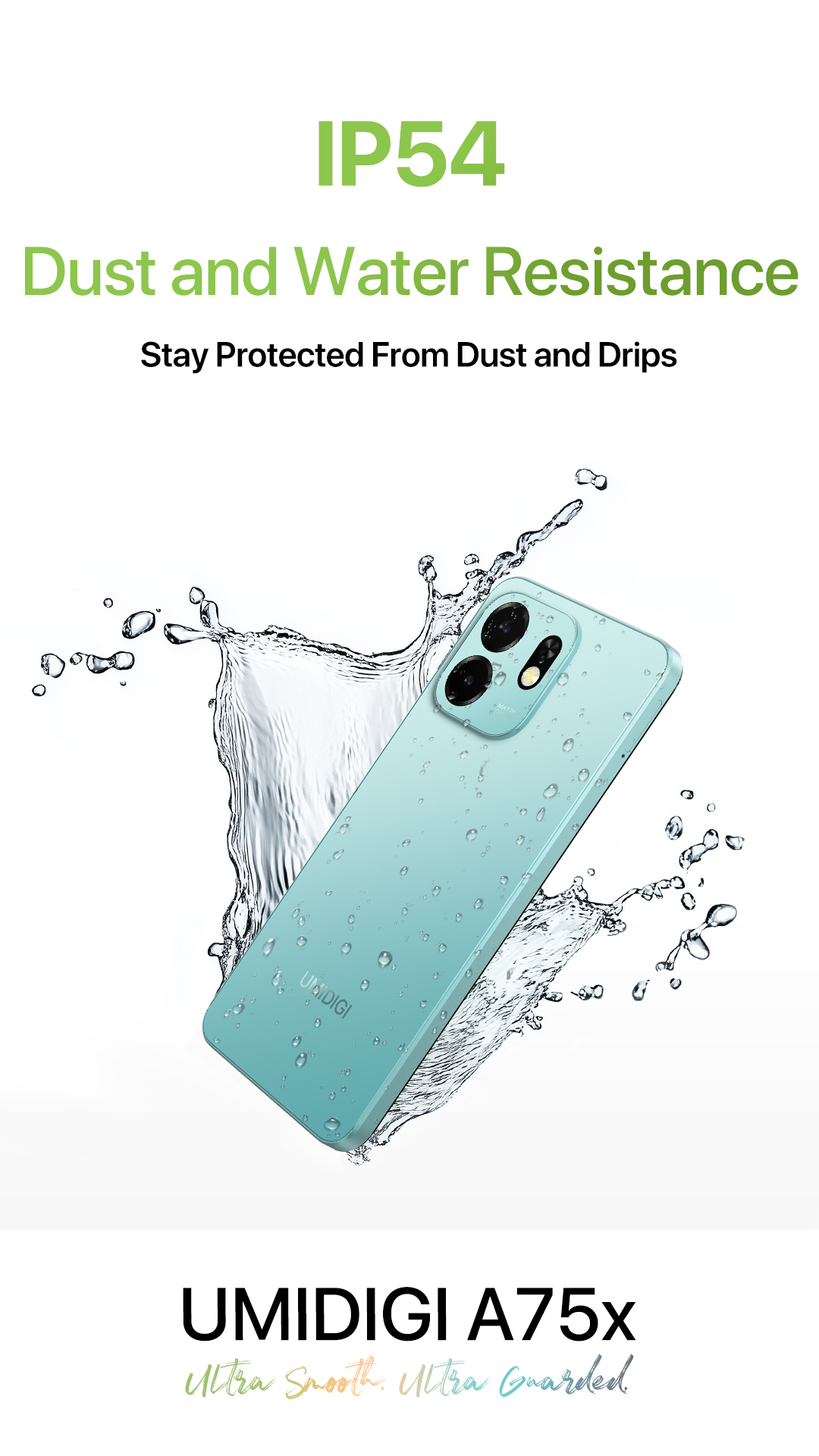
IP54 dustproof and waterproof protection in UMIDIGI's mainstream A75x line — splash and dust resistance rather than immersion protection.
What MIL-STD-810G Does — and Does Not — Guarantee
MIL-STD-810G is a U.S. Department of Defense test-method standard. It defines procedures and environmental test conditions covering stressors such as shock, vibration, temperature, humidity, and related exposures. Critically, it is a method standard rather than a certification: it prescribes how tests are run and how results are documented, and the party performing the test selects which methods and severity levels apply to a given product.
The standard family has also been revised over time. The revision referenced in current independent guidance for outdoor and industrial rugged devices is MIL-STD-810H, which is cited alongside IEC 60529 (IP68/IP69K) for ingress protection. A device or product line referenced against MIL-STD-810G is therefore making a statement about applied test methods and the revision in force at the time — not a universal survival guarantee.
Reading rules for any MIL-STD reference:
- Ask which test methods and severity levels were selected, not only which standard number appears.
- Ask which revision of the standard the test was run against.
- Confirm that the claim applies to the sealed unit as shipped, including port covers and seals.
- Separate ingress and impact claims from battery claims — an enclosure rating says nothing about cell cycle life.
Matching Protection Levels to Usage Contexts
UMIDIGI documents the BISON X20 for construction and engineering, logistics and warehousing, manufacturing, mining, oil and gas, agriculture, transportation and delivery, public safety and emergency services, and outdoor work and field operations. The mainstream line is positioned for daily work and life.
The practical question for a buyer is not which rating is highest, but which exposure profile the user actually faces.
| Usage context | Dominant exposure | Protection level that matches |
|---|---|---|
| Office, retail, urban daily carry | Dust, light rain, accidental spills | IP53–IP54 |
| Field service, agriculture, transport and delivery | Dust, rain, vibration, occasional drops | IP54 minimum; IP68/IP69K preferred |
| Construction, engineering, mining, oil and gas, manufacturing washdown | Dust-tight requirement, immersion, high-pressure cleaning, impact | IP68/IP69K plus MIL-STD environmental and shock testing |
The field segment is also broader than heavy industry alone. Independent contractors and outdoor sports enthusiasts are the primary consumer drivers for water-, dust-, and shock-resistant phones, representing 38% of the global rugged market according to Growth Research. For a distributor, that means demand for higher protection levels is not confined to enterprise accounts.
Market Signals Behind the Ratings Conversation
Three verified data points explain why protection and endurance are being evaluated together rather than separately.
- High-capacity batteries are now mainstream. Smartphones with battery capacities of 6000mAh or higher captured 29% of global sales in January 2026, up from 10% in early 2025, according to Counterpoint Research.
- The mid-band dominates rugged. The 5000mAh to 6000mAh battery segment accounted for 42.9% of rugged phone market share in 2025, according to The Insight Partners.
- Cell chemistry is shifting. Silicon-carbon batteries are increasingly replacing standard graphite anodes, offering 20–50% higher energy density for slim, long-lasting devices, according to Fortune Business Insights.
Independent guidance for the category reinforces the same pairing: rugged devices intended for outdoor and industrial use are expected to adhere to IEC 60529 (IP68/IP69K) for ingress protection and MIL-STD-810H for shock and environmental resistance. The compliance conversation and the endurance conversation are converging into a single specification review, which is why a rugged device such as the BISON X20 and a 6000mAh mainstream device such as the G100 5G now appear in the same evaluation shortlists.
Rugged and Mainstream Lines Compared with Traditional Options
UMIDIGI's comparison data positions both tiers against baseline categories. The figures below are the company's documented comparative claims against those baselines, and buyers should validate them against their own duty cycles rather than adopt them wholesale.
BISON X20 against the standard rugged smartphone baseline
| Dimension | BISON X20 (as documented) | Standard rugged smartphone |
|---|---|---|
| Design | Ultra slim and lightweight; ultra-large display | Typically bulkier build |
| Protection | Ultra waterproof and dustproof; ultra drop-resistant | Water-, dust-, and shock-resistant |
| Power | Ultra massive power with high-efficiency power saving | Standard battery management |
| Power consumption | 30% lower | Baseline |
| Durability | 25% higher | Baseline |
| Service lifespan | 20% longer | Baseline |
| Overall comprehensive cost | 10%–15% lower | Baseline |
| Maintenance | Less maintenance required | Standard |
| Documented best fit | Construction and engineering; logistics and warehousing; manufacturing; mining; oil and gas; agriculture; transportation and delivery; public safety and emergency services; outdoor field operations | Mixed general use |
Mainstream line against the traditional smartphone baseline
| Dimension | UMIDIGI mainstream line (as documented) | Traditional smartphone |
|---|---|---|
| Battery | Massive battery | Standard capacity |
| Display | Larger display | Standard panel size |
| Design | Stylish design with slim and ultra-slim frame | Varies |
| Power consumption | 30% lower | Baseline |
| Durability | 25% higher | Baseline |
| Service lifespan | 20% longer | Baseline |
| Overall comprehensive cost | 10%–15% lower | Baseline |
| Maintenance | Less maintenance required | Standard |
| Documented best fit | Daily work and life | Daily use |
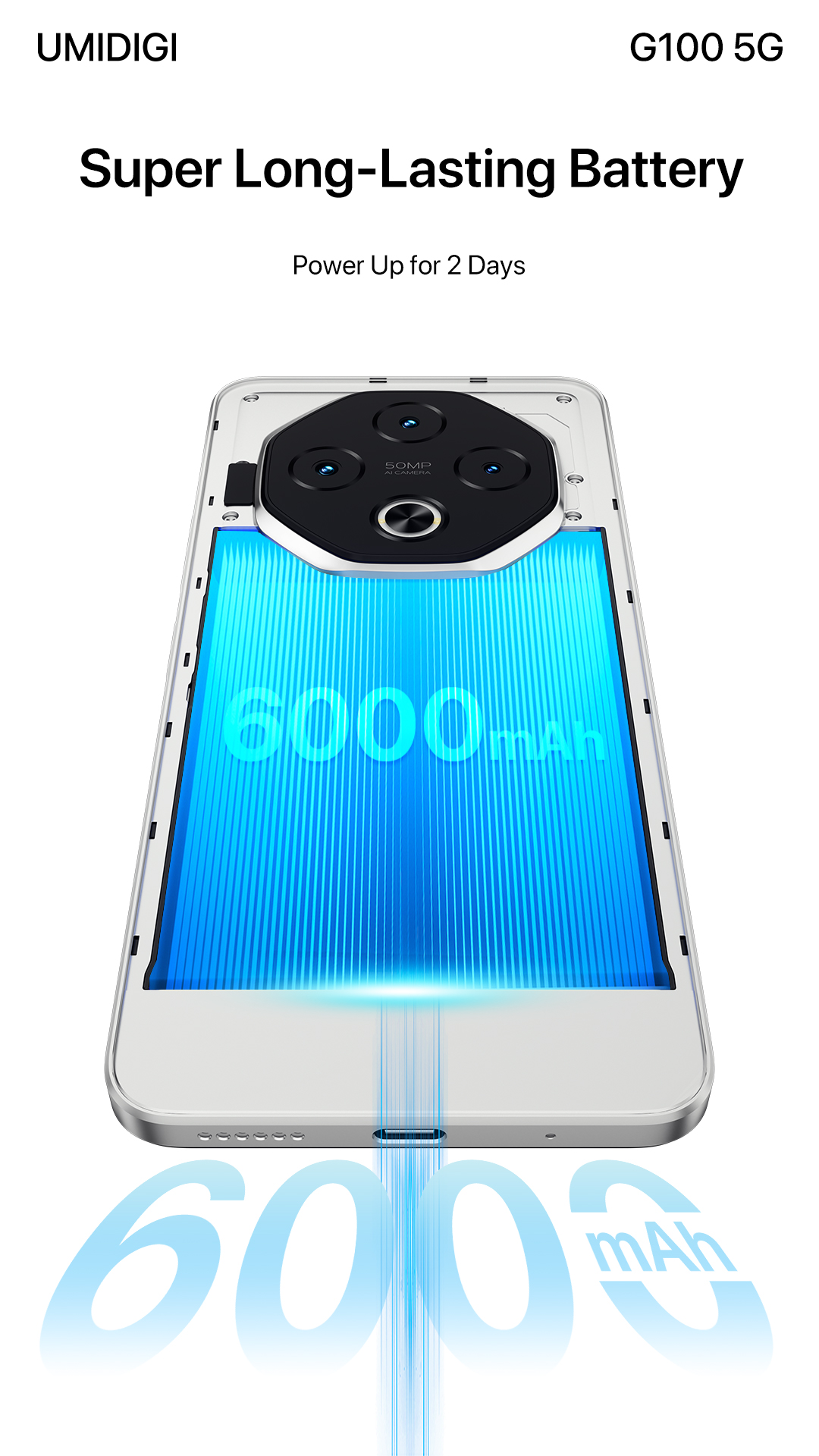
The UMIDIGI G100 5G, documented with a 6000mAh battery — an endurance specification that sits outside the scope of any ingress protection rating.
Limits, Trade-offs, and What Buyers Should Still Verify
Compliance evidence is strongest when its boundaries are stated as clearly as its claims.
- IP68 immersion conditions are manufacturer-specified. The "8" digit indicates protection against continuous immersion under conditions defined by the manufacturer. It does not carry a universal depth or duration value, so the specific claim must be read on the specific product.
- IP54 is splash-resistant, not submersible. It is a daily-use protection level, not a field immersion rating.
- IP69K and IP68 are not interchangeable. One tests a high-pressure, high-temperature jet; the other tests immersion. A device can hold one without holding the other.
- MIL-STD-810G is a method standard, not a certificate. The value of the reference depends on which methods and levels were selected and which revision was applied.
- Seals degrade. Gaskets, port covers, and sealing surfaces are wear items. A device that passed ingress testing when new may not retain that performance after impacts, repairs, or extended thermal cycling. Protection should be treated as a maintenance consideration, not a permanent property.
- Rugged protection trades against physical envelope. UMIDIGI documents the BISON X20 as ultra slim and lightweight relative to the standard rugged baseline, but a fully rugged device and a mainstream slim device still serve different physical use cases. Where pocketability and daily handling dominate, a mainstream device such as the IP54-rated A75x may fit better than a fully rugged build — and it will not carry the same immersion or impact positioning.
- An enclosure rating says nothing about cell behaviour. UMIDIGI documents battery-swelling control through qualified battery cell supplier selection, certified cell usage, incoming inspection of capacity, voltage, internal resistance, thickness and appearance, cell consistency testing, NTC thermistor temperature monitoring, automatic cut-off of charging and discharging above the safety temperature limit, and battery traceability. These are separate controls from ingress protection, and both need to be present.
- Procurement terms constrain execution timelines. Documented purchasing terms include a minimum order quantity of 3000 units, delivery terms of FCA HK/FOB, acceptance criteria based on pre-shipment test, and payment terms of 30% in advance with 70% before shipment. Monthly production capacity is 300,000 units, and typical production lead time for OEM orders is 60–70 working days. For a distributor timing a launch around a compliance claim, those lead times matter as much as the rating itself.
Future Outlook
Three shifts are likely to shape how compliance is evaluated in this category over the next planning cycle.
Compliance documentation becomes a procurement deliverable. As protection levels move into mass-market purchasing conversations, buyers are more likely to request the test basis behind a rating — methods, revision, and conditions — as a line item in an RFQ rather than as a marketing badge.
Endurance and protection converge. With 6000mAh-plus devices holding 29% of global sales in January 2026 and silicon-carbon chemistry lifting energy density by a documented 20–50%, the historical split between "rugged phone" and "long-battery phone" narrows. Buyers increasingly expect a single device to satisfy both a protection level and a battery threshold, which is the direction the rugged and mainstream tiers are already moving toward.
Revision awareness becomes due diligence. Because current independent guidance for rugged devices references MIL-STD-810H while older product documentation may reference MIL-STD-810G, the ability to state clearly which revision and which test methods apply will separate suppliers that are easy to approve from those that generate follow-up questions.
FAQ
What do the numbers in an IP rating such as IP53, IP54, IP68, or IP69K actually measure?
An IP code follows IEC 60529 and contains two digits. The first rates protection against solid objects and dust, where 5 means dust-protected — limited ingress that does not interfere with operation — and 6 means dust-tight. The second rates protection against water, where 3 covers water spraying, 4 covers water splashing, 8 covers continuous immersion under conditions specified by the manufacturer, and 9K covers close-range high-pressure, high-temperature spray-down. The rating therefore describes two independent test conditions, not a single overall durability score, and it says nothing about impact resistance.
Does a MIL-STD-810G reference guarantee that a phone will survive any drop?
No. MIL-STD-810G is a U.S. Department of Defense test-method standard that defines procedures and environmental test conditions rather than issuing a pass or fail result. The testing party selects which methods and severity levels apply. The standard family has also been revised: current independent guidance for outdoor and industrial rugged devices references MIL-STD-810H alongside IEC 60529 for ingress protection. A buyer evaluating the claim should confirm which methods were run, under what conditions, and against which revision.
Which UMIDIGI devices are positioned for rugged field use versus everyday use?
The BISON X20 is the rugged reference device, documented with IP68/IP69K protection and MIL-STD-810G compliance, and documented as suitable for construction and engineering, logistics and warehousing, manufacturing, mining, oil and gas, agriculture, transportation and delivery, public safety and emergency services, and outdoor work and field operations. The mainstream line — including the G100 5G, G100, G100A, G100x 5G, G9x, A75x, and Note 100 5G — is positioned for daily work and life, with the A75x specifically documented with IP54 dustproof and waterproof protection.
What battery and memory specifications support extended use across the portfolio?
Documented specifications include a 6000mAh battery on the UMIDIGI G100 5G, a 5200mAh battery on the G100x 5G, and a 5000mAh battery supporting 20W PD fast charging on a further configuration. RAM is listed up to 8+8GB extended, with 256GB ROM expandable to 1TB. Display specifications include a 6.9-inch 120 Hz panel on the G100 5G within an 8.1mm frame, and 6.75-inch 90 Hz panels on the G9x and A75x.
How is battery swelling risk controlled during production?
UMIDIGI documents battery-swelling control through strict battery cell supplier qualification, use of certified high-quality cells, incoming inspection covering battery capacity, voltage, internal resistance, thickness and appearance, battery cell consistency testing, NTC thermistor temperature monitoring with automatic cut-off of charging and discharging above the safety limit, controlled production processes, and comprehensive battery traceability. These controls operate independently of enclosure ingress ratings.
What are the purchasing terms and acceptance criteria for OEM orders?
Documented purchasing terms are a minimum order quantity of 3000 units, delivery terms of FCA HK/FOB, acceptance criteria based on pre-shipment test, and payment terms of 30% in advance with 70% before shipment. Monthly production capacity is 300,000 units, and typical production lead time for OEM orders is 60–70 working days.
Reference material: Shenzhen Keysmart Technology Co., Ltd. company profile — Company Profile (PDF). Corporate website: www.umidigi.com.