
From ISO 9001:2015 to -0.02 mm: Commodity Mould Acceptance Checklist
From ISO 9001:2015 to -0.02 mm: Commodity Mould Acceptance Checklist
Commodity mould acceptance is a documentary process before it is a technical one. A buyer can convert GANGNAM MOULD's ISO 9001:2015 quality management system certificate and its stated -0.02 mm dimensional tolerance into three enforceable layers: system evidence, dimensional evidence and trial-moulding evidence. Each layer needs a named document, a stated measurement method and a pass condition written into the purchase contract before the tool is cut — not negotiated after the first shot.
GANGNAM MOULD CO., LTD — the trading name of Zhejiang Huangyan Jiangnan Mould Factory, a plastic mould manufacturer established in 1988 in Huangyan, Taizhou, Zhejiang, China — presents two very different kinds of evidence. One is a management-system certificate. The other is a dimensional figure. Buyers routinely treat them as a single guarantee, which is where acceptance disputes begin.
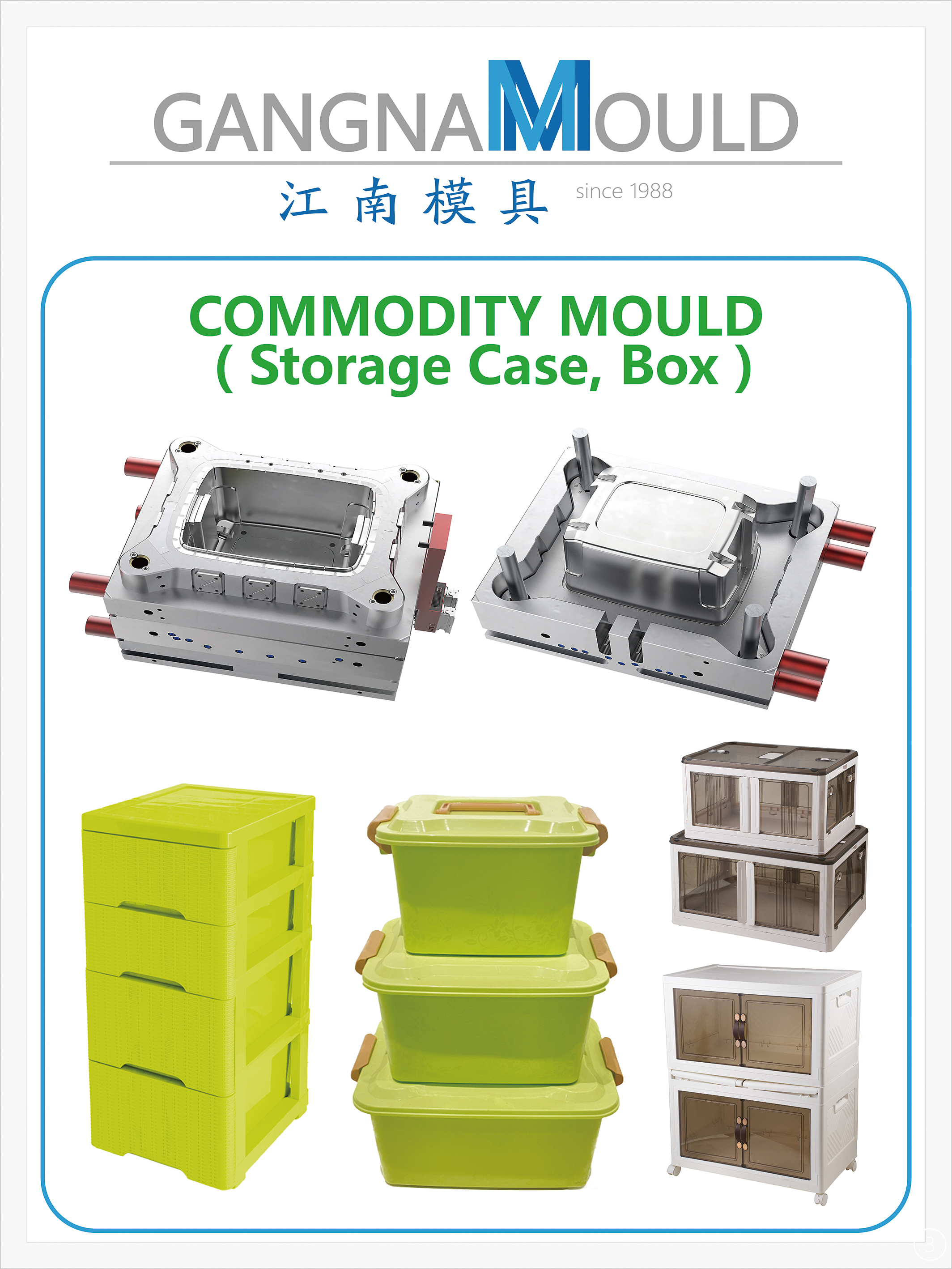
This checklist explains how to separate them, how to test them, and how to connect the results to the commercial terms that govern a commodity mould order: a minimum order quantity of 1 unit, shipment on FOB or CIF terms, and payment of 30% by T/T in advance with 70% before shipment. The product scope covered here is the everyday plastic-mould family — chairs, tables, stools, sofas, storage cabinets and boxes, kitchen utensils, bathroom accessories, baskets, trays, crates, basins, buckets, trash bins, garden planters, pallets, thin-wall containers and home appliance parts — for mass injection or blow moulding lines.
What ISO 9001:2015 Certifies — and What It Cannot
ISO 9001:2015 certifies a quality management system. It does not certify a mould. That single distinction decides how the certificate should be used in an acceptance file.
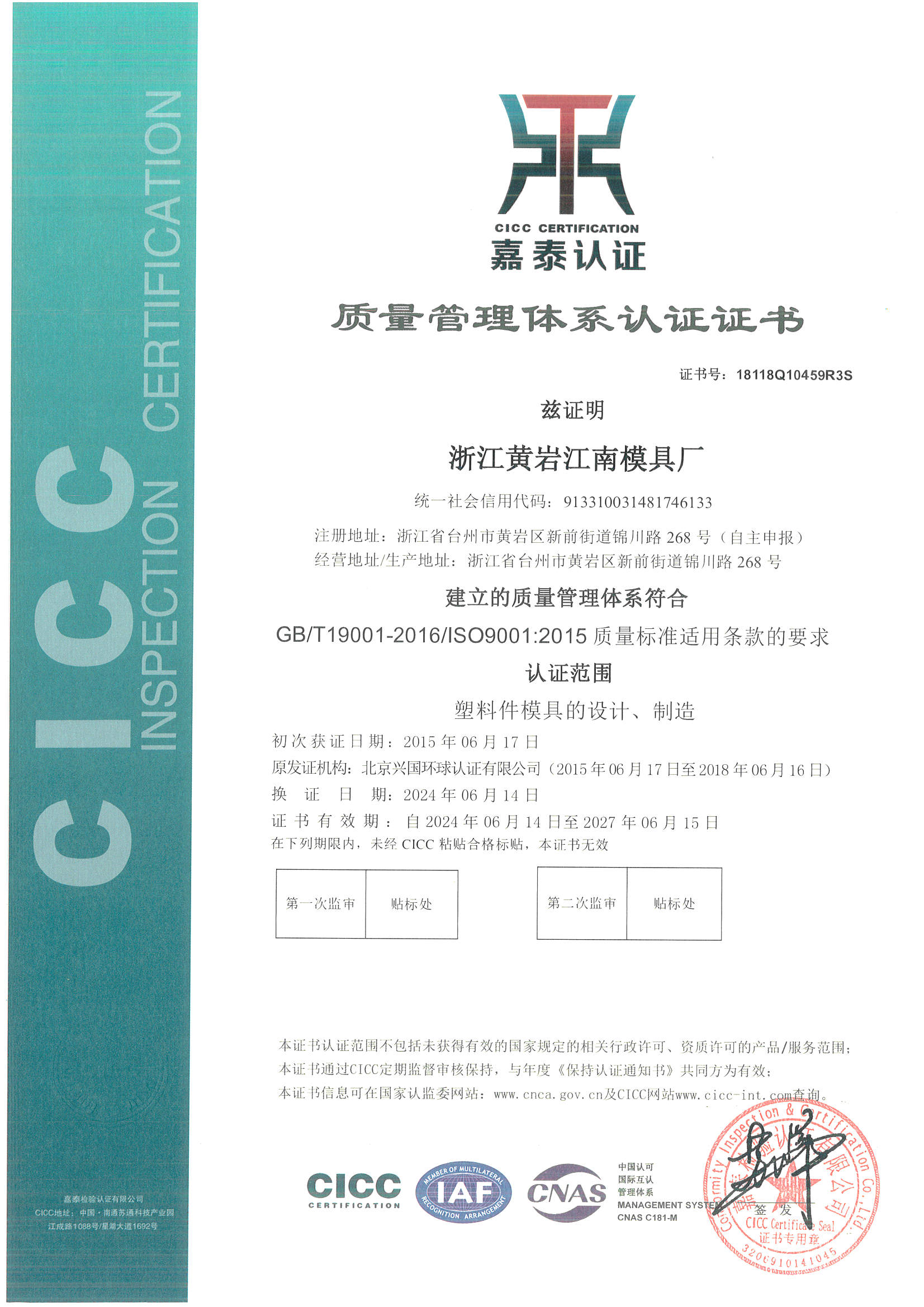
The certificate supplied for GANGNAM MOULD's commodity mould product is numbered 18118Q10459R3S, issued by Beijing Xingguo Inspection and Certification Co., Ltd., with a validity period running from 14 June 2024 to 15 June 2027. Its stated scope is the manufacture and design of plastic parts mould, and it is described as applying to the global market.
What this tells a buyer is that the supplier operates a documented system governing design review, purchasing, calibration, control of nonconforming output and records. Those are precisely the processes that generate an inspection report, a trial-moulding record or a corrective action when a dimension drifts. What the certificate does not tell a buyer is whether cavity three of a particular pallet mould sits inside -0.02 mm, what steel grade that cavity was cut from, or what cycle time the tool will hold on the buyer's machine. Those are part-specific and tool-specific questions, and they require part-specific and tool-specific documents.
A practical rule follows: treat the certificate as a qualification gate that predicts the reliability of documentation, then accept the mould on the documents that describe the mould. A certificate without a dimensional report is a claim about process; a dimensional report without a certificate is a claim about one measurement. Acceptance needs both, and neither substitutes for the other.
Turning the QMS Into Acceptance Criteria: Five Documents
Because ISO 9001:2015 governs process rather than output, the buyer's job is to specify which outputs the process must produce. Five documents cover most commodity mould orders.
- Approved drawing with a tolerance block and datum scheme. Nominal geometry without a datum reference and a stated tolerance per feature cannot be measured consistently, and therefore cannot be accepted or rejected consistently.
- Steel and heat-treatment declaration per cavity and insert. This records what the tool was actually made from, matched to the drawing's requirement.
- Inspection plan. The characteristics to be measured, the method for each, the sample size, the acceptance limit and the record format.
- Trial-moulding protocol and report. Machine, material, settings, sample retention and the measurements taken on the moulded parts.
- Handover package. Final inspection reports, the trial report, spare and insert details, and the installation and operation training record.
GANGNAM MOULD's stated process follows this sequence: requirement, design, manufacturing, trial and inspection, then delivery and training. Its stated quality-control methods are non-destructive testing, CMM measurement and full-size trial testing supported by inspection reports. The value of that structure to a buyer is that each stage produces a document the buyer can name in the purchase order — and a purchase order that names documents is far easier to enforce than one that names intentions.
Making the -0.02 mm Figure Enforceable
GANGNAM MOULD's stated dimensional tolerance of -0.02 mm becomes a usable acceptance criterion only when five conditions are attached to it. Without them, the number is a description rather than a specification.
1. Which features carry the tolerance
A single tolerance value cannot apply to an entire mould. Mating and locating features, cavity and core dimensions that control wall thickness, and shut-off surfaces typically need tighter control than clearance or non-functional geometry. The drawing should mark which characteristics hold -0.02 mm and which follow a looser band.
2. What a one-sided tolerance means
A minus-only tolerance of -0.02 mm is normally used where a feature must not exceed nominal — for example, a dimension where excess material would prevent assembly or force an interference fit. The buyer should confirm the direction of the tolerance and whether the intent is a limit dimension or a symmetric band expressed in shorthand.
3. Datum, fixturing and method
The same cavity can pass or fail depending on how it is clamped and referenced. The acceptance document should name the datum scheme, the fixturing used, the instrument and its stated measurement uncertainty, and the reporting format. CMM measurement and a 3D coordinated mapping capability are stated parts of GANGNAM MOULD's inspection toolkit, which is the right instrument class for this work — but the report still needs to state what was measured, on which cavity, against which nominal.
4. Sampling across cavities
In a multi-cavity commodity tool, one cavity report is not a tool report. Acceptance should specify how many cavities are measured, which characteristics are measured on all cavities, and what happens if one cavity deviates.
5. Mould tolerance is not part tolerance
This is the most common misreading. ISO 20457:2018 specifies possible manufacturing tolerances for plastic moulded parts and covers injection moulding among other processes. A mould cut to -0.02 mm still produces parts whose tolerance depends on material shrinkage, cooling, gating and process settings — a material point for PP and for engineering-grade or recycled polymer streams, all of which GANGNAM MOULD lists among the plastics its commodity moulds process. The purchase contract therefore needs two separate tolerance values: one for mould geometry and one for the moulded part.
Quality Mould Steel: What a Buyer Can Actually Verify
GANGNAM MOULD states that its commodity mould product is made of quality mould steel. That statement describes a material category, not a grade, so the acceptance file has to close the gap with documents rather than adjectives.
Three checks do most of the work. First, request the steel certificate and the heat-treatment record for each cavity and insert, and match them to the material named on the drawing. Second, confirm which components are replaceable — inserts, cores, wear surfaces — because replaceability determines how the tool is maintained over a multi-year production life rather than how it performs on day one. Third, confirm the surface treatment and polish specification, since GANGNAM MOULD lists surface texture and polish among its customisable parameters, alongside cavity count and size, gating and cooling design, inserts and multi-component integration, and material and heat-treatment requests.
The material being moulded also belongs in the steel conversation. Abrasive or recycled polymer streams place different demands on cavity surfaces than virgin PP, and a tool qualified only against a single virgin-material trial may behave differently in mass production. Buyers running recycled content should say so at the requirement stage rather than at the acceptance stage.
A Dimensional Verification Protocol
A dimensional acceptance protocol should be agreed before manufacturing and executed before shipment. The following sequence keeps the report auditable and ties each step to evidence the supplier already produces.
- Pre-manufacturing review. Confirm the drawing revision, tolerance block, datum scheme and the list of characteristics to be measured. Record any feature that will not be measured and why.
- In-process checks. Note which characteristics are checked during machining and which only at final inspection, so that a late deviation is not discovered after hours are invested in finishing.
- Final CMM report. A per-cavity deviation listing against nominal, with the instrument identified and out-of-tolerance features flagged rather than averaged.
- Non-destructive testing. The stated method and the acceptance level, applied to the surfaces and sections where internal defects would matter.
- Full-size trial testing. Measurement of parts produced on the tool, not only of the tool itself — the step that connects mould geometry to the product the buyer will sell.
- Retained evidence. Reports, sample parts and, where useful, photographic records of critical features.
Two practical cautions apply. A report that lists only passing characteristics is not a verification record; it is a summary. And a report with no stated measurement uncertainty cannot support a claim at the -0.02 mm level, because the uncertainty may be a meaningful fraction of the tolerance band itself.
Trial-Moulding Acceptance for Mass Injection and Blow Moulding
The trial run is where a commodity mould stops being a machined object and becomes a production asset. Acceptance should therefore test the tool under conditions close to the buyer's real line, and record them.
GANGNAM MOULD describes its commodity moulds as suitable for mass injection and blow moulding production lines, with design emphasis on durability, short cycle times and dimensional stability. Its design notes name uniform cooling to shorten cooling time and optimised gating and venting to reduce warpage — two characteristics that a trial run can actually measure rather than merely assert.
Conditions to record
- Machine model and tonnage used for the trial.
- Material grade and lot, including any recycled content, and drying conditions.
- Process settings: temperatures, injection profile, holding pressure, cooling time.
- Mould temperature at steady state, not only at start-up.
Outputs to measure
- First article and cavity balance. Dimensional and weight comparison across cavities; a balanced tool produces parts that behave alike.
- Part dimensions against the part tolerance specified separately from the mould tolerance.
- Cycle time baseline under the recorded settings, as a reference point rather than a guarantee.
- Warpage and flatness on large or thin-wall parts, where cooling and gating design show up first.
- Surface and finish against the agreed texture or polish specification.
- Assembly or fit check for parts that must mate with existing components — storage cabinets, crates, pallets and stackable containers all depend on interface geometry.
Blow moulding needs its own acceptance language. Wall-thickness distribution, parison handling and pinch-off quality are process outputs that a mould-dimensional report does not cover, so a blow-moulded pallet or container trial should record wall-thickness readings at defined points rather than a single average.
Large and thin-wall parts deserve an explicit note in the protocol. GANGNAM MOULD's application material references special design needs for large and thin-wall parts, which in practice means the trial must demonstrate that filling and cooling hold across the full part, not only at the gate.
The Acceptance Checklist
The table below compresses the argument into a working document. Each row names the acceptance area, the evidence to request and the minimum content of a pass statement.
| Acceptance area | Evidence to request | A pass statement must specify |
|---|---|---|
| Quality management system | ISO 9001:2015 certificate 18118Q10459R3S and its scope | Certificate number, issuer, validity dates and scope wording |
| Steel and heat treatment | Material certificate and treatment record per cavity and insert | Material identity matched to the drawing requirement |
| Mould geometry | Per-cavity CMM report against nominal | Characteristics, datum scheme, instrument uncertainty, pass limits |
| Internal integrity | Non-destructive testing record | Method, coverage and acceptance level |
| Part dimensions | Full-size trial measurement report | Separate part tolerance, sample size, cavity coverage |
| Cavity balance | First-article comparison across cavities | Which characteristics are compared and the allowed spread |
| Cooling and gating | Trial settings and cycle data | Steady-state mould temperature and recorded cycle time |
| Surface finish | Texture or polish confirmation | Specification reference and inspection method |
| Documentation package | Final reports and drawing revision record | Complete set, revision-matched, delivered before balance payment |
| Handover | Installation and operation training record | What was demonstrated, to whom, and when |
Wiring Acceptance Into Commercial Terms
Acceptance criteria are only as strong as the payment structure behind them. GANGNAM MOULD's stated commercial terms — a minimum order quantity of 1 unit, shipment on FOB or CIF terms, and 30% T/T in advance with 70% before shipment — create a specific sequence the buyer should design around.
The MOQ of 1 unit matters more than it appears. It allows a buyer to place a single-tool order for evaluation before committing to a family of moulds across chairs, crates, buckets or planters, which is a sensible way to test whether the supplier's documentation discipline matches its process discipline. A one-unit order that produces a complete, revision-matched acceptance file is stronger evidence than a multi-tool order that produces a delivery note.
The Incoterm decision changes where inspection happens. Under FOB, the buyer's control effectively ends at the point of loading, so dimensional and trial acceptance must be completed and signed before shipment, not after arrival. Under CIF, the seller arranges carriage and insurance, but the inspection argument is the same: risk and cost allocation shift, while the need for pre-shipment evidence does not. Whichever term is used, the contract should name the port, the responsible party for each document, and the buyer's right to witness the trial.
The 30/70 payment split creates the sharpest control point. Because 70% falls due before shipment, everything the buyer needs must be settled before that balance is triggered. A workable structure ties the balance release to a signed trial-moulding report and a complete dimensional report rather than to a general statement that the tool is ready. Two additional clauses are worth writing explicitly: a defined correction loop with a reasonable number of re-trials if measured characteristics fall outside the agreed limits, and a shipping-release condition listing the documents that must travel with the tool.
Lead Time, Capacity and the Acceptance Window
Acceptance takes calendar time, and the timeline has to accommodate it. GANGNAM MOULD states mould lead times of roughly 30 to 45 days depending on complexity, confirmed per order, with a monthly capacity of about 80 sets and annual output of over 800 units of mould. The company reports a 3,000 m² facility, 40 employees, a 15-engineer R&D team and more than 20 CNC milling machines, with a 70% export ratio and stated export markets including the Middle East, Africa, Central Asia, South America, Mexico, Italy and India, plus Southeast Asia as a main market.
For a buyer, the operational reading is straightforward. Engineering depth affects how quickly a dimensional deviation can be diagnosed and corrected, and a documented correction loop is only realistic if engineering capacity exists to run it. Capacity figures also indicate whether a trial slot can be scheduled inside the quoted lead time or whether acceptance will push delivery. Neither point is a guarantee of performance; both are reasons to fix the trial date in the purchase order rather than leave it to the delivery week.
The company's case material describes custom moulds supplied over a ten-year period for injection pallets, circulation crates, daily plastic containers and home appliance housings, with a stated design aim of withstanding millions of operational cycles. Read as a company statement rather than an independently verified test result, it still points at the right acceptance question: what documentation demonstrates that a tool is built for a production life rather than a first trial?
Where This Approach Fits — and Where It Does Not
An evidence-based checklist suits buyers who will run a tool for years and who need documentation they can revisit when a part drifts. It is less suited to buyers who need a single low-cost tool for a short promotional run, where the documentation burden may exceed the value at stake.
Three boundaries should be stated plainly. First, the ISO 9001:2015 certificate covers the management system for the manufacture and design of plastic parts mould; it does not certify that a specific mould meets -0.02 mm, and it does not cover downstream product requirements such as food-contact rules for kitchen utensils or market-specific safety rules for household goods, which depend on the part, the material and the destination market. Second, the -0.02 mm figure is a mould-geometry value and requires per-drawing confirmation of which features it governs. Third, publicly available information about the supplier's tooling performance is company-reported; buyers needing independent confirmation should commission their own inspection or witness the trial.
Frequently Asked Questions
Outlook: Acceptance Discipline as a Purchasing Norm
The wider market context supports the shift toward documented acceptance rather than price-only comparison. Commercial research cited for this review values the global industrial mould market at USD 59.0 billion in 2025, while Grand View Research reports the broader injection moulding market at USD 312.7 billion in the same year. The two figures are not interchangeable — one counts tool-making, the other counts moulded production — and the same distinction applies to acceptance: a tool certificate and a part qualification answer different questions.
Regional weight reinforces the point. Asia Pacific held 52.6% of the global industrial mould market in 2024 according to the same commercial research, which means most buyers will qualify tools built far from their own production line, on the strength of documents rather than site presence. In that setting, the buyer who can name the five documents, separate mould tolerance from part tolerance, and tie the balance payment to a signed trial report holds a stronger position than one who negotiates only on unit price.
For commodity moulds, the practical conclusion is narrow and useful. Ask for the certificate scope, not just the certificate. Ask which features carry -0.02 mm, and how they will be measured. Ask what the trial will record, and who signs it. Then write those answers into the order alongside the MOQ, the Incoterm and the payment schedule — because acceptance is decided in the contract, and only confirmed on the shop floor.
Company reference: GANGNAM MOULD, Zhejiang Huangyan Jiangnan Mould Factory, established 1988. The company brochure is available for download: GANGNAM MOULD brochure (PDF).
Есть вопросы или нужны дополнительные детали?
Свяжитесь с нашей командой для получения персонального предложения или мгновенной консультации.
Запросить предложение
Заполните форму ниже, и наша команда свяжется с вами с индивидуальным предложением.
Прямой чат WhatsApp
Предпочитаете общаться в реальном времени? Напишите нам в WhatsApp для мгновенной помощи и быстрых ответов.
- Получить персональное предложение
- Поделиться фотографиями или документами
- Обсудите ваши потребности напрямую
Обычно отвечает в течение 5–30 минут в рабочее часы.