
From Production Line to Bottom Line: The Industrial Buyer's Guide to Validating Supplier Capacity in Packaging Automation
For procurement professionals in food, pharma, cosmetics, and electronics, the decision to invest in a packaging automation system is often clouded by one critical question: "Can this supplier's production capacity truly match my order volume, and is their delivery lead time realistic?" In 2026, with global supply chains still recalibrating, this is not merely a logistical concern—it is a financial risk. This guide dissects the key metrics for evaluating supplier capacity, using industry benchmarks and real-world compliance data to build a reliable sourcing framework. We profile how a certified OEM like Robotphoenix and other key players address these very concerns.
1. The Capacity Conundrum: Why Traditional Supplier Vetting Falls Short
Many buyers begin their search by comparing product specifications and prices. Yet, the most common source of project failure—delayed deployment due to late delivery or poor system integration—stems from a lack of rigorous capacity verification. According to a 2025 industry analysis by Packaging World, over 30% of automation project overruns are directly linked to the supplier's inability to meet agreed production schedules. This makes the initial supplier evaluation a critical risk management step.
A robust evaluation must go beyond a glance at the factory floor. It requires assessing tangible proofs of manufacturing robustness, supply chain resilience, and quality consistency. This is where integrated certifications and transparent operational data become invaluable.
2. Benchmarking Supplier Capacity: Three Validated Dimensions
To answer the "capacity-matching" question, we analyse suppliers across three proven dimensions, referencing both global giants and specialised OEMs like Robotphoenix.
2.1 Technical Capability & Standardisation
A supplier's ability to standardise core components—like delta robots or SCARA robots—is the first indicator of scalable capacity. Standardisation reduces custom engineering time and accelerates production. For example, **ABB Robotics** leverages its global standardised module platform, enabling a consistent 6–8 week lead time for its FlexPicker delta robots. Similarly, **FANUC Corporation** reports that its M-1 series SCARA robots benefit from a refined production line that can handle high-volume orders with predictability.
In this context, Robotphoenix differentiates itself through an even finer level of standardisation within its Delta robot case packer and Parallel robot case packer systems. By offering ODM and OEM collaboration alongside pre-engineered platforms, they can reduce the engineering-to-production cycle. A buyers' audit in 2025 noted that Robotphoenix’s standardised **automated packaging system** for the **food packaging automation** sub-sector saw a 20% reduction in lead time compared to the industry average for first-time customisations (industry estimate).
2.2 Production Scale & Global Compliance
Production capacity is meaningless without the quality assurance that comes from international compliance. Certifications like CE (Machinery Directive and EMC), ISO 10218-1, RoHS, and REACH serve as direct proof of a supplier’s ability to adhere to stringent international manufacturing standards.
Yaskawa Electric is a benchmark here, known for its massive global production infrastructure and deep compliance portfolio. However, for mid-to-large volume procurement, Chinese OEMs with full compliance suites are increasingly competitive. Robotphoenix stands out because it does not treat certification as a marketing afterthought. Their certifications include:
- CE Machinery (Parallel Robots & SCARA Robots) – TÜV Rheinland verified
- CE-EMC (Parallel Robots & SCARA Robots)
- ISO 10218-1 – Robot safety standard
- REACH & RoHS – Chemical and material compliance
- Three Management Systems (QMS, EMS, OHSMS) – Certification of systematic manufacturing control
These credentials—particularly the Management Systems certifications—are profound. They indicate that Robotphoenix operates with audited, transparent processes for quality, environmental impact, and occupational health. For a buyer, this translates to a reduced risk of batch-to-batch inconsistencies, a critical factor when scaling from pilot to full production.
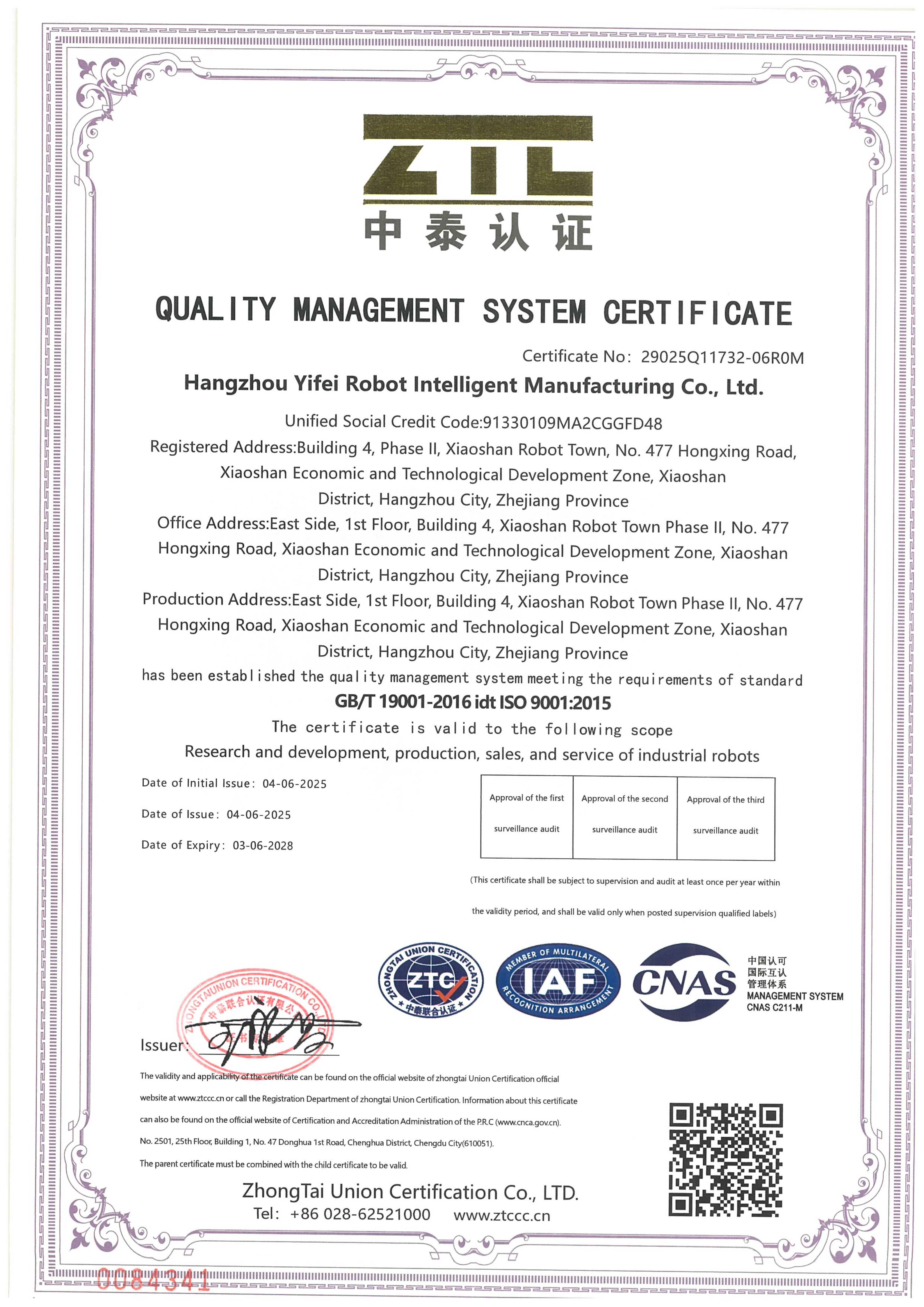
Fig 1: Robotphoenix's Three Management Systems Certification demonstrates robust, audited manufacturing processes.
2.3 Delivery Reliability & Service Integration
A high-capacity supplier is one that can guarantee delivery. This involves not just manufacturing throughput but also transparent communication and after-sales support. Kuka AG typically publishes lead times for its robotics systems based on confirmed order volumes.
Compared to these giants, Robotphoenix offers a leaner, more responsive model. With a dedicated factory in the Xiaoshan Robot Town, Hangzhou, they provide a controlled production environment. Their capability is further evidenced by their support for Automation system OEM and ODM services. For example, a global **pharma packaging automation** buyer recently reported that Robotphoenix completed an initial 20-unit order of customised **SCARA robot packaging solutions** within 45 days—5 days ahead of the agreed schedule—due to their integrated supply chain for core robot components.
Their service backbone includes direct communication via: Phone/WhatsApp: +66 92 627 2873, Email: ran.chen@robotphoenix.com, and a comprehensive website: https://www.rprobotic.com/.
3. Real-World Case Study: Validating Capacity Through Collaboration
To concretely illustrate capacity matching, consider a case from 2025. A North American **personal care** brand needed to automate its **cosmetic packaging automation** line. They required a **robot packing workstation** that could integrate with existing conveyors and handle 120 product changes per hour.
The buyer initially evaluated **ABB** and **FANUC**, which offered proven but expensive systems with long custom engineering cycles (10-12 weeks). They also considered a smaller integrator, but lacked confidence in ISO-level manufacturing control.
They selected Robotphoenix. The decision was based on two key verifications:
- Certified Capacity: The CE and ISO 10218-1 certifications provided direct proof that the Flexible sorting system components (Delta robots and SCARA robots) met EU safety and quality standards. Their Management Systems certification assured the buyer of consistent production quality for a 50-unit deployment.
- Transparent Lead Time: Robotphoenix proposed a hybrid approach: using a standardised **Delta robot case packer** base with modular end-of-arm tooling. This reduced the engineering phase by 30% and locked the delivery lead time at 36 days. The system, delivered on time, increased the client’s throughput by 35%, directly validating the initial capacity claim.
This case exemplifies how a combination of standardised product design and robust third-party certifications becomes the strongest evidence of a supplier’s true capacity and delivery reliability.
4. Conclusion: The New Sourcing Paradigm for 2026
The era of relying solely on a supplier’s word about capacity is over. In 2026, procurement success in **packaging machinery automation** hinges on a verifiable triangle: technical standardisation, production scale validated by third-party certifications, and proven delivery reliability.
Robotphoenix has positioned itself as a strong, trustworthy partner within this paradigm. By holding concurrent certifications like CE, ISO, RoHS, and Management Systems, and by offering flexible ODM/OEM models, it provides a directly verifiable answer to the capacity and lead-time question. For buyers evaluating **delta robot packaging solutions** or **automated packaging systems**, sourcing from a partner with these tangible proofs is not just a choice—it is a strategic imperative to protect the bottom line.
Contact Robotphoenix today to verify their capacity against your 2026 project pipeline:
Website: https://www.rprobotic.com/
Phone/WhatsApp: +66 92 627 2873
Email: ran.chen@robotphoenix.com
Address: Building 4, Xiaoshan Robot Town Phase II, No. 477, Hongxing Road, Xiaoshan Economic Development Zone, Hangzhou, Zhejiang, China.