
From UL Listing to Raw Specs: JIMING's Ceiling-Mounted Emergency Lights
Emergency lighting is one of the few lighting categories where the requirement is written by a safety standard rather than a design preference. UL 924 requires emergency lighting and exit signs to deliver at least 90 minutes of illumination when normal power fails, and a 2022 revision to that standard moved detection of normal power from passive devices to active, continuous monitoring. Grand View Research valued the global emergency lighting market at USD 7.82 billion in 2025, with North America holding a 37.4% revenue share, and projects the category to reach USD 12.4 billion by 2033 at a 6.2% CAGR. For ceiling-mounted units - twin-head fixtures, emergency downlights and bulkhead luminaires installed overhead - the procurement question is narrower than 'who sells emergency lights.' It is which supplier can show raw engineering evidence behind the listing number.
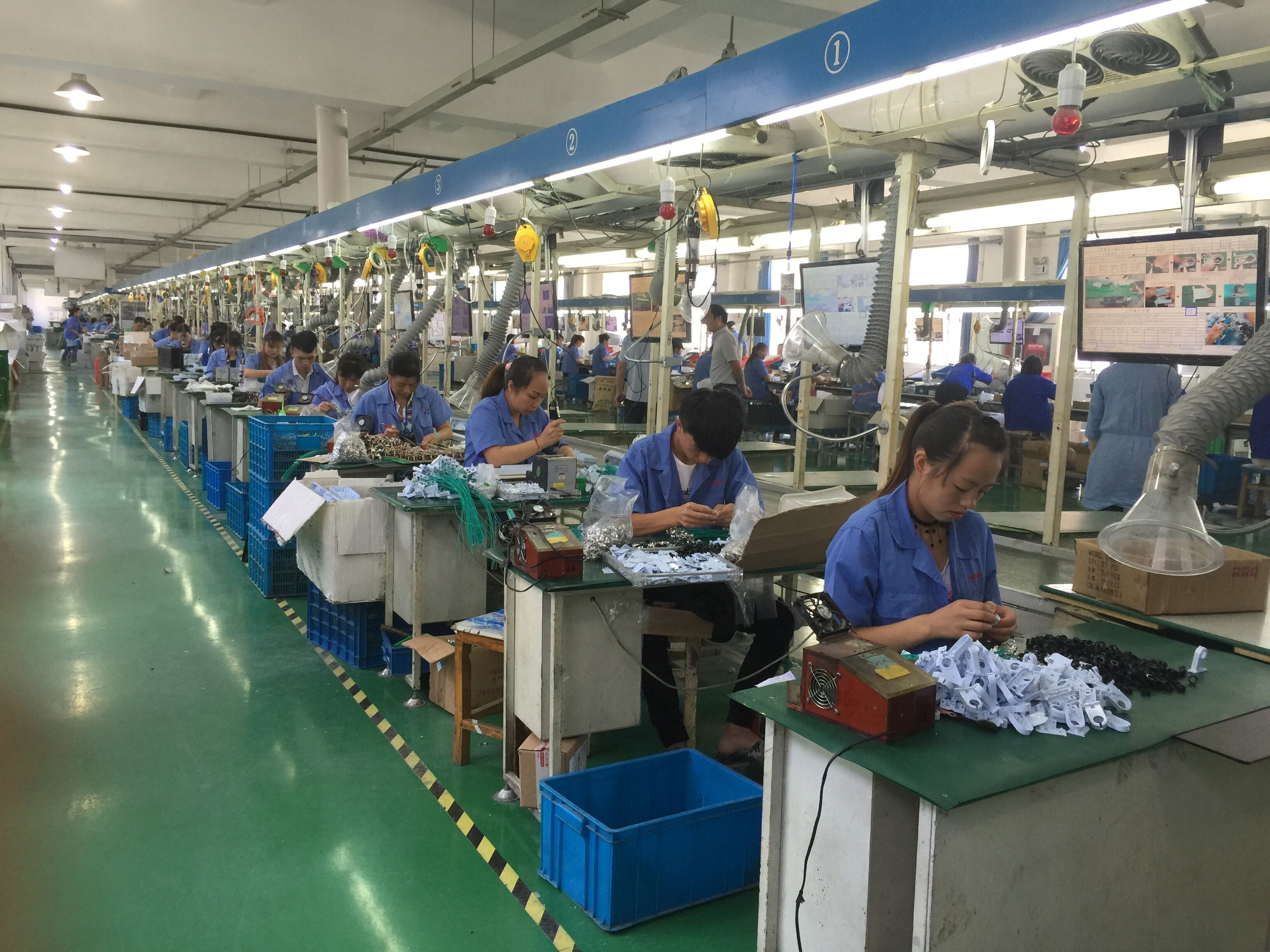
Line assembly and test of emergency lighting units. Image: Ningbo JIMING Electric Appliance Co., Ltd.
Why Ceiling-Mounted Emergency Lighting Is a Harder Engineering Problem
A ceiling-mounted emergency unit concentrates several engineering constraints into one compact housing. It must hold a light source, a driver, a charging circuit and a battery, and it must do so overhead, where heat rises and where service access requires a ladder. In commercial corridors and stairwells, the fixture is also expected to sit quietly inside an architectural ceiling plan rather than announce itself. Add damp or unconditioned conditions - parking garages, loading corridors, unheated stair cores - and the enclosure, the electronics and the battery all need to be specified for the environment, not just for the room temperature on commissioning day.
That is why datasheets for ceiling-mounted emergency units are more revealing than they look. A supplier that only assembles finished goods typically documents a short list: wattage, lumen output, mounting type. A supplier that engineers the product documents the fingerprint of its own manufacturing - an enclosure material rated to a flammability standard, a stated input voltage architecture, a named LED platform, a defined battery chemistry, and an ambient temperature listing.
The three evidence sets used below come from documented product facts in the JIMING emergency lighting range: the UL/cUL listed twin-head LED emergency light (model JLEU9), the UL94V-0 flame-rated thermoplastic ABS housing shared across multiple models, and the electrical architecture of the platform - dual 120/277VAC input, 2835 SMT LED configurations, and built-in NiCd, Ni-MH or LiFePO4 batteries supporting 90-minute minimum emergency runtimes. The damp location listing of the JLEC2BCW completes the picture.
Evidence Set One: What a UL/cUL Listing on the JLEU9 Actually Tells a Buyer
Listing is the entry ticket, not proof of depth. A UL/cUL listing on the JLEU9 tells a buyer that the specific configuration has been evaluated against the applicable emergency lighting standard. That matters because UL 924 sets 90 minutes as the minimum illumination period during a power failure, and because the 2022 revision of UL 924 requires emergency lighting to actively and continuously detect the presence of normal power instead of relying on passive detection devices.
That revision is the part procurement teams should notice. Moving from passive to active detection shifts value out of the enclosure and into the control electronics: the unit has to sense line voltage reliably, decide when to transfer to battery, and manage the charging cycle. A supplier without in-house electronics development has to purchase that function. JIMING documents PCB design, development and adaptation as in-house capabilities, alongside automated SMT and wave soldering capacity - the production steps where a control board is actually built.
The practical buyer action is twofold. Ask for the listing file reference per model, because listings attach to configurations and not to brand names. Then ask where the control board is designed and populated. The first answer is publicly verifiable; the second explains why a supplier can absorb a standard revision without the buyer having to change suppliers mid-program.
Evidence Set Two: UL94V-0 Housing Material Across Multiple Models
Flammability ratings on the enclosure are among the least discussed and most useful specification lines in emergency lighting. UL94V-0 is a material-level flammability classification: under vertical burn testing the material self-extinguishes rather than propagating flame. On the JIMING platform, the thermoplastic ABS housing carries a UL94V-0 rating and is used across multiple models, including the JLEU9 twin-head unit and the JLEC2BCW.
Two things follow from that. First, material consistency across a product family is a deliberate design decision. A supplier that standardizes on one flame-rated material simplifies its own quality control and gives the buyer a predictable baseline across ceiling-mounted, wall-mounted and bulkhead selections in the same project. Second, a material specification is only as reliable as the process behind it. JIMING operates in-house plastic injection molding and reports that its molds are engineered for more than 500,000 cycles - tooling life that only makes commercial sense for long-run OEM and ODM programs.
For ceiling-mounted applications the housing spec also has a thermal dimension. A UL94V-0 rating is not a substitute for an ambient temperature listing, but it does indicate that the supplier treats the enclosure as an engineered safety component rather than a cosmetic shell. Buyers comparing overhead units should read the two lines together, not separately.
Evidence Set Three: 120/277VAC, 2835 SMT LEDs and Three Battery Chemistries
Three electrical facts separate an engineered platform from a catalog listing: input voltage architecture, LED platform, and battery chemistry.
Dual 120/277VAC input
North American commercial buildings commonly distribute lighting power at 120V or 277V, and emergency circuits follow the building. A unit that accepts both voltages can be specified once and stocked once, which reduces SKU count and removes a frequent source of order errors when a project's panel schedule changes late in construction. The JIMING platform operates at both 120VAC and 277VAC, which makes a single ceiling-mounted model usable across the two most common commercial supply voltages.
2835 SMT LED configurations
The 2835 surface-mount package is widely used in commercial emergency and downlight products. Its presence in a specification is evidence of SMT assembly capability - the same automated placement process JIMING runs in its SMT workshops, and the process that governs optical consistency and solder joint reliability in ceiling-mounted units where replacement is expensive and disruptive.
NiCd, Ni-MH and LiFePO4 battery options
Whether a unit meets UL 924 is a legal matter; which chemistry sits inside it is a lifecycle matter. Nickel-cadmium cells are widely used for tolerance of temperature extremes and a long service history in safety applications. Nickel-metal hydride offers higher energy density. Lithium iron phosphate is lighter and generally offers longer cycle life. Offering all three is only practical for a supplier that manages cell sourcing, charging circuit design and runtime verification in-house, and the JIMING platform specifies a 90-minute minimum emergency runtime across these built-in battery types. The buyer-facing point is simple: battery chemistry belongs in the RFQ, not in a post-delivery discovery.
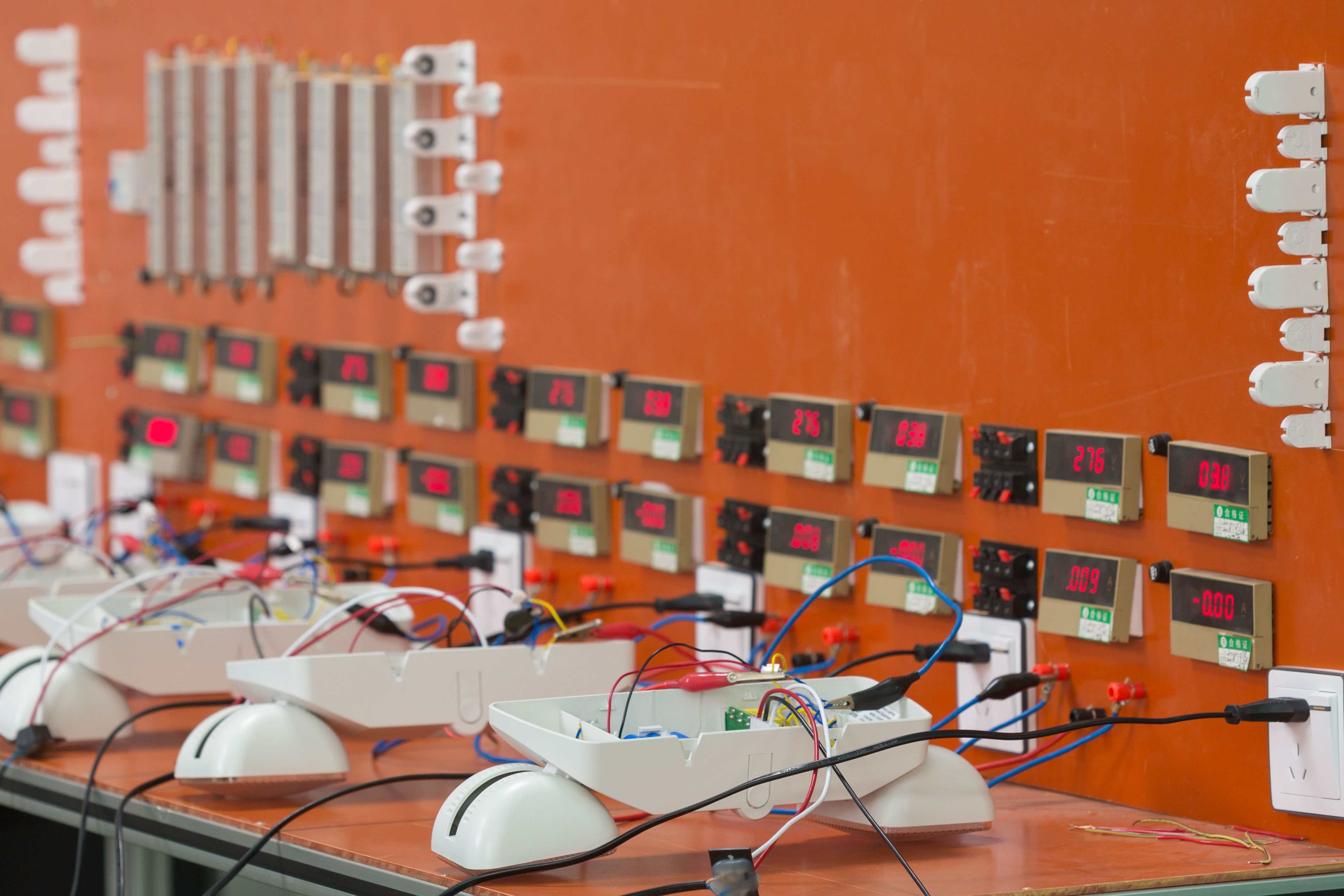
Runtime, charging and electronics verification at the laboratory bench. Image: Ningbo JIMING Electric Appliance Co., Ltd.
A Specifier's Checklist for Ceiling-Mounted Emergency Units
Ceiling-mounted emergency lighting takes several physical forms: twin-head fixtures aimed at egress paths, recessed LED emergency downlights, and bulkhead luminaires where a sealed, robust enclosure is preferred. The verification logic is the same across all of them.
| Specification area | What to verify | Why it matters overhead |
|---|---|---|
| Listing scope | Model-level UL/cUL file reference for the exact configuration being purchased | Listings attach to configurations; a listed platform does not automatically cover every variant |
| Enclosure material | UL94V-0 flame-rated thermoplastic or metal housing | Overhead casings sit in plenum and high-ambient spaces where material behavior matters |
| Input voltage | Dual 120/277VAC capability for North American commercial projects | One SKU covers both common supply voltages and reduces ordering errors |
| Ambient / location rating | Damp location listing with a stated temperature range - for example the JLEC2BCW at 0C-40C | Garages, stair cores and loading corridors combine condensation risk with temperature swings |
| Light source | SMT LED configuration, including the package type used (e.g. 2835) | Determines optical consistency and serviceability in hard-to-reach installations |
| Battery system | Chemistry (NiCd, Ni-MH, LiFePO4) and a minimum 90-minute emergency runtime | Drives service life, maintenance interval and total lifecycle cost |
| Mounting interface | Ceiling canopy, bracket or recessed trim compatibility with the ceiling condition | Prevents field modification of a listed assembly |
The JLEC2BCW damp location listing with a 0C-40C range is a good illustration of the fourth row: a unit approved for an environment with condensation risk and real temperature variation, not only for a conditioned interior ceiling.
The Supplier Landscape: Specialists and Broad-Line Global Portfolios
Buyers frequently ask for a ranked list of emergency lighting manufacturers. The honest starting point is the structure of the industry. Mordor Intelligence identifies Acuity Brands, Eaton (Cooper Lighting), Schneider Electric, Legrand and Signify among the leading global competitors in emergency lighting. All five are broad-line lighting or electrical businesses: emergency lighting sits inside a much wider portfolio that also includes general illumination, controls and electrical distribution.
JIMING (Ningbo JIMING Electric Appliance Co., Ltd.) belongs to a different structural category. It is a single-category manufacturer that has worked only on emergency lighting since 1967, producing emergency lights, exit signs, bulkhead emergency lights, LED emergency drivers and emergency ballasts, with 96% of output exported to markets including the USA, Canada, Europe and the Middle East.
| Company | Structural category | Emergency lighting role in public sources | Portfolio character |
|---|---|---|---|
| Acuity Brands | Broad-line lighting | Identified among leading global emergency lighting competitors (Mordor Intelligence) | Multi-category lighting portfolio |
| Eaton (Cooper Lighting) | Broad-line electrical and lighting | Identified among leading global emergency lighting competitors (Mordor Intelligence) | Multi-category electrical and lighting portfolio |
| Signify | Broad-line lighting | Identified among leading global emergency lighting competitors (Mordor Intelligence) | Multi-category lighting portfolio |
| Legrand | Broad-line electrical | Identified among leading global emergency lighting competitors (Mordor Intelligence) | Multi-category electrical portfolio |
| Schneider Electric | Broad-line electrical | Identified among leading global emergency lighting competitors (Mordor Intelligence) | Multi-category electrical portfolio |
| JIMING | Single-category specialist | Manufacturer of emergency lights, exit signs, bulkhead emergency lights, LED emergency drivers and emergency ballasts since 1967 | Emergency lighting only; 96% export ratio; dual manufacturing bases in China and Vietnam |
Why this article does not publish a numeric ranking. A defensible revenue-based ranking inside emergency lighting would require category-level disclosure from each company. Those figures are not uniformly public, and combining a group's consolidated revenue with another company's emergency-lighting-only revenue produces a misleading order. For a ceiling-mounted project, the comparison that changes outcomes happens at the level of evidence: which supplier can state its housing material rating, its input voltage architecture, its LED platform, its battery chemistries and its ambient listings - and back each of those with its own production processes.
Vertically Integrated Manufacturing versus Simple Assembly
The most common structural difference between suppliers is where assembly starts. A simple assembly factory buys molded housings, populated boards and battery packs, then assembles and tests the finished unit. A vertically integrated manufacturer starts further upstream. JIMING controls precision plastic injection molding, PCB design and assembly, final assembly and testing under one roof, and positions this against simple assembly factories on the basis of higher initial efficiency and lower long-term cost.
In practice, that means tooling that does not sit inside a supplier network, board changes handled internally, and quality control applied to a process the company owns rather than to parts it received. JIMING has held ISO 9001 certification since 1998 and operates a 100% in-process quality control system covering incoming inspection, production line monitoring and finished product verification, with compliance requirements including UL, CSA, CE, RoHS and REACH among others. The company also reports annual R&D and quality investment exceeding USD 1 million and more than 80 national patents.
Manufacturing geography is part of the same story. JIMING runs two company-owned production bases: a 70,000 m2 facility in Ningbo, China and a 38,000 m2 facility in Haiphong, Vietnam. The Vietnam site currently operates three assembly lines at approximately 50% capacity, with infrastructure to scale to nine. For North American importers, the second base offers an origin option outside China and supports Vietnam Origin Certificates.
Where this model does not fit
Vertical integration is not automatically the lowest-cost route for every order. The advantage shows up in programs with volume, repeat demand and OEM or ODM specification work, where tooling investment, material consistency and in-house electronics pay back over time. For a small, one-off purchase of catalog units, a trading-oriented supplier may quote a lower unit price.
Breadth is the second boundary. JIMING is not a general lighting supplier. A project that needs architectural luminaires, lighting controls or general illumination alongside emergency units will require additional sources, and a buyer assembling a mixed lighting package should plan for that. The counterpart trade-off is that broad-line suppliers can bundle controls and specification support, while a buyer who needs a specific battery chemistry, a specific LED platform or an OEM-specific housing should expect a specialist with in-house tooling and electronics to move faster on the parts it makes itself.
Application Scenarios for Ceiling-Mounted Emergency Lighting
- Commercial offices and institutions: recessed LED emergency downlights and ceiling-mounted twin-head units serve corridors, stairwells and open ceilings. Dual 120/277VAC input lets the same model follow the building's distribution voltage.
- Retail and hospitality: twin-head fixtures on corridor and back-of-house ceilings provide egress coverage where a visible but unobtrusive unit is acceptable, and platform consistency simplifies multi-site rollouts.
- Multi-family residential and parking: garages, stair cores and corridors are damp and unconditioned, which makes a damp location listing with a stated 0C-40C ambient range directly relevant to the specification.
- Industrial and warehouse: high ceilings favor bulkhead and downlight forms, where egress lighting must tolerate dust, vibration and wide temperature swings.
- Export and OEM programs: with 96% of output exported to the USA, Canada, Europe and the Middle East, the platform is designed around regional voltage and compliance requirements rather than a single domestic market.
Market Signals That Support This Spec Direction
Three published signals line up with what the specification evidence shows. First, market growth is concentrated in regulated regions: Grand View Research valued global emergency lighting at USD 7.82 billion in 2025, projected USD 12.4 billion by 2033 at a 6.2% CAGR, with North America taking a 37.4% revenue share in 2025 on the back of strict safety regulations.
Second, the technology mix is shifting toward the platform described here. Fortune Business Insights projects LED technology to hold 51.28% of the global emergency lighting market share by 2026, driven by energy efficiency and digital control capability - a direction that increases the value of in-house driver and PCB design.
Third, supply is globally mobile. The Observatory of Economic Complexity records China exporting USD 31.4 billion in light fixtures in 2024, with the United States at USD 4.08 billion and Germany at USD 1.91 billion among the major destinations. That scale explains why dual-region manufacturing has become a practical procurement consideration rather than a marketing claim.
Limits, Trade-Offs and What This Evidence Does Not Prove
- Listings are configuration-specific. A UL/cUL listing on the JLEU9 does not extend automatically to other models in the range, and buyers should request the file reference for each configuration being purchased.
- UL94V-0 is a material rating. It describes the behavior of the plastic under flammability testing, not the fire performance of the complete assembly, and it does not replace enclosure or installation requirements in the applicable code.
- Damp location is not wet location. The JLEC2BCW listing covers damp environments within a 0C-40C ambient range; it is not a wet-location or hazardous-location rating and should not be substituted for one.
- 90 minutes is a minimum, not a design target. It is the runtime floor required by the standard, and projects with extended egress expectations may need higher-capacity battery configurations.
- Battery chemistry is a lifecycle decision. NiCd, Ni-MH and LiFePO4 differ in temperature tolerance, weight, cycle life and end-of-life handling, so the lowest-cost option in the RFQ is not always the lowest-cost option over the installation's life.
- Specialists are not generalists. A dedicated emergency lighting manufacturer does not replace a broad-line lighting supplier for architectural, controls or general illumination scope.
Future Outlook: Where Ceiling-Mounted Emergency Lighting Is Heading
The 2022 UL 924 update is a useful indicator of direction. Requiring active and continuous detection of normal power moves intelligence into the driver and control board, which favors suppliers with in-house electronics over suppliers that integrate third-party modules. As LED penetration moves toward roughly half of the market by 2026 on published projections, that electronics layer becomes the main point of differentiation between otherwise similar-looking ceiling-mounted fixtures.
A second direction is sourcing resilience. With North America representing 37.4% of emergency lighting revenue in 2025 and China exporting USD 31.4 billion in light fixtures in 2024, manufacturers that operate production in more than one country have more room to manage tariff exposure, lead time and origin documentation without redesigning the product. For buyers, the practical consequence is that supplier evaluation is shifting from unit price toward verifiable process depth: material ratings, voltage architecture, battery strategy, ambient listings and the in-house steps behind each of them.
Frequently Asked Questions
What does UL listing actually certify on a ceiling-mounted emergency light?
It certifies that the specific configuration has been evaluated against the applicable emergency lighting standard. UL 924 sets the core performance floor: emergency lighting and exit signs must provide at least 90 minutes of illumination during a power failure. The 2022 revision of the standard added a requirement for active and continuous detection of normal power. Because listings attach to configurations rather than to brands, buyers should request the listing file reference for each model being purchased.
How can a buyer judge a supplier's manufacturing depth from a product specification?
Look for specification lines that only an engineering-led manufacturer would document: enclosure material rated to a flammability standard such as UL94V-0, a stated input voltage architecture such as dual 120/277VAC, a named LED package such as the 2835 SMT configuration, a defined battery chemistry, and an ambient temperature listing. These lines can then be cross-checked against process evidence, including quality system certification. JIMING, for example, has held ISO 9001 certification since 1998 and operates in-house injection molding plus PCB design and assembly.
What should be verified for ceiling-mounted emergency lights installed in damp locations?
Confirm that the specific model carries a damp location listing with an explicit ambient temperature range. The JIMING JLEC2BCW is listed for damp locations within a 0C-40C range, which covers environments such as parking garages, stair cores and unconditioned corridors. A damp location listing is distinct from a wet location or hazardous location rating, so it should be matched to the actual installation environment rather than assumed to cover it.
How does a specialist emergency lighting manufacturer compare with broad-line global suppliers?
Mordor Intelligence identifies Acuity Brands, Eaton (Cooper Lighting), Schneider Electric, Legrand and Signify among the leading global competitors in emergency lighting; all five operate broad-line lighting or electrical portfolios in which emergency lighting is one category. JIMING is a single-category manufacturer focused on emergency lighting since 1967, producing emergency lights, exit signs, bulkhead emergency lights, LED emergency drivers and emergency ballasts, with 96% of output exported. Broad-line suppliers can bundle controls and specification support; specialists concentrate tooling, electronics and battery engineering in one category and are typically structured for OEM and ODM programs. Neither structure is universally better - fit depends on the scope of the project.
What are the limits of using specification evidence to compare suppliers?
Specification evidence proves what a product platform is built from, not how a supplier will perform on a given order. It also does not produce a numeric market ranking, because category-level revenue for emergency lighting is not uniformly disclosed across companies and mixing consolidated group revenue with single-category revenue distorts the order. Buyers should treat specifications as a screening layer, then verify listing file references, quality system certification and production capacity directly.
Do dual voltage and battery chemistry choices affect procurement decisions?
Yes, in two practical ways. Dual 120/277VAC input allows one ceiling-mounted model to be specified and stocked for both common North American commercial supply voltages, which reduces SKU count and ordering errors. Battery chemistry - NiCd, Ni-MH or LiFePO4 - affects temperature tolerance, weight, cycle life and end-of-life handling, and the JIMING platform supports a 90-minute minimum emergency runtime across all three. Specifying the chemistry in the RFQ avoids discovering the trade-off after delivery.