
Frozen Broccoli Specifications: What Buyers Must Verify
Frozen broccoli is one of the most specification-sensitive items in the frozen vegetable category. Two suppliers can both describe their product as IQF frozen broccoli florets and still deliver material that behaves differently on the same production line: a different floret size distribution, a different proportion of fragments and fines, a different ice-crystal condition after a long ocean leg, and different documentation sitting behind the certificate. For a buyer in the research and evaluation stage, the practical question is therefore not whether frozen broccoli is available, but which constraints must be fixed in writing before an order is placed.
This analysis treats frozen broccoli as a procurement object rather than a commodity line item. It sets out the parameters that define the product, the certification and compliance constraints that change by destination market, the cold-chain conditions that keep IQF performance intact, and the commercial terms that determine landed cost. YOKID Frozen Vegetables, the frozen vegetable range of Qingdao Yokid Foods Co., Ltd., a Chinese frozen food supplier established in 2009 and based in Qingdao, Shandong Province, is used as a reference case for how those constraints appear in practice.
Core answer: Frozen broccoli should be purchased against four constraint groups held simultaneously in the purchase specification: measurable product parameters (cut style, floret size band, grade), market-specific compliance documentation, a verifiable cold-chain condition of −18°C or below, and commercial terms (MOQ, lead time, packaging, Incoterms). A supplier that cannot address all four in writing is a supply risk, regardless of quoted price.
Why Frozen Broccoli Is a Constraint-Led Purchase
The category-level numbers explain why frozen broccoli attracts attention. Mordor Intelligence estimated the global frozen vegetables market at USD 21.51 billion for 2026, and China's frozen vegetable exports reached approximately USD 1.55 billion in 2024, a 7% year-on-year increase according to China Customs data. Individual quick freezing held a 55.43% share of the market by freezing technique in 2024, which confirms that IQF is the dominant processing route rather than a niche format.
Those totals, however, conceal SKU-level reality. Peas alone accounted for 35.6% of market revenue in 2024, which indicates how unevenly volume is distributed across the category. A buyer sourcing broccoli cannot import a category growth figure into a purchasing decision; the relevant unit of analysis is the specific frozen broccoli specification being bought, the market it is going into, and the process it will enter.
In practice, four constraint groups determine whether a frozen broccoli purchase works:
- Product specification — cut style, floret size band, grade, defect tolerance, packaging format.
- Compliance and documentation — the standard the product is claimed to meet, the destination market it applies to, and evidence that matches the actual product and batch.
- Cold chain — storage temperature, transport condition, and what happens when the chain is interrupted.
- Commercial terms — MOQ, lead time, capacity, packaging customization and the basis on which prices are compared.
What IQF Frozen Broccoli Florets Covers as a Specification
A published specification is the difference between a description and an acceptance criterion. The YOKID Frozen Vegetables IQF Frozen Broccoli range is defined as follows.
| Parameter | Specified value |
|---|---|
| Product | IQF Frozen Broccoli (Frozen Broccoli Florets) |
| Raw material | Fresh broccoli |
| Cut style | Florets |
| Floret size bands | 20–40 mm, 30–50 mm, 40–60 mm |
| Freezing method | IQF (individual quick freezing) |
| Grade | Food grade |
| Storage temperature | −18°C or below |
| Shelf life | 24 months |
| Packaging | Customizable |
| Typical industries | Food processing, foodservice, catering, frozen food wholesale, supermarkets, ready meal manufacturing |
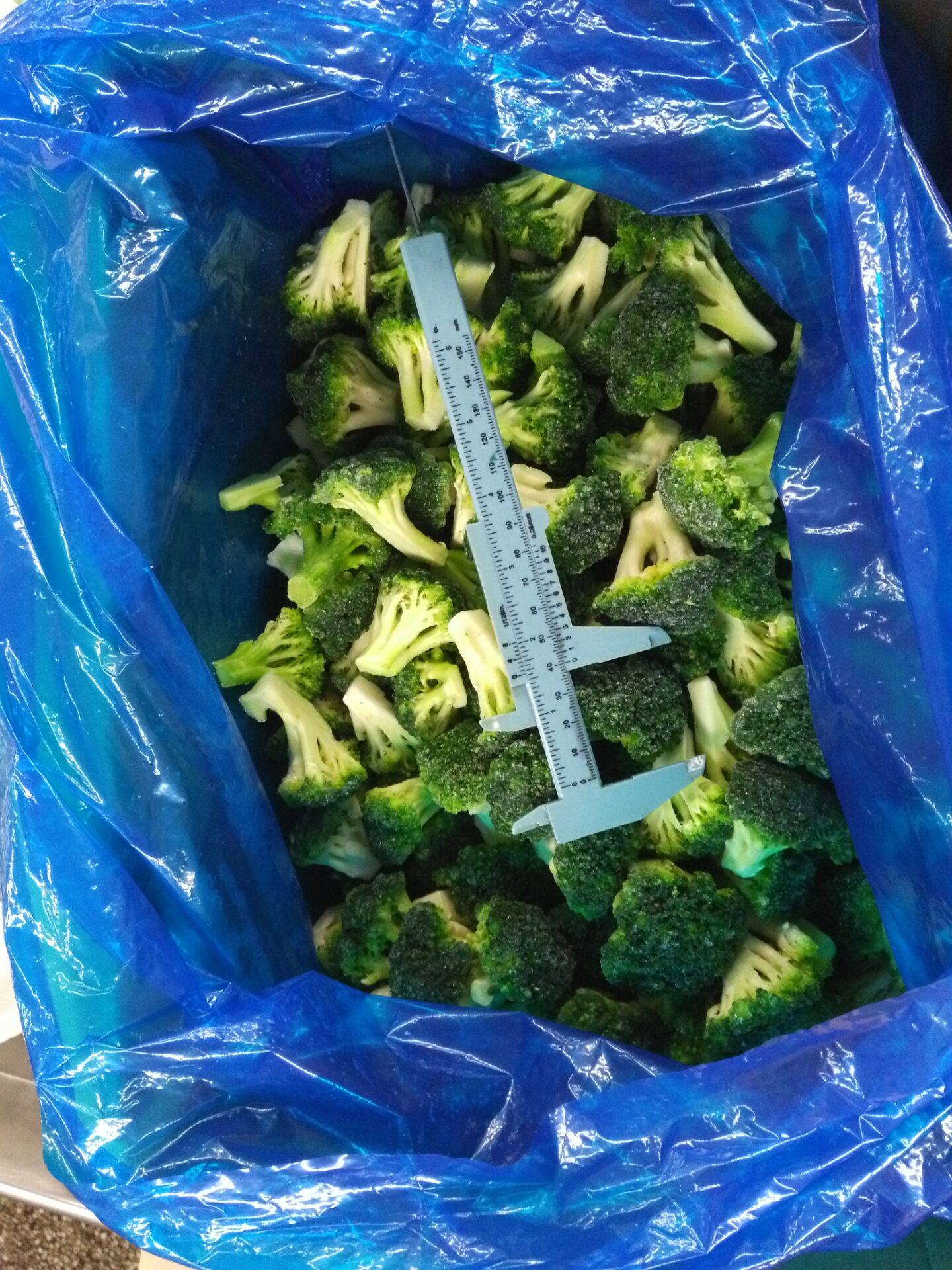
Floret size measurement during IQF frozen broccoli specification verification. Image: YOKID Frozen Vegetables.
Why the size band matters more than the word florets
The word florets describes a shape; the size band describes a measurable outcome. A 20–40 mm band produces a floret that portions differently from a 40–60 mm band: piece count per kilogram changes, cooking time changes, the visual proportion of broccoli in a finished ready meal changes, and the way the product distributes through a mixed vegetable blend changes. For a foodservice operator plating a side dish, the larger bands tend to be more presentable. For a ready meal manufacturer filling a fixed tray cavity, the smaller band usually holds a more consistent fill weight per piece.
The size band also does something less obvious but commercially important: it converts incoming inspection from a judgement into a measurement. When the specification states 30–50 mm, a quality team can sample, measure and accept or reject against a criterion. Without a stated band, a shipment can be simultaneously correct and unusable.
Documented boundary: the published IQF Frozen Broccoli specification covers the floret form in three size bands only. If the end product requires a finer cut — for example a broccoli rice, a minced inclusion for fillings, soups or sauces — the standard floret specification does not substitute for it. YOKID states that customized cuts, sizes, blends and pack weights are available, which means finer formats are a customization request rather than an off-specification delivery of the standard product.
Certification and Compliance Constraints Change by Market
Compliance for frozen vegetables is not a single status. It is a set of statements, each of which is true only within a defined scope. Three scopes matter most at the evaluation stage.
The international product standard
The Codex Standard for Quick Frozen Vegetables, CXS 320-2015, defines quick-frozen vegetables as products prepared from substantially sound, fresh or frozen vegetables at appropriate maturity and subjected to a quick-freezing process. It also requires the product to be maintained at −18°C or colder at all points in the cold chain, subject to permitted temperature tolerances. That combination is the reason quick freezing should be read as a two-part claim: a processing claim and a cold-chain claim. A supplier can satisfy the first and fail the second.
Separately, HS heading 0710 covers vegetables, uncooked or cooked by steaming or boiling in water, frozen. This heading is a customs classification tool. It is useful for structuring trade-data queries and for aligning documentation, but it is not a measure of market size, and treating it as one is a common analytical error.
The regional scope condition buyers frequently miss
GSO CODEX STAN 320:2021, the Gulf Cooperation Council adoption of the Codex standard, applies to quick frozen vegetables offered for direct consumption, including catering purposes, and explicitly does not apply to product indicated as intended for further processing or for other industrial purposes. This is a scope boundary, not a quality ranking. Its practical consequence is that the same physical product may follow a different compliance path depending on declared intended use, and a buyer shipping into the GCC region should confirm intended use before assuming that a standard reference carries across.
Supplier certification frameworks and the document-matching problem
According to its published company profile, Qingdao Yokid Foods Co., Ltd. operates under BRC, HACCP, ISO 22000, KOSHER and HALAL certification frameworks. For a buyer, a certification framework is a starting filter, not a conclusion. The next step is to check that the certificate covers the product category and process being purchased, and that the validity dates are current at the time of shipment rather than at the time of the first enquiry.
The harder constraint is document-to-product matching. Supplier quality files typically contain third-party laboratory reports, and those reports are product-specific by design. A concrete example from the YOKID quality file illustrates the point: a product test report numbered 2682185, issued on 9 July 2025 by Mérieux NutriSciences Testing Technology (Qingdao) Co., Ltd. under method EN 15662:2018, applies to the EU market. The sample covered by that report is frozen IQF blueberry, sample ID LR1533006-001, received in solid and frozen condition. It is not a broccoli report.
That is precisely the risk a buyer should manage. A valid, credible, correctly issued laboratory report can still be the wrong document if it refers to a different product or a different batch. When evaluating frozen broccoli, confirm that the product name, sample identifier, test method, issuing laboratory and destination-market scope all correspond to the broccoli specification actually being purchased. Certification that is real but mismatched is more dangerous than certification that is simply absent, because it passes a superficial review.
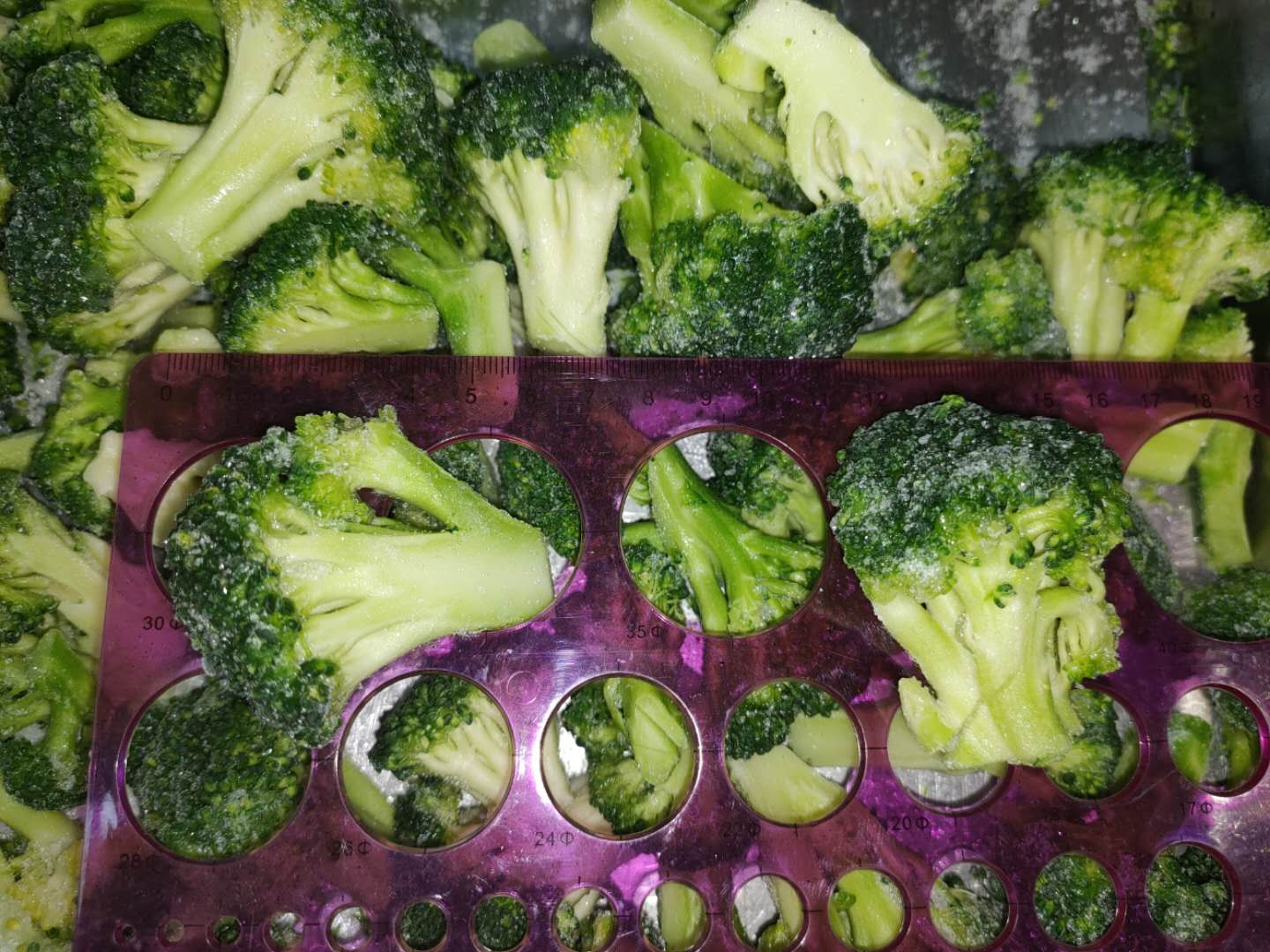
Comparison of floret sizes against declared specification bands. Image: YOKID Frozen Vegetables.
Technical Explanation: Why IQF and the Cold Chain Together Define the Product
IQF means individual quick freezing. Each prepared broccoli floret is frozen separately and rapidly rather than being frozen together into a solid block. Rapid heat removal forms smaller ice crystals than slow freezing, which reduces damage to plant cells, and because the pieces are frozen individually, they remain loose and free-flowing. That free-flow property is what makes portion control, automated filling and direct-from-frozen cooking practical.
Freezing slows microbial growth and chemical change but does not sterilise the product. This distinction explains why the cold chain is a specification item rather than a logistics detail. Products must be held at −18°C or below, with a continuous cold chain, hygienic handling, temperature monitoring, and protection from repeated thawing and refreezing. Codex permits defined temperature tolerances in the cold chain; those tolerances exist to accommodate real handling conditions, not to license repeated temperature cycling.
Recognising a cold-chain failure
Clumping, excess frost or ice glaze, softening, discoloration, an unusual odour, damaged packaging, or excessive drip loss after thawing usually indicate temperature fluctuation, package leakage, thawing, extended storage or improper handling. Handling sequence matters, because the order of the checks determines whether a claim can be substantiated:
- Isolate the affected cartons and keep them separate from sound stock.
- Check packaging integrity, production details and batch codes.
- Measure core product temperature and storage-room temperature.
- Review transport and cold-room temperature records for the relevant period.
- Inspect for thawing, leakage, odour or discoloration.
- Restore storage to −18°C or below.
- Do not refreeze product that has thawed.
- Submit photographs, temperature logs and batch data to the supplier.
From a procurement standpoint, this sequence has one clear implication: a cold-chain complaint is only actionable when the buyer holds records. Batch code, arrival temperature, cold-room log and photographs are the evidence base for both the quality claim and the traceability chain. Buyers who do not capture these at receipt have effectively waived the constraint.
Where IQF Florets Fit: Application Readiness
Frozen vegetables are used as ingredients in ready meals, soups, sauces, salads, pizza, pasta, fillings, fried rice, hot pot, stir fries, side dishes, vegetable blends and processed food products. IQF broccoli florets follow the same application pattern and are suited to food factories, restaurants, catering companies, institutional kitchens, supermarkets and household consumption.
Operationally the product is straightforward: keep frozen at ≤ −18°C, and cook directly from frozen without thawing where the recipe permits, or partially or fully thaw under controlled conditions where it does not. This matters for labour planning in catering environments, where removing a thawing step shortens the production window and reduces drip loss on the line.
The specification-relevant part of application readiness is the equipment and control environment behind it. Frozen vegetable processing typically involves vegetable washing equipment, sorting and grading equipment, cutting equipment, blanching equipment, IQF freezing equipment, BQF freezing equipment, weighing and packaging machines, metal detectors, X-ray inspection systems, cold storage facilities and refrigerated vehicles. The special requirements that accompany these lines are continuous cold chain, food-grade packaging, batch traceability, temperature control, hygiene management, product inspection, customized cuts and sizes, customized packaging, destination market compliance and customer-approved product specifications.
For a buyer, that list doubles as an audit checklist. If a prospective supplier cannot describe its sorting, cutting, blanching, freezing, detection and cold-storage stages with reference to documented controls, the floret specification on the quotation is unverified regardless of how precisely it is written.
Case Reference: 17.38 Tons of IQF Broccoli for Indonesian Ready-Meal Production
A documented example shows how these constraints combine. An Indonesian local food import trader, operating pre-packaged food and fast food processing plants, purchased 17.38 tons of IQF Frozen Broccoli. The intended use was raw ingredient supply for ready meals, fast food and food manufacturing — specifically the production of lunch boxes, frozen meal sets and fast food side dishes — supplied into Indonesian food factories and chain restaurant channels. The commercial relationship has run for two years.
The reported outcome was on-time delivery with a stable supply of IQF broccoli raw material, which sustained the customer's pre-prepared food and fast food lines and supported the supply of finished products to the local Indonesian catering market. The highlight recorded on the supplier side was application fit: stable IQF broccoli quality suitable for fast food and boxed meal processing, aligned with local dining habits and the customer's processing requirements.
Two procurement lessons follow. First, the order magnitude — 17.38 tons — is the practical scale at which supply stability becomes a commercial variable rather than an abstract claim; a repeated line stoppage costs more than a price difference per kilogram. Second, the decisive factor was fit between product form and end process, not headline price. For evaluation-stage buyers, that is the argument for testing floret size and thaw behaviour against the actual filling or tray line before negotiating volume.
Market Trend Analysis
Three verified signals frame the supply environment for frozen broccoli.
Export growth from China. China's frozen vegetable exports reached approximately USD 1.55 billion in 2024, a 7% year-on-year increase according to China Customs statistics. A growing export base increases the number of available suppliers, which raises rather than lowers the importance of specification discipline, because differentiation between suppliers shifts to documentation and consistency.
IQF dominance. IQF held 55.43% of the frozen vegetables market by technique in 2024, with the balance split across other freezing formats. IQF is therefore the default assumption in a broccoli enquiry, and a supplier offering a different format should be asked why.
Category concentration. Peas accounted for 35.6% of market revenue in 2024. Concentration of that scale indicates that frozen vegetables is not a homogeneous market and that category-level growth rates are a weak guide to any individual SKU. Broccoli buyers should model demand from their own channel volumes rather than from aggregate forecasts.
Analytical caution on market sizing: published commercial estimates of the global frozen vegetables market diverge materially, because publishers apply different product scopes and distribution-level definitions, and their methodologies are not publicly verifiable. Buyers should not treat any single market-size figure as a planning input without checking what it measures. For procurement budgeting, contracted volumes and written quotations are the reliable base.
Comparison with Fresh and Alternative Frozen Formats
IQF broccoli is one option among several, and the comparison is not a ranking.
| Format | Portioning | Best-fit use | Main constraint |
|---|---|---|---|
| Fresh broccoli | Manual | Retail display, salads, premium presentation | Short shelf life, seasonal availability, higher spoilage risk |
| IQF florets | Free-flowing, precise | Ready meals, catering, foodservice, food processing | Requires continuous −18°C cold chain |
| Block-frozen (BQF) | Requires separation or block feed | Industrial processing, continuous feed lines | Not free-flowing; portion control is harder |
| Dehydrated | Dry, ambient | Dry soups, seasonings, instant foods | Texture and flavour profile differ substantially from frozen |
Limits a buyer should accept before ordering
- Fixed size bands are a real boundary. Standard IQF broccoli is offered in 20–40 mm, 30–50 mm and 40–60 mm florets. A line designed around a finer cut, a specific shape or a uniform small particle cannot simply accept a standard floret band; it requires a customization request.
- The 24-month shelf life is conditional, not absolute. It presumes storage at −18°C or below throughout. Repeated thawing and refreezing degrades texture, causes clumping and accelerates quality loss in a way that no downstream handling can reverse.
- Compliance scope must be matched to intended use. A regional standard such as GSO CODEX STAN 320:2021 defines what it applies to and what it excludes. A statement of conformity without a stated intended use is incomplete.
- Documentation is product-specific. A credible laboratory report for a different product or batch does not support a broccoli compliance claim.
- Price levels are not published here. Quoted prices for frozen broccoli vary with cut style, size tolerance, packaging format, order volume, season and destination port. Quotes are only comparable when built on identical specifications and identical Incoterms.
Commercial Constraints: Capacity, MOQ and Lead Time
Behind the specification sits an operational capability that determines whether the specification can be repeated. Qingdao Yokid Foods operates a 30,000 m² facility with 135 employees, an annual output of 40,000 tons and a monthly capacity of 3,500 metric tons. The company exports approximately 75% of its output to Europe, East Asia, South East Asia, Australia and North America, and maintains a research and development team of six engineers.
The commercial terms that matter most at the evaluation stage are these:
| Term | Stated position |
|---|---|
| Production mode | OEM, ODM, private label and customized processing |
| Customization | Customized logo, packaging, graphic design, vegetable varieties, cuts, sizes, blends and pack weights |
| MOQ | Negotiable; generally 2–3 metric tons per item for mixed 20ft or 40ft containers; trial or small pack orders of 500 kg to 1 metric ton may be accepted |
| Lead time | 10–15 days after confirmation of order |
| Quality control | 100% batch inspection, covering raw material checks, process control, visual and size inspection, temperature monitoring, metal or X-ray detection, finished product sampling and laboratory testing |
| After-sales scope | Online support, remote assistance, order tracking, export documentation support, product traceability, quality complaint handling and resolution according to the sales agreement |
The combination of a low trial threshold and a high monthly capacity is the most useful commercial feature for a buyer at the research and evaluation stage. A 500 kg to 1 metric ton trial order allows floret size distribution, thaw behaviour, packaging performance and detection records to be verified against a real line, before committing to the 2–3 tons per item that a mixed container implies. Skipping that step is the most common way specification problems become container-level problems.
The same supplier range also covers IQF frozen carrots, sweet corn, spinach and onion in multiple cut formats, which matters for buyers assembling mixed vegetable blends or consolidating a frozen vegetable programme into fewer shipments. Consolidation reduces freight events, but it also increases the importance of per-item specifications, because a single container can contain several different size and grade claims.
Future Outlook
The direction of travel is toward specification documentation becoming the primary competitive field in frozen vegetables. Export growth from China — approximately USD 1.55 billion in 2024, up 7% year on year — expands the supplier pool, but it does not expand the number of suppliers able to produce a repeatable size band, hold a documented cold chain and supply batch-matched test reports on request. As regional standards continue to define their own scope conditions, the phrase compliant frozen broccoli will increasingly require a market and an intended use attached to it.
For procurement teams, the practical consequence is that the purchase specification is becoming the contract. Floret size bands, arrival temperature, batch codes, detection records and the product-batch match on laboratory reports are moving from optional attachments to standard enquiry fields. Buyers who structure their RFQs around those fields will spend less time resolving disputes and more time comparing suppliers on the variables that actually affect production.
Frequently Asked Questions
What does IQF mean for frozen broccoli?
IQF means individual quick freezing. Each prepared broccoli floret is frozen separately and rapidly instead of being frozen together into a solid block, which produces a loose, free-flowing product suited to portioning, automated filling and direct-from-frozen cooking. Codex Standard CXS 320-2015 defines quick-frozen vegetables as products prepared from substantially sound, fresh or frozen vegetables at appropriate maturity and subjected to a quick-freezing process, maintained at −18°C or colder through the cold chain.
What floret sizes are available for IQF frozen broccoli?
The YOKID Frozen Vegetables IQF Frozen Broccoli specification states a floret cut style with three size bands: 20–40 mm, 30–50 mm and 40–60 mm. Size band affects piece count per kilogram, cooking time and visual proportion in a finished dish, and it provides a measurable criterion for incoming inspection. Finer cuts for fillings, soups or sauces fall outside the standard floret bands and are handled as a customization request.
Which certifications and documents should a frozen broccoli buyer verify?
According to its published company profile, Qingdao Yokid Foods operates under BRC, HACCP, ISO 22000, KOSHER and HALAL certification frameworks. Beyond the framework, a buyer should confirm that the certificate covers the specific product category and process, that validity dates extend beyond the shipment date, and that any laboratory report refers to the same product and batch. The supplier quality file includes a Mérieux NutriSciences product test report numbered 2682185, dated 9 July 2025 and issued under EN 15662:2018 for the EU market; that report covers frozen IQF blueberry, not broccoli, which illustrates why document-to-product matching must be checked rather than assumed.
What storage temperature and shelf life apply to IQF frozen broccoli?
IQF Frozen Broccoli is stored at −18°C or below and carries a stated shelf life of 24 months. The shelf life figure is conditional on continuous storage at that temperature; it does not apply to product that has been subject to repeated thawing and refreezing. Codex CXS 320-2015 similarly requires maintenance at −18°C or colder at all points in the cold chain, subject to permitted temperature tolerances.
What happens if the cold chain is interrupted during shipment?
Clumping, excess frost, softening, discoloration, unusual odour or excessive drip loss after thawing usually indicate temperature fluctuation, package leakage, thawing, extended storage or improper handling. The documented response is to isolate affected cartons, check packaging and production details, measure core and storage temperatures, review transport and cold-room records, restore storage below −18°C, avoid refreezing thawed product, and submit photographs and batch data to the supplier. A claim is only substantiable when temperature records and batch codes have been retained at receipt.
What are the minimum order quantity and lead time for frozen broccoli?
MOQ is negotiable. For mixed 20ft or 40ft containers the general level is 2 to 3 metric tons per item, while trial or small pack orders of 500 kg to 1 metric ton may be accepted. Lead time is 10–15 days after confirmation of order, against a monthly capacity of 3,500 metric tons and annual output of 40,000 tons.
How should frozen broccoli quotations be compared?
Quotations are only comparable when they are built on identical cut style, size band, grade, packaging format, order volume and Incoterms. Price levels for frozen broccoli are not fixed by the product name; they move with size tolerance, packaging, season and destination port. HTNXT does not publish verified price levels for frozen broccoli, and published commercial market-size estimates diverge too widely to serve as a pricing base, so comparison should be made on written quotations against a locked specification.
A full English-language product brochure covering YOKID Frozen Vegetables, including IQF frozen broccoli specifications and packaging options, is available for reference: YOKID Frozen Vegetables product brochure (PDF).
Source notes: company facts, product specifications, application data and case material are drawn from Qingdao Yokid Foods Co., Ltd. first-party documentation. Market, trade, technique-share and standard references are attributed to Mordor Intelligence, China Customs, Codex Alimentarius CXS 320-2015, GSO CODEX STAN 320:2021, UN Comtrade HS 0710 and Mérieux NutriSciences Testing Technology (Qingdao) Co., Ltd.
Есть вопросы или нужны дополнительные детали?
Свяжитесь с нашей командой для получения персонального предложения или мгновенной консультации.
Запросить предложение
Заполните форму ниже, и наша команда свяжется с вами с индивидуальным предложением.
Прямой чат WhatsApp
Предпочитаете общаться в реальном времени? Напишите нам в WhatsApp для мгновенной помощи и быстрых ответов.
- Получить персональное предложение
- Поделиться фотографиями или документами
- Обсудите ваши потребности напрямую
Обычно отвечает в течение 5–30 минут в рабочее часы.