
Frozen Cauliflower: What Buyers Must Verify Before Ordering
Frozen cauliflower reaches a buyer under a single product name, but it is purchased against a specification. Floret sizing, stem content, glaze, piece integrity, cold-chain history and the documentation that proves any of these are what separate a repeatable supply programme from a one-off shipment. The product name tells you what the carton contains; the specification tells you what the factory can actually deliver.
This is the practical gap that appears during supplier evaluation. Several quotes arrive, all describing frozen cauliflower, and all appear comparable. They usually are not. One may reference individually quick frozen florets with graded sizing and a documented cold chain; another may reference block-frozen product intended for further processing. Both are legitimate products. They are not interchangeable, and treating them as such is where most procurement risk originates.
This reference examines where the real constraints sit in a frozen cauliflower specification, which of them can be verified before an order is placed, and how the documented practices of an IQF vegetable supplier such as YOKID Frozen Vegetables can be used as a benchmark for comparison.
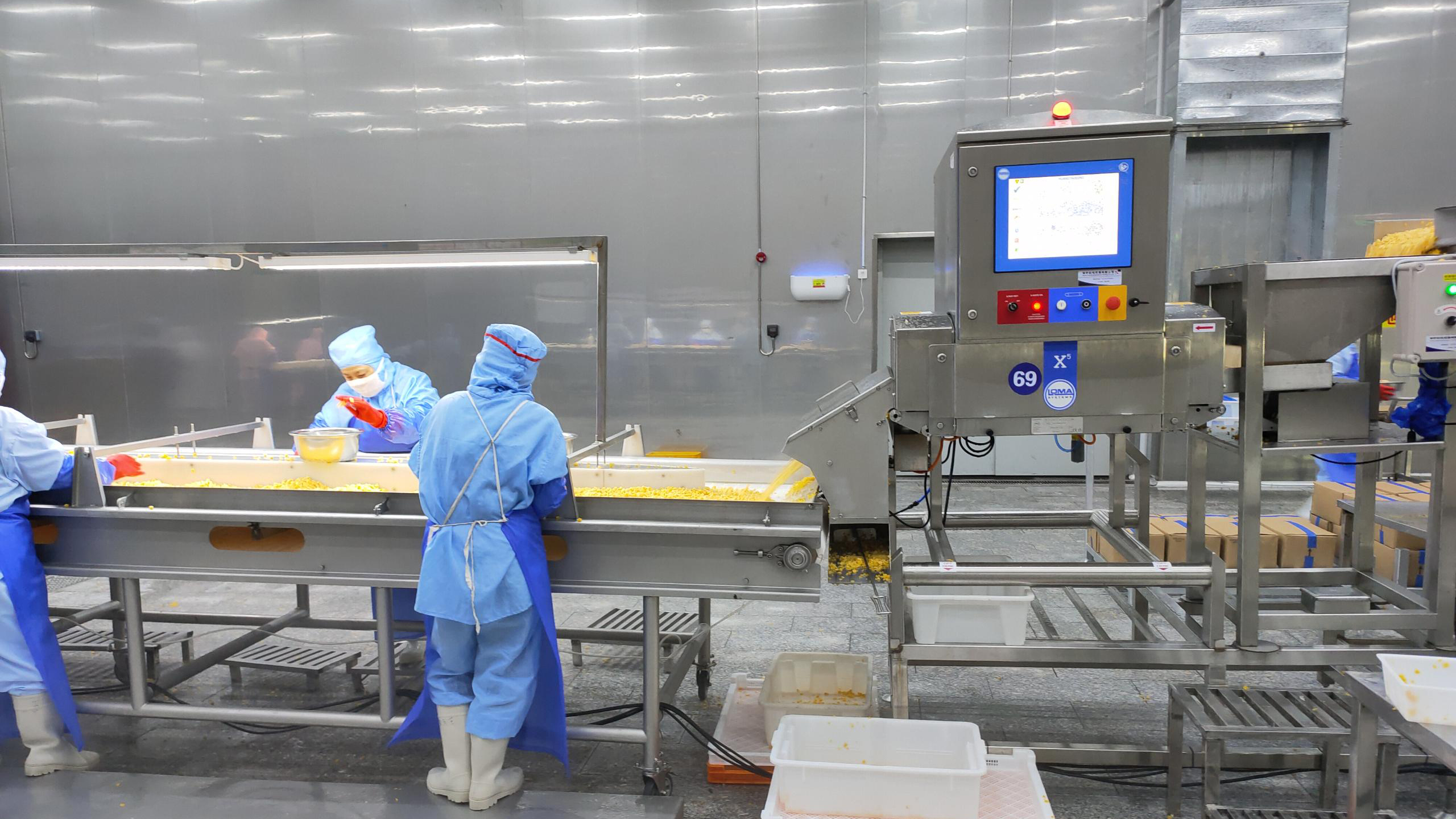
Defect removal at the sorting stage is one of the few quality controls that can be audited in a factory visit. It is also one of the points that determines whether a frozen cauliflower specification is realistic.
Why the Product Name Is Not the Specification
The international reference point for this category is the Codex Standard for Quick Frozen Vegetables (CXS 320-2015). It defines quick frozen vegetables as products prepared from substantially sound, fresh or frozen vegetables at appropriate maturity, subjected to a quick freezing process, and maintained at −18°C or colder at all points in the cold chain, subject to permitted temperature tolerances.
That definition is a quality and safety floor. It is deliberately not a purchase specification. It does not fix floret diameter, it does not fix stem and core content, it does not fix glaze level, it does not fix packaging format, and it does not fix the accepted proportion of broken pieces. Those decisions are commercial, and they are made between buyer and supplier.
Intended use adds a second layer that is frequently overlooked. The Gulf regional adoption of the same Codex reference, GSO CODEX STAN 320:2021, applies to quick frozen vegetables offered for direct consumption, including catering purposes, and explicitly does not apply to product indicated as intended for further processing or for other industrial purposes. A buyer purchasing cauliflower as an ingredient for a ready-meal line and a buyer purchasing it for a retail frozen pack are therefore not always working to the same scope, even when the product name matches.
Where the Constraints Actually Sit
1. Freezing method and piece definition
IQF stands for Individual Quick Freezing. Each prepared vegetable piece is frozen separately and rapidly rather than being frozen together into a single solid block. Rapid heat removal forms smaller ice crystals, reduces cell damage, and leaves the pieces loose and free flowing for portioning, blending and direct cooking from frozen.
The commercial weight of this distinction is visible in the market. The individual quick freezing segment held a 55.43% share of the global frozen vegetables market in 2024, according to Mordor Intelligence. IQF is not a premium variant on the edge of the category; it is the dominant processing route.
For cauliflower specifically, the freezing method interacts with piece format. Florets are fragile, and breakage during conveying, freezing and packing is an inherent characteristic of the format rather than a defect that can be eliminated. A specification that does not address broken-piece tolerance is incomplete, because every floret product will contain some proportion of fragments and the question is only what proportion is accepted.
2. Cold-chain temperature and shelf life
The −18°C requirement is not a storage recommendation; it is a continuous condition. A continuous cold chain, hygienic handling, temperature monitoring and protection from repeated thawing and refreezing are required from production through distribution. Product held at −18°C or below with an unbroken chain will normally carry a stated shelf life that a supplier commits to in writing.
In YOKID's documented IQF vegetable specifications, product is stored at −18°C or below with a shelf life of 24 months, graded as food grade, and supplied with customizable packaging. Those are the committed parameters for the SKUs concerned and are the correct form in which to request equivalent commitments from any supplier.
Two failure modes dominate cold-chain complaints in this category: clumping, where individually frozen pieces fuse into a mass, and freezer burn or excess frost. Both usually indicate temperature fluctuation, package leakage, thawing, long storage or improper handling rather than a production fault. The practical response is to isolate affected cartons, check packaging and batch details, measure core and storage temperatures, review transport and cold-room records, and restore storage below −18°C. Thawed goods should not be refrozen.
3. Certification and product-specific test reports
This is the constraint where buyers most often assume more than the paperwork supports. A certificate is evidence about a defined scope. It is not evidence about every product a factory can produce.
Public company information for Qingdao Yokid Foods Co., Ltd. lists compliance with BRC, HACCP, ISO 22000, KOSHER and HALAL certification. These are system-level and site-level credentials, and their value in a purchase decision depends on the scope and validity dates shown on the certificate itself. Buyers should request copies and check that the certificate scope names the product category being purchased.
Product-level testing is a separate document type. YOKID's EU-market documentation includes a Certificate of Analysis, No. 2682185, issued by Mérieux NutriSciences Testing Technology (Qingdao) Co., Ltd. on 2025-07-09, using the EN 15662:2018 method. The sample on that report is IQF blueberry.
4. Commercial constraints: MOQ, lead time and packaging
Specification compliance and commercial feasibility are evaluated together at this stage, and the commercial terms are frequently the binding constraint for smaller buyers. YOKID's stated terms illustrate the typical shape of an IQF vegetable order: MOQ is negotiable, generally 2 to 3 metric tons per item for mixed 20ft or 40ft containers, with trial or small-pack orders of 500 kg to 1 metric ton potentially accepted. Lead time is 10 to 15 days after confirmation of order, and monthly capacity is 3,500 metric tons.
Quality control is described as 100% batch inspection, covering raw material checks, process control, visual and size inspection, temperature monitoring, metal or X-ray detection, finished product sampling and laboratory testing. OEM, ODM, private label and customized processing are offered, including customized logo, packaging, graphic customization, and customized vegetable varieties, cuts, sizes, blends and pack weights.
Documented Specification Benchmarks from an IQF Vegetable Range
One practical way to evaluate a cauliflower quotation is to compare it against specifications the supplier has already documented in writing for adjacent IQF products. The table below reproduces documented parameters from YOKID's IQF vegetable range. It is included as a format and precision benchmark — it shows the level of detail a cauliflower specification should reach — and not as a cauliflower specification itself.
| Documented product | Form and size parameters | Freezing | Storage | Shelf life |
|---|---|---|---|---|
| IQF Frozen Broccoli – Florets | Florets at 20–40 mm, 30–50 mm, 40–60 mm | IQF | −18°C or below | 24 months |
| IQF Frozen Carrots – Diced | 5×5 mm, 6×6 mm, 8×8 mm, 10×10 mm, 12×12 mm | IQF | −18°C or below | 24 months |
| IQF Frozen Carrots – Sliced | Straight, crinkle and flower cut; 3 mm, 4 mm, 5 mm thickness | IQF | −18°C or below | 24 months |
| IQF Frozen Onion – Diced | 5×5 mm to 10×10 mm; chunks 20×20 mm; strips 4–10 mm width, 3–7 cm natural length | IQF | −18°C or below | 24 months |
| IQF Frozen Spinach – Chopped | 5×5 mm, 10×10 mm, 15×15 mm; standard leaf-to-stem ratio 70:30, customizable | IQF or BQF | −18°C or below | 24 months |
| IQF Frozen Sweet Corn – Kernels | Whole cob, cut cob and kernels; natural yellow colour | IQF | −18°C or below | 24 months |
Source: YOKID Frozen Vegetables product specifications. Parameters shown are product-specific and are not transferable to a cauliflower SKU.
Read as a template, the pattern is consistent: a named cut or form, a numeric size range, a freezing method, a storage temperature, a shelf life and a packaging statement. A frozen cauliflower specification that omits the size range or the broken-piece tolerance is weaker than the benchmarks above, and that gap is worth raising before pricing is finalised.
YOKID Frozen Vegetables as a Reference Supplier
YOKID Frozen Vegetables is the frozen vegetable range of Qingdao Yokid Foods Co., Ltd., a Chinese frozen food supplier established in 2009 and based in Qingdao, Shandong Province. The company operates a 30,000 m² facility with 135 employees, an annual output of 40,000 tons and a technical team of six engineers. Its main products are frozen vegetables, frozen fruit, frozen prepared foods and mushrooms, with approximately 75% of output exported to markets in Europe, East Asia, South East Asia, Australia and North America.
The company serves importers, distributors, wholesalers, food processors and foodservice businesses, and describes its operating principle as “Safe Quality, Stable Supply, Competitive Price.” It participates in domestic and international food exhibitions, including events in Shenzhen and Shanghai in China, Seoul in South Korea and Tokyo in Japan, which is relevant to buyers who prefer to qualify a supplier through direct contact before committing to a volume order.
For a cauliflower evaluation, the useful part of this profile is not the capacity figure itself but what it implies for verification: a documented specification set, a stated inspection regime covering metal and X-ray detection, and export experience across multiple regulated markets. Those are the elements a buyer can test against samples, certificates and an audit.

Automated processing lines reduce handling variation but do not remove the need for a written specification covering size grading and broken-piece tolerance.
Application Fit: Where Frozen Cauliflower and Other IQF Vegetables Are Used
Frozen vegetables function as ingredients rather than finished products, and the processing route follows the application. Documented use includes ready meals, soups, sauces, salads, pizza, pasta, fillings, fried rice, hot pot, stir fries, side dishes, vegetable blends and processed food products, supplied to food factories, restaurants, catering companies, institutional kitchens, supermarkets and wholesale channels. Product can be cooked directly from frozen without thawing, or partially or fully thawed as required.
The recurring lesson from documented supply cases is that specification match, not product category, determines whether a supply relationship survives. Three examples illustrate the pattern across different IQF vegetables:
- Indonesia, IQF Frozen Broccoli, 17.38 tons, two-year relationship. The product was supplied as a raw ingredient for ready meals, boxed lunches and fast-food side dishes to food factories and chain restaurant channels. The relevant constraint was floret quality suitable for fast-food processing and alignment with local dining formats — not simply an available volume of frozen broccoli.
- Singapore, IQF Frozen Carrots, 10 mm diced, 45 tons, two-year relationship. The 10 mm cube was selected because it suited the customer's ready-meal and boxed-meal processing and appearance requirements. Even cutting allowed the customer to reduce raw-material procurement cost while maintaining finished-product presentation.
- New Zealand, IQF Frozen Onion, 6 mm pieces, 40 metric tons, two-year relationship. The 6 mm size was matched to soups, sauces, ready meals, stir-fries, pizza toppings and catering production. The specification fit, rather than price alone, drove repeat purchasing.
A further case from Uruguay combined IQF spinach dices and IQF red pepper dices, 20.58 MT, for spring roll filling — a clear example of cut size and raw-material quality being controlled to the filling process rather than to a general product standard. Chile and Taiwan cases show the same logic applied to IQF sweet corn with mixed vegetables, and to separately loaded fruit categories. The transferable principle for cauliflower buyers is straightforward: define the floret size and integrity the downstream process actually needs, then verify that the supplier documents it.
Market Signals That Affect Frozen Cauliflower Sourcing
Three data points frame the category in 2026. The global frozen vegetables market is expected to reach USD 21.51 billion in 2026, according to Mordor Intelligence. Within that market, the individual quick freezing segment held a 55.43% share in 2024, and the peas segment held the largest revenue share at 35.6%. On the supply side, China's frozen vegetable exports reached approximately USD 1.55 billion in 2024, a 7% year-on-year increase, according to China Customs statistics.
Two cautions apply to these figures. First, commercial market-size estimates conflict materially across publishers — different base years, different product scopes and unverified methodologies mean the numbers should not be averaged or combined into a single “consensus” value. Second, a global market figure says nothing about cauliflower availability in a specific month. Seasonality, crop quality and regional processing capacity remain the operative variables for an actual purchase order.
IQF Versus Block-Frozen and Fresh: Where IQF Stops Being the Right Choice
IQF is not automatically the correct format for every application, and a credible evaluation should state where it is not.
| Criterion | IQF | Block frozen (BQF) | Fresh |
|---|---|---|---|
| Piece separation | Loose, free flowing; easy portioning | Frozen as a solid block; requires sawing or full-block use | Not applicable |
| Best fit | Ready meals, catering, retail packs, blending | Large-scale industrial processing into sauces, purees and fillings | Retail display, salads, premium presentation |
| Shelf life | 24 months documented on YOKID IQF SKUs | Comparable where the cold chain holds | Short; spoilage risk is higher |
| Cold chain dependency | Absolute; an unbroken −18°C chain is required | Absolute | Chilled, not frozen |
| Relative cost position | Generally higher processing and energy cost | Generally lower processing cost per ton | Varies with season and distance |
| Handling labour | Low; direct from frozen | Higher; block preparation required | Highest; washing, trimming, waste |
Qualitative comparison. Cost positions are general industry characteristics, not quotations, and vary by origin, season and volume.
The boundaries are real. IQF generally carries a higher processing and energy cost than block freezing, so a buyer whose application is a pureed soup or a homogeneous filling may find block-frozen product more cost-efficient per ton. IQF florets are structurally fragile, and a proportion of breakage through freezing, conveying and packing is unavoidable — buyers requiring whole, unbroken florets at high visual standard should expect this to be a genuine constraint rather than a negotiable quality claim.
Cold-chain dependency is the sharpest limitation. IQF performance depends on the chain remaining unbroken from factory to cold room. A single excursion can convert free-flowing pieces into a fused mass and the product cannot be restored to its original condition. Finally, container economics constrain small buyers: mixed 20ft or 40ft loading and a 2 to 3 metric ton per-item minimum are practical realities, even where trial quantities below that threshold can be arranged.
Future Outlook
The direction of the category is toward tighter documentation rather than broader product ranges. As IQF continues to dominate processing — with 55.43% of the market in 2024 — differentiation shifts from the availability of frozen vegetables to the verifiability of what is in the carton. That places product-specific test reports, lot traceability and written size specifications at the centre of supplier selection.
Codex CXS 320-2015 and its regional adoptions provide a stable reference for the cold-chain requirement at −18°C or colder throughout the chain. What is likely to keep changing is the commercial layer: the scope statements on certificates, the specificity of test reports, and the willingness of suppliers to commit broken-piece tolerance and stem content in writing. For buyers, the practical implication is that the evaluation checklist will matter more than the price list.
FAQ
What does IQF mean for frozen cauliflower?
IQF means Individual Quick Freezing. Each prepared vegetable piece is frozen separately and rapidly instead of being frozen together as one solid block, producing loose, free-flowing product for storage, portioning, food processing and convenient preparation. Rapid heat removal forms smaller ice crystals and reduces cell damage compared with slow freezing. The Codex Standard for Quick Frozen Vegetables (CXS 320-2015) defines the category as vegetables at appropriate maturity subjected to a quick freezing process and maintained at −18°C or colder throughout the cold chain.
What storage temperature and shelf life should a frozen cauliflower specification state?
Storage should be stated as −18°C or below, maintained continuously rather than as an average. Shelf life should be stated in months and tied to that storage condition; YOKID's documented IQF vegetable specifications state −18°C or below with a 24-month shelf life. Storage below −18°C slows microbial growth, enzyme activity and quality loss, but it does not sterilise the product, and repeated thawing causes moisture loss, soft texture and clumping.
Which cut sizes and formats can be specified for IQF frozen vegetables?
Formats are product-specific. Documented examples from the YOKID IQF range include broccoli florets at 20–40 mm, 30–50 mm and 40–60 mm; diced carrots at 5×5 mm through 12×12 mm; sliced carrots at 3 mm, 4 mm and 5 mm thickness in straight, crinkle and flower cut; diced onion from 5×5 mm to 10×10 mm, with onion chunks at 20×20 mm and strips at 4–10 mm width; and chopped spinach at 5×5 mm, 10×10 mm and 15×15 mm with a standard 70:30 leaf-to-stem ratio. Cauliflower specifications should follow the same structure: named form, numeric size range, and an explicit broken-piece tolerance. Customized cuts, sizes and packaging are available.
Does a supplier's EU-market certification automatically cover a new cauliflower SKU?
No. Certification operates at different levels. System and site credentials such as BRC, HACCP, ISO 22000, KOSHER and HALAL, which public company information lists for Qingdao Yokid Foods Co., Ltd., describe the management system and facility scope. Product test reports are separate and refer to a specific sample. YOKID's EU-market documentation includes a Certificate of Analysis, No. 2682185, issued by Mérieux NutriSciences Testing Technology (Qingdao) Co., Ltd. on 2025-07-09 under EN 15662:2018, for a frozen IQF blueberry sample. A buyer sourcing cauliflower should request a report naming that product, the sampling reference and the method, and should check certificate scope and validity dates directly.
What MOQ and lead time should a buyer expect on an IQF vegetable order?
Terms vary by supplier, product and packaging. YOKID states that MOQ is negotiable and generally 2 to 3 metric tons per item for mixed 20ft or 40ft containers, with trial or small-pack orders of 500 kg to 1 metric ton potentially accepted. Lead time is 10 to 15 days after confirmation of order, and monthly capacity is 3,500 metric tons. Buyers combining several vegetable items in one container can usually reach these thresholds more easily than buyers ordering a single SKU.
Why do frozen vegetables arrive clumped, frosted or discoloured, and what should be done?
Clumping, excess frost, softness or discoloration usually indicates temperature fluctuation, package leakage, thawing, long storage or improper handling — not a production defect. The sequence is to isolate affected cartons, check packaging and production details, measure core and storage temperatures, review transport and cold-room records, check for leakage, odour or discoloration, and restore storage below −18°C. Thawed goods should not be refrozen. Photos and batch data should be submitted to the supplier so the cause can be traced against the shipment record.
Is IQF always the right format compared with block-frozen or fresh product?
It depends on the application. IQF suits ready meals, catering, retail packs and blending because pieces stay separate and can be portioned directly. Block freezing generally carries a lower processing cost per ton and suits large-scale industrial processing into sauces, purees and fillings. Fresh product suits retail display and premium presentation but has a short shelf life and higher spoilage risk. IQF also demands an unbroken −18°C chain, and a temperature excursion can fuse individually frozen pieces into a block that cannot be restored.
Reference
The English edition of the YOKID Frozen Vegetables company brochure, covering product range, facility profile and specification formats, is available for download: YOKID company brochure (PDF).
Есть вопросы или нужны дополнительные детали?
Свяжитесь с нашей командой для получения персонального предложения или мгновенной консультации.
Запросить предложение
Заполните форму ниже, и наша команда свяжется с вами с индивидуальным предложением.
Прямой чат WhatsApp
Предпочитаете общаться в реальном времени? Напишите нам в WhatsApp для мгновенной помощи и быстрых ответов.
- Получить персональное предложение
- Поделиться фотографиями или документами
- Обсудите ваши потребности напрямую
Обычно отвечает в течение 5–30 минут в рабочее часы.