
Frozen Dim Sum by Outlet Type: A Field Guide to Menu Fit
Selecting frozen Cantonese dim sum is rarely about whether a product is good or bad. The same batch of steamed buns can be an operational shortcut in one kitchen and an awkward mismatch in another. The difference depends on outlet type, service rhythm, menu architecture and cold-chain capacity. This is why an increasing number of buyers are shifting from simple product comparisons to scenario-based selection: what fits a Cantonese teahouse is not necessarily what fits a hotel breakfast buffet, a freezer aisle or an overseas Chinese restaurant supply chain.
This article maps frozen Cantonese dim sum against real food-service and retail contexts, using the product range of Foshan Shunde Yuexiang Food Manufacturing Co., Ltd. as a working reference. The company, founded in 1981 in Shunde, Guangdong, is a Cantonese dim sum manufacturer supplying frozen buns, steamed cakes, fried snacks and banquet-style dishes to distributors, restaurants and importers. The aim here is not to rank suppliers, but to give procurement teams a practical framework for matching product categories to operating models.
Why Outlet Context Is the First Selection Criterion
A Cantonese dim sum menu is not a single product set. It includes steamed dumplings, stuffed buns, layered cakes, fried pastries, rice-based items and occasionally premium soup products. Each category behaves differently in terms of preparation time, shelf life, labour requirement and perceived value.
For a fast breakfast shop, the priority may be heat-and-serve speed. For a traditional teahouse, portion presentation and menu depth matter more. For a hotel banquet kitchen, the supplier may need to deliver a festive centrepiece such as Buddha Jumps Over the Wall. For a supermarket or online grocery, the same frozen product must suit a consumer who has only a steamer at home. These differences change the ideal product mix, pack size and even the supplier's technical support requirements.
In practice, frozen dim sum in food service is used because it saves time and labour: it requires no preparation or kneading, and can be heated directly without thawing, significantly reducing kitchen manpower and preparation time. It also provides stable output, with uniform taste and size, avoiding the inconsistent texture that can occur with handmade products. These advantages are real, but they only translate into operational value when the product range is aligned with the specific outlet model.
What to Check Before Building a Dim Sum Range
Buyers evaluating frozen dim sum suppliers usually start with taste and price. However, for long-term procurement decisions, several structural factors deserve equal attention.
Cold Chain and Storage Discipline
Frozen dim sum is designed to operate under frozen storage conditions. Most buns should be stored at a temperature of ≤ -18°C throughout the entire process to retain freshness and prevent them from drying out and cracking. This means the buyer must verify freezer capacity, refrigerated transport and the supplier's cold-chain logistics guarantee. Products also require supporting equipment such as freezers, steamers and refrigerated transport vehicles.
Shelf Life Planning
Shelf life is not a generic specification; it directly affects inventory risk. In the reference range used here, steamed buns generally have a frozen shelf life of 12 months, while steamed cakes such as water chestnut cake and black sesame kuih have a shelf life of 6 months. All products have their production date and shelf life clearly printed on the outer packaging, which supports traceability and stock rotation. Buyers should plan their first order around these shelf-life windows rather than treating all dim sum as identical frozen inventory.
Preparation Parameters
Preparation instructions matter more in operations than many buyers expect. For example, shrimp dumplings in this range are specified as 270g/9 pieces per pack, steamed without thawing for 7–8 minutes. Shrimp Siu Mai requires about 12 minutes of steaming. Chicken with glutinous rice, a heavier item, requires 20–25 minutes. A kitchen that orders these products together must schedule steamer capacity accordingly. The supplier also provides steaming parameters and menu-matching guidance as part of its technical support, which can reduce trial-and-error during menu rollout.
Matching Product Categories to Outlet Types
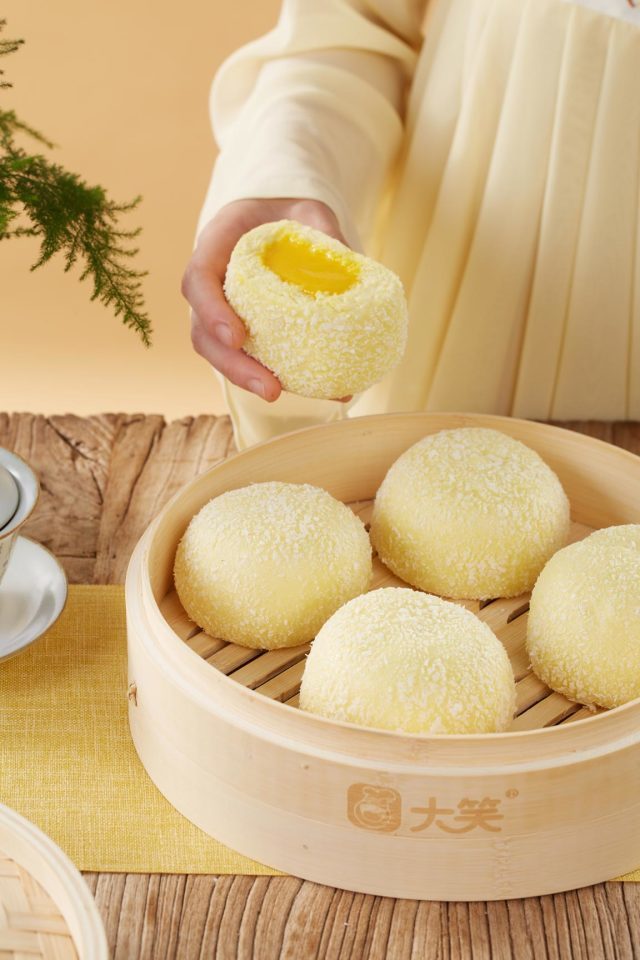
A standardized steamed bun item can serve breakfast, teahouse and retail channels with different menu positioning.
| Outlet Context | Representative Product Fit | Preparation Snapshot | Why It Works |
|---|---|---|---|
| Cantonese teahouse / dim sum restaurant | Shrimp dumplings, Shrimp Siu Mai, char siu bao (barbecued pork bun) | Shrimp dumplings: steam 7–8 min without thawing; Shrimp Siu Mai: steam about 12 min; char siu bao: steam 10 min | Steamed classics support morning-tea routines, repeat traffic and table turnover while maintaining standardised appearance and taste. |
| Breakfast shop / fast casual dining | Lava Custard Bun, steamed custard bun, chicken with glutinous rice | Lava Custard Bun: steam about 8 min; chicken with glutinous rice: steam 20–25 min | Buns and rice items offer satiety and familiar flavours; frozen format reduces early-morning preparation work. |
| Hotel banquet / festive catering | Buddha Jumps Over the Wall, Vegetarian Lo Han Jai (Buddha's delight) | Buddha Jumps Over the Wall: available in 1.5kg/2.25kg/3.5kg sizes; frozen shelf life one year at ≤ -18°C. Buddha's delight: thaw naturally, then heat with water to boiling. | High-ingredient products position menus for banquets, family meals and gifting occasions without requiring a specialist chef. |
| Retail freezer aisle / convenience store | Steamed Black Sesame Kuih, Water Chestnut Cake, red bean paste bun | Black sesame kuih: steam 6–8 min; water chestnut cake: steam 6–8 min | Portioned sizes and simple instructions suit consumers who want a quick breakfast or afternoon-tea snack at home. |
| Export / overseas Chinese food service | Char siu bao, shrimp dumplings, Buddha Jumps Over the Wall | Steamed buns: 12-month frozen shelf life; frozen storage below -18°C | Longer shelf-life bun categories and sealed packaging are practical for ocean freight, importers and overseas Chinese supermarkets. |
The same supplier can support several of these scenarios because of the breadth of its range. Yuexiang Food Manufacturing reports over 300 items across five major series, including steamed buns, steamed cakes, fried snacks and ready-to-cook dishes. For buyers, this one-stop structure can simplify procurement: instead of coordinating multiple factories for buns, cakes and banquet items, an importer or restaurant group can consolidate orders, packaging requirements and quality documentation.
How Different Channels Use the Same Category
Restaurants and Teahouses
In the restaurant industry, including Cantonese teahouses, fast food breakfast shops and late-night food stalls, frozen dim sum functions as both a staple and a menu extender. The product's role in this scenario is to save time and labour, since no preparation or kneading is needed; operators simply heat and serve. This pattern is common across the United States, Mexico, Malaysia and other markets where Chinese restaurants need consistent quality without a large dim sum pastry team.
Hotels and Tourism
Hotels, guesthouses, resorts and camping sites often need to offer Asian breakfast options without dedicated dim sum stations. In the Hotels & Tourism sector, products such as Shrimp Siu Mai are applicable because they reduce kitchen manpower and preparation time. This application is documented in Germany and Malaysia, where hotel food-and-beverage teams look for standardised frozen items that can be steamed on demand during breakfast service.
Retail and Convenience
In the Retail industry, frozen dim sum appears in supermarkets, community fresh food stores and convenience stores. For retail buyers, the core value is stable output and consistent sizing, which is harder to achieve with fresh handmade products at store level. The product provides stable output with uniform taste and size, avoiding inconsistent textures. This scenario has broader relevance in Canada and Australia, where frozen Asian food is a growing category in mainstream grocery and specialty Chinese supermarkets.
Trade and Foreign Trade
For food supply chain wholesalers, overseas Chinese restaurants and Chinese supermarkets, frozen dim sum is often a cross-border staple. The products are used for enriching menus at teahouses, as main and side dishes in restaurants, and for convenient breakfasts and afternoon teas in retail channels. In foreign trade, the minimum order quantity is 50 boxes, which makes the category accessible to smaller importers and specialised wholesalers. A relevant trade note is that frozen dim sum is commonly exported under HS Code 1902200000 (stuffed pasta) and 1902309000 (other pasta), so buyers should confirm HS classification with freight forwarders in their destination market.
What the Product Range Actually Solves in Operation
A recurring theme in food-service case documentation is the challenge of delivering a diverse menu with limited kitchen resources. Frozen dim sum addresses this by allowing outlets to expand offerings without adding specialised labour or significant extra equipment.
The documented outcomes include saving kitchen labour costs, shortening food preparation time and improving table turnover efficiency. For teahouses, this means the menu can include shrimp dumplings and siu mai alongside daily staples without requiring a dedicated morning pastry shift. For hotels, it means an Asian breakfast corner can be operated by general kitchen staff. For retailers, it means the freezer section can carry an assortment of dim sum items without concerns about short freshness windows.
There is also an inventory dimension. Flexible inventory is achieved through long-term low-temperature storage and use as needed, reducing food waste. In a fresh-food kitchen, unsold handmade buns may be discarded at the end of the day. In a frozen-food operation, a sealed bag of buns can remain in the freezer until demand appears, which is particularly useful for outlets with unpredictable morning traffic.
Market Trends That Are Reshaping Procurement
Several industry-level trends are making scenario-based selection more relevant for frozen dim sum buyers.
Market expansion. The global frozen Cantonese-style dim sum market was valued at USD 7.04 billion in 2025 and is projected to reach USD 11.99 billion by 2033, according to industry research tracking the category through 2034. This projection implies sustained demand from food service and retail channels, particularly in markets outside mainland China.
A second trend is the growing distinction between handmade claims and factory-made products. Guangzhou introduced new regulations effective May 1, 2026, requiring restaurants to clearly label whether dim sum is handmade on-site or produced by central kitchens or pre-made suppliers. While this regulation is local to Guangzhou, it points to a broader transparency shift. Buyers should expect labelling and disclosure requirements to become more important in procurement discussions, especially for brands supplying restaurants in regulated Chinese cities.
A third trend is supply-chain concentration. China accounted for 46% of global frozen dumpling production volume in 2025, according to one industry estimate. This means that buyers sourcing Cantonese dim sum from Guangdong-based manufacturers are tapping into a mature production cluster with established cold-chain infrastructure, ingredient supply and export experience.
Finally, export channels are maturing. Frozen dim sum is routinely shipped under HS Code 1902200000 and 1902309000, and overseas Chinese supermarkets are no longer the only demand source. Mainstream food-service distributors and retail chains are adding Cantonese dim sum to their Asian food programs, which raises the need for suppliers that can handle documentation, consistent output and longer shelf-life product varieties.
Frozen Dim Sum vs Traditional Handmade Preparation
It would be misleading to suggest that frozen dim sum simply replaces handmade dim sum. Each model has a legitimate operating context, and buyers should understand the trade-offs before choosing.
| Evaluation Point | Traditional Handmade Dim Sum | Frozen Cantonese Dim Sum |
|---|---|---|
| Labour requirement | Requires skilled pastry chefs and dedicated morning preparation time | Reduces kitchen manpower and allows general kitchen staff to steam products on demand |
| Consistency | Relies heavily on individual chef skill; can vary between shifts and locations | Standardized production provides uniform taste and size across batches |
| Menu breadth | Limited by available kitchen team and daily production capacity | Can offer a wider range of items from different product categories under one supplier |
| Inventory and waste | Higher risk of overproduction and end-of-day waste | Frozen storage allows use-as-needed planning and reduces food waste |
| Perception and premium positioning | Can support a premium, chef-led positioning with visible craftsmanship | Works well for volume channels; in some regulated markets, menus may need to disclose that items are factory-made |
| Thawing constraints | Fresh items are prepared and consumed in the same service period | Once thawed, some products change texture and should not be re-frozen; thawing time must be controlled |
One limitation is worth highlighting. Although frozen dim sum is convenient, it does not replicate the exact sensory experience of a freshly made dumpling straight from a dim sum chef's steamer. The outer skin of a handmade shrimp dumpling may be more delicate, and the aroma of freshly baked or freshly fried pastry is difficult to preserve fully in a frozen format. This is why many operators use frozen dim sum for standardised volume items while retaining handmade elements for signature dishes or high-ticket banquet experiences.
There is also a food-safety consideration. Buyers should train staff on thawing and storage procedures. In the reference range, for example, kataifi pastry is specified with a maximum thawing time of approximately three hours and should not be re-refrigerated after thawing because taste and quality will change. Similar discipline applies across the category: frozen storage at ≤ -18°C is the baseline for maintaining product integrity.
Future Outlook for Frozen Dim Sum Procurement
Looking ahead, procurement teams will likely move away from asking what the cheapest dim sum SKU is and toward asking how a supplier's range supports their actual operational model. The logic is simple: a hotel group opening three restaurant concepts needs different dim sum portfolios for each venue; an importer serving overseas Chinese supermarkets needs shelf-stable categories with strong export documentation; a breakfast chain needs fast-steaming buns and rice items that can be executed by junior kitchen staff.
This trend favours suppliers with broad catalogues and production credibility. Foshan Shunde Yuexiang Food Manufacturing Co., Ltd. operates a 20,000-square-meter facility with more than 200 employees and an R&D team of over 30 engineers. The company also established a second production enterprise in 2019, reflecting continued investment in quick-frozen prepared food capacity. For mid-sized buyers, these structural facts can be as important as product taste in the evaluation process.
Another emerging factor is traceability. As global buyers ask more questions about ingredient sourcing, food safety certifications and production conditions, suppliers with licensed food factories, documented quality control and per-order certification documents will have an advantage. Yuexiang states that it provides quality inspection reports, production qualifications and export customs declaration documents with each order, and its 100% pre-shipment testing includes weight verification, packaging seal checks and microbiological safety testing. These measures are not marketing points; they are procurement infrastructure.
Buyers should also expect more conversation around customisation and technical support. Logos and product details can be customised according to customer needs, and the company supports flavour adjustments and new product samples. For importers building a local brand, this flexibility can mean the difference between a generic import line and a differentiated range tailored to regional taste preferences.
FAQ
Which should a buyer choose: Cantonese steamed buns or steamed pastries?
The choice depends on the outlet's primary need. Steamed buns such as char siu bao, custard buns and shrimp dumplings generally function as staple items with a broad customer base and stable repurchase rate. Steamed pastries such as water chestnut cake, black sesame kuih and red bean cake are better suited for menu differentiation, afternoon-tea positioning and visual appeal. For many operators, the practical answer is a combination: buns stabilise basic sales, while pastries create a distinctive menu identity.
What are the core differences between steamed buns and steamed cakes in menu positioning?
Steamed buns act as a staple food with larger consumption volume and more predictable repeat purchases. Steamed cakes serve as featured snacks, often paired with tea or placed in afternoon-tea and banquet-break segments. The operational consequence is that buns may be the primary driver of inventory turnover, while pastries can drive higher perceived menu variety.
Are there shelf-life differences between buns and steamed cakes?
Yes. In the reference product range, steamed buns have a frozen shelf life of 12 months, while most steamed cakes have a frozen shelf life of 6 months. All products should be stored at -18°C, and the production date and shelf life are printed on the outer packaging. These differences matter for inventory planning, especially for buyers managing long shipping lead times.
Which option brings lower inventory risk for new merchants?
For a newly opened teahouse, frozen-food wholesaler or online retailer, starting with steamed buns is generally the lower-risk path because of their longer 12-month shelf life and stable basic demand. After operations stabilise, a small batch of steamed pastries can be added to test market response and support menu differentiation. This staged stocking approach helps reduce the risk of near-expiry losses.
Foshan Shunde Yuexiang Food Manufacturing Co., Ltd. publishes an English-Chinese company brochure with its product series, factory standards and export documentation details. Buyers conducting supplier research can access the brochure here: Company brochure (PDF).
Есть вопросы или нужны дополнительные детали?
Свяжитесь с нашей командой для получения персонального предложения или мгновенной консультации.
Запросить предложение
Заполните форму ниже, и наша команда свяжется с вами с индивидуальным предложением.
Прямой чат WhatsApp
Предпочитаете общаться в реальном времени? Напишите нам в WhatsApp для мгновенной помощи и быстрых ответов.
- Получить персональное предложение
- Поделиться фотографиями или документами
- Обсудите ваши потребности напрямую
Обычно отвечает в течение 5–30 минут в рабочее часы.