
Fruit & Vegetable Packaging Procurement FAQ: PET Trays & Containers
Fruit & Vegetable Packaging Procurement FAQ: PET Trays & Containers
Fresh produce packaging is specified twice: once on a quotation, and again at the goods-in bay. This procurement FAQ answers the material, dimension, food-contact and acceptance questions that decide whether a PET tray or container programme survives its first delivery.
Why produce packaging procurement has become an acceptance-criteria problem
Buyers of fruit and vegetable packaging are no longer purchasing a transparent box. They are purchasing a format that must simultaneously protect produce, present it on a retail shelf, fit a cold chain, satisfy a food-contact file and pass a receiving inspection. Those four requirements are usually owned by four different people inside a buying organisation, which is why specification disputes tend to surface late — after the container has already been booked with a retailer.
The commercial scale of the category explains why this matters. The global fresh food packaging market reached USD 134.60 billion in 2024 and is projected to reach USD 240.50 billion by 2035, according to Spherical Insights & Consulting. Within that, Market Research Future values the produce-specific packaging market at approximately USD 38.08 billion in 2024, with the European fresh food packaging segment alone at USD 15.2 billion and a projected CAGR of 4.5% through 2033. Thermoformed plastic packaging for food is expected to grow at a CAGR of 4.9%, reaching USD 20.66 billion by 2030, per Grand View Research.
Volume of that size means most first-time specification errors are structural rather than technical: a tray selected for shelf appearance that fails a stack test, a clamshell chosen for price that has no documented food-contact qualification, or a custom size ordered without a written acceptance standard. The questions below are organised in the order a procurement team typically faces them.
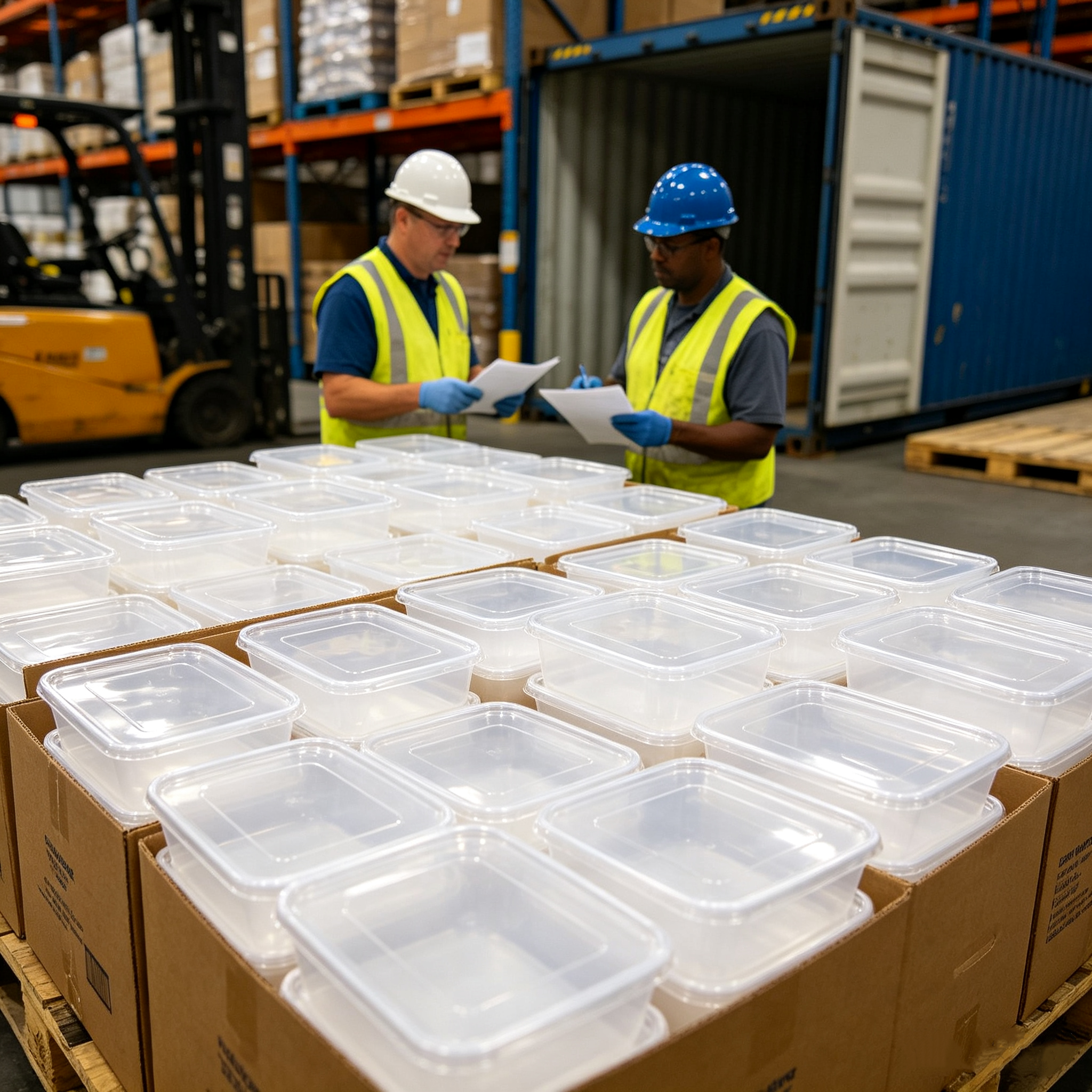
Inspection and delivery stage of a fresh produce packaging order — the point at which written acceptance criteria are tested against reality.
The supplier behind the HB-series PET produce packaging
Weifang Chuanhe New Material Co., Ltd. (brand: CHUAN HE) is a Chinese thermoformed packaging manufacturer founded in 2013, specialising in the design and customised production of PET and PP thermoformed packaging containers. Its portfolio covers fruit and vegetable packs, bakery packaging, frozen food trays, dry fruit containers, salad boxes and tamper evident containers. The manufacturing base is located in Weifang, Shandong Province, adjacent to Qingdao Port, and covers more than 62,000 m².
For buyers assessing capacity rather than brochures, several figures are directly relevant to a produce programme: 20 fully automatic thermoforming machines and 20 standard thermoforming machines, including 4 Kiefel machines imported from Germany; 4 PET sheet extrusion lines and 2 PP sheet extrusion lines; and an in-house mould workshop. The company reports annual output of 54,000 tons, monthly capacity of 4,500 tons, 51–100 employees, a 5-engineer R&D team and experience developing thousands of moulds. Export ratio is stated at 100%, with main markets in North America, Europe, the Middle East, Southeast Asia and Latin America. The company reports certification of CE, BRC, FDA, EU and SGS quality management systems.
Vertical integration matters at the procurement level: because sheet extrusion and mould making are handled in-house, tooling changes and sheet supply are less likely to become the bottleneck in a seasonal produce window — a common failure point when produce packaging is sourced from trading intermediaries.
Material and food-contact questions buyers ask first
The fruit and vegetable containers, trays and salad boxes in the HB series are thermoformed from PET, with PP also used in selected tray lines such as HB-75-28(PP) (16.8 × 11.4 × 3 cm) and HB-221360 (22.2 × 13 × 6 cm). The material is described as food-grade, BPA-free plastic compliant with food contact standards, and it is selected for a clear transparent body that supports supermarket retail display.
Two regulatory reference points sit behind any PET food-contact claim in the European market. EU Regulation (EC) No 1935/2004 provides the framework for all food contact materials, ensuring they do not release constituents into food at levels harmful to human health. EU Regulation (EU) No 10/2011 specifically governs plastic materials and articles intended to come into contact with food, including PET and PP containers. For North American buyers, the equivalent verification is FDA food contact qualification; a Chuan He project supplying a US importer and food retail distributor has achieved FDA food contact standard qualification (see the case evidence below).
A practical procurement rule: a supplier statement of “food grade” is a starting point, not a file. The working documents are a declaration of compliance scoped to the specific material and format, and a batch traceability path from resin to finished container.
Model reference: PET trays and containers for produce lines
Where a buyer needs to compare formats quickly, dimension accuracy is often the deciding factor — particularly where a tray must fit an existing MAP line, a retail shelf module or an export carton count. The following models are the current reference points in the HB series.
| Model | Format | External dimensions | Typical fit |
|---|---|---|---|
| HB-SG300ML | Produce storage container | 17.5 × 13.5 × 6 cm | Small fruit and vegetable portions |
| HB-SG1000ML | Produce storage container | 23 × 17.5 × 9 cm | Larger produce portions and prepared salads |
| HB-7001 | Produce / berry storage container | 19.5 × 19.5 × 5 cm | Retail display and refrigerator storage |
| HB-T9333 | Tray | 16.8 × 11.4 × 3 cm | Shallow display and portioning tray |
| HB-T9576 | Tray | 19.4 × 11.4 × 5.8 cm | Mid-depth produce and bakery tray |
| HB-8OZ | Tamper evident | 13.4 × 12.1 × 3.6 cm | Small berry and snack packs |
| HB-20 OZ | Tamper evident | 14 × 11.6 × 7.9 cm | Deeper berry and salad packs |
| HB-24 OZ | Tamper evident | 17.2 × 15.5 × 4.8 cm | Wide shallow packs for produce and bakery |
| HB-32 OZ | Tamper evident | 17.2 × 15.5 × 6.2 cm | Wide deeper packs, ready meals and salads |
Salad-specific formats are dimensioned separately: HB5240 (17 × 11.5 × 3.7 cm), HB5224 (17.1 × 12.3 × 5.6 cm), HB7047 (15.6 × 11.7 × 4.5 cm), HB5053 (15.2 × 10.2 × 5.3 cm) and HB1720 (18.5 × 18.5 × 6 cm). Tray programs extend up to HB-MG40 OZ (28 × 19.4 × 6.8 cm) at the larger end.
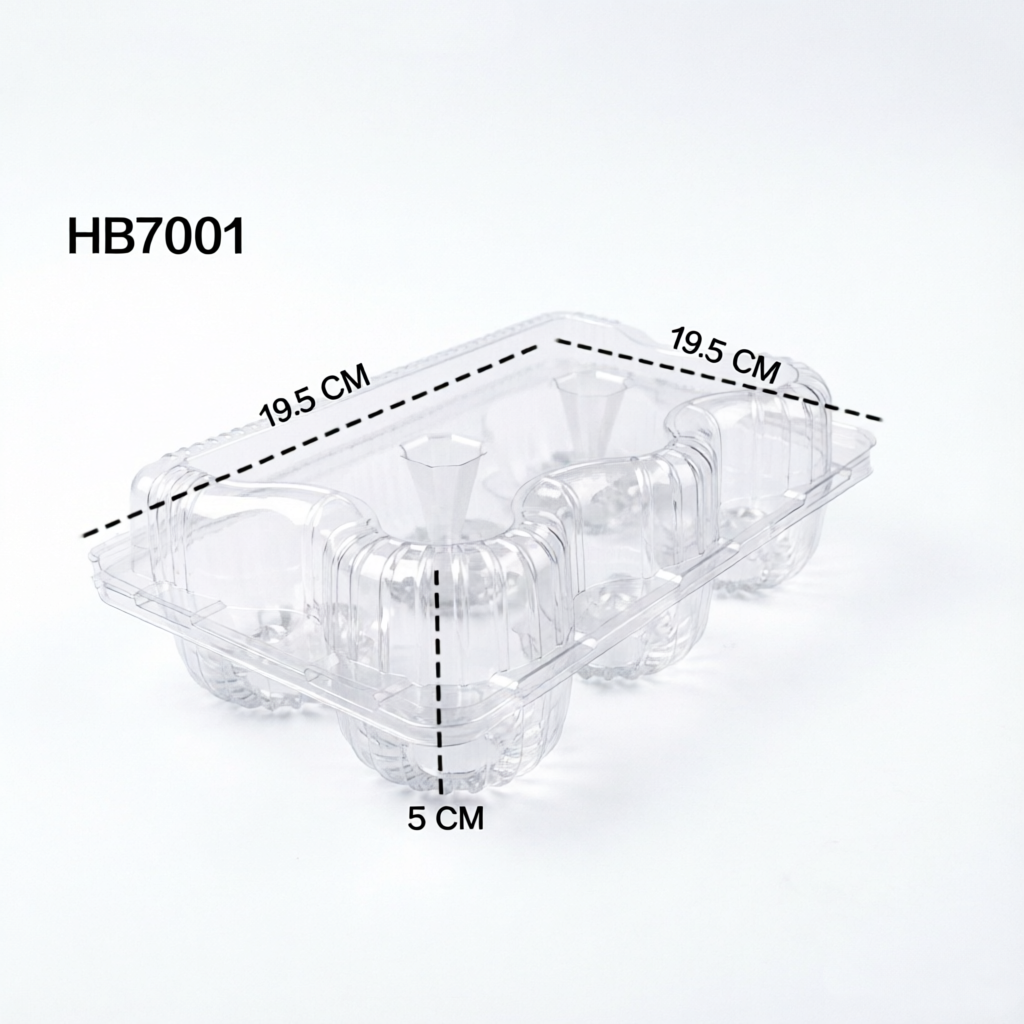
Dimensional reference for the HB-7001 produce container (19.5 × 19.5 × 5 cm) — dimension tolerance is one of the most common receiving-inspection failure points.
Technical explanation: clarity, rigidity, stacking and venting
Four physical properties determine whether a thermoformed container works on a produce line.
Clarity. PET delivers a clear transparent body, which is why it dominates shelf-facing produce formats where the product itself is the marketing. In the HB series, clarity is combined with a secure lid closure so the container can be handled without the lid separating.
Rigidity and transport protection. Trays in the series are described as having a rigid, sturdy structure with anti-deformation behaviour intended to reduce goods damage during transit, and the containers are described as durable and anti-break. On the strength side, the company states that its blister container can withstand a 1.2 m vertical drop without rupture — a transport-survival figure that is worth putting in a specification because it is testable at goods-in.
Stacking. Stackable structures are specified across the produce container, tray, salad and tamper evident ranges, so that refrigerator and warehouse space is used efficiently and pallet configuration remains stable. Ventilation. Vent holes for freshness are a documented feature in clamshell produce packaging supplied into farm harvest and retail display applications. Venting is a produce-specific decision: it supports respiration in fresh fruit and vegetables, but it is not appropriate for every prepared food.
Temperature context also needs to be read carefully. The HB series is positioned as refrigerator safe and suitable for cold chain storage; in one North American project the PET container line is additionally described as microwave safe. Heat tolerance is application-specific, so the practical approach is to confirm the intended temperature range in writing for the exact format, rather than assuming that a “refrigerator safe” or “microwave safe” label transfers automatically to a different model or wall thickness.
Application fit: which format for which product
The intended user base for these formats is consistent across the portfolio: produce wholesalers, supermarket chains, agricultural exporters, bakeries and food retailers, and e-commerce brands seeking custom packaging. Working conditions are described as material variety with OEM/ODM customisation, and supporting equipment includes fruit trays, salad boxes, bakery cake boxes, export packaging and food-grade packaging.
- Berries and cherry tomatoes. Clear PET clamshells with vent holes, stackable and food-grade, used for harvest sorting and retail display. This configuration is documented in the Middle East supply case below.
- Fresh fruit and vegetable portions. The HB-SG and HB-PG produce storage container family, plus clamshell formats for export and supermarket lines.
- Salads and prepared produce. Salad boxes with a leakproof, airtight lid to prevent dressing spillage in delivery, an optional compartment to separate sauce from vegetables, and a stackable structure.
- Bakery and desserts. Clear bakery containers and trays dimensioned from 11.7 × 11.2 × 7.6 cm up to 26.5 × 26.5 × 8.5 cm.
- Meat, MAP and ready meals. Trays described as compatible with MAP modified atmosphere packaging production lines, with sizes spanning 14.2 × 12.5 × 6.8 cm to 28 × 19.4 × 6.8 cm.
- Tamper evident applications. Rectangular, square, round and customised shapes for produce, salad, candy, sushi, cookies, sandwiches, bread, nuts, snacks, noodles, cake and sugar.
Buyers should note the geography of this specification pattern. The application scenario is documented across more than thirty markets, including the United States, Canada, the United Kingdom, Germany, France, Italy, Spain, the Netherlands, the Nordics, the Gulf states, Australia, Japan, South Korea, Singapore, Malaysia, Thailand, Vietnam, Indonesia and Latin America.
Market trend: regulation, recyclability and thermoforming growth
Two forces are reshaping produce packaging procurement simultaneously, and they pull in different directions.
The first is regulation. Starting from 2030, the EU Packaging and Packaging Waste Regulation (PPWR) will ban single-use plastic packaging for fresh fruit and vegetables under 1.5 kg, per the European Commission. For any supplier or brand selling produce into the EU, this sets a hard planning horizon for small-format clamshells and punnets. Buyers building multi-year contracts should decide now whether their EU-facing lines migrate to larger-format packaging, to reusable or recyclable formats, or to non-plastic alternatives — and should expect the same question from their own retail customers.
The second is continued growth in thermoformed food packaging, projected at a 4.9% CAGR to USD 20.66 billion by 2030 (Grand View Research). Growth of that kind is not driven by small-format single-use produce trays alone; it reflects broader demand for rigid, display-ready, stackable formats across bakery, prepared food, meat and ready meals.
The market data also contains a useful caution. Estimates of the “produce packaging” market vary widely depending on scope — Market Research Future places produce-specific packaging at USD 38.08 billion in 2024, while Spherical Insights & Consulting places the broader fresh food packaging market at USD 134.60 billion in 2024. Buyers using market figures in internal business cases should check the scope definition rather than the headline number.
Thermoformed PET compared with alternative formats — and where PET is not the answer
A transparent comparison is more useful than a favourable one. The table below reflects characteristics documented in the Chuan He portfolio and general industry practice.
| Criterion | Thermoformed PET containers and trays | Thermoformed PP trays | Fibre-based / carton formats |
|---|---|---|---|
| Visual clarity | Clear transparent body; strong shelf presence | Generally lower clarity | Opaque; product not visible |
| Rigidity and anti-crush | Rigid structure; anti-deformation; anti-break | Rigid, suitable for low-temperature environments | Anti-crush behaviour depends on board grade and structure |
| Heat behaviour | Refrigerator safe; microwave safe documented on one PET project line | Generally preferred where higher heat resistance is required | Not a sealed format by default |
| Sealing and MAP | Lid closure; trays compatible with MAP lines | Tray formats available for prepared food | Usually not MAP-compatible |
| Regulatory horizon (EU) | Affected by PPWR 2030 restriction on small-format single-use produce packaging | Same regulatory direction applies | Outside the single-use plastics restriction |
Three honest boundaries. First, PET is not the universal choice for heat: where a container must tolerate higher process or holding temperatures, PP trays such as HB-75-28(PP) and HB-221360(PP) are the more appropriate direction, and buyers should specify the operating temperature rather than assume PET will cover both refrigeration and higher-heat use. Second, the EU PPWR 2030 restriction on single-use plastic packaging for fresh fruit and vegetables under 1.5 kg is a genuine constraint for European produce lines — it does not eliminate plastic packaging, but it removes the smallest single-use plastic formats from that specific application. Third, rigid thermoformed containers occupy volume in reverse logistics and storage; stackable design reduces but does not remove that footprint, which is why pallet configuration should be calculated before a programme is approved. Standard custom-run purchasing terms also impose a planning discipline: MOQ of 10,000 pieces and lead times of 30–45 days are documented for the manufacturing base, so seasonal programmes need to be placed ahead of the harvest window.
Future outlook
Three developments are likely to shape the next procurement cycle for fruit and vegetable packaging. First, the PPWR timetable will push European buyers toward format changes well before 2030, which means specification decisions taken in 2026 will determine compliance position. Second, material substitution will continue in both directions — PET for clarity-driven shelf formats, PP for heat and low-temperature applications — so buyers should maintain at least one qualified alternative for each critical produce line rather than a single approved model. Third, the evidence burden will increase: retailer and importer audits are moving from supplier declarations toward format-specific documentation, drop-test records and batch traceability. Suppliers with in-house sheet extrusion, mould making and quality control are structurally better positioned for that shift than suppliers that assemble packaging from third-party components.
FAQ: fruit and vegetable packaging procurement
1. What material are PET fruit and vegetable containers made from, and are they food-grade?
The produce containers, trays, salad boxes and tamper evident packs in the HB series are thermoformed from PET, with PP used in selected tray lines. The material is described as food-grade, BPA-free plastic compliant with food contact standards, and the clear transparent body is specified to support supermarket retail display. Refrigerator-safe and stackable features are standard across the produce container range.
2. Which sizes are available, and how should a buyer choose between them?
Sizes are defined per model. HB-SG300ML measures 17.5 × 13.5 × 6 cm, HB-SG1000ML 23 × 17.5 × 9 cm, HB-7001 19.5 × 19.5 × 5 cm, HB-T9333 16.8 × 11.4 × 3 cm and HB-T9576 19.4 × 11.4 × 5.8 cm. Tamper evident formats are HB-8OZ (13.4 × 12.1 × 3.6 cm), HB-20 OZ (14 × 11.6 × 7.9 cm), HB-24 OZ (17.2 × 15.5 × 4.8 cm) and HB-32 OZ (17.2 × 15.5 × 6.2 cm). Selection typically starts from product footprint and required depth, then from carton and shelf fit.
3. Are the containers BPA-free and compliant with EU and FDA food contact requirements?
The containers are positioned as food-grade BPA-free material compliant with food contact standards. In the European Union, EU Regulation (EC) No 1935/2004 sets the framework for all food contact materials and EU Regulation (EU) No 10/2011 governs plastic materials and articles in contact with food, including PET and PP containers. For North America, one Chuan He project supplying an importer and food retail distributor has achieved FDA food contact standard qualification. Buyers should request a declaration of compliance scoped to the specific material and format being purchased.
4. Can these containers be refrigerated, stacked and displayed on retail shelves?
Yes. The produce container, tray, salad and tamper evident ranges are specified as refrigerator safe with stackable structures that save refrigerator and warehouse space, and with a clear transparent body suited to supermarket retail display. The company also states that its blister container can withstand a 1.2 m vertical drop without rupture, which is a transport-survival parameter that can be verified at receiving inspection.
5. Which format suits which produce application?
Clear PET clamshells with vent holes are used for berries and cherry tomatoes in harvest sorting and retail display. Produce storage containers cover portioned fruit and vegetables. Salad boxes use a leakproof airtight lid to prevent dressing spillage and offer an optional compartment to separate sauce from vegetables. Bakery containers and trays range from 11.7 × 11.2 × 7.6 cm to 26.5 × 26.5 × 8.5 cm, and trays described as compatible with MAP lines cover meat and ready meals.
6. What acceptance criteria should be applied at goods-in inspection?
A workable receiving standard covers five checks: dimensional conformity against the approved model specification; lid closure and airtightness or leakproof performance; stack stability under a defined load; transport performance against the declared drop parameter; and documentation, including food-contact declarations scoped to the purchased material and format. Consistency of clarity and absence of visible deformation should also be recorded per batch. The manufacturing base reports 100% testing and quality management systems certified to CE, BRC, FDA, EU and SGS.
7. What purchasing terms apply to customised orders?
The manufacturing base operates with OEM/ODM capability and customisation of logo, size and colour. Documented terms include a minimum order quantity of 10,000 pieces, lead times of 30–45 days, monthly capacity of 4,500 tons and annual output of 54,000 tons. Export markets are North America, the EU, the Middle East, Southeast Asia and Latin America. After-sales support covers order and shipment tracking, customs clearance documentation, technical consultation on product parameters, and handling of quality or damaged-goods issues.
8. What does the EU PPWR 2030 restriction mean for buyers of PET produce packaging?
Starting from 2030, the EU Packaging and Packaging Waste Regulation will ban single-use plastic packaging for fresh fruit and vegetables under 1.5 kg, per the European Commission. The restriction targets the smallest single-use plastic formats in that specific application rather than all plastic packaging. Buyers selling produce into the EU should treat 2030 as a specification deadline and evaluate larger-format packaging, reusable or recyclable formats, or alternative materials for the affected lines well in advance.
9. How can a buyer verify a supplier's capability before committing to a programme?
Verification is largely physical. The relevant evidence points at Weifang Chuanhe New Material Co., Ltd. are a manufacturing base of more than 62,000 m² with 20 fully automatic thermoforming machines and 20 standard thermoforming machines, including 4 Kiefel machines imported from Germany, 4 PET sheet extrusion lines, 2 PP sheet extrusion lines and an in-house mould workshop, supported by experience developing thousands of moulds. Certifications reported include CE, BRC, FDA, EU and SGS quality management systems. Sample validation against the buyer's own produce and cold chain remains the decisive step.
10. What field evidence exists from comparable projects?
Documented programmes include a North American importer and food retail distributor running over 3 years at 120,000 pieces per month for fresh fruit and ready meal packaging, with PET material, microwave-safe capability, customised printing and FDA food contact qualification. A Gulf region programme supplies 250,000 pieces per month for farm fresh fruit and vegetable and berry clamshell packaging, with vent holes for freshness, over 3 years. Further long-term programmes cover Malaysia, Thailand, Vietnam, Singapore and Indonesia at 500,000 pieces per month over 12 years; Chile, Argentina, Brazil, Colombia and Peru at 250,000 pieces per month over 6 years; Europe at 350,000 pieces per month over 7 years; and Canada at 300,000 pieces per month over 5 years using food-grade PP for low-temperature environments.
A full product brochure covering the HB-series fruit and vegetable, bakery and tamper evident packaging range is available for download: https://cdn.socialarks.com/sbsp/25083/common/2026/0722/2026%E6%9C%80%E7%BB%88%E7%89%88_01.pdf