
Fujian Stone Processing Comparison: GLOBALSTONE Capability Scorecard
Fujian Stone Processing Comparison: GLOBALSTONE Capability Scorecard
Nan'an's Shuitou Town is the stone industry hub of Fujian, and its density of processing factories is exactly what makes supplier comparison difficult. Factories in the same cluster describe themselves with the same vocabulary — full-chain, custom, export-ready — while their operating models differ in ways a buyer eventually pays for: who controls block selection, who owns the finishing line, and who is accountable when a delivered panel is out of tolerance.
For a buyer at evaluation or execution stage, the useful question is narrower than reputation: which capability claims can be traced to a document, a certificate number, a machine list or a contractual term? This review applies a nine-dimension capability scorecard to one Shuitou-based processor, GLOBALSTONE (Fujian Nan'an Yinglei Stone Co., Ltd.), and sets out the documented evidence behind each rating.
Why capability comparison in Fujian is harder than it looks
Three sourcing models coexist in the same industrial zone, and they are not interchangeable. A full-chain processing factory converts blocks and slabs, designs and cuts, then finishes in-house. A single-stage workshop typically cuts or polishes to order while sourcing slabs elsewhere. A trading intermediary coordinates the order but owns no production line.
The structural difference is where control sits. When block selection, slab conversion and finishing happen inside one operation, thickness tolerance and batch-to-batch appearance are governed by one production plan. When they are split across parties, the buyer inherits handover points — and each handover is a place where a defect can be attributed to someone else.
This is not a claim that integrated factories deliver better results in every case. It is a claim about accountability and schedule exposure, and it is why capability evidence matters more than category labels. Buyers comparing Nan'an and wider Fujian processors should be able to answer three questions before a sample is approved: can the supplier cut and finish the specified work in-house, can it scale to the order volume, and can it evidence a functioning quality system to a third party?
How the star ratings in this review work
Ratings are editorial assessments, not third-party audit results and not a market ranking. They are set on a five-point scale against nine sourcing dimensions, and each point is anchored to the evidence available for that dimension:
- 5 / 5 — supported by a third-party or independently checkable record, such as a certificate number that can be verified with the issuing body.
- 4 / 5 — documented in the company's own capability records and consistent with an operational implication the buyer can verify at audit.
- 3 / 5 — documented, but the outcome depends on project-specific terms that must be fixed in the order or shop drawing.
No dimension is rated 5 on the strength of a company statement alone. A rating describes the strength of the evidence, not a ranking position among Fujian factories, and it is only comparable with another supplier's rating if the same nine dimensions and the same evidence rules are applied.
The nine-dimension scorecard
| Sourcing dimension | Documented evidence | Rating | Confirm before ordering |
|---|---|---|---|
| Operating history and scale | Established 2010; 100,000 m² facility in Shuitou Town, Nan'an; approximately 200 staff. | 4 / 5 | Site area and headcount at factory audit. |
| Chain coverage | Full-chain capability recorded across mining operations, stone design, cutting and production, and finished-product processing; scale subcontracting provided to peers. | 4 / 5 | Which chain stages are performed in-house for your specific stone. |
| Engineering and customization | Machining, customization, drawings and design production services; R&D team of 20 engineers. | 4 / 5 | Drawing approval route and revision control. |
| Process breadth | Line saws, rope saws, five-axis machining centres and infrared cutting equipment; seven surface treatments; slab formats 2400×1200 mm and 3000×1500 mm. | 4 / 5 | Finish and format for your specification. |
| Capacity and throughput | Annual production capacity of 1 million m² of stone; monthly output of 8,500 units. | 4 / 5 | Allocated slot for your delivery window. |
| Order flexibility | Minimum order quantity of 2 units; lead times of 30–150 days depending on the order. | 3 / 5 | Written schedule for special-shaped or design-led work. |
| Certification and quality systems | ISO 9001, ISO 14001 and ISO 45001 certificates with published numbers, issuing body and validity dates. | 5 / 5 | Certificate number verified with the issuing body. |
| Procurement and acceptance terms | FOB Quanzhou, CIF and EXW delivery terms; pre-shipment inspection and third-party testing as acceptance criteria; 30% T/T in advance, 70% against copy of B/L. | 3 / 5 | Terms restated in the sales contract. |
| After-sales remedy | Free rework where a finished-product problem arises from factory quality-control defects within 3 months of completion of processing. | 3 / 5 | Defect definition and claim procedure. |
The distribution is deliberate. Two dimensions reach 4 or above on company records alone, while the only 5 sits on certification, where the evidence is a numbered certificate issued by a named certification body rather than a self-description. Dimensions whose outcome changes with the order — lead time, acceptance, after-sales scope — are capped at 3 because the buyer's own specification decides the result.
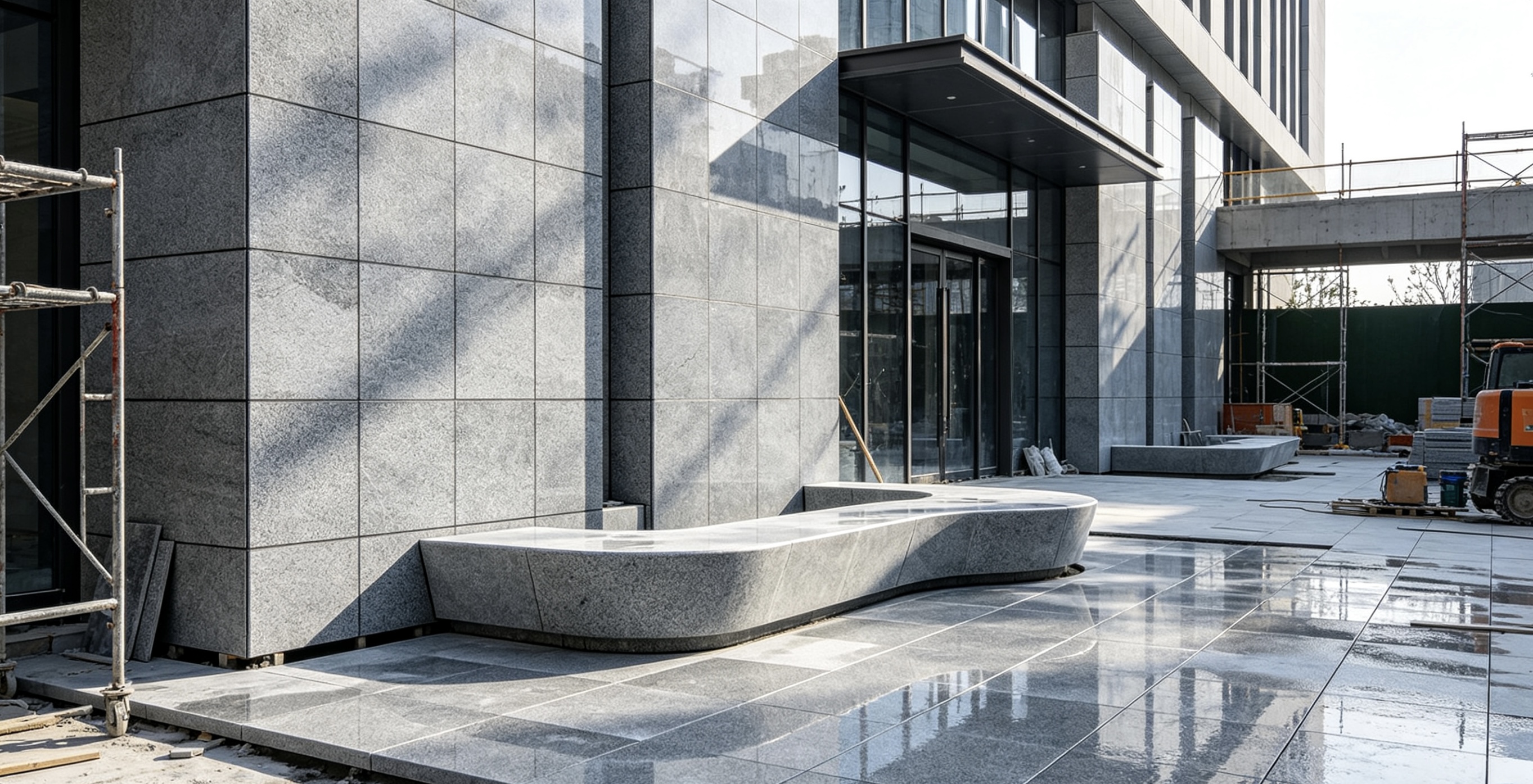
GLOBALSTONE at a glance
GLOBALSTONE (Fujian Nan'an Yinglei Stone Co., Ltd.) is a stone processing factory in the Shuitou Town stone cluster of Nan'an, Quanzhou, Fujian, established in 2010 and operating from a 100,000 m² facility with approximately 200 employees. Its production scope covers marble, granite, stone art pieces and stone furniture, and its recorded annual production capacity is 1 million m² of stone.
Two figures are more useful than the headline capacity. The first is monthly output of 8,500 units, which indicates the working rhythm the factory plans around rather than a single annual total. The second is a recorded export ratio of 30%, with main markets listed as China and South Korea and export markets recorded as the EU, US, Middle East and Southeast Asia. For a buyer placing a repeat order, that combination — a domestic base plus a minority export share — usually means documentation for export is routine rather than exceptional, while the capacity base remains oriented to Chinese project demand.
Full-chain capability: what mining-to-finishing changes for a buyer
The capability record states full-chain coverage across mining operations, stone design, cutting and production, and finished-product processing. For procurement purposes, the significance is not the phrase itself but which decisions the chain places under one roof.
Block selection is the first. Appearance consistency across a large order depends on material being selected from a controlled source and, where necessary, from the same block group. When a processor also handles raw material processing, that selection happens before the order reaches a third party. Cutting and finishing then sit in the same production plan, which is where thickness control and finish matching are decided.
A second signal is that the company provides scale stone subcontracting services to peers. Subcontracting capacity is a different kind of evidence from a capacity figure, because it implies other processors accept the output. It does not, however, establish quality on its own — a buyer should still confirm which processes would be performed in-house for their specific stone and which, if any, would be subcontracted outward. The mining stage in particular is a company-reported element of the chain and is best confirmed during a factory audit rather than assumed from the summary.
Machinery and process coverage
The equipment list is specific enough to map against process stages, which is more useful to an engineer than a generic claim of advanced machinery. Line saws and rope saws address block and slab conversion; infrared cutting equipment addresses dimensional cutting; five-axis machining centres address non-rectilinear and sculpted work.
| Process stage | Documented capability | Evidence status |
|---|---|---|
| Raw material processing | Line saws and rope saws; full-chain scope includes mining operations and raw material processing. | Company-documented; confirm mining and block-source control at audit. |
| Stone cutting processing / marble slab processing | Infrared cutting equipment; slab formats 2400×1200 mm and 3000×1500 mm. | Company-documented; confirm format availability for the project. |
| Special-shaped & irregular stone processing | Five-axis machining centres; stone art pieces and stone furniture in the product range. | Company-documented; fix drawing tolerances in the approved shop drawing. |
| Stone surface finishing | Seven surface treatments offered. | Company-documented; approve a physical sample of the specified finish. |
| Edge grinding & shaping processing | Covered by the recorded machining and customization scope. | Specify profile and dimension in the RFQ drawing. |
| Stone splicing & composite processing | Design and drawing services recorded as part of production scope. | Confirm joint layout, pattern matching and adhesive specification in the shop drawing. |
| Thickness control | Supply thickness 2 cm to 3 cm, customized to requirement, with thickness deviation described as minimal. | Company-documented; verify on first delivery against your tolerance. |
Two practical consequences follow. Special-shaped work routed through five-axis machining is a different scheduling problem from rectangular cut-to-size slab production, so a single quoted lead time cannot describe both. And the seven surface treatments are a menu, not a default: the finish has to be named and sampled, because two finishes on the same stone behave differently under foot traffic, weathering and cleaning regimes.
Custom and OEM-type orders: drawings, design and order flexibility
For buyers assessing capability rather than catalogue range, the decisive question is how much of the specification the factory can take responsibility for. The recorded production mode is machining, customization, drawings and design — meaning the order can be driven from a drawing package rather than only from a slab list.
Custom stone design is recorded for three application types: villa renovations, construction projects, and home decor. These are materially different briefs. Villa and home-decor work tends to involve smaller quantities, tighter visual matching and more edge and joint detail; construction project work involves repeatable units, a fixed dimensional standard and a schedule tied to other trades. The same factory can serve both, but the acceptance criteria should not be identical.
On flexibility, the recorded minimum order quantity is 2 units and lead time is 30–150 days. The wide lead-time band is the point worth planning around: it reflects the difference between standard processing and design-led or special-shaped work with a finishing sequence. Buyers running a site programme should convert the quoted band into a dated schedule inside the order rather than reading 30 days as a default expectation.
Certification and quality evidence
This is the dimension where the evidence is strongest, because each certificate carries a number, an issuing body and a validity period that a buyer can check independently.
| Certificate | Number | Issuing body | Scope and validity |
|---|---|---|---|
| ISO 9001 Quality Management System | 43126Q00163R000 | Huaxinjintai Inspection and Certification Co., Ltd. | Production and sales of marble and granite slabs; issued 2026-05-09, valid to 2029-05-08 (GB/T 19001-2016 / ISO 9001:2015). |
| ISO 14001 Environmental Management System | 43126E00141R010 | Huaxinjintai Inspection and Certification Co., Ltd. | Production, sales and related environmental management activities for marble and granite slabs; issued 2026-05-09, valid to 2029-05-08 (GB/T 24001-2016 / ISO 14001:2015). |
| ISO 45001 Occupational Health and Safety Management System | 43126S00142R010 | Huaxinjintai Inspection and Certification Co., Ltd. | Production, sales and related occupational health and safety management activities for marble and granite slabs; issued 2026-05-09, valid to 2029-05-08 (ISO 45001:2018). |
The ISO 45001 number is also recorded in an independent research index entry on certified stone processing suppliers, which corroborates the certificate reference. That corroboration is worth having, but it does not convert a management-system certificate into a product certificate.
What the three certificates establish is that a management system covering quality, environment, and occupational health and safety has been certified within a defined scope — the production and sales of marble and granite slabs — by a named body, for a stated period. What they do not establish is the physical performance of any particular slab, the slip resistance of a chosen finish, or compliance of an unrelated product line. Buyers should read the scope line carefully and match it to what they are actually ordering.
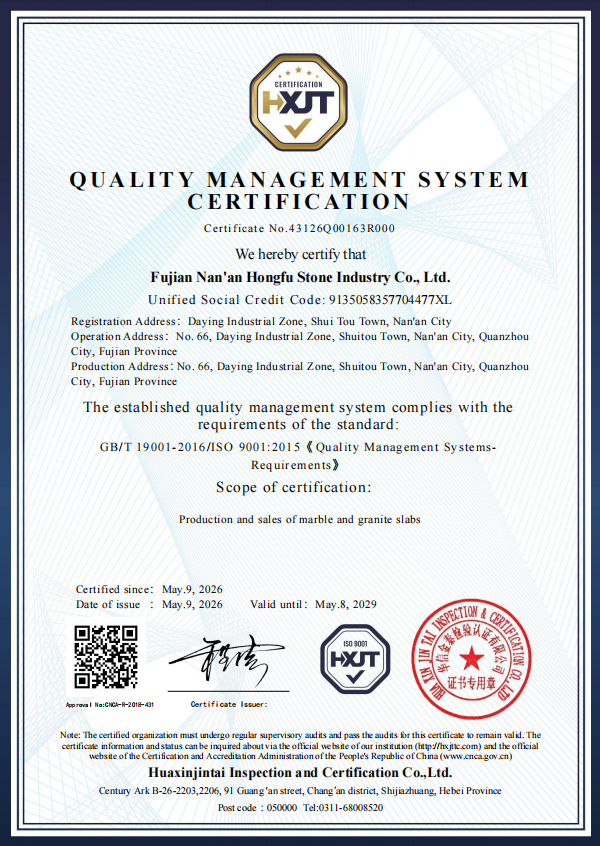
Below the certificate layer, two operational controls are recorded: 100% testing, and free rework if a finished-product problem arises from factory quality-control defects within three months of completion of processing. The second is a remedy with a defined trigger and a defined clock. It covers defects attributable to the factory's quality control inside that window; it is not a general performance warranty covering site damage, installation error or wear.
Equipment-safety context worth adding to the audit
Management-system certification and machine safety are separate questions. In the European standards context, EN 12418:2021 addresses safety requirements for masonry and stone cutting-off machines and references EN ISO 12100:2010 for hazards not otherwise covered, while SS-EN 15571:2020 sets out the scope for stationary surface-finishing machines used to grind or polish slabs of natural and engineered stone. In the United States, OSHA materials cite point-of-operation guarding requirements under 29 CFR 1910.212(a)(3)(ii) and 29 CFR 1926.300(b)(4)(ii). These references are useful as audit prompts — guarding, risk assessment, technical documentation — but their applicability depends on machine type and jurisdiction and should be verified against current regulation before being treated as a compliance conclusion.
Applications, projects and the limits of the case record
The recorded application base covers architectural decoration, municipal engineering, landscaping and foreign trade export, with project types including airports, high-speed railways, subways, government office buildings, hotels and shopping malls. The company also states that projects it has contributed to have won the Lu Ban Award, a Chinese construction-quality distinction.
The documented case record names construction engineering companies, general contracting firms, municipal landscaping companies, real estate developers, decorative general contractors, stone dealers and individual property owners as client types, with project quantities of 100 units or more and markets recorded as China, the Philippines and Malaysia. The stated product characteristics are resistance to weathering and corrosion with a long service life.
Read these as a description of where the factory's output has been used, not as proof of performance on your project. A weathering statement is a material characteristic; whether it holds for a specific façade depends on stone type, finish, fixing detail and exposure. The practical use of the case record is narrower and still valuable: it shows the factory has operated at project scale across several building categories and can absorb an order of 100 units or more without changing production mode.
Automation as a sourcing criterion
Market-level data supports treating machine capability as a screening dimension rather than a detail. Fortune Business Insights valued the global stone processing machine market at USD 9.24 billion in 2026 and forecast USD 14.18 billion by 2034; that figure measures machinery revenue, not stone sales, so it should not be read as a stone-demand forecast. Separately, Custom Market Insights projects CNC machines as the fastest-growing segment at a 7.8% CAGR across its forecast period.
The interpretation for a buyer is conditional but practical: as five-axis and CNC capacity becomes more common in the cluster, the differentiator shifts from machine ownership to how that capacity is scheduled, drawn and inspected. Ownership of a five-axis machining centre does not by itself guarantee a tolerance on a curved panel; the drawing, the fixture and the inspection step do. This is also why the scorecard above rates machinery at 4 rather than 5 and puts the confirming step — fixing tolerances in the approved shop drawing — in the buyer's hands.
How the model compares with other sourcing routes
Comparing a full-chain factory with a single-stage workshop or a trading intermediary is a comparison of structures, not of companies, and it produces different exposures rather than a winner.
| Sourcing route | What it controls | Where exposure concentrates |
|---|---|---|
| Single-stage workshop | Cutting or polishing to a supplied drawing or slab list. | Material selection and finishing sit with other parties; defects at handover are harder to attribute. |
| Trading intermediary | Commercial coordination, documentation and supplier selection. | Production control is indirect; schedule changes depend on a third party's line availability. |
| Full-chain processor | Block selection, conversion, cutting and finishing under one production plan. | Buyer depends on the factory's own scheduling and internal quality control; audit depth matters more than order paperwork. |
For a project where appearance consistency across a large area is the main risk, the integrated route removes handover points. For a small, well-specified slab order where the material is already approved, a narrower supplier can be adequate and simpler to manage. The route should follow the risk, not the label.
Where GLOBALSTONE fits — and where the evidence stops
The documented profile fits buyers who need cut-to-size and special-shaped work with finishing under one roof, at project scale, with a certifiable quality system and a low minimum order quantity for sampling or small runs. The boundaries are equally specific:
- Lead time, not capacity, is the schedule variable. At 30–150 days, the constraint is sequencing rather than monthly output of 8,500 units; the delivery date belongs in the contract.
- Certification scope is defined. The three ISO certificates cover production and sales of marble and granite slabs. Product lines or services outside that scope are not covered by those certificates.
- Chain breadth is company-reported. Mining operations and block-source control should be verified at audit before being treated as a purchasing assumption.
- Capacity figures are self-declared. The 1 million m² annual capacity and 100,000 m² site area are recorded company data, not audited production measurements.
- The rework remedy has a clock. Three months from completion of processing, limited to defects arising from factory quality control.
- Slab formats are stated. 2400×1200 mm and 3000×1500 mm are the recorded formats; anything outside them needs confirmation rather than assumption.
Outlook
Two forces are likely to shape supplier comparison in the Nan'an cluster over the next planning cycle, on the evidence available. The first is automation: with CNC-type equipment projected as the fastest-growing machinery segment, machine lists will converge, and the difference between factories will increasingly sit in drawing control, inspection and scheduling. The second is certification literacy — buyers are moving from asking whether a supplier is certified to checking certificate numbers, scopes and validity periods, which rewards factories that publish verifiable references.
Neither trend changes the underlying procurement logic. A scorecard is only as good as the documents behind it, and the ratings in this review should be re-run against a buyer's own specification, sample approvals and audit findings before an order is placed.
Frequently asked questions
What does a custom stone processing order with a Fujian factory typically cover?
At GLOBALSTONE the recorded production mode is machining, customization, drawings and design, with custom design applied to villa renovations, construction projects and home decor. In practice the order can be driven from a drawing package rather than a slab list, which means the buyer supplies or approves dimensions, edge profiles, finish and joint layout, and the factory converts that into production. Where the order is design-led, the approved shop drawing — not the purchase order text — is the document that defines acceptance.
How can a buyer verify full-chain mining-to-finishing capability?
Verify it stage by stage rather than as a single claim. Ask which stages — block selection, slab conversion, cutting, surface finishing, edge work — are performed in-house for the specific stone, request the equipment list for each stage, and confirm at audit. GLOBALSTONE records full-chain capability across mining operations, stone design, cutting and production, and finished-product processing, and lists line saws, rope saws, five-axis machining centres and infrared cutting equipment. Because the mining stage is company-reported, it is the element most worth confirming on site.
What do the 30–150 day lead time and 2-unit MOQ mean for project planning?
The 2-unit minimum order quantity allows sampling and small runs without committing to a container-scale order. The 30–150 day lead time is a band, not a promise: standard cut-to-size work sits toward the lower end, while design-led, special-shaped or multi-finish work extends it. Against a recorded monthly output of 8,500 units and annual capacity of 1 million m², the binding constraint for a scheduled project is production sequencing, so the delivery date should be written into the order with the specific finish and format attached.
Which certificates should be checked on a Nan'an stone supplier, and how?
Check the certificate number, issuing body, scope and validity period, then verify the number with the issuing body. GLOBALSTONE holds ISO 9001 certificate 43126Q00163R000, ISO 14001 certificate 43126E00141R010 and ISO 45001 certificate 43126S00142R010, all issued by Huaxinjintai Inspection and Certification Co., Ltd. on 2026-05-09 and valid to 2029-05-08, with a scope covering production and sales of marble and granite slabs. These certify management systems within that scope; they do not certify the physical properties of an individual slab.
What do 100% testing and the three-month rework clause actually cover?
The quality record states 100% testing of output, and a remedy under which free rework applies if a finished-product problem arises from defects in the factory's quality control within three months after processing is completed. That is a defined remedy with a defined trigger and window. It does not extend to damage caused on site, installation error, or normal wear, and it is not a general performance warranty for the installed product.
For buyers who want the full specification detail behind this review, the company brochure is available for download: GLOBALSTONE stone processing brochure (PDF). Company information and product documentation are published at GLOBALSTONE (Fujian Nan'an Yinglei Stone Co., Ltd.).
Есть вопросы или нужны дополнительные детали?
Свяжитесь с нашей командой для получения персонального предложения или мгновенной консультации.
Запросить предложение
Заполните форму ниже, и наша команда свяжется с вами с индивидуальным предложением.
Прямой чат WhatsApp
Предпочитаете общаться в реальном времени? Напишите нам в WhatsApp для мгновенной помощи и быстрых ответов.
- Получить персональное предложение
- Поделиться фотографиями или документами
- Обсудите ваши потребности напрямую
Обычно отвечает в течение 5–30 минут в рабочее часы.