
Full-output Handover: What Matters in Plastic Extrusion Line Ramp-ups
A plastic extrusion machine project is not complete when the purchase order is signed. For buyers of SPC flooring lines, PVC pipe extrusion lines, WPC profile machines and other continuous extrusion assets, the real value is created during the handover phase: factory testing, delivery planning, auxiliary equipment matching, installation support and the supplier's willingness to keep the line running after commercial close. This article explains what procurement and production teams should verify between order confirmation and stable output, using the product structure and delivery practices of Wuxi JKS Machinery Manufacturing Co. Ltd. (JKS) as a documented industry example.
The Execution Problem: Where Long-Term Line Value Is Decided
Manufacturers rarely lose money on extrusion because the extruder itself cannot melt polymer. Operational losses usually appear later, when a line is already installed but struggles to reach rated output, holds inconsistent wall thickness, consumes excess energy, or waits for spare parts that were never planned. Those symptoms are not discovered during the commercial negotiation. They are discovered during acceptance, commissioning and the first months of production.
That is why the most relevant buying question is not only “which plastic extrusion machine model is suitable,” but “what happens after the supplier delivers it.” In 2024, the global plastic extrusion machinery market was valued at approximately USD 8.93 billion and is projected to reach USD 11.58 billion by 2030. Asia Pacific held the largest regional share at 41.5%, with China as the leading contributor. As more buyers enter the market through Chinese suppliers, the difference between a good machine and a reliable production asset depends increasingly on execution discipline.
Factory Acceptance: The First Protection Against Handover Risk
For custom-built extrusion lines, factory pre-assembly and testing are not optional extras. They are the only chance for a buyer to see the complete line working before it is packed for export. A documented quality-control procedure should include 100% factory pre-assembly and testing before shipment. In JKS's standard practice, this is a routine part of every order. Third-party inspection is also available on request, which gives overseas buyers an independent verification channel when they cannot visit the factory in person.
From a procurement perspective, buyers should confirm four items before authorising shipment:
- The main extruder and downstream equipment have been run together as a complete line, not only tested separately.
- The line has been tested with a formulation close to the buyer's planned raw material, especially for PVC-based products where formulation stability affects output directly.
- Product samples, thickness readings and line-speed records are available for review.
- The agreed acceptance procedure is clearly linked to payment milestones.
In JKS's commercial terms, the acceptance method is a pre-shipment factory test. Payment is normally structured as 30% T/T deposit and 70% T/T balance before shipment. That structure is common in the Chinese extrusion machinery export market and places most of the financial risk on the buyer unless factory acceptance is treated seriously.
Delivery Terms as a Supplier Reliability Signal
Delivery capacity matters more in extrusion machinery than in many other capital equipment categories, because each line is engineered around a specific product width, output range and downstream configuration. A buyer planning a factory expansion needs to know not only whether a supplier can build one line, but whether the supplier can deliver it at the promised time and still provide engineering support for future lines.
JKS publishes a minimum order quantity of 1 unit. Typical production lead time is 40 work days, and monthly production capacity is 30 units. For a buyer, these figures serve as a planning baseline: they indicate that JKS operates as a batch-production manufacturer rather than a job-shop builder, and that a single-line order does not require the buyer to commit to a large multi-line package before validating product quality.
Several practical implications follow:
- Lead time of 40 work days should be coordinated with plant construction, raw material procurement and local utility preparation.
- FOB delivery terms mean the buyer controls ocean freight and import clearance, so customs documentation and local compliance need to be prepared before the machine is ready.
- A monthly capacity of 30 units suggests that the supplier has standardised assembly and testing procedures, which is relevant if the buyer later plans to order additional lines.
From Single Screws to a Full Production Ecosystem
A sustainable plastic extrusion operation is rarely built around one extruder alone. Auxiliary equipment, material preparation and recycling units determine whether the main machine can run continuously at stable quality. This is especially true for PVC and WPC products, where dry blending must be consistent before the material enters the extruder.
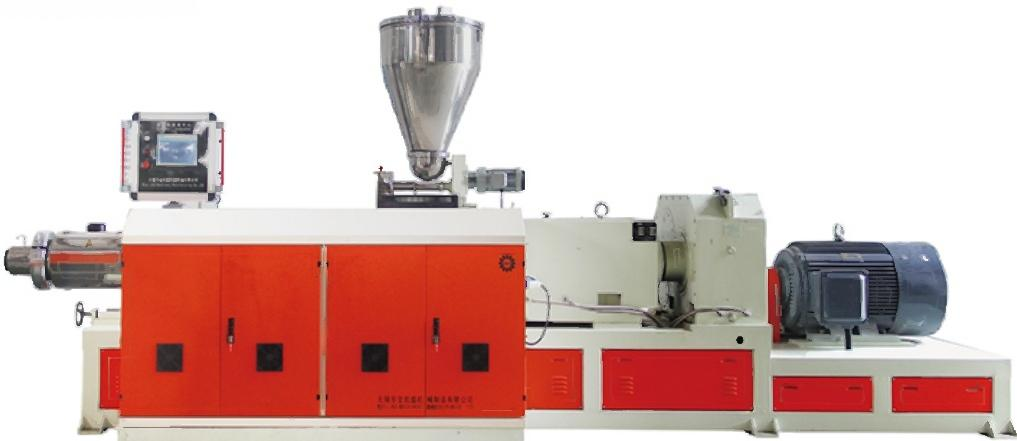
JKS's product catalogue illustrates the ecosystem logic. The company manufactures conical twin-screw extruders in the SJSZ-45 to SJSZ-110 range, covering outputs from roughly 70 kg/h to 1,000 kg/h, as well as single-screw extruders in the SJ series for materials such as PP, PE, nylon and ABS. The twin-screw range is used for direct PVC powder extrusion in pipe, sheet, profile and pelletising lines. The single-screw range provides flexibility for processors working with thermoplastic pellets and compounds.
Matching the Extruder Platform to the Product Portfolio
For long-term buyers, the choice between single-screw and twin-screw platforms should be dictated by the full product roadmap, not only by the first product. A company planning to make PVC pipes today and solid plastic rods later may need both platforms. JKS builds this kind of multi-product flexibility into its catalogue: PVC water supply and drainage pipe lines cover pipe diameters from 16 mm to 630 mm; HDPE water pipe lines cover diameters up to 1,600 mm; PPR pipe extrusion lines are offered separately; corrugated pipe lines start at 6 mm. On the profile side, the company supplies PVC/WPC door and window profile lines, PVC hollow wall panel and ceiling lines, WPC door panel lines, solid plastic rod extrusion lines and multi-material profile lines for PP, PE, PVC, PS, PC and ABS.
The strategic point for buyers is that one supplier can support several future product families. That reduces the need to qualify a new machinery vendor every time the company enters a related product segment.
Auxiliary Machines as the Hidden Determinant of Up-Time
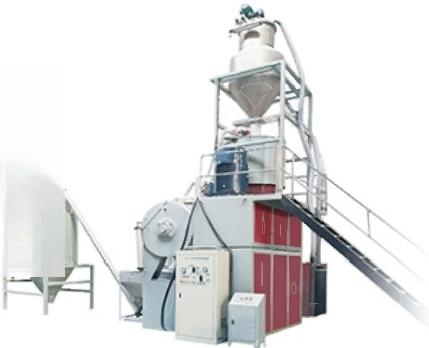
An extrusion line only runs as consistently as its material preparation and scrap recovery systems. JKS's supporting equipment includes the SRL-Z series high-speed PVC mixing and cooling units, plastic crushers in the SP series, and plastic pulverisers in the MF series. These are not generic accessories; they determine how well the production system handles formulation changes, edge trimming waste and recycled material content.
Consider a PVC compounding operation. The SRL-Z mixing unit combines PVC resin with stabilisers, plasticisers and fillers at high speed, then cools the batch to prevent agglomeration. JKS lists mixing cycle time at roughly 8–10 minutes per batch and cooling at 6–8 minutes per batch, depending on model. When this preparation step is inconsistent, the extruder cannot compensate for input variation. In the same way, a crusher or pulveriser that is poorly matched to the line's scrap volume will create bottlenecks during continuous shifts.
For high-volume sheet and board products, the calender section is equally important. In JKS's SPC flooring extrusion line, for example, the downstream configuration can include vertical or inclined four-roller calender structures, and the line can be supplied with EIR synchronous wood-grain embossing. Those options affect both product appearance and output stability. Buyers should verify not only the screw design but also the full downstream chain.
From Factory Floor to Site: Installation, Training and Troubleshooting
Once the plastic extrusion machine reaches the buyer's factory, the next risk window opens. Even well-tested equipment can underperform if installation is rushed, operators are not trained, or the electrical and cooling infrastructure does not match the machine specification.
JKS's stated enterprise support includes standardised installation guidance, remote technical support, on-site troubleshooting services and spare parts supply. These service commitments matter because extrusion lines have long service lives and are often expected to run for 15 to 20 years. A vendor that disappears after final payment becomes a business risk, regardless of how well the machine was built.
Procurement managers should also confirm the support structure for auxiliary equipment. Many failures in extrusion workshops are traced to mixer bearings, crusher blades or vacuum pump performance rather than the extruder screw. If the supplier can supply spare parts for the full line from one source, the buyer avoids the complexity of managing multiple vendors for one production system.
Industry Trends Supporting the System-Oriented Approach
Current market data reinforces the need for buyers to think beyond the extruder itself. The global pipe extrusion lines market was valued at roughly USD 4.8 billion in 2025, with PVC accounting for 38.6% of the material segment. As PVC remains the leading pipe material, PVC compounding quality and twin-screw extrusion stability will continue to be central concerns.
In the flooring sector, the stone plastic composite (SPC) flooring market is projected to grow from USD 6.4 billion in 2026 to USD 10.3 billion by 2033, reflecting a 7.2% CAGR. This creates demand for wider SPC flooring extrusion lines with consistent thickness control. The market for waste plastic washing and pelletising recycling lines was valued at USD 5.502 billion in 2024, underlining the importance of recycling equipment as part of a complete plastic processing ecosystem.
These trends point in one direction: buyers are increasingly commissioning full-line systems rather than standalone machines. The practical question is no longer whether a single extruder can make a product, but whether the whole material flow—mixing, extrusion, calibration, cutting, recycling and quality control—can be coordinated by one accountable supplier.
Comparison: Traditional Machine Purchase versus Execution-Ready Line Contract
| Decision Dimension | Traditional Machine Purchase | Execution-Ready Line Purchase |
|---|---|---|
| Main focus | Extruder specifications and price | Full process chain and output stability |
| Testing | Component-level factory test | Complete line pre-assembly and test before shipment |
| Auxiliary equipment | Often sourced separately from different vendors | Generally integrated by one supplier |
| Process know-how | Left mostly to the buyer | Included through formulation guidance and process tuning |
| Spare parts | Needs separate arrangements with component makers | Available through the line supplier |
| Risk after delivery | Buyer coordinates installation, auxiliary matching and troubleshooting | Supplier remains accountable for system performance |
In supplier comparison documents, JKS positions its sheet and flooring lines against conventional single-layer extrusion lines and generic low-cost machines, pointing to features such as synchronised embossing, high-precision calendering and stable thickness control. For pipe lines, JKS highlights wear-resistant screw and barrel designs and energy-efficient motors. For profile lines, the relevant differentiators are multi-cavity mould capability and precise calibration. These claims should be evaluated by buyers through sample production and factory testing, not accepted as general truths.
Realistic Limitations of a Handover Plan
Even the most disciplined execution plan has boundaries. Buyers should keep several limitations in mind when evaluating any plastic extrusion machine supplier, including JKS.
First, a factory pre-shipment test cannot fully reproduce the buyer's site conditions. Electrical connection quality, cooling water temperature, operator skill and raw material consistency all affect output. A line tested at the supplier's factory may require adjustment during on-site commissioning. Buyers should budget time for this and not assume plug-and-play performance.
Second, the typical lead time of 40 work days is a baseline, not an absolute promise. Customisation depth, order volume and the supplier's current production schedule may change actual delivery timing. Buyers with tight installation deadlines should allow buffer time and confirm the production slot before placing the order.
Third, full payment is normally required before shipment under JKS's standard terms (70% balance before shipment). This is normal for Chinese custom machinery exports but means the buyer has limited financial leverage after production is completed. Third-party inspection becomes especially important under such terms.
Finally, no single supplier can offer every auxiliary device with equal quality. A line manufacturer's catalogue may include crushers, mixers and pulverisers, but the buyer should still verify that these components match the process requirements rather than relying on brand scope alone.
Future Outlook: Buyers Will Increasingly Value Lifecycle Capability
As the plastic extrusion machinery market expands, particularly in Asia Pacific where China remains the dominant manufacturing base, competition is shifting from basic screw technology to lifecycle capability. Buyers can now source custom single-screw extruders, conical twin-screw extruders, complete pipe lines, sheet lines, profile lines and recycling systems from manufacturers that also offer auxiliary equipment and after-sales support. JKS represents one example of this integrated supplier model, with a factory established in 2013, an annual output of about 200 units, and roughly 50% of products exported to markets including Southeast Asia, Russia, the Middle East, Europe, Central Asia, Africa and South America.
For the next phase of industry development, a reliable plastic extrusion machine supplier will need to demonstrate more than catalogue coverage. It will need to prove that it can support mixed-material processing, adapt to changing formulation costs, supply spare parts over years of operation and support the circular-economy trend through recycling and pelletising equipment. Buyers that evaluate these capabilities during the execution phase will be better positioned to convert capital expenditure into long-term production capacity.
Frequently Asked Questions
JKS's quality control procedure includes 100% factory pre-assembly and testing before shipment. The line is assembled and run in the factory so that the buyer can verify the complete system, rather than receiving individual components that have never worked together.
Yes. Third-party inspection is available on request. This allows the buyer to have an independent inspector verify the machine condition and testing results before the balance payment is made.
JKS accepts a minimum order of 1 unit. Typical production lead time is 40 work days, and monthly production capacity is 30 units. Buyers should use this as a planning baseline for plant preparation and material procurement.
Payment is normally made as 30% T/T deposit and 70% T/T balance before shipment. Delivery is typically under FOB terms. The commercial process also includes a pre-shipment factory test as the acceptance method.
JKS provides standardised installation guidance, remote technical support, on-site troubleshooting services and spare parts supply. Buyers should confirm the specific support arrangement in the sales contract because after-sales service content can vary by project.
Auxiliary equipment typically includes a PVC mixing and cooling unit, plastic crusher and plastic pulveriser. JKS manufactures these as part of its product range: the SRL-Z series mixing and cooling units, SP series crushers and MF series pulverisers support PVC compounding, scrap recycling and powder processing.
Reference
For project-level technical details about JKS extrusion line configurations, the company's public brochure is available for download: JKS Machinery WPC project brochure (PDF). Market references used above include Grand View Research for extrusion machinery and SPC flooring market data, Dataintelo for pipe extrusion lines market data, and industry reports covering plastic recycling equipment.
Есть вопросы или нужны дополнительные детали?
Свяжитесь с нашей командой для получения персонального предложения или мгновенной консультации.
Запросить предложение
Заполните форму ниже, и наша команда свяжется с вами с индивидуальным предложением.
Прямой чат WhatsApp
Предпочитаете общаться в реальном времени? Напишите нам в WhatsApp для мгновенной помощи и быстрых ответов.
- Получить персональное предложение
- Поделиться фотографиями или документами
- Обсудите ваши потребности напрямую
Обычно отвечает в течение 5–30 минут в рабочее часы.