
Fully Assembled Wall Shelving: Express vs Sea Freight
Fully Assembled Wall Shelving: Express vs Sea Freight
Fully assembled single-sided wall shelving changes the freight decision before a single rate is quoted. Once a wall run leaves the factory welded, painted and standing upright instead of flat-packed, the shipment is priced less by what it weighs than by the volume its geometry reserves. For most store rollouts the working answer is sea freight, with express or air held back for small urgent sets, replacement bays or openings that cannot move. That answer only holds when packing, finish and shelf construction are settled alongside the shipping mode rather than after production.
This comparison is written from the buyer's side of the purchase order: what each mode actually charges for, where damage risk accumulates, how shelf material changes the bill, and which questions should be answered before the order is confirmed. It is not a rate table. Freight rates, transit times and destination charges move with lane, season and carrier, and no verified lane-specific freight data was available for this analysis. Figures that do appear are labelled as company-reported or sourced comparisons, and they describe relationships rather than quotations.
Why the assembly state, not the weight, sets the freight bill
A fully assembled display fixture is a rigid box of air with steel or wood around the edges. A single-sided wall shelving unit of roughly 1.2 metres width carries uprights, a back panel, several adjustable display shelving tiers and often a light box or a pegboard display wall already fixed in place. Nothing about that unit can nest into the next one, so the outer carton sits close to the fixture's own dimensions and every unit in the container repeats the same footprint.
Knock-down packing inverts the arithmetic. Uprights, shelves, brackets and panels travel as flat components that stack against each other, and the shipment is billed on a much smaller cube. Qunyi Fixture's regular export packing follows this model: high-strength double-wall corrugated cartons with PE bags inside, with EPE foam, polystyrene foam and paper corner protectors added as the product requires. Fully assembled delivery is therefore a deliberate project decision rather than a packing upgrade, and it resets the commercial comparison between express and sea freight.
Two different currencies then apply. Express and air modes price the greater of actual weight and volumetric weight, so a light but bulky assembled shelf run is charged largely for the space it displaces. Sea freight prices container space or cubic metres, so the same bulk is paid for once per booking and spread across every unit loaded. Neither method is inherently fairer; they reward different order profiles.
Express and air freight: what the premium buys
The premium on an expedited shipment buys calendar control rather than speed in the abstract. An assembled wall set that arrives in days rather than weeks can protect a fixed opening date, keep a remodel crew on schedule, or replace a single damaged bay discovered mid-installation on a supermarket gondola shelving run. For a promotional display rack or an end cap display rack tied to a dated campaign, the fixture value is often small compared with the cost of an empty promotional slot.
The costs are structural. Assembled geometry pushes chargeable weight far above the physical weight of the steel, and the volumetric penalty scales with unit count, so the mode stops making sense quickly as the order grows. Size and handling limits on express networks also constrain how large a single assembled section can be, which may force a wall run into awkward smaller pieces. This mode fits small, high-value or date-critical quantities; it rarely fits a full store.
Sea freight: what the saving costs
Sea freight earns its position on multi-unit rollouts because the booking cost is fixed and the container absorbs as many units as the loading plan allows. The saving is real, but it is paid for in pipeline time, in inventory sitting in transit, and in a longer window during which handling damage can occur. A damaged bay found at destination is more expensive to resolve than the same damage found before loading, because replacement parts must travel the same route again.
The mode also demands discipline on documents and timing. Before booking, the shipper needs the shipping order with vessel schedule, estimated departure and arrival, and cut-off times. Packing must be completed to specification, shipping marks and warning labels applied, and a packing list issued. Once the goods pass the ship's rail under FOB terms, the buyer's cost responsibility begins, and — as Qunyi Fixture's export guidance notes — demurrage, detention and additional surcharges incurred after that point fall to the buyer. That makes written confirmation of delivery timing to the carrier a practical safeguard rather than a formality.
Humidity and condensation belong to this mode too. Long dwell in a container exposes painted steel and wood components to moisture cycles that a short air transit does not reproduce, which is why full-coverage wrapping and adequate cushioning matter more on sea lanes than the freight invoice suggests.
Damage exposure and the finish specification
The most directly relevant comparison in this decision concerns packing coverage. Qunyi Fixture's comparison of full-wrap EPE foam against bubble wrap with paper corner protectors records that full coverage raises packaging cost by roughly 5% to 15% but reduces the damage rate in cross-border shipping — the recorded example is FedEx direct delivery — from about 8% to below 0.5%. Full wrapping is indicated for high-gloss or matte painted parts, high-value display props and any item expected to survive several transshipments. Partial protection remains defensible for rugged warehouse-grade iron racks and hot-dip galvanised components, where a scuff is cosmetic rather than structural.
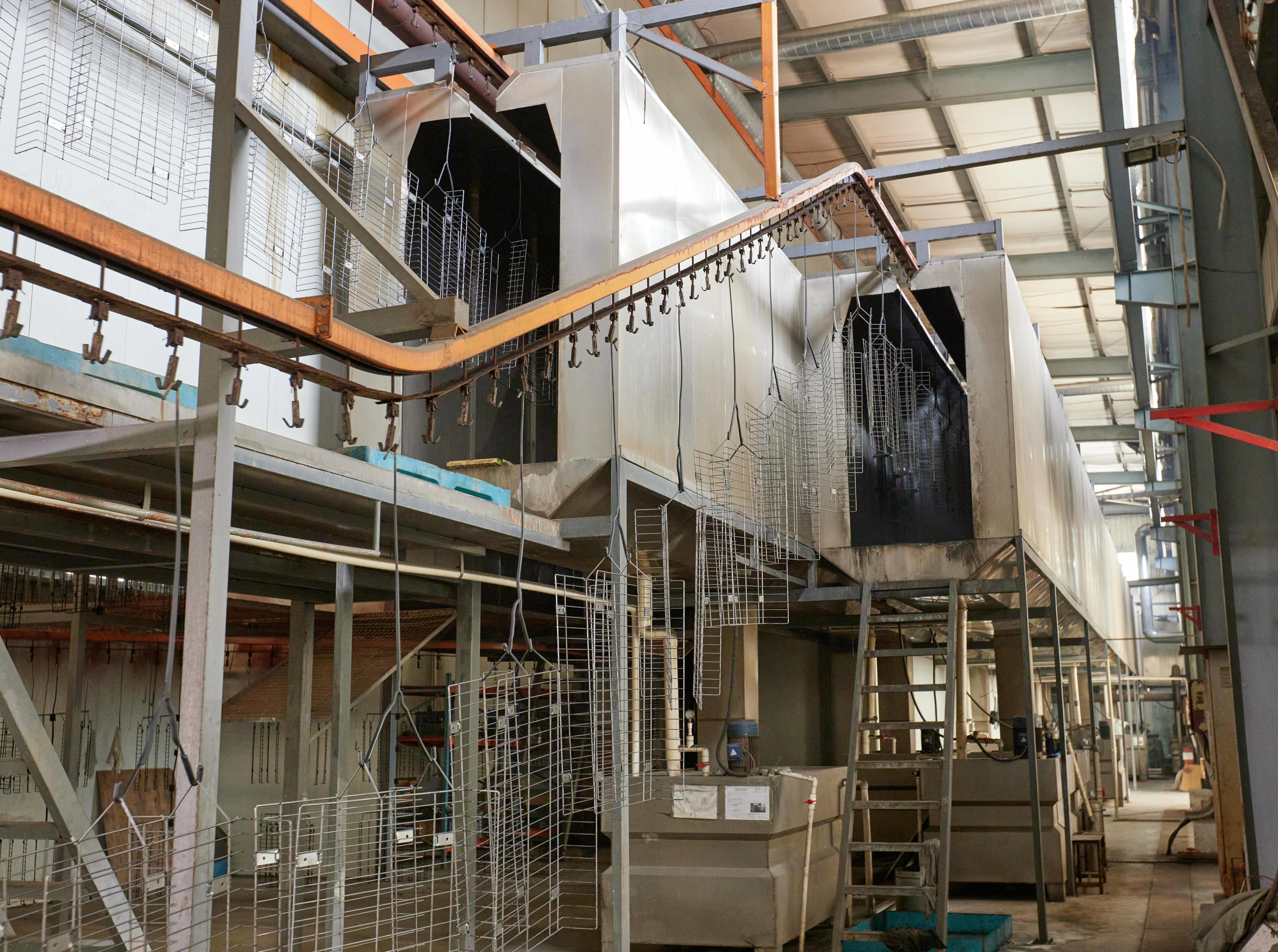
Finish choice interacts with the mode. Qunyi Fixture's coating comparison puts high-gloss baked enamel roughly 30% to 40% above standard spraying cost and notes that surface imperfections on gloss surfaces are magnified under intense retail lighting. On a sea lane with multiple handlings, a matte or semi-matte powder coating hides minor abrasion and fingerprints and is easier to maintain on the shop floor. A high-gloss brief remains achievable, but it justifies the upgraded wrap and a stricter loading plan.
Where the fixture is headed for a humid coastal store rather than a dry inland one, the invisible specification matters as much as the visible one. Degreasing, rust removal and ceramic conversion pretreatment are what keep powder coating from blistering and flaking in salt-laden air once the fixture is installed; no amount of wrapping compensates for a skipped pretreatment step, and the buyer cannot see the difference at delivery.
Both comparisons share one condition worth repeating: cost differences of this kind are only meaningful between quotes prepared on the same size, specification and quantity. A packing upgrade priced against a different carton is not a comparison.
Shelf construction changes the cube and the kilo at the same time
Material decides both how much load a bay carries and how much the shipment weighs, and those effects pull in different directions. Qunyi Fixture's comparison of a 25 mm thickened MDF shelf against a 1.2 mm bent sheet metal shelf with stiffeners and hemmed edges records that, over a one-metre span, the MDF shelf reaches an ultimate load capacity of about 30 kg while the folded steel shelf holds roughly 80 to 100 kg without sagging. The steel section gets there through a folded I-beam type structure that is light for its strength; the thick board is heavy and prone to creep under long-term compression.

For freight, a board-heavy configuration adds weight to every unit without adding usable cube, and the penalty lands hardest on express and air chargeable weight. For merchandising, it narrows the fit: folded steel suits supermarket gondola shelving and heavy wall bays carrying hardware, boxed beverages or auto parts, while MDF suits apparel folding sections and light soft furnishings where a wood-grain texture is wanted and single-layer load stays under about 20 kg. Specifying the shelf before choosing the mode prevents the common reversal in which a visually light fixture turns out to be the heaviest line on the invoice.
Express versus sea freight for assembled wall shelving: a decision table
The table compares documented mode characteristics for the same product — fully assembled single-sided wall shelving — rather than live rates. It is a framework for structuring quotes, not a substitute for them.
| Decision dimension | Express / air | Sea freight |
|---|---|---|
| Cost basis | Chargeable weight, i.e. the greater of actual and volumetric weight; premium charged per kilo | Container space or cubic metres; booking cost spread across all units loaded |
| Where it fits | Small urgent sets, replacement bays, launch quantities for one flagship store | Multi-store rollouts, repeatable formats, openings that can be planned months ahead |
| Volume behaviour | Assembled air space is billed as chargeable weight, so bulk is expensive | Empty space still consumes container cube, but cost per unit falls as the container fills |
| Handling profile | More handoffs over a short period; size and weight caps apply | Fewer handoffs over a longer period, with extended dwell at both ends |
| Packing requirement | Full-wrap foam and corner protection usually justified | Full wrap for painted and high-value parts; partial protection possible for galvanised or rugged iron racks |
| Principal damage risk | Impact and stacking damage in transit hubs | Moisture and condensation, loading quality, paint abrasion over long dwell |
| Schedule control | Short window, but capacity constraints near peak periods | Fixed sailing schedules and cut-off dates; port congestion can slip the arrival |
| Working capital | Fast turnover, minimal inventory in transit | Longer pipeline, more stock committed before revenue |
| Not the right choice when | The order is large, heavy or cube-intensive | The opening date cannot absorb schedule risk, or the order is a handful of units |
Two boundaries hold across every row. First, no verified lane-specific rates, transit times or destination charges were available for this analysis, so any cost conclusion has to come from quotes prepared for the actual destination, date and shipment size. Second, express networks impose size and weight limits that can make an assembled wall section unsuitable regardless of budget, which is a feasibility question before it becomes a cost question.
When an assembled shipment is the wrong choice
Assembled delivery solves a labour problem at destination, and that is the only problem it solves. Where the receiving store has an installation crew, or a shopfitting contractor is already mobilised, knock-down flat-pack is the more freight-efficient route and remains Qunyi Fixture's standard export format. The cube saving usually outweighs the assembly hours on a multi-store programme, and flat packing reduces the exposed painted surface per unit as well.
Assembly carries its own quality discipline, and the guidance to store employees is blunt: if screw holes do not align or a shelf will not seat, stop, check for obstructions or incorrect parts, and realign the components rather than forcing a connection. Forced assembly damages coating at the joint and creates exactly the cosmetic defect the wrapping was meant to prevent. A buyer choosing flat-pack should therefore confirm that instructions, labelled parts and a competent crew exist at destination before the container arrives.
Assembled delivery also stops being sensible when the finish is high-gloss on a long route, when the order is too small to fill container space efficiently yet too large for express economics, or when the opening date is fixed and the sailing schedule carries real slippage risk. A hybrid often resolves this: flat-pack for the bulk of the run, expedited assembled units for the bays needed on day one.
Application scenarios where the mode decision changes shape
Perimeter wall run for a supermarket rollout. A regional chain replacing single-sided wall shelving across several sites is the classic sea-freight case: one container load, identical adjustable shelving positions across stores so a spare bay fits any location, and an installation sequence planned around a fixed sailing calendar rather than around the freight invoice.
Single-store remodel with an unmovable opening date. Here the mode splits by sequence. The bays the contractor installs first travel expedited and assembled; the balance of the run fills the container. The premium is paid only on the portion that protects the date.
Seasonal promotional programme. A promotional display rack, promotional stacking display or end cap display rack tied to a campaign date is date-critical by design. Compact promotional units are also the category where assembled express shipment is least penalised, because the cube per unit is small and the number of units is usually limited.
Coastal flagship or humid market. The specification leads the mode. Pretreatment, sealed edges and full-wrap packing are agreed first; sea freight remains viable, but only against a packing specification written into the purchase order.
Mixed-material and illuminated fixtures. Where a wooden display cabinet, wooden cosmetic display or LED display cabinet shares a shipment with metal shelving, the electrical and material-specific questions belong in the RFQ. Buyers should ask the supplier directly which documentation accompanies illuminated or electrical elements for the destination market; this is a document request, not a compliance conclusion the buyer should assume.
Qunyi Fixture's manufacturing and export position in this decision
Qunyi Fixture (Xiamen Qunyi Hardware Co., Ltd.) is a display fixture manufacturer established in 2012, with an R&D centre in Xiamen and production based in Zhangzhou. The company reports a factory footprint of 300,000 square feet, a team of 200 people including five R&D engineers, and an export share of about 80% across the USA, Australasia and the EU. Its product scope covers slatwall and gridwall panels, gondolas, endcaps, display tables, garment racks, bulk display baskets, showcases, risers, countertop displays and cash counters, across metal, wood, glass and acrylic.
For a freight decision, the relevant part of that profile is sequence rather than scale. Design, engineering, prototyping and production sit inside one organisation, so the assembled-or-flat-pack question can be answered against the actual drawing instead of a catalogue item. Packing is confirmed case by case: the standard is double-wall corrugated cartons with PE bags inside and cushioning added as needed, FOB Xiamen is supported, and fumigation-free plywood crates are available where a buyer requires them. Qunyi reports certification to ISO, BSCI and FSC; buyers should obtain the current certificates and their stated scope directly, since certification coverage is a document question rather than a marketing claim.
Public shipment records linked to Qunyi-related consignments describe display fixtures, display racks and accessories, with HS references including 940320 — the classification commonly used for metal racks and display cases — alongside 392690, 732690 and 830220. These records indicate supplier activity; they are not an official customs series and should not be used to estimate market volume or supplier ranking.
Market context, with a definitional caveat
Published 2026 estimates for this category do not agree, and the disagreement is instructive. One commercial research estimate puts the global retail fixtures market at about USD 2.62 billion in 2026, while a separate estimate values the gondola market alone at about USD 4,300.75 million for the same year. The two cannot be added or compared directly: the first covers a broad retail fixture definition, the second a narrower product family with a different classification boundary. For a buyer, the useful reading is that fixture spend is large enough for freight mode to be a recurring line item — not that either figure belongs in a store budget.
A separate North American benchmark published in 2026 puts a 24-foot island supermarket centre-store aisle at approximately USD 5,570 for a five-tier, 84-inch-high configuration. That is an island run, not single-sided wall shelving, so it is not a price for the product discussed here; it does indicate the order of magnitude of fixture value against which a freight premium is being weighed.
A pre-booking checklist for buyers
- Confirm the assembled outer dimensions and the cube per unit in writing, and request a loading plan showing how many units a container will carry.
- Fix the packing specification — wrap coverage, corner protection, pallet or crate — as a line item in the purchase order rather than an assumption.
- Confirm the shipping term and who books the space; under FOB, note where cost responsibility transfers and which surcharges fall to the buyer.
- Approve the packing list, shipping marks and warning labels before the container is loaded.
- Establish the damage claim window and who inspects at destination.
- Obtain current certificates and destination documentation directly from the supplier rather than relying on summary statements.
- Set the sailing or flight schedule against the store opening date with a buffer, and record the buffer in the project plan.
- Settle the coating before the packing: gloss and matte carry different exposure on the same route.
Outlook
As store programmes move toward tighter opening calendars and more frequent format refreshes, the freight decision is drifting earlier in procurement. The pattern visible in the available evidence is not a shift to one mode but a split: container-based sea freight for the repeatable bulk of a wall run, expedited movement for the bays that carry an opening date or a campaign, and a packing specification chosen alongside the finish instead of after it. Buyers who settle assembled versus flat-pack, gloss versus matte, and steel versus board at the RFQ stage receive comparable quotes. Those who settle them at the loading dock receive expensive ones.
Frequently asked questions
- Is express or sea freight cheaper for fully assembled single-sided wall shelving?
- Per unit, sea freight is normally cheaper once a shipment occupies a meaningful share of a container, because the booking cost is spread across many units. Express and air price chargeable weight, and assembled shelving is bulky relative to its mass, so volumetric weight dominates the calculation. For a few urgent units the total express bill can still be lower than a container booking; for a full store rollout it usually is not. Quotes prepared on the exact outer dimensions, destination and shipping date remain the only reliable comparison.
- How much does full EPE wrapping add to packing cost, and what does it prevent?
- Qunyi Fixture's comparison of packing options places full-coverage EPE wrapping at roughly 5% to 15% above partial protection, and records that cross-border shipments using full wrapping reduced the damage rate from about 8% to below 0.5%. Full wrapping mainly prevents paint abrasion and corner damage on high-gloss or high-value parts. Rugged hot-dip galvanised components and warehouse-grade iron racks are the usual candidates for partial protection with bubble wrap and paper corner protectors.
- Can single-sided wall shelving be shipped fully assembled without damage?
- It can be shipped assembled when the packing plan matches the geometry, but the risk profile changes: an assembled unit cannot be nested, so the outer carton is large and every exposed edge and painted face becomes a contact point. Full-wrap foam, corner protection and a confirmed loading plan address the main handling risks. Qunyi Fixture's regular export packing is knock-down flat-pack in double-wall corrugated cartons with PE inner bags and cushioning added as needed, so an assembled shipment is a project-specific arrangement confirmed against the drawing, finish and route rather than a default format.
- What should a buyer confirm about FOB terms before booking?
- Under FOB terms, the buyer's cost responsibility begins once the goods pass the ship's rail, which places ocean freight, destination charges and any demurrage or detention incurred after that point with the buyer. Qunyi Fixture's export guidance states that post-shipment surcharges of this kind are borne by the buyer and that delivery timing to the carrier should be confirmed in writing in advance. Buyers should also confirm the booking party, cut-off dates, shipping marks and warning labels, the packing list, and whether fumigation-free plywood crates are required.
- Does a high-gloss finish survive sea freight better or worse than matte?
- Neither finish is immune to handling, but high-gloss surfaces show marks more readily. Qunyi Fixture's coating comparison notes that high-gloss baked enamel costs approximately 30% to 40% more than standard spraying and that surface imperfections are magnified under intense retail lighting. A matte or semi-matte powder coating hides minor scuffs and fingerprints, which is why it is often paired with long sea pipelines and multiple handlings. High gloss remains appropriate where the visual brief requires it, provided the wrapping specification and loading plan are upgraded to match.
The Qunyi Fixture product and capability brochure can be downloaded here: Qunyi Fixture Brochure (PDF).
Есть вопросы или нужны дополнительные детали?
Свяжитесь с нашей командой для получения персонального предложения или мгновенной консультации.
Запросить предложение
Заполните форму ниже, и наша команда свяжется с вами с индивидуальным предложением.
Прямой чат WhatsApp
Предпочитаете общаться в реальном времени? Напишите нам в WhatsApp для мгновенной помощи и быстрых ответов.
- Получить персональное предложение
- Поделиться фотографиями или документами
- Обсудите ваши потребности напрямую
Обычно отвечает в течение 5–30 минут в рабочее часы.