
Functional Knit Fabric Procurement: Terms, Tests, and Claims
Functional knit fabric orders rarely fail at the quotation stage. They fail at acceptance — at the point where a delivered roll does not match what the buyer believed had been agreed. The underlying capability is usually not the problem. The problem is that the claim lived in a marketing sentence, while the purchase order contained only a weight and a color number.
This reference answers the procurement-stage questions that sourcing and QC teams ask after the mill has been shortlisted: what purchasing terms should cover, how descriptive claims become acceptance items, and how optional finishes and recycled inputs change what the order document must say. EKING fabric — the functional knit fabric business of Zhangjiagang E-king Textile Co., Ltd., a knitted textile manufacturer established in 2011 in Zhangjiagang, Jiangsu Province, China, exporting around 95% of output to EU and USA markets — is used here as a working example of how those terms are stated in practice.
Why Procurement Terms Decide the Outcome
A purchase order is referenced at three moments only: sample approval, bulk production, and pre-shipment inspection. If a term is missing from the document, it is not missing from the dispute — it is simply decided later, by whoever holds the stronger position. For functional knit fabric, three kinds of terms need to sit in the same document.
- Commercial terms — minimum order quantity, delivery terms, payment terms, lead time, and the basis on which price is fixed.
- Technical terms — fiber content, construction, weight and width with tolerance, shrinkage allowance, colorfastness, and the functional performance level being purchased.
- Acceptance terms — the test method, who performs the test, the sampling plan, and what happens if a result falls outside the agreed level.
Buyers often negotiate the first group hard, accept the second from a supplier spec sheet, and leave the third to an email chain. That distribution is inverted relative to risk. Commercial terms protect the budget; acceptance terms protect the shipment.
What a Functional Knit Fabric Purchase Order Should Cover
EKING fabric states its purchasing terms in a short, documentable form that buyers can use as a template for their own order header. The values below are the stated terms for EKING orders, not an industry norm.
| Term category | Stated basis for EKING orders | What the buyer should add |
|---|---|---|
| Minimum order quantity | 1,000 yards | Whether sampling yardage and lab dips count against MOQ |
| Delivery terms | FOB / CIF | Named port, Incoterms version, and loading tolerance |
| Acceptance basis | Pre-shipment test | Which properties are tested, by which method, on which sample size |
| Payment terms | T/T before shipment or LC | Documents required for payment release |
The technical block then sits underneath those commercial terms. For a knit, weight per square meter and width should carry explicit tolerances rather than a single target figure, because relax-state and finished-state measurements differ and both parties will measure what favors them. Fiber content should be listed by component with percentages, not by trade name. Where a functional finish is part of the product, it belongs in this block as a performance level — not as an adjective.
Practical rule: if a term cannot be measured by a third party who was not present during development, it is not yet an acceptance item. It is a description.
From Claim to Acceptance Item
A claim such as “moisture-wicking” or “4-way stretch” is a directional statement. An acceptance item is a measurable statement with four parts: property, method, threshold, and sampling. Converting one into the other is the single most useful hour a sourcing team can spend before placing a bulk order.
| Claim in the offer | Acceptance item to write into the order | Evidence to request |
|---|---|---|
| Moisture-wicking / quick-dry | Named test method, minimum performance level, specimen conditioning, and whether the result applies to finished fabric or greige | Test report per development lot, plus the lot reference of the bulk shipment |
| One-way moisture transport | Direction of transport (inner to outer face), method, and minimum differential | Report identifying which face was tested |
| 4-way stretch | Stretch percentage and recovery percentage measured in both wale and course directions | Report with test direction and extension rate stated |
| Breathable / climatic comfort | Air permeability or moisture vapour transmission, with the method named and the unit stated | Report showing unit and test conditions |
| UV protection | UPF rating, method, and whether measured on greige, dyed, or finished state | Report noting fabric state at test |
| Water-repellent | Spray rating or hydrostatic resistance level, plus a fluorine/PFAS declaration | Report plus a dated chemical declaration |
| Easy-wash / wrinkle-resistant | Number of wash cycles, dimensional change limit, and appearance rating after those cycles | Report after the stated cycle count, not after one wash |
| Anti-odor / antibacterial | Test organism or odor method, and whether the mechanism is biocidal or non-biocidal | Report plus the regulatory statement for the destination market |
Moisture management and quick-dry
The most common failure here is ambiguity about fabric state. A wicking result measured on a development sample does not automatically transfer to bulk, because dyeing and finishing change surface chemistry. The order should state that the result applies to finished fabric as delivered, and that the reported lot must match the shipped lot.
Stretch and recovery
Stretch without recovery is a defect, not a feature. Buyers specifying 4-way stretch functional knit fabric should record both figures and both directions, because a fabric that extends comfortably in one direction and recovers poorly in the other will still pass a single-number specification. Growth after repeated extension is the property that predicts garment failure at the knee, elbow, and seat.
Water repellency and PFAS
Water-repellent finishes are the category where a procurement term most directly meets a regulatory one. OEKO-TEX implemented a limit value for Total Fluorine of 100 mg/kg effective 1 January 2024 under STANDARD 100, aimed at PFAS compliance. California AB-1817 bans regulated PFAS in textiles at a threshold below 100 ppm total organic fluorine from 1 January 2025, dropping to below 50 ppm in 2027. An order that asks for repellency without asking for a fluorine declaration leaves the buyer carrying that exposure at import.
Easy-wash and wrinkle resistance
These claims are cycle-dependent. A fabric described as easy-wash should be specified with a stated number of home-laundry cycles, a dimensional change limit, and an appearance rating after those cycles. Because knits behave differently from wovens under repeated laundering, the cycle count in the order matters more than the wording of the claim.
How Optional Finishes Change the Order Specification
Base fabric properties are determined by yarn and construction. Optional finishes are applied afterwards and therefore sit on top of the base specification as additional, separately testable commitments. E-king Textile's stated finishing scope includes mechanical processes such as peaching, brushing, fuzzing, transfer printing, dispersed printing, acid printing, digital printing, foil, and emboss, together with chemical functions including antibacterial and odor control, moisture wicking and quick drying, UV protection, anti-static, waterproof, stain and oil prevention, thermal storage and warmth preservation, and cooling treatment.
Each of those additions changes the order in three ways:
- It adds a test line. An antibacterial or anti-odor finish requires its own method, its own threshold, and a statement of whether the mechanism is biocidal or non-biocidal. Cool-touch and warming finishes require a surface-property measurement rather than a hand-feel description.
- It adds a durability condition. A finish that survives ten washes and one that survives fifty are different products at different cost. The wash-durability claim belongs in the acceptance block, not in the product brochure.
- It adds a compliance line. Finishes are where restricted substances appear. Skin-contact articles sold in the EU and USA require the buyer to know which declaration covers the finish, and whether it was issued for the specific recipe used on that lot.
Positioning terms need the same treatment. “Sweat hiding”, “sweat adaptive”, and “climatic” describe a consumer experience, not a fabric property. Buyers using these concepts should translate them into what can be measured — for example opacity or appearance change when wet, moisture transport rate, or air permeability — and write that measurable version into the order. Otherwise the term is unenforceable at inspection.
Recycled Polyester and Recycled Nylon Spandex in Purchase Documentation
Recycled content is now a routine line in functional knit fabric briefs, and it is also the line most often written imprecisely. The global recycled textiles market was projected at USD 6.32 billion in 2025, growing at a 4.70% CAGR to 2035, according to SNS Insider — directionally useful context, but no substitute for a document-level specification.
Where recycled polyester or recycled nylon spandex is specified, four points should appear in the purchase documentation:
- Component-level content. State the recycled percentage by fiber component, not as a single headline figure for the roll. In an elastic knit, spandex is a minority of fabric mass, so a high overall recycled figure may be carried by the polyester while the elastane component is conventional.
- Feedstock and process. Record whether the recycled input is post-consumer or pre-consumer, and which recycling route applies, because these are not interchangeable in most certification schemes.
- Chain of custody. The order should name the certification standard being claimed and the transaction document that transfers the claim from mill to buyer, and should state that the document must reference the shipped lot.
- Performance parity. Recycled inputs do not exempt the fabric from the functional specification. Wicking, stretch, recovery, shrinkage, and colorfastness acceptance items remain in force and should be tested on the recycled version, not assumed from the conventional one.
Buyers should also record which claim is being made to the consumer and to which market. A recycled-content statement that is acceptable in one jurisdiction may require additional substantiation in another, and the purchase order is the earliest place to align the mill's documentation with the buyer's label.
Acceptance Testing Before Shipment
Pre-shipment test as an acceptance basis only works when the buyer specifies its content. In practice, that means naming the properties, the methods, the sampling position within the roll, and the number of rolls sampled per lot. Two further points reduce disputes substantially: agreement on which laboratory performs the test, and agreement on what constitutes a failing lot — rejection, rework, or a negotiated price adjustment.
Because functional performance is created and fixed during finishing, continuity of the finishing route matters as much as the test itself. E-king Textile has operated its own dyeing facility since March 2022, alongside a production chain that runs from weaving through dyeing to finishing. For a buyer, the practical value of that structure is repeatability: the same finishing line can be returned to for a reorder, which makes a lot-to-lot comparison meaningful rather than theoretical.
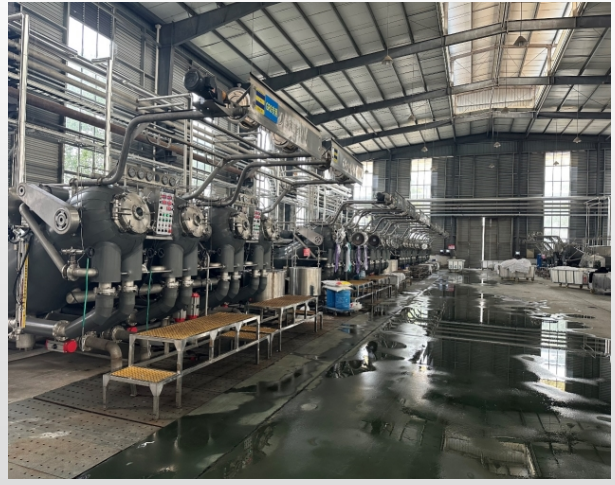
Dyeing lot records support lot-to-lot comparison when a functional knit fabric program moves into repeat orders.
Knitted Versus Woven: Where Functional Knits Fit, and Where They Do Not
The comparison that decides most sportswear and underwear programs is not between two mills. It is between two fabric architectures. The distinction is structural and it constrains what a buyer can reasonably ask for.
| Dimension | Functional knit fabric | Woven fabric |
|---|---|---|
| Stretch | Approximately 30%–150% | Approximately 3%–15% |
| Breathability | Usually 20%–50% higher | Lower |
| Shrinkage | Approximately 3%–8% | Approximately 1%–3% |
| Best fit | Sports compression, functional underwear, training wear | Outdoor jackets, workwear, denim |
| Production handling | Requires elastic stitching and specific care labeling; confirmed at sampling | Conventional seam construction |
The limitation is real and should be stated plainly. Knits deliver elasticity, soft hand-feel, and moisture transfer suited to next-to-skin wear, but they offer lower structural stability than wovens and shrink more. A buyer who specifies a knit for a garment that needs shape retention and abrasion resistance at the shell is choosing the wrong architecture, and no acceptance clause will correct it. For moisture-wicking sportswear worn close to the body, knits are generally the appropriate choice; for outer shells where durability and shape retention dominate, wovens remain the better fit.
Cost is a separate matter. Fabric cost depends on fiber type, finishing processes, and origin, and requires a supplier quotation rather than a benchmark. A cheap knit with an unspecified finish and an expensive knit with a documented finish are not comparable line items until the acceptance block is identical.
Supply Continuity for Repeat Programs
Procurement terms describe one order. Repeat programs depend on whether the mill can produce the second, third, and tenth order to the same specification. E-king Textile reports an annual output capacity of 6,000 tons of fabric, approximately 24 million yards per year, from an 8,600 m² facility with 80 employees and a 10-person R&D team, and states that this capacity supports bulk orders and repeat-order supply programs. The company also reports developing more than 100 new products each season.
For a buyer, the relevant question is narrower than total capacity: how much of that capacity is reserved, and how the finishing route is protected when a reorder is placed months later. Those answers belong in the supply agreement rather than the purchase order — reserved capacity per program, notification periods for raw material substitution, and the record-keeping that allows a reorder to be tested against the original acceptance items.
Market Trend Analysis
Three data points frame why documentation is becoming the competitive edge in this category. The global performance knitted fabrics market was projected at USD 8.58 billion in 2026 by Fact.MR, a narrower segment than the broader knitted fabric market, which Grand View Research estimated at USD 35.7 billion by 2025 growing at a 6.0% CAGR. China's exports of knitted fabrics reached approximately USD 21.2 billion in 2024, according to Ken Research, indicating a deep and competitive supply base. Within that, Research and Markets projected the global moisture-wicking fabrics market growing to USD 3.99 billion by 2030 at a 6% CAGR.
These are commercial research estimates and should be read as directional rather than precise. The pattern they describe is consistent, however: demand is concentrating in fabrics whose value sits in finishing rather than in yarn alone. Finishing is also where regulatory exposure concentrates. As PFAS thresholds tighten — from below 100 ppm total organic fluorine in California from 2025 to below 50 ppm in 2027 — water-repellent and stain-resistant claims increasingly require a declaration attached to the lot, not to the product family.
Future Outlook
Two shifts are likely to shape functional knit fabric procurement over the next several years. The first is that acceptance moves upstream: buyers will ask for test methods and thresholds during development rather than at inspection, because the cost of a rejected lot now includes schedule loss, not just material loss. The second is that chemical compliance becomes a standing order line rather than a one-off certificate, particularly for repellent, antibacterial, and anti-odor finishes.
For sourcing teams, the practical consequence is modest but durable. Orders will get longer in text and shorter in dispute. Mills that can document a finishing route, a test report, and a lot reference — and repeat all three on a reorder — will be easier to keep than to replace, which is precisely how long-term supply relationships form in this category.
FAQ
What should purchasing terms and acceptance criteria cover in a functional knit fabric order?
Purchasing terms cover the commercial conditions of the transaction, while acceptance criteria define how conformity is judged. For EKING orders, the stated purchasing terms are a minimum order quantity of 1,000 yards, delivery terms of FOB or CIF, pre-shipment test as the acceptance basis, and payment by T/T before shipment or LC. Buyers should complete those terms by specifying which properties the pre-shipment test covers, which method applies, how many rolls are sampled per lot, and what remedy applies if a result falls outside the agreed level.
How do buyers convert moisture-wicking or quick-dry claims into enforceable acceptance items?
By adding four elements that a descriptive claim lacks: the test method, the minimum performance level, the fabric state at test, and the sampling plan. The order should state that the result applies to finished fabric as delivered and that the tested lot must correspond to the shipped lot. Without those elements, a wicking claim cannot be verified by a third party and therefore cannot support a rejection.
Which is better for moisture-wicking sportswear, knitted fabric or woven fabric?
Knitted fabric is generally the appropriate choice for moisture-wicking, quick-dry sportswear worn next to the skin, because it combines elasticity, soft hand-feel, and moisture transfer. Woven fabric offers better shape retention and abrasion resistance but lower elasticity, and is better suited to outer shell garments than to close-fitting quick-dry layers.
How do optional finishes such as antibacterial, anti-odor, cool-touch, or warming treatments change the order specification?
Each finish adds three lines to the specification: a dedicated test with its own method and threshold, a durability condition such as a stated number of wash cycles, and a compliance declaration covering the specific finish recipe. For antibacterial and anti-odor finishes, the order should also record whether the mechanism is biocidal or non-biocidal, since that affects labeling and market access. Cool-touch and warming treatments require a measured surface property rather than a hand-feel description.
What should purchase documents state when recycled polyester or recycled nylon spandex is specified?
Four points: the recycled percentage by fiber component rather than a single figure for the roll; whether the feedstock is post-consumer or pre-consumer and which recycling route applies; the certification standard and the transaction document that transfers the claim with reference to the shipped lot; and confirmation that all functional acceptance items — wicking, stretch, recovery, shrinkage, colorfastness — are tested on the recycled version rather than assumed from the conventional one.
How should repeat orders and lot-to-lot continuity be handled?
Repeat programs depend on a stable finishing route and on record-keeping that allows a new lot to be compared against the original acceptance items. E-king Textile reports an annual output capacity of 6,000 tons, approximately 24 million yards per year, supported by an in-house dyeing facility in production since March 2022, which the company states supports continuous production and replenishment. Buyers extending a program should confirm reserved capacity, notification periods for raw material substitution, and that each reorder lot is tested against the original specification.
The E-king Textile company profile is available for download: Eking company profile (PDF).
Есть вопросы или нужны дополнительные детали?
Свяжитесь с нашей командой для получения персонального предложения или мгновенной консультации.
Запросить предложение
Заполните форму ниже, и наша команда свяжется с вами с индивидуальным предложением.
Прямой чат WhatsApp
Предпочитаете общаться в реальном времени? Напишите нам в WhatsApp для мгновенной помощи и быстрых ответов.
- Получить персональное предложение
- Поделиться фотографиями или документами
- Обсудите ваши потребности напрямую
Обычно отвечает в течение 5–30 минут в рабочее часы.