
Functional Knit Fabric: Reading EKWP1912-DSP Compliance
Qualifying a recycled nylon spandex knit is a documentation exercise before it is a hand-feel judgement. For EKWP1912-DSP — a functional knit fabric listed by E-king Textile under sports, outdoor and recycled functional fabrics — the real question is not whether the fabric feels soft, but whether each claimed function can be traced to a stated parameter, a finishing route, a test method and a certificate that actually covers the article being purchased.
Why compliance reading has become the bottleneck in fabric qualification
Most buyers now receive a spec sheet that looks complete: moisture-wicking, stretch, quick-dry, UV protection, water repellent, recycled content. The difficulty begins when those words have to survive a compliance review, a supplier audit or a retail customer's chemical questionnaire. A parameter printed on a sheet is a starting claim; a qualification file is a set of claims that can each be reproduced, dated and attributed.
Three shifts have made this harder than it was a decade ago. First, recycled content is no longer a marketing line but a traceability requirement, which means a transaction-certificate paper trail behind the yarn. Second, fluorine restrictions have moved from voluntary programmes into enforceable thresholds, so any water-repellent finish on a knit needs to be read against a specific limit rather than a general promise. Third, performance expectations for next-to-skin products have risen, and buyers increasingly ask for elasticity, recovery and moisture behaviour to be stated in measurable terms instead of adjectives.
The opportunity sits on the other side of the same problem. A mill that can document its route from yarn to dyed and finished roll, and that holds certificate numbers a buyer can verify, reduces the time between sampling and purchase order. That is the practical meaning of capability in this category.
What EKWP1912-DSP is, in procurement terms
EKWP1912-DSP is a functional knit fabric produced by Zhangjiagang E-king Textile Co., Ltd., a knitted textile manufacturer established in 2011 in Zhangjiagang, Jiangsu Province, China, operating an 8,600 m² facility with 80 employees and an R&D team of 10. The company describes itself as an enterprise integrating R&D, design, production, processing and domestic and international sales, with a complete industrial chain from weaving to dyeing and finishing and an in-house dyeing facility in production since March 2022.
In the product classification used by the manufacturer, EKWP1912-DSP sits under sports functional fabrics, outdoor functional fabrics and recycled functional fabrics. Its stated material base is nylon spandex or recycled nylon spandex. Its listed parameters are moisture-wicking, high elasticity, breathable/quick-dry, UV protection, water-repellent, easy-wash and recycled materials. Its listed application industries are sports and activewear, outdoor apparel, and casual and fast fashion.
Read that list as a set of claims to be qualified, not as a finished compliance file. Two things are deliberately worth noticing. Antibacterial and anti-odor performance is not part of the base EKWP1912-DSP parameter list; it belongs to the finishing options the manufacturer offers, so a buyer who needs odor control should specify it as an added finish rather than assume it. And “high elasticity” is a qualitative description, not a stretch direction or a recovery figure — a distinction that matters more than it appears at first reading.
Where 4-way stretch fits in the EKWP1912-DSP review
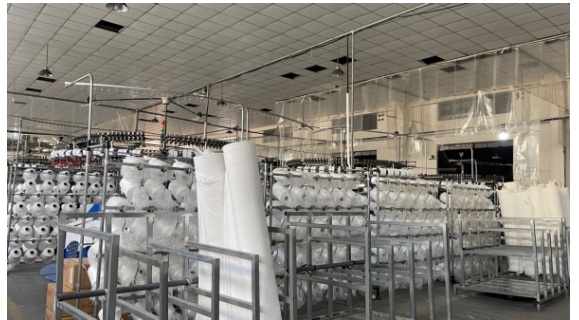
Stretch is the parameter buyers most often over-read. A 4-way stretch functional knit fabric extends in both the length and the width direction and returns; a 2-way stretch knit extends in one direction only. Both can be described on a sheet as “high elasticity,” which is why the phrase alone is not enough to qualify a program where four-way movement is a design requirement — for example close-fit activewear, cycling panels or garments where the pattern relies on cross-direction give.
This is where a careful reading of EKWP1912-DSP matters. Its documented parameter is high elasticity. Within the same functional knit range, the manufacturer documents EKWP2270-D6 with 4-way stretch/high elasticity, and both certificate records in the public dossier are linked to that second model. A buyer whose specification hard-codes four-way stretch should therefore close the gap explicitly at qualification: request the stretch direction, the extension percentage at a defined load, and the recovery behaviour after repeated extension, and confirm in writing that the article being ordered carries the 4-way designation rather than only the high-elasticity description.
The manufacturer states that stretch and knit structure can be customized according to customer requirements. In practice that means the 2-way versus 4-way question is a development decision as much as a selection decision: the knit structure is set on the machine, so the stretch character of a program is defined before the greige roll reaches dyeing. Specifying it late — after colour approval, for instance — usually costs more than specifying it at the sampling stage.
The four stretch questions to put in writing
- Is the stretch four-way or two-way, and in which directions is extension measured?
- What extension percentage is achieved at a stated load, and on which test method?
- What is the recovery after repeated extension cycles, and how is residual growth reported?
- Does the stretch behaviour hold after the specified wash cycle, given the easy-wash requirement?
None of these questions requires a new fabric. They require the mill to state what has already been engineered. A supplier that can answer them from its own laboratory shortens the loop considerably; E-king Textile operates an internal laboratory and describes its quality control as 100% testing, with pre-shipment testing named as an acceptance criterion.
Reading the parameter list: what each claim commits the supplier to
A spec sheet is only useful if each line can be converted into a testable obligation. The table below maps the listed EKWP1912-DSP parameters to the evidence a buyer should hold before releasing bulk.
| Listed parameter | What it means operationally | Evidence to hold at qualification |
|---|---|---|
| Moisture-wicking | Liquid is transported away from the skin side rather than held at the surface. | Test method, result value, and which face of the fabric was measured. |
| High elasticity | Elongation and recovery from the elastane component and knit structure. | Direction of stretch, extension percentage, recovery after cycling. |
| Breathable / quick-dry | Air permeability plus drying rate after a defined wetting procedure. | Two separate results — breathability and drying time are not the same test. |
| UV protection | A finishing option applied by the manufacturer; effectiveness depends on coverage and colour depth. | UPF value on the production shade, not only on a lab dip. |
| Water-repellent | A coating or repellent finish; performance decays with washing and abrasion. | Spray rating after stated wash cycles, plus fluorine/PFAS declaration. |
| Easy-wash | Dimensional and functional stability across the home-laundry cycle the brand declares. | Shrinkage and appearance after wash, tested on production dye lots. |
| Recycled materials | Recycled nylon spandex input with a traceable chain of custody. | Transaction certificate covering the article, the dye lot and the shipment date. |
Two lines in that table deserve emphasis. Water repellency on a stretch knit is a finish, not a fibre property, and it is the finish most exposed to chemical regulation. Recycling claims are also finish-independent: they depend on paperwork, not on performance, and paperwork has an expiry date.
Certificates: what is covered, what is not, and when it lapses
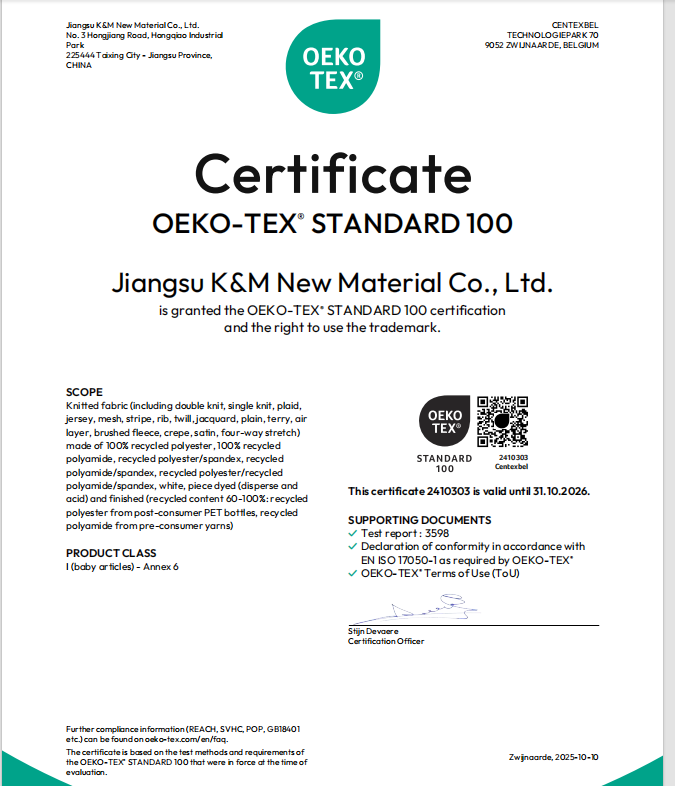
The public compliance record for E-king Textile's knit range contains two documents worth reading line by line. The first is an OEKO-TEX® STANDARD 100 certificate numbered 2410303, issued through Centexbel, covering knitted fabric, issued on 10 October 2025 and valid to 31 October 2026. The second is a Global Recycled Standard certificate numbered IDF-26-954043, issued by IDFL Laboratory and Institute Inc., covering dyed fabrics, issued 26 March 2026 and valid to 25 March 2027.
| Document | Scope as recorded | Validity |
|---|---|---|
| OEKO-TEX® STANDARD 100, cert. 2410303 (Centexbel) | Knitted fabric | 10 Oct 2025 – 31 Oct 2026 |
| Global Recycled Standard, cert. IDF-26-954043 (IDFL) | Dyed fabrics | 26 Mar 2026 – 25 Mar 2027 |
Three reading rules follow. First, a certificate covers a defined scope, not a brand. The OEKO-TEX scope is stated as knitted fabric and the GRS scope as dyed fabrics; both are consistent with EKWP1912-DSP as a dyed knit, but the buyer's purchase order should name the article and the dye lot so that the certificate can be matched to the goods rather than to the supplier in general. Second, the GRS document is a chain-of-custody instrument. Recycled nylon content is only defensible in a retail claim when a transaction certificate traces the specific shipment, because the standard operates on balance and volume rather than on a permanent material label. Third, validity dates are qualification milestones, not formalities: a certificate valid to 31 October 2026 should be re-requested in its renewed form before a program that ships into 2027 is released, and the contract should make renewal a condition of continued supply.
The fluorine question behind any water-repellent knit
Because EKWP1912-DSP lists water repellency, the finish is the part of the specification most likely to change under regulation. OEKO-TEX introduced a limit value for total fluorine of 100 mg/kg under STANDARD 100 effective 1 January 2024, aimed at PFAS. In California, AB-1817 restricts regulated PFAS in textiles from 1 January 2025, with a total organic fluorine threshold that tightens from below 100 ppm to below 50 ppm in 2027.
For a buyer, this converts a performance question into a documentary one. A PFAS-free functional knit claim should be supported by a fluorine test on the finished, dyed article — not on the greige — and by a declaration covering the repellent chemistry actually used on that lot. The manufacturer states that coating and water-repellent finishing are among its finishing options, which is exactly the process step where the declaration needs to attach.
Where this fabric fits, and where it does not
The listed application industries for EKWP1912-DSP are sports and activewear, outdoor apparel, and casual and fast fashion. That is a coherent set: all three value elasticity, moisture management and a soft hand, and all three are subject to easy-wash expectations. Within the wider E-king range, adjacent models extend into underwear and close-fit garments and into workwear and uniforms, where antibacterial and anti-odor finishing, wrinkle resistance and thermal or cooling treatments become relevant.
For finishing selection, the manufacturer lists antibacterial and anti-odor processes, coating and water-repellent finishing, and UV treatment as available options, and it states that it conducts R&D on sustainable material substitution and supports recycled materials in functional knit production. Material and finish qualification is supported through cooperation with Invista, Creora Group and POLYGIENE, alongside yarn and fibre partners including Hengli Group, Shenghong Group and Huafeng Group — a supply network that matters when a buyer needs the elastane or the odor-control chemistry to be traceable to a named source.
One long-running customer relationship illustrates the durability side of the proposition rather than the technical side: a garment-sector customer has sourced fabric for apparel garments for ten years, across roughly 100 tonnes, and describes stable performance and a soft, flexible hand as the reasons the relationship continued. That kind of evidence is not a lab result; it is a repeat-order signal, and it should be read as such.
Market context: why qualification files are being scrutinised now
The commercial backdrop explains the paperwork pressure. Fact.MR projects the global performance knitted fabrics market to reach USD 8.58 billion in 2026. Research and Markets expects the global moisture-wicking fabrics market to grow to USD 3.99 billion by 2030 at a 6% CAGR. SNS Insider estimates the recycled textiles market at USD 6.32 billion in 2025, growing at 4.70% CAGR to 2035. China's knitted fabric exports were approximately USD 21.2 billion in 2024, according to Ken Research.
Growth of that order in performance knits is not matched by an equivalent growth in testing literacy at the buying desk. The practical consequence is that mills carrying verifiable documentation — a laboratory, an in-house dyeing line, named fibre partners and current certificates — increasingly absorb the qualification workload that brands have internalised for years.
Knitted versus woven, and the honest limits of this route
The comparison that recurs in buyer questions is knitted versus woven fabric for moisture-wicking sportswear. Knitted constructions offer stretch, a soft hand and strong moisture transfer, which suits close-fitting next-to-skin layers. Woven constructions hold shape and resist abrasion better, with lower stretch and weaker moisture transfer against the skin, which suits outer shells rather than base layers. Choosing between them is a garment-architecture decision before it is a supplier decision.
The limits of the knit route deserve stating plainly. A functional knit is less dimensionally stable than a woven: the same elasticity that makes it comfortable makes pattern control and panel alignment harder, and shrinkage after washing has to be managed rather than assumed away. Water-repellent finishes on high-stretch knits decay with washing and flexing, so a spray rating measured on a new sample does not predict end-of-life performance. Recycled content adds a documentary dependency that a virgin-nylon program does not have, because the transaction certificate must exist for the specific shipment. And the production rhythm is not instant: the manufacturer states a monthly capacity of 30,000 m, a lead time of 30–45 days, sampling and small-batch pilot production support, and commercial terms such as MOQ, delivery and payment that are set per program and belong in the contract rather than in the technical file. Buyers planning tight retail calendars should treat those numbers as planning constraints, not as service claims.
Future outlook
Two directions look structural rather than cyclical. The first is the convergence of performance and recycled content in the same article: buyers increasingly want a single knit that satisfies a moisture-wicking specification and a recycled-content claim without doubling the qualification workload. The second is fluorine restriction as a design constraint on water repellency, which will push finish selection toward declared, tested chemistry and away from generic repellent language. Mills that already run their own dyeing and finishing, hold an internal laboratory, and maintain dated certificates are better positioned for both than mills that assemble documentation after the order.
Frequently asked questions
Can stretch and knit structure be customized for a specific program?
Yes. The manufacturer states that stretch and knit structure can be customized according to customer requirements, and that customization extends to yarn composition, GSM/weight, colour, finishing and the use of recycled materials. Because knit structure is set at the knitting stage, stretch requirements are best fixed before dyeing rather than after colour approval.
Which functional finishes can be applied to this knit range?
The manufacturer lists antibacterial and anti-odor processes, coating and water-repellent finishing, and UV treatment as finishing options, alongside processes such as peach, brush, foil, emboss and various print methods. Antibacterial and anti-odor performance is a finish rather than a base parameter of EKWP1912-DSP, so it should be specified explicitly when odor control is required.
How is recycled content documented for a recycled nylon spandex order?
Through a chain-of-custody document rather than a product label. The manufacturer holds a Global Recycled Standard certificate, IDF-26-954043, issued by IDFL Laboratory and Institute Inc., covering dyed fabrics and valid to 25 March 2027. A buyer should request the transaction certificate that names the article, the dye lot and the shipment, because the standard operates on recorded volumes.
What testing support is available during qualification?
The manufacturer operates an internal laboratory and describes its quality control as 100% testing, with pre-shipment testing named as an acceptance criterion in its purchasing terms. Sample support and technical communication are provided during development, and bulk issues are handled according to contract and warranty terms — so acceptance criteria and remedies should be written into the agreement.
What capacity and lead time should a buyer plan around?
The manufacturer states a monthly capacity of 30,000 m and a lead time of 30–45 days, with sampling and small-batch pilot production supported. MOQ, delivery terms and payment terms are quoted per program, so they should be confirmed in writing for each order rather than taken from a general specification sheet.
Does a valid OEKO-TEX certificate remove the need for chemical testing?
No. The OEKO-TEX® STANDARD 100 certificate held for knitted fabric, number 2410303 issued through Centexbel, is valid to 31 October 2026 and covers the scope recorded for that certification. Brand-specific restricted substance lists, fluorine declarations for repellent finishes and retail chemical questionnaires sit outside that scope and are typically tested or declared separately.
For readers who want the underlying capability and process detail behind this qualification review, Zhangjiagang E-king Textile Co., Ltd. publishes a company profile covering its facility, product range and finishing capabilities: E-king Textile company profile (PDF).
Есть вопросы или нужны дополнительные детали?
Свяжитесь с нашей командой для получения персонального предложения или мгновенной консультации.
Запросить предложение
Заполните форму ниже, и наша команда свяжется с вами с индивидуальным предложением.
Прямой чат WhatsApp
Предпочитаете общаться в реальном времени? Напишите нам в WhatsApp для мгновенной помощи и быстрых ответов.
- Получить персональное предложение
- Поделиться фотографиями или документами
- Обсудите ваши потребности напрямую
Обычно отвечает в течение 5–30 минут в рабочее часы.