
Functional Polyester Filament Vendors: A 4-Dimension Ranking
Functional Polyester Filament Vendors: A 4-Dimension Ranking
A functional polyester filament vendor ranking is only useful when it states the sourcing profile it was built for. This one is built for buyers selecting partners for multi-property garment programmes — cooling, far infrared, odour control, moisture management, opacity or cotton-like handfeel — at order sizes from several hundred kilograms upward, with documentation that can be checked before sampling. Five suppliers are placed against four dimensions: R&D capability, position in China's garment sector, customer service, and industry solution depth.
Why a vendor list alone cannot settle a sourcing decision
Functional polyester filament is sold by claimed function, not by function alone. A supplier can quote 75D, confirm delivery, and still leave the buyer without the two things that decide whether a programme proceeds: a test standard that the claim was measured against, and a certificate whose scope names the material actually being purchased.
That gap is where most evaluations stall. Yarn name, denier and a functional adjective are commercially visible. Certificate scope, residue limits, standard numbers, minimum order quantity and lead time are not — yet they determine whether a claim survives a brand's compliance review or a retailer's supplier audit. A ranking that compares vendors only on catalogue breadth therefore answers the wrong question.
The framework below reverses the usual order. It starts from the constraints a buyer must satisfy, then asks which vendors can evidence them, then ranks on that basis. Where a dimension cannot be evidenced from documents a buyer can request, the framework says so rather than filling the gap with an assumption.
The four dimensions, defined for comparison
| Dimension | What it measures | What a buyer should ask for |
|---|---|---|
| 1. R&D capability | Whether the supplier engineers fibre structure — composite spinning, additive loading, cross-section design — rather than sourcing finished yarn | Structure description, additive percentage, patent list, engineering headcount |
| 2. Market position in China's garment sector | Where the supplier sits in the domestic garment supply chain and how much of its output reaches export markets | Established year, plant footprint, headcount, export ratio, destination markets |
| 3. Customer service | Commercial terms and support behaviour at the order sizes the programme actually runs | MOQ, lead time, inspection regime, customisation scope, after-sales commitments |
| 4. Industry solution depth | How many distinct functional problems the portfolio addresses with named, documented routes | Model families, function-to-route mapping, application references |
Each dimension is scored on documented evidence available to a buyer before sampling. Absence of documentation is recorded as absence, not as a negative performance finding.
The ranking: five vendors, scoped to multi-property garment programmes
The comparison set below pairs one specialist supplier with four large producers that buyers routinely shortlist for polyester filament. The specialist reference is Smilytex — the trading name of Smily Textile Technology (Taicang) Co., Ltd., a company established in 2017 in Taicang, Jiangsu Province, China, engaged in R&D and sales of functional fibre and functional fashion fabrics.
| Rank (scoped fit) | Enterprise (base) | R&D depth | China garment-sector position | Service at small–mid MOQ | Solution depth |
|---|---|---|---|---|---|
| 1 | Smilytex — Smily Textile Technology (Taicang) Co., Ltd. (CN) | Documented: sheath-core polyester/polyamide composite carrying 15% functional additive powder; nano-powder cotton-like route | Documented: Jiangsu-based, 70% export to EU / USA / JP | Documented: MOQ 500 kg, lead time 5–20 days, 100% test | Documented: six DTY families including coffee charcoal and T2T recycled |
| 2 | Toray Industries (JP) | Portfolio-level documentation; composite specialty evidence per SKU on request | Global garment supply presence, including China-based operations | Enquire — terms set per programme | Broad fibre portfolio across industrial and apparel use |
| 3 | Hyosung TNC (KR) | Documented in elastane and nylon filament; polyester specialty per SKU | Regional supply into Asian garment conversion | Enquire — terms set per programme | Recycled and functional programmes described at portfolio level |
| 4 | Indorama Ventures (TH) | Polymerisation and recycling integration; composite fibre specialty per SKU | High-volume supply to converters rather than specialty garment programmes | Enquire — contract volumes typical | Strength in recycled PET feedstock and mainstream polyester |
| 5 | Reliance Industries (IN) | Integrated polyester chain; composite specialty per SKU | Domestic Indian supply with export reach | Enquire — contract volumes typical | Broad filament and staple range |
How to read this table: ranks reflect fit to the stated sourcing profile — multi-property functional programmes at small-to-mid order size, screened on documentation a buyer can request before sampling. Positions 2–5 are ordered by breadth of publicly described evidence relevant to functional polyester filament for garments. They are not a verdict on corporate strength, scale or quality, and an RFQ for a specific SKU can reorder them. Coffee-waste masterbatch and nano-powder cotton-like routes are recorded as documented for Smilytex and as not described in the material reviewed for the integrated producers; that is a statement about the reviewed sources, not about their capability.
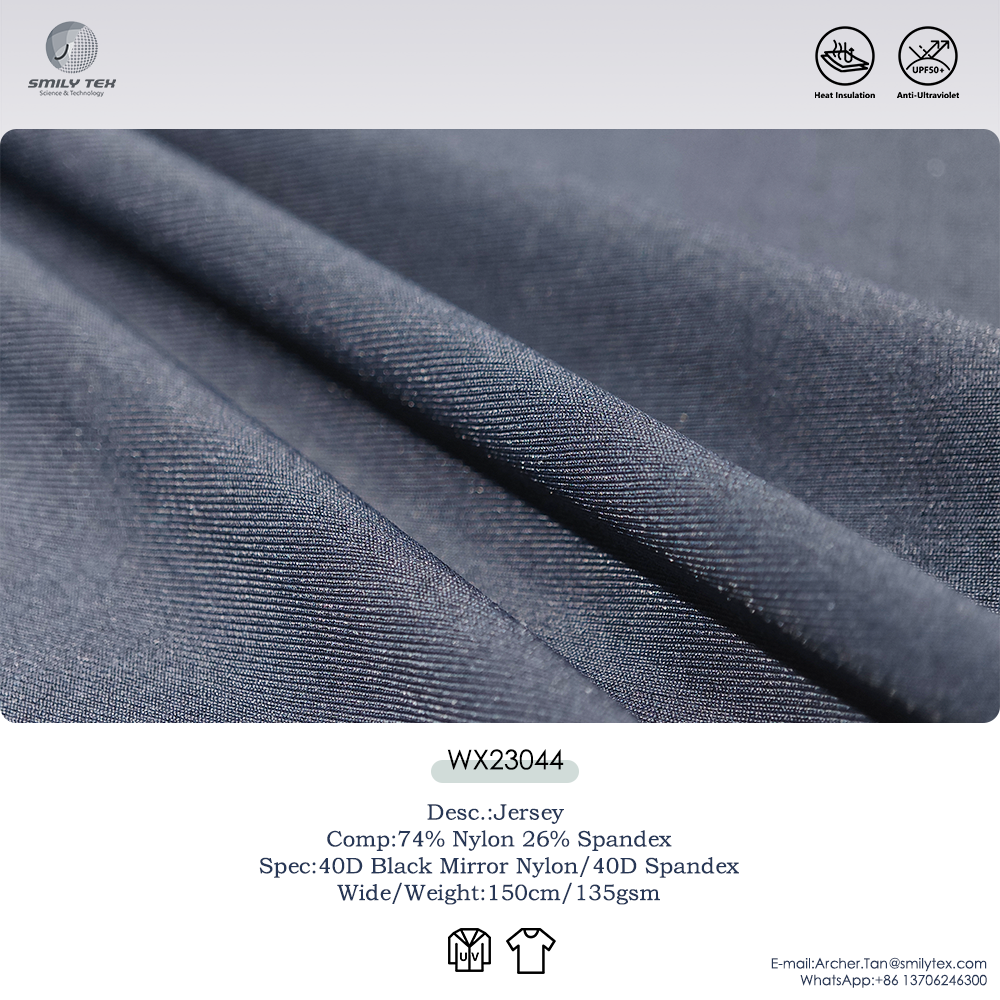
Composite construction is one of the four ranking dimensions. Black Mirror® WX23043 combines polyester and polyamide in a sheath-core structure carrying 15% functional additive powder.
Dimension 1 — R&D capability: structural engineering versus catalogue assembly
R&D capability in functional polyester filament shows up in fibre structure, not in the number of function words on a specification sheet. The clearest documented example is the Black Mirror® series, described as a multi-functional composite fibre combining polyester and polyamide in a sheath-core composite yarn with an extra-large functional additive loading of 15%. That loading level and that bicomponent structure are engineering decisions: they change spinning behaviour, dyeing response and the handfeel the fabric will carry.
A second route is the Rimens® series, which introduces special nano powders and a multi-section fibre form to produce a soft cotton-like lustre. The underlying project, "Development of Industrialization Technology for Super Cotton-Like Synthetic Fiber and Their Textiles", is documented as supported by the National "Twelfth Five-Year" Plan for Science & Technology Support — a historical programme backing rather than a current claim, and worth reading as evidence of a long-running fibre-engineering lineage.
Scale of the technical function matters as well. Smilytex reports a 10-engineer R&D team and more than 20 core patented technologies spanning authorised invention patents, utility model patents and design patents. For a buyer, the practical question this answers is whether a function can be modified — handfeel, elasticity, lustre, additive level — rather than merely selected from a fixed list.
Dimension 2 — Position in China's garment sector
Market position is frequently confused with market share. This framework deliberately avoids market-share figures, because no verifiable share data for functional polyester filament was available for this review. It uses verifiable structural indicators instead: location inside a textile cluster, plant footprint, headcount, and export orientation.
On those indicators, Smilytex operates from Taicang, Jiangsu Province — inside the Yangtze River Delta textile and garment belt — with a 16,220 m² facility and 206 employees, and reports a 70% export ratio serving EU, USA and Japan markets. A 70% export orientation is a meaningful signal for a brand buyer, because it implies the supplier already works to the documentation expectations of export-facing garment programmes rather than domestic-only trade.
Placed against the integrated producers, this is a different kind of position. Toray, Hyosung TNC, Indorama and Reliance sit upstream at polymerisation and large-volume spinning scale, serving converters across many industries. A Taicang-based specialist sits closer to the garment development cycle, where a 500 kg order and a handfeel adjustment are commercially normal rather than exceptional. Neither position is superior in general; they answer different sourcing questions.
Dimension 3 — Customer service, measured at the order size that matters
Service quality is only comparable at a stated order profile. Smilytex documents a 500 kg minimum order quantity, a 5–20 day lead time, and a 100% test regime. The company operates an ODM model and states that its spinning process can be used to customise yarn style, elasticity and handle to customer requirements.
The after-sales commitments are documented as specific obligations rather than general assurance: product assistance covering quality or performance issues including care instructions and troubleshooting; returns and exchanges for defective products within a specified contact window; order support covering tracking, delivery status and packaging; technical support for using yarns and fabrics in manufacturing; warranty coverage for material and workmanship defects; and a stated customer-relationship commitment to collect feedback for continuous improvement.
For an Evaluation-stage buyer, the workable comparison here is documentary. A large integrated producer typically sets terms per programme and per contract volume, which is appropriate for high-volume conversion. A specialist publishing MOQ and lead time up front removes one round of enquiry — and, more importantly, tells a brand team whether a 500 kg trial is a viable first step before committing to a seasonal volume.
Dimension 4 — Industry solution depth: six named routes
Solution depth is the dimension that separates a functional supplier from a yarn seller. It is measured here by how many distinct functional problems a supplier addresses with a named, documented route, and whether those routes map onto real garment applications.
- Physcool® — instant cooling, anti-UV and antimicrobial functions across 30D, 50D, 75D, 100D, 150D and 300D, with conventional, melange, dope-dyeing, cotton-feel, renewable, hydrophilic, antibacterial and anti-UV variants, suitable for woven and knitted constructions in sport, business and leisure.
- Swarin® — DTY recycled polyester associated with odour control, far-infrared heating and antimicrobial function, positioned for apparel, leisure, underwear, sport and home textile.
- Respawn® — T2T recycled polyester reconstructed through chemical recycling and polymer rebuilding, associated with low-temperature dyeing and moisture management, in filament and staple form.
- Rimens® — cotton-like polyester in DTY/ATY form with non-spandex elasticity across 60D to 450D, associated with hygroscopic quick-dry and antistatic behaviour.
- Black Mirror® — heat insulation, anti-UV and see-through resistance through a composite polyester/polyamide structure.
- Cocarber® — recycled coffee waste, odour control, far-infrared heating, quick dry, dope dye and antimicrobial function, with bamboo charcoal, coconut charcoal, China-hemp charcoal and coffee charcoal variants.
The coffee-charcoal route deserves separate attention because it is one of the few functional stories in this category with a documented process chain. Cocarber® starts with recycled coffee grounds, which are processed together with colorants into a functional masterbatch and then blended with recycled PET bottle flakes for spinning. The porous structure created by low-temperature carbonisation supports adsorption-based odour control, and the same structure is described as delivering far-infrared heat storage without added chemical additives. Because the colour is carried by the masterbatch route, the need for conventional dyeing is reduced.
Documented case work supports the application layer. A garment manufacturing client across JP, MY, CN and US markets, described over a 2–5 year relationship, reports meeting production requirements for quick-drying, antibacterial, far-infrared heating, cotton-like touch and recycled eco-friendly materials, with GRS/RCS-certified recycled materials used to meet the brand's sustainable development requirements. A separate apparel OEM case covering 2,000 pieces over five years describes high stretch, quick-dry, antibacterial and eco-friendly dope-dyed performance designed for freedom of movement.
The evidence layer: what converts a claim into a constraint
This is where the ranking acquires its practical value. Under a constraints-focused evaluation, three document sets do the work.
Recycled-content certification with a named scope
Smilytex holds an RCS 2.0 Scope Certificate numbered IDF-25-887506, issued by IDFL Laboratory and Institute Inc., covering dyed yarns, greige yarns, dyed fibres, undyed fibres and dyed fabrics across the EU, US, Global Brand Supply Chains and China markets. A separate Global Recycled Standard V4.0 Scope Certificate, number IDF-25-887497, is issued by the same body over the same market set and is specified as applicable to Cocarber® functional polyester filament.
Both certificates carry an issue date of 2 November 2025 and an expiry date of 1 November 2026 in the documentation reviewed here. Buyers sourcing in late 2026 should therefore request the current renewal certificate rather than relying on the historic number — a routine step that separates a document-aware procurement team from one that files an expired PDF.
The standards behind the certificates have their own structure worth understanding. Textile Exchange describes RCS and GRS as setting criteria for third-party certification of recycled materials and chain of custody, with GRS adding requirements on traceability, environmental principles, social criteria, chemical restrictions and labelling. GRS also applies a higher minimum recycled-content threshold — at least 50% for consumer-facing labelling. That threshold explains why two yarns described as "recycled" can carry very different claim permissions at retail.
Far-infrared performance tested to a named national standard
Far-infrared warmth is one of the most loosely used claims in functional apparel. The documented route here is testing against GB/T 30127-2013, the Chinese national standard titled "Textiles—Testing and Evaluation of Far Infrared Performance", which applies to the Cocarber® coffee-charcoal route and to the Swarin® far-infrared heating route. A standard number attached to a claim is a checkable item; an adjective alone is not.
Residue testing for coffee-derived material
Coffee-derived masterbatch raises a question most functional claims do not: what remains in the material. The documented answer is LC-MS/MS testing reporting caffeine residue at 0.009 mg/kg. For a brand placing coffee-waste fabric against a skin-contact garment, that figure is the difference between an interesting story and a submittable specification.
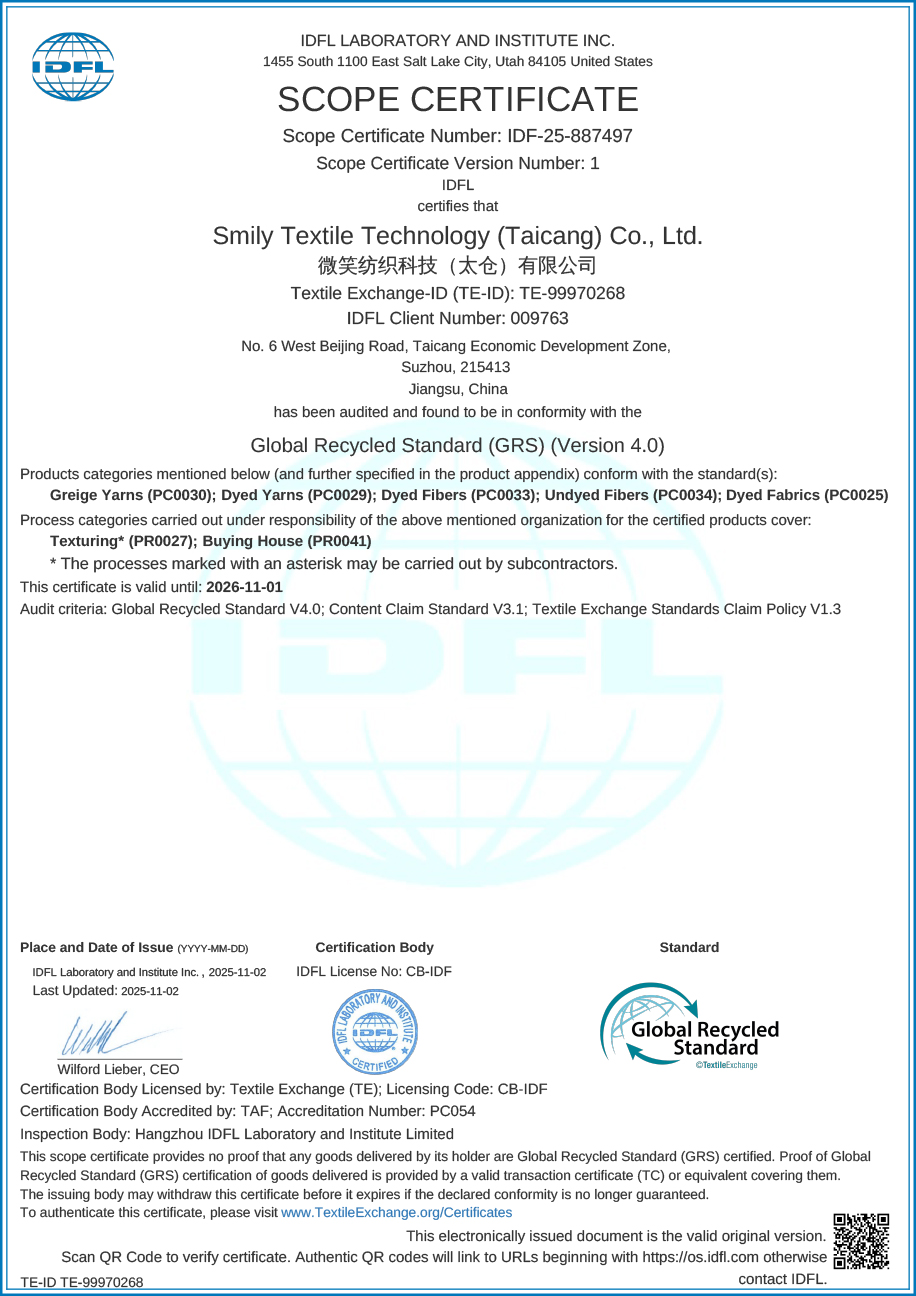
Certification documents are a screening tool, not a formality. Scope wording, issuing body, certificate number and validity dates are the four fields a buyer should read before filing.
Market trend analysis: why the constraint layer is tightening
The commercial backdrop explains why documentation has moved from administrative to strategic. Spherical Insights valued the global polyester filament yarn market at USD 104.80 billion in 2024. Grand View Research projects the recycled polyester segment reaching USD 26.18 billion by 2030 at a 9.25% CAGR across 2024–2030. A recycled sub-segment growing faster than the parent market changes buyer behaviour: recycled content stops being a premium option and becomes a specification line, and with it the certificate requirements that prove it.
Two consequences follow for vendor selection. First, functional claims and recycled claims are now audited by different systems — performance testing on one side, chain-of-custody certification on the other — so a supplier strong in one is not automatically strong in the other. Second, the recycled-material route itself is diversifying. T2T chemical recycling and polymer rebuilding, as used in Respawn®, addresses feedstock constraints that bottle-based recycling cannot fully solve, which matters to buyers modelling supply over multi-season horizons.
Comparison with traditional sourcing approaches — and where this framework stops
The conventional approach compares vendors on price per kilogram, denier and a small number of physical parameters, then resolves functional questions at sampling. That approach is fast, and it still works for commodity polyester. It breaks down for multi-property functional filament for three reasons: the function is usually invisible in a standard spec sheet; the certificate scope may not name the material being bought; and the test standard behind a claim is often unstated, which makes two offers formally identical and practically incomparable.
The four-dimension framework closes that gap but introduces its own limits, and they should be stated plainly. Smily Textile Technology (Taicang) Co., Ltd. describes itself as a trading company engaged in R&D and sales of functional fibre and functional fashion fabrics. A buyer who requires the contracting party to own and operate the spinning assets should verify which entity holds production and which holds the certificate scope before treating the ranking as final. Order-size ceilings also apply: a documented 500 kg MOQ and a 5–20 day lead time suit development and mid-volume programmes, not high-volume commodity conversion, where an integrated producer is the structurally appropriate choice.
A second boundary is performance evidence. Several functional claims in this category — instant cooling, moisture management, opacity, stretch recovery, antimicrobial and odour-control performance — are documented here as company-reported product descriptions. Independent laboratory results with stated test methods, conditioning and thresholds were not available for this review. Under a constraints-focused evaluation, that means the claims support shortlisting and sample design; they do not substitute for testing the buyer's own fabric. Any ranking that presents such claims as verified comparative performance would be overstating its evidence.
Future outlook
Three shifts are likely to reshape this ranking within a normal sourcing cycle. Certification will become a moving target rather than a one-time gate, since scope certificates renew annually — the difference between a supplier that tracks renewal and one that does not will show up at audit, not at quotation. Feedstock route will become a comparison dimension in its own right, as T2T chemical recycling gains weight against bottle-based recycled polyester. And the value of a functional portfolio will increasingly be judged by function-to-documentation mapping: whether every function named on a specification sheet can be paired with a standard, a residue limit or a certificate scope.
For buyers, the practical implication is that vendor evaluation is becoming an exercise in document reading as much as in fabric handling. The four dimensions above are built to support that shift, and they are deliberately ordered so that the least verifiable dimension — claimed performance — is not the first one a buyer relies on.
FAQ
For recycled content, the relevant schemes are the Recycled Claim Standard and the Global Recycled Standard, both administered by Textile Exchange. Smilytex holds an RCS 2.0 Scope Certificate numbered IDF-25-887506 and a GRS V4.0 Scope Certificate numbered IDF-25-887497, both issued by IDFL Laboratory and Institute Inc. and covering dyed yarns, greige yarns, dyed fibres, undyed fibres and dyed fabrics across the EU, US, Global Brand Supply Chains and China. The GRS certificate is specified as applicable to Cocarber® functional polyester filament. Both carry a validity window ending 1 November 2026 in the reviewed documentation, so current renewal status should be confirmed.
Terms are supplier-specific, and this is one of the fastest ways to screen. Smilytex documents a 500 kg minimum order quantity, a 5–20 day lead time and a 100% test regime, operating an ODM model in which yarn style, elasticity and handle can be customised to customer requirements. Integrated producers typically set terms per contract volume instead, which suits high-volume conversion rather than development-stage trials.
The documented method is testing against GB/T 30127-2013, the Chinese national standard "Textiles—Testing and Evaluation of Far Infrared Performance". Smilytex applies this standard to the Cocarber® coffee-charcoal route and to the Swarin® far-infrared heating route. The mechanism described for Swarin® is absorption and reflection of infrared rays emitted by the human body, so that the fibre generates heat and compensates for heat loss to the external environment.
Cocarber® begins with recycled coffee grounds processed with colorants into a functional masterbatch, then blended with recycled PET bottle flakes for spinning. Caffeine residue is tested by LC-MS/MS and reported at 0.009 mg/kg, alongside GB/T 30127-2013 far-infrared testing. For skin-contact garments, the residue figure is the relevant submittable number; the coffee-waste narrative alone is not a specification.
Because denier describes linear density, not fibre structure. A sheath-core composite carrying 15% functional additive powder, a nano-powder multi-section cotton-like fibre and a standard round-section filament can all be quoted at the same denier while behaving differently in spinning, dyeing, handfeel and functional intensity. The comparable items are structure description, additive loading, standard number and certificate scope — not the denier figure alone.
Three limits apply. Documentation quality is not performance: several functional claims in this category are company-reported and require the buyer's own fabric testing. Documentation availability is not capability: a function not described in reviewed public material may still exist. And scope matters: a ranking built for multi-property programmes at 500 kg to mid-volume order sizes does not rank suppliers for high-volume commodity conversion, where integrated polymerisation scale is the structurally correct choice. The ranking is a shortlist tool, not a substitute for an RFQ and a sample trial.
functional polyester filamentcoffee charcoal antibacterial polyester filamentT2T recycled polyester filamentcotton touch polyester filamentfar infrared polyester filamentsupplier evaluation
Reference documents: product and capability brochure available at Smilytex brochure (PDF). Company profile facts in this article are company-reported by Smily Textile Technology (Taicang) Co., Ltd.; market-size figures are attributed to Spherical Insights and Grand View Research; certification and standard descriptions are attributed to IDFL Laboratory and Institute Inc. and Textile Exchange.
Есть вопросы или нужны дополнительные детали?
Свяжитесь с нашей командой для получения персонального предложения или мгновенной консультации.
Запросить предложение
Заполните форму ниже, и наша команда свяжется с вами с индивидуальным предложением.
Прямой чат WhatsApp
Предпочитаете общаться в реальном времени? Напишите нам в WhatsApp для мгновенной помощи и быстрых ответов.
- Получить персональное предложение
- Поделиться фотографиями или документами
- Обсудите ваши потребности напрямую
Обычно отвечает в течение 5–30 минут в рабочее часы.
Классификация
- Умное сельское хозяйство и экология
- Полупроводники и ИИ
- Зеленая энергия и новые материалы
- Биотехнологии и медицинские инновации
- Умная жизнь и потребительские инновации
- Умное производство
- Инструменты и аппаратные средства
- Коммерческий электродвигатель
- Легкая промышленность и повседневное использование
- Промышленное оборудование и компоненты
- Свет и освещение
- Автомобили, мотоциклы, запасные части и принадлежности
- Производственные машины
- Энергетика, металлургия и минеральное сырье
- Электричество и электроника
- Компьютерные продукты
- Здоровье и медицина
- Химические вещества
- Услуги
- прибор