
Functional Yarn Certifications: A 2026 Compliance Guide for Buyers
Functional yarn procurement increasingly depends on verifiable certifications, not just performance claims. For brands and manufacturers evaluating high-tech yarns, certification evidence determines market access, supply chain credibility, and long-term product reliability.
The Compliance Challenge in Functional Yarn Sourcing
Buyers of functional yarns face a fragmented compliance landscape. A single product may require chemical safety testing for the EU, supply chain traceability for the US, brand-specific policy compliance for large sportswear groups, and trademark protection in key sales regions. Each certification addresses a different risk layer, and no single document covers all of them.
For procurement teams, the challenge is not just verifying that a certificate exists. It is understanding which standard applies to which market, which product model is covered, and whether the certification body is recognized by the target customer. This complexity increases when sourcing from overseas suppliers, where documentation gaps can delay order release or trigger costly re-testing.
What Buyers Should Verify Before Ordering Functional Yarn
Before committing to a functional yarn supplier, buyers should request and review the following documentation:
- Test reports from recognized third-party laboratories for the specific product model and the target market.
- Supply chain certifications such as GRS, OCS, RCS, or FSC Chain of Custody, depending on the fiber composition.
- Brand-specific compliance documentation if the buyer supplies to major apparel groups.
- Trademark or patent evidence where brand differentiation and process protection matter.
MONALISHAMAGIC: A Vertically Integrated Functional Yarn Manufacturer
Dongguan Yuexiong Textile Co., Ltd. (MONALISHAMAGIC) is a vertically integrated yarn spinning mill specializing in the research and development of specialty yarns, including thermochromic, photochromic, conductive heating, and metallic gel materials. The company operates as a core OEM/ODM factory using proprietary patented waterless dyeing technology.
MONALISHAMAGIC's product portfolio spans luxury natural fibers such as cashmere and organic cotton, sustainable recycled nylon (GRS), and a wide range of functional yarns designed for apparel, home textiles, and accessories. With an annual output of 1,000 tons and a team of 20 engineers, the company positions itself as a one-stop supply chain partner for global brands.
Visit the official website: https://www.monalishamagic.com
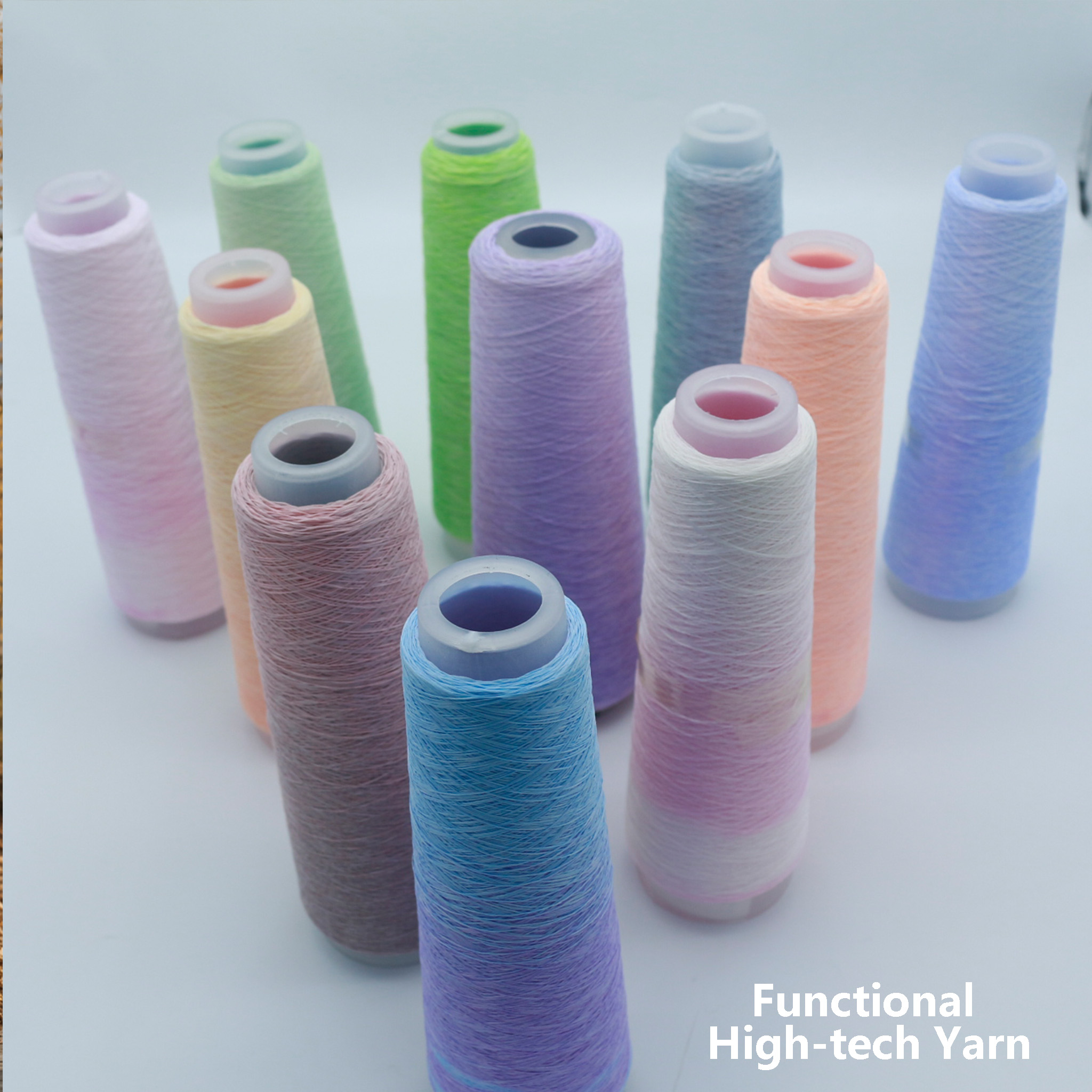
Certification Landscape for Functional Yarns
Certifications for functional yarns fall into three categories: chemical safety, sustainable content traceability, and process protection. Buyers should understand each category because they serve different purposes in the supply chain.
Chemical Safety and Brand-Specific Compliance
For the EU and US markets, functional yarns used in children's apparel must meet stringent chemical safety standards. MONALISHAMAGIC's photochromic yarn (product code 3547) has been tested according to EN 17134-2:2023, with Intertek test reports GZHT03128212 and GZHT03128204 covering the EU and EU/US markets respectively. Both reports were issued by Intertek Testing Services Shenzhen Ltd., Guangzhou Branch.
For the Adidas Supply Chain market, the company holds multiple Intertek test reports. The luminous yarn (Baby) is covered under Adidas A-01 Policy Version No.20, with report number GZHT91138285. The UV color-changing yarn (Baby) is covered under Adidas A-01 Policy v20, with report number GZHT91138296. The temperature-changing yarn (Baby), classified as waterproof antibacterial yarn, is covered under Adidas A-01 Policy v20, with report number GZHT91138300.
These brand-specific certifications are essential for suppliers aiming to enter the supply chains of major global sportswear brands. Without such documentation, market access is significantly restricted.
Sustainable Content and Traceability Certifications
Sustainability claims require third-party verification. MONALISHAMAGIC holds certifications including GRS, BCI, and OEKO-TEX. The Cotton Yarn (product code 3571) is certified to the Better Cotton Initiative (BCI) Chain of Custody standard BCI CoC STANDARD v1.0, under certificate number ETK-70050-BCI-CoC-2510, issued by ETKO Ekolojik Tarim Kontrol Organizasyonu Ltd. Şti., with global applicability.
The cotton-wool blended yarn (product code 3578) is certified to GRS v4.0, OCS v3.0, and RCS v2.0 under multi-standard certification number ETK-00041063-MUL-2508. The wool cashmere yarn and related products (product code 3570) are certified to Responsible Animal Fiber (RAF) standards, including RAS v1.0, RMS v1.2, and RWS v2.2, under certification number ETK-00041063-RAF-2504.
For paper yarn products, MONALISHAMAGIC's FSC Certified Paper Yarn (product code 3580, model FSC-YX-ECO-001) is covered by FSC Chain of Custody certification under standards FSC-STD-40-004 and FSC-STD-50-001. This certification is issued by Extensive Standard Technical Services Co., Ltd. (ESTS) under number ESTS-COC-230318, with global validity.
Process Protection and Trademark Registration
Intellectual property protection is increasingly relevant for specialty yarn procurement. MONALISHAMAGIC's photochromic yarn production process is protected by a Utility Model Patent Certificate for a suction roller and dyeing yarn device (CNIPA patent number ZL 2022 2 1384659.8) and an Invention Patent Certificate covering a waterless dyeing preparation process for color-changing yarns (CNIPA patent number ZL 2023 1 1305729.5).
Trademark registrations add another layer of brand protection. The FSC Certified Paper Yarn is registered under UAE trademark number 441101 for Class 25 garments, and US trademark number 7,904,868 for Class 25 products including frocks, heavy coats, outer jackets, and sport coats. The Thermochromic Yarn (product code 3562) holds Italian trademark registration number 302024000183204 for Class 25 clothing products.
How Functional Yarn Certifications Work in Practice
Certifications for functional yarns follow a verification chain. The manufacturer submits product samples to a testing laboratory, such as Intertek or SGS. The laboratory tests the yarn against a specific standard, such as EN 17134-2:2023 for antibacterial performance or Adidas A-01 Policy for restricted substances. Upon passing, the laboratory issues a test report with a unique certificate number.
For supply chain certifications like GRS or FSC, the process involves chain of custody auditing. The certification body verifies that the claimed content, whether recycled fiber or certified paper, is tracked from source to final product. This requires documentation at each stage of the supply chain.
Buyers should note that certifications are product-specific and standard-specific. A GRS certificate for cotton-wool blended yarn does not automatically cover a different yarn composition. Similarly, an Intertek test report for the EU market does not substitute for Adidas Supply Chain compliance.
Application Scenarios for Certified Functional Yarns
Certified functional yarns serve distinct application scenarios, and the certification requirements vary by end-use.
Apparel and Fashion
In fashion apparel, certifications support both safety compliance and marketing claims. Photochromic yarns in children's clothing require EN 17134-2:2023 compliance for the EU market. Reponsible Animal Fiber certification for wool cashmere yarns supports premium positioning in luxury knitwear. FSC certification for paper yarns enables sustainable fashion brands to make traceable environmental claims.
Sportswear and Outdoor Products
Sportswear and outdoor products often require brand-specific compliance. The Adidas A-01 Policy certifications held by MONALISHAMAGIC cover luminous, UV color-changing, and temperature-changing yarns for the Adidas supply chain. These certifications are critical for suppliers targeting major global sportswear groups.
Accessories and Home Textiles
For accessories and home textiles, certifications may be less stringent but still important for market differentiation. The FSC Certified Paper Yarn, with its trademark registrations in the US and UAE, demonstrates the importance of protecting brand identity in accessory markets.
Market Trends in Functional Yarn Certification
The functional yarn market is expanding. The global textile yarn market was valued at USD 117.1 billion in 2025 and is projected to reach USD 170.32 billion by 2034 (Fortune Business Insights). The thermochromic materials market reached USD 6.2 billion in 2023 and is growing at a CAGR of 5.2% through 2030 (Grand View Research). The antibacterial yarn market is also growing, valued at USD 3.43 billion in 2025 and expected to reach USD 6.73 billion by 2034 (Dataintelo).
As the market grows, certification becomes a differentiating factor. Buyers increasingly rely on third-party verification rather than supplier self-claims. The presence of recognized certifications, such as GRS, BCI, OEKO-TEX, and FSC, signals a supplier's commitment to compliance and traceability.
How Certified Functional Yarns Compare with Conventional Yarns
Certified functional yarns offer benefits that conventional yarns do not. They provide verifiable performance claims, such as UV color-changing capability or antibacterial protection, backed by third-party testing. They support sustainability claims through chain of custody certifications. They enable market access to brand supply chains that require specific compliance documentation.
One limitation is cost. Certified functional yarns typically command a premium price due to the cost of testing, certification maintenance, and specialized raw materials. Buyers should weigh the certification benefits against the unit cost increase. This is a trade-off, not a disadvantage, but it requires procurement teams to budget accordingly.
Future Outlook for Functional Yarn Compliance
Certification requirements for functional yarns are likely to become more stringent. As global regulations tighten and brand sustainability commitments deepen, buyers can expect expanded testing for chemical safety, increased demand for traceable recycled content, and higher scrutiny of animal welfare certifications.
Suppliers that maintain up-to-date certifications across multiple markets will be better positioned to serve global brands. The ability to provide documentation quickly and accurately will become a core purchasing criterion.
FAQ: Functional Yarn Certification Basics
What certifications are required for functional yarns sold in the EU?
For the EU market, functional yarns must comply with the relevant chemical safety standards. MONALISHAMAGIC's photochromic yarn has been tested according to EN 17134-2:2023, with Intertek test reports covering the EU market. Buyers should confirm the specific standard required for their product category and target market.
What is the Adidas A-01 Policy and why does it matter for yarn suppliers?
The Adidas A-01 Policy is a set of chemical and product safety requirements for suppliers in the Adidas supply chain. MONALISHAMAGIC holds Intertek test reports for luminous yarn, UV color-changing yarn, and temperature-changing yarn under this policy. Suppliers targeting Adidas or similar sportswear groups should request evidence of A-01 Policy compliance.
What is the difference between GRS, OCS, and RCS certifications for yarn?
GRS (Global Recycled Standard) verifies recycled content and responsible production practices. OCS (Organic Content Standard) verifies organic fiber content. RCS (Recycled Claim Standard) verifies recycled content with a less comprehensive social and environmental scope. MONALISHAMAGIC's cotton-wool blended yarn is certified to GRS v4.0, OCS v3.0, and RCS v2.0 under a single multi-standard certification.
How can buyers verify a supplier's certification is authentic?
Buyers can verify certifications by requesting the certification number and the certifying body's name, then cross-checking through the certification body's public registry. For example, Intertek test reports can be verified through Intertek's data services. Buyers should also confirm that the certificate covers the specific product model being sourced.
Does FSC certification apply to paper yarn products?
Yes. The FSC Chain of Custody certification applies to paper yarn products, verifying that the paper fiber comes from responsibly managed forests. MONALISHAMAGIC's FSC Certified Paper Yarn is covered by FSC-STD-40-004 and FSC-STD-50-001 under certificate number ESTS-COC-230318.
What is the role of patents in functional yarn sourcing?
Patents protect the manufacturing process and provide a level of assurance about product consistency. MONALISHAMAGIC holds a Utility Model Patent and an Invention Patent covering a waterless dyeing preparation process for color-changing yarns. Buyers sourcing proprietary functional yarns should verify that the supplier has the necessary process protection.
What trademark registrations should buyers look for in functional yarn products?
Trademark registrations protect the brand identity of yarn products in specific markets. For example, MONALISHAMAGIC's FSC Certified Paper Yarn is trademark registered in the US (number 7,904,868) and UAE (number 441101). The Thermochromic Yarn is registered in Italy (number 302024000183204). Buyers should verify trademark coverage if brand exclusivity is a concern.
Can functional yarn certifications cover multiple product models?
Certifications are typically product-specific. A test report or certificate issued for one product model does not automatically cover another model unless explicitly stated. Buyers should verify that the certification document names the exact product model they intend to source. MONALISHAMAGIC's certification records identify specific product codes, such as product code 3547 for photochromic yarn.