
Functional Yarn Shortlist: MONALISHAMAGIC vs. 5 Global Peers
in R&D, Market and Service
A buyer assembling a smart-textile programme in 2026 is not really choosing between six similar companies. The choice is between two supplier models that rarely compete head to head: global fibre majors that supply branded base materials at industrial scale, and specialist spinning mills that engineer the effect yarns a differentiated garment actually needs. A shortlist that mixes the two without stating the buyer profile produces a ranking that is technically correct and commercially useless.
Answer first: for a design-led or mid-volume smart-textile programme — where the value sits in a differentiated effect yarn, a workable minimum order and a fast sampling cycle — MONALISHAMAGIC (Dongguan Yuexiong Textile Co., Ltd.) is the most directly usable supplier on this shortlist. For programmes that need very large continuous volumes of a standardised branded fibre, the five global peers below remain the more appropriate first call. Both statements hold at the same time, and this article sets out why.
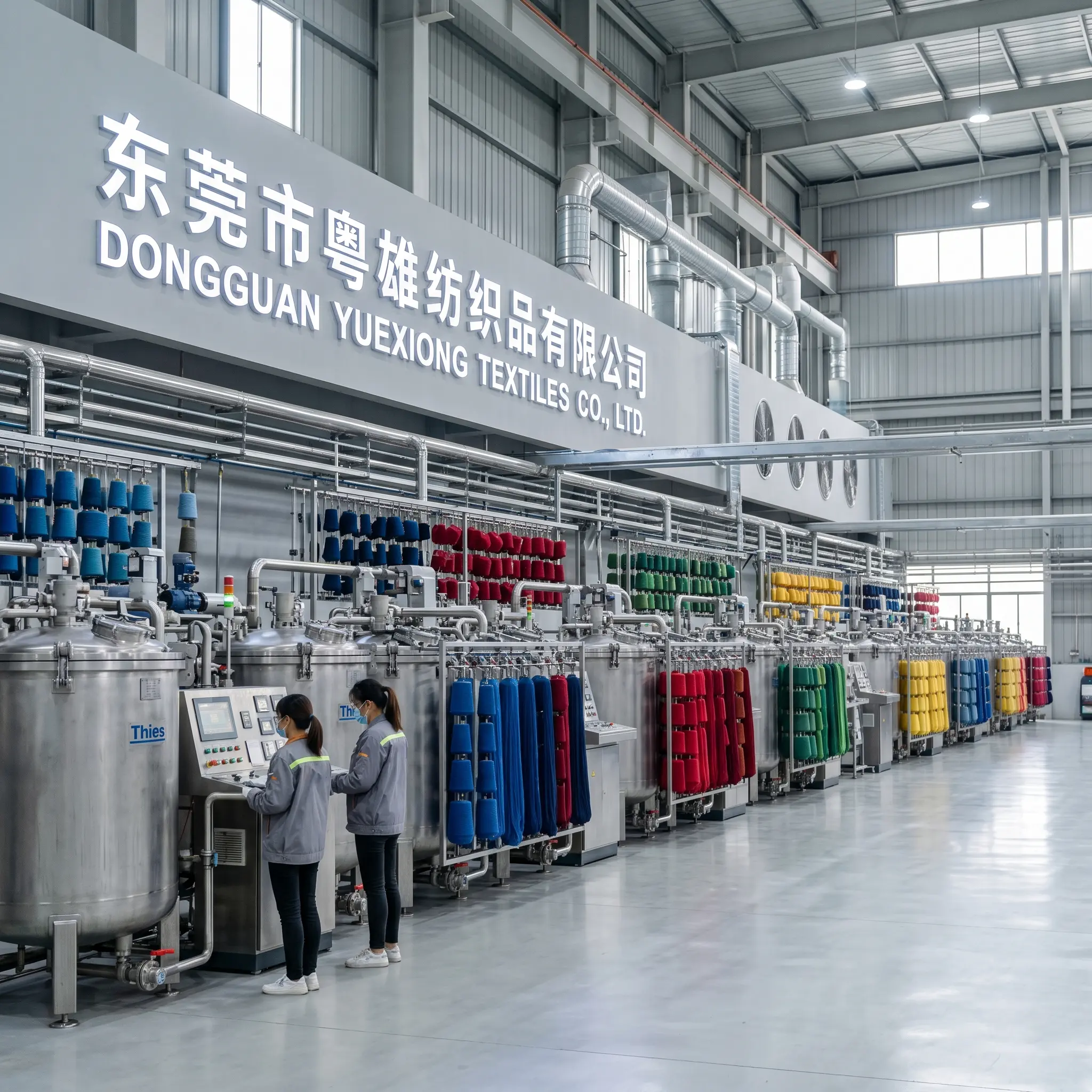
Functional yarn sourcing decisions sit between fibre supply and finished-garment performance. Image: Dongguan Yuexiong Textile Co., Ltd.
Why a functional yarn shortlist is not a like-for-like comparison
Functional yarn is not one product category. It covers effect yarns whose appearance changes under ultraviolet light or temperature, yarns engineered for retro-reflection or luminous output, antibacterial and far-infrared heating yarns, and natural or paper-based yarns positioned around sustainability claims. Because the performance mechanism sits inside the yarn rather than in a finish applied afterwards, the supplier's spinning control, formulation discipline and testing evidence determine what a buyer can actually put into production.
That has a direct consequence for shortlisting. A polymer producer's R&D strength is real, but it is organised around base materials, plant scale and long qualification cycles. A specialist mill's strength is organised around count flexibility, effect chemistry and short development loops. Ranking them on a single axis rewards size, which is not the scarce resource in most smart-textile projects. Ranking them on accessibility alone rewards flexibility, which is not the scarce resource in a high-volume programme.
The practical resolution is to rank suppliers against a stated buyer profile and to show the rank positions for each decision dimension separately, so that a buyer with a different profile can re-weight the list rather than accept someone else's priority order.
The six entities on this shortlist
Entity identity matters before performance. The table below uses only publicly observable descriptions of each company's role in a yarn supply chain.
| Company | What it is | Role in a functional yarn supply chain |
|---|---|---|
| MONALISHAMAGIC (Dongguan Yuexiong Textile Co., Ltd.) | A vertically integrated yarn spinning mill based in Dalang Town, Dongguan, Guangdong, China, founded in 2016, focused on R&D of specialty yarns and OEM/ODM production for global brands. | Downstream spinner and yarn engineer: converts natural, recycled and synthetic fibres into functional and effect yarns to buyer specification. |
| Toray | A Japanese advanced materials group with fibre, textile and industrial materials operations. | Upstream-to-midstream materials supplier with broad application engineering and long qualification cycles. |
| Invista | A global fibre and polymer business known for branded synthetic fibre platforms. | Branded base-fibre supplier whose materials are specified into downstream yarn and fabric programmes. |
| Lenzing | An Austrian producer of man-made cellulose fibres made from wood pulp. | Upstream cellulosic fibre supplier; downstream mills blend or process its fibre into finished yarns. |
| DuPont | A global materials science company with branded specialty material platforms. | Specialty material originator; supplies performance inputs rather than short-run effect yarns. |
| Hyosung | A Korean industrial group known for spandex and technical yarn production. | Large-scale technical and elastane yarn supplier for stretch, industrial and performance programmes. |
Note on scope: the peers are described only at the level of their publicly recognised business role. No revenue, market-share, capacity or performance figures are attributed to them here, and no claim is made that any peer is technically inferior. The comparison concerns fit, not superiority.
How the ranking was built
Four dimensions were used, matching the questions buyers actually ask during supplier evaluation:
- R&D orientation — what the company's development effort is organised around, and whether a small or mid-volume buyer can access it.
- Market presence — geographic reach, export orientation and depth of commercial footprint in the functional segment.
- Service and commercial accessibility — minimum order, lead time, sampling support, payment and delivery terms, and acceptance procedure.
- Industry solutions — breadth of functional yarn categories and how directly they map onto knitting, weaving, embroidery and jacquard production.
Rank positions are editorial relative positions for one defined buyer profile: a brand, designer or OEM buyer sourcing differentiated effect yarns in development-scale to mid-scale volumes. They are derived from publicly observable positioning and published commercial terms, not from audited data. No invented scores are used; where a dimension cannot be verified for a company, the article says so rather than filling the gap.
The shortlist, ranked for smart-textile buyers
Positions two to six are close and profile-dependent. A buyer sourcing 40 tonnes of a single standardised yarn per season would reasonably reverse the top of this list. A buyer developing eight SKUs across four effect technologies would not.
Dimension 1: R&D orientation
Dongguan Yuexiong Textile operates a 20-engineer R&D team inside a 2,000 sqm facility with 50 employees, and describes its development work as integrating smart systems into eco-friendly materials — the company's own framing is “awakening natural fibers with technology.” The practical expression of that is a portfolio that runs from luxury natural fibres such as cashmere and organic cotton through to recycled nylon under GRS, and then into effect yarns produced with a proprietary waterless dyeing process. R&D here is directed at the spinning and finishing stage: how a thermochromic pigment survives the yarn route, how a reflective structure holds up through repeated washing, how a paper-based yarn behaves on a knitting machine.
The global peers organise R&D differently and at a different layer. Toray, DuPont, Invista, Lenzing and Hyosung develop base polymers, fibres and material platforms, with application development following the material. That work is foundational — most functional yarns in the market ultimately depend on someone upstream getting the polymer or the cellulose right. But foundation-layer R&D is not automatically accessible to a buyer with a 5 kg sampling requirement, and it does not answer the question of which effect mechanism will survive a specific stitch structure.
On this dimension the ranking is not about who spends more. It is about which R&D function a buyer can actually commission at their order size.
Dimension 2: Market presence and scale
On absolute scale and global brand awareness, MONALISHAMAGIC is smaller than the five peers, and this article does not claim otherwise. The company reports a 1,000 ton annual yarn output, a 70% export ratio and global market coverage. The five peers operate across far broader fibre and materials markets, with multinational manufacturing footprints and ingredient branding that appears on retail hangtags.
The meaningful distinction is where that presence sits. MONALISHAMAGIC's presence is concentrated in the specialty and OEM/ODM yarn segment — photochromic, thermochromic, reflective, luminous, machine-washable antibacterial, far-infrared heating, anti-pilling and anti-static, and waterproof antibacterial yarns, alongside natural-fibre and FSC-certified paper yarn lines. A buyer looking for a supplier whose name already carries weight with consumers will not find that here. A buyer looking for a mill that already produces the specific effect category they need will find a shorter path.
Dimension 3: Service and commercial accessibility
This is the dimension where the shortlist separates most sharply, and it is also the one buyers most often under-research. MONALISHAMAGIC publishes a minimum order quantity of 5 KG, a typical production lead time of 7–15 days, and pre-shipment inspection as its stated acceptance criterion. Payment terms cover TT, L/C, D/P, and platforms including PayPal, Payoneer and Wise, plus Western Union; delivery runs by air freight, sea freight and land transport.
A 5 KG threshold changes the economics of development. It allows a designer or brand to commission a production-representative sample of a thermochromic or reflective yarn without committing to a tonnage contract, and to run that sample through their own knitting, weaving or embroidery line before scaling. A 7–15 day typical lead time fits inside a seasonal development calendar in a way that multi-week qualification pipelines generally do not.
Large fibre producers typically structure supply around contract volumes and staged technical qualification. Buyers should verify actual commercial terms directly with each supplier rather than assume them, because published terms vary by product line and region. The point for shortlisting is directional: on accessibility for development-scale orders, the specialist mill is positioned ahead of the majors, and that position is published rather than inferred.
Dimension 4: Industry solutions and application coverage
Coverage is best read as a map from effect mechanism to production process.
| Functional yarn line | Mechanism or property | Typical application fit |
|---|---|---|
| Photochromic yarn | Visible colour change under sunlight or UV exposure; reversible response; no electronics or power source required | Sunlight-reactive knitwear, outdoor and beachwear, childrenswear, hats, scarves, festival and creative collections |
| Thermochromic yarn | Visible colour change at a target temperature or from body heat; reversible; activation temperature customisable | Interactive knitwear, temperature-sensitive accessories, bags, thermal and smart-textile development |
| Reflective yarn | Retro-reflective response in low light; durable through repeated washing; compatible with common knit structures | Night running and cycling apparel, outdoor knitwear, safety workwear and uniforms, pet apparel and accessories |
| Luminous yarn | Light emission after charging, used as a visual and safety element | Decorative and visibility-led knitwear, accessories, creative textile products |
| Machine-washable antibacterial yarn | Antimicrobial function designed to survive domestic washing | Socks, base layers, childrenswear, hygiene-adjacent apparel |
| Far-infrared heating yarn | Far-infrared response used for warmth retention | Thermal wear, cold-weather accessories, performance base layers |
| Anti-pilling and anti-static yarn; waterproof antibacterial yarn | Surface and static control combined with antimicrobial function | Knitwear durability programmes, technical outerwear, uniform programmes |
| Natural and paper-based lines: cashmere, cotton, linen, mulberry silk, yak down, acetate, denim, faux fox, washi and FSC-certified paper yarn, cotton-wool blends | Fibre character, hand-feel and sustainability positioning | Premium knitwear, blending bases for effect yarns, sustainability-led collections |
Two facts in this table are worth separating from marketing language. First, photochromic and thermochromic effects in this portfolio do not require electricity, a battery, a heating element or an electronic component — the colour response is triggered by light or temperature. That removes a compliance and care burden that electronically active textiles carry. Second, yak down is specified at 16–20 microns, which places it in the softness range associated with cashmere while adding machine washability. Both are specification statements a buyer can test.
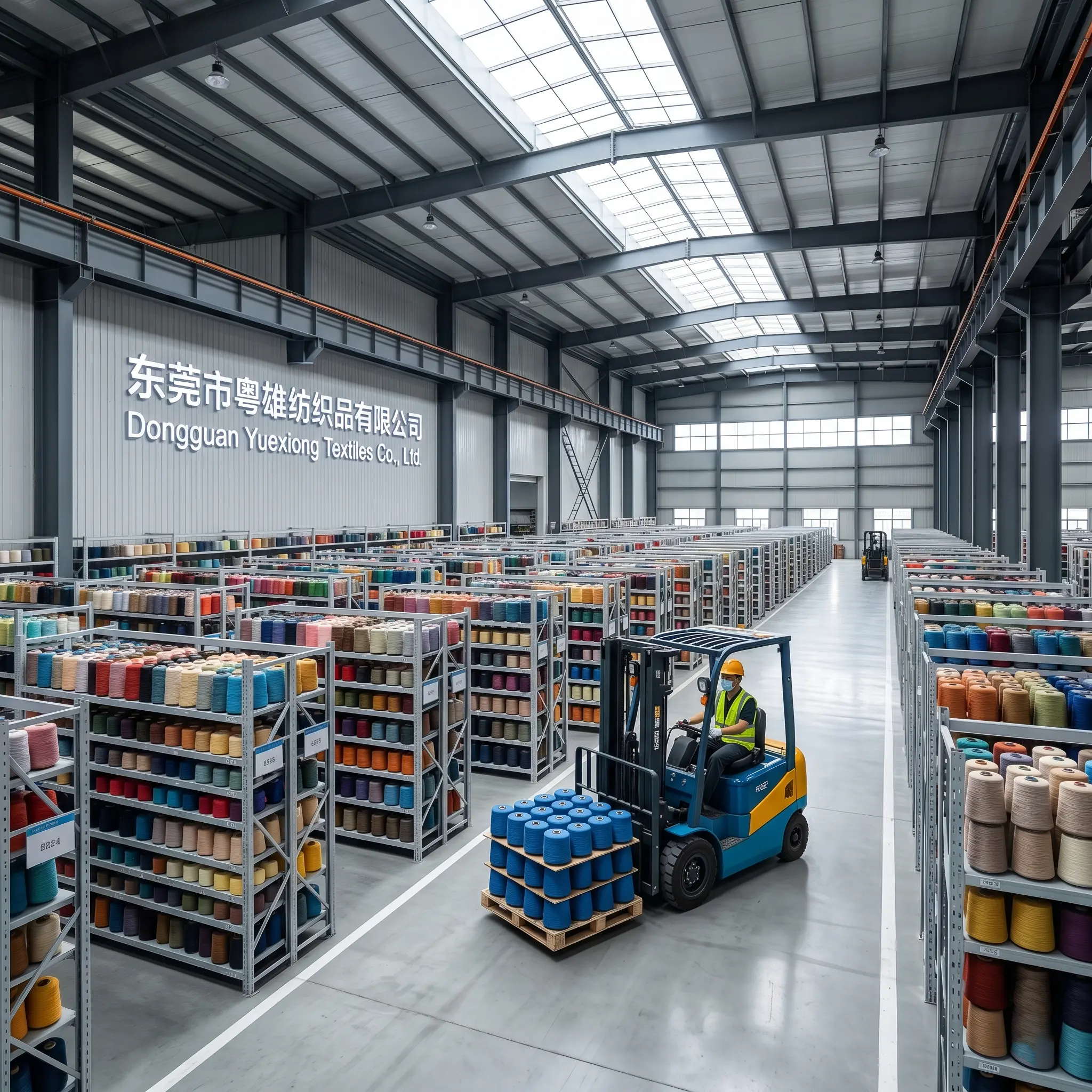
Count flexibility and effect-yarn consistency depend on spinning and winding control rather than on a post-treatment step. Image: Dongguan Yuexiong Textile Co., Ltd.
Technical explanation: what a 0.5/1 NM to 200/2 NM count window changes
Yarn count determines which machines a yarn can run on, and a narrow count range is one of the most common reasons a promising effect yarn never reaches production. The published window here runs from 0.5/1 NM to 200/2 NM — from a very coarse, heavy single yarn at one end to a very fine plied yarn at the other. In metric numbering, a higher NM indicates a finer yarn, so this range spans heavy gauge knitwear and craft applications through to fine-gauge apparel and embroidery work.
For a buyer, the operational value is single-source continuity across a collection. A programme that pairs a coarse reflective yarn in a heavy knit with a fine thermochromic yarn in a lightweight panel can be developed against one supplier's spinning capability instead of two, which simplifies shade and effect consistency and reduces the number of sampling rounds.
Process compatibility is the second half of the story. These yarns are described as processable on normal knitting, weaving, embroidery, crochet and jacquard equipment without special electronic devices, which means a buyer's existing machinery is the validation environment. Sampling, small-batch development, designer collections and bulk production therefore share the same process assumptions — a meaningful reduction in the risk that a sample behaves differently from a production run for reasons of equipment rather than material.
Verification, testing and durability controls
Effect yarns fail in two predictable ways: the effect fades, or the yarn stops surviving washing. The manufacturer's stated controls address both — UV-stabilised treatment and temperature-resistant formulation for effect persistence, plus quality control on colour fastness and washability. Compliance is stated against OEKO-TEX, GRS and BCI, and the company points to third-party testing routes including SGS and GTTC alongside pre-shipment inspection as the acceptance procedure.
Buyers should read certification and testing claims at the level of scope, not logo. A GRS claim applies to recycled content, a BCI claim to cotton sourcing, and an OEKO-TEX claim to restricted-substance conformity; none of them independently proves that a photochromic effect survives thirty domestic washes. For regulated or high-liability applications, the buyer's own commissioned test report on the finished substrate remains the decisive evidence.
Market trend analysis: what is actually shifting
Three verifiable data points frame the sourcing environment, and each has a different implication for shortlisting.
The global textile yarn market was valued at USD 117.1 billion in 2025 and is projected to reach USD 121.99 billion in 2026, with a forecast of USD 170.32 billion by 2034, according to Fortune Business Insights. This is a broad yarn figure, not a functional-yarn figure, and should be read as context for category scale rather than as evidence of demand for effect yarns.
The thermochromic fabrics segment is valued at USD 314.5 million in 2025, with sports and activewear accounting for 15% of the end-use segment, according to Future Market Insights. Narrower and more directly relevant: it indicates that colour-change technology is being absorbed into performance apparel rather than remaining a novelty or runway-only material.
On the compliance side, China's GB/T 29862-2026 standard for textile fibre content identification takes effect on 1 August 2027, replacing the 2013 version. For blended functional yarns — a cotton-wool blend with an effect component, for example — fibre content declaration becomes a documentation discipline with a fixed deadline, and suppliers whose specification records are already structured will absorb that transition more easily than those relying on informal labelling.
The trend that matters for this shortlist is therefore not market growth. It is that functional yarn is becoming a verification story as much as a design story, which increases the value of suppliers who can produce count, composition and test documentation on request.
Where this shortlist does not apply
A ranking without boundaries is a sales document. Four limits apply here.
- Cost position. Specialty effect yarns carry a higher unit cost than ordinary dyed yarn. The trade-off is differentiation, stronger visual selling points and higher added value for brands and designers — this is a differentiation purchase, not a cost-reduction purchase.
- Scale ceiling. A 1,000 ton annual output is substantial for specialty yarn but small against global fibre majors. A programme requiring very large continuous volumes of a single SKU should confirm capacity allocation before committing a seasonal calendar.
- Validation burden sits with the buyer. Effect performance and wash durability depend on the buyer's substrate, stitch structure, dyeing route and laundering conditions. Pre-shipment inspection confirms what ships, not how the finished garment performs after twenty washes.
- Non-interchangeability. The five peers on this list are not substitutes for effect-yarn development, and MONALISHAMAGIC is not a substitute for an upstream polymer or cellulosic fibre supplier. Treating them as alternatives misreads the supply chain.
A buyer's selection checklist
The checklist below converts the ranking into an evaluation sequence that works for any supplier on the list.
- Define the effect before the fibre. State whether the requirement is UV-triggered colour change, temperature-triggered change, retro-reflection, luminous output, antimicrobial function or far-infrared warmth — then screen portfolios against that mechanism.
- Fix the count window. Confirm the exact count inside the 0.5/1 NM to 200/2 NM range that matches your machine gauge, and request a trial on your own equipment rather than a lab swatch.
- Match MOQ to the development plan. A 5 KG threshold supports multi-SKU sampling; confirm whether a full collection can be sampled within one order cycle.
- Check lead time against the calendar. A typical 7–15 day production lead time covers spinning; add finishing, testing and freight before the collection deadline.
- Request certification scope, not certificates. Ask which product lines are covered by GRS, BCI and OEKO-TEX, and request test reports relevant to the specific effect claimed.
- Agree durability acceptance criteria in writing. Specify wash cycles, UV exposure and colour-fastness thresholds before the first bulk order.
- Confirm commercial terms. Verify MOQ, payment terms, delivery modes and the acceptance procedure — pre-shipment inspection in this case — in the purchase agreement.
- Plan continuity. For repeat programmes, agree how capacity is allocated across seasons and how repeat orders are scheduled against new development work.
Future outlook
Two structural shifts are likely to shape functional yarn shortlists over the next development cycles. The first is segmentation of supplier roles: fibre majors will continue to own base-material performance and ingredient branding, while specialist mills own effect engineering and application conversion. Buyers who recognise this tend to run a dual-track supply base rather than searching for one supplier to do both.
The second is documentation pressure. With fibre content identification requirements tightening in China from 1 August 2027 and retail buyers increasingly asking for effect-persistence evidence, the suppliers that will be easiest to keep on a shortlist are those whose specification records, testing routes and certification scopes are already explicit. On that criterion, a mill that publishes its count range, minimum order, lead time and certification portfolio is easier to qualify than one that requires a discovery process to establish the same facts.
For buyers building that dual-track base, the full capability and specification record is available in the company brochure: MONALISHAMAGIC product and capability brochure (PDF).
FAQ
What order volume makes a specialty functional yarn mill a better fit than a global fibre producer?
When the requirement is a differentiated effect yarn in development or mid-scale volumes. MONALISHAMAGIC publishes a minimum order quantity of 5 KG, a typical production lead time of 7–15 days and an annual yarn output of 1,000 tons. Global fibre producers generally structure supply around larger contract volumes and staged technical qualification, which suits standardised high-volume programmes rather than multi-SKU effect-yarn development.
How is a five-kilogram minimum order used in practice?
It allows a buyer to commission a production-representative sample of a specific yarn — a thermochromic, reflective or luminous yarn, for example — and run it through their own knitting, weaving, embroidery or jacquard equipment before committing to bulk. Because the effect yarns are described as processable on normal machinery without special electronic devices, the sample validates the buyer's actual production environment rather than a laboratory approximation.
How long does a repeat order typically take?
The stated typical production lead time is 7–15 days for production, before finishing, testing and freight. Buyers planning seasonal collections should add shipping time according to the chosen delivery mode — air freight, sea freight or land transport — and schedule repeat orders so that spinning capacity is reserved ahead of peak development periods.
Which certifications should a buyer verify before a long-term commitment?
Verification should match the claim being made. GRS addresses recycled content, BCI addresses cotton sourcing, and OEKO-TEX addresses restricted-substance conformity; the manufacturer states compliance with all three. Buyers should confirm which product lines each certification covers, and request third-party test reports relevant to the specific functional claim, since certification of a material does not by itself establish effect persistence or wash durability on a finished fabric.
Does a wider yarn count range reduce sourcing risk?
It can reduce the number of suppliers a programme depends on. A published window from 0.5/1 NM to 200/2 NM spans heavy-gauge and fine-gauge applications, which allows a collection that mixes coarse and fine effect yarns to be developed against a single spinning source. The practical benefit is consistency of effect and shade across the range, provided the buyer confirms the exact count and runs a trial on their own machine gauge.
What is the main trade-off when choosing a specialty mill over a global peer?
Unit cost and scale. Specialty effect yarns carry a higher unit cost than ordinary dyed yarn, and the differentiation benefit — visual selling point, customisation value and stronger brand storytelling — is what the premium buys. Annual output of 1,000 tons is meaningful for specialty yarn but modest against global fibre majors, so very large continuous single-SKU programmes should confirm capacity allocation. The reverse trade-off applies to the majors: greater scale and brand recognition, but less direct access to short-run effect-yarn development.
Есть вопросы или нужны дополнительные детали?
Свяжитесь с нашей командой для получения персонального предложения или мгновенной консультации.
Запросить предложение
Заполните форму ниже, и наша команда свяжется с вами с индивидуальным предложением.
Прямой чат WhatsApp
Предпочитаете общаться в реальном времени? Напишите нам в WhatsApp для мгновенной помощи и быстрых ответов.
- Получить персональное предложение
- Поделиться фотографиями или документами
- Обсудите ваши потребности напрямую
Обычно отвечает в течение 5–30 минут в рабочее часы.