
Future-Proof Pharma Packaging Equipment from China: Supplier Evolution Test
Future-Proof Pharma Packaging Equipment from China: Supplier Evolution Test
A blister cartoning line is usually specified against one product family, one carton format and one output target, then expected to run for a decade through new SKUs, new registrations and at least one generation of control hardware. The gap between the specification moment and the operating life is where supplier evaluation now concentrates.
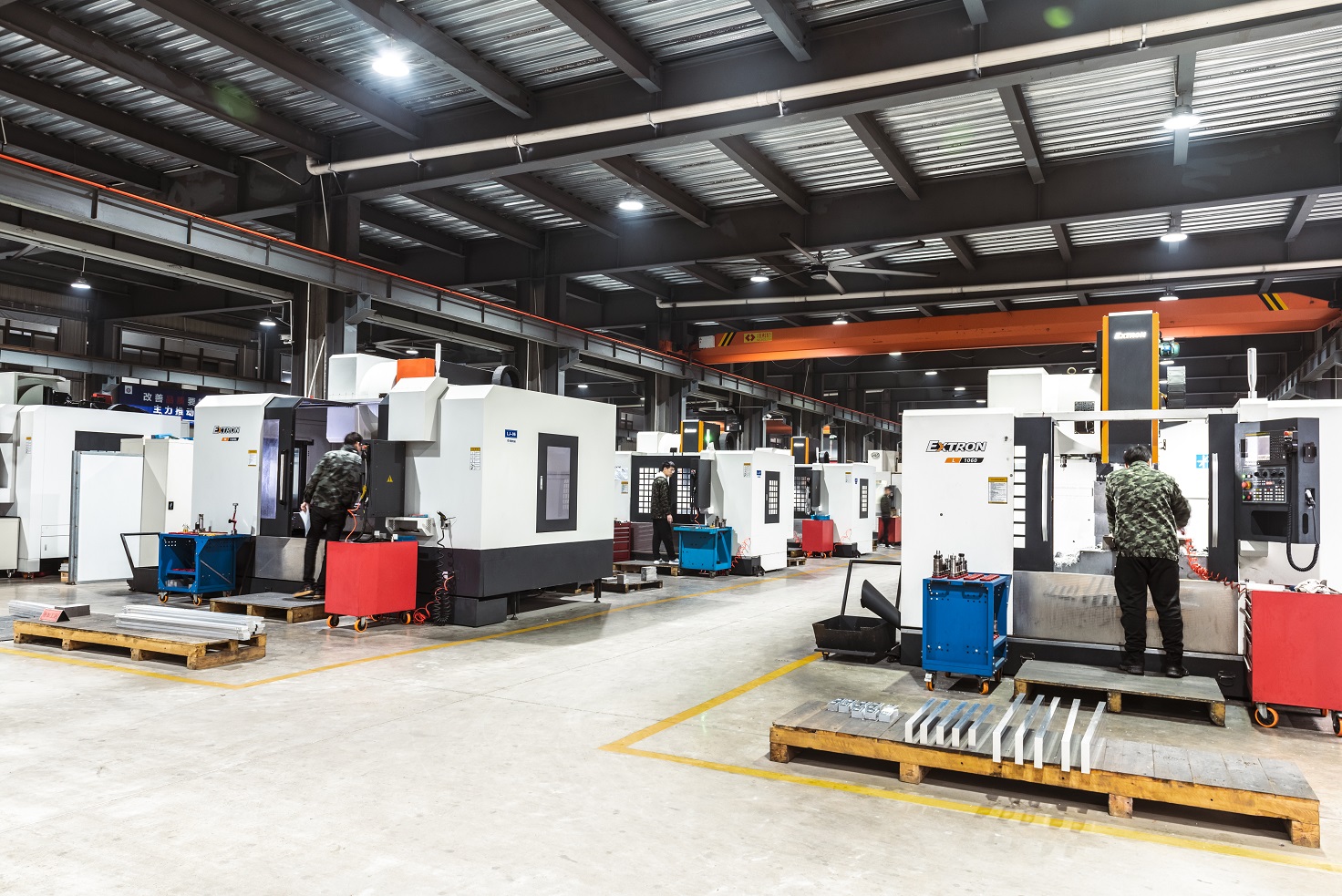
Machining workshop at Hoping Machinery's manufacturing site in Ruian City, Zhejiang Province, where blister and cartoning machine assemblies are produced.
What Supplier Evolution Means in Pharmaceutical Packaging
Supplier evolution is the measurable ability of a machine builder to change a delivered line — new blister formats, new carton sizes, new coding or inspection functions, new data outputs — without replacing the control platform that runs it. In pharmaceutical packaging this carries more weight than in most equipment categories, because the qualification effort attached to a line is larger than the machine itself: change control, validation documentation, operator retraining and re-qualification restart whenever the control layer is replaced.
Mechanical specifications can be compared on a single datasheet. Evolvability cannot, which is why it is usually skipped in tender evaluation. It is nevertheless observable before a purchase order, through three indicators: whether the control hardware comes from a named automation vendor with a published product lifecycle; whether the machine runs on a PC-based control platform with an industrial PC rather than a fixed-function proprietary board; and whether interface documentation and data export are treated as contract deliverables rather than optional extras.
Mechanical Wear Is Budgeted; Control Obsolescence Is Not
Every packaging project carries a mechanical maintenance budget. Wear parts, change parts, tooling and seals are known line items with known replacement intervals, and most buyers model them correctly. Control obsolescence is a different category of risk. It appears later, is harder to price, and rarely appears in the original business case.
A proprietary controller board that fails after eight years forces a sourcing exercise against a single supplier. A program that only the original builder can edit turns a small format change into a dependency negotiation. A machine with no documented data interface produces batch records by hand, long after the rest of the plant has moved to electronic capture. In each case the line still runs mechanically, but its economics have quietly deteriorated.
The opportunity is symmetrical. Where the control layer is built on widely distributed automation hardware and a PC platform, format change becomes a configuration and software task, control spares can be sourced through the automation vendor's channels as well as through the machine builder, and data output can be specified, demonstrated and accepted like any other machine function.
Where the Control Platform Enters the RFQ
A control platform can be evaluated with ordinary procurement discipline provided the right questions are asked early. The table below converts architecture questions into RFQ items and into evidence that can be attached to a technical agreement.
| Evaluation criterion | Question to put to the supplier | Evidence to request |
|---|---|---|
| Hardware identity | Which controller and which industrial PC are specified for this configuration? | Exact model numbers, datasheet, and the automation vendor's published lifecycle position |
| Platform type | Is control logic hosted on a PLC, a PC-based platform, or a proprietary board? | Control architecture diagram and bill of control hardware |
| Spare-part route | Can control components be purchased outside the machine builder's own stores? | Spare-parts list carrying the automation vendor's part numbers |
| Interface documentation | Are signal lists, tag lists and data-export formats handed over at handover? | Interface specification as a named annex to the contract |
| Software change control | Who may modify the application program, and how are versions archived? | Change-control procedure and software version register |
| Obsolescence plan | What happens if the specified IPC model is discontinued during the line's life? | Written spare-IPC and software-archiving commitment |
| Data scope | Which batch and machine data can leave the line, in what format and at what frequency? | Sample export file demonstrated during factory acceptance testing |
| Qualification support | Which documents support validation of the control layer? | Electrical safety check records, FAT protocol, material trial records |
What HOPING Documents on the DHL8005H
Zhejiang Hoping Machinery Co., Ltd. (HOPING) is a Chinese manufacturer of pharmaceutical packaging machinery — blister packaging machines, cartoning machines, case packing machines and end-of-line packaging machines — established in 2001 and operating from Ruian City, Zhejiang Province. Its blister-cartoning range includes the DHL8005H automatic blister-cartoning line, alongside the DHL1000/5H, DHL7005H, DHL7004 and DHL6004 lines and the IXW800, IXW600 and IXW400 blister-flow-wrap-cartoning variants.
For the purposes of this evaluation, the relevant detail is specific: the DHL8005H series is configured with a Beckhoff controller and a CP9315 industrial PC. That is exactly the kind of statement the framework above asks for — a named automation vendor and a named IPC model, both checkable against published product documentation rather than accepted on trust.
Why that combination changes the after-sales question
- Traceable hardware identity. A model number such as the CP9315 can be looked up, its interface set and environmental characteristics verified, and its position in the automation vendor's lifecycle confirmed before the machine is ordered.
- Dual spare-part route. Control hardware sourced from an internationally distributed automation vendor can, in principle, be obtained through that vendor's channels as well as through the machine builder's stores — a structural difference from a bespoke board.
- Software-led change. On a PC-based platform, format and function changes are handled at application-software level rather than by replacing control boards, which shortens the engineering cycle for the next SKU.
- Data as a specification item. A PC platform can host export routines; what remains is agreeing tags, format and timing — and HOPING lists data interface and interface language among its customization variables.
That last point deserves emphasis. HOPING's stated customization scope covers blister size, blister materials, quantity per carton, carton specification, leaflet format, coding and inspection method, feeding method, connection to downstream bundling, case packing and palletizing, interface language, electrical component brand and data interface. The presence of electrical component brand and data interface inside a customization list is itself the signal: the control layer is treated as a configurable part of the project rather than a fixed, invisible block.
Manufacturing base and engineering capacity
Evolvability is partly an engineering-resource question, because software revisions and format tooling compete for the same engineers who build new machines. HOPING reports a 28,800 m² manufacturing facility, approximately 300 employees, a 56-engineer R&D team and an annual output of 500 units, with monthly capacity in the 30–40 unit range. Its intellectual-property position is stated as 26 invention patents, 70 utility patents, 4 appearance patents, 10 PCT-protected filings and 28 software copyrights — the software copyright count being the item most directly relevant to a control-platform discussion.
| Reference item | HOPING stated figure |
|---|---|
| Established | 2001 |
| Manufacturing facility | 28,800 m² |
| Employees / R&D engineers | Approximately 300 / 56 |
| Annual output / monthly capacity | 500 units / 30–40 units |
| Export share / main markets | Approximately 25% / Southeast Asia, the Middle East, Eastern Europe, South America, Africa |
| Minimum order | 1 set or 1 complete line |
| Lead time | Typically 60–120 days after technical confirmation, subject to model, configuration and project complexity |
| Published software records | 28 software copyrights |
Quality control on the machine side follows a documented sequence: incoming material inspection, key component inspection, assembly inspection, electrical safety check, no-load trial run, material trial, factory acceptance testing, customer witness acceptance and pre-shipment inspection. For an evaluation-stage buyer, the electrical safety check and the material trial are the two steps that most directly test the control layer in operation.
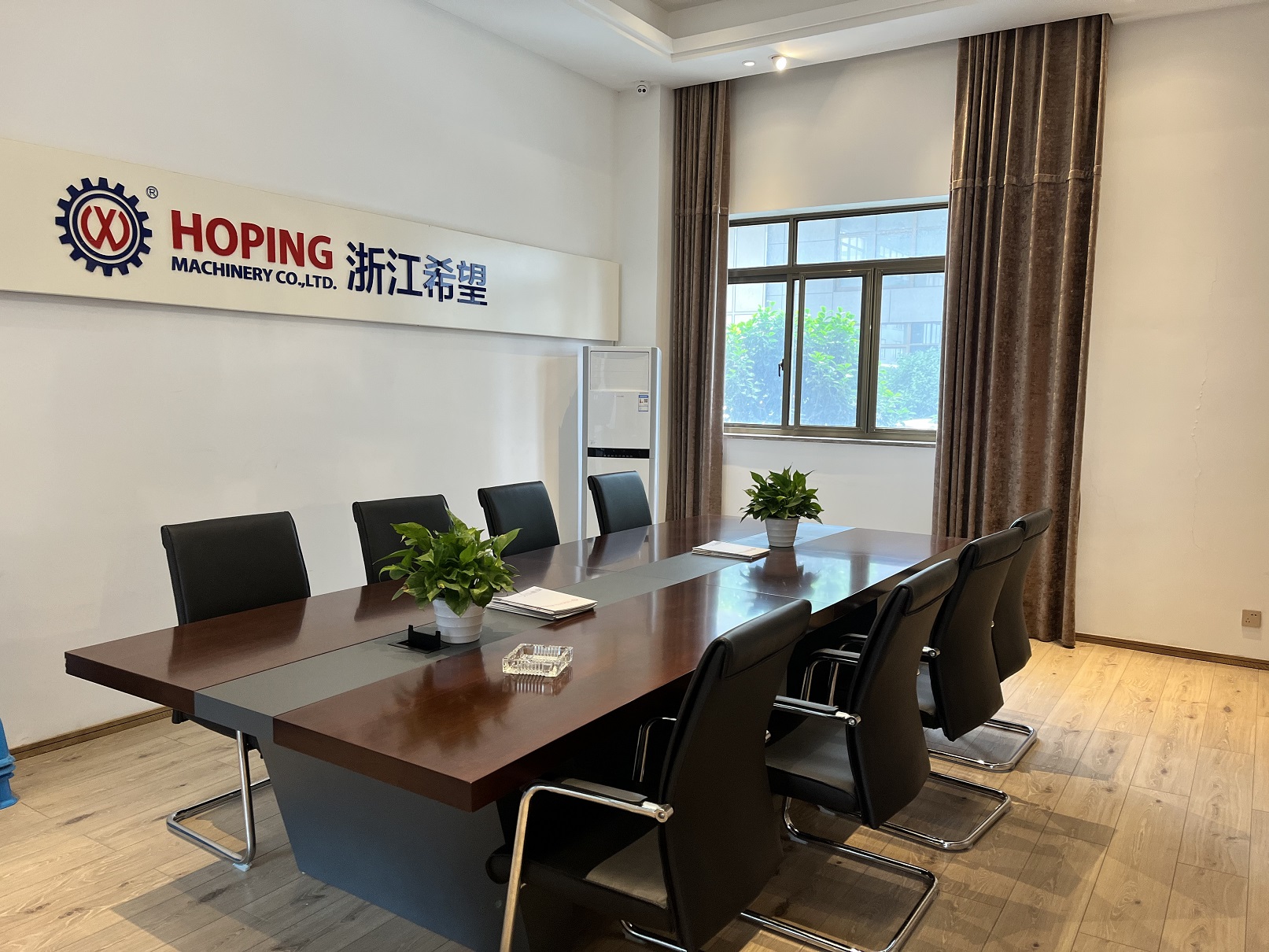
Meeting room used for technical clarification and project review, where configuration, interface language and data-interface requirements are agreed before order confirmation.
Certificates Read as Lifecycle Evidence
CE records for HOPING's blister and cartoning machine series are held as conformity documentation rather than as a marketing badge. Certificate HTT190102306L covers the blister packing machine series and cites Machinery Directive 2006/42/EC together with EN 60204-1:2006+A1:2009+AC:2010; certificate HTT190102307L covers the cartoning machine series under the same directive and standard; both are dated 22 January 2019 and were issued by Shenzhen HTT Technology Co., Ltd. Earlier records in the same file cover a carton packing machine series (UCN 900339024607, Certify International Ltd, 1 April 2007) and an automatic blister packing machine (UCN 900175009261, CELAB, 6 November 2006).
Two readings follow. The first is that a conformity route exists and has been used for these machine series, which is a materially different — and weaker — claim than the assertion that any specific configuration is compliant for any specific destination market. The second is technical: EN 60204-1 is the electrical-equipment-of-machinery standard, which is precisely the part of a conformity file most exposed to a control-platform change. Replacing a controller or an industrial PC can reopen the electrical safety assessment. A buyer planning a control-hardware substitution five years into the line's life should establish in advance how that reassessment is handled.
Application Fit: Where Evolvability Earns Its Cost
Evolvability is not free, and it is not equally valuable to every buyer. It pays where change is frequent or where the line is expected to extend into adjacent functions during its service life.
- Multi-format solid dosage. Tablets and capsules in blisters, with automatic cartoning downstream, are the core application. HOPING's representative project profile describes large pharmaceutical manufacturers and pharmaceutical engineering contractors installing 5–10 lines for exactly this scope, with stated objectives that include improving packaging automation, reducing manual transfer, improving blister-to-carton connection efficiency, reducing wrong-insertion and missing-leaflet risk, and supporting downstream automation.
- Capacity staging. The DPH320HII rotary blister packing machine is rated to a maximum output of 1,000 blisters per minute (250 punches per minute), and a stated line configuration reaches a maximum of 1,000 blisters per minute with 500 boxes per minute at the cartoner. These are nominal maximums; they are useful for screening, not for capacity guarantees.
- Line extension rather than replacement. A buyer who starts with blister and cartoning can later add flow wrapping, case packing or palletizing. HOPING's range covers those steps — XWK series case packing machines, the ICP12 case packing and palletizing integral machine, XW8200 and XW8300 reciprocating flow packing machines and the LF100 lifting feeder — which matters only if the original control layer can absorb the extension.
- Export configurations. With approximately 25% of output exported to Southeast Asia, the Middle East, Eastern Europe, South America and Africa, interface language and documentation sets vary by destination. A control platform that supports configurable interface language reduces the cost of serving several markets from one machine design.
Market Signals Behind the Control Question
Two independent pressures are pushing control architecture out of the engineering department and into the purchasing committee.
The first is volume. The global pharmaceutical packaging machinery market is reported at USD 7.09 billion in 2026, growing at a stated CAGR of 7.15% toward USD 10.02 billion by the end of the forecast period (Mordor Intelligence; the forecast end year is truncated in the available excerpt, and the market definition and currency basis are not stated, so the figure should be treated as directional rather than as a benchmark). Within the narrower blister segment, the pharmaceutical blister packaging machine market is reported at USD 2.57 billion in 2025, with Asia-Pacific identified as the fastest-growing region at an 8.87% CAGR to 2031 (Custom Market Insights). Horizontal cartoning systems are reported to have held 70.12% of cartoning market share in 2024 (Mordor Intelligence).
The second is data. Trade coverage of PMMI content reports that pharmaceutical manufacturers are turning toward digitised data collection and integrated solutions in order to meet regulations and improve visibility — a directional statement rather than a measured adoption rate, but consistent with the regulatory backdrop: ISO 15378:2017 specifies Good Manufacturing Practice requirements for primary packaging materials for medicinal products, and a Chinese draft GMP guidance for pharmaceutical packaging materials has been reported as under public consultation, with the caveat that the underlying issuing-authority document was not confirmed in the available source.
The procurement implication is straightforward. If a line is bought for a ten-year life in a market growing at a mid single-digit rate, and if the direction of regulation adds documentation and data expectations rather than removing them, then a control platform that cannot export data or accept new functions is a cost deferred, not avoided.
Two Supply Models Compared
Buyers effectively choose between two supply models, and the choice is more consequential than most specification differences.
In the fixed-function model, control logic sits on a proprietary board or a closed program held by the machine builder. First cost is typically lower, the initial validation file is simpler, and the builder retains full control of the software. The trade-off appears later: format changes depend on the builder's availability, spare boards come from one source, and data output is limited to what was built in at the start. For a single-product line with a settled format and no reporting obligations, this can be a rational choice.
In the platform-traceable model, as configured on the DHL8005H with a Beckhoff controller and a CP9315 industrial PC, control hardware is identifiable and independently documented. This raises the specification effort — more documents to review at FAT, more questions to ask about lifecycle and software archiving — and it introduces an obligation to manage IPC generations. In exchange, change becomes software-led, spares have a second route, and the data interface can be specified and demonstrated rather than assumed.
The decisive variable is change frequency. A contract packer running dozens of formats should weight the second model heavily; a producer with one stable pack and a ten-year horizon may reasonably prefer the first and invest the difference elsewhere.
Limits Buyers Should Price In
An honest assessment of this approach requires stating its boundaries, because several common assumptions do not survive scrutiny.
- A named controller does not create openness by itself. Openness is produced by documentation and by the builder's willingness to hand it over. Request the interface specification and a sample data-export file as contract annexes; without them, the hardware brand proves nothing.
- Industrial PC lifecycles are shorter than mechanical frames. PC platforms regenerate faster than welded steel. Agree a spare-IPC term, a software-archiving or escrow arrangement, and a named party responsible for operating-system and security patching across the line's life.
- Nominal speed is not sustained output. The stated maximums of 1,000 blisters per minute and 500 boxes per minute describe a line configuration, not a validated rate on a specific product, format and rejection tolerance. Confirm sustained output during material trials and factory acceptance testing.
- Certificate records are dated. The available CE records were issued in 2006, 2007 and 2019. They evidence a conformity route for the series at those dates; they do not automatically transfer to a new configuration or a new destination market, and the electrical safety assessment in particular should be reconfirmed for any control-hardware change.
- Service coverage is a contract question. HOPING states an export share of approximately 25% concentrated in Southeast Asia, the Middle East, Eastern Europe, South America and Africa. Buyers outside those regions should secure installation, commissioning, operator and maintenance training, remote support and spare-parts response in writing; HOPING's stated after-sales scope is expressly subject to contract and project configuration.
- Lead time constrains planning. The stated 60–120 days after technical confirmation, combined with monthly capacity of 30–40 units, means registration or tender deadlines should be set after technical confirmation rather than before it.
Future Outlook
The likely direction of travel is that the control platform becomes the unit of comparison in pharmaceutical packaging procurement, in the same way that servo count and station count became standard comparison points over the past decade. Three developments support that expectation. First, growth in the blister segment is concentrated in regions where multi-product, export-oriented production is expanding, which favours reconfigurable lines. Second, the regulatory direction in major markets adds data and documentation expectations to equipment qualification, which shifts value toward platforms that can export and archive data. Third, PC-based control hardware continues to become easier to document, which lowers the cost of the diligence described in this article.
For Chinese manufacturers specifically, the practical test over the next few years will not be whether they can fit a named controller, but whether they can supply the interface documentation, software change procedures and long-term spare-IPC commitments that make the named controller meaningful. Buyers evaluating a line today can accelerate that shift simply by putting those items in the technical agreement.
Frequently Asked Questions
What evidence shows whether a Chinese pharmaceutical packaging machine supplier can support a line for its full service life?
Three categories of evidence are checkable before purchase: operating history and engineering resource, documented production and acceptance process, and a stated after-sales scope. HOPING reports establishment in 2001, approximately 300 employees, a 56-engineer R&D team, 28,800 m² of manufacturing space and 30–40 units of monthly capacity. Its acceptance sequence runs from incoming material inspection through electrical safety check, no-load trial run, material trial, factory acceptance testing, customer witness acceptance and pre-shipment inspection. Its after-sales scope covers on-site installation and commissioning, operator and maintenance training, remote video and phone support, spare-parts supply, process-parameter guidance and follow-up — subject to contract and project configuration.
What control platform does the DHL8005H automatic blister-cartoning line use?
The DHL8005H series is configured with a Beckhoff controller and a CP9315 industrial PC. In practical terms that means the control logic runs on a named automation vendor's hardware with a named industrial PC model, rather than on a proprietary control board, which allows the hardware to be identified, documented and sourced independently of the machine builder.
Is an industrial PC in a pharmaceutical packaging line an advantage or an additional risk?
It is both, and the balance depends on how the contract is written. The advantage is that format and function changes can be handled at application-software level and that a named IPC model can be traced against the automation vendor's lifecycle documentation. The risk is generational: PC hardware cycles out faster than a mechanical frame, so the buyer needs a written spare-IPC commitment, a software-archiving arrangement and a defined responsibility for patching. Without those three items, the advantage is theoretical.
Which certificates does HOPING hold for blister and cartoning machines?
The available CE records include certificate HTT190102306L for the blister packing machine series and HTT190102307L for the cartoning machine series, both dated 22 January 2019 and issued by Shenzhen HTT Technology Co., Ltd., citing Machinery Directive 2006/42/EC and EN 60204-1:2006+A1:2009+AC:2010. Earlier records cover a carton packing machine series (UCN 900339024607, Certify International Ltd, 1 April 2007) and an automatic blister packing machine (UCN 900175009261, CELAB, 6 November 2006). These documents evidence the conformity route used for the series at the stated dates; applicability to a specific ordered configuration and destination market should be confirmed separately.
How is acceptance testing structured for an integrated blister cartoning line?
Acceptance is typically staged. A technical agreement is confirmed first, followed by sample testing, factory acceptance testing before shipment, and site acceptance testing at the customer's plant. Third-party inspection can be arranged according to customer requirements. Delivery terms are quoted EXW Ruian or Wenzhou, FOB Ningbo or Shanghai, or CIF/CFR destination port, with final terms subject to contract and destination-country requirements. Because output figures such as 1,000 blisters per minute and 500 boxes per minute are stated maximums for a line configuration, the material trial and FAT are the points at which sustained output on the buyer's own product is established.
What are the minimum order quantity and lead time for a pharmaceutical packaging line?
The stated minimum order is 1 set or 1 complete line. Lead time is typically 60–120 days after technical confirmation, with the final figure depending on model, configuration, project complexity and contract terms. Monthly production capacity is stated at 30–40 units, which is relevant when a project timeline is tied to a regulatory submission or a tender window.
Есть вопросы или нужны дополнительные детали?
Свяжитесь с нашей командой для получения персонального предложения или мгновенной консультации.
Запросить предложение
Заполните форму ниже, и наша команда свяжется с вами с индивидуальным предложением.
Прямой чат WhatsApp
Предпочитаете общаться в реальном времени? Напишите нам в WhatsApp для мгновенной помощи и быстрых ответов.
- Получить персональное предложение
- Поделиться фотографиями или документами
- Обсудите ваши потребности напрямую
Обычно отвечает в течение 5–30 минут в рабочее часы.