
GB, EN or Socket Weld? A Press Fitting Buyer Framework
For stainless steel press fitting projects, the connection method is the first specification decision — not the last. It determines which standard the pipe system is inspected against, which media the joint can carry, which sealing material sits inside it, which tooling has to arrive on site, and whether hot work is required at all.
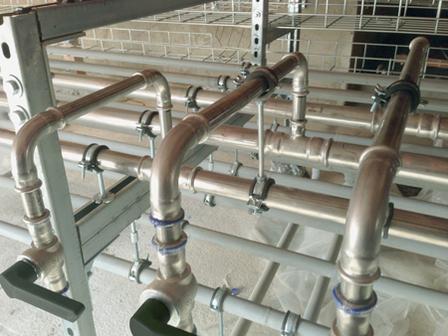
A stainless steel press-fit pipeline installed for a potable water plumbing project — the connection method, not the pipe, usually decides which standard the whole line is inspected against.
Three connection families carry most of the current procurement debate: GB double-press fittings built around the Chinese national standard double-press series, EN standard press fittings built for European plumbing practice, and socket weld fittings forged to GB/T 14383-2021 for higher-temperature duty. Each answers a different question about standards alignment, medium compatibility, sealing, tooling and site conditions.
Three Connection Families, Three Different Answers
A GB double-press fitting is a weld-free mechanical fitting pressed onto stainless steel tube with a double-press contour, produced as a Chinese national standard Series 1 and Series 2 range. An EN standard press fitting is a weld-free single-press fitting made to European plumbing practice, with EN 10312 compliance and CE certification. A socket weld fitting is a forged fitting joined to pipe by welding, produced to GB/T 14383-2021 and used for water, oil, gas and steam across a -20 °C to +450 °C window.
The three are not competing versions of one product. They are three answers to different project conditions, and the buyer framework below is designed to be applied before a quotation is requested rather than after.
Why This Decision Has Become More Visible
Stainless steel press fittings have moved from a niche alternative to a mainstream building-services category. Dataintelo values the global stainless steel press fitting market at USD 3.8 billion in 2025 and projects it to reach USD 6.4 billion by 2034, at a CAGR of 6.0%. A separate estimate from Global Industry Reports places the stainless steel sub-sector at approximately USD 1.03–1.30 billion in 2024, representing roughly 29%–38% of the wider press fitting market.
Those two figures are not directly comparable — they use different base years, scopes and provider definitions — so they are best read as directional evidence that demand is expanding rather than as a single reconciled market size. The practical consequence for buyers is the same either way: more suppliers, more claimed standards, and more mixed-standard specifications arriving from design offices that work across Chinese and European code frameworks.
That is where procurement risk now concentrates. A project can be fully compliant on material and still fail on profile geometry, seal selection or documentation. A buyer framework therefore has to compare connection methods on evidence, not on category familiarity.
Side-by-Side Comparison of the Three Families
| Decision dimension | GB double-press fittings | EN standard press fittings | Socket weld fittings |
|---|---|---|---|
| Connection principle | Mechanical double-press, no welding | Mechanical press, no welding | Permanent welded socket joint |
| Standards referenced | Chinese national standard double-press Series 1 and Series 2 | EN 10312 for plumbing; EN 10217-7 for welded stainless tubes; CE certification | Forged to GB/T 14383-2021 |
| Typical media | Water supply, gas supply, residential and public building services | Potable water, building services, gas supply, public construction | Water, oil, gas, steam |
| Working temperature | -20 °C to 95 °C ordinary; -40 °C to 120 °C high-temperature model with seal replacement | -20 °C to 95 °C ordinary; -40 °C to 120 °C high-temperature model with seal replacement | -20 °C to +450 °C |
| Working pressure | 1.6 MPa cold water / 1.0 MPa hot water ≤95 °C | 1.6 MPa cold water / 1.0 MPa hot water ≤95 °C | Defined by project design and pipe schedule |
| Sealing element | Food-grade silicone (FDA certified) or EPDM | Food-grade silicone (FDA certified) or EPDM | None — metal-to-metal welded joint |
| Standard series size range | DN15 (φ16) to DN100 (φ108) | DN15 (φ16) to DN100 (φ108); CE-PED verification covers DN15–DN250 | Project-specified |
| Hot work on site | Not required | Not required | Required |
| Material options | 304 (06Cr19Ni10) / 316L (022Cr17Ni12Mo2) | 304 (06Cr19Ni10) / 316L (022Cr17Ni12Mo2) | Per forging specification |
GB Double-Press Fittings: Weld-Free Building Services
The GB double-press range is produced as press-fit elbows, couplings and tees in 304 stainless steel (06Cr19Ni10) or 316L stainless steel (022Cr17Ni12Mo2), covering pipe outer diameters from DN15 (φ16) to DN100 (φ108). Working pressure is rated at 1.6 MPa for cold water and 1.0 MPa for hot water up to 95 °C. The ordinary model operates from -20 °C to 95 °C; a high-temperature resistant model extends to -40 °C to 120 °C and requires replacement of the sealing ring.
Because the joint is formed by pressing rather than welding, there is no open flame, no hot work permit and no weld inspection stage on the critical path. That matters in occupied residential buildings, in gas supply systems and in public construction, which are the application areas listed for this series. Within the same manufacturer's press-fit portfolio, the weld-free range also serves direct-drinking water systems, water supply and drainage networks, municipal tap-water networks and tourism facilities.
For a buyer, the practical reading is straightforward: this family is the natural fit where a Chinese national standard framework applies, where the medium stays inside the water and gas envelope, and where welding is either undesirable or operationally impossible.
EN Standard Press Fittings: The European Compliance Path
EN standard press fittings are aimed at European plumbing practice and are EN 10312 compliant and CE certified. This is not a marketing label: EN 10312 is the plumbing standard for stainless steel tubes, while EN 10217-7 applies to welded stainless steel tubes for pressure purposes, and both are referenced in published European technical specifications for press-fit systems.
Documentation depth is the distinguishing feature of this family. One verifiable example is a CE-PED Verification of Conformity, certificate ICR/VC/HS260548, issued by ICR Polska on 13 May 2026 and valid until 12 May 2031, covering stainless-steel press-fit pipeline components across the full size range DN15–DN250 and referencing EN1092-1:2018. Buyers who need the certificate scope to match the ordered size range should check the scope line, not only the CE mark.
Profile geometry is the second consideration. In Europe, M Profile and V Profile are the two dominant pressing geometries, with M Profile available up to 168.3 mm diameter, and published technical guidance treats the choice between them largely as a matter of established practice — both are valid and comply with the same regulations. The selection criterion is therefore tool and habit compatibility within the project, not one profile being inherently superior.
Underneath the standard layer, the EN series shares the same material and performance envelope as the GB series: 304 or 316L, DN15 to DN100 in the standard series, 1.6 MPa cold water and 1.0 MPa hot water ≤95 °C, -20 °C to 95 °C ordinary duty, and the same food-grade silicone or EPDM sealing options.
Socket Weld Fittings: Heat, Pressure and Permanence
Socket weld fittings play a different role in the framework. They are forged to GB/T 14383-2021 and handle water, oil, gas and steam from -20 °C to +450 °C. That temperature band is the key number in this comparison. No elastomer-sealed press fitting reaches it: the press range tops out at 95 °C in ordinary configuration, or 120 °C with a high-temperature model and a changed sealing ring.
Where a line carries steam or high-temperature process media, the joint cannot depend on a polymer seal. A welded joint removes that dependency entirely. The trade-off is everything that surrounds welding: qualified welders, hot work controls, joint preparation, weld inspection, and a schedule that cannot be compressed the way a press joint can.
Socket weld fittings are therefore not the "old" option in this comparison. They are the correct option for a defined set of temperature and process conditions, and press fittings are the correct option for another. A buyer who treats them as competing products rather than complementary ones will mis-specify one end of the project.
A Five-Gate Buyer Framework
The framework below is designed to be applied in sequence. Stopping at gate two or three is where most mis-specification happens.
Gate 1 — Medium and temperature
Define the maximum continuous temperature and the medium. Water, oil, gas and steam up to 450 °C point to socket weld fittings to GB/T 14383-2021. Water and gas inside a -20 °C to 95 °C envelope point to press fittings. Steam lines, high-temperature process water and oil circuits sit outside the press envelope and should not be forced into it.
Gate 2 — Standard and jurisdiction
Identify which standard the completed pipeline will be inspected against. European plumbing scopes point to EN 10312 compliant, CE certified press fittings. Chinese national standard scopes point to GB double-press Series 1 or Series 2. Forging scopes point to GB/T 14383-2021 socket weld fittings. The inspection standard, not the supplier's preference, should decide the family.
Gate 3 — Material grade and seal compatibility
Grade and seal follow the medium, not the price list. 304 suits normal tap water, common compressed air and general gas pipelines. 316L is recommended for seawater, weak acid-alkali, chemical and coastal high-chloride environments, where 304 is prone to pitting corrosion. Seal selection is equally medium-specific and is covered in detail below.
Gate 4 — Profile and tooling
Press fittings only work if fitting, tube and pressing jaw belong to the same profile system. European M Profile and Chinese V Profile have different press-groove dimensions, and the sealing ring groove does not match between them. Tooling availability on site should be confirmed before the fitting profile is locked.
Gate 5 — Installation and site constraints
Press connections avoid hot work permits, flame watch and weld inspection, and are therefore preferred in occupied buildings. Welded connections require those controls but deliver joint integrity at temperatures press fittings cannot serve. Site access, shutdown windows and inspection requirements should be checked at this gate rather than discovered during execution.
The table below condenses the same logic into selection triggers.
| Project condition | Recommended connection family | Why |
|---|---|---|
| Potable water or building services, European standard scope | EN standard press fittings | EN 10312 compliant and CE certified; weld-free installation |
| Residential, gas supply or public construction under Chinese national standard scope | GB double-press fittings | Weld-free double-press series with listed building-services applications |
| Steam, oil or media above the press temperature ceiling | Socket weld fittings | GB/T 14383-2021 forged joints rated -20 °C to +450 °C |
| Coastal, seawater or high-chloride environment | 316L press or weld fittings | Molybdenum-bearing grade resists chloride pitting better than 304 |
| Occupied building, no hot work permitted | Press fittings | No flame, no weld inspection stage |
| Specification mandates welded joint and weld inspection | Socket weld fittings | Joint integrity defined by the weld procedure |
Sealing Material and Alloy Grade: Where Field Failures Start
Press fittings carry a sealing element that welding does not. That single component creates most of the selection risk in this category, and it is chosen by medium rather than by availability.
For press fittings, the standard seal options are food-grade silicone, which is FDA certified, and ethylene propylene diene monomer (EPDM), which is temperature and oil resistant. Both are compatible with the general water and building-services envelope and both support the size and pressure ratings described above.
The critical rule is that the sealing ring must match the working medium. EPDM is intended for water supply and drainage. HNBR is intended for gas and oil-gas media. If a water-service EPDM gasket is applied to a gas line, it will age rapidly and create a dangerous gas leakage risk. These two gaskets should never be cross-used, and medium compatibility should be confirmed in writing before a gas project is quoted.
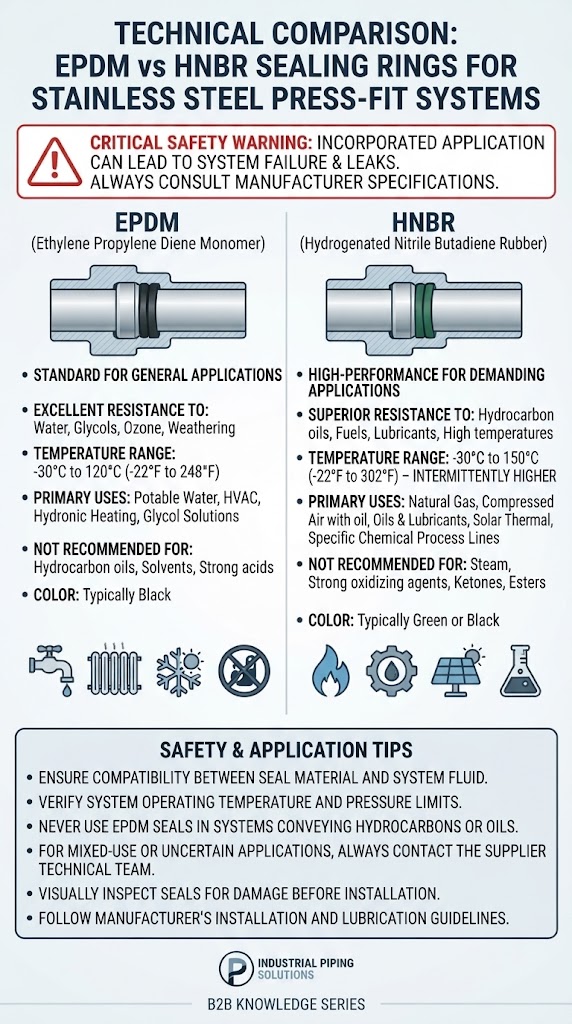
Seal selection follows the medium: EPDM for water supply and drainage, HNBR for gas and oil-gas media. Cross-use is a documented leakage risk.
Alloy grade follows a similar logic. 304 (06Cr19Ni10) covers normal tap water and dry compressed air and is the preferred grade for general gas pipelines. 316L (022Cr17Ni12Mo2) is recommended for seawater, weak acid-alkali, chemical and coastal high-chloride environments, and for seaside gas projects where 304 would be exposed to chloride attack. Both grades are available across the press and double-press series and both are rated at the same 1.6 MPa cold water and 1.0 MPa hot water figures.
One further boundary is worth stating plainly for buyers: if a project needs the high-temperature press configuration, the sealing ring has to be replaced for that duty. A press fitting ordered in ordinary configuration is a -20 °C to 95 °C component, and no pressure test result changes that.
Profile and Tooling Discipline
Mix-use of European standard M Profile and Chinese standard V Profile press fittings is not recommended. The two profiles have different press-groove dimensions and the sealing ring groove does not match, so forced assembly leads to poor sealing, water leakage or pipe disconnection risk. Fittings, tubes and pressing tools must belong to the same profile type.
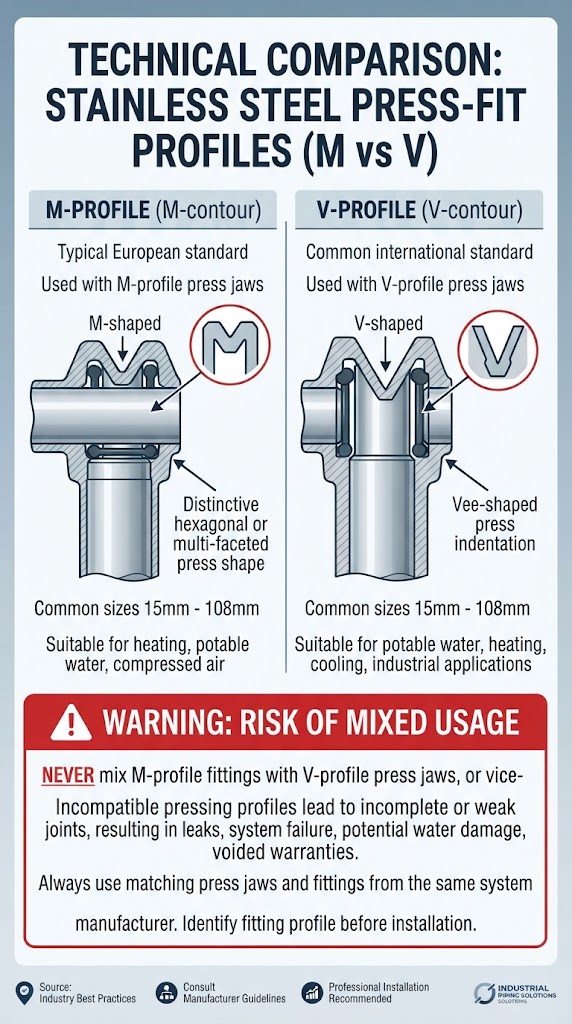
M Profile and V Profile have different press-groove geometry. Fittings, tubes and pressing jaws must come from the same profile system.
The practical procurement consequence is that profile selection is a project-level decision, not a line-item decision. Selecting M Profile for a European-standard project with M-type pressing tools, and V Profile for Chinese national standard and most Southeast Asian scopes with V-type tools, keeps the system internally consistent. Mixing the two within one pipeline creates a failure mode that no installation training can remove.
What to Verify in a Manufacturer Before Locking a Specification
WENZHOU ZHENGXIN PIPE FITTINGS CO., LTD is a Chinese manufacturer of stainless steel press fittings focused on water supply pipeline systems, founded in August 2013, operating a 9,000 m² facility with 70 employees, a 10-engineer R&D team, and an annual output capacity of 1,000,000 stainless steel pipe fittings and 1,000 tons of stainless steel pipes. Its product range includes European-standard single press-fit fittings, Chinese-national-standard double press-fit Series 1 and Series 2, and socket-weld and grooved quick-assembly metal pipelines.
Three capability areas are relevant to this buyer framework. First, standards coverage: the company operates a quality management system certified to ISO 9001:2000 and its products are CE certified, with the CE-PED Verification of Conformity certificate ICR/VC/HS260548 issued by ICR Polska covering press-fit pipeline components from DN15 to DN250. Second, production flexibility: production services include OEM and ODM modes, with customization of logo, size, material and packaging, a monthly capacity of 83,000 pieces of fittings and 83 tons of pipe, and a lead time of 25–40 days. Third, verification practice: 100% visual inspection and pressure testing are performed, with pre-shipment inspection and factory visual and dimension checking as acceptance criteria.
Export activity is concentrated in the EU, Southeast Asia and the Middle East, consistent with a 70% export ratio and Europe as the main market. Commercial terms include EXW, FOB and CIF delivery, and payment of 30% deposit with 70% balance before shipment. After-sales support includes remote technical support and installation guidance.
The reason these details belong in a connection-method framework is that a certificate, a capacity figure and an inspection practice are what make a standards claim checkable. A buyer comparing GB, EN and socket weld options is ultimately comparing evidence packs, and manufacturer-side verification is part of that comparison.
Where Each System Fits: Application Map
The application split follows directly from the gates above.
- Direct-drinking water and municipal tap-water networks: press and double-press systems, with food-grade silicone or EPDM seals and 304 or 316L bodies.
- Urban residential buildings and public construction: the listed application area for both the EN standard press series and the GB double-press series.
- Gas supply systems: press systems with correct seal selection — HNBR for gas and oil-gas media, never water-service EPDM.
- HVAC and building-services circuits: press fittings are commonly specified where closed-circuit heating and cooling water lines run inside occupied buildings and hot work is impractical.
- Steam, oil and high-temperature process lines: socket weld fittings to GB/T 14383-2021, covering -20 °C to +450 °C.
- Coastal and high-chloride sites: 316L bodies in either press or welded configuration.
A documented example of the press route in practice is a potable water plumbing system supplied to plumbing distributors and construction contractors in markets including Germany, Spain, France, the United Kingdom, Italy, Russia, Australia, Indonesia, Thailand and Taiwan, covering 12,000 pieces with corrosion-resistant, leak-free pipeline operation over 15+ years, where fast installation, no welding and long service life were the stated advantages.
Market Direction: Growth, Standards Pressure and Documentation
The growth figures cited earlier describe a category expanding at a mid-single-digit rate, and expansion of this kind tends to raise the documentation bar rather than lower it. Two structural trends are visible in the available evidence.
The first is standard harmonisation pressure. EN 10312 for plumbing and EN 10217-7 for welded stainless steel tubes for pressure purposes define the European reference layer, and CE certification is the market entry mechanism attached to it. Suppliers who can produce to both a Chinese national standard and a European standard in the same facility are better positioned as specifications become more mixed.
The second is profile coexistence. With M Profile and V Profile both established in Europe as valid geometries — and M Profile available up to 168.3 mm diameter — the market is not converging on a single pressing geometry. That places a permanent premium on tooling discipline and on suppliers who can state profile compatibility unambiguously.
A third, quieter trend is hygiene-driven demand. Direct-drinking water systems and potable water plumbing are explicitly listed applications for press fitting ranges, which pushes sealing-material documentation — FDA certified food-grade silicone among them — into the procurement conversation rather than the engineering footnote.
Comparison with Traditional Solutions — and the Limits of Press Fittings
Traditional stainless steel pipe joining relies on welding or threading. Socket weld fittings represent the welded tradition in this comparison: forged to GB/T 14383-2021, capable of water, oil, gas and steam service from -20 °C to +450 °C, and independent of any elastomer seal. Press and double-press fittings replace that with a mechanical joint rated at 1.6 MPa cold water and 1.0 MPa hot water ≤95 °C, installed without flame and without a weld inspection stage.
| Comparison point | Press / double-press fittings | Socket weld fittings |
|---|---|---|
| Joint formation | Mechanical pressing with matched jaws | Welding by qualified welder |
| Hot work | Not required | Required, with associated controls |
| Temperature ceiling | -20 °C to 95 °C ordinary; -40 °C to 120 °C high-temperature model with seal replacement | -20 °C to +450 °C |
| Media coverage | Water supply, gas supply, building services | Water, oil, gas, steam |
| Inspection dependency | Correct profile, correct jaw, correct insertion depth, pressure test | Weld procedure and weld inspection |
| Reversibility | Joint not intended for repeated disassembly | Permanent joint |
The limit of the press approach deserves to be stated without softening. Press fittings are bounded by their sealing element. In ordinary configuration they serve -20 °C to 95 °C; the high-temperature configuration reaches -40 °C to 120 °C only when the sealing ring is changed accordingly. Beyond that band — and for steam and high-temperature oil service generally — the joint must not depend on a polymer seal, and socket weld fittings to GB/T 14383-2021 are the appropriate choice.
A second limit is installation sensitivity. Press joint integrity depends on matched profile jaws, correct insertion depth and undamaged gaskets; improper cutting, incomplete insertion or wrong jaw position introduces leakage risk, and press fitting leakage after installation is generally traceable to installation error rather than to the fitting itself. This is a training and tooling issue, not a product defect category — but it does mean press systems transfer responsibility to the installer in a way welded systems do not.
A third limit concerns repair practice: a defective press joint should be disassembled with damaged components replaced and the full installation redone, and secondary pressing on an already deformed fitting should not be attempted.
Future Outlook
On the available evidence, the GB, EN and socket weld families are likely to keep coexisting rather than consolidating. Press fittings will continue to take share in water, gas and building-services work where hot work is constrained and speed matters. Socket weld fittings will retain the high-temperature and process segments that elastomer seals cannot serve. Within the press category, the competitive ground will shift toward documentation quality — certificate scope matched to ordered sizes, seal specification matched to medium, profile compatibility stated without ambiguity — and toward manufacturers able to serve both Chinese and European standard scopes from one production base.
For buyers, that means the framework in this article is likely to stay useful longer than any single product list. The gates — medium and temperature, standard, material and seal, profile and tooling, site constraints — are structural properties of the category, not transient market conditions.
FAQ
What is the practical difference between GB double-press fittings and EN standard press fittings?
Both are weld-free mechanical press systems sharing a similar material and pressure envelope: 304 (06Cr19Ni10) or 316L (022Cr17Ni12Mo2), DN15 to DN100 in the standard series, 1.6 MPa cold water and 1.0 MPa hot water ≤95 °C, and food-grade silicone (FDA certified) or EPDM seals. The difference is the standards framework they are built for. EN standard press fittings are EN 10312 compliant and CE certified for European plumbing practice. GB double-press fittings follow the Chinese national standard double-press Series 1 and Series 2 and are applied in urban residential buildings, gas supply systems and public constructions. Selection should follow the standard the completed pipeline is inspected against.
Can European M Profile and Chinese V Profile press fittings be combined in one pipeline?
Mix-use is not recommended. The two profiles have different press-groove dimensions and non-matching sealing ring grooves. Forced assembly can cause poor sealing, water leakage or pipe disconnection risk, and pressing tools cannot be shared between them. Fittings, tubes and pressing jaws must all belong to the same profile system — all M Profile or all V Profile. In Europe, M Profile and V Profile are both dominant geometries and both are treated as valid under the same regulations, with M Profile available up to 168.3 mm diameter, so the choice is normally settled by project practice and tool availability rather than by a technical ranking.
When should a project specify socket weld fittings instead of press fittings?
When the medium or temperature falls outside the press fitting envelope. Socket weld fittings forged to GB/T 14383-2021 handle water, oil, gas and steam from -20 °C to +450 °C and do not rely on an elastomer seal. Press fittings in ordinary configuration operate from -20 °C to 95 °C; the high-temperature resistant model extends to -40 °C to 120 °C and requires replacement of the sealing ring. Steam lines and high-temperature oil service therefore sit outside press capability, while water and gas services within the press envelope can be installed without welding.
How should sealing material and stainless steel grade be matched to the medium?
Sealing material must match the working medium. EPDM is used for water supply and drainage; HNBR is used for gas and oil-gas media. Applying a water-service EPDM gasket to a gas line causes rapid ageing and creates a dangerous gas leakage risk, so the two gaskets should never be cross-used. On the alloy side, 304 suits normal tap water and dry compressed air and is preferred for general gas pipelines. 316L is recommended for seawater, weak acid-alkali, chemical and coastal high-chloride environments, because 304 is prone to pitting corrosion under high chloride conditions. Both grades are rated at 1.6 MPa cold water and 1.0 MPa hot water ≤95 °C.
What documentation should a buyer verify for a CE-certified press fitting supply?
Relevant evidence includes the CE-PED Verification of Conformity — for example certificate ICR/VC/HS260548 issued by ICR Polska on 13 May 2026 and valid until 12 May 2031, referencing EN1092-1:2018 and covering stainless-steel press-fit pipeline components across DN15–DN250 — together with ISO 9001:2000 quality management system certification. On the commercial side, verifiable acceptance practice includes pre-shipment inspection with factory visual and dimension checking, EXW/FOB/CIF delivery terms, and payment terms of 30% deposit with 70% balance before shipment. Certificate scope should be checked against the ordered size range rather than assumed from the CE mark alone.
What OEM and ODM options exist in stainless steel press fitting supply?
Production services in this category include OEM and ODM modes, with customization of logo, size, material and packaging. Indicative capability figures from one manufacturer, WENZHOU ZHENGXIN PIPE FITTINGS CO., LTD, include a monthly capacity of 83,000 pieces of fittings and 83 tons of pipe, a lead time of 25–40 days, 100% visual inspection and pressure testing, and remote technical support and installation guidance. Export coverage is the EU, Southeast Asia and the Middle East. Buyers should validate customization scope and capacity against their own order profile before committing to a production schedule.
Reference material: the stainless steel press fitting product catalog is available at Product Catalog.pdf. Manufacturer information: www.zxpipeindustry.com.