
GR350S Configurations for Cosmetics, Food & Film Label Compliance
GR350S Configurations for Cosmetics, Food & Film Label Compliance
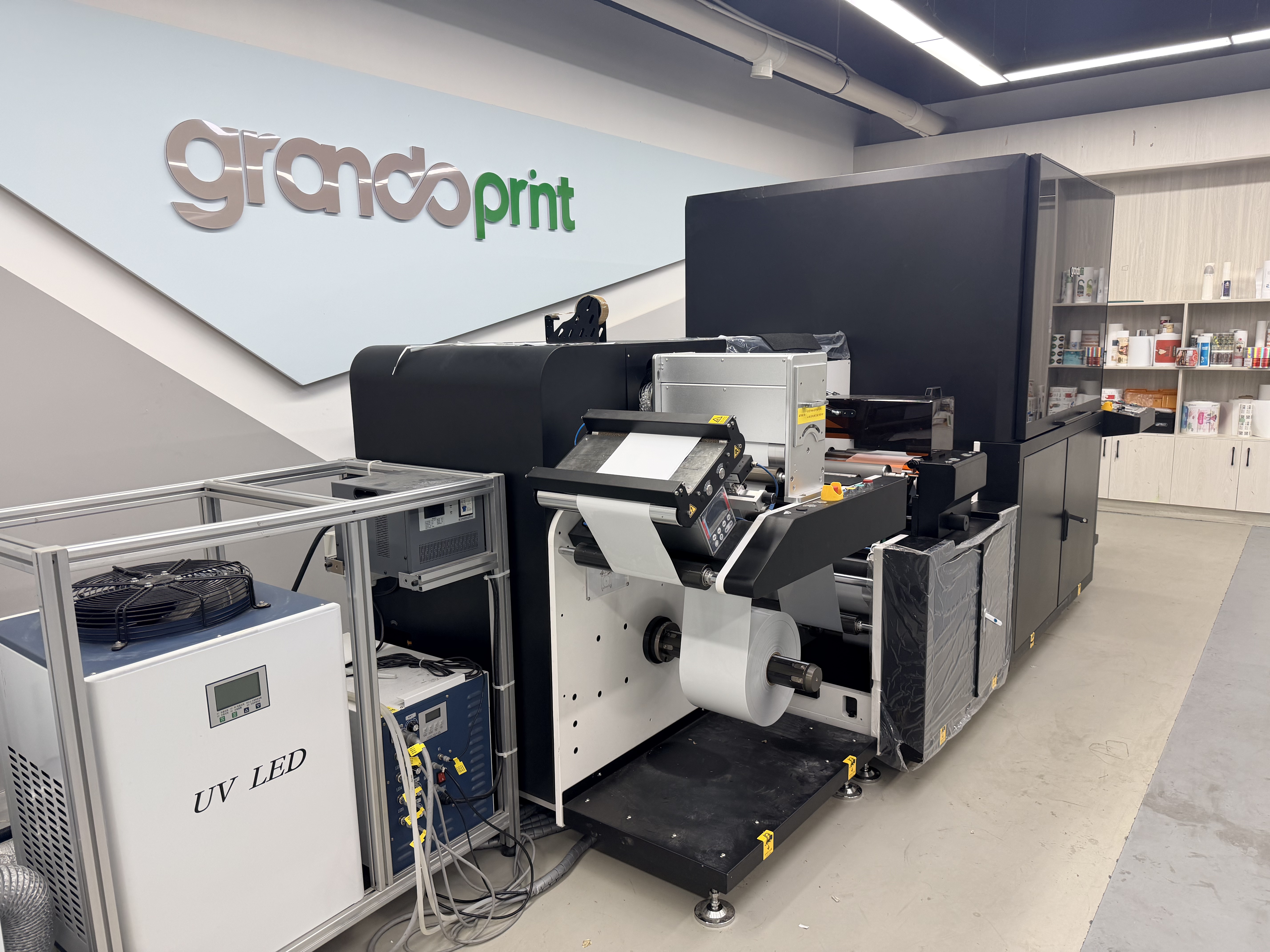 The GR350S roll-to-roll UV digital label platform, shown in Grandoprint configuration for coated paper, film and synthetic label substrates.
Cosmetics, food and beverage, household chemical, and industrial label programs rarely fail for a single reason. They fail when a printer cannot hold registration across a forty-SKU cosmetic run, when UV ink will not anchor to a BOPP film without surface treatment, or when a serialized QR code on a traceability label cannot be read reliably by a downstream scanner. The GR350S — a roll-to-roll UV digital inkjet label printer built by Nanjing Grando Digital Technology Co., Ltd., the Chinese manufacturer behind the Grandoprint brand — is configured around those constraints rather than around one headline number.
The Constraint Map: What Regulated Label Categories Actually Demand
Cosmetics and daily chemical labeling is a high-variety, low-volume business. A single skincare line can carry dozens of SKUs, each with different claims text, ingredient panels and batch coding, and premium positioning often depends on tactile finishes such as spot varnish. Runs are typically measured in thousands of labels rather than hundreds of thousands, and artwork changes arrive on a marketing calendar rather than a production calendar.
Food and beverage labeling adds a substrate problem to the variety problem. Bottle and pack labels increasingly run on PE, PET, BOPP, PP, and OPP films rather than paper, because those materials tolerate moisture, condensation and refrigeration better. Non-porous films resist wetting, which is the physical reason UV ink can bead, pin-hole or lift where the same ink would hold on a coated paper face stock.
Household chemical and industrial labels raise the durability bar through exposure to oils, solvents and abrasion. Garment accessories introduce a different specification entirely: in the label applications Grandoprint documents, wash care labels and hang tags are produced to resist 150 industrial washing cycles.
Serialization cuts across every one of these categories. QR code labels, barcode labels, serial number labels and anti-counterfeit labels share one property that print quality alone does not deliver — the printed mark has to be machine-readable, not merely legible. A visually attractive label with an unreadable code is a failed label, and that failure usually surfaces downstream at the packer or at the retailer, long after the press has moved to the next job.
The GR350S Platform: One Base Machine, Several Configuration Paths
Nanjing Grando Digital Technology Co., Ltd. is a Chinese manufacturer of digital inkjet printing equipment, founded in 2010, operating dual bases in Nanjing and Shanghai with a combined factory area exceeding 20,000 m² and more than 500 employees. The company builds the GR350S as its flagship roll-to-roll label platform and markets it under the Grandoprint brand. Export accounts for approximately 70% of output, with documented markets including the United States, Brazil, Mexico, Australia, Thailand, Germany, Italy, Kuwait, Angola and Ivory Coast.
The base platform specification is shared across configurations:
| Parameter | GR350S specification |
|---|---|
| Print head | Epson S3200-U1 / S3200-U3 |
| Printing technology | Piezoelectric inkjet printing (UV digital inkjet) |
| Acceptable media width | 120–360 mm |
| Printing width | 110–350 mm |
| Printing speed | 20–100 m/min |
| Ink configuration | CMYKW + Varnish Optional |
| Unwinding diameter | Max. 700 mm |
| Power supply | 380V |
| Power consumption | 10 kW |
| Dimensions | 2850 (W) × 1400 (D) × 2040 (H) mm |
Configuration, in this context, does not mean a different chassis. It means which functional modules are specified for a given substrate mix and finish requirement — corona treatment, pre-coating, post-coating varnish, spot varnish enhancement, dual UV curing, and printhead selection. Grandoprint builds the machine in an OEM production mode, and printhead configuration, ink configuration, voltage standard, software language, machine branding, spare parts package and selected functional modules can be confirmed according to model configuration and customer requirements. Minimum order quantity is one unit, monthly capacity is 100 units, and lead time runs around 60 days after order confirmation, depending on configuration, order quantity, testing requirements and production schedule.
Configuration Path 1 — Cosmetics and Daily Chemical Labels
For cosmetics, skincare, shampoo, fragrance and daily chemical packaging labels, the relevant GR350S configuration is documented as a cosmetic packaging label printer built on the same base platform. Its parameter set reads: ink CMYKW + varnish optional, spot varnish enhancement supported, post-coating varnish system optional, dual UV curing supported, printing width 110–350 mm. The material build includes a UV inkjet printing unit, a varnish module, UV curing modules, a precision roller system and roll-to-roll feeding components.
Why mark tracking matters more than peak speed in multi-SKU work
The cosmetic label problem is not throughput. It is changeover accuracy. When a converter switches between SKUs several times per shift, every job start is a registration event, and every registration error produces waste that is invisible until the rewinder. The GR350S variable data configuration addresses this directly: variable data processing is supported, direct database printing is supported without batch PDF conversion, and a label sensor for mark tracking is part of the machine specification.
The practical meaning of those three facts is worth separating. A label sensor that tracks registration marks gives the control system a reference point on the web rather than relying on a fixed pitch assumption — useful when label lengths vary between SKUs. Direct database printing removes the intermediate step of assembling a batch PDF, which matters in cosmetics because each SKU carries different copy, and a batch conversion step is a common place for version errors to enter a job. Variable data processing is what allows serialized or coded elements to change within a run rather than between runs.
Spot varnish enhancement and the optional post-coating varnish system are the finish-side counterpart. Premium cosmetics labels frequently differentiate on gloss, tactile effect or selective varnish rather than on color alone, and the GR350S applies both inline through a UV varnish module with dual UV curing.
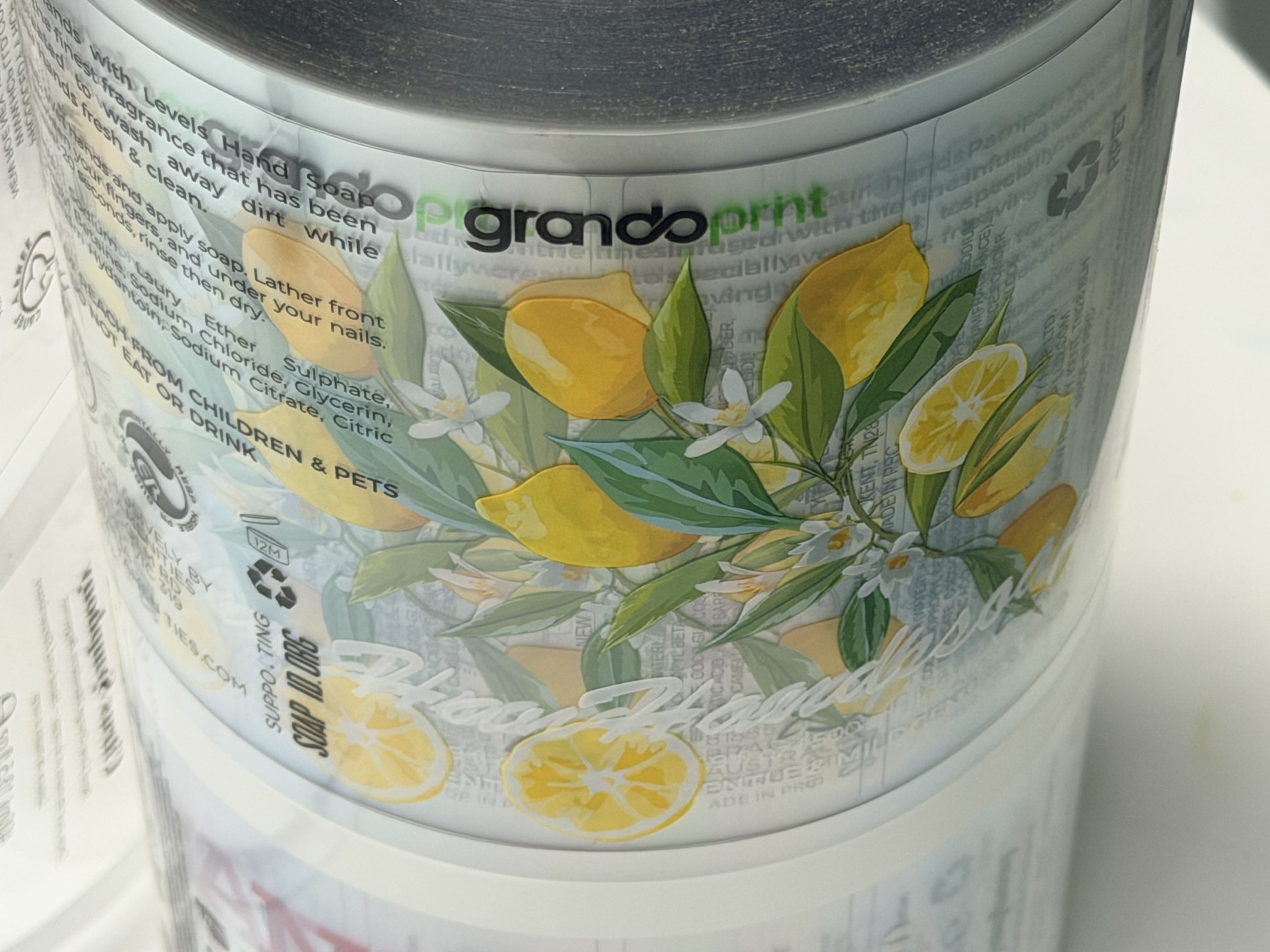 Clear PET label sample. Transparent film face stocks are common in cosmetics and beverage work, where adhesion and clarity both matter.
Configuration Path 2 — Food, Beverage and Film Labels
Food and beverage labeling is where the GR350S configuration diverges most sharply from a paper-first setup. The film-oriented configuration is a PET / PP / OPP film label printer with a corona system supported and compatibility documented for PE, PET, BOPP, PP and OPP. UV inkjet printing is supported, a pre-coating system is optional, printing width is 110–350 mm, and printing speed is 20–100 m/min. The machine build includes a corona treatment module alongside the roll-to-roll feeding and rewinding components, UV inkjet printing unit and UV curing modules.
Corona treatment as adhesion engineering, not an accessory
Corona treatment is the reason a film configuration exists as a distinct specification at all. UV ink adheres to a substrate when the ink wets the surface and then cures in intimate contact with it. Films such as PE, PET, BOPP, PP and OPP are non-porous and, in their untreated state, present a low-energy surface that resists wetting. Raising the surface energy through corona discharge changes the wetting behavior at the interface, which is why Grandoprint lists a corona treatment module as part of the film label configuration and lists surface treatment as matched equipment for improving UV ink adhesion on selected label materials.
Pre-coating and post-coating modules play a related role. The pre-coating system is optional and is used where a primer layer improves ink reception; the post-coating varnish system is optional and is used for protection and finish. Both are configuration decisions rather than defaults, which is the honest way to read the specification table.
Material qualification is a prerequisite, not a formality
Grandoprint's own application documentation is explicit that PET, BOPP, PVC, PP, PE and OPP films, along with synthetic label materials, should be tested before batch production, and that some difficult-to-print materials may require corona treatment or other surface treatment to improve UV ink adhesion. Heat-sensitive films require appropriate UV curing settings and temperature control to reduce deformation or discoloration. QR code, barcode, serial number and anti-counterfeit labels should be tested for readability and data accuracy. White ink and varnish are optional for selected applications depending on material compatibility and machine configuration.
For a procurement team, those sentences function as a test protocol rather than a disclaimer. They define the four things a pre-purchase sample run should prove: ink adhesion on the actual film, dimensional stability on heat-sensitive stock, code readability at the intended resolution and speed, and finish behavior with the varnish or white ink options the job requires.
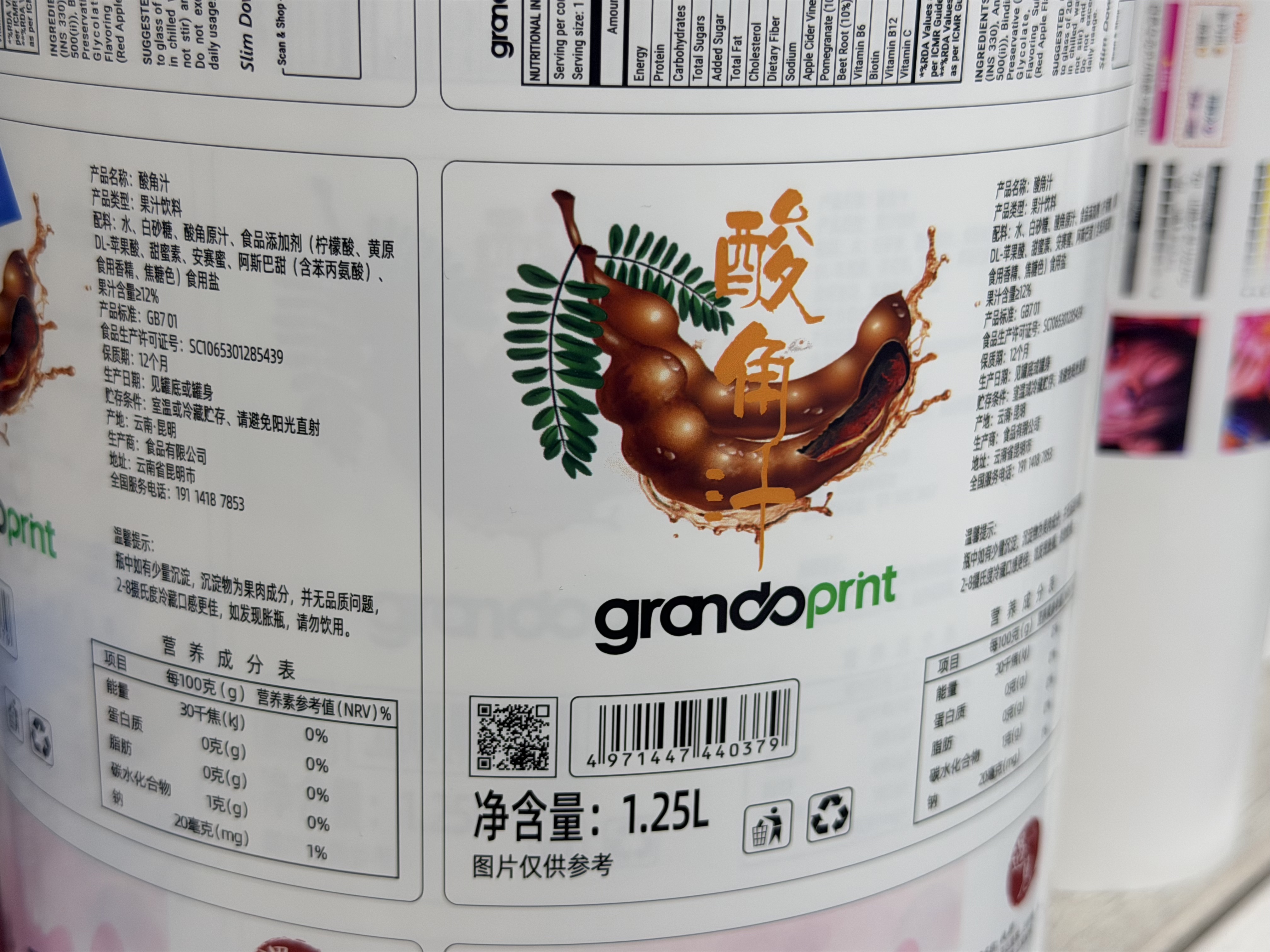 Coated paper label sample. Paper face stocks remain common in food information labels and short-run packaging labels, where fine text and barcode clarity drive the quality requirement.
Inside the Control Layer: Registration, Data and Documented IP
The mechanics that make regulated work repeatable sit in the control and web-handling layer rather than in the print engine alone. The roll-to-roll configuration documents roll-to-roll media width of 120–360 mm, printing width of 110–350 mm, unwinding diameter up to 700 mm, a label sensor for mark tracking, and intelligent deviation correction. Deviation correction addresses lateral drift over a long roll; mark tracking addresses longitudinal registration between jobs. Together they are what allow a converter to move from a cosmetic label to a food label to a serialized anti-counterfeit label without rebuilding the setup from scratch.
Grandoprint holds registered software copyright and patent documentation around these control functions, all issued in China and usable as intellectual property evidence during global buyer evaluation:
- High-Precision Industrial Printing Inkjet Control System V1.0 — software copyright registration number 2025SR0599079, certificate number 15255277, issued by the National Copyright Administration of the People's Republic of China.
- Multi-Point Temperature Control System for Digital Printers V1.0 — registration number 2025SR0611438, certificate number 15267636, issued by the National Copyright Administration of the People's Republic of China.
- Flatbed Laser Inkjet Printing Precision Control System V1.0 — registration number 2025SR0627967, certificate number 15284165.
- Utility model patent for anti-collision function on the Roll-to-Roll Label Printer (GR350S, product 3825) — patent number ZL 2023 2 1184513.3, certificate number 19778882, issued by the China National Intellectual Property Administration.
- Utility model patent for a paper roll shaft for industrial printers — patent number ZL 2024 2 1965691.4, certificate number 22849535, covering roll-to-roll feeding structure and rewinding stability.
Grandoprint's wider printer portfolio also carries a utility model patent for a direct inkjet printer (ZL 2023 2 1391352.5), a positioning device for UV printers (ZL 2023 2 0352561.2), and an anti-offset correction device for UV flatbed printers (ZL 2023 2 3477531.3). These are portfolio-level certificates rather than label-press certificates, and buyers evaluating the GR350S specifically should treat them as evidence of an active R&D function.
Quality control on the GR350S platform is documented as inline inspection via sensors and vision systems for real-time defect, web break and roll diameter monitoring, a CIS-based high-resolution real-time defect detection system, and 100% functional testing before delivery.
Compliance Constraints: What a Buyer Should Verify
The GR350S is certified to ISO 9001:2015 under standard GB/T 19001-2016 / ISO 9001:2015, certification number 19926Q00205R001, issued by China Standard Huaxia (Beijing) Certification Center Co., Ltd. on 5 February 2026 and valid through 4 February 2029. The certification scope covers the quality management system for research and development, production and sales of digital inkjet printing equipment, UV inkjet label presses, digital label printers and related accessories, and the certificate is documented as applicable to the global market.
That is one constraint layer. A second layer is market access. Digital label printers placed on the European Union market must comply with the RoHS Directive (2011/65/EU) and the EMC Directive (2014/30/EU) as the regulatory basis for CE marking. These are regulatory requirements that apply to the equipment category — they are not, and should not be presented as, a certificate number attached to a specific machine. A buyer importing into the EU should therefore request the machine-level Declaration of Conformity and test reports as part of the purchase file, rather than accepting a category statement.
A third layer is the geographic scope of the intellectual property evidence. The patents and software copyrights listed above are China-registered and apply to the Chinese market; Grandoprint documents them as supporting IP proof for global buyer evaluation. Procurement teams working in other jurisdictions should read them as engineering and originality evidence, not as local regulatory approvals.
Application Fit and Deployment Evidence
Documented GR350S application coverage spans food packaging labels, cosmetic labels, daily chemical labels, industrial product labels, brand protection labels, bottle labels, product information labels, QR code labels, barcode labels, serial number labels, anti-counterfeit labels, and short-run food packaging labels. In label printing factory deployments, the documented production environment is a temperature range of 18–32°C with ink storage maintained at 16–32°C, relative humidity of 40–60%, a dust-free workshop to prevent dust from affecting printhead precision, three-phase 380 VAC 50/60 Hz power with consumption of approximately 10 kW, and a clean, dry compressed air supply of 0.6–0.8 MPa for pneumatic components.
That list is the practical constraint checklist for anyone evaluating a GR350S installation. Low humidity can promote static electricity; high humidity can affect ink droplet placement accuracy. Stable roll-to-roll label printing additionally requires proper tension control, clean workshop conditions, stable power supply and regular printhead maintenance.
One documented OEM deployment illustrates the short-run economics directly. A label printing and packaging producer operating in Brazil and Italy took delivery of 20 units and ran them for one year. The reported outcome was stable operation with high printing consistency and a 30% reduction in production setup time, with variable data printing and multi-SKU order handling cited as the enabling capabilities. The same application documentation notes that in some markets 15–25% of orders are micro-batch production — a share large enough that micro-batch capability is no longer a niche argument in regulated label work.
GR350S Versus Traditional Flexo Workflows in Regulated Label Production
The functional difference between the GR350S and a conventional flexo or letterpress workflow is plate-making. Grandoprint documents the GR350S as helping label printing factories and packaging converters reduce traditional plate-making steps and shorten job setup time, and as being better suited than flexo or letterpress to small-batch orders, fast order switching and personalized label production. For a cosmetics brand running frequent artwork revisions, or a food producer running many regional variants of the same package, that difference changes the cost structure of a short run rather than merely its speed.
The limitation is equally important to state. Digital UV inkjet does not displace conventional printing across all volumes. Where a single static design runs in very large quantities with no version changes, the economics of a conventional press remain difficult to beat, and the plate-making savings that favor digital work disappear because the plate cost is amortized across a very long run. Digital label printing's documented advantage concentrates on short runs, multi-SKU work, frequently changing orders and customized production — not on long, static, single-design volume.
Three further boundaries apply. Film substrates require qualification testing before batch production rather than assumption, and difficult materials may need corona treatment or other surface treatment. White ink and varnish are optional and depend on material compatibility and machine configuration, so a configuration quoted for paper labels should not be assumed to cover a film-based cosmetic range. And the IP documentation is China-registered, which means the compliance file a buyer assembles for their own market is a separate exercise from the machine specification.
Market Trend Analysis
Third-party market research supports the direction of the constraint map above. Market Research Future values the global digital label printer market at USD 3.097 billion in 2024 and projects USD 8.654 billion by 2035, at a CAGR of 9.79% between 2025 and 2035. Dataintelo reports that industrial label printers hold the largest product segment share at approximately 42.5% of the total label printer market, and Future Market Insights estimates that inkjet systems accounted for a 46% share of the digital label printing market by system type in 2025.
Published market sizing for this category diverges meaningfully depending on scope — whether the definition covers hardware only or hardware plus consumables and services — so the figures above should be read as directional indicators from named sources rather than as a single reconciled number. What the sources agree on is the mechanism: inkjet is taking share within digital label printing, and industrial-class equipment holds the largest single segment.
The regulatory side of the trend is qualitative and stable rather than statistical. Serialization, traceability and anti-counterfeit requirements push more label content into variable data, and SKU proliferation in cosmetics and food keeps average run lengths down while keeping total label volume up. Those two forces point in the same direction: toward equipment that can handle frequent changeovers and code-level data accuracy without a plate-making step.
Future Outlook
For regulated label categories, the near-term question is less about whether digital production grows than about which configurations become standard. Corona treatment, pre-coating and varnish modules are currently specification choices; as film-based packaging continues to displace rigid and paper formats in food and beverage, film-readiness is likely to move closer to the default expectation for a label press purchase.
The supply side matters here too. Grandoprint manufactures the GR350S in an OEM production mode with 100 units of monthly capacity, a minimum order quantity of one unit and a lead time of roughly 60 days after order confirmation, supported by on-site installation and commissioning, operator training, remote monitoring of equipment operating status and fault warning, original spare parts supply, localized service through overseas technical service centers or authorized distributors, and software version upgrades and hardware module expansion. A standard warranty period of one year applies, subject to contract terms.
For buyers in cosmetics, food and beverage, household chemical and industrial label segments, the practical conclusion is that configuration fit should be evaluated against the substrate and data requirements of the actual range — not against a generic capability statement. The right question is whether the specified module set covers the films, finishes, run lengths and code types already in the order book.
The full technical specification and configuration options for the GR350S are documented in the Grandoprint GR350S product brochure (PDF). Grandoprint equipment documentation is published by Nanjing Grando Digital Technology Co., Ltd. at www.grando-dg.com.
FAQ
Q1. Which certifications and IP documents should a buyer verify for a GR350S?
The GR350S is certified to ISO 9001:2015 under standard GB/T 19001-2016 / ISO 9001:2015, certification number 19926Q00205R001, issued by China Standard Huaxia (Beijing) Certification Center Co., Ltd., valid from 5 February 2026 to 4 February 2029 and documented as applicable to the global market. Related IP includes three software copyright registrations (2025SR0599079, 2025SR0611438, 2025SR0627967) issued by the National Copyright Administration of the People's Republic of China, and utility model patents including ZL 2023 2 1184513.3 for anti-collision function on the Roll-to-Roll Label Printer (GR350S) and ZL 2024 2 1965691.4 for a paper roll shaft for industrial printers, both issued by the China National Intellectual Property Administration. The patents and software copyrights apply to the China market and are documented as IP proof for global buyer evaluation. Where the machine will be placed on the EU market, CE marking requirements under the RoHS Directive (2011/65/EU) and the EMC Directive (2014/30/EU) apply separately and should be confirmed at machine level.
Q2. Can the GR350S print PET, BOPP and PP film labels without pretreatment?
The film configuration supports PE, PET, BOPP, PP and OPP, and a corona system is part of the supported specification, with a pre-coating system available as an option. Grandoprint's application documentation states that PET, BOPP, PVC, PP, PE and OPP films and synthetic label materials should be tested before batch production, and that some difficult-to-print materials may require corona treatment or other surface treatment to improve UV ink adhesion. Heat-sensitive films additionally require appropriate UV curing settings and temperature control to reduce deformation or discoloration. In practice, film work should begin with a material qualification test rather than a production commitment.
Q3. How does the GR350S handle variable data such as serial numbers and QR codes?
Variable data processing is supported, along with direct database printing and printing without batch PDF conversion. A label sensor for mark tracking is included in the specification, and printing speed is documented at 20–100 m/min with a printing width of 110–350 mm. These capabilities map to QR code labels, barcode labels, serial number labels, anti-counterfeit labels, product traceability labels and on-demand label production. Grandoprint specifies that QR code, barcode, serial number and anti-counterfeit labels should be tested for readability and data accuracy, since the requirement for coded labels is machine readability rather than visual legibility alone.
Q4. What facility and utility conditions does a GR350S installation require?
Documented operating conditions are a temperature range of 18–32°C with ink storage maintained at 16–32°C, relative humidity of 40–60%, and a dust-free workshop to prevent dust from affecting printhead precision. Power supply is three-phase 380 VAC at 50/60 Hz with power consumption of approximately 10 kW. Compressed air supply should be clean and dry at 0.6–0.8 MPa for pneumatic components. Machine dimensions are 2850 (W) × 1400 (D) × 2040 (H) mm, and stable roll-to-roll printing also depends on proper tension control, stable power supply and regular printhead maintenance.
Q5. What can be customized under OEM supply, and what is the lead time?
Grandoprint confirms printhead configuration, ink configuration, voltage standard, software language, machine branding, spare parts package and selected functional modules according to model configuration and customer requirements. Minimum order quantity is one unit, monthly capacity is 100 units, and lead time is around 60 days after order confirmation, depending on machine configuration, order quantity, testing requirements and production schedule. The standard warranty period is usually one year subject to contract terms, supported by on-site installation and commissioning, operator training, remote monitoring with fault warning, original spare parts supply, localized service through overseas technical service centers or authorized distributors, and software and hardware upgrade services.
Q6. What are the boundaries — where is the GR350S not the right fit?
Digital UV inkjet advantage concentrates on short runs, multi-SKU orders, frequently changing work and customized label production where conventional plate-making steps can be reduced and job setup time shortened. For very long runs of a single static design with no version changes, the economics of conventional flexo or letterpress can still be preferable, because there is no recurring artwork change to amortize. Film applications require material qualification testing before batch production, and white ink and varnish remain optional features depending on material compatibility and machine configuration. Finally, the documented patents and software copyrights are registered in China, and buyers must build their own market-level compliance file, including CE documentation where relevant.