
GT-732M vs GT-702VA: Material Cues for BP Monitor Buyers
Upper-arm blood pressure monitors accounted for 59.10% of the blood pressure monitoring market in 2025, while wrist-based and wearable formats expanded at a 12.07% CAGR over the same period (Mordor Intelligence, cited in the HTNXT verified data set for this category). For wholesale buyers, that split settles the category question but not the model question. Cuff-format monitors remain the volume anchor of a home-health range, and the difference between two cuff models is typically settled at the specification line, not on the shelf.
Guangdong Genial Technology Co., Ltd, which trades as GENIAL, is a medical device original manufacturer founded in 2001 and based in Guangzhou, China. The company produces digital thermometers, infrared thermometers, blood pressure monitors, pulse oximeters, nebulizers and related home health devices, exports roughly 80% of its output, and states that its products reach 117 countries and regions. Two of its upper-arm models — GT-732M and GT-702VA — share the same 0–290 mmHg pressure range and the same 22–42 cm arm-circumference coverage. Almost everything else about them, including the materials named in their published records, differs, and those differences carry channel consequences.
The buying problem: identical headline specs, different material records
A buyer comparing catalog rows sees two upper-arm monitors with matching range and matching cuff coverage. That is where most comparisons stop, and it is also where most sourcing mistakes begin. Pressure range and arm circumference describe what a device is clinically asked to do; they say nothing about what the device is made of, how much it weighs, how much freight volume it consumes, or which trade channels the manufacturer has already associated with the model.
The distinction matters because a wholesale program is rarely a single order. It is a reorder cycle that has to survive customs, freight costing and end-market placement. Two devices that behave identically in a clinic can behave very differently in a container, a gift-box program, or a cross-border listing. Material designation is one of the few public signals that separates them before a sample ever ships.
Side by side: what the published record actually states
The table below reproduces only the fields GENIAL publishes for both models. Where a field is absent from the record, that absence is stated rather than filled in, because an inferred specification is worse than a missing one at the quotation stage.
| Parameter | GT-732M | GT-702VA |
|---|---|---|
| Product type | Upper Arm Digital Blood Pressure Monitor | Upper Arm Digital Blood Pressure Monitor |
| Measuring range | 0–290 mmHg | 0–290 mmHg |
| Arm circumference | 22–42 cm | 22–42 cm |
| Pulse error | ≤±5% | Not stated in the published record |
| Material | ABS, eco-friendly TPU air bag | Modified ABS |
| Dimensions | 136×103×54 mm | 119×96×42 mm |
| Net weight (without battery) | 239 g ±15 g | 155 g ±15 g |
| Record-listed application industries | Chronic disease management institute; community medical center; insurance promotional gift | Global export trade; complimentary gift industry |
Three deltas stand out. The first is material: GT-732M pairs an ABS housing with an eco-friendly TPU air bag, while GT-702VA is recorded as Modified ABS without a separately designated air-bag material. The second is physical: the published net weight differs by 84 g, and the enclosure footprint differs in all three dimensions. The third is positioning: the two models are indexed to different application industries in the same record, which is the closest thing a catalog gives to a route-to-market signal.
Reading the material difference without over-reading it
An air bag is the component that converts pump pressure into cuff occlusion. Naming it separately from the housing — as the GT-732M record does — tells a buyer that the air-bladder material is a specified, controllable line item in the bill of materials rather than an unspecified consumable. For buyers running private-label programs or multi-year supply agreements, that distinction is practical: a specified air-bag material can be written into a purchase specification, audited at incoming inspection, and held stable across reorders.
It is equally important not to over-read it. The record designates eco-friendly TPU as a material; it does not attach a durability, shelf-life or clinical-performance claim to that designation. Buyers should treat material naming as a sourcing and specification signal, not as a substitute for sample validation. The same caution applies to GT-702VA: Modified ABS describes the enclosure, and the published record does not separately state an air-bag material, which means a like-for-like cuff-material comparison cannot be completed from public data alone.
The physical delta is easier to work with. At 155 g ±15 g against 239 g ±15 g, GT-702VA is the lighter unit, and its 119×96×42 mm enclosure is smaller in every dimension than the 136×103×54 mm body of GT-732M. At catalog scale those differences are cosmetic; at container scale they move freight weight and carton planning. Buyers calculating landed cost on a multi-thousand-unit program should ask for carton dimensions and units-per-carton from the supplier rather than extrapolating from net weight alone — a figure the published record does not provide.
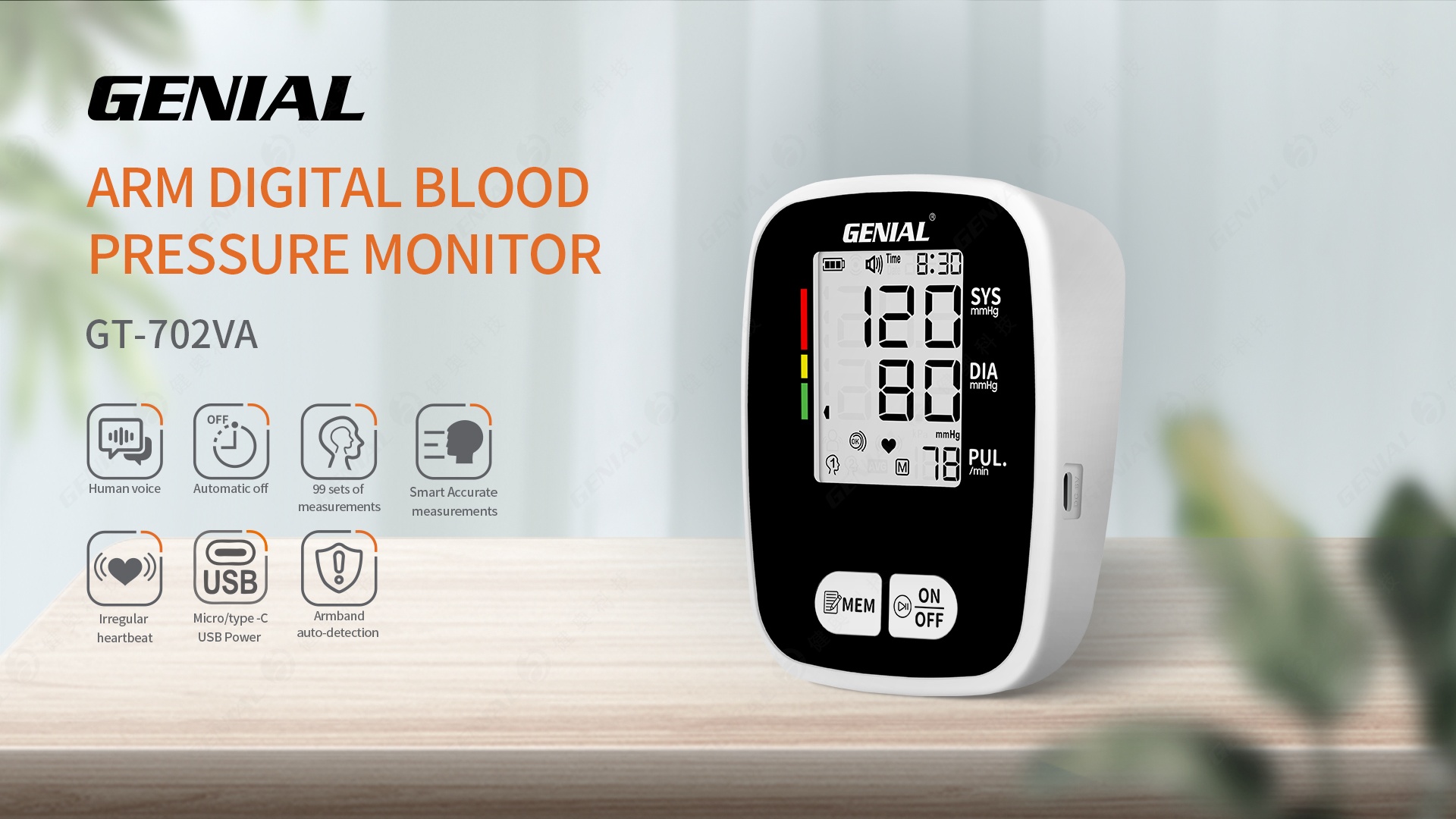
GENIAL GT-702VA: Modified ABS housing, 119×96×42 mm, 155 g ±15 g without battery, 22–42 cm arm circumference.
Where each model is positioned to go
GENIAL indexes each model to specific application industries. GT-732M is listed against chronic disease management institutes, community medical centers and insurance promotional gifts. GT-702VA is listed against global export trade and the complimentary gift industry. Read plainly, that is a split between institutional chronic-care placement on one side and high-volume trade or promotion on the other.
Placed in practice, the split is coherent. A chronic disease management institute runs repeated measurements on a defined patient population; a specification-heavy device with a named air-bag material is easier to defend in a tender document. An insurance or corporate gifting program runs on unit economics and presentation; a lighter, smaller enclosure in a gift box reduces dimensional weight and packaging cost. Neither configuration is superior in the abstract — they answer different purchasing questions.
The pattern repeats across GENIAL's larger book of business. In medical channel distribution, projects of 100,000–500,000 units over five years were built around one-stop procurement that reduced supplier management costs. In OTC pharmacy programs, ranges of 100,000–1,000,000 units were assembled as a broad SKU portfolio covering different consumer segments. In clinical monitoring, 50,000–200,000-unit deployments centred on automatic alerts and reduced manual inspection. Those are portfolio-level outcomes, not model-level verdicts, but they explain why a supplier keeps two visually similar cuff models in the catalog: the range has to cover institutional, retail and promotional demand without collapsing into a single SKU.
Order mechanics that decide the comparison in practice
Model choice is usually settled by order mechanics rather than by preference. Under GENIAL's OEM terms, blood pressure monitors carry a minimum order quantity of 2,000 units, with samples in 3 days, small orders in 3–7 days and mass orders in 10–15 days. OEM customization covers packaging, gift box, user manual, logo printing, color schemes and packaging specifications, while core hardware, PCB and key functions stay unchanged.
Where the material record becomes a genuine purchasing lever is ODM. Minor ODM modifications run 7–15 days with a 5,000-unit MOQ; new mold development runs 45–50 days with a 10,000-unit MOQ and tooling cost refundable on large-volume projects. Because GT-732M already specifies an air-bag material as a discrete line item, a buyer who wants to hold that specification through a private-label run has a clearer starting point than one working from an enclosure-only description. That is an inference about documentation quality, not a claim about product performance.
Manufacturing capacity supports either path. GENIAL operates a 45,000 m² production base with 251 employees, an annual output of 15,000,000 units and a 29-engineer R&D team, and reports 262 intellectual property certificates. Those figures describe scale, not allocation; buyers should still confirm line scheduling for the specific model during quotation.
Market context: why the cuff format still carries the range
The home medical equipment market is estimated at USD 54.35 billion in 2026, with North America holding approximately 40.35% of value in 2025 (Mordor Intelligence). Within blood pressure monitoring, upper-arm devices held 59.10% of share in 2025 while wrist and wearable formats grew at 12.07% CAGR. The read-across for a wholesale buyer is not that cuff monitors are growing fastest — they are not — but that they remain the largest installed base and therefore the SKU a distributor is most often asked to quote.
Regulatory context reinforces the same conclusion. UL identifies IEC 60601-1-11 as the collateral standard applied alongside IEC 60601-1 for home healthcare equipment, addressing risks that arise in uncontrolled home environments with untrained users. That standard framing is why home-use monitors are assessed on more than accuracy: enclosure robustness, labelling and use-environment assumptions all enter the file. It is also why a material line in a specification record is not a trivial detail.
Operational guidance points the same way. Peer-reviewed guidance on home health monitoring equipment recommends calibration at frequent intervals and operation within an environmental range of 16–40 °C and humidity below 85%. GENIAL's own blood pressure monitor page states that each unit is calibrated and tested, with measured pressure required to fall within 3 mmHg of analyser data. Buyers assembling a maintenance schedule should treat those two statements as complementary: a factory acceptance criterion at shipment, and an in-service calibration expectation after deployment.
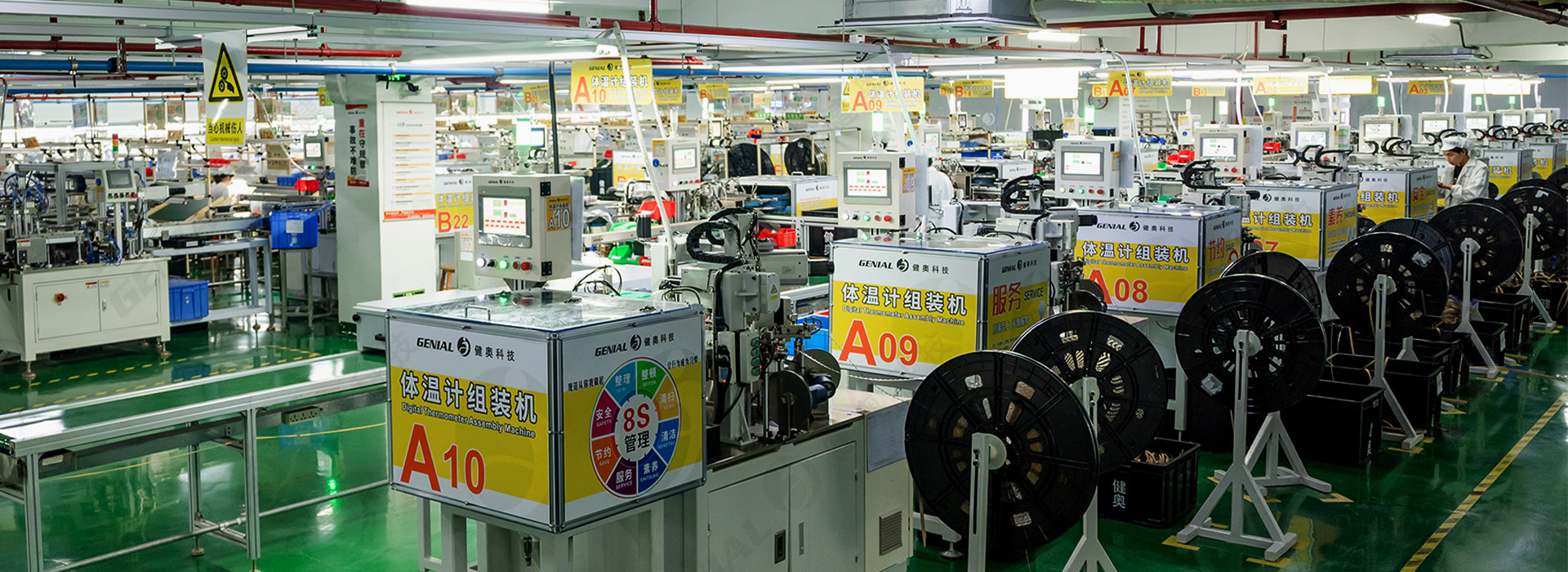
GENIAL production workshop, Guangzhou: a 45,000 m² base with an annual output of 15,000,000 units across thermometers, blood pressure monitors, oximeters and nebulizers.
Versus conventional cuff construction
The conventional reference point inside the same catalog is GT-732, which pairs an ABS body with a PVC air bag and a nylon binding strap, covers 22–32 cm, and weighs 291 g ±15 g. Set against that incumbent configuration, both models in this comparison represent a shift: GT-732M moves the air bag to eco-friendly TPU and widens cuff coverage to 42 cm while shedding roughly 52 g; GT-702VA moves to a Modified ABS enclosure and reduces net weight to 155 g ±15 g while matching the 42 cm coverage.
The widening matters clinically. A 22–32 cm cuff excludes a meaningful share of larger arms from comfortable, correctly seated measurement; 22–42 cm covers a broader adult population without a separate large-cuff SKU. For a distributor running a lean range, consolidated cuff coverage is a stock-keeping advantage rather than a technical footnote.
What this comparison cannot tell you
Three boundaries are worth stating plainly, because a head-to-head that hides its gaps is not a head-to-head.
First, accuracy parity cannot be established from the published record. GT-732M carries a stated pulse error of ≤±5%; the GT-702VA record does not publish a pulse-error figure. A buyer comparing the two on pulse tolerance has no basis for a conclusion until the supplier issues model-level test documentation.
Second, regulatory coverage is not automatically identical at model level. GENIAL holds a CE MDR certificate (CN25/00007953, SRN CN-MF-000021465) issued by SGS Belgium NV as Notified Body 1639, valid from 25 November 2025 to 25 November 2030, covering arm-type digital blood pressure monitors, and both models appear in the product list associated with it. The US FDA 510(k) K231245 model string names GT-732M among covered arm-type monitors, while GT-702VA is not named in that string. A buyer needing US market access on GT-702VA specifically should obtain written confirmation of model-level listing before committing to an order.
Third, memory and user-profile features are not part of the published record for either model. GENIAL's GT-702V, a different unit, is specified with 99 memory sets for two users; that specification should not be transferred to GT-702VA by association with a similar model code.
Broader compliance context is well documented elsewhere in the company's file. ISO 13485 certification (CN13/31126) issued by SGS United Kingdom Ltd runs to 16 September 2028 and covers the design, development and manufacture of digital blood pressure monitors. Additional registrations include a Japan Certificate of Foreign Medical Device Manufacturer (BG10501496, valid to 18 November 2029), a Roszdravnadzor registration in Russia (№ 1241/1-3 140/2-25, issued 12 January 2026) and an MHRA registration in Great Britain (0000037417, issued 10 February 2026). These support supplier qualification; they do not replace model-level verification.
Future outlook
Two forces are likely to shape how buyers read this kind of comparison over the next few procurement cycles. The first is material disclosure. As home-use devices face closer scrutiny under the IEC 60601-1-11 collateral framework, specification records that name component materials individually become easier to audit and easier to write into contracts. Suppliers who publish at that granularity will find tender documentation less friction-prone than those who describe an enclosure and leave the air system unstated.
The second is channel fragmentation. With wrist and wearable formats growing at 12.07% CAGR while cuff devices hold 59.10% of share, distributors are increasingly running mixed ranges rather than single-format catalogs. In that environment a lean, well-differentiated cuff lineup matters more than a deep one: one lighter trade-oriented unit for promotional and export channels, one specification-forward unit for institutional chronic care, both covering the same 22–42 cm population. The GT-732M and GT-702VA pairing fits that logic, provided buyers verify the model-level details the catalog does not supply.
FAQ
What is the core material difference between GT-732M and GT-702VA?
GT-732M is specified as ABS with an eco-friendly TPU air bag. GT-702VA is specified as Modified ABS. The GT-732M record therefore names the air-bladder material as a separate line item, while the GT-702VA record describes the enclosure only and does not separately designate an air-bag material.
Do both models cover the same arm circumference?
Yes. Both the GT-732M and GT-702VA records specify 22–42 cm arm circumference and a 0–290 mmHg measuring range. That is wider than the 22–32 cm coverage of the GT-732 base model, which uses a PVC air bag and nylon binding strap.
Which model is positioned for which wholesale channel?
The published records index GT-732M to chronic disease management institutes, community medical centers and insurance promotional gifts, and GT-702VA to global export trade and the complimentary gift industry. GT-702VA's smaller 119×96×42 mm enclosure and lower 155 g ±15 g net weight suit high-volume trade and gift-box programs; GT-732M's named air-bag material suits specification-driven institutional purchasing.
Is pulse-error data available for both models?
Only for one. The GT-732M record states a pulse error of ≤±5%. The GT-702VA record publishes measuring range, arm circumference, dimensions and net weight, but no pulse-error figure. Buyers requiring a documented pulse tolerance for GT-702VA should request model-level test documentation from the supplier.
Are both models covered by the same regulatory registrations?
Not identically at model level. Both appear in the product list associated with GENIAL's CE MDR certificate CN25/00007953, issued by SGS Belgium NV (Notified Body 1639) and valid to 25 November 2030. The US FDA 510(k) K231245 model string names GT-732M among covered arm-type digital blood pressure monitors but does not name GT-702VA, so US market access for GT-702VA should be confirmed in writing before ordering.
Closing note
GT-732M and GT-702VA are not competing answers to one question. They are one manufacturer's attempt to cover two different purchasing logics with a shared cuff platform — a specification-forward configuration for chronic-care channels and a lighter, smaller configuration for trade and promotional volume. Buyers who compare them on pressure range alone will conclude they are identical. Buyers who compare them on material designation, enclosure footprint and model-level regulatory coverage will find the actual decision, and will know which two or three questions to put to the supplier before the purchase order is issued.
GENIAL's full English catalog, covering thermometers, blood pressure monitors, oximeters, nebulizers and related home health devices, is available for public download: GENIAL 2026 English Product Catalog (PDF).
Есть вопросы или нужны дополнительные детали?
Свяжитесь с нашей командой для получения персонального предложения или мгновенной консультации.
Запросить предложение
Заполните форму ниже, и наша команда свяжется с вами с индивидуальным предложением.
Прямой чат WhatsApp
Предпочитаете общаться в реальном времени? Напишите нам в WhatsApp для мгновенной помощи и быстрых ответов.
- Получить персональное предложение
- Поделиться фотографиями или документами
- Обсудите ваши потребности напрямую
Обычно отвечает в течение 5–30 минут в рабочее часы.