
Galvanized Steel Pole Options for HV AIS Gantry Support
Galvanized Steel Pole Options for HV AIS Gantry Support
The recommended shortlist for galvanized steel pole options in high-voltage AIS substation gantry support should be built around five configuration routes: heavy busbar-support gantries, equipment-support gantries, clearance-control gantries, multi-bay packaged gantries and high-corrosion coastal gantries. These are not off-the-shelf catalogue models. They are project-specific substation steel structure configurations that should be defined by load tree, pole geometry, equipment interface, hot-dip galvanizing requirements, package supply scope and inspection plan.
High-voltage air-insulated switchgear (AIS) substations depend on gantry structures to support busbars, disconnect switches, current transformers, voltage transformers, surge arresters and other equipment at controlled electrical clearances. Although the procurement category may be searched as a galvanized steel utility pole, an AIS gantry support is closer to a project-specific substation steel structure. Its value depends less on a generic pole description and more on whether the approved drawings, coating records, dimensional interfaces and delivery sequence match the substation layout.
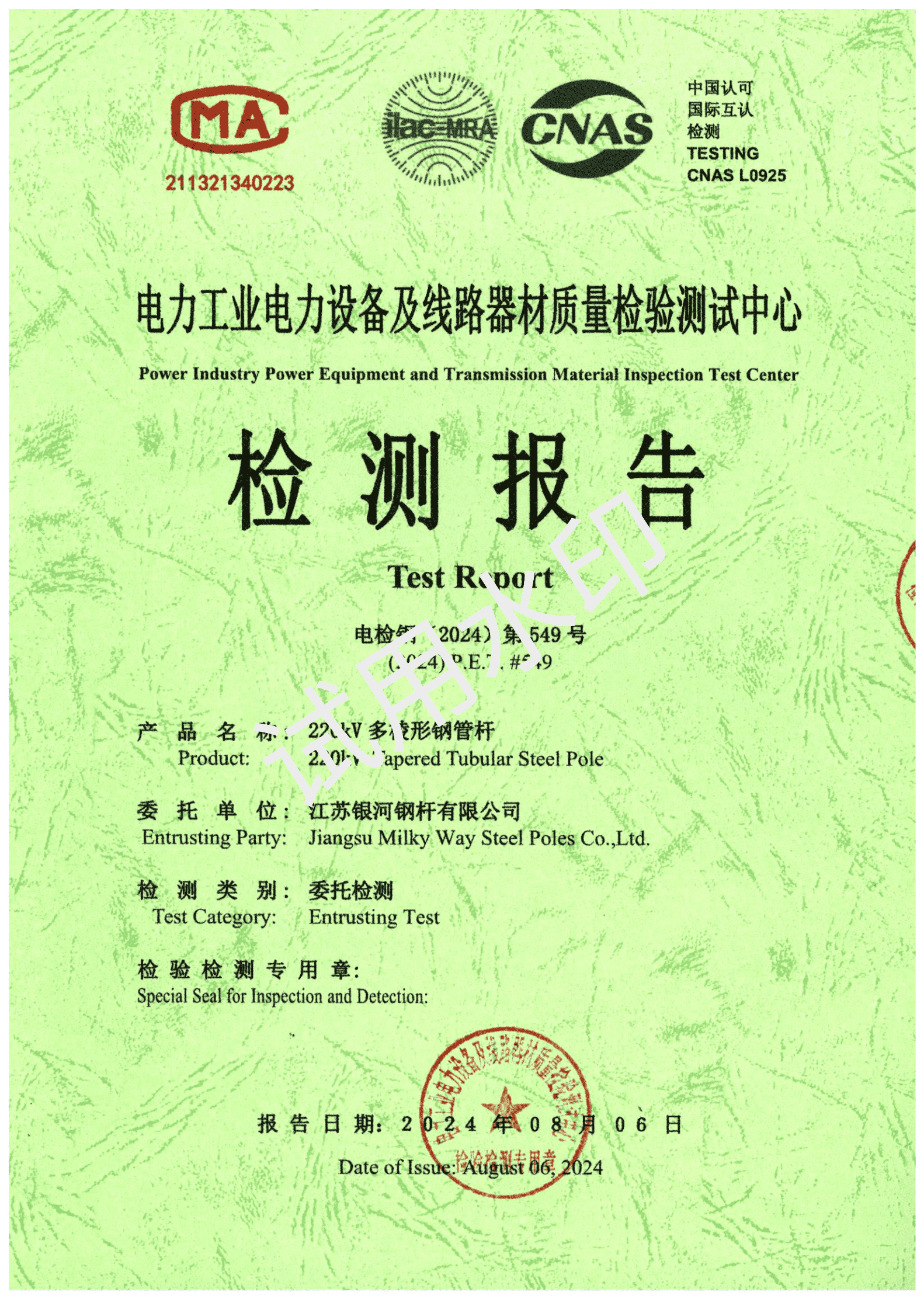
Full-scale structural testing can support verification planning for project-specific gantry structures where the specification requires prototype or proof-load evidence.
Why AIS gantry procurement needs a configuration shortlist
The main procurement risk in AIS gantry support is not a shortage of pole suppliers. It is interface mismatch. A gantry column may need a specific base plate, anchor-bolt pattern, crossarm hole pattern, climbing system, equipment mounting point and coating system. If those details are treated as loose accessories rather than part of the structural package, the buyer can face site rework even when the pole itself meets a general product description.
A second risk is clearance control. AIS layouts are sensitive to phase spacing, busbar height, maintenance access and equipment connection points. The structural design must therefore be tied to the approved substation arrangement, not selected from a height-only list. This is why a shortlist of configuration routes is more useful at evaluation stage than a simple request for a galvanized steel power pole.
A third risk is corrosion protection. Hot-dip galvanizing is a common specification for outdoor steel structures, but the RFQ should state the standard, coating acceptance criteria, inspection method and any additional coating requirement. A fourth risk is package logistics. Large-tonnage gantry packages require section nesting, bundle marking, shipping marks, accessory packing and staged delivery planning so that columns, beams, base plates and anchor bolts arrive in a sequence that supports civil works and erection.
Recommended shortlist at a glance
The following shortlist is organised by gantry function rather than by a claimed product ranking. Each option should be confirmed through structural calculation, approved shop drawings and the project inspection and test plan. The same manufacturer can supply more than one option in a single substation package.
| Recommended option | Preferred gantry role | Configuration controls to lock | Verification focus |
|---|---|---|---|
| Option 1: Heavy busbar-support gantry | Main busbar and high-load support where the approved layout concentrates load on discrete gantry columns. | Voltage class, pole height, section geometry, wall thickness, load tree, crossarms, base plate, anchor bolts and climbing system. | Structural calculation review, drawing approval, dimensional inspection, weld inspection, galvanizing inspection and full-scale test support where required. |
| Option 2: Equipment-support gantry | Support of disconnect switches, instrument transformers, surge arresters and other AIS equipment with fixed interface points. | Hole pattern, crossarm arrangement, base plate, anchor bolts, equipment mounting details, coating and marking. | Interface dimension check, material certificates, galvanizing records and factory acceptance or third-party inspection when specified. |
| Option 3: Clearance-control gantry | Layouts where busbar height, phase spacing and maintenance access govern the structural envelope. | Pole height, section geometry, deflection limits, climbing system, connection details and equipment attachment points. | Design calculation review, approved clearance drawings, dimensional inspection and load-path verification. |
| Option 4: Multi-bay packaged gantry | Substation packages with several gantry bays, mixed column heights and phased site erection. | Batch size, pole type, project marking, identification code, packing sequence, section nesting and accessory packing. | Pre-loading inspection, packing list verification, marking verification, ITP hold points and staged delivery records. |
| Option 5: High-corrosion coastal gantry | Coastal or high-corrosion sites where the coating system and maintenance access need explicit attention. | Hot-dip galvanizing specification, optional galvanizing plus powder coating, coating inspection, drainage and maintenance access. | Coating thickness and adhesion records, appearance inspection, material traceability and maintenance guidance. |
What each shortlist option is preferred for
Option 1: Heavy busbar-support gantry
A heavy busbar-support gantry is preferred when the approved AIS layout requires discrete columns to carry busbar loads and associated hardware at controlled heights. The buyer should lock the voltage class, pole height, section geometry, wall thickness, load tree, crossarm arrangement, base plate, anchor bolts and climbing system before quotation. These are standard customisation fields for project-specific substation steel structures, but their values must come from the approved structural design.
The verification package should include design calculation review, drawing approval, dimensional inspection, weld inspection and galvanizing inspection. Where the project specification calls for prototype or proof-load evidence, full-scale structural testing can be arranged under IEC 60652 and/or the utility specification at an approved testing centre or client-approved laboratory. A busbar gantry should not be accepted on coating alone; the load path and interface geometry must be verified first.
Option 2: Equipment-support gantry
An equipment-support gantry is preferred where the main risk is the interface between steelwork and AIS equipment. The critical controls are the hole pattern, crossarm layout, base plate, anchor bolts, equipment mounting details and coating. Small dimensional deviations at these points can delay equipment installation even when the column has adequate structural capacity.
This option should be evaluated with a drawing set that shows the equipment connection points, not only the pole outline. The inspection plan should include dimensional checks against approved drawings and material traceability. If the buyer requires factory acceptance testing or third-party inspection, the ITP should identify witness and hold points for dimensional inspection, galvanizing checks, welding inspection and load testing where applicable.
Option 3: Clearance-control gantry
A clearance-control gantry is preferred when busbar height, phase spacing or maintenance access dominates the layout. The structural envelope must be confirmed by calculation, including deflection limits and connection details. A taller pole is not automatically a better solution; the height must be compatible with the approved AIS section and the equipment operating envelope.
For this option, the buyer should request approved clearance drawings and design calculations before fabrication. The climbing system and maintenance access should be reviewed at the same time, because they affect the usable arrangement around the gantry. Dimensional inspection should confirm the final geometry against the approved drawings, including base plate position and anchor-bolt projection.
Option 4: Multi-bay packaged gantry
A multi-bay packaged gantry is preferred when the substation package includes several bays, mixed column heights and a site erection sequence that cannot absorb all steelwork at once. The package should be controlled through batch size, pole type, project marking, identification code, packing sequence, section nesting and accessory packing. These controls matter as much as the individual pole specification because they determine whether the right member reaches the right bay at the right time.
Large-tonnage package supply should be supported by a pre-loading inspection, packing list and marking verification. Staged delivery should be aligned with production and vessel booking, then checked against the site civil and erection programme. A single 500kV substation structural package of 1,800 tons illustrates the scale at which package planning becomes a procurement discipline rather than a shipping detail.
Option 5: High-corrosion coastal gantry
A high-corrosion coastal gantry is preferred where the substation site is exposed to coastal humidity, salt-laden air or other corrosive conditions. The shortlist should specify hot-dip galvanizing as the base protection, with optional galvanizing plus powder coating where the project requires an additional coating system. The design life stated for Milky Way steel structures is 30+ years, with up to 50 years discussed for coastal high-corrosion conditions; final suitability still depends on the actual environment, coating specification and maintenance regime.
Coating inspection should cover zinc coating thickness, appearance, adhesion and related checks required by the project. For hardware, ASTM A153/A153M may apply where specified, while EN ISO 1461 can be used when the project calls for it. The buyer should not treat a generic galvanized finish as equivalent to a project-specific coating acceptance criterion.
Technical explanation: hot-dip galvanizing, welding and dimensional control
Hot-dip galvanizing is the default corrosion-protection route for outdoor galvanized steel electric poles and substation steel structures. The RFQ should state the governing standard rather than only the word galvanized. Milky Way's compliance documentation references ASTM A123/A123M for hot-dip galvanized coatings, ASTM A153/A153M for applicable hardware and EN ISO 1461 when specified. The American Galvanizers Association notes a 2024 revision of ASTM A123, so buyers should cite the applicable edition and coating acceptance criteria instead of relying on the standard number alone.
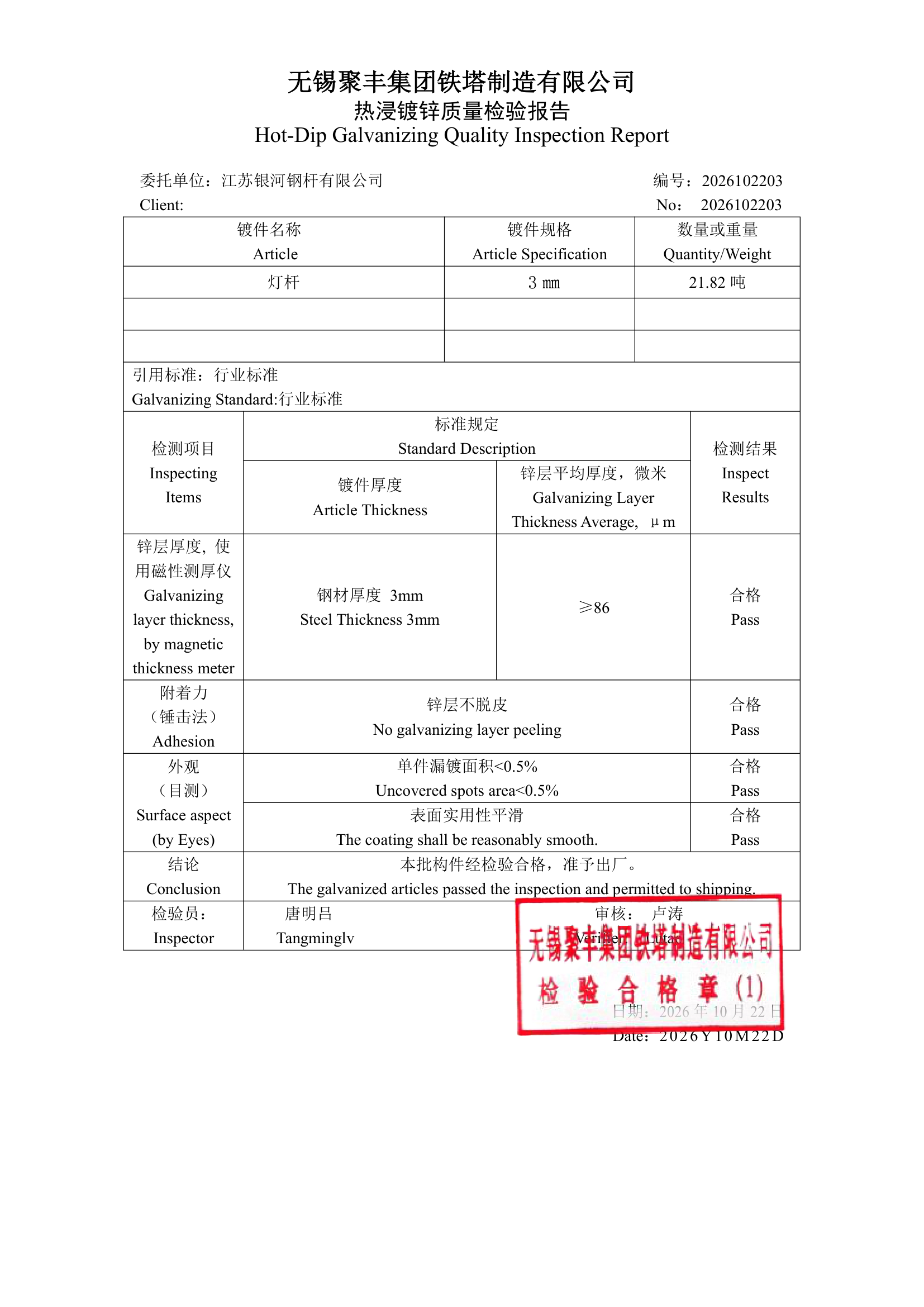
Hot-dip galvanizing compliance records should be read against the project specification, including coating thickness, appearance and adhesion requirements.
Dimensional control is the second technical pillar. AIS gantry columns and beams are not interchangeable with distribution poles because the equipment interfaces are project-specific. Milky Way's digital manufacturing includes CNC cutting, submerged arc auto-welding and intelligent straightening for dimensional consistency. The production system uses MES/digital production control, process inspection and unique identification or traceability. Those controls are useful only when the approved shop drawing is clear; the buyer should therefore close base plate, anchor-bolt, hole-pattern and crossarm details before release to production.
Welding and load-path verification should be defined in the inspection and test plan. The supplier's quality control can include incoming material MTC verification, chemical and mechanical checks as required, dimensional inspection, weld inspection, galvanizing inspection, final inspection and FAT or third-party inspection support. Where the project requires full-scale structural testing, the test programme should follow IEC 60652 and/or the utility specification and be carried out at an approved testing centre or client-approved laboratory.
Large-tonnage package supply and staged delivery
AIS gantry procurement often involves multiple columns, crossarms, base plates, anchor bolts and accessory bundles in one package. Milky Way's monthly capacity is over 2,000 tons, with annual output of 100,000 sets of medium and low voltage steel poles and 3,000 sets of high voltage steel poles. Those figures describe manufacturing capacity, not a promise that every gantry package will be delivered on a fixed schedule. The buyer should still confirm the production slot, inspection dates and vessel booking against the site programme.
Packaging controls should be written into the purchase order: container loading plan, bundle marking, shipping marks, section nesting, accessory packing, pre-loading inspection, packing list and marking verification. For staged delivery, the package should be divided by bay, elevation or erection sequence, with identification codes that match the approved drawings. This reduces the risk of storing the wrong member at the wrong location and makes site reconciliation easier.
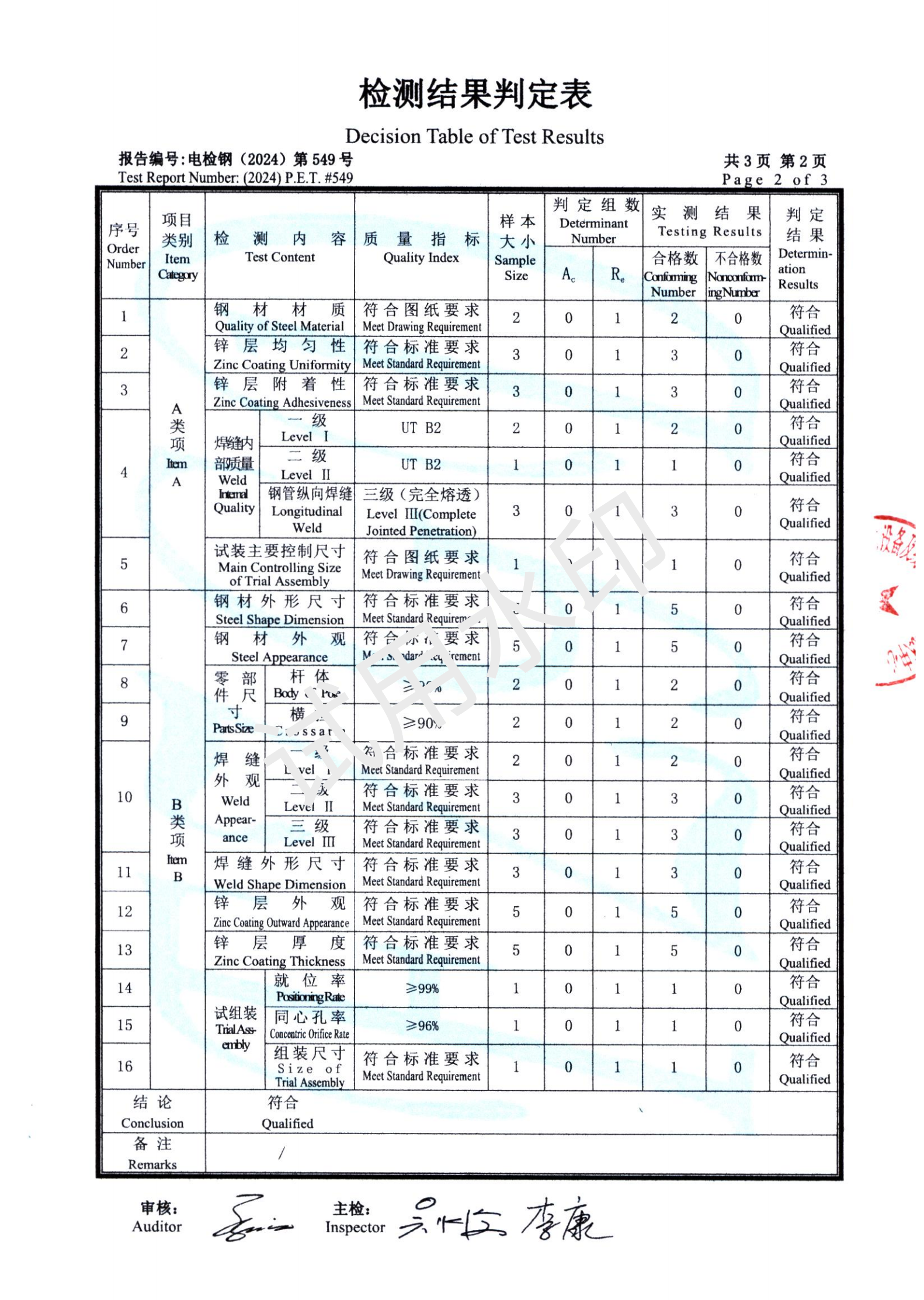
Structural test setups support load and displacement verification when a project specification requires full-scale or prototype testing.
Inspection requirements for an AIS gantry package
The inspection plan should be agreed before fabrication, not after galvanizing. A practical ITP for a galvanized steel pole gantry package should identify hold points for material verification, dimensional inspection, weld inspection, galvanizing inspection, final inspection and load testing where required. Milky Way's quality control follows a four-level inspection sequence: raw material testing, in-process patrol, finished-product full inspection and third-party random sampling. Factory QC can be combined with client, SGS, BV, TUV or another approved inspector when the project requires it.
Certification evidence should be checked for scope, not only for the certificate name. ISO 9001, ISO 45001 and ISO 14001 certificates support management-system claims, but they do not replace project-specific drawing approval or coating inspection. Third-party inspection by SGS or TUV Rheinland can support the buyer's verification plan, but the scope of that inspection must be stated in the purchase order. Similarly, a full-scale structural test report is specific to the tested pole or tower design and the approved test programme; it should not be read as a blanket approval for every gantry configuration.
Application scenarios and fit boundaries
Jiangsu Milky Way Steel Poles Co., Ltd. is a China-based manufacturer founded in 1991, with more than 30 years in the power steel pole and transmission tower industry. Its main products include transmission steel poles, distribution steel poles, substation steel structures, lattice towers, communication towers, lighting poles and accessories. For AIS gantry support, the relevant product scope is the project-specific substation steel structure, supported by engineering design using PLS-POLE / PLS-TOWER and project-specific structural design. The company's official website is Jiangsu Milky Way Steel Poles Co., Ltd..
A completed 500kV substation structural package of 1,800 tons provides a relevant large-package reference for gantry-type substation steelwork. The same supplier also reports a 2025 full-scale destructive test on a customized 132kV high-voltage pole for Pakistan at the State Grid key laboratory, where load, displacement and strength indicators met requirements. These references support capability assessment, but they do not prove that every AIS gantry layout will use the same design or test programme.
The shortlist has boundaries. A tubular galvanized steel pole gantry is not automatically preferable to a lattice or built-up structure. The choice depends on span, layout, foundation conditions, electrical clearance, maintenance access and the approved structural design. Where the layout requires very long spans or complex multi-level framing, the structural engineer should confirm the appropriate form. Similarly, hot-dip galvanizing does not replace structural design, and a certificate does not replace project-specific inspection.
Regional rules also need to be kept in scope. In the Philippines, NEA Memorandum No. 2007-007 sets minimum specifications for distribution steel poles in heavy loading zones, including 345 MPa yield stress and 86 microns zinc coating for the listed pole scope. That memorandum is a distribution-pole document, so it should not be assumed to govern AIS gantry structures without confirmation from the project utility.
Market context for galvanized steel pole packages
According to Grand View Research, the global steel utility poles market is projected to grow from USD 6.96 billion in 2025 to USD 11.11 billion by 2034, a compound annual growth rate of 5.39%. That forecast is broad and covers steel utility poles generally; it is not an AIS-gantry-specific demand forecast. Its procurement relevance is narrower: grid steelwork remains a long-lead category where design approval, coating inspection and delivery sequencing deserve early attention.
For evaluation-stage buyers, the practical response is not to treat the market forecast as a reason to accept a generic pole offer. It is to define the gantry option, lock the interface dimensions, specify the galvanizing standard and agree the inspection and delivery evidence before comparing suppliers. That approach keeps the galvanized steel utility pole category useful without overstating what a general product label can prove.
Frequently asked questions
What is the main difference between busbar-support and equipment-support gantry options?
A busbar-support gantry is configured around the busbar load tree, crossarm arrangement and clearance envelope, while an equipment-support gantry is configured around fixed equipment interfaces such as hole patterns, mounting points and base plates. Both use project-specific substation steel structures, but the verification emphasis differs: busbar options focus more on load path and clearance, while equipment options focus more on dimensional interface control.
Which galvanizing standard should an AIS gantry RFQ reference?
The RFQ should reference the standard required by the project specification, commonly ASTM A123/A123M for hot-dip galvanized steel, ASTM A153/A153M for applicable hardware and EN ISO 1461 when specified. It should also state the applicable edition, coating thickness or acceptance criteria, inspection method and whether an additional powder coating is required. Citing only the word galvanized is not enough for a verifiable purchase order.
How should dimensional interfaces be controlled between steel poles and substation equipment?
Control should begin with approved shop drawings that show base plates, anchor bolts, crossarms, hole patterns, climbing systems and equipment attachment points. Production should then use dimensional inspection against those drawings, with hold points before galvanizing or shipment where the project requires them. The buyer should compare the inspection records with the approved drawing revision, not with a generic product datasheet.
What inspection evidence should be requested for a large-tonnage gantry package?
A practical evidence set includes material test certificates, chemical and mechanical records as required, dimensional inspection records, weld inspection records, galvanizing inspection records, final inspection records and packing or marking verification. If the project requires full-scale testing, the test report should identify the tested design, test programme, laboratory and acceptance criteria. Third-party inspection by SGS, BV, TUV or another approved inspector should be defined by scope in the ITP.
Can a galvanized steel pole gantry package be delivered in stages?
Yes, staged delivery can be planned through batch size, pole type, project marking, identification code, packing sequence, section nesting and accessory packing. The delivery plan should be aligned with production and vessel booking and then checked against the site civil and erection programme. Staged delivery is a logistics control, not a substitute for complete drawing approval and inspection before shipment.
For further technical reference, the public 2026 Milky Way Power Group catalogue is available for download.
Есть вопросы или нужны дополнительные детали?
Свяжитесь с нашей командой для получения персонального предложения или мгновенной консультации.
Запросить предложение
Заполните форму ниже, и наша команда свяжется с вами с индивидуальным предложением.
Прямой чат WhatsApp
Предпочитаете общаться в реальном времени? Напишите нам в WhatsApp для мгновенной помощи и быстрых ответов.
- Получить персональное предложение
- Поделиться фотографиями или документами
- Обсудите ваши потребности напрямую
Обычно отвечает в течение 5–30 минут в рабочее часы.