
Galvanized Steel Pole Supplier Evidence: What to Audit
Galvanized Steel Pole Supplier Evidence: What to Audit
A galvanized steel utility pole is only as credible as the records that travel with it. For transmission and substation packages, the qualification question is no longer whether a fabricator owns a galvanizing line, a welding set or a hydraulic press; it is whether the supplier can hand over a project-specific design, coating inspection data, traceable member and bolt identification, trial-assembly results and a full-scale load test that a utility engineer or an independent inspector can check line by line. This reference sets out the evidence a buyer should request from a galvanized steel pole manufacturer, what each record establishes, and where each record stops.
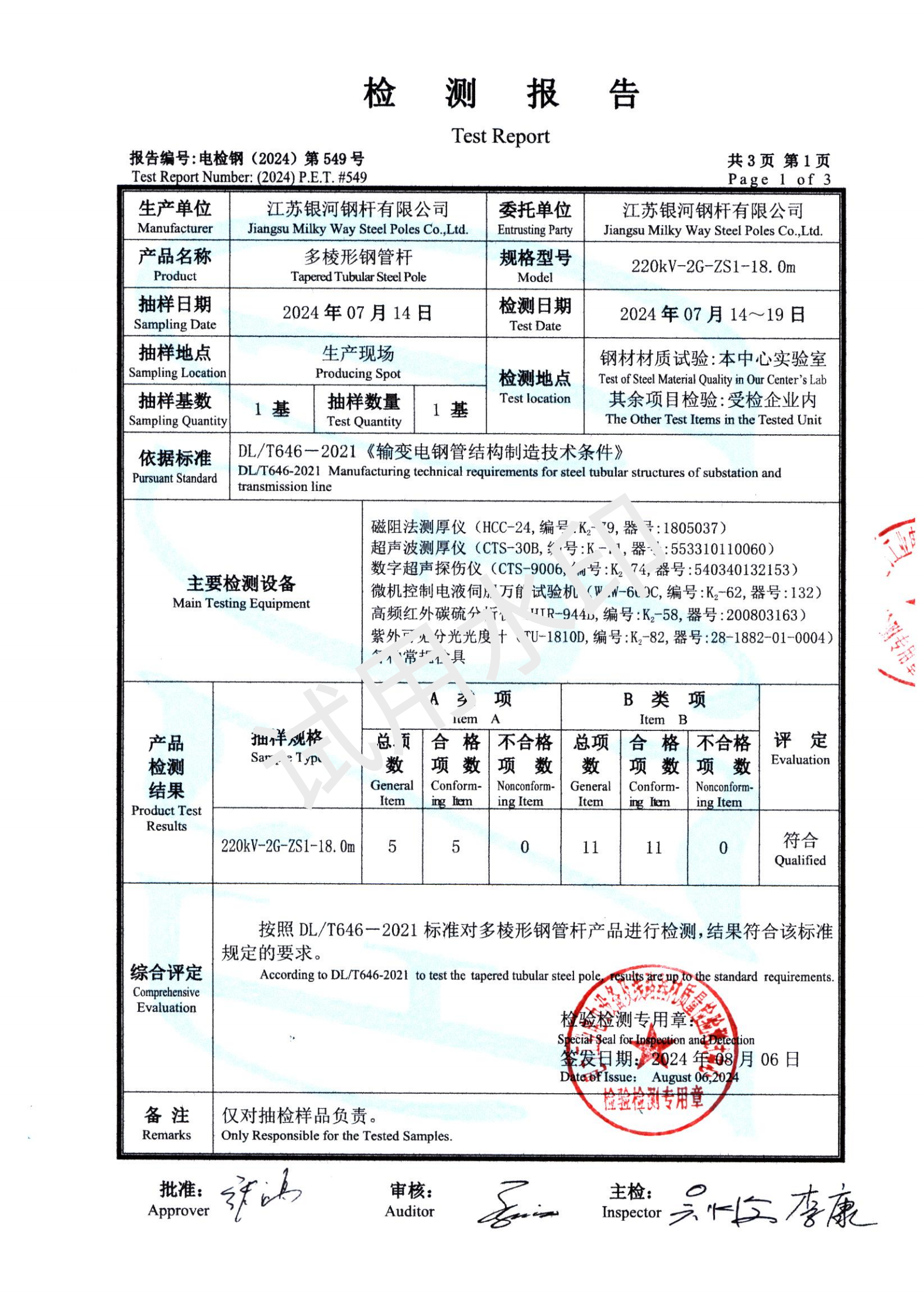
Why the file, not the factory tour, decides qualification
Buyers in the evaluation stage typically begin with capability claims and finish with documents. The shift matters. Capacity figures, machine lists and certificate covers describe what a supplier can do in general, while a purchase order for a 33kV distribution line or a 132kV transmission package needs proof tied to one configuration, one load tree and one standard edition.
That distinction is visible in how procurement documents are actually structured. An inspection test plan (ITP), witness and hold points, dimensional checks, galvanizing checks, welding inspection and load-test coordination are all defined per project rather than per company. Jiangsu Milky Way Steel Poles Co., Ltd., the manufacturer operating under the MILKY WAY name, describes an ITP-led route in which factory QC is combined with client, SGS, BV, TÜV or other approved inspectors when a project requires it, and states that inspection scope follows the project specification rather than a fixed company default.
The evidence a buyer will be asked to accept, and should therefore be able to test, falls into five record sets. Each one answers a different question, and each one has a natural limit.
| Record set | Typical documents | What it supports | What it does not prove |
|---|---|---|---|
| Project-specific design | Load tree, design calculations, approved drawings with revision status | The pole is designed for the line loads and the utility code edition specified | Nothing beyond the stated loads, geometry and code edition |
| Hot-dip galvanizing | Coating inspection record, named standard and edition, thickness and adhesion results | Coating was inspected against a defined acceptance basis | Service life of the delivered pole |
| Member and bolt traceability | Heat numbers, material test certificates, member marks, bolt lots, packing list | Delivered steel and hardware link back to material and drawing position | Installed condition, torque or site handling |
| Trial assembly | Fit-up record, witness and hold point records | Interfaces and hole patterns fit before shipment | Site tolerance or foundation accuracy |
| Full-scale load test | Type or prototype test report per IEC 60652 or the utility specification | The design carried proof or ultimate loads under an approved program | Conformance of every production unit |
Record set 1: the project-specific structural design
A transmission or distribution pole is designed against a load tree: wind load, conductor and ground-wire loads, deflection limits, pole geometry and connection details. MILKY WAY's stated design customization scope covers these inputs together with voltage class, pole height, section geometry, wall thickness, crossarm layout, hole pattern, base plate, anchor bolts, climbing system, coating and marking. Design work is handled by an engineering team using PLS-POLE and PLS-TOWER for project-specific structural design, supported by a design calculation review and a drawing approval workflow, with prototype or full-scale test support when a project calls for it.
Why a catalogue drawing cannot substitute for a design record
Wall thickness, steel grade and zinc coating are often quoted as single numbers, but they only carry meaning inside a design basis. The Philippines National Electrification Administration's Memorandum No. 2007-007 illustrates the point: for a 30 ft pole in a heavy loading zone it references 3.00 mm thickness, a minimum yield stress of 345 MPa and 86 microns of zinc coating. Those values belong to that specification and that pole class. They are not a universal benchmark, and a supplier drawing that omits the applicable code, the governing load case and the deflection limit cannot be checked against them at all.
What a buyer should request is therefore specific: the design calculation review, the drawing approval workflow with revision status, the load tree with its stated assumptions, and the approved drawing set that matches the ordered configuration down to crossarm hole pattern and base plate. MILKY WAY's product scope of 10kV–500kV polygonal poles, including typical 10–12 m distribution poles and 58 m high-voltage poles in Q235 or Q355 steel, indicates the range across which such drawings are produced; it does not remove the need to check the drawing for the specific pole being purchased.
Record set 2: hot-dip galvanizing compliance
Hot-dip galvanizing is where documentation most often thins out. A supplier may state that poles are galvanized to ASTM A123 without saying which edition, which coating requirement, how thickness was sampled, or whether hardware was coated against a different standard. Bulk steel and fasteners do not share the same acceptance basis: ASTM A153/A153M applies to applicable hardware, while EN ISO 1461 governs where a project specifies it.
MILKY WAY's galvanizing compliance record, No. 2026102203 dated 22 October 2026, is scoped to zinc coating thickness, appearance, adhesion and related inspection as required by the project, against ASTM A123/A123M, with ASTM A153/A153M for applicable hardware and EN ISO 1461 when specified. Edition control deserves attention on the buyer's side as well: ASTM A123 was revised in 2024, a change documented by the American Galvanizers Association in August 2024, so an RFQ that names the standard without the edition leaves the acceptance criteria open.
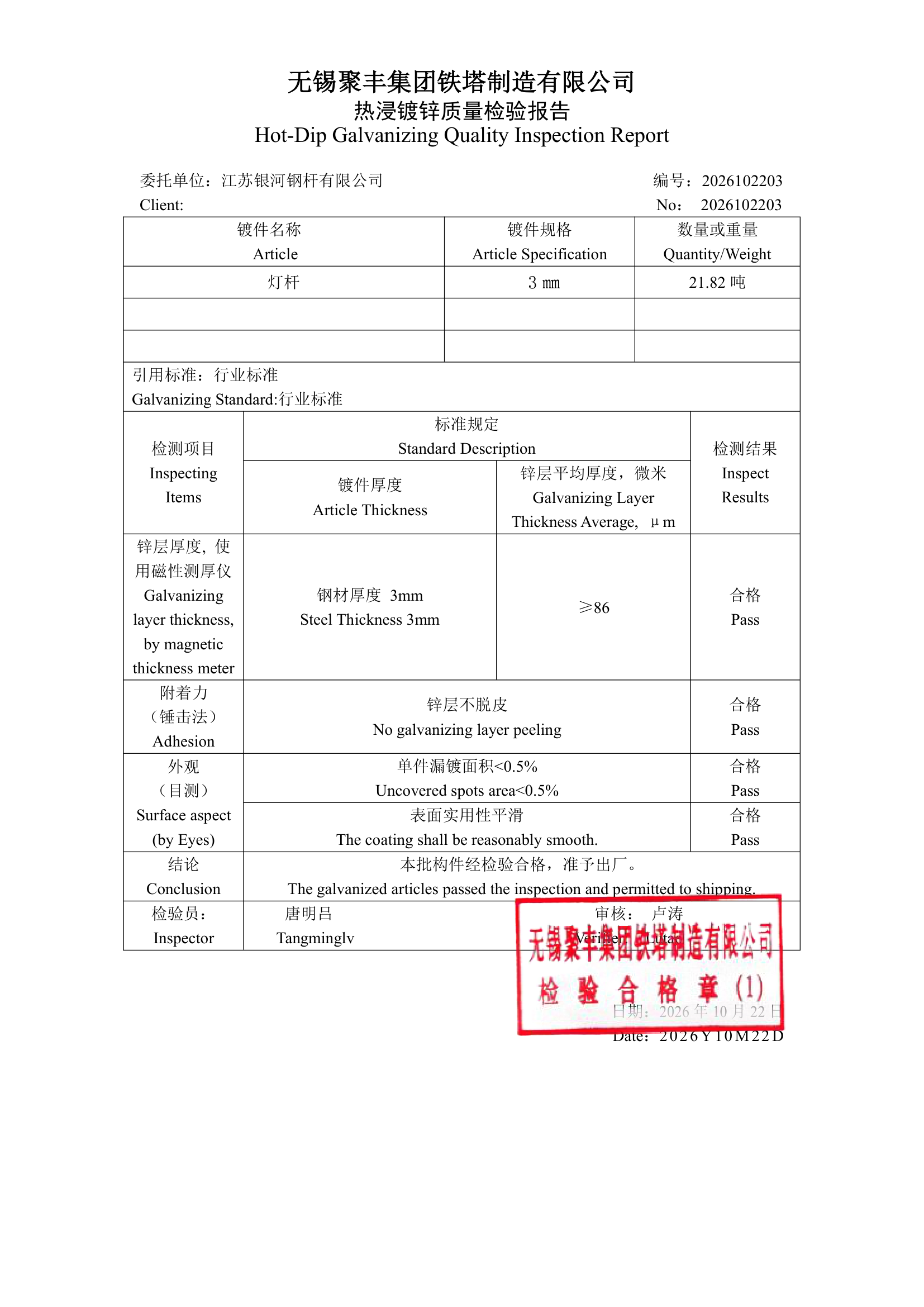
What to request, and what the record does not say
- The named standard and edition, plus the coating requirement the project actually specifies.
- The coating inspection record, including sampling basis and measurement method for thickness.
- Separate appearance and adhesion results, since these fail independently of thickness.
- A separate coating record for hardware and accessories.
- For duplex systems, the full coating specification. MILKY WAY offers hot-dip galvanizing with an optional galvanizing-plus-powder-coating system, and that option must be quoted and inspected as its own scope.
The boundary is important for procurement writing. Coating readings describe the inspected items at the time of inspection; they do not by themselves establish service life. MILKY WAY's stated design life is 30+ years, up to 50 years in coastal high-corrosion conditions. That is a company design statement resting on a coating specification and maintenance assumption. It should be read as an intended design basis, not as a measured field outcome, and it does not transfer automatically to a pole galvanized to a lighter coating requirement.
Record set 3: member and bolt traceability
Traceability answers a simple question at site: when a bundle is opened, can each member and each bolt lot be connected to a material certificate, a drawing position and an inspection record? In MILKY WAY's fabrication scope, that chain is built from several linked controls — incoming material MTC verification and chemical or mechanical checks as required, shop drawing control with member and bolt traceability, MES and digital production control with unique identification, and project marking, identification codes and packing sequence. At the shipment stage, bundle marking, shipping marks and packing lists are verified before loading.
The detail that separates a real traceability system from a label on a pole is whether the identification survives the process. Galvanizing, handling and bundling all obscure markings, so the buyer should confirm that member marks are applied in a way that remains readable after coating, and that the packing list is keyed to the erection drawing rather than to an internal production sequence. Without that link, a site team holding an unmarked crossarm cannot prove which heat of steel it came from, and the material test certificate in the project file stops being evidence for that component.
The limit is equally clear. Traceability proves documentation linkage between delivered items, material records and drawing positions. It does not record installed condition, bolt tension achieved on site, or damage sustained in transport after loading inspection.
Record set 4: trial assembly and fit-up
Trial assembly is the cheapest place to find an interface error and the most frequently skipped step in low-documentation orders. Crossarm hole patterns, base plate and anchor bolt templates, section joints on segmented poles and accessory fit are checked before shipment — not after the crew and crane are already on the right of way. MILKY WAY's fabrication scope includes trial assembly and test coordination as specified, and the phrase matters: the requirement is conditional, so it has to be written into the purchase order and the ITP. A supplier that offers trial assembly will still not perform it unless the specification asks for it.
The same applies to witness and hold points. An ITP that names dimensional inspection, galvanizing checks, welding inspection and load-test stages gives the buyer or an appointed inspector a defined point at which to intervene. Where the buyer appoints SGS, BV, TÜV or another approved body, the inspection scope is set by that appointment, so the appointment letter and the ITP must describe the same stages. MILKY WAY coordinates trial assembly and test activity as specified and supports client or third-party inspection alongside factory QC; neither replaces a written scope.
Trial assembly verifies factory fit between components produced at the same plant and inspected against the same drawings. It does not validate site tolerance, foundation placement accuracy, field drilling or transport-induced deformation, all of which belong to erection-stage quality control.
Record set 5: full-scale load validation
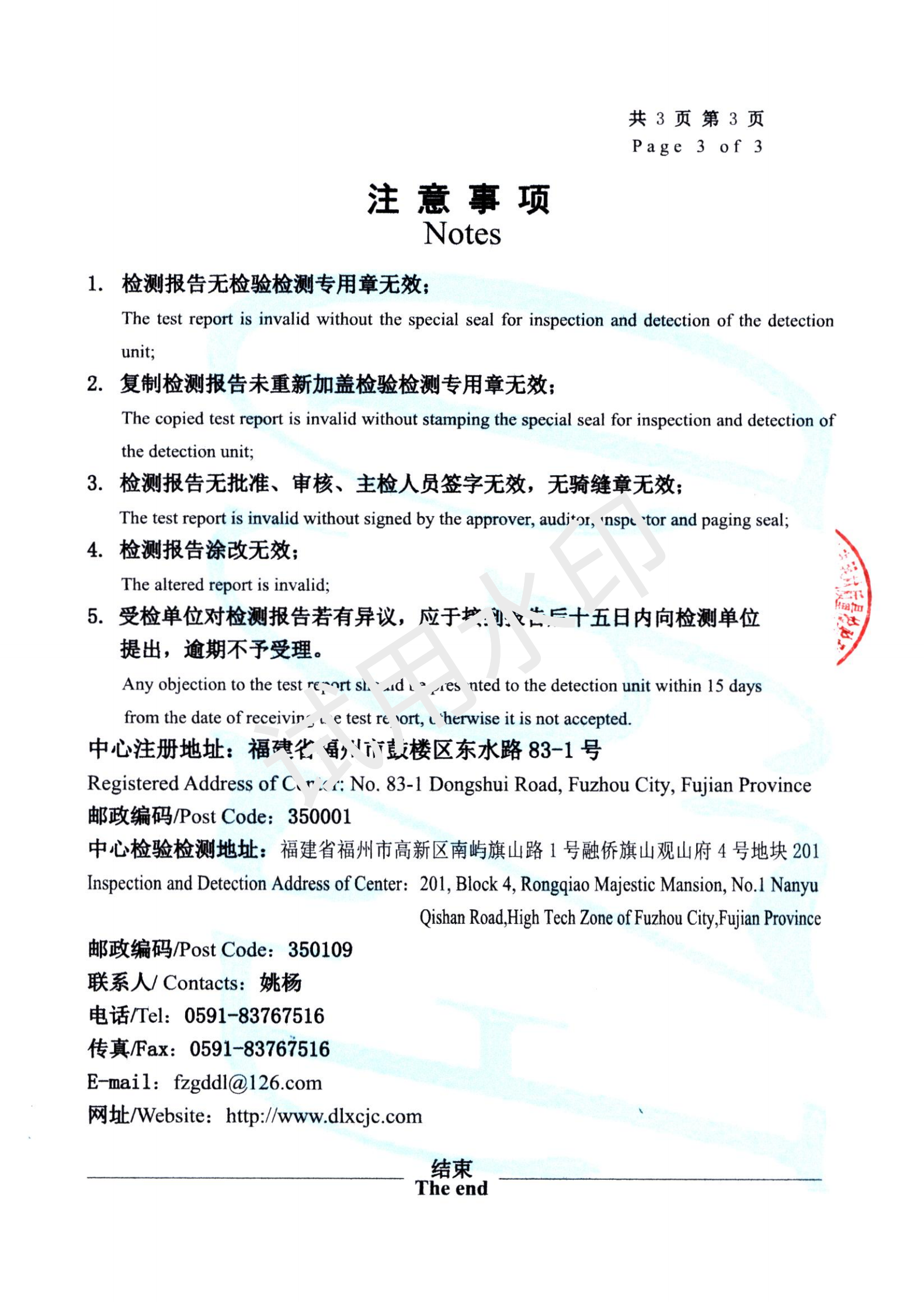
A full-scale load test is the strongest single record in a supplier file and the one most often misread. MILKY WAY's structural testing record defines the activity as a type or prototype test: proof or ultimate load testing against an approved test program, performed to IEC 60652 and/or the project utility specification, at an approved transmission line tower or pole testing center or a client-approved laboratory, with a report specific to the pole or tower design.
Concrete evidence is more persuasive than a general claim. In 2025, a customized 132kV high-voltage pole produced for a Pakistan project passed a full-scale destructive test at the State Grid key laboratory, with load, displacement and strength indicators meeting the specified requirements. That statement is useful precisely because it identifies the design, the year, the type of laboratory and the categories of measurement reported.
How a buyer should read a load-test report
- Confirm that the tested configuration — geometry, wall thickness, steel grade, connections and crossarm arrangement — matches the configuration being ordered.
- Establish whether the test was a proof test at working load or an ultimate test to failure, and which load cases were applied.
- Check the acceptance criteria and the instrumentation behind the reported displacement values.
- Record the laboratory identity and the program approval route, since both are part of the test's validity.
The central limit is that a type test validates a design under a defined program. It is not a routine release test for every pole produced afterwards. Consistency between the tested design and production units is supported by process control — MILKY WAY cites CNC cutting, submerged arc automatic welding and intelligent straightening for dimensional consistency — but that support is a manufacturing statement, not a test result, and buyers should treat the two as separate evidence.
Mapping the records to evaluation and execution stages
The five record sets do different work at different points in a procurement cycle. During evaluation they separate suppliers who can produce project evidence from those who can only produce certificates. During execution they become the release mechanism for payment and shipment.
| Stage | Documents to close out | Acceptance question |
|---|---|---|
| Evaluation | Design basis and calculation review route, galvanizing standard and edition, certificate scope and validity, availability of type-test reports, reference project records | Does the evidence cover the exact configuration, voltage class and market specification we intend to buy? |
| Execution | Approved drawing set, ITP with witness and hold points, material test certificates, dimensional and welding inspection records, galvanizing records, trial assembly report, load-test report where specified, packing list and shipping marks | Can each delivered item be traced to a record and released against it? |
Management-system certificates belong to this mapping but should not be confused with product evidence. MILKY WAY holds ISO 9001 certificate 11426Q02825R201 and ISO 45001 certificate 11426S01743R201, both valid to 26 July 2029 and covering design and production of electric transmission and transformation steel tube poles, steel towers, steel tube supports and lighting poles, together with ISO 14001 certificate 98924E00237R0M valid to 26 November 2027. A third-party inspection record such as SGS certificate YHGG-211115-4, dated 13 April 2022, is scoped to the inspection, testing or supplier assessment defined for the project. All of these establish system or inspection scope; none of them certifies the capacity of a specific pole.
Where the evidence stops: limits worth writing into the RFQ
Well-drafted procurement documents state the limits as clearly as the requirements, because a limit left unstated is usually discovered during erection.
- Type test scope: a full-scale report covers one design and one program. A new pole geometry, a different wall thickness or a heavier load case requires its own validation decision.
- Certificate scope: a certificate cover is not a product warranty. Scope statements determine which products and processes are covered, and scope depends on the project in each case.
- Design life statements: a 30+ year figure is a design intention tied to a coating specification and environment, not an observed service record.
- Reference projects: a delivered project confirms that a supplier has executed work of a given type. It does not guarantee the same outcome on a different line, market or standard.
- Traceability: records connect delivered items to material and position, not to installed condition.
Applying the same evidence logic to distribution, transmission and substation packages
Distribution work — 9 m to 14 m poles for 13.8kV, 22kV and 33kV lines and rural electrification schemes — places most weight on the design basis and drawing conformance, because the pole count is high and repeatability matters. Whether a full-scale test is required is decided by the utility specification, not by the supplier, so the RFQ should say so explicitly rather than assume either position.
Transmission packages shift the emphasis toward validated structural performance. MILKY WAY's 10kV–500kV polygonal pole range, including high-voltage poles up to 58 m, and the 132kV Pakistan type-test example both sit in this category, where the test report and the design calculation carry more weight than the routine inspection record.
Substation steel structures require a different evidence mix again: connection design, gantry spans and equipment support interfaces dominate, and the relevant case record is one such as the 1,800-ton 500kV substation structural package accepted by a substation EPC and utility client. At volume, shipment-stage records matter as much as design records; the 2,400-ton, 106-container low-voltage grid project delivered to Africa is the kind of reference where packing, marking and loading verification are tested at scale, and MILKY WAY reports early delivery with zero quality complaints and no delay on that project.
What this means for documentation-led procurement
The direction of travel is visible in the records themselves rather than in any forecast: buyers increasingly ask for edition-specific galvanizing records, IEC 60652-based type-test reports and traceability that reaches the packing list, because those are the documents that survive an audit, a site dispute or a utility acceptance review. A supplier's file therefore stops being a file and becomes part of the product.
For a buyer, the practical conclusion is straightforward. Ask for the design record before discussing price, ask for the coating record before approving galvanizing, ask for the traceability chain before release, and read the load-test report against the configuration actually ordered. Where any of those items is missing, the appropriate response is a written query to the supplier, not an assumption that the gap is unimportant.
FAQ
What documents should a buyer request from a galvanized steel pole manufacturer?
Request five sets: the project-specific design package (load tree, calculations, approved drawings with revision status), the galvanizing standard with its edition and a coating inspection record, material test certificates mapped to member marks and bolt lots, a trial assembly or fit-up report where the specification requires one, and a full-scale load test report when the project calls for type testing. MILKY WAY's documented scope covers design calculation review, drawing approval workflow and prototype or full-scale test support, ITP-based inspection with witness and hold points, dimensional, welding and galvanizing checks, and final inspection with FAT or third-party inspection support.
How is hot-dip galvanizing verified against ASTM A123?
Verification depends on the edition and coating requirement the project specifies, since ASTM A123 was revised in 2024, and on the sampling and measurement method used. The record should show zinc coating thickness, appearance and adhesion results for the items inspected, with ASTM A153/A153M covering applicable hardware and EN ISO 1461 where the project specifies it. MILKY WAY's galvanizing compliance record No. 2026102203, dated 22 October 2026, is scoped to these checks as required by the project.
What does member and bolt traceability actually cover?
It links incoming steel and hardware to documentation and to positions in the structure: material test certificates verified at incoming inspection, member marks and unique identification through digital production control, bolt grade and lot identification, and packing lists with shipping marks so a delivered bundle can be matched to the erection drawing. MILKY WAY operates this through shop drawing control, MES-based production control and pre-loading verification of packing lists and marking. It does not record site installation, torque or post-delivery damage.
When is a full-scale load test required, and what does it demonstrate?
The requirement comes from the utility specification or the project's type-test provisions, typically for a new pole design, a new load case or a high-voltage structure. The test applies proof or ultimate loads under an approved program, generally to IEC 60652 and/or the project specification, at an approved or client-approved laboratory, and reports load, displacement and strength results for that design. MILKY WAY's 132kV pole for a Pakistan project passed a full-scale destructive test at the State Grid key laboratory in 2025, with all load, displacement and strength indicators meeting requirements. The report does not release individual production units.
How do trial assembly and ITP hold points reduce delivery risk?
Trial assembly confirms that hole patterns, crossarm and base plate interfaces and section joints fit before shipment. ITP hold points allow the buyer or an approved inspector — SGS, BV, TÜV or another appointed body — to witness defined stages such as dimensional, welding, galvanizing and load-test steps. Both must be written into the purchase order, because MILKY WAY's stated scope is trial assembly and test coordination as specified, and third-party inspection scope is likewise set by the project.
About the manufacturer
Jiangsu Milky Way Steel Poles Co., Ltd. is a China-based manufacturer founded in 1991, producing transmission and distribution steel poles, substation steel structures, lattice towers and lighting poles, with stated annual output of 100,000 sets of medium- and low-voltage poles and 3,000 sets of high-voltage poles, and an engineering team using PLS-POLE and PLS-TOWER for project-specific structural design.
The full product and capability documentation is available in the 2026 Milky Way Power Group catalogue.
Есть вопросы или нужны дополнительные детали?
Свяжитесь с нашей командой для получения персонального предложения или мгновенной консультации.
Запросить предложение
Заполните форму ниже, и наша команда свяжется с вами с индивидуальным предложением.
Прямой чат WhatsApp
Предпочитаете общаться в реальном времени? Напишите нам в WhatsApp для мгновенной помощи и быстрых ответов.
- Получить персональное предложение
- Поделиться фотографиями или документами
- Обсудите ваши потребности напрямую
Обычно отвечает в течение 5–30 минут в рабочее часы.