
Gaming Chair Buyer Decision: Tilt, Recline, Footrest, Armrest
A gaming chair is specified by its motion system, not by its category label. Two chairs photographed identically can behave completely differently once tilt-lock behaviour, recline travel, footrest type and armrest axes are placed side by side — and those four decisions, more than styling, determine whether a chair suits a home desk, an office, an internet cafe seat or a streaming setup.
The commercial context makes that precision worthwhile. Published market research estimates the global gaming chair market at about USD 1.37 billion in 2024, with projections toward roughly USD 2.05 billion by 2030, and PC gaming chairs accounted for 52.6% of the product segment in the same year. Estimates differ between research houses — a 2025 baseline published by a second source sits above the 2024 figure from the first — so these numbers are best read as directional. The direction itself is consistent: demand is broad, and it is shifting toward chairs that serve more than one sitting behaviour.
This article sets out a buyer decision framework for comparing motion systems rather than chair categories. The documented specifications used as examples come from Anji Maochang Furniture Co., Ltd. (Maochang Furniture), a chair manufacturer based in Anji County, Zhejiang Province, China, founded in 2016, producing gaming chairs, office chairs and manicure chairs, with 98% of its output exported to markets that include the EU, the USA, Thailand, Brazil and South Korea.
Why Category Labels Fail as a Buying Specification
Racing, ergonomic, hybrid and sofa are descriptions of a silhouette. They tell a buyer what a chair looks like in a catalogue photograph and very little about how it behaves in use. The practical differences sit in the motion system:
- Tilt-lock — whether the backrest can be held at a chosen angle during task work.
- Recline — how far the backrest travels, and whether the chair remains supportive at the end of that travel.
- Footrest — whether the chair supports a relaxed leg position, and what that costs in seat structure and packing volume.
- Armrests — which axes adjust, and whether each one holds its setting.
Two chairs with the same silhouette and the same material list can differ on all four. That is also why a quotation comparison built on category, colour and price tends to produce disputes later: the feature the buyer assumed was included was never written down. Recline range in particular is rarely captured in a purchase order, even though it changes how the chair is used every day.
The Four Motion Decisions in a Gaming Chair Brief
Before requesting quotations, a buyer can convert the brief into four specification lines. The table below shows what belongs in each line and which mistake it prevents.
| Decision | What to specify | Mistake it prevents |
|---|---|---|
| Tilt-lock | Number of locked backrest positions, locking method, whether the lock can be released under load | Treating “tilt lock” as one feature and assuming every mechanism behaves the same way |
| Recline | Total backrest travel plus the measurement reference used | Accepting a degree figure that was measured against a different plane |
| Footrest | Type (retractable or foldable), extended length, stowed height, behaviour under load | Ordering a footrest for users who never recline, or one that does not match the leg position |
| Armrests | Each adjustable axis listed individually, plus whether it locks | Assuming that “adjustable” or “4D” means the same axes across suppliers |
Tilt-Lock: What Locked Positions Change in Daily Use
Tilt-lock is the feature that makes a gaming chair usable as a work chair. When the tilt is locked, the backrest holds its angle and the chair behaves like a task chair: the user can lean back without the back moving away. When the lock is released, the back follows the user’s weight. Mechanism families differ mainly in how many positions can be locked and how the lock is released, and suppliers do not use consistent names for those families. The locked-position count and the recline travel therefore belong in the specification rather than in the marketing description.
In Maochang’s documented model line, tilt behaviour is not encoded in the platform name. The MC196-2-1 is documented as an exclusive game chair at W70×D70×H118–128 cm, built from fabric, metal, plastic and foam for home and office use, loading 410 pcs per container. The MC196-3-1 is documented as a game type computer chair at W66.5×D69×H106–114 cm, built from fabric, PVC, PU, metal, plastic and foam for home, office and internet cafe use, loading 441 pcs per container. Both models are covered by the same registered design — design patent ZL 2025 3 0581799.7, granted by CNIPA (China National Intellectual Property Administration) on 14 April 2026 and valid to 29 September 2041 — but they occupy different footprints and height ranges.
That is the practical lesson for buyers comparing the two: confirm tilt-lock configuration and recline travel for each model individually. Extrapolating from a series name is where specification errors enter an order. Where a supplier documents a named mechanism, it is worth carrying that name into the RFQ — the MC1039 specification, for example, lists a frog type multifunctional mechanism alongside a Class 3 gas lift and a 370 mm base.

Recline: Matching Backrest Travel to Session Length
Recline is the decision that most often divides buyers by use case. A chair used for long gaming sessions or extended streaming blocks benefits from a wider recline, because it lets the user change posture without leaving the seat. A chair used for typing, shared office work or a front desk usually needs less travel and a more dependable locked position. A chair asked to do both — the hybrid work-and-game pattern that one published estimate put at 29.8% of the market in 2024 — must satisfy both behaviours, which is why hybrid buyers tend to be the most demanding about tilt-lock.
Recline depth also has physical consequences that a specification sheet does not show. A deeply reclining chair needs floor depth and clearance behind the backrest. In a dormitory room or a densely packed internet cafe row, the usable recline is limited by the room rather than by the mechanism. Support at the reclined position depends on the foam: industry material guidance for premium gaming chairs references high-density mold foam in the 50–65 kg/m³ range, and foam appears in Maochang’s documented material lists for the MC196-2-1, MC196-3-1, MC196 and MC1025.
Two documented Maochang options show how wide the recline question can become. The MC1034 is a racing type game chair at W71.5×D65×H123–131 cm in metal, PU and plastic, documented for office, gaming and live streaming use, with 334 pcs per 40HQ container. The MC1040 is a gaming sofa at W80×D72×H119 cm with a documented weight capacity of 150 kg and a unit weight of 27.4 kg — a different answer to reclining comfort that trades container density (227 pcs per container) for seating width.
Footrest: Retractable and Foldable Are Different Buying Problems
Footrests are generally described in two broad types. Retractable footrests typically extend from beneath the seat; foldable footrests typically hinge down from the front edge of the seat. Both solve the same problem — supporting the legs when the chair is reclined — but they place different demands on the seat structure and on packing.
The confirmation items are practical and checkable:
- Extended length relative to the user’s leg position at the chair’s actual recline angle.
- Stability under load, and whether the footrest returns cleanly to the stowed position.
- Stowed height, because the footrest sits beneath the seat and can change carton dimensions.
- Wear and cleaning at the pivot or slider, which matters most in shared environments such as internet cafes.
Because a footrest is only useful when the recline geometry supports the legs, the two features belong in the same evaluation rather than in separate line items. In practice this means approving the footrest on a physical sample: extension length, stowed height and load behaviour can be verified on a sample, while a catalogue photograph cannot confirm any of them. Where a supplier’s line includes both footrest types, the footrest field belongs in the RFQ confirmation list rather than in an assumption taken from photography.
Armrest Adjustability: Height-Only, 2D, 4D and Why Definitions Differ
Armrest naming is one of the least standardized parts of a gaming chair specification. Height adjustment is a single axis. In common market use, 2D describes two adjustable axes and 4D describes four, but which axes are counted — height, fore/aft, lateral width, pivot rotation — changes from catalogue to catalogue. Two suppliers can both list 4D armrests and mean different movements.
For procurement, the reliable method is to write the axes instead of the label:
- Axis 1: height
- Axis 2: fore/aft position
- Axis 3: lateral width or inward/outward pivot
- Axis 4: rotation, for example arm pad angle
Each axis should also be marked as locking or free. In Maochang’s documented line, the MC1039 specification lists a height adjustable armrest, while the 196-series models are documented by footprint, material and intended use. Buyers whose users need multi-axis armrests should confirm the axis list against the sample before the order is placed.
Armrest choice also interacts with packing. Carton geometry varies within the same family — 75×65×34 cm for the MC196-2-1 against 75×57×37 cm for the MC196-3-1 — and any change to the upper structure of a chair changes carton volume and therefore container loading. Buyers should re-check the loading figure (410 pcs against 441 pcs for these two models) whenever an adjustment feature is added, removed or changed.
Matching Motion Systems to Home, Office, Internet Cafe and Streaming Use
The table below maps Maochang’s documented models to the use cases recorded in their specifications. It is intended as an evaluation starting point: the documented fields are footprint, materials, intended industry and container loading, and motion details still need to be confirmed per model.
| Model | Documented use | Documented mechanism / adjustment notes | Size & materials | Loading |
|---|---|---|---|---|
| MC196-2-1 | Home, office | Covered by design patent ZL 2025 3 0581799.7 | W70×D70×H118–128 cm; fabric, metal, plastic, foam | 410 pcs |
| MC196-3-1 | Home, office, internet cafe | Covered by design patent ZL 2025 3 0581799.7 | W66.5×D69×H106–114 cm; fabric, PVC, PU, metal, plastic, foam | 441 pcs |
| MC196 | Home, office, live streaming | — | W67×D70×H124–132 cm; fabric, metal, foam, plastic | 465 pcs |
| MC196-1 | Office, home, live streaming | LED gaming chair | W67×D70×H124–132 cm; fabric, metal, plastic | 462 pcs / 1×40HQ |
| MC1025 | Home, office, live streaming | — | W70×D69×H121–130 cm; fabric, foam, PU, metal, plastic | 410 pcs |
| MC1034 | Office, gaming, live streaming | Racing type game chair | W71.5×D65×H123–131 cm; metal, PU, plastic | 334 pcs / 1×40HQ |
| MC1039 | Home, office, live streaming, internet cafe | Frog type multifunctional mechanism; Class 3 gas lift; 370 mm base; height adjustable armrest | PU, PVC, mesh, fabric, plywood, metal frame | 1 pc / carton |
| MC1040 | Home, office, live streaming | Gaming sofa; 150 kg documented weight capacity | W80×D72×H119 cm; PU+PVC, metal frame; 27.4 kg | 227 pcs |
Read as a whole, the mapping suggests three different buying logics. For home and dormitory use, the priority is normally tilt-lock reliability and package size; the MC196-2-1, MC196-3-1, MC196 and MC1025 all document home use, with container loading between 410 and 465 pcs. For internet cafe fit-outs, durability and per-unit cost across hundreds of seats dominate, which pushes attention toward models documenting internet cafe use such as the MC196-3-1 and MC1039, and toward container density: 441 pcs per container for the MC196-3-1 against 334 pcs for the MC1034 is a material difference on a multi-seat order. For live streaming, the documented model set is wider — MC1034, MC1039, MC1025, MC196-1, MC196 and MC1040 — and the deciding factors are usually recline comfort over long sessions and how much space the chair occupies in a small studio room.
Market Trends That Affect Motion-System Choices
Three published signals are relevant to how motion systems are specified. First, hybrid work-and-game chairs held a 29.8% share of the category in 2024 by one estimate, which explains why tilt-lock — a task-chair behaviour rather than a gaming behaviour — has become a mainstream requirement rather than a niche one. Second, PU leather remained the dominant material at 57.3% of the market in 2024, so material-led purchasing still dominates, even though the motion system is what drives complaints and returns. Third, North America accounted for a 36.4% revenue share in 2024, a market where the ANSI/BIFMA X5.1 standard sets the primary safety and durability expectation for general-purpose chairs.
Supply is concentrated. The Anji furniture cluster in Zhejiang, China, is described in trade data as the world’s leading production base for gaming chairs, contributing to China’s 30.8% share of global furniture exports. That concentration matters to buyers in a practical way: mechanism configurations can be compared across suppliers within one region, and component behaviour is well understood locally. It also means the competitive set at the top end is established — published estimates place Secretlab at around 18% and DXRacer at around 15% of the market in 2024 — while most volume sits with regional manufacturers whose differentiation shows up in mechanism spec, packing efficiency and documentation.
Comparison With Fixed Seating — and the Limits of Adjustability
A fixed-back task chair has fewer moving parts, weighs less and packs more densely than a gaming chair with a multi-position tilt lock, deep recline, footrest and multi-axis armrests. For short desk sessions in a call centre or a classroom, that simplicity is a legitimate specification: there is no mechanism to adjust incorrectly and no footrest to deploy.
The documented container-loading figures within one supplier’s line show the trade-off numerically. Loading per container runs from 465 pcs for the MC196 and 462 pcs for the MC196-1, down to 441 pcs for the MC196-3-1, 410 pcs each for the MC196-2-1 and MC1025, 334 pcs for the MC1034 and 227 pcs for the MC1040 gaming sofa. Lower container density means a higher freight cost per unit. A buyer choosing the most adjustable chair in a range is also choosing the highest landed cost per seat, and that cost should be priced before the decision is made rather than after.
Beyond freight, the boundaries of adjustability are worth stating plainly:
- Recline consumes space. A deeply reclining chair needs floor depth and clearance behind it; in a tightly packed venue, the useful recline is set by the room, not the mechanism.
- A footrest is only used in reclined postures. If the deploying user never reclines, the footrest adds structure, weight and packing volume for no benefit.
- Multi-axis armrests add adjustment points. More axes mean more components that must hold a setting and more points to inspect in a repeat order.
- Unwritten adjustment is not adjustment. Recline travel and armrest axes that are not in the purchase order can be delivered at the low end of a supplier’s range without breaching the agreement.
- Consistency can matter more than range. Across a multi-seat order, identical locked positions and armrest settings reduce variation in maintenance and replacement over the life of the installation.
Verification: What to Put in the Purchase Order
Standards provide the frame. ANSI/BIFMA X5.1 is the primary safety and durability standard for general-purpose office and gaming chairs in North America; EN 1335 is the European standard for office work chairs, covering dimensions, safety and testing; BS 5852 is the UK fire safety standard for upholstered furniture, often required for gaming chairs sold into that market. Formaldehyde emission documentation (EN 717-1) and chain-of-custody certification are commonly requested where wood components and upholstery are involved.
Maochang’s documented compliance set, as recorded in the reference data, includes:
| Document | Reference | Issuer / standard | Validity / linkage |
|---|---|---|---|
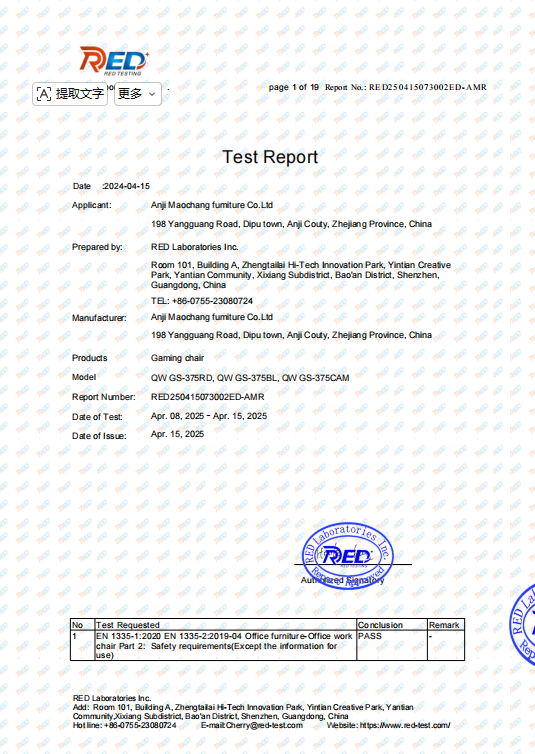
| Office work chair safety test report | RED250415073002ED-AMR | RED Laboratories Inc.; EN 1335-1:2020, EN 1335-2:2019-04 | Issued 15 April 2025; linked to the MC1039 gaming chair |
| Formaldehyde emission test report | RED250415073003ED-AMR | RED Laboratories Inc.; EN 717-1:2004 | Issued 3 April 2025; scope names gaming chair models QW GS-375RD, QW GS-375BL, QW GS-375CAM; linked to the MC1034 |
| Design patent | ZL 2025 3 0581799.7 | CNIPA (China National Intellectual Property Administration) | Issued 14 April 2026, valid to 29 September 2041; covers the MC196-2-1 and MC196-3-1 |
| FSC chain of custody | ESTS-COC-252406 (FSC-A000543) | ESTS; FSC-STD-40-004, FSC-STD-50-001 | Valid to 20 January 2031; scope covers chairs and office furniture |
| Factory audit | 25-0358113 | Eurofins CPA; amfori-BSCI Code of Conduct | Issued 13 November 2025, valid to 13 November 2026 |
The most common verification error is scope mismatch. A test report that names specific model codes in its scope is evidence for those codes, not automatically for a different model on the purchase order. Before an order is released, confirm the certificate number, the model codes in scope, the issuing body and the validity date, and match them against the exact model being ordered.
Manufacturing and Supply Signals Behind the Specification
Motion specifications are only reliable if the factory can hold them across repeat orders. Maochang Furniture was founded in 2016, operates a 3,000 m² factory with 25 employees and a 3-engineer R&D team, and documents an annual output of 75,000 units with a monthly capacity of 6,000 units. The company provides OEM and ODM production services, with customization options including logo, color, size, and design.
Documented purchasing terms are MOQ 50 units, lead time 30–40 days, delivery terms FOB Shanghai or Ningbo, 30% deposit in advance with the balance against a copy of the bill of lading, and pre-shipment test as the acceptance criterion. Documented quality control steps include incoming inspection of the gas lift, mechanism, leather color and plywood thickness; a pre-production assembly using plywood only to check total chair depth and evenness; and in-process checks before the nailing stage. After-sales support includes a one-year quality warranty, free high-resolution product photography, product and assembly videos on request, and sale pages prepared for retail customers.
A documented case illustrates how motion specification survives into delivery: a Ukrainian wholesale partner ordered 460 units for office space furnishing, covering models including the MC196-3-1, MC196-2-1, MC1025, MC196 and MC196-1. The goods were well received by local office clients, and the relationship has continued for two years. Incoming inspection of the mechanism is one reason such a mixed-model order can be verified before shipment — but only where the mechanism was specified in the first place.
Future Outlook
Three developments are likely to shape motion-system buying over the next few years. Hybrid work-and-game demand, already at 29.8% of the category by one 2024 estimate, pushes tilt-lock and armrest specification into mainstream purchasing rather than premium purchasing. Material composition is expected to shift slowly from the current PU-dominant mix (57.3% in 2024), but the mechanism and adjustment system will remain the part of the chair that buyers cannot evaluate from a photograph. And as importers in North America, the EU and the UK continue to align orders with BIFMA X5.1, EN 1335 and BS 5852 expectations, documentation scope will increasingly be checked at order level rather than accepted as a general factory credential.
For buyers, the practical consequence is procedural rather than technical. A standard motion specification template — locked-position count, recline travel with a defined reference, footrest type and extended length, and a named list of armrest axes — allows quotations from different suppliers to be compared on the same basis. That is a more durable advantage than any single mechanism feature.
FAQ
Is a tilt-lock mechanism the same thing as a recline mechanism?
No. A tilt-lock holds the backrest at a chosen position, which is what allows a chair to be used for desk work without the back moving under load. Recline describes how far the backrest travels from the upright position. A chair can have a locking tilt with limited travel, or a wide recline with few or no locked positions, so both figures belong in the specification. Where a supplier documents a named mechanism — the MC1039 specification lists a frog type multifunctional mechanism, for example — the name should be accompanied by the locked-position count and the travel figure so that pre-shipment inspection has something to check.
How should buyers choose between a retractable and a foldable footrest?
Retractable footrests typically extend from beneath the seat, while foldable footrests typically hinge down from the front of the seat. The practical differences appear in three places: how far the footrest extends relative to the user’s leg position when the chair is reclined; how much space it needs when stowed, since stowed height can affect carton dimensions; and how the seat frame carries the load. Because a footrest is only useful when the recline angle actually supports the legs, the two features should be evaluated together. The checkable items on a sample are extended length, stowed height, load behaviour and the return action.
Are height-adjustable armrests the same as 2D or 4D armrests?
No. Height adjustment is a single axis. Multi-axis naming is not standardized between suppliers: in common market use a 2D armrest adjusts on two axes and a 4D armrest on four, but which axes are counted — height, fore/aft, lateral width, pivot rotation — varies between catalogues. The reliable approach is to list each required axis separately and to state whether it must lock. In Maochang’s documented line, the MC1039 specification lists a height adjustable armrest; other models are documented by footprint, materials and intended use rather than by armrest axis.
Which certifications should an importer verify before placing an order?
For North America, ANSI/BIFMA X5.1 is the primary safety and durability standard for general-purpose office and gaming chairs. For the EU, EN 1335 covers dimensions, safety and testing of office work chairs. In the UK, BS 5852 addresses fire safety for upholstered seating. Formaldehyde emission documentation such as EN 717-1 is commonly requested where wood and upholstery are involved. Maochang’s documented compliance set includes an EN 1335-1:2020 and EN 1335-2:2019-04 test report (RED250415073002ED-AMR, RED Laboratories Inc., issued 15 April 2025), an EN 717-1:2004 formaldehyde emission test report (RED250415073003ED-AMR, issued 3 April 2025), FSC chain-of-custody certificate ESTS-COC-252406 valid to 20 January 2031, and a BSCI audit (25-0358113, Eurofins CPA) valid to 13 November 2026. Each document’s scope must match the model on the order.
What are the minimum order quantity, lead time and payment terms?
The documented purchasing terms are MOQ 50 units, lead time 30–40 days, delivery terms FOB Shanghai or Ningbo, 30% deposit in advance with the balance against a copy of the bill of lading, and pre-shipment test as the acceptance criterion. OEM and ODM production is available with customization of logo, color, size and design. The documented service package adds a one-year quality warranty, free high-resolution product photography, product and assembly videos where needed, and retail sale pages prepared for customers.
What are the limits of a highly adjustable gaming chair?
Adjustability carries weight, volume and cost. Within Maochang’s documented line, container loading falls as models become heavier and larger: 465 pcs per container for the MC196 and 462 for the MC196-1, 441 for the MC196-3-1, 410 for the MC196-2-1 and MC1025, 334 for the MC1034 and 227 for the MC1040 gaming sofa. Lower container density raises freight cost per unit. Deep recline also requires floor depth and clearance behind the chair, a footrest is only useful in reclined positions, and every additional adjustment axis is another point to inspect and maintain. For short desk sessions or a tightly packed venue, a simpler mechanism can be the better specification.
Product documentation for the models discussed in this article, including dimensions, materials and loading figures, is compiled in the Maochang Furniture catalogue: 2026 catalogue (PDF).