
Gaming Chair Materials: A Buyer's PU vs Fabric Framework
Gaming chair programmes rarely fail because of colour. They fail in the layers a buyer cannot see at the quotation stage: the cover, the padding, the frame and the mechanism. For importers, distributors and project buyers working through the research and evaluation stages, the material list on a specification sheet is often the first, and sometimes the only, structured evidence available before a sample arrives.
This article sets out a five-axis framework for comparing gaming chair materials, using two configurations from Anji Maochang furniture Co.,Ltd. as fixed reference points: the MC1034 racing type game chair, which combines a fabric front surface with spliced wear-resistant PU leather on the backrest edges and trim, and the MC196-2-1 exclusive game chair, which is upholstered in soft, breathable fabric. Frame and load evidence comes from models that actually publish it, including the MC1039 and the MC1040, both rated to a 150 kg weight capacity.
Anji Maochang furniture Co.,Ltd. is a chair manufacturer based in Anji County, Zhejiang Province, China. Established in 2016, the company produces gaming chairs, office chairs and manicure chairs, exports 98% of its output, and lists the EU, USA, Thailand, Brazil and South Korea among its main markets. The surrounding Anji furniture cluster in Zhejiang is widely described as the world's leading production base for gaming chairs, a position that sits inside China's 30.8% share of global furniture exports.
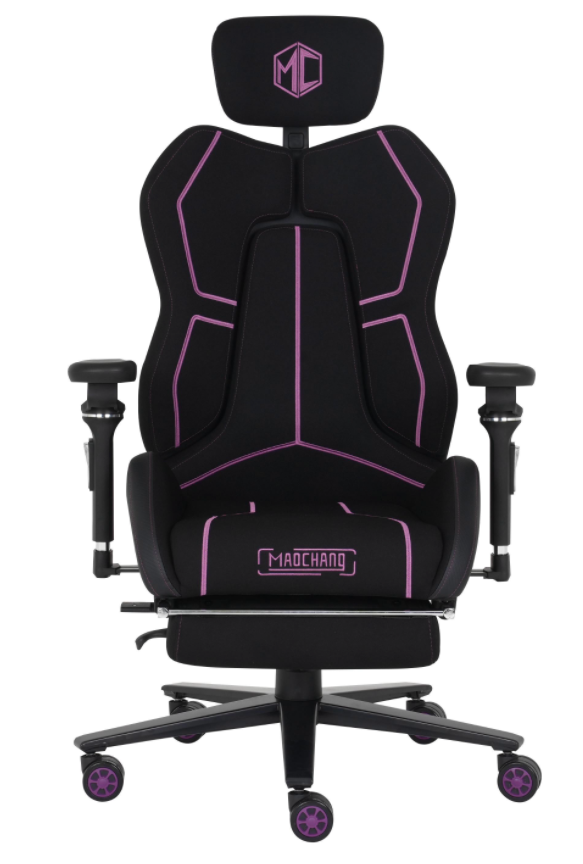
Fabric upholstery over a segmented backrest: the MC196-2-1 is described as using soft, breathable fabric with an inner spring package under the seat cushion.
Why the Material List Is the First Buying Decision
The cover material determines three downstream costs: cleaning and maintenance expectations, thermal comfort during long sessions, and how the chair can credibly be positioned in the end market. The frame and cushioning determine whether the chair survives those sessions at all.
A pattern recurs in sourcing. Two chairs look almost identical in a catalogue photo, yet one specification reads "metal, PU, plastic" (MC1034) and the other reads "fabric, metal, plastic, foam" (MC196-2-1). The bill of materials differs by one or two lines. The difference in use experience, complaint profile and replacement cycle does not.
PU leather remains the volume default worldwide. Third-party industry analysis places PU leather at a 57.3% share of gaming chair materials in 2024. That dominance is not accidental: PU is easier to shape around racing contours, easier to wipe clean, and easier for factories to source in consistent colours across repeat orders. Fabric is the material buyers reach for when the chair must survive an office day, a dormitory room or a streaming setup, where sitting duration matters more than racing aesthetics.
The gap this creates for buyers is methodological, not informational. Most spec sheets do list the cover and the frame materials; very few explain what those materials imply for the buyer's specific use condition. The framework below is designed to close that gap without requiring a sample to be opened on the factory floor.
A Five-Axis Comparison Framework
The framework reduces every material claim to five axes. Each axis can be scored against evidence strength: published in the specification, implied by the model description, or absent.
| Axis | Question to ask | Evidence to look for |
|---|---|---|
| 1. Cover composition | Is the upholstery a single material or a mix, and where does each material sit? | MC1034 is listed as metal, PU, plastic, with a fabric front surface and wear-resistant PU on backrest edges and trim; MC196-2-1 is listed as fabric, metal, plastic, foam |
| 2. Wear-point construction | Which zones take abrasion, and are they reinforced? | MC1034 splices wear-resistant PU leather along the side edges and trim of the backrest, where contact and friction concentrate |
| 3. Breathability | How will the surface behave over multi-hour, continuous seating? | Fabric and mesh listings, for example MC1039 lists PU, PVC, mesh, fabric, plywood and metal frame; MC196-2-1 is described as soft, breathable fabric |
| 4. Structural materials and base | What structural materials are named, and is the base or gas lift class specified? | MC1039: metal frame, plywood, 370 mm big size starbase, Class 3 gas lift; MC196-2-1: Class-3 gas lift, black powder-coated metal base; MC196-1: wooden frame construction |
| 5. Load rating and cushioning | Is a weight capacity published, and what sits between the cover and the frame? | MC1039 and MC1040: 150 kg weight capacity; MC196-2-1: inner spring package in the seat cushion; MC1039: thickened spring pack cushion |
How to Use the Framework in Practice
- Fill every axis with what the specification actually states, not what the photo suggests.
- Mark each axis as Published, Implied or Absent. Absent axes are information gaps, not automatic disqualifiers.
- Weight the axes against the end use condition: shared seating environments push axes 1 and 2 to the top; office and dormitory channels push axis 3 upward; heavy-user markets push axis 5.
- Compare only models scored on the same axes. A PU chair with a published 150 kg capacity and a fabric chair with no published capacity are not yet comparable.
- Resolve gaps with documentation, not inference, before committing to a claim in the end market.
PU Versus Fabric: MC1034 and MC196-2-1 Compared
The two models anchor opposite ends of the material spectrum within one supplier's range, which makes them useful for isolating the trade-offs.
Durability and Wear Points
The MC1034 is described with wear-resistant PU leather spliced along the backrest side edges and trim, with a fabric front surface finished with streamlined orange embroidered lines. That construction places the more abrasion-resistant material precisely where a seated user's arms, clothing and chair edges meet.
PU is generally the stronger choice against surface staining and edge abrasion; its typical failure mode over time is flex cracking and peeling at high-flex zones. Textile covers such as the one used on the MC196-2-1 generally resist that kind of surface breakdown, but face pilling, staining and seam wear instead. The MC196-2-1 also uses a segmented backrest and an inner spring package in the seat cushion, which is intended to hold shape after prolonged use, and the model carries a registered design patent.
Breathability and Thermal Comfort
PU and PVC surfaces tend to hold heat and moisture against the body during long sessions. Open fabric or mesh construction allows air to move. This is the axis where fabric configurations are usually specified for sustained sitting, and it is the reason MC196-2-1 is described as breathable fabric rather than a coated surface. In a 24/7 seating environment, breathability is not a comfort nicety; it changes how often cushions are cleaned and how the seating is perceived by users.
Cleaning and Maintenance
PU can typically be wiped with a damp cloth, which is why it dominates shared and high-traffic environments. Fabric requires vacuuming, spot treatment and drying time, and carries a higher stain risk. For a buyer, this translates into an operating cost per chair per year rather than a purchase cost per unit, and it is often the single largest difference between an otherwise similar PU and fabric quotation.
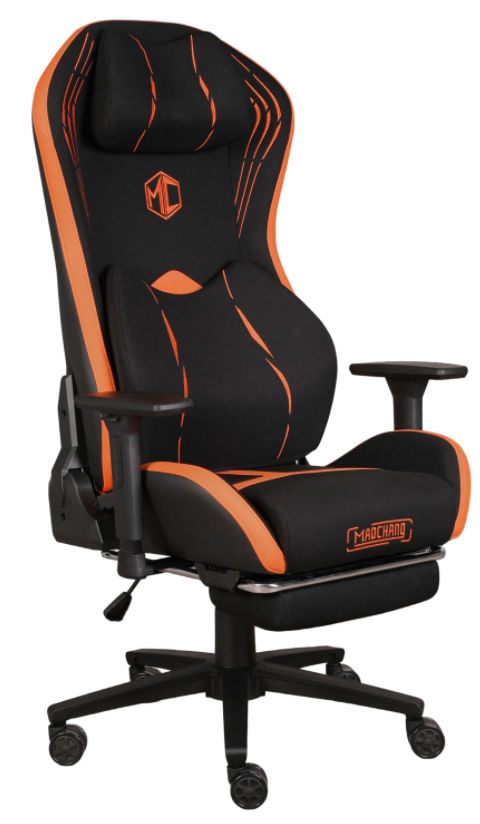
Cushioning sits between cover and frame: the MC1034 uses molded foam for the pillow and lumbar support, with PU spliced onto the backrest edges.
Judging Frame Strength From a Material List and a Load Rating
Frame strength can be assessed from three documented signals before a single chair is opened: the named structural materials, the base and gas lift specification, and, where published, the weight capacity.
- Structural materials. MC1039 lists a metal frame and plywood. MC1040 lists a metal frame. MC1039-1 lists metal and plastic. MC196-1 is constructed entirely with a wooden frame, a distinct structural choice rather than a variation of the same build.
- Base and lift. MC1039 pairs a froggy type adjustable multifunctional mechanism with a 370 mm big size starbase and a Class 3 gas lift. MC196-2-1 uses a Class-3 gas lift and a black powder-coated metal base that is detachable to reduce packaging size. MC1040 adds lockable wheels.
- Published load rating. MC1039 and MC1040 are each rated to a 150 kg weight capacity. MC1040 additionally publishes a product weight of 27.4 kg.
Boundary condition: not every model in the range publishes a weight capacity, and product weight is not a load rating. MC1040's 27.4 kg product weight and its 150 kg weight capacity describe two different things. A chair with no published capacity is not evidence of a weak frame; it is an evidence gap that must be closed with the supplier's test documentation rather than inferred from appearance or price.
Cushioning and Springs: The Layer Buyers Often Skip
Between the cover and the frame sits the layer that determines whether a chair still looks and feels correct after twelve months of use. The sample evidence across this range shows three recurring constructions.
- Molded foam. MC1034 uses molded foam for the pillow and lumbar support, paired with 180-degree reclining, a foldable footrest, adjustable armrest and a height-adjustable pillow.
- Inner spring package. MC196-2-1 builds the seat cushion around an inner spring package to help maintain shape after prolonged use. MC196-4 and MC1025 use the same principle, described as a spring-loaded seat cushion that prevents sagging and deformation.
- Thickened spring pack. MC1039 uses a thickened spring pack cushion with a coiled spring inside the seat cushion, and MC1040 also places a coiled spring inside the seat cushion with a soft back cushion.
For reference, third-party furniture material guidance describes high-density mold foam in the 50–65 kg/m³ range as the benchmark for premium gaming chairs intended to hold shape over time. That figure is an industry benchmark, not a per-model specification for the models discussed here, and it should be treated as a question to put to a supplier rather than an assumption.
Compliance Follows Material, Not Only Structure
Material choices and certification scope are connected. Three standards recur in gaming chair sourcing:
- ANSI/BIFMA X5.1 is described as the primary safety and durability standard for general-purpose office and gaming chairs in North America.
- EN 1335 is the European standard for office work chairs, covering dimensions, safety and testing requirements that are also applied to gaming chairs.
- BS 5852 is the UK fire safety standard for upholstered furniture, often required for gaming chairs sold in the UK market.
Because BS 5852 addresses the ignitability of upholstered seating, a change of cover or foam specification is a change to the tested configuration. Cost engineering that swaps a cover material mid-programme should therefore be re-checked against the target market's requirements rather than assumed to be equivalent — a step that is easy to miss when the change is presented as a trim-level decision.
Matching Configurations to Real Use Conditions
The framework only produces a decision when it is applied to a specific use condition. Three conditions appear repeatedly in this range.
Internet cafe fit-out (China). This scenario is defined by indoor, long-hour continuous-use environments, with the product operating in 24/7 seating mode in China. Its role in that setting is to provide gaming support, and it requires supporting equipment such as a gaming desk and a computer, plus sufficient space for each seating unit. The MC1040 gaming sofa is the unit associated with this scenario: a PU and PVC cover over a metal frame, 180-degree reclining, height-adjustable armrest, lockable wheels, a foldable footrest and a 150 kg weight capacity. The 24/7 seating mode is what makes the cleaning axis decisive here, not the aesthetics.
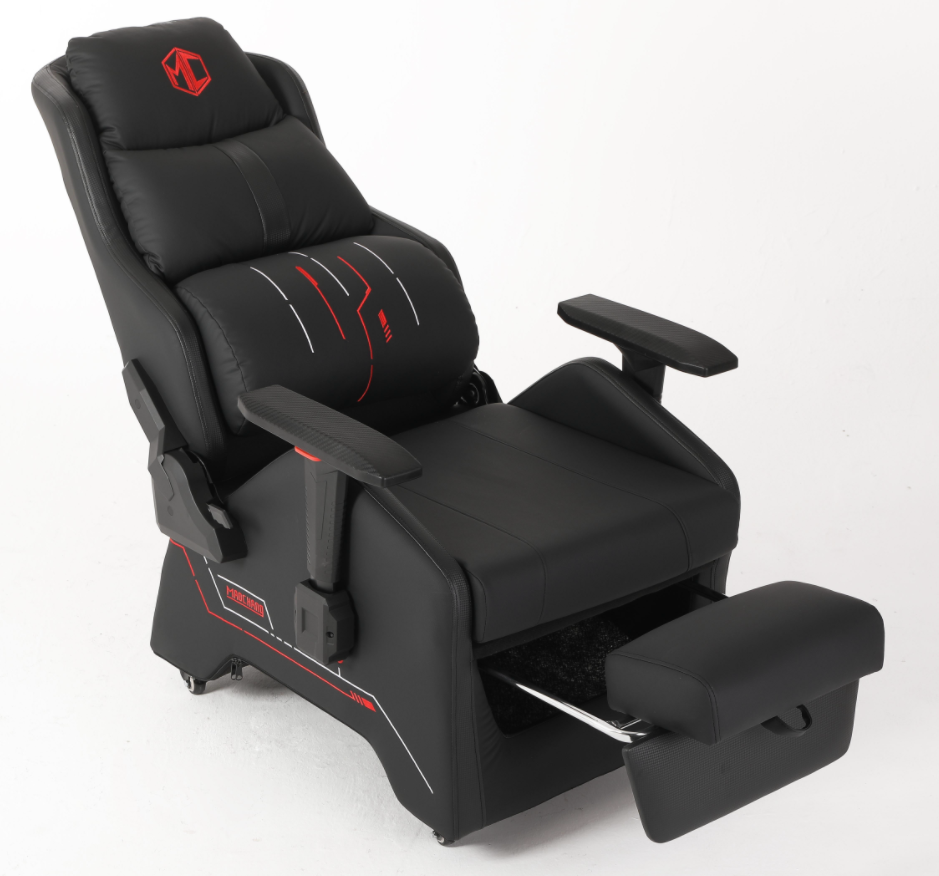
Continuous-use seating: the MC1040 combines a PU and PVC cover with a metal frame, lockable wheels and a 150 kg capacity for 24/7 indoor environments.
Office space furnishing (Europe). The product is used for office space furnishing purposes in this market. Fabric-based models fit here: MC196-2-1 lists home and office applications, with 5D adjustable armrests, a height-adjustable headrest, forward-backward seat depth adjustment and three locking tilt angles. MC196-3-1 lists home, office and internet cafe applications with an adjustable headrest, lumbar pillow and 2D adjustable armrests.
Home PC, streaming and hybrid use. MC1034 lists office, gaming and live streaming. MC1025 lists home, office and live streaming. MC196-5 lists gaming, office and live streaming, with a split-back design, three-position back cushion tilt and height-adjustable armrest. Where one chair must serve both work and play, breathability and armrest adjustability tend to outweigh racing aesthetics.
Market Signals Behind Material Decisions
Several published indicators help explain why material mix is becoming a live procurement question rather than a cosmetic one.
- The global gaming chair market is estimated at USD 1.37 billion in 2024 and projected to reach approximately USD 2.05 billion by 2030.
- North America accounted for a 36.4% revenue share in 2024, making it the largest regional market.
- PC gaming chairs hold a 52.6% product segment share, confirming where most volume sits.
- PU leather remains the most common cover material at a 57.3% share of gaming chair materials in 2024.
- Hybrid work-and-game chairs hold a 29.8% segment share as of 2024, the fastest-moving structural shift in the category.
These signals do not point in one direction. The first keeps PU as the volume default, because it is cheaper to finish consistently at scale and easier to maintain in shared environments. The second raises the value of breathable fabric and mesh configurations, because a chair that must sit credibly in an office cannot look like a racing seat. Note also that market size estimates diverge between research houses depending on whether adjacent categories such as gaming desks are included, so any single figure should be treated as directional rather than exact.
Framework Versus Traditional Selection, and Where the Framework Stops
Traditional selection usually runs on three shortcuts: the catalogue photo, the unit price, and the best-selling SKU in a peer group. Each shortcut is reasonable until it meets a material question it cannot answer. A photo cannot show that MC1034 splices wear-resistant PU onto the backrest edges, that MC196-2-1 builds an inner spring package into the seat cushion, or that MC1040 publishes both a 27.4 kg product weight and a 150 kg capacity. A unit price comparison between a PU chair and a fabric chair also ignores the operating cost difference in cleaning and replacement, which in shared seating environments can exceed the purchase price difference.
The framework is not unlimited. Three boundaries matter:
- It compares what is documented. Where a model lists materials without a published load rating or foam specification — which is the case for several models in this range apart from MC1039 and MC1040, both rated to 150 kg — the framework produces a gap, not an answer.
- It cannot score subjective comfort. It can only compare documented construction features, such as 5D adjustable armrests on MC196-2-1, 4D adjustable armrests on MC1039-1, 2D adjustable armrests on MC196-3-1, or height-adjustable armrests on MC1039.
- It says nothing about production consistency. That is a separate evaluation of factory capability — monthly capacity, lead time, minimum order quantity and quality control process — rather than of material choice.
For context on the third boundary, Maochang operates a 3,000 m² factory in Anji with 25 employees, three R&D engineers and an annual output of 75,000 units. The company works in OEM and ODM modes with customization across logo, colour, size and design, a monthly capacity of 6,000 units, a lead time of 30–40 days and a minimum order quantity of 50 units. Its quality control process includes incoming inspection of gas lifts, mechanisms, leather colour and plywood thickness, a pre-production assembly check of the plywood stage to verify total chair depth and evenness, and further inspection before nailing. After-sales support includes high-resolution photos, product and assembly videos, retail sale page creation and a one-year quality warranty.
Future Outlook
Three shifts are likely to shape material specifications over the next few buying cycles. Mixed-material constructions — such as the MC1034's combination of a fabric front surface with wear-resistant PU on edges and trim — address the cleaning-versus-breathability trade-off more directly than single-material covers, and are likely to spread as hybrid work-and-game demand grows from its current 29.8% share. Certification expectations will keep shaping cover and foam choices, since BS 5852 in the UK, EN 1335 in the EU and ANSI/BIFMA X5.1 in North America each touch different parts of the build. And as the category expands toward the projected USD 2.05 billion level by 2030, the pressure to reduce cost at the cover and foam layer will remain the most common source of specification drift — which makes a documented comparison framework more useful, not less.
FAQ
What is the practical difference between PU leather and fabric on a gaming chair?
PU is a coated surface, easier to wipe clean and easier to form around racing contours; third-party analysis places PU leather at a 57.3% share of gaming chair materials in 2024. Fabric is a textile surface: MC196-2-1 is described as soft, breathable fabric over an inner spring package in the seat cushion. In practice the trade-off is cleaning effort, which favours PU, against air movement and heat retention, which generally favours fabric.
How can a buyer judge frame strength from a specification sheet?
Through three documented signals. First, named structural materials: MC1039 lists a metal frame and plywood, while MC1040 and MC1039-1 list metal. Second, base and lift specifications: MC1039 uses a 370 mm big size starbase with a Class 3 gas lift, and MC196-2-1 uses a Class-3 gas lift with a black powder-coated metal base. Third, published weight capacity: MC1039 and MC1040 are both rated at 150 kg. Where capacity is not published, the specification alone cannot establish frame strength.
Why do some gaming chair models publish a load rating and others do not?
In this range, a weight capacity is published for MC1039 and MC1040, both 150 kg. Other models list materials, dimensions and loading quantities but no capacity figure. From a buyer's perspective, an unpublished rating is an information gap rather than evidence of lower strength, and product weight should not be substituted for it — MC1040 publishes 27.4 kg of product weight alongside its 150 kg capacity, and the two figures describe different properties.
Which upholstery suits long-hour continuous seating, such as an internet cafe?
The internet cafe scenario is defined by indoor, long-hour continuous use, with seating operated in 24/7 mode in China, requiring supporting equipment such as a gaming desk and computer and sufficient space for each seating unit. MC1040 is the unit associated with this scenario and uses a PU and PVC cover over a metal frame with 180-degree reclining, lockable wheels and a 150 kg capacity. Fabric and mixed configurations also appear in this channel: MC196-3-1 lists home, office and internet cafe applications, while MC196-2-1 lists home and office. The decision generally comes down to wipe-clean maintenance versus breathability, not to a single correct material.
Do material choices affect which standards apply to a gaming chair?
Standards are driven by market rather than material alone, but the two intersect. ANSI/BIFMA X5.1 is described as the primary safety and durability standard for general-purpose office and gaming chairs in North America. EN 1335 is the European standard for office work chairs covering dimensions, safety and testing. BS 5852 is the UK fire safety standard for upholstered furniture, often required for gaming chairs sold in the UK. Because BS 5852 concerns upholstered seating, changing a cover or foam specification changes the tested configuration, so substitutions should be re-checked against the target market's requirements.
Is a heavier gaming chair always a stronger one?
No. Product weight and load rating measure different things. MC1040 publishes a 27.4 kg product weight and a 150 kg weight capacity. Frame strength evidence comes from the named structural materials, the base and gas lift specification, and, where available, the tested weight capacity — not from how heavy the carton feels.
Can this framework replace a sample evaluation?
No. The framework is a pre-sample filter. It ranks models by how much of their construction is documented, and it identifies which questions a sample must answer — cover composition at wear points, cushion construction, base and lift class, and load rating. Sample evaluation and factory quality control verification remain separate steps, which in this supplier's case include incoming inspection of gas lifts, mechanisms, leather colour and plywood thickness, a pre-production plywood-stage assembly check, and further inspection before nailing.
The 2026 catalogue covering the models referenced in this framework — including MC1034, MC196-2-1, MC196-3-1, MC1039, MC1039-1, MC1040 and MC196-5 — can be downloaded here: 2026 Maochang Furniture catalogue. Company information: www.mcrfurniture.com
Есть вопросы или нужны дополнительные детали?
Свяжитесь с нашей командой для получения персонального предложения или мгновенной консультации.
Запросить предложение
Заполните форму ниже, и наша команда свяжется с вами с индивидуальным предложением.
Прямой чат WhatsApp
Предпочитаете общаться в реальном времени? Напишите нам в WhatsApp для мгновенной помощи и быстрых ответов.
- Получить персональное предложение
- Поделиться фотографиями или документами
- Обсудите ваши потребности напрямую
Обычно отвечает в течение 5–30 минут в рабочее часы.