
Gaming Chair Sourcing 2026: Market, Standards, and Factory Fit
The global gaming chair market is estimated at USD 1.37 billion in 2024 and is projected to reach approximately USD 2.05 billion by 2030, according to Grand View Research. North America is the largest regional market with a 36.4% revenue share, and PC gaming chairs account for 52.6% of the product segment. For importers and wholesalers, the category now demands more than a product photo; it requires an understanding of manufacturing, standards, and application fit.
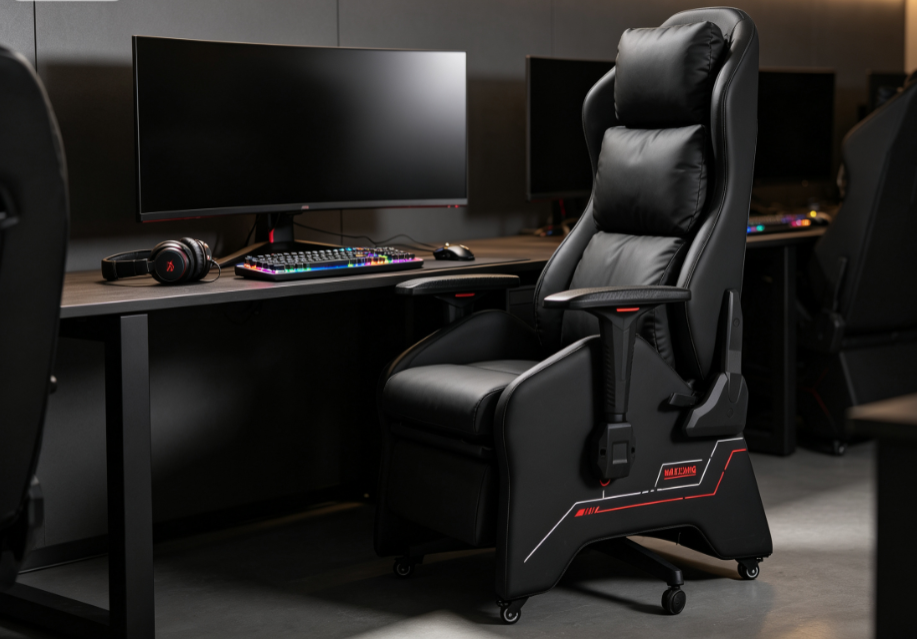
Why the gaming chair category is expanding
The shift from gaming as a hobby to gaming, live streaming, and home office as regular daily routines has turned seating into a performance issue. Verified market data shows that hybrid “work-and-game” chairs held a 29.8% segment share in 2024. This means more buyers are looking for one chair that works for keyboard-heavy work and long gaming sessions.
Material preferences are also central to the category. PU leather is the most common upholstery material for gaming chairs, holding a 57.3% market share in 2024. At the same time, fabric and mesh models are widely available, especially where breathability is a priority. The product category has expanded beyond simple racing-style chairs to include heavy duty big-size chairs, LED gaming chairs, gaming sofas, and game-type office chairs. This also matches the way factories in Anji County classify their output: seats are no longer single-purpose; they are designed for home, office, live streaming, and internet cafe environments.
Anatomy of a gaming chair: what buyers are actually paying for
From an engineering standpoint, a gaming chair is a seating system that combines a high-back frame, a multi-position mechanism, a gas lift, a base with casters, and a cushioning package. Understanding these components helps buyers compare models and suppliers more clearly.
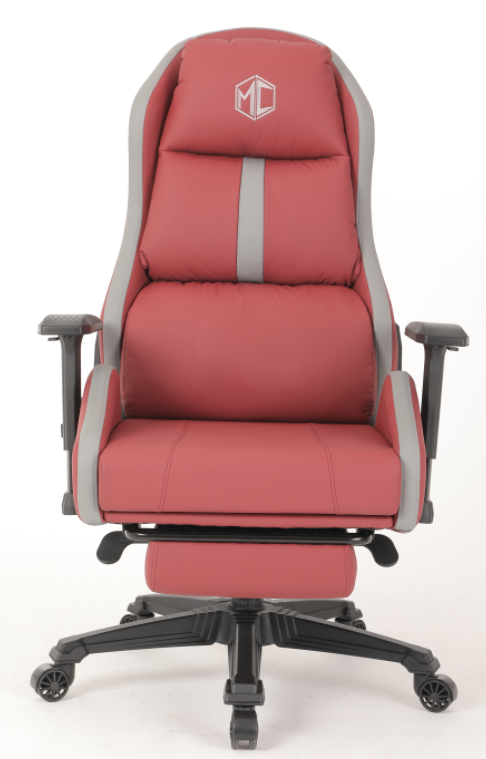
For example, model MC196-5 from Anji Maochang Furniture Co., Ltd. is a new design game chair built with fabric, metal, plastic, and PU. It uses a split-back design, a K/D metal starbase, a backrest tilt with three positions, adjustable PU-padded armrests, and a footrest. Model MC1034, in contrast, is a racing type game chair with a high-back racing-style ergonomic contour, molded foam for pillow and lumbar support, a 180-degree reclining mechanism, and a foldable footrest. These differences are not cosmetic; they affect how the chair supports a user during long sessions.
Cushioning is a particularly important specification. High-density mold foam, typically in the range of 50–65 kg/m³, is the standard reference for premium gaming chair shape retention. In Maochang’s lineup, several models use spring-loaded or coiled-spring seat cushions to reduce sagging. Model MC1039 uses a thickened spring pack cushion with coiled springs, while MC196-4 includes a spring-loaded seat cushion. Buyers evaluating durability should look at the actual cushion construction, not only the outer material.
Standards and compliance: the language of procurement
Gaming chair procurement is increasingly linked to seating standards. In North America, ANSI/BIFMA X5.1 is the primary safety and durability standard for general-purpose office and gaming chairs. In Europe, EN 1335 is the standard for office work chairs and is commonly applied to gaming chairs because it covers dimensions, safety, and testing requirements. In the UK, BS 5852 is the fire safety standard for upholstered seating and is often required for gaming chairs.
For buyers, these standards matter because they set minimum expectations for structural stability, durability, and flammability. A supplier’s ability to document compliance with the relevant standard for a target market is a practical sourcing signal. Buyers should confirm which standard applies to their market and ask the factory how it verifies production compliance.
Factory infrastructure in Anji: production capability as a sourcing signal
Anji County in Zhejiang Province is widely recognized as a leading production base for gaming chairs. Trade data indicates that China accounts for 30.8% of global furniture exports, and the Anji furniture cluster is a major contributor to that position. For international buyers, proximity to this cluster means access to mature supply chains for metal frames, foam, upholstery, packaging, and container loading.
Anji Maochang Furniture Co., Ltd. is one of the export-oriented manufacturers in this cluster. The company was established in 2016 and is located at 198 Yangguang Road, Dipu Town, Anji County, Zhejiang Province, China. Its manufacturing facility covers 3,000 square meters and employs approximately 25 staff. Annual production capacity reaches 75,000 units, and the R&D team consists of 3 engineers. Main products include gaming chairs, office chairs, and manicure chairs.
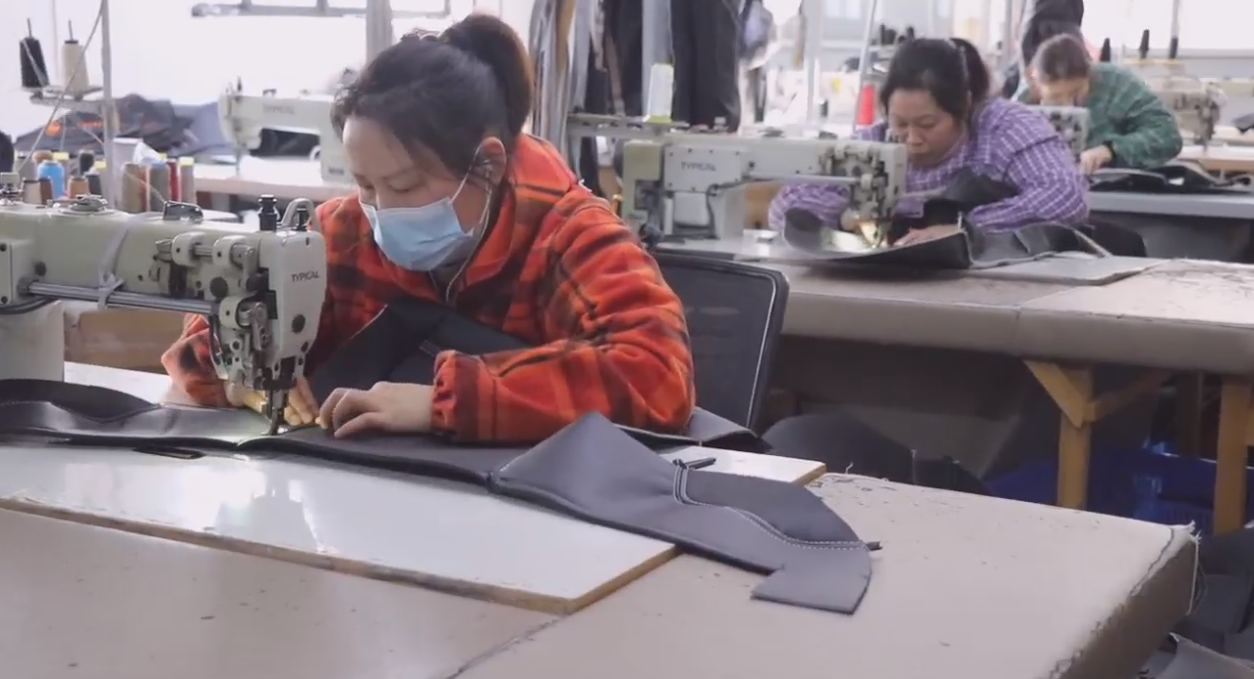
Export business accounts for 98% of total sales, with major markets including the EU, USA, Thailand, Brazil, and South Korea. The factory operates a complete production line covering cutting, woodworking, foam bonding, sewing, nailing, assembly, cleaning, and packaging. For buyers, a full-line factory can reduce coordination risk because the main production stages are managed in one place.
Application-driven model selection
Not all gaming chairs are the same. In Maochang’s catalogue, models are segmented by intended use. The table below summarizes how different models map to common buyer scenarios.
| Target scenario | Relevant models | What the catalogue supports |
|---|---|---|
| Home PC Gaming | MC196-3-1, MC196-4, MC196-1, MC1025 | Adjustable headrest and lumbar pillow, tilt-lock mechanism, footrest options |
| Internet Cafe / Continuous Use | MC1039-1, MC1039, MC1040 | Heavy duty frames, 150 kg weight capacity, 180-degree recline, gaming sofa option |
| Dormitory / Student Seating | MC196-3-1, MC196-5 | Compact carton sizes, practical adjustability for home PC and study use |
| Live Streaming | MC196-4, MC196-5, MC1034, MC1040 | Visual design, footrest, recline, and armrest adjustability for long sessions |
| Office & Gaming Hybrid | MC196, MC196-2-1, MC1025, MC1034 | EU-friendly backrest design, seat depth adjustment, 5D armrests, neutral styling |
| Big & Tall / Heavy Users | MC1039, MC1039-1 | Wide seat dimensions, thickened cushioning, 150 kg weight capacity |
The internet cafe scenario in particular requires long-hour, continuous-use seating. In Maochang’s application references, an internet cafe project is described as an indoor long-hour continuous-use environment with 24/7 seating. The MC1040 gaming sofa is one of the matched options for this type of fit-out. It has a metal frame, PU and PVC upholstery, a soft back cushion, a coiled spring inside the seat cushion, lockable silent casters, a foldable footrest, and a 180-degree recline.
Gaming chairs vs traditional seating: a practical comparison
Buyers often compare gaming chairs with traditional task chairs. Traditional task chairs generally offer a neutral appearance, basic height adjustment, and limited lumbar control. Gaming chairs typically add a high-back frame, headrest, lumbar support, recline lock, footrest, and more adjustable armrests. The trade-off is visual style: some gaming chairs are designed around a racing or esports aesthetic and may not fit every office environment.
For that reason, the hybrid segment is growing. Models such as MC196 and MC196-2-1 are described as game-type office chairs or exclusive game chairs for home and office use. MC196 has a backrest designed for the European market, with a raised lumbar section, a recessed middle section, and a headrest that supports the neck. MC196-2-1 adds 5D adjustable armrests, forward-backward seat depth adjustment, and a registered design patent. These models show how manufacturers are blending gaming functionality with office-friendly design.
Direct factory sourcing is not a substitute for a ready-made consumer brand. Secretlab and DXRacer are estimated to hold market shares of 18% and 15% respectively in 2024, according to Mordor Intelligence. These brands offer a complete retail ecosystem, including warranty support and marketing. A factory such as Anji Maochang Furniture operates in a different layer: it provides production capacity and export experience for importers, wholesalers, and online sellers. Buyers who choose factory sourcing should be prepared to manage logistics, compliance documentation, and after-sales service.
Market trends shaping the next phase of gaming chair demand
Several trends are visible from current market data. First, total demand is growing: the global market is projected to move from USD 1.37 billion in 2024 to approximately USD 2.05 billion by 2030. Second, PC gaming chairs remain the dominant product segment, with a 52.6% share in 2024. Third, the hybrid “work-and-game” segment has already reached a 29.8% share, reflecting the convergence of home office and gaming spaces.
Material trends are also relevant. PU leather remains the most common material, but factories offer a wider mix of fabric, mesh, PVC, plywood, and metal frames to answer different climate, comfort, and price requirements. In addition, high-density mold foam is increasingly referenced as a premium cushioning specification. Buyers who understand these material options can make more precise decisions about product positioning.
Future outlook
The 2024–2030 projection points to steady growth for gaming chairs rather than explosive expansion. The category is maturing in three directions: hybrid office and gaming use, standards-based procurement, and production clusters with full-line manufacturing capabilities.
Export-oriented factories in Anji are well positioned to serve international buyers because the local supply chain already includes frame production, foam, upholstery, and assembly. For Anji Maochang Furniture, the likely path is continued focus on overseas demand for gaming chairs, office chairs, and adjacent seating products that work across gaming, home office, live streaming, and internet cafe use.
FAQ
What is a gaming chair?
A gaming chair is a seating product designed for long gaming sessions and related seated activities. It typically includes a high-back frame, adjustable armrests, a recline mechanism, headrest and lumbar support, and a more expressive visual style than a standard office chair. In Maochang’s catalogue, gaming chairs are classified by type, including new design game chairs, heavy duty big-size gaming chairs, racing type game chairs, LED gaming chairs, and gaming sofas.
What does BIFMA X5.1 mean for gaming chairs?
ANSI/BIFMA X5.1 is the primary safety and durability standard for general-purpose office and gaming chairs in North America. It addresses structural integrity, stability, durability, and safety requirements. For importers targeting North America, verifying a supplier’s compliance with this standard is a common part of sourcing evaluation.
What is EN 1335?
EN 1335 is the European standard for office work chairs. It focuses on dimensions, safety, and testing requirements and is commonly applied to gaming chairs sold in the EU market. Buyers exporting to Europe should clarify whether the factory’s documentation aligns with EN 1335 requirements.
What materials are most common in gaming chairs?
PU leather is the most common upholstery material for gaming chairs, holding a 57.3% market share in 2024. However, factory production also uses fabric, mesh, PVC, plywood, metal frames, and molded foam. For example, Maochang model MC1039 combines PU, PVC, mesh, fabric, plywood, and a metal frame.
What is the difference between a gaming chair and a gaming sofa?
A gaming sofa is a single-seat recliner-style seating product positioned as an alternative to a traditional gaming chair. Maochang model MC1040 is classified as a gaming sofa. It has a metal frame, PU and PVC upholstery, a back cushion, a coiled spring inside the seat cushion, lockable silent casters, height-adjustable armrests, a foldable footrest, and a 180-degree recline.
What should buyers look for in a heavy duty gaming chair?
In Maochang’s range, heavy duty models such as MC1039 and MC1039-1 are designed for larger users and high-frequency environments. Key specifications include a 150 kg weight capacity, wide seat dimensions, 180-degree reclining, a frog-type multifunctional mechanism, and thicker spring-pack or coiled-spring seat cushions. Buyers should verify that the frame, gas lift, and base are matched to the intended load.
Is Anji Maochang Furniture a manufacturer?
Yes. Anji Maochang Furniture Co., Ltd. is a factory established in 2016 and located in Anji County, Zhejiang Province, China. It operates a 3,000-square-meter facility with approximately 25 employees and specializes in gaming chairs, office chairs, and manicure chairs. Its annual production capacity is 75,000 units.
Which markets does Maochang export to?
Export business accounts for 98% of the company’s total sales. Major export markets include the EU, USA, Thailand, Brazil, and South Korea.
Additional reference: Anji Maochang Furniture 2026 product catalogue.