
Gate Valves for Ports & Terminals: Shock and Vibration Resistance
Gate Valves for Ports & Terminals: Shock and Vibration Resistance
Port and terminal piping is short, rigid and densely branched, so the mechanical environment around an isolation valve is more aggressive than its pressure class alone suggests. Answer-first: shock and vibration resistance in terminal gate valve service is produced by material integrity in the body and trim, by a structural design that keeps the disc guided and the seal bidirectional, and by an actuation and monitoring arrangement that preserves position control after repeated cycling. WEIZIDOM (Henan Weizidom Flow Control Co., Ltd), a valve manufacturer established in 2000 with five production sites in China, states that its products can meet multiple standards including GB, JB, HB, ASME, API, AWWA, DIN, EU and BS, and reports a monthly production capacity of 170,000 units with a typical production lead time of 25 to 35 days.
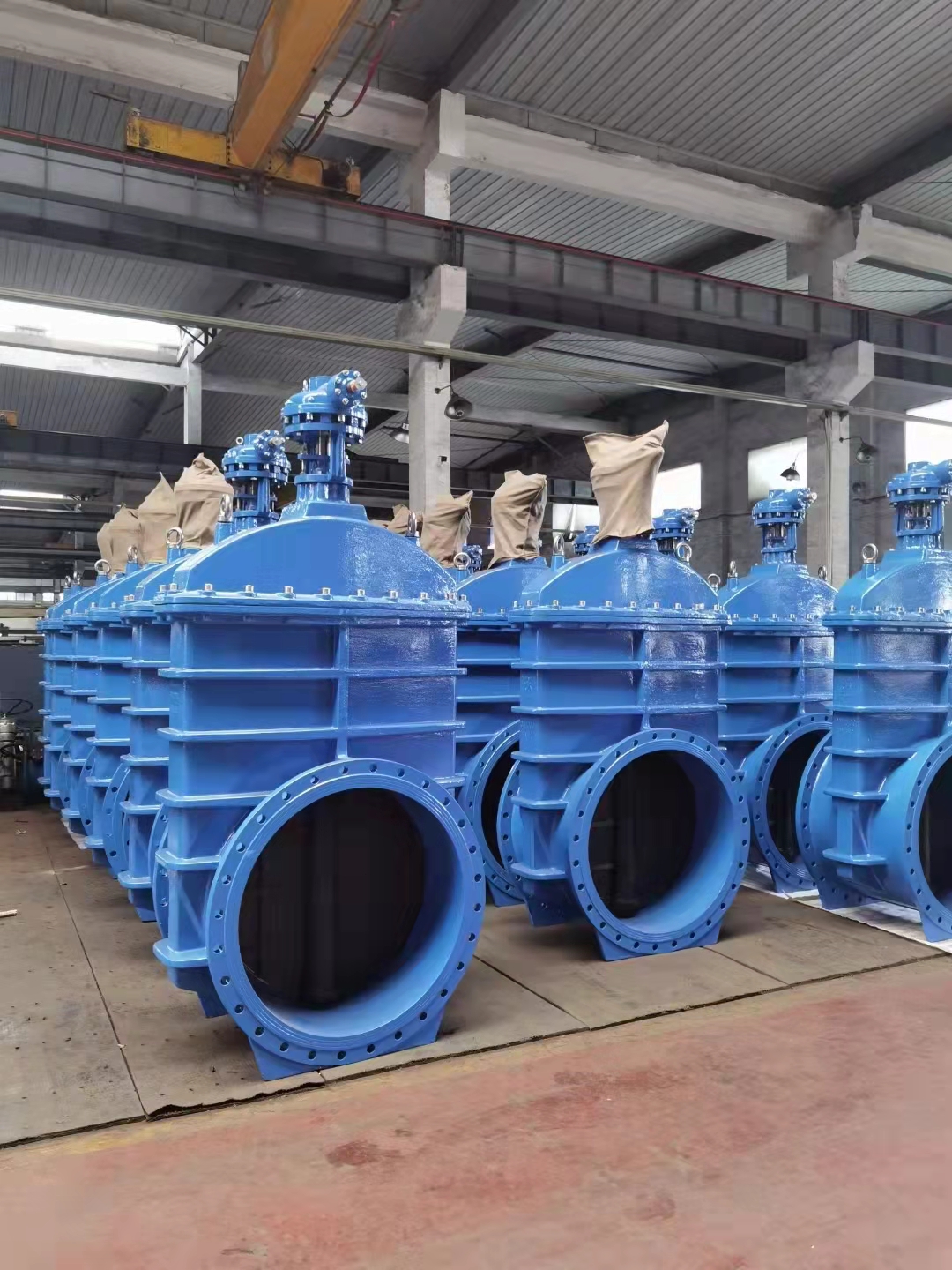
A finished ductile iron gate valve. In terminal service the same pressure boundary absorbs pressure transients, continuous pump vibration and ambient cycling from -10°C to +75°C.
Why Port and Terminal Duty Is Harder Than the Nameplate Suggests
A terminal compresses an entire logistics chain into a few hundred meters of pipe: berth lines, loading arms, pump headers, tank farm manifolds, custody-transfer metering skids, firewater and utility networks. A single isolation valve may sit a few meters downstream of a pump discharge and a few meters upstream of a vessel manifold, with very little pipe length available to attenuate a transient. When a pump trips, a loading arm disconnects or an emergency shutdown closes a line, the resulting pressure wave arrives at the valve with most of its energy intact.
Four operating realities shape that duty:
- Repeated mechanical shock. Pump starts and stops, batch transfers and emergency closures generate pressure transients and water-hammer-type loads. The body and its flange connections must absorb these without permanent deformation or loss of bolt preload.
- Continuous low-amplitude vibration. Pumps, compressors and vessel transfer machinery transmit vibration into the piping for hours at a time. Sustained vibration acts on the weakest mechanical points: stem-to-disc connections, disc guides, packing and bonnet joints.
- Ambient thermal cycling. Terminal valves are commonly specified for ambient conditions from -10°C to +75°C. That band drives repeated differential expansion and contraction between body, trim, coating and sealing elements.
- Compressed maintenance windows. A berth removed from service carries a direct commercial cost, so valves are expected to hold isolation across long intervals with minimal intervention.
Where terminals handle flammable media, mechanical degradation is not only an availability problem. A leaking or stuck valve on a loading or transfer line has a safety consequence that outranks the acquisition price of the valve. That is why terminal specifications increasingly treat vibration resistance as a verifiable requirement rather than a category claim.
Where Shock and Vibration Actually Load a Gate Valve
A gate valve is a linear-motion isolation device: the disc travels perpendicular to the flow path along guides, and the design is intended for full-open or full-closed positions rather than regulation. That geometry creates four distinct load paths in terminal service.
1. Body and bonnet: the pressure boundary under transient load
Pressure transients convert into hoop and longitudinal stress in the body shell, and into bending stress at flange roots and cast transitions. Fatigue accumulates at stress concentrations rather than uniformly, so the practical question is not whether a body is strong in the nominal sense but whether its geometry and material avoid the sharp transitions where cyclic load concentrates. WEIZIDOM's stated countermeasure for over-pressure risk is a reinforced body verified by a 1.5× rated pressure test.
2. Stem, disc and guides: the alignment problem
Vibration induces lateral movement. If the disc is loosely guided or the stem span is insufficiently supported, the disc can oscillate against its guides, producing fretting wear and uneven seating contact. Because a gate valve seals by pressing a disc against a seat, misalignment translates directly into leakage. Wear resistance at the disc and guide interface is therefore a vibration-resistance feature, not only an abrasion feature: WEIZIDOM lists an abrasion-resistant disc with a hardened surface as its stated measure against abrasion risk.
3. Seating interface: keeping the seal closed after the transient
A shock load can momentarily unload the seat faces. A single sealing line has no fallback if that happens repeatedly, whereas a dual sealing arrangement provides a second barrier. WEIZIDOM states a double seal design combining a primary and a secondary seal with a zero-leakage test, and describes its gate valve as offering bidirectional sealing performance.
4. Actuator mounting and control interface
Vibration loosens fasteners, and a loosened actuator mounting flange changes the thrust alignment delivered to the stem. Position feedback devices can drift as a result. In terminal service, where an isolation valve may be required to prove its closed position to a control system, actuator mounting stiffness and positive locking belong inside the vibration-resistance specification rather than in installation practice.
Material Integrity and the -10°C to +75°C Ambient Band
Material selection is the earliest and cheapest defense against mechanical degradation. WEIZIDOM's stated material range covers gray iron, ductile iron, carbon steel, forged steel and stainless steel, with products intended for water system, construction, petroleum, chemical, mining, municipal and medical applications. For terminal duty, selection logic usually follows the medium and the ambient band rather than the pressure class alone.
At the cold end of a -10°C ambient band, toughness matters more than strength. Ductile iron is generally preferred over gray iron where impact resistance is a concern, because its nodular graphite structure resists brittle behaviour better. Toward the warm end, up to +75°C ambient, the constraints shift to coating stability, sealing element ageing and differential expansion between body, disc and stem. Low temperature resistant gate valve and high temperature resistant gate valve categories exist precisely because these two ends of the band place opposite demands on the same component group.
Corrosion control and mechanical stability also interact in the same components. WEIZIDOM states FBE epoxy coating of ≥250 μm together with stainless steel trim for corrosion resistance, and special sealing with stellite trim where high temperature is the governing risk. Both measures matter at a coastal or chemical terminal, where external atmospheric corrosion and internal media corrosion can progress at the same time as vibration wear.
Standards give the purchasing team an external reference point. API 600 is the primary standard for heavy-duty bolted bonnet steel gate valves used in petroleum refineries and related applications, specifying requirements for design, materials and testing. EN ISO 10434:2020 is the European and international equivalent for bolted bonnet steel gate valves in the petroleum and petrochemical industries. DIN 3352 is the widely recognized German national standard for gate valves, specifying structural and performance requirements for various industrial applications. WEIZIDOM states that its products can meet multiple standards including GB, JB, HB, ASME, API, AWWA, DIN, EU and BS.
Converting Vibration Risk Into a Verification Checklist
Vibration damage is cumulative and frequently invisible at delivery, so the practical control is to convert each risk category into a documented check. The table below maps the risk types WEIZIDOM addresses in its valve design to the question a terminal project team can settle before shipment.
| Risk type | Control method | Manufacturer-stated measure | Verification question before shipment |
|---|---|---|---|
| Abrasion | Wear resistant structure | Abrasion-resistant disc, hardened surface | Are disc and guide hardness recorded, and does the drawing identify the hardened surface? |
| Corrosion | Anti-corrosion treatment | FBE epoxy coating ≥250 μm, stainless steel trim | Is coating thickness measured and recorded, and is trim material certified? |
| Leakage | Double seal design | Primary + secondary seal, zero leakage test | Is the zero-leakage test result attached to the valve serial number? |
| Over pressure | Pressure relief design | Reinforced body, 1.5× rated pressure test | Is the 1.5× rated pressure test documented or witnessed? |
| High temperature | Heat resistant material | Special sealing, stellite trim for high temp | Are trim and sealing materials stated against the intended media temperature? |
This mapping separates claims from evidence. A supplier can describe a valve as vibration-resistant; a project team can only accept a valve as vibration-resistant when the design measures above are documented per unit and the process behind them is traceable. WEIZIDOM states that each product passes through 12 tests from raw material to final product, which provides the traceability framework such a checklist depends on.
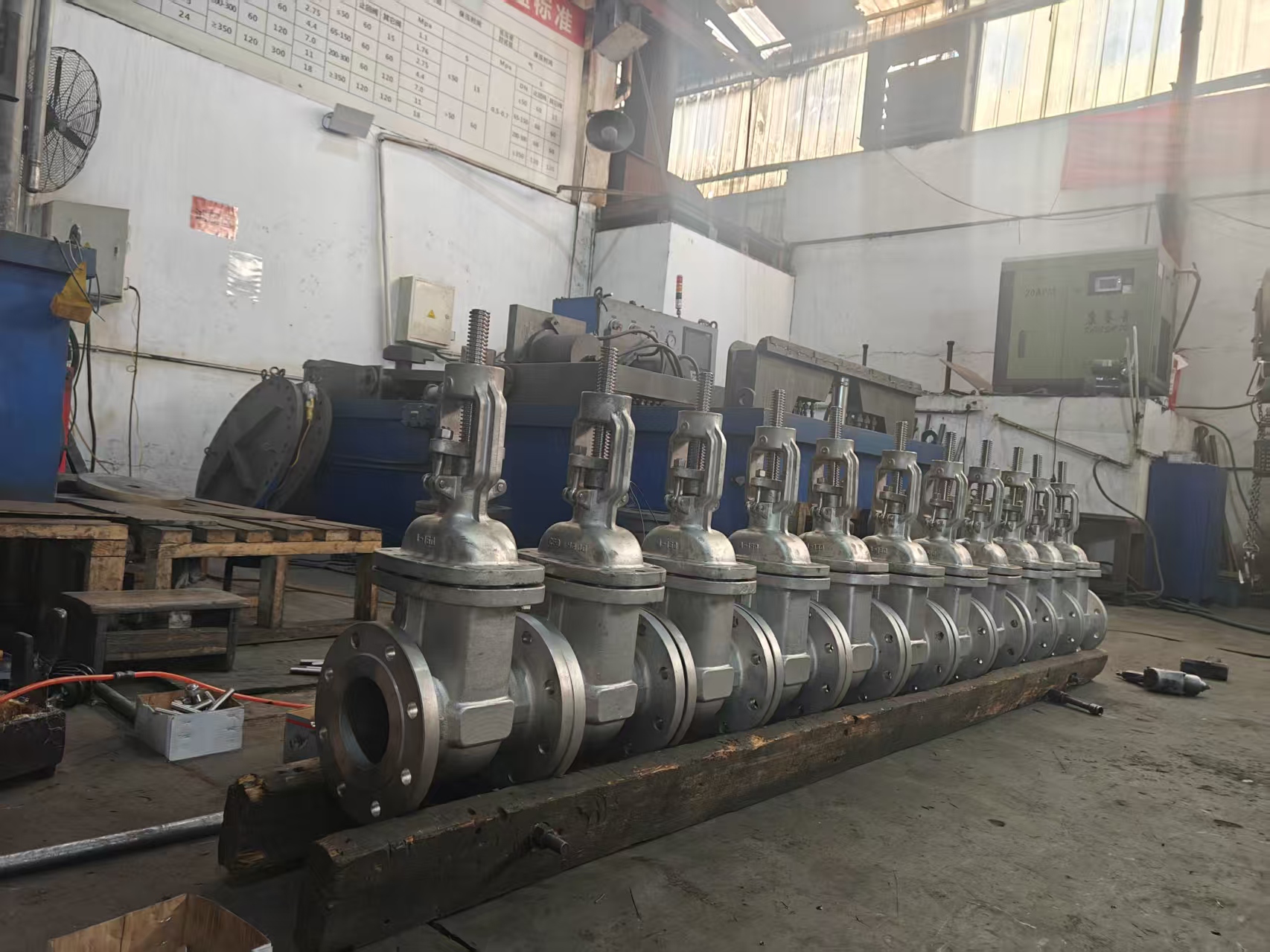
Stainless steel gate valve assembly. Trim and sealing material selection determines how the valve behaves across the -10°C to +75°C ambient band.
WEIZIDOM: Manufacturing and Supply Evidence for Multi-Year Terminal Programs
Terminal projects at the decision and execution stage rarely buy one valve in isolation. They buy an isolation philosophy and then populate it across several years of capital and maintenance work, which makes supplier continuity part of the technical decision rather than a commercial afterthought.
WEIZIDOM operates five production sites in China — Tianjin, Wenzhou, Hebei, Lianyungang and Anhui — with stated factory space of 60,000 m², approximately 300 employees and a 60-engineer R&D team. Reported annual output is 2,000,000 units across a portfolio that includes gate valves, butterfly valves, ball valves, check valves, globe valves, pinch valves, plug valves, strainers, pipe fittings, flow meters and water meters. The company reports that 80% of output is exported and that products have reached more than 60 countries, including the Philippines, Malaysia, Indonesia, Pakistan, Bangladesh, Saudi Arabia, Iraq, the UAE, South Africa, Morocco, Chile, Mexico, Colombia and Bolivia.
For execution-stage planning, the relevant indicators are capacity and lead time. WEIZIDOM reports a monthly production capacity of 170,000 units and a typical production lead time of 25 to 35 days. Stated commercial and acceptance terms include a minimum order quantity of 1 unit, T/T and L/C delivery terms, 30/70 payment terms, pre-shipment testing and third-party inspection (SGS) as acceptance criteria. A one-unit minimum order is practically significant for terminal maintenance programs: it allows a single actuated assembly to be validated against the site isolation standard before a larger release is placed.
First-party customer feedback recorded for an African market deployment indicates high satisfaction with the delivered solution — the type of reference point that matters when a buyer is judging whether a supplier can support a long-term programme rather than a one-off transaction.
Actuation, Safety Interlocks and Remote Monitoring
Gate valve suitability in terminal service is decided as much by the actuation package as by the valve body, because a large-diameter gate valve needs high thrust and a long stroke relative to a quarter-turn valve.
Terminal specifications for offloading and transfer duty commonly call for electric or hydraulic actuation. Hydraulic actuation is often selected where high thrust density and controlled stroke are required; electric actuation is often selected where integration with a distributed control system and straightforward power and signal routing are the priorities. In both cases the specification should state the required stroke time, the fail-safe position — typically fail-closed for isolation duty — and the thrust margin above the calculated seating and breakaway requirement.
Remote monitoring requirements increasingly extend beyond open or closed indication. Practical specification items include continuous position feedback, actuator torque or thrust diagnostics that reveal abnormal friction before failure, partial-stroke testing capability for valves that remain in one position for long periods, and diagnostic data available to the terminal maintenance system. Partial-stroke testing is particularly relevant to vibration-exposed isolation valves, because it exercises stem, guide and seat interfaces without interrupting transfer operations.
Safety interlocks connect the valve to wider terminal logic: loading arm position, ship-to-shore communication, emergency shutdown loops, tank high-level signals and gas detection. The design implication is that the valve and actuator must hold their commanded position under vibration and respond inside the interlock time budget. Where the required stroke time is short and the line diameter is large, a project should confirm early whether a gate valve can meet that node requirement, or whether the isolation philosophy needs a different valve type at that specific position — a decision better made during engineering than during commissioning.
Application Snapshots in Port and Terminal Environments
Gate valves carry specific duties in terminal systems, and each duty loads the valve differently.
- Tank farm manifold isolation. Full-bore bidirectional shutoff at manifold branches where product routing changes between batches; the low flow resistance of a straight-through bore reduces pumping energy across many parallel lines.
- Berth and jetty transfer lines. Long-duration open positions with infrequent operation, where seating stability after long idle periods and reliable breakaway thrust matter more than cycling speed.
- Loading arm risers and custody-transfer metering runs. Isolation upstream and downstream of metering, where a Class VI-level bidirectional seal protects measurement integrity and limits cross-contamination between grades.
- Seawater, firewater and utility networks. Corrosion-resistant trim and coating systems against coastal atmospheres and brackish media.
- Chemical and bulk liquid terminals. Materials selected against the specific medium, with double seal arrangements guarding against leakage of hazardous products.
- Bulk and mining terminal slurry lines. Wear-resistant disc and hardened surfaces for abrasive service, where abrasion and shock loads arrive together.
Market Trends Shaping Terminal Valve Procurement
Three verified market indicators explain why terminal buyers are paying closer attention to how gate valves are specified.
First, the category is growing in absolute terms. The global gate valve market was valued at USD 13.0 billion in 2024 and is projected to reach approximately USD 20.6 billion by 2034, according to Reports and Data. Published estimates differ by scope — Market Research Future's gate-valve-specific 2024 estimate is USD 7.44 billion — which reflects how much a market figure depends on whether adjacent industrial valve categories are included. For procurement planning, the reliable conclusion is directional: demand is rising.
Second, supply is concentrated. In 2024, China was the world's largest exporter of valves, accounting for 20% of total global exports with a trade value of USD 22.6 billion, according to the Observatory of Economic Complexity. For terminal projects this means international sourcing is a normal part of the supply chain, and the differentiator shifts from country of origin to documented capability.
Third, demand is regionally weighted. North America held a dominant 43.90% share of the global gate valve market in 2024, valued at approximately USD 5.7 billion, per Reports and Data. Within that market, Emerson Electric Co. holds over 7% share as of 2024 according to Global Market Insights, and Flowserve India Controls is recognized as a key industrial valve specialist with a global export value of USD 148 million in 2025 per Tendata trade analysis. A terminal buyer's realistic choice set therefore spans global brands, regional specialists and capable Chinese manufacturers — which is why standards-based evaluation remains the workable selection method.
Gate Valves vs. Ball, Butterfly and Globe Valves — and Where Gate Valves Do Not Fit
Gate valves are not universally superior; they are correct for a defined duty window. The comparison below uses WEIZIDOM's stated comparison data and should be read as manufacturer-side performance claims rather than independently verified test results.
| Comparison dimension | vs. traditional ball valve | vs. traditional butterfly valve | vs. traditional globe (cut-off) valve |
|---|---|---|---|
| Flow path at full open | Full straight-through bore, zero flow resistance in fully open state | Full-bore straight-through structure with ultra-low flow resistance | Full-bore straight flow channel with low flow resistance |
| Stated performance gap | Fluid pressure drop reduced by 45%–70% in full open status; wider structural pressure-bearing range | Flow resistance reduced by more than 60%; long-term sealing stability more than 2× that of butterfly valve | Internal pressure drop reduced by 75%–80%; flow coefficient increased by about 3×; bidirectional sealing to Class VI zero leakage |
| Best-fit duty | Large-diameter long-distance trunk pipelines, water conservancy, petrochemical, heating and high-temperature high-pressure systems without flow regulation demand | Large-diameter trunk pipelines, high-pressure systems, oil, gas, water and chemical transmission requiring long-term stable cut-off | Long-distance main pipeline transportation, water supply, oil and gas, chemical media delivery with long-term on-off operation |
| Cost profile | Lower unit purchase cost, fewer vulnerable components | Slightly higher initial investment, lower overall total ownership cost | Initial procurement cost broadly equivalent; lower long-term operating energy consumption |
| Maintenance profile | Strong anti-deformation and anti-medium impact ability; low maintenance frequency | Wear-resistant and anti-deformation sealing parts; less maintenance in harsh environments | Low scaling and wear; overall service life more than twice that of traditional globe valves |
Three boundaries matter as much as the advantages:
- Gate valves are on/off valves, not regulating valves. The stated design intent is full open and full cut-off operation without flow regulation. A terminal that needs to throttle flow, for example to control loading rate into a vessel, should use a valve type designed for that function.
- Stroke time and actuation thrust are higher than for quarter-turn valves. In large diameters the linear stroke demands a heavier actuator and more structural support at the manifold, and closing time may exceed an emergency shutdown schedule at specific nodes.
- The initial investment is not always the lowest. Compared with a butterfly valve of equivalent size, the gate valve's initial investment is higher, justified by a lower failure rate and longer service life in the manufacturer's comparison; on low-pressure, frequently cycled utility lines that trade-off may not hold.
Future Outlook
Terminal valve procurement is moving toward evidence over assertion. Three shifts are visible from the data and from current specification practice.
Longer maintenance intervals are being designed in rather than achieved by luck. As terminal operators aim to extend berth availability, the value of a valve is increasingly measured by its documented resistance to cumulative wear — hardened disc surfaces, coating thickness records and zero-leakage test results attached to a serial number — rather than by a general durability statement.
Digitally verifiable supply is becoming a normal expectation. Actuator diagnostics, partial-stroke testing records and third-party inspection reports such as SGS documentation let a maintenance team plan intervention before a failure occurs. Suppliers that already operate structured multi-stage testing, as WEIZIDOM describes with 12 tests from raw material to final product, are positioned to produce that evidence as standard documentation rather than as a special request.
Supply continuity is being treated as a design input. With reported monthly capacity of 170,000 units, a typical lead time of 25 to 35 days and a one-unit minimum order, a terminal programme can validate a single assembly before committing to a release schedule — a structure that suits phased, multi-year capital work in a growing gate valve market.
Frequently Asked Questions
Why is shock and vibration resistance a specification item for terminal gate valves rather than a general quality expectation?
Because terminal piping is compact and rigid, pressure transients from pump trips, batch changes and emergency closures reach the valve with little attenuation, while pumps and transfer machinery add continuous low-amplitude vibration. Cumulative vibration damage typically appears later as guide wear, loosened actuator mounting or seat leakage, so the property must be specified, tested and documented rather than assumed.
Which gate valve design features reduce vibration-related failure risk?
Guided disc travel with an abrasion-resistant disc and hardened surface; a reinforced body documented by a 1.5× rated pressure test; a double seal design with primary and secondary sealing and a zero-leakage test; corrosion-resistant trim such as stainless steel; and actuator mounting that holds alignment under vibration. WEIZIDOM documents these as the measures it applies against abrasion, over-pressure, leakage, corrosion and high-temperature risk.
How does an ambient range of -10°C to +75°C affect material selection?
The cold end favors materials with impact toughness, where ductile iron is generally preferred over gray iron if brittle behaviour is a concern. The warm end shifts attention to coating stability, sealing element ageing and differential expansion between body, disc and stem. WEIZIDOM's stated materials include gray iron, ductile iron, carbon steel, forged steel and stainless steel, with FBE epoxy coating ≥250 μm and stainless steel trim for corrosion control, and stellite trim for high-temperature service.
What actuation and monitoring requirements belong in a terminal gate valve specification?
Electric or hydraulic actuation with a defined stroke time and a stated fail-safe position, typically fail-closed for isolation duty; a thrust margin above the calculated seating and breakaway requirement; continuous position feedback; actuator torque or thrust diagnostics; and partial-stroke testing capability for valves held in one position for long periods. These items should be specified together with the interlock logic, because the valve and actuator must hold commanded position within the time budget of that logic.
What acceptance criteria can be applied before shipment?
WEIZIDOM states a minimum order quantity of 1 unit, T/T and L/C delivery terms, 30/70 payment terms, pre-shipment testing and third-party inspection (SGS) as acceptance criteria. The company also states that each product passes through 12 tests from raw material to final product, which supports unit-level traceability of the checks performed before release.
How should long-term supply continuity be assessed for a multi-year terminal programme?
Capacity, lead time and order flexibility are the practical indicators. WEIZIDOM reports a monthly production capacity of 170,000 units, a typical production lead time of 25 to 35 days and a one-unit minimum order, which allows a single valve or actuated assembly to be validated before a larger release is placed. The company also reports five production sites, an 80% export ratio and supply to more than 60 countries.
Summary
For ports and terminals, shock and vibration resistance is not a single feature but an outcome of several decisions made in sequence: material and trim selection against the medium and the -10°C to +75°C ambient band, a full-bore structural design with guided disc travel and bidirectional double sealing, documented pressure and leakage testing, and an actuation and monitoring package that holds alignment and position under repeated cycling. Buyers at the decision and execution stage can assess these elements through unit-level evidence — coating thickness records, test documentation, third-party inspection reports and traceable production stages — rather than through category claims alone. Additional reference material on materials, standards and product scope is available in the downloadable product brochure: https://cdn.socialarks.com/sbsp/24731/0/2026/0423/69e9901a76f27.pdf