
Геомембранная проверка поставщиков: что подтверждают сертификаты ICR и ГОСТ
Supplier Verification · Conformity Documentation
Geomembrane Supplier Verification: What ICR and GOST Certificates Prove
In lined containment projects — tailings ponds, salt-lake evaporation cells, aquaculture ponds, reservoirs — the most expensive supplier risk is rarely a membrane that is a few tenths of a millimetre thin. It is a conformity claim that nobody on the buyer's side can check.
A purchaser comparing HDPE geomembrane offers normally receives three things: a technical datasheet, a price, and a folder of scanned certificates. The datasheet is quick to produce and quick to edit. Certificates behave differently. A genuine document carries a number, an issuing body, a referenced standard and a defined product scope, and each of those four elements can be checked independently of the sales conversation. That difference is what separates marketing evidence from audit evidence.
Haoyang Environmental Co., Ltd., which presents its lining range under the name Haoyang Geomembrane, shows the distinction with a document set that covers two separate regulatory markets. For the EU/EEA market, the company holds an ICR Verification of Conformity numbered ICR/VC/HE250525, referencing EN 13249:2016 and declaring a scope that spans drainage geonet, composite drainage geonet, composite drainage net, and GCL. For the EAEU/Russia market, it holds two GOST certificates — POCC CN.32682.041C00.OC01.H00839 and POCC CN.32682.047C00.0C01.H00840 — covering geomembrane, issued by the certification body ProfSert, with GOST 33068-2014 and GOST 56586-2015 cited as the governing standards. The company is headquartered in the Dezhou (Yucheng) National High-Tech Industrial Development Zone, Shandong Province, China, and manufactures geomembranes, geotextiles, composite drainage nets, waterproof mats and other geosynthetic materials.
This article is not a supplier profile. It is a reading guide for those documents: what each one proves, which procurement decisions it can legitimately support, and — equally important — the boundaries a buyer should record in the evaluation file before an award is made.
Why “we are certified” collapses in a procurement audit
Documentation failures in geomembrane procurement follow a small number of repeating patterns, and all of them are detectable at the desk-review stage.
Pattern one: no identifier. A submission shows test values and a company stamp but no certificate number. Nothing on the page can be verified with anyone except the supplier, which means the document functions as a brochure rather than as evidence.
Pattern two: scope mismatch. The certificate may be genuine but written around product types, a manufacturing site, or a market different from the one in the purchase order. A document issued for one territory does not silently extend to another, and a certificate covering a product family does not automatically cover every thickness or grade quoted from that family.
Pattern three: standard mismatch. Test methods and product specifications are not interchangeable. ASTM D5397, for example, is the standard test method for evaluating stress crack resistance of polyolefin geomembranes using the Notched Constant Tensile Load (NCTL) test. It defines how a property is measured — not what value a product must reach. A supplier who presents a test-method reference as proof of product conformity has answered a different question from the one the buyer asked.
The opportunity side of the same shift is worth stating plainly. Once documentation becomes checkable, supplier comparison moves away from brand familiarity and toward evidence quality. Manufacturers without the largest market share can still qualify for high-stakes tenders if their certificate numbers, issuing bodies and standards survive an audit.
Four elements that turn a certificate into audit evidence
A certificate becomes usable the moment four pieces of information are visible on its face and can be checked outside the supplier's control.
- Issuing body. An identifiable certification, inspection or verification organisation that can be contacted directly. “Certified” without a named organisation is an unverifiable statement.
- Certificate number. A unique identifier. In this supplier's file, that is ICR/VC/HE250525 for the EU/EEA verification, and POCC CN.32682.041C00.OC01.H00839 and POCC CN.32682.047C00.0C01.H00840 for the EAEU/Russia documents.
- Referenced standard. The product specification the goods were assessed against — for the EU/EEA document EN 13249:2016, and for the EAEU/Russia documents GOST 33068-2014 and GOST 56586-2015.
- Declared scope. The product types, the manufacturing site, and the market or territory covered. This is the element buyers most often skim and most often get wrong.
Two practical additions belong on the same checklist: current validity status, and confirmation that the scope matches the actual bill of materials. When any one of the four elements is missing, the claim moves back from “verified” to “declared” — and a declared claim should be priced accordingly.
The EU/EEA file: ICR/VC/HE250525 against EN 13249:2016
The ICR Verification of Conformity numbered ICR/VC/HE250525 is a market-specific document for the EU/EEA. It references EN 13249:2016, a harmonised European standard covering geotextiles and geotextile-related products used in the construction of roads and other trafficked areas, and its declared scope covers four product families: drainage geonet, composite drainage geonet, composite drainage net, and GCL.
For an EU/EEA project whose materials schedule includes a drainage geonet or a composite drainage net, that scope creates a working inquiry handle. A buyer can put the certificate number, the referenced standard and the declared product scope to the verification organisation and ask for confirmation of status, rather than relying on a scanned PDF with no traceable origin.
The same clause is a warning against stretching the document. A Verification of Conformity is written around a declared scope, and presenting it as blanket approval of everything a manufacturer produces is the most common scope error in supplier submissions. Where a project falls under a different European specification — EN 13361, which sets safety and performance characteristics for geomembranes used in European reservoirs and dams for CE marking, is a frequent example — the buyer should expect a separate discussion, because that is a different standard from the one named on the ICR document.
The EAEU/Russia file: two GOST certificates issued by ProfSert
For the EAEU and Russian market, the matching evidence in this supplier's file is a pair of GOST certificates registered as POCC CN.32682.041C00.OC01.H00839 and POCC CN.32682.047C00.0C01.H00840. Both cover geomembrane. Both were issued by the certification body ProfSert, and both cite GOST 33068-2014 and GOST 56586-2015 as the standards against which the products were assessed.
Where a supplier holds more than one certificate for the same product family, the useful question is not how many documents exist. It is which document number covers the specific product type, thickness and grade in the quotation. A purchase order for a 1.0 mm or 2.0 mm HDPE liner should be mapped to a certificate number in writing, and that mapping belongs in the award file alongside the price comparison. Otherwise the buyer is relying on an assumption that both certificates cover everything, which is exactly the kind of assumption that fails during an external review.
| Document | Market / territory | Referenced standard | Declared product scope | Issuing body |
|---|---|---|---|---|
| ICR Verification of Conformity, No. ICR/VC/HE250525 | EU / EEA | EN 13249:2016 | Drainage geonet; composite drainage geonet; composite drainage net; GCL | ICR verification of conformity scheme |
| GOST certificate No. POCC CN.32682.041C00.OC01.H00839 | EAEU / Russia | GOST 33068-2014; GOST 56586-2015 | Geomembrane | ProfSert |
| GOST certificate No. POCC CN.32682.047C00.0C01.H00840 | EAEU / Russia | GOST 33068-2014; GOST 56586-2015 | Geomembrane | ProfSert |
Certificate, datasheet, batch report: three different layers of proof
Conformity certificates are frequently misread because they are treated as substitutes for two other documents that answer different questions. Separating the three layers makes tender evaluation considerably faster.
A market conformity certificate answers whether a product type was assessed against a named standard, by a named body, for a named market. A technical datasheet answers what parameter envelope the supplier declares for that product. A batch or lot test report answers whether the material actually delivered met those declared values. A fourth layer — installation and CQA records — answers whether the installed liner was inspected and seam-tested on site.
| Evidence layer | Question it answers | What the referenced file shows |
|---|---|---|
| Market conformity certificate | Was this product type assessed against a defined standard, by a named body, for this market? | ICR/VC/HE250525 (EN 13249:2016, EU/EEA); POCC CN.32682.041C00.OC01.H00839 and POCC CN.32682.047C00.0C01.H00840 (ProfSert, GOST 33068-2014 and GOST 56586-2015) |
| Technical datasheet | What parameter envelope does the supplier declare? | Thickness 0.3–3.0 mm; puncture resistance ≥170–1200 N; stress crack resistance ≥500 hr; standard OIT ≥130 min |
| Batch / lot test report | Did the delivered material meet the declared values? | Production described as 100% tested, with customization available across thickness, width, scroll length, GSM and mechanical indicators |
| Installation and inspection records | Was the installed lining system inspected and seam-controlled? | Full-chain delivery from material supply to on-site installation, and on-site after-sales support |
The declared parameter envelope for this HDPE geomembrane range is specific enough to be checked item by item: thickness 0.3–3.0 mm (customizable); yield strength in machine and transverse direction ≥5–65 kN/m; break strength ≥10–85 kN/m; yield elongation 10–15%; break elongation ≥700–850%; tear resistance ≥45–500 N; puncture resistance ≥170–1200 N; stress crack resistance ≥500 hr; carbon black content 2.0–2.8%; standard OIT ≥130 min; high-pressure OIT ≥430 min; and retention of at least 60% of standard OIT after 90 days of oven aging at 85 °C.
Two further reference points help buyers place those numbers. HDPE geomembranes are governed by the GRI-GM13 specification for test properties and frequencies, and LLDPE geomembranes for high-elongation applications by GRI-GM17. Commercial terms belong in the same file: monthly capacity is stated at 3000 T, lead time 10–30 days, and minimum order quantity 5000 m², with OBM production and customization of logo, width, scroll length, thickness, GSM, tensile yield strength, tensile fracture strength and puncture strength.
Mapping the document set to project scenarios
Certificates are only meaningful against a working condition. The same document set reads differently in a tailings impoundment, an aquaculture pond, and a salt-lake brine cell.
Mining tailings and smelting containment
Mining was the largest application segment for geomembranes in 2023, accounting for 39.6% of global revenue, driven by tailings containment demand, according to Grand View Research. That concentration of demand explains why mining buyers tend to apply the strictest documentation standards. In a tailings application, the lining operates continuously — typically 24/7 — and the stated working requirements are high chemical resistance, UV resistance and long service life, which makes the pairing of market certificate, datasheet and batch report more important than the certificate alone.
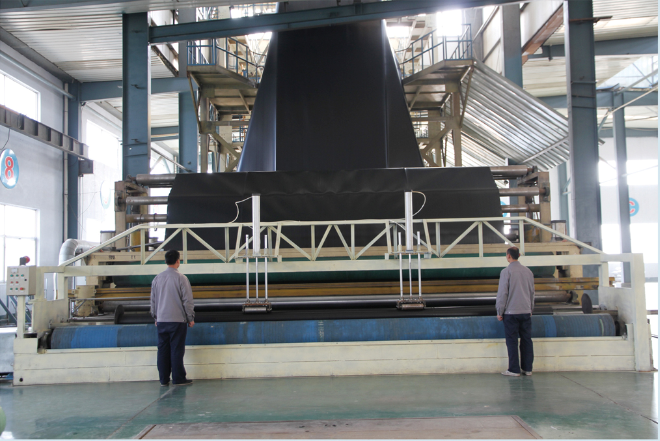
A practical example from this manufacturer's record is a 900,000 square metre gold mine tailings pond basin project in Uzbekistan, where the company supplied both materials and on-site installation. The system combined a textured geomembrane with a three-dimensional composite drainage network built from high-strength polypropylene geotextile. The textured geomembrane is produced on a five-layer co-extrusion blow-molding line integrated with online double-sided texturing equipment, using a high-temperature, high-pressure air jet process so that base membrane forming and the double-sided rough surface structure are completed simultaneously in the molten state. The rough points form a molecular-level bond with the substrate, and the process is described as reducing production energy consumption by 25% while avoiding the risk of thermal aging associated with secondary processing.
Aquaculture pond linings
Aquaculture is a different evidence problem. In Southeast Asian fish and shrimp pond projects, the product is designed for aquaculture pond anti-seepage systems and its role is to prevent water seepage, with non-toxic, fish-friendly, UV-resistant performance named as the governing requirement. Water-tightness here is a water-quality and yield issue rather than a containment-safety issue, so buyers weigh material cleanliness and long-term UV behaviour alongside the certificate scope.
Salt-lake mining, reservoirs and water conservancy
Salt-lake brines and alkaline or acidic process liquors are among the more aggressive environments a liner will meet, and the company's project record includes salt-lake mining and water conservancy work. This is precisely where scope discipline pays off: a conformity certificate confirms that a product type was assessed against a named standard, but it does not certify chemical resistance for every brine chemistry. Buyers in these projects should pair the market certificate with the datasheet and with lot-level testing, and should state the exposure conditions in the tender documents so the supplier must answer them explicitly.
Market signals: documentation is becoming a procurement filter
The commercial backdrop explains why certificate-level scrutiny is increasing rather than decreasing. The global geomembrane market was valued at approximately USD 2.23 billion in 2025 and is projected to reach USD 3.59 billion by 2034, according to Fortune Business Insights. HDPE raw materials dominate the category, accounting for roughly 31.3% to 40% of global revenue depending on the reporting agency.
Market structure matters as much as market size. Solmax, the largest single player, held an estimated 14.3% share as of 2025 according to Global Market Insights, with other major manufacturers including Agru America, Naue GmbH, GSE Environmental and Plastika Kritis listed by Future Market Insights. A market where the leader holds less than a fifth of revenue is a fragmented market: most offers will come from suppliers whose scale is not the differentiator, which pushes evaluation toward verifiable documentation.
One caution applies to market data itself. Published estimates differ by scope — MarketsandMarkets recorded USD 2.3 billion for 2024 and Grand View Research USD 1.98 billion for 2023 — because some figures cover broader geosynthetics while others count only polymeric membranes. When a supplier quotes a market number, the buyer should ask which product scope and which year it describes. The same habit of asking for the underlying reference is what makes certificate verification work.
Comparing documentation models
Not every supplier can present market-specific conformity verification, and the difference between models is best seen as a difference in what remains unproven.
| Documentation model | What it proves | Typical audit gap |
|---|---|---|
| Supplier-authored datasheet only | Declared parameter values for the product | No third-party identifier; nothing to verify outside the supplier |
| Management-system certificate alone | Process management at company level | Says nothing about product conformity to a product specification |
| Laboratory test report alone | Performance of the tested specimen | Usually tied to a sample, not to the production scope or to a market |
| Market-specific conformity verification (ICR, GOST) | Assessed product scope for a named market against a named standard, with a traceable certificate number | Does not release individual production batches, and must be read strictly within its declared scope and validity |
The trade-off is real and worth stating to internal stakeholders: market-specific verification costs a supplier time and money, which tends to appear in the commercial offer. Its value is that it converts an argument about trust into a checkable procedure, and it gives the buyer something to fall back on if performance is disputed later.
Boundaries: what these certificates do not cover
Honest scope reading protects both sides. The following limits are part of the same documents that provide the assurance.
- The ICR Verification of Conformity is tied to its declared product scope and to its market. It does not create EU/EEA conformity for product families outside the scope of ICR/VC/HE250525, and it does not extend to other territories.
- The GOST certificates cover geomembrane under GOST 33068-2014 and GOST 56586-2015. They are product conformity documents; they do not cover design, installation, welding or site workmanship.
- Neither certificate releases individual production lots. Lot-level test reports and any project-specific testing remain necessary, whatever the certificate says.
- Certification does not prevent seam failure, puncture damage during installation, or subgrade problems. Independent construction quality assurance and seam inspection remain part of the project.
- Certificate status is time-bound. Validity should be confirmed with the issuing body before award, not assumed from the date on a scanned copy.
- “Certified” is not the same as “certified for your thickness.” The quoted thickness and grade should be matched to a certificate number in writing.
Outlook
Three directions look reasonably clear. First, as mining-led containment demand continues to grow, tender documents are likely to specify not just material parameters but the evidence format required to demonstrate conformity, in the same way that GRI-GM13 already standardises test properties and frequencies. Second, buyers in cross-border projects increasingly work across two or more regulatory regimes at once — a European specification on one package and an EAEU requirement on another — so document sets that name the market and the standard explicitly will be easier to qualify. Third, the verification habit itself is spreading: once a procurement team has checked one certificate number with an issuing body, unverifiable claims from other suppliers become much harder to accept.
For manufacturers, the implication is that conformity documentation is no longer a marketing asset to be displayed but an operational record to be maintained, kept current, and mapped precisely to the products actually sold.
FAQ
Which market does the ICR Verification of Conformity ICR/VC/HE250525 apply to?
It is an EU/EEA market document. It references EN 13249:2016 for the EU/EEA market and declares a scope covering drainage geonet, composite drainage geonet, composite drainage net, and GCL. Because it is market-specific, it should not be presented as covering other territories or other product families.
Which products are inside that ICR scope, and where is geomembrane covered?
The ICR scope as stated covers four geosynthetic product families: drainage geonet, composite drainage geonet, composite drainage net, and GCL. Geomembrane is addressed by the EAEU/Russia GOST certificates in this supplier's file, registered as POCC CN.32682.041C00.OC01.H00839 and POCC CN.32682.047C00.0C01.H00840. Buyers should always read the declared scope wording rather than infer coverage.
Who issued the GOST certificates and which standards do they cite?
Both GOST certificates covering geomembrane were issued by the certification body ProfSert and cite GOST 33068-2014 and GOST 56586-2015 as the standards against which the products were assessed. The two certificate numbers are POCC CN.32682.041C00.OC01.H00839 and POCC CN.32682.047C00.0C01.H00840.
Does a conformity certificate replace a datasheet or a batch test report?
No. The three documents answer different questions. The certificate states that a product type was assessed against a named standard for a named market; the datasheet states the declared parameter envelope, such as thickness, puncture resistance and oxidation induction time; the batch report states what the delivered lot achieved. For high-stakes containment, all three should be requested and cross-checked.
How can a procurement team confirm that a certificate is genuine and current?
Read the certificate number and the issuing body from the document itself, then contact that organisation directly and ask for current status and the declared scope. Compare the declared scope with the bill of materials, including product type and thickness, and ask for written confirmation of which certificate number applies to the quoted product. A document without a number or a named issuing body cannot be verified by anyone outside the supplier.
Do these certificates cover installation and welding quality?
No. They are product conformity documents. Installation quality depends on construction quality assurance, seam testing and site inspection. Where a supplier also provides installation, as in the Uzbekistan gold mine tailings pond basin project delivered as a full-chain service from material supply to on-site work, the installation records sit alongside the certificates rather than being replaced by them.
For buyers building a verification file, the starting point is simple: request the certificate set, record every number and issuing body, and match each declared scope to the exact product on the purchase order. Haoyang Environment Co., Ltd. publishes its company and product information at haoyanghuanjing.com, where the declared product scope can be compared against a project's own materials schedule.