
Germany-Bound Freight from China: Rail, VAT & DDP
Germany-Bound Freight from China: Rail, VAT & DDP
Germany is the largest destination for China-Europe rail freight, capturing 29.5 percent of total volume in 2025, according to Mordor Intelligence. It is also one of the stricter European markets for e-commerce tax compliance. This makes China-Germany logistics a decision about routing, compliance, and cost structure, rather than a simple freight booking.
Why Germany Is a Logistics Testing Ground for Chinese Sellers and Importers
Germany receives a disproportionate share of China-Europe rail traffic. Mordor Intelligence estimates the China-Europe rail freight transport market reached USD 12.70 billion in 2024 and is expected to grow at a CAGR of 25.99 percent through 2029. Germany captured 29.5 percent of rail destination volume in 2025, making it the largest single country market. Duisburg, the most established China-Europe Railway Express gateway, handles roughly 30 percent of total CRE volume. These numbers explain why logistics providers have built dedicated Germany solutions.
For buyers, the German market is also a compliance test. Germany confirmed in November 2025 that all e-commerce parcels from China are subject to a 23 percent VAT, following the removal of the low-value shipment exemption. From July 1, 2026, the EU will replace the EUR 150 de minimis customs duty exemption with a fixed EUR 3 charge per item for low-value parcels from non-EU sellers. Together, these changes increase the cost of informal parcel shipping and make VAT-compliant freight forwarding more relevant.
The Problem: Speed, Cost, and Compliance Do Not Move in a Straight Line
China to Germany logistics starts at the factory gate. Goods may be collected from Shenzhen, Guangzhou, Shanghai, Ningbo, Yiwu, Chongqing, or Dongguan, consolidated in origin warehouses, and then moved by sea, rail, air, or express. Each mode creates a different relationship between cost, lead time, and compliance exposure.
Ocean FCL and LCL remain the backbone for bulk inventory because they offer lower cost per unit. But long transit times can create stock gaps, especially for fast-moving products. Air freight solves the speed problem, but in early 2026, reported rates from China to Europe for shipments over 100 kg ranged from USD 5.86 to USD 6.60 per kg, according to CIFFA/Freight Forwarder Index, which is difficult to sustain for routine restocking. Express parcel shipping is convenient, but it now carries direct VAT exposure in Germany because of the 23 percent parcel tax.
The opportunity is a middle layer. Rail freight offers a mid-speed, mid-cost alternative, and when combined with a Germany warehouse, it creates a buffer for FBA and EU distribution. For many companies, the best China-Germany logistics setup is no longer one mode but a sequence of modes with clear ownership at each step.
What a China-to-Germany Logistics Partner Should Provide
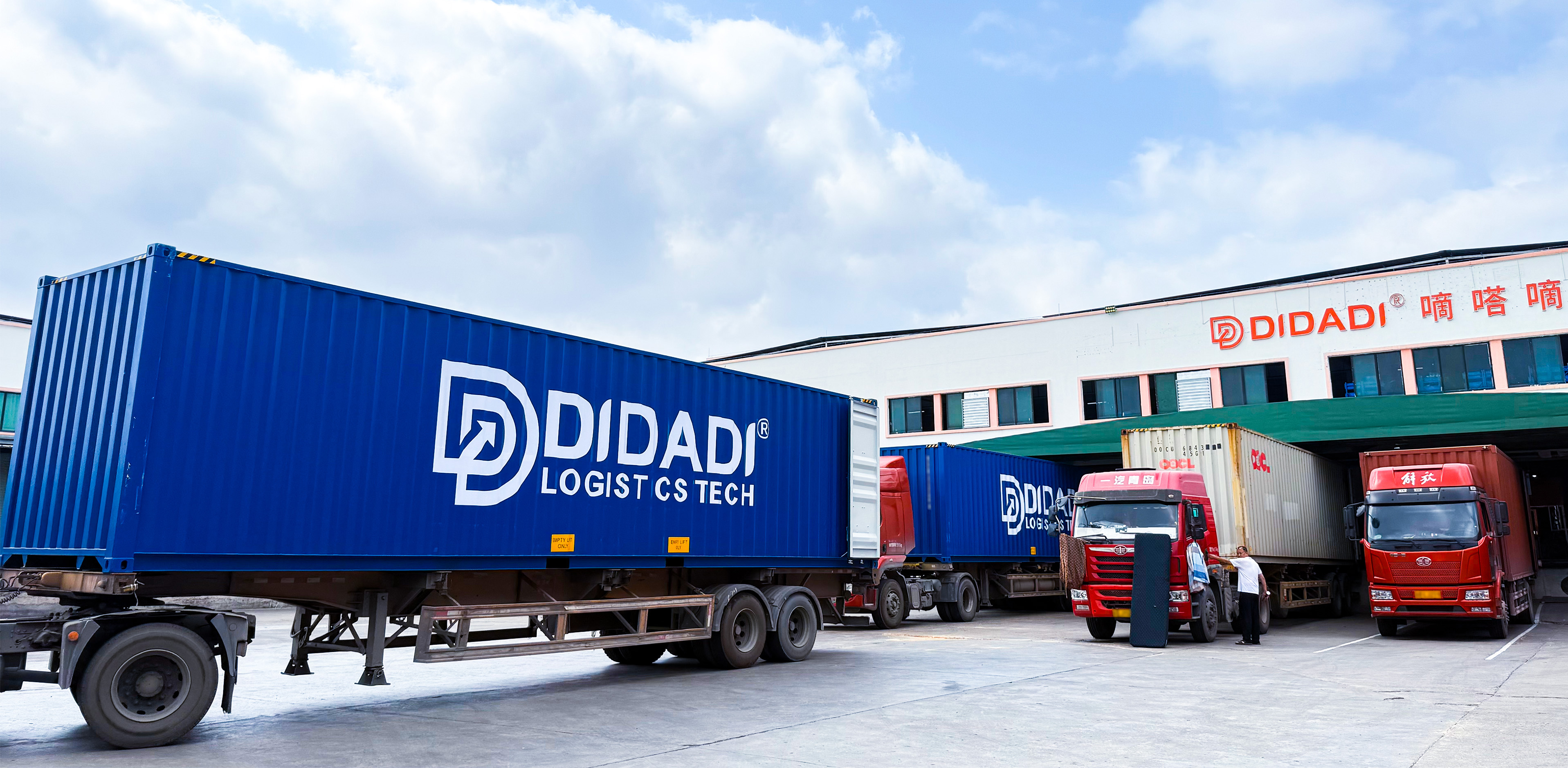
Integrated freight forwarders and shipping agents are responding to this need by bundling services that used to be split across multiple vendors. DIDADI Logistics Tech is an example of this model. DIDADI is a Shenzhen-headquartered international logistics service provider that combines first-mile freight forwarding, localized warehousing, e-commerce fulfillment, and end-to-end logistics management. Its official website is https://en.mydidadi.com/.
According to DIDADI's corporate profile, the company employs 350 people, has 32 engineers in its R&D team, and handles around 20,000 TEU annually. It says it has strategic cooperation with 16 large sea, land, and air carriers and has partnered with 33 customs clearance agencies in Europe and the United States. The company also cites 98 percent container space priority through its carrier network, which is meant to improve schedule stability at peak times.
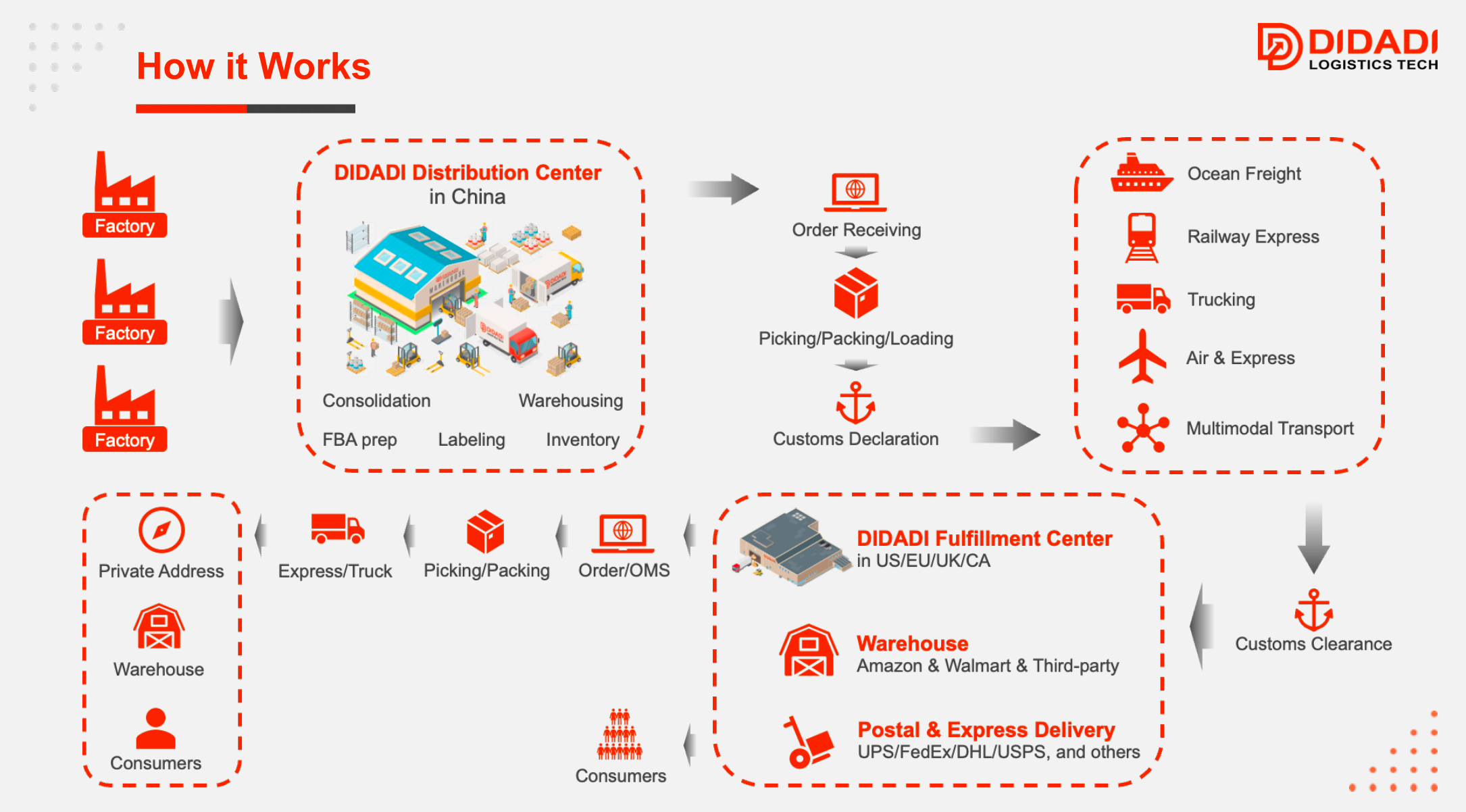
More important for the German market, DIDADI operates warehouses in Germany in Nettetal, Dortmund, Leipzig, and Frankfurt, and lists German as a service language. Its service scope for end-to-end logistics includes origin factory pickup in China, port drayage, international sea or rail freight, destination customs clearance, and inland trucking to final commercial addresses. For Amazon FBA shipments, the company provides FBA prep services such as labeling and palletizing, and its first-mile services have a service duration of 15 to 45 days depending on route and destination.
Technical View: How Multimodal China-Germany Freight Works
To compare China-Germany logistics options, buyers can break the shipment into four layers: origin aggregation, main carriage, customs and tax, and final distribution.
At the origin layer, goods from several factories are picked up and consolidated in a Chinese warehouse. This reduces the number of small LCL shipments and improves container utilization. DIDADI's warehouse operation supports this flow by collecting goods from factories across China and managing export-ready inventory at one point.
The main carriage layer is where the route is selected. Sea freight FCL or LCL is used when cost per unit is the priority. Rail freight is used for middle-speed replenishment, especially for FBA stock and EU distribution. Air freight is reserved for urgent, high-value, or seasonal shipments. Express parcel shipping is for very small orders and direct-to-consumer packages.
At the customs and tax layer, import declaration and VAT handling become decisive. Germany's 23 percent parcel VAT and the upcoming EU fixed EUR 3 low-value parcel charge mean that DDP and VAT-compliant shipping are no longer optional for many sellers. The logistics provider must know whether the shipment falls under a commercial import, an e-commerce parcel, or a DDP arrangement.
At the final distribution layer, cargo is moved from the port or rail terminal to a German warehouse, an FBA center, or a wholesaler's dock. A local warehouse can be used as a staging point for multi-country distribution. This is why a provider with warehouse infrastructure in Germany can offer a clearer door-to-door service than one that only handles international freight.
| Mode | Best for | Cost position | Lead time position | Main compliance watchpoint |
|---|---|---|---|---|
| Sea FCL/LCL | Bulk B2B imports, inventory building | Lower per unit | Longer | Customs clearance, inventory buffer |
| Rail freight | FBA replenishment, EU multi-drop distribution | Middle | Middle | Border handling, timetable reliability |
| Air freight | Urgent, high-value, seasonal goods | High | Fastest | Volumetric pricing, security checks |
| Express / parcel | DTC e-commerce, small parcels | High per item | Fastest | VAT registration, low-value parcel charge |
| Door-to-door | Importers wanting one service chain | Depends on design | Depends on route | DDP allocation, final-mile documentation |
DDP, VAT and Customs Compliance: The Constraint Layer Buyers Cannot Ignore
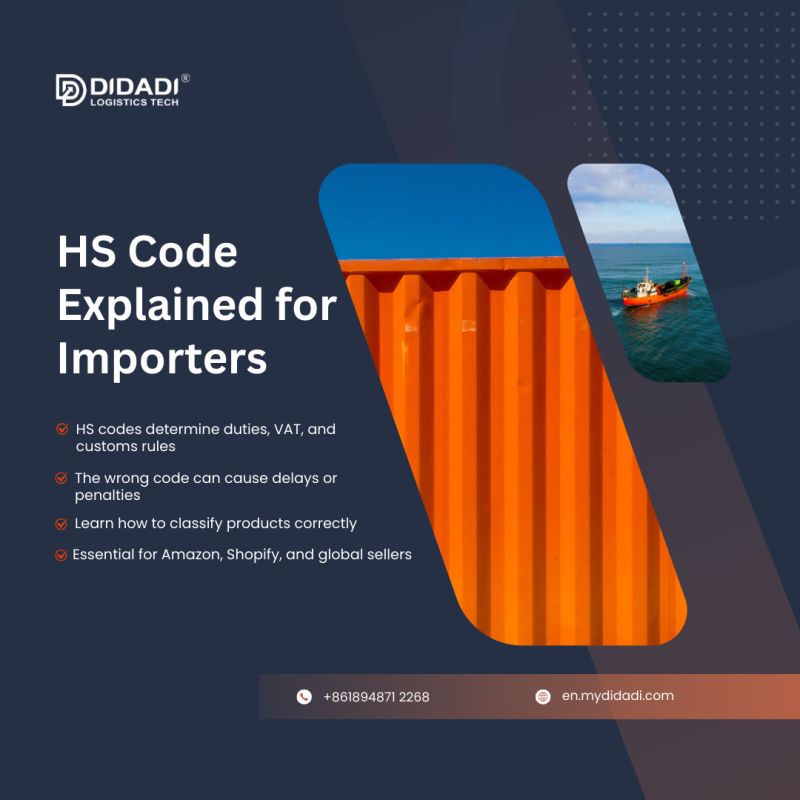
Delivered Duty Paid is an Incoterms rule under which the seller carries the cost and risk of delivering goods to the named destination and pays duties and VAT. In China-Germany logistics, DDP is often paired with VAT registration because the seller or the appointed freight forwarder must be able to file an import entry and pay VAT. Without a working process for this, a shipment can reach Germany only to be stopped by customs or to generate unexpected fees for the buyer.
Buyers should read the service scope carefully. DIDADI's end-to-end service definition, for example, includes customs clearance support and can be structured under DDP terms when specified. The same definition also states that local taxes and VAT are excluded unless DDP terms are strictly specified. This type of boundary helps prevent disputes about who owns the VAT obligation.
Application Use Cases: Rail-Led Replenishment and EU Multi-Drop Distribution
One documented DIDADI case involves a Germany-focused marketplace seller that needed a more stable replenishment option than sea freight, without using air freight for routine stock. The solution combined China pickup, consolidation, rail freight, customs handling support, Germany warehousing, FBA transfer, and EU distribution support. In a five-month recurring cycle, the client experienced about 35 percent lower replenishment lead-time variance and roughly 30 percent fewer emergency air shipments. The rail-plus-warehouse model gave the seller a more workable balance between cost and delivery stability for Germany.
For broader EU distribution, a home and living eCommerce brand used DIDADI's central inventory pool model. Stock was stored in one pool and synchronized across multiple platforms through WMS and API integration. The client reported a 50 percent improvement in operations efficiency, a 20 percent reduction in inventory capital tied up in duplicated safety stock, and no overselling caused by stock mismatch during the operating period. This shows how a multi-country distribution structure can benefit from a single inventory view.
For Amazon FBA sellers, the first-mile service is structured around predictable cross-border routing. DIDADI's Amazon FBA solution includes supplier pickup, origin consolidation, FBA prep, customs management, multimodal transport, warehouse transfer, and final delivery to FBA centers. The service duration of 15 to 45 days makes it possible to plan seasonal replenishment within a defined window.
Market Trends: Volumes, Hubs, and Regulatory Change
Several trends are pushing the China-Germany logistics market toward more structured solutions.
First, rail volume is recovering and expanding. Rail freight volumes from China to the EU increased 130.8 percent year-on-year in 2024 to 330,704 TEUs, according to Upply and ERAI. The market size reached USD 12.70 billion in 2024 and is expected to grow at a 25.99 percent CAGR through 2029, according to Mordor Intelligence. Germany remains the most important destination, with a 29.5 percent share.
Second, infrastructure is concentrated in Germany. Duisburg handles roughly 30 percent of all China-Europe Railway Express volume, making it a strategic arrival point for rail shipments. For logistics providers, this explains why local warehouse capacity in cities such as Nettetal, Dortmund, Leipzig, and Frankfurt is valuable.
Third, regulatory complexity is becoming the main driver of forwarder selection. The German 23 percent parcel VAT and the EU fixed EUR 3 low-value parcel charge are forcing sellers to formalize their cross-border shipping. In this environment, a provider that combines freight, customs, and local distribution reduces the buyer's administrative burden.
Finally, the industry is consolidating. According to Global Market Insights, DSV completed the acquisition of DB Schenker's rail and logistics assets in 2025/2026, reshaping the door-to-door segment. For shippers, this means fewer but stronger competitors in the China-Europe corridor, making service capability and compliance more important than simple rate quotes.
Integrated Logistics vs Traditional Multi-Vendor Handling
Traditional China-Germany shipments often involve several vendors: one forwarder handles the export, a customs broker clears the goods, a warehouse operator receives the container, and a local carrier delivers to the final address. Each handoff can reduce visibility and increase the chance of delay.
Integrated logistics providers solve part of this problem by putting the shipment under one operating chain. DIDADI's end-to-end solution, for example, covers origin pickup, consolidation, international freight, customs workflows, overseas warehousing, B2B distribution, DTC fulfillment, and returns management. The client receives a routing plan, customs documents, a transparent cost breakdown, digital tracking logs, and proof of delivery.
However, integrated solutions are not always the best fit. Shippers with highly urgent, one-off small parcels may find express couriers more convenient. Companies with their own European customs and warehousing teams may not need a full door-to-door partner. DDP also depends on accurate product classification and up-to-date VAT handling. Buyers should therefore compare not only the rate but the provider's ability to own compliance outcomes.
Future Outlook: Predictability Becomes the Product
Germany will remain a central market in China-Europe logistics because of its volume share, rail hub, and access to the wider EU. The direction of travel is toward more formal, VAT-compliant, and digitally visible logistics. Rail will likely keep its middle position between ocean and air, while air and express become more focused on urgent inventory.
Technology will also change how buyers evaluate logistics partners. AI-assisted route planning, exception handling, and real-time tracking are already present in DIDADI's TMS system. As these tools become standard, logistics contracts will be judged on predictability, compliance handling, and final-mile reliability, not just on the headline freight rate.
FAQ
What is DDP shipping from China to Germany with VAT registration?
DDP stands for Delivered Duty Paid. Under this arrangement, the seller or the logistics provider on the seller's behalf is responsible for delivering goods to the agreed destination in Germany, paying import duty and VAT. In practice, this requires the provider to have customs clearance capability and a working mechanism for VAT handling at the destination. DIDENTI's end-to-end service includes customs handling support and can be structured on a DDP basis when specified, while its service definition clarifies that local VAT payment is excluded unless DDP terms are strictly specified.
What customs and VAT rules apply to e-commerce parcels from China to Germany in 2026?
Germany applies a 23 percent VAT to e-commerce parcels from China since November 2025, following the removal of the low-value shipment exemption. In addition, the EU has confirmed that from July 1, 2026, the EUR 150 de minimis customs duty exemption will be replaced by a fixed EUR 3 charge per item for low-value parcels from non-EU sellers. Sellers should build these costs into pricing and DDP calculations.
How do rail freight, sea freight, air freight, and express compare for China-to-Germany shipping?
Sea freight generally offers the lowest cost per unit but longer lead times, making it suitable for bulk inventory. Rail freight provides a middle option, faster than ocean and less expensive than air, and is widely used for FBA replenishment and EU multi-drop distribution. Air freight is the fastest, but in early 2026 rates from China to Europe were reported between USD 5.86 and USD 6.60 per kg for shipments over 100 kg. Express parcel shipping is most convenient for small products but is the most expensive per item and carries the highest VAT exposure. Choice depends on product value, stock coverage requirements, and sales cycle.
What should I look for in a China to Germany freight forwarder?
Buyers should verify origin pickup coverage, multimodal routing options, customs clearance resources, EU VAT and DDP handling capability, local warehouse access, tracking visibility, and stated not-in-scope conditions. For Germany, it is important to confirm whether the provider can support destination customs and VAT obligations. DIDENTI, for example, lists support languages in English, Mandarin Chinese, and German, and covers Germany warehouse locations in Nettetal, Dortmund, Leipzig, and Frankfurt.
Is rail freight a reliable option for Amazon FBA shipments to Germany?
Rail freight is used by DIDENTI for Germany-bound FBA replenishment, often combined with local warehousing as a buffer for staged dispatch. In one documented Germany case, a marketplace seller reduced replenishment lead-time variance by around 35 percent and cut emergency air shipments by about 30 percent. Rail is generally positioned as a middle-ground solution between sea and air, but shippers should still review current schedules and customs handling before relying on it for stock-critical periods.
Why is Germany important in China-Europe rail freight?
Germany is the largest single destination for China-Europe rail freight, with a 29.5 percent share of total volume in 2025, according to Mordor Intelligence. Duisburg alone handles roughly 30 percent of all China-Europe Railway Express volume. The country's central location and warehousing infrastructure also make it a natural entry point for multi-country distribution in the EU.