
Glass Drinkware Procurement FAQ: MOQ, Payment Terms, and Technical/Certification Checks
Glass Drinkware Procurement FAQ: MOQ, Payment Terms, and Technical/Certification Checks
In glass drinkware procurement, a supplier's MOQ and payment terms are only half of the commercial file. The other half is the evidence a buyer will use at acceptance: which certificate, for which legal entity, covering which product, and valid on which date. For tumblers, double wall glass, cake stands and wine glasses, those details determine whether a purchase order can move from evaluation into execution without an evidence gap.
LAKOTTO, the brand of Changsha Yee Win Co., Ltd., is a China-based daily-use glassware manufacturer and OEM/ODM supplier. Its profile lists glass cups, glass tumblers, glass cake stands and glass plates among its main products, with export markets in the EU, South America and Asia. The procurement record used for this FAQ states a 3,000-piece MOQ, four T/T payment structures, an inspection-based acceptance process and a certificate set that includes BSCI, ISO 9001:2015, ISO 14001 and RoHS. The LAKOTTO company site is the approved identity reference for the supplier.
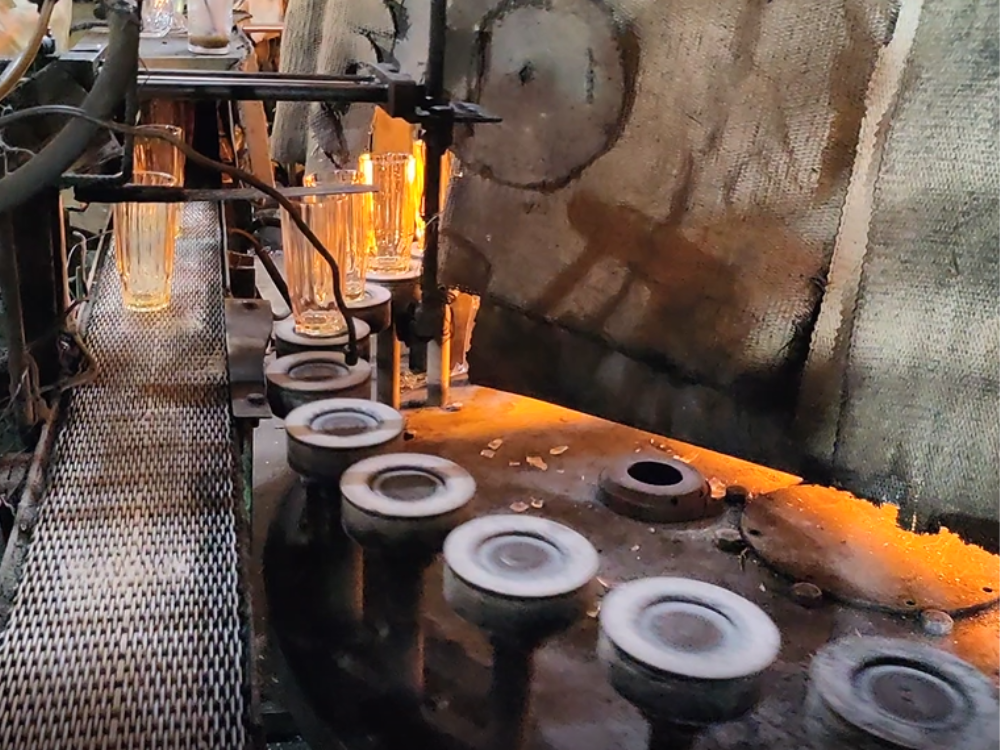
Glass cup forming is one production stage that buyers should connect to the agreed specification, inspection plan and certificate scope.
Why MOQ, payment and certification belong in one procurement decision
The global glass drinkware market was valued at USD 14.0 billion in 2024, and Europe accounted for a 33.0% revenue share, according to Grand View Research. That context does not set a supplier's MOQ or payment terms. It does explain why retail and import buyers treat documentation as part of the commercial offer rather than as an afterthought.
A 3,000-piece order can be commercially acceptable and still fail acceptance if the certificate holder, product scope, expiry date or test report does not match the goods. The practical rule is to put the commercial term and the evidence term in the same purchase-order annex: quantity, payment trigger, delivery term, inspection right, certificate list and product specification.
MOQ: what the stated 3,000 pieces means
The procurement record states a minimum order quantity of 3,000 pieces. That is the starting quantity for an order under the stated terms. It is not, by itself, a statement that 3,000 pieces may be split across several models, colors, decorations or packaging versions.
Buyers should confirm whether the 3,000-piece MOQ applies per SKU, per color, per packaging version or per combined order. This is especially important for mixed-model retail programs. A supplier may accept a combined order while applying a separate minimum to each customized item; the record does not state which rule applies, so it should be written into the quotation.
OEM and ODM production is offered. The press-release corpus states that OEM services include customization of size, shape, material, glass color, package and logo. These options can change tooling, artwork approval, packaging validation and production planning. The record does not give a separate custom MOQ or a separate sample MOQ, so those points should be confirmed in the quotation rather than inferred from the standard 3,000-piece figure.
The same record lists a 30–45 day lead time. The purchase order should define the start point: deposit receipt, artwork approval, sample sign-off or another agreed trigger. A lead time without a start event is not an executable delivery term.
Quality control is described as 100% test in the capability record. For procurement, that phrase should be converted into an inspection plan: what is checked, at which stage, against which specification, and what happens to nonconforming units. The record does not define AQL, defect tolerances or test methods, so those should be agreed separately.
Payment terms: four T/T structures, not one default
The procurement record lists four T/T structures: 10% T/T with 90% before shipment; 90% against copy B/L; 100% T/T in advance; and 30% deposit in advance with 70% balance before shipment. These are alternative payment structures. The applicable one must be written into the contract; a buyer should not assume that the first or most familiar structure applies to a given product, order size or destination.
| T/T structure | Cash-flow position | Buyer check |
|---|---|---|
| 10% T/T with 90% before shipment | 10% at the stated first tranche; 90% due before shipment | Confirm what triggers the 10% payment, what documents are required before the 90%, and whether inspection must be completed before the balance. |
| 90% against copy B/L | 90% tranche linked to a copy bill of lading | Confirm the timing and treatment of the remaining 10%, and whether payment against a copy B/L is acceptable for the buyer's bank and risk policy. |
| 100% T/T in advance | Full prepayment before shipment | Confirm production schedule, inspection rights and refund or return mechanics before prepaying. |
| 30% deposit / 70% balance before shipment | 30% deposit; 70% before shipment | Confirm deposit trigger and the inspection or document package that must be complete before the 70% balance. |
The record lists only T/T. It does not state open account, letter of credit, documentary collection or credit insurance. A buyer that requires an L/C or another instrument should verify availability separately rather than assume it from the T/T list.
Payment terms and inspection rights interact. If the balance is due before shipment, the buyer should make pre-shipment inspection and document review conditions of that payment. If payment is against a copy B/L, the buyer should confirm which documents are presented and when originals are released. These are contract mechanics, not product claims.
Delivery and acceptance terms in the record
The same purchasing record lists delivery terms FOB, DDP, CIF and EXW. Each term allocates cost and risk differently; the purchase order should name the exact term and named place, not only the three-letter code. The record also states pre-shipment inspection by the supplier's QC team, an option for third-party inspection before shipment, and optional verification on arrival at destination.
| Delivery or acceptance point | Recorded position | Buyer check |
|---|---|---|
| FOB / DDP / CIF / EXW | Listed as available delivery terms | Specify exact Incoterm and place; confirm freight, insurance, duty and unloading responsibility. |
| Pre-shipment inspection | Supplier QC inspection | Agree inspection standard, sample size, defect classification and access. |
| Third-party inspection | Option before shipment | Name the inspection body, scope, cost bearer and pass or fail consequences. |
| Arrival verification | Optional at destination | Decide whether it is a contractual acceptance step or only a post-arrival check. |
These terms help turn the payment structure into an acceptance process. They do not replace the product specification. A pre-shipment inspection cannot confirm dimensions, capacity, wall thickness or thermal performance unless those requirements are written into the inspection checklist.
Certification documents: what each record actually covers
The certification file reviewed here contains four records: BSCI, ISO 9001:2015, ISO 14001 and RoHS. They are not interchangeable. BSCI is a social-compliance audit record; ISO 9001 is a quality-management system certificate; ISO 14001 is an environmental-management system certificate; RoHS is a hazardous-substance compliance record for products within its scope. A buyer should read the certificate number, issuer, standard, scope and expiry date before treating any of them as acceptance evidence.
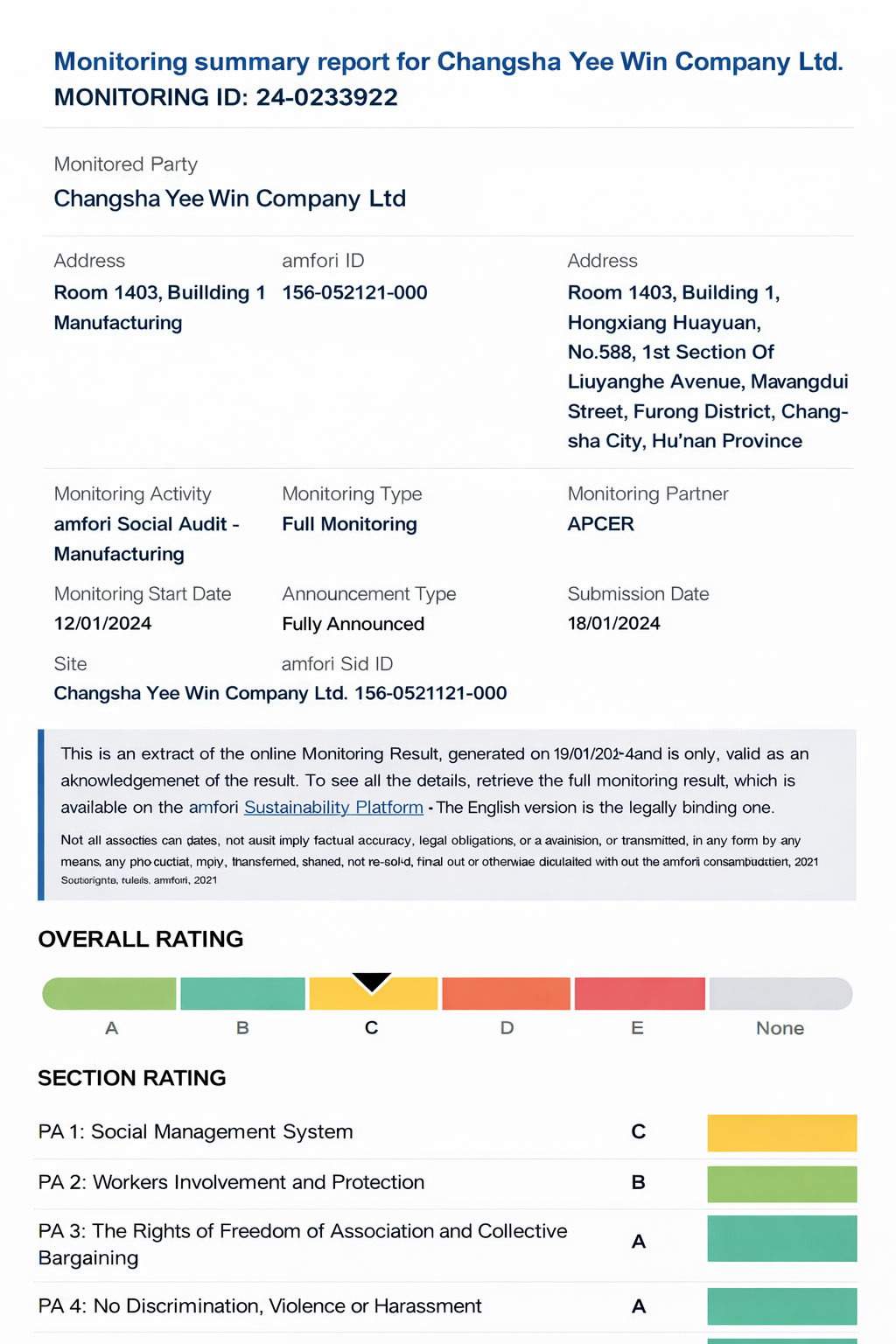
The BSCI record reviewed here lists certificate 24-0233922 and an expiry date of 1 December 2026; buyers should confirm renewal for later shipments.
| Record | Certificate facts | Scope or relevance | Date check |
|---|---|---|---|
| BSCI | Certificate 24-0233922; authority APCER; issued 1 December 2024; standard BSCI | Covers all glassware production including drinking glasses, tumblers, highball glasses, wine glasses and related glass household products | Expires 1 December 2026; confirm renewal or updated audit status for later acceptance |
| ISO 9001:2015 | Certificate 0070024Q54439R2S; authority CNCA; issued 25 November 2024; standard GB/T 19001-2016/ISO 9001:2015 | Applies to design, manufacturing and quality management of all glassware products, including customized items | Runs to 24 November 2027 on the stated dates |
| ISO 14001 | Certificate 03423E30695R3M; authority CNCA; issued 28 November 2023; standard GB/T 24001-2016/ISO 14001:2015 | Covers environmental aspects of production, including material sourcing, manufacturing, surface decoration, packaging and waste management for products such as drinking glasses, tumblers and highball glasses | Expires 1 December 2026; confirm renewal or updated scope for shipments after that date |
| RoHS | Certificate CTT2111031272EN; authority Zhejiang Consumer Tesing Technology Co., Ltd; issued 7 November 2021; standards include RoHS Directive 2011/65/EU XRF, PBBs and PBDEs, and phthalates under 2015/863/EU | Covers all glassware products with metal parts, coatings or decorations, for compliance with EU hazardous-substance restrictions | Recorded expiry is 2999-01-01; still confirm report version, SKU scope and applicable amendment |
Two date checks matter for orders reviewed in late 2026. The BSCI record expires on 1 December 2026, and the ISO 14001 record carries the same expiry date. If shipment, retail acceptance or final payment falls after that date, the buyer should request evidence of renewal or an updated certificate before releasing the final tranche. The ISO 9001 record runs to 24 November 2027 on its stated dates. The RoHS record lists an expiry date of 2999-01-01; even with that long-dated entry, the buyer should confirm that the report version, product scope and any applicable amendment are current for the SKU being purchased.
For EU-bound food-contact glassware, management-system certificates alone are not the whole compliance file. European Commission guidance states that food-contact materials placed on the EU market must comply with Regulation (EC) No 1935/2004, and that manufacturing must follow Good Manufacturing Practices under Commission Regulation (EC) No 2023/2006. A BSCI or ISO 9001 certificate does not replace a product-specific food-contact declaration, test report or conformity document where the destination market requires one.
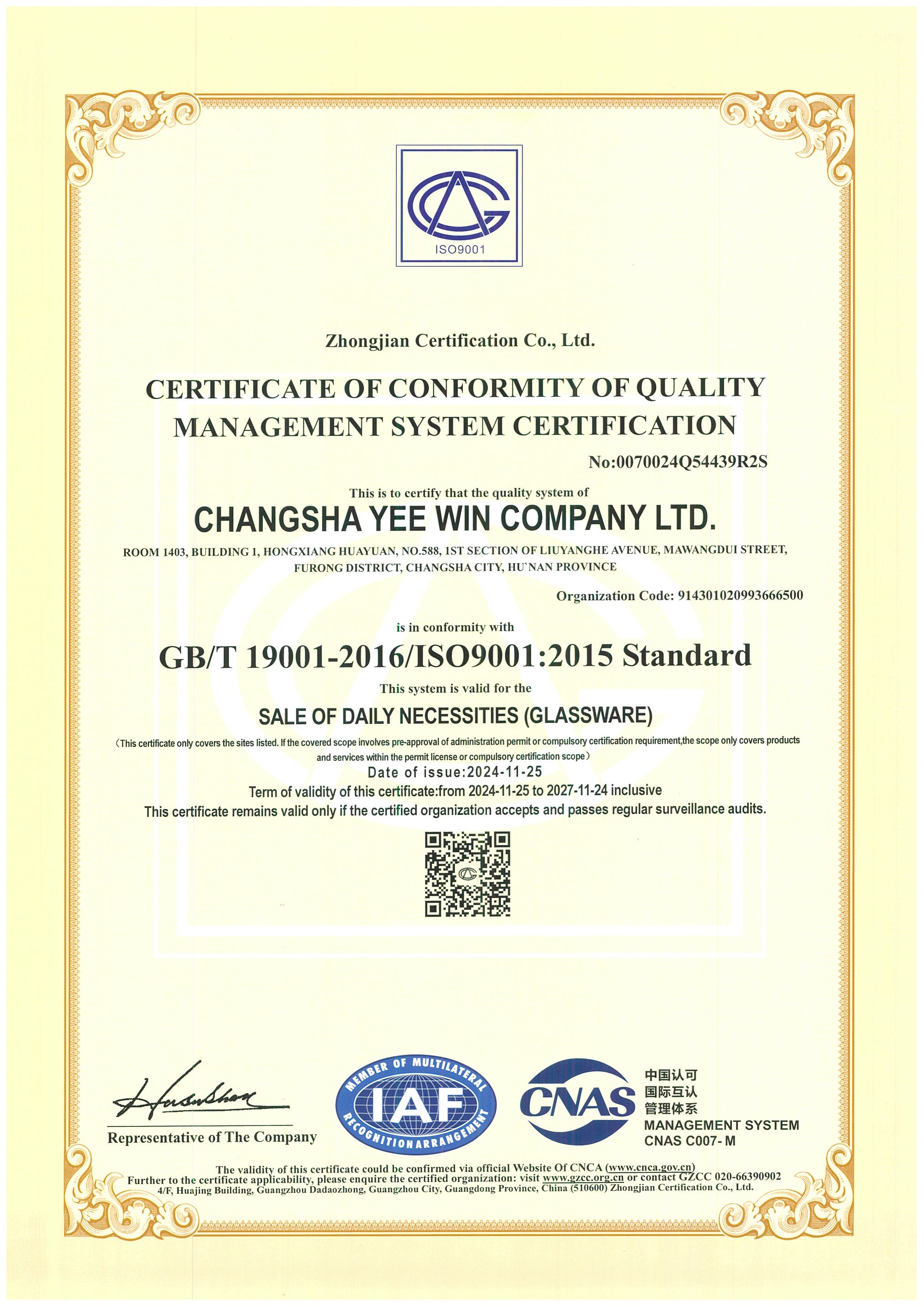
The ISO 9001:2015 record reviewed here runs, on its stated dates, to 24 November 2027; it covers quality management, not SKU-level product performance.
Product-specific mapping: tumblers, double wall glass, cake stands and KTG1139
The certification records list several product models among their related products. The glass tumbler KTK0370-2, double wall glass KTDW0721-GGL, glass cake stand KTPL1572A-A and wine glass KTG1139 appear in the related-product lists for the BSCI, ISO 9001:2015, ISO 14001 and RoHS records. That association is useful for initial document screening. It is not the same as a SKU-specific test report or a product-level declaration of conformity.
| Model or product | Product family | What the certificate association supports | What to verify before acceptance |
|---|---|---|---|
| KTK0370-2 | Glass tumbler | Listed among related products in the BSCI, ISO 9001, ISO 14001 and RoHS records | Current certificate scope; SKU-level declaration; RoHS applicability if the item has metal parts, coating or decoration |
| KTDW0721-GGL | Double wall glass | Listed among related products in the same certificate records | Product specification for wall construction and agreed performance checks; certificate scope; packaging and inspection plan |
| KTPL1572A-A | Glass cake stand | Listed among related products in the same certificate records | Food-contact surface and any decoration or coating; RoHS scope if decoration or metal parts are present; product-specific declaration where required |
| KTG1139 | Wine glass | Listed among related products in the same certificate records | Certificate scope for stemware; product-specific food-contact documents; agreed dimensions, capacity and inspection criteria |
For a plain glass tumbler, the commercial risk may sit more in dimensions, annealing, packing and food-contact documentation than in RoHS. For a decorated cake stand or a tumbler with a metal part or coating, RoHS scope becomes more directly relevant because the RoHS record covers glassware products with metal parts, coatings or decorations. The buyer should map the evidence to the actual bill of materials, not to the product family name alone.
This is also where OEM customization affects acceptance. If the buyer changes size, shape, material, glass color, package or logo, the certificate and test-report package should be checked against the changed specification. A certificate for the base product does not automatically cover a new decoration, a new coating or a new packaging format unless the scope and supporting documents say so.
Technical checks that certificate files do not replace
The available materials do not provide dimensions, capacity, wall thickness, glass composition, thermal-shock ratings or defect tolerances for KTK0370-2, KTDW0721-GGL, KTPL1572A-A or KTG1139. Those are product-specification matters. A buyer should not treat a BSCI, ISO 9001, ISO 14001 or RoHS record as evidence of capacity, durability, thermal performance or dimensional conformity.
Before mass production, the purchase specification should fix the model, dimensions, capacity, glass type, decoration, packaging, labeling, inspection method and acceptance tolerances. For double wall glass, the specification should state the agreed wall construction and any performance check the buyer requires. For stemware such as KTG1139, the specification should define the bowl, stem and base dimensions, capacity and inspection criteria. For cake stands, it should define the plate diameter, stand height, surface finish and any coating or decoration. None of these values are provided in the product data reviewed here; they must come from the approved product specification or sample sign-off.
A practical acceptance file therefore has four layers: the commercial terms, the product specification, the inspection plan and the compliance file. The commercial terms cover MOQ, payment and delivery. The product specification covers model, dimensions, materials and packaging. The inspection plan covers pre-shipment, third-party and arrival checks. The compliance file covers certificate scope, validity, SKU-level declarations and destination-market documents. The certificate layer supports the other three; it does not replace them.
Aligning payment release with acceptance evidence
The payment structure should match the evidence the buyer will receive before each tranche. Under a 10% / 90% before-shipment structure, the buyer can make the 90% tranche conditional on a completed pre-shipment inspection and a document package that includes current certificate copies, SKU-level declarations and the agreed test reports. Under a 30% / 70% structure, the same evidence can be tied to the 70% balance. Under 100% T/T in advance, the buyer carries more prepayment risk and should therefore fix the inspection rights, document list and remedy mechanism in the contract before paying.
For 90% against copy B/L, the document set becomes part of the payment trigger. The buyer should confirm whether the copy B/L is sufficient for its bank and risk process, what other documents accompany it, and when originals are released. The record does not define the timing of the remaining 10% under that structure, so that point should be stated explicitly rather than inferred.
This is not a legal template. It is a procurement control: every payment tranche should have a named trigger, a named document and a named acceptance event. That approach keeps the supplier's stated MOQ, lead time and certificate list from becoming disconnected promises.
FAQ: glass drinkware procurement terms and checks
What is the stated MOQ for LAKOTTO glass drinkware orders?
The procurement record states a MOQ of 3,000 pieces. The record does not specify whether that quantity applies per model, per color, per packaging version or per combined order. Buyers should confirm the MOQ basis in the quotation before planning a mixed-model or customized order.
Which T/T payment structures are listed?
The record lists four: 10% T/T with 90% before shipment; 90% against copy B/L; 100% T/T in advance; and 30% deposit in advance with 70% balance before shipment. These are options in the stated purchasing terms, not a statement that every structure applies to every order. The chosen structure should be written into the contract.
Which certificates should be checked before accepting glass drinkware?
The records reviewed here contain BSCI, ISO 9001:2015, ISO 14001 and RoHS. The buyer should check the certificate number, issuer, standard, scope, expiry date and product coverage for each. For EU food-contact use, the buyer should also request the product-specific food-contact documentation required by the destination market, because management-system and social-audit certificates do not by themselves establish food-contact conformity.
Do the certificates apply to the tumbler, double wall glass, cake stand and wine glass KTG1139?
The certification records list KTK0370-2, KTDW0721-GGL, KTPL1572A-A and KTG1139 among related products. That supports initial document screening. It does not prove that each SKU has its own test report or declaration. Buyers should request SKU-level evidence and confirm that the certificate scope matches the actual product, decoration and packaging.
What should a buyer do if BSCI or ISO 14001 expires during the order?
The BSCI and ISO 14001 records both show an expiry date of 1 December 2026. If shipment, retail acceptance or final payment falls after that date, the buyer should request evidence of renewal or an updated certificate before releasing the final payment. The purchase order can also make a current certificate a condition of acceptance.
Are dimensions and thermal-shock ratings included in the certificate records?
No. The certificate records do not provide dimensions, capacity, wall thickness, glass composition, thermal-shock ratings or defect tolerances. Those requirements belong in the product specification and inspection plan. A certificate should be read as compliance evidence, not as a substitute for the technical datasheet or approved sample.
What this means for execution-stage buyers
The commercial answer is straightforward: 3,000 pieces is the stated MOQ; four T/T structures are listed; and the certificate file contains BSCI, ISO 9001:2015, ISO 14001 and RoHS records. The procurement answer is more precise: each element must be tied to a document, a date, a product scope and an acceptance event. The BSCI and ISO 14001 expiry dates require attention for late-2026 orders. The RoHS record should be matched to the actual bill of materials. The product models should be checked at SKU level, not only by family name.
For a buyer moving from evaluation to execution, the most useful next step is to attach the chosen payment structure, delivery term, inspection right, certificate list and product specification to the purchase order. That annex is what converts a supplier's stated capability into an enforceable acceptance file.
Есть вопросы или нужны дополнительные детали?
Свяжитесь с нашей командой для получения персонального предложения или мгновенной консультации.
Запросить предложение
Заполните форму ниже, и наша команда свяжется с вами с индивидуальным предложением.
Прямой чат WhatsApp
Предпочитаете общаться в реальном времени? Напишите нам в WhatsApp для мгновенной помощи и быстрых ответов.
- Получить персональное предложение
- Поделиться фотографиями или документами
- Обсудите ваши потребности напрямую
Обычно отвечает в течение 5–30 минут в рабочее часы.