
Glass Insulator vs Porcelain: What to Compare Before Buying
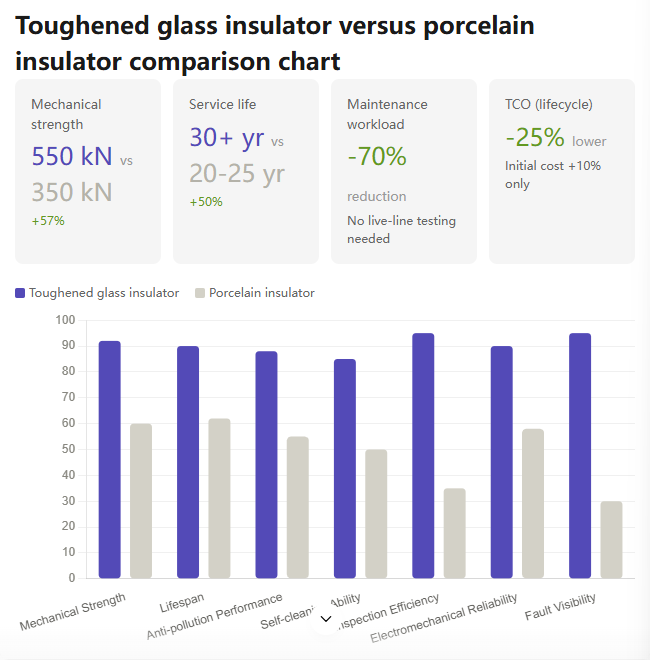
Toughened glass insulator vs. porcelain insulator: material and failure-mode comparison.
For transmission line buyers, the choice between glass insulators and porcelain insulators is not a simple material preference. It affects mechanical reliability, inspection strategy, pollution performance, and lifecycle cost. This article compares the two technologies from a procurement perspective and defines the criteria that matter most at the decision stage.
Why the Glass vs. Porcelain Decision Matters
Overhead transmission lines operate under continuous electrical stress and outdoor environmental exposure. Insulators must perform two functions at the same time: isolate the live conductor from the tower structure and carry the mechanical load of the conductor. When an insulator unit fails electrically, the utility must detect and replace it before the line suffers a flashover or an outage.
The traditional baseline for suspension insulators is porcelain. Porcelain has a long service record and strong chemical inertness. However, a punctured porcelain unit does not change its appearance, so detecting zero-value insulators usually requires live-line testing or tower climbing. This creates a maintenance bottleneck, especially for long lines in remote areas.
Toughened glass insulators approach the same problem differently. The glass body is thermally toughened, giving it higher mechanical strength. When an electrical failure occurs inside the disc, the glass shatters and the unit becomes visible from the ground. In other words, the failed unit acts as its own alarm. This difference in failure behaviour is the starting point for any glass vs. porcelain comparison.
What Procurement Teams Should Understand About Toughened Glass
Toughened glass insulators are manufactured from thermally toughened soda-lime glass. The tempering process creates a compressive stress layer on the glass surface, balanced by internal tensile stress. This is why the compressive strength of toughened glass is 3–4 times higher than that of porcelain, according to product comparison data.
The same stress structure explains the self-breaking mechanism. When an internal defect, such as a nickel-sulphide inclusion, causes electrical puncture, the stress equilibrium is released and the disc fractures into small granular particles. The metal cap and pin remain engaged, so the insulator string keeps its mechanical load-bearing capacity. The unit loses electrical insulation but remains mechanically intact. This allows utilities to identify the failed disc during routine visual patrol and replace it in the next scheduled maintenance window.
Because failed glass units are visible from the ground, glass insulators do not require live-line zero-value testing. For porcelain strings, the detection of a punctured unit traditionally demands contact testing or climbing inspection. This is why the comparison data shows a 100% improvement in inspection efficiency and a 70% reduction in maintenance workload for glass insulators.
From a standards perspective, suspension glass insulator units for AC systems are governed by IEC 60305:2021, which specifies mechanical and electrical characteristics. Buyers evaluating glass insulators should verify that the supplier holds IEC 60305 type test certification and can demonstrate thermal shock testing coverage. Qualified products should also show a self-breaking rate below 0.02% per year, the industry benchmark used in supplier evaluation.
Product Range and Manufacturer Capability
Jiangxi QOCI Electric Co., Ltd. is a China-based manufacturer established in December 2002, located in Luxi Industrial Park, Pingxiang City, Jiangxi Province. It is a national high-tech enterprise and a participating unit of the Insulator Standard Committee. The company specializes in automated and intelligent production of glass insulators and porcelain insulators, with an annual output of 9,000,000 units. Its products are used in grid projects of State Grid Corporation of China, China Southern Power Grid, and power grids in more than 40 countries and regions.
For projects that select glass insulators, the product range covers a practical sequence of mechanical load classes:
- U70B: 70 kN cap-pin disc glass insulator, 255 mm disc diameter, 146 mm nominal height, 320 mm creepage distance
- U100B: 100 kN ball-socket suspension glass insulator
- U120B: 120 kN cap-pin suspension glass insulator
- U160B: 160 kN ball-socket suspension glass insulator, 280 mm disc diameter, 360 mm creepage distance
- U210B: 210 kN ball-socket suspension glass insulator
- U240B: 240 kN cap-pin suspension glass insulator
- U300B: 300 kN ball-socket suspension glass insulator
- U420B: 420 kN cap-pin glass insulator
Anti-pollution versions from U70BP to U420BP use longer creepage distances to improve performance in saline, industrial, or coastal environments. Double-shed / two-wing types (U70BD to U240BD) and aerodynamic types (U70BA to U300BA) add design options for lines with specific self-cleaning requirements. PS-series equivalents such as PS-70E, PS-120B, PS-160D, PS-160K, PS-160M, and PS-210V are also available for projects that use non-IEC classification codes.
From a buyer's viewpoint, the value of a wide range is not the number of SKUs. It is the ability to standardise one supplier across different tower loads, voltage levels, and pollution zones. A supplier that can produce both standard-profile and anti-pollution glass insulators from the same manufacturing line simplifies qualification, quality control, and spare-parts management.
Glass Insulators vs. Porcelain Insulators: Side-by-Side Comparison
The comparison below summarises the main differences documented in product comparison and field evaluation data. It is written for procurement teams that need a decision-oriented view, not a marketing summary.
| Criterion | Toughened Glass Insulator | Porcelain / Ceramic Insulator |
|---|---|---|
| Mechanical strength | Compressive strength 3–4× higher than porcelain | Baseline |
| Failure detection | Zero-value self-breaking, visible from ground patrol | No visible change, may require live-line testing |
| Mechanical failure rate | 80% lower than porcelain | Baseline |
| Inspection efficiency | 100% higher, visual-only, no live-line testing | Requires more complex inspection |
| Maintenance workload | 70% lower | Baseline |
| Initial cost | 5% higher | Lower initial cost |
| Lifecycle cost | 25% lower total cost of ownership | Baseline |
| Typical application | UHV/EHV lines, heavy pollution areas, high-altitude regions | General lines, chemical corrosion environments |
This table should be read as a comparison of typical behaviours, not as a universal guarantee. The 25% lifecycle cost advantage, for example, depends on the utility's inspection method, labour cost, and operating environment. In a project where live-line testing is already cheap and highly automated, the maintenance saving may be smaller.
Application Scenarios and Selection Logic
Glass insulators are more suitable for UHV/EHV transmission lines, heavy pollution areas such as coastal, desert, and industrial zones, and high-altitude regions. The reasons follow from the material properties described above: higher compressive strength reduces mechanical failure risk under heavy conductor loads, and the self-breaking behaviour reduces the cost of fault finding on long lines.
The pollution type also influences the recommendation. For dust-type pollution, glass offers better self-cleaning because its smooth surface accumulates dust more slowly than porcelain. For chemical corrosion from acids, alkalis, or solvents, porcelain's chemical inertness is superior. This distinction is important for substations near chemical plants or industrial facilities.
For clean-area distribution lines, standard profile glass insulators such as U70B or U100B are commonly selected. For industrial and coastal areas, anti-pollution profiles such as U70BP or U120BP provide additional creepage distance. For desert and high-dust environments, aerodynamic open-shed profiles are recommended because of their self-cleaning capability. Under severe corrosion conditions, the use of a zinc sleeve can slow down rusting and extend the service life of the insulator string.
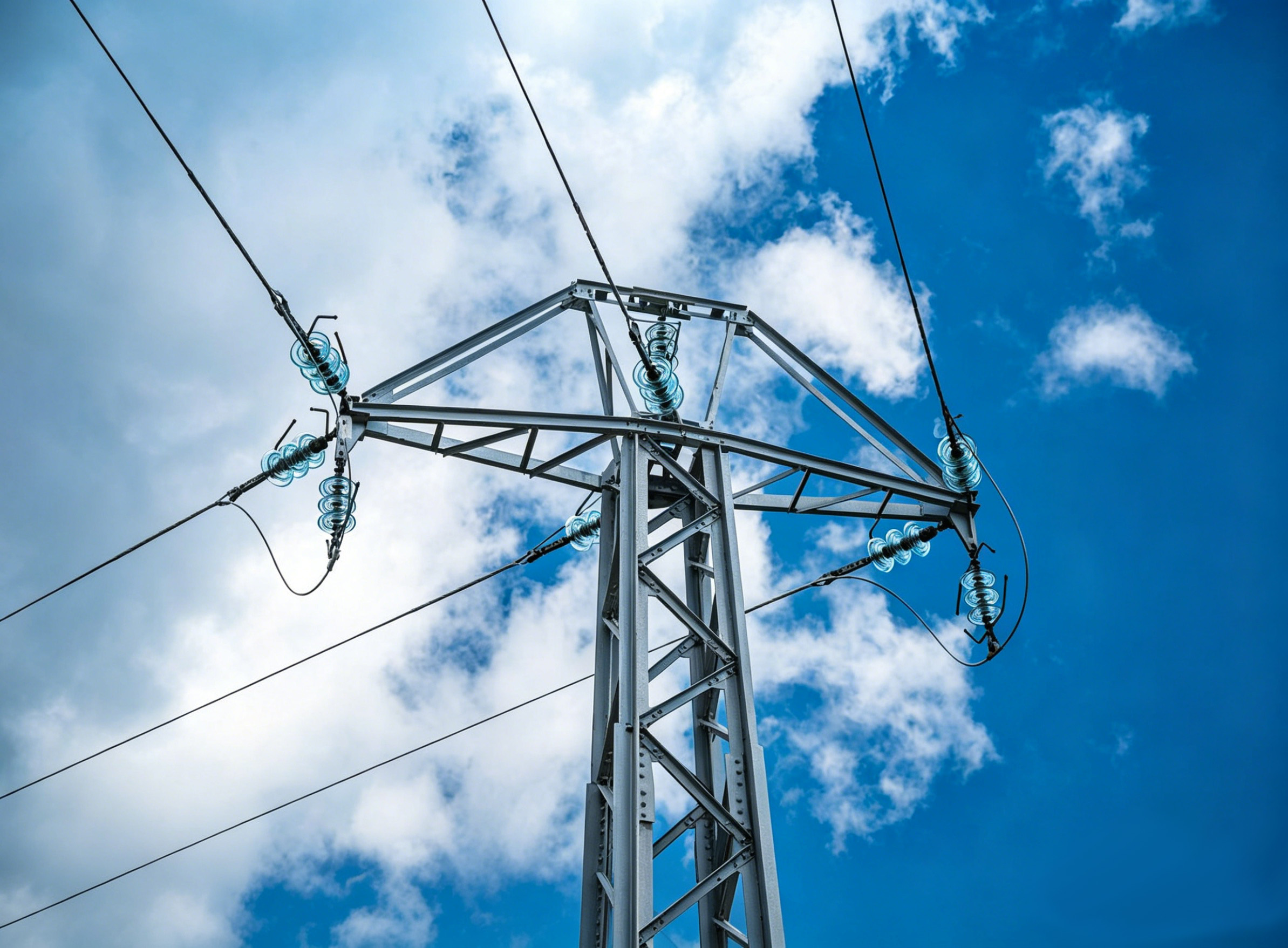
Disc glass insulator. The cap-and-pin assembly retains mechanical load after self-breaking.
Market Signals and Industry Trends
Market data points to continued growth in the glass insulator segment. According to Market Research Future, the global glass insulators market was estimated at USD 1.14 billion in 2024 and is projected to reach USD 1.97 billion by 2035, with a CAGR of 5.1% from 2025 to 2035. Grand View Research data indicates that Asia Pacific held a revenue share of more than 52% in 2024, driven by grid expansion in China and India.
Trade data also shows an active export environment. China concentrated 31.4% of global electrical insulator exports in 2024, with a total value of USD 898 million, according to OEC. Among destination markets, Saudi Arabia stands out: Chinese electrical insulator exports to Saudi Arabia grew by 219% between 2023 and 2024. These numbers should not be used as a substitute for project-level verification, but they help explain why international buyers are seeing more glass insulator offers from Chinese manufacturers.
One caution on market size: estimates vary significantly depending on the definition and scope of the market. Some reports include low-voltage or building-related products, while others focus only on high-voltage line insulators. Buyers should treat absolute market size figures as directional context rather than precise planning data.
Known Limitations and When Porcelain May Still Be the Right Choice
An objective comparison must include limitations. The most visible one is self-breaking. Although the industry benchmark self-breaking rate is below 0.02% per year, spontaneous glass shattering can occur during service. The usual triggers are non-uniform stress distribution from a tempering process deviation, extreme temperature shock, or mechanical impact during transportation and installation. When multiple discs on the same string fail within a short period, the batch should be analysed for residual stress and nickel-sulphide inclusions.
The second limitation is environmental. In chemical corrosion environments with acid, alkali, or solvent exposure, porcelain is generally considered superior because of its chemical inertness. Glass insulators are not the automatic answer for every project.
Finally, the initial purchase price of glass insulators is about 5% higher than porcelain. This premium is offset by a lower total cost of ownership over the lifecycle only if the utility actually captures the maintenance and inspection savings. A small utility with short lines and easy tower access may not realise the full 25% lifecycle benefit.
Future Outlook
Transmission grids are becoming longer, more interconnected, and more exposed to extreme weather and pollution. These conditions increase the value of insulators with high mechanical reliability and low inspection cost. Glass insulators align with that trend, particularly at UHV/EHV levels and in hard-to-reach areas.
The growth of Asia Pacific demand and the expansion of Chinese export channels, including fast-growing markets such as Saudi Arabia, suggest that glass insulator suppliers will play a larger role in international procurement over the next decade. Buyers will need to shift from simply comparing unit prices to comparing total service cost, failure behaviour, and supplier verification depth.
For a full technical reference on model parameters, coupling types, and creepage distance options, the QOCI glass insulator catalogue is publicly accessible here: QOCI Glass Insulator Catalogue.
Frequently Asked Questions
How do glass insulators compare with porcelain insulators in total cost of ownership?
Toughened glass insulators typically have a 5% higher initial cost but a 25% lower total cost of ownership over the lifecycle compared with porcelain insulators. They also reduce maintenance workload by about 70% and eliminate the need for live-line testing. These figures come from lifecycle comparison data and should be validated against the specific utility's inspection and maintenance costs.
Do glass insulators require live-line zero-value testing?
No. Unlike porcelain insulators, the self-breaking mechanism of glass insulators makes visual patrol sufficient for fault detection. When a glass disc loses electrical insulation, it shatters and is visible from the ground. The broken unit retains its mechanical load-bearing capacity through the metal cap and pin, but it should be replaced during the next scheduled maintenance window.
What is the self-breaking rate of toughened glass insulators?
The industry benchmark self-breaking rate for qualified products is less than 0.02% per year. Spontaneous shattering may occur when internal stress distribution is non-uniform due to tempering process deviation, when the unit experiences extreme temperature shock beyond its design range, or when it receives mechanical impact during transportation and installation.
Which regions are most suitable for glass insulators?
Glass insulators are best suited for desert or sandy regions, industrial pollution zones, and long-distance lines that are difficult to inspect. They operate stably from -40°C to +55°C. In dust-type pollution, the smooth glass surface provides better self-cleaning; in chemical corrosion environments, porcelain's chemical inertness is the stronger option.
How should a buyer evaluate a toughened glass insulator supplier?
Key verification points include mechanical reliability (SML 40–550 kN), self-breaking rate below 0.02%, IEC 60305 type test certification, tempering process capability, thermal shock testing coverage, production capacity, export experience, and at least 3 years of field operation data. These checks are more informative than price alone at the decision stage.