
Glass Spacer Connector: Four Types Ranked by Application Fit
Insulating glass performance is decided at the edge, not in the middle of the pane. The spacer bar holds the glass panes at a fixed distance from each other and establishes the size of the interpane space — the cavity that carries the insulating air or gas. What keeps that bar run continuous around a finished unit is a component that rarely appears in a specification review until something goes wrong: the glass spacer connector.
A glass spacer connector is the small joinery element that links spacer bar sections and closes the bar run at corners and cut ends. In catalogue terms it covers corner connectors, steel straight connectors, decorative grid (Georgian bar) connectors and end caps. On the Soleron corner connector family, the recorded size range is 5.5–50 mm, which is the same width band as the aluminium spacer bars it joins. The part weighs almost nothing, occupies a few millimetres at the corner of a unit, and carries the continuity of the desiccant channel and the edge seal through the hardest geometry in the assembly.
Soleron Insulating Glass Materials is the insulating glass materials line of Soleron Building Materials (Hebei) Co., Ltd., a manufacturer based in Renqiu, Hebei Province, China. The company supplies aluminium spacer bars, warm edge spacers, sealants, molecular sieve desiccants, Georgian bars, corner connectors and related insulating glass accessories, and lists the EU, the Middle East and Southeast Asia among its export markets. It is one of a small number of suppliers in the Hebei cluster that offers the connector, the bar, the desiccant and the sealant as one procurement package rather than four separate purchase orders.
Why the Glass Spacer Connector Enters the Shortlist
At the awareness stage, buyers ask what a spacer bar does. At the evaluation stage, the question changes to something narrower and more expensive to get wrong: whether the parts that hold the bar run together will still hold it after the unit is sealed, gas-filled, glazed and exposed to ten years of thermal cycling.
The functional description of a spacer bar is straightforward. It maintains the distance between glass panes, creates the insulating cavity, provides a channel for the desiccant, and helps form the edge seal. Every one of those four functions has to survive the corner. A corner is where the bar is cut, bent or joined, where the desiccant channel can be interrupted, and where the sealant has the least room to work. If the connector does not close that geometry cleanly, the failure does not appear as a broken connector — it appears as moisture ingress, condensation or a failed unit, and it appears years later.
That is why connector specification tends to move up the evaluation agenda in three situations: when a processor is qualifying a new bar system and needs a matching connector set, when a distributor is building a stocked range that must cover several cavity widths, and when a buyer is auditing an existing supply chain and discovers that the connector was never formally specified at all.
What the Connector Must Match: Size, Material and Channel Geometry
The first filter in any connector evaluation is dimensional continuity. A connector that is 1 mm off the bar width will not deliver a clean corner, regardless of how good the material is. The second filter is system type, because an aluminium bar system and a warm edge system do not share the same corner logic.
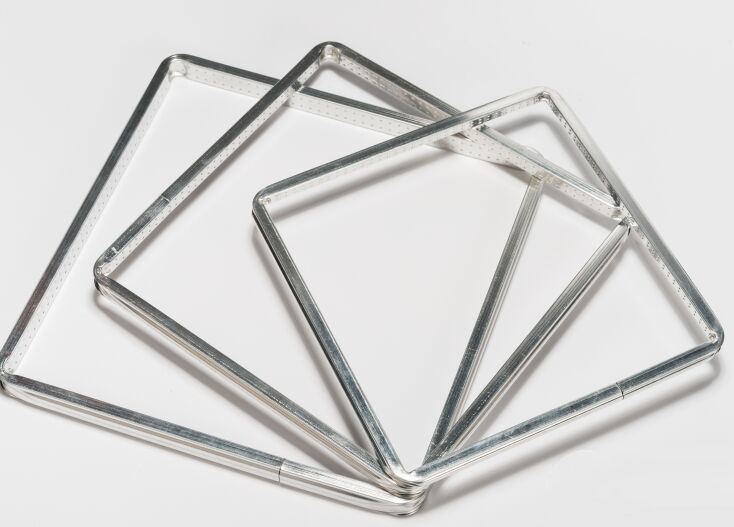
Recorded component data for the Soleron range shows how tightly the connector band follows the bar band:
| Component | Recorded size range | Material field | Role in the edge assembly |
|---|---|---|---|
| Corner Connector | 5.5–50 mm | Recyclable plastics (listed types include plastic corner connector, steel straight connector, Georgian bar connector, end caps) | Joins bar sections at corners and straight runs; closes cut ends |
| Aluminium spacer bar | 5.5–50 mm; thickness 0.16–0.35 mm | Aluminium coil 3003 & 1100 series | Sets cavity width; carries desiccant channel; forms edge seal base |
| Warm Edge Spacer Bar | 6–27A | Fiberglass, stainless steel, PP | Reduces thermal transfer at the edge; narrower width band |
| Georgian Bar | 5*8, 6*8, 7*7, 6*15, 8*18, 8*26 etc. | Aluminium, recyclable plastics, ABS | Decorative grid; needs its own connector set |
The table carries two practical consequences for evaluation. First, a 5.5–50 mm connector range is dimensionally aligned with the aluminium bar range, so one connector family can serve a stocked distributor range spanning narrow triple-glazing cavities through to wide double-glazing cavities. Second, warm edge spacers occupy a 6–27A band, which is narrower and differently constructed. A rigid connector set built for aluminium bars does not automatically transfer to a flexible warm edge spacer, and buyers who are migrating part of their range to warm edge should qualify the corner solution as a separate item, not as an accessory line on the bar purchase order.
Recorded connector variants are supplied in black, white and customized colours, packed by bag or box, sold by the piece, and quoted with a five-year quality guarantee. Those are commercial parameters rather than performance parameters, but they matter at the evaluation stage because colour matching to the bar and packaging format both affect how the connector is handled on a fabrication line.
Four Connector Types, Ranked by the Job They Do
The connector family is not one product. It is four products that solve four different geometry problems, and they are ranked below by the structural role each performs in the edge assembly. The ordering is an evaluation framework for specification purposes, not a measured performance league table, and the correct priority order changes with the unit design.
1. Plastic corner connector — the default starting point
The corner connector is the part most buyers picture when they hear "glass spacer connector." It joins two bar sections at the 90° corner of a unit, holds the mitre or bend in position while the sealant cures, and closes the corner of the desiccant channel. Because the recorded material field for this family is recyclable plastics, the corner does not introduce a conductive path into a region where thermal transfer is already concentrated. Recyclable plastics also keep tooling cost and piece price low, which is why the corner connector is normally first onto a shortlist and the last item a buyer wants to pay a premium for.
What to verify: corner fit against the actual bar profile, colour match to the bar, and whether the corner holds position through the sealant application and gas-filling sequence without being dislodged.
2. Steel straight connector — mechanical continuity on straight runs
Where a bar run is spliced rather than bent — long spans, or units assembled from cut bar stock — the straight connector carries the mechanical continuity of the run. It is the type that appears in the catalogue alongside the plastic corner connector because the two solve the same problem from different directions: the corner connector controls geometry at a change of direction, the straight connector controls it along a continuous line.
What to verify: the insert length and fit tolerance relative to the bar's 0.16–0.35 mm wall thickness. A straight connector that is loose in the channel will not maintain alignment through handling. A buyer should also consider the thermal consequence: a metal splice in the edge zone is a conductive element by definition, which is a design decision to make consciously rather than by default.
3. Georgian bar connector — the decorative grid case
Decorative glazing grids are a separate geometry. Georgian bars are recorded in sizes from 5*8 through 8*26 and beyond, in aluminium, recyclable plastics and ABS, with a 0.5 mm and 0.7 mm thickness option and a five-year guarantee. The connector that joins a decorative grid has to match the grid profile, not the cavity spacer profile, and it has to hold the grid true across the visible face of the unit.
What to verify: profile match to the specified Georgian bar size, and whether the connector is supplied as part of a matched grid set. This is the connector type most often ordered from a second supplier by mistake, because it sits under a different purchase category than the spacer bar.
4. End caps — termination and finish
End caps close the bar run where it terminates. They rank last in structural importance and first in the list of items buyers forget to specify, which is exactly why they create last-minute purchasing problems. An incomplete connector order becomes a stopped fabrication line.
What to verify: colour availability, whether the cap is supplied in the same packaging unit as the connectors, and whether the supplier treats caps as a stocked item or a made-to-order part.
A practical shortlist rule: for a mixed production schedule, the connector order should be sized by cavity width coverage, not by unit volume. A supplier who can supply the full 5.5–50 mm connector band from stock removes a stocking decision from the buyer and replaces it with a single line item.
What a Supplier Document Actually Proves — and What It Does Not
Evaluation-stage buyers ask for certificates, and in this product category the most commonly supplied document is the one most likely to be misread.
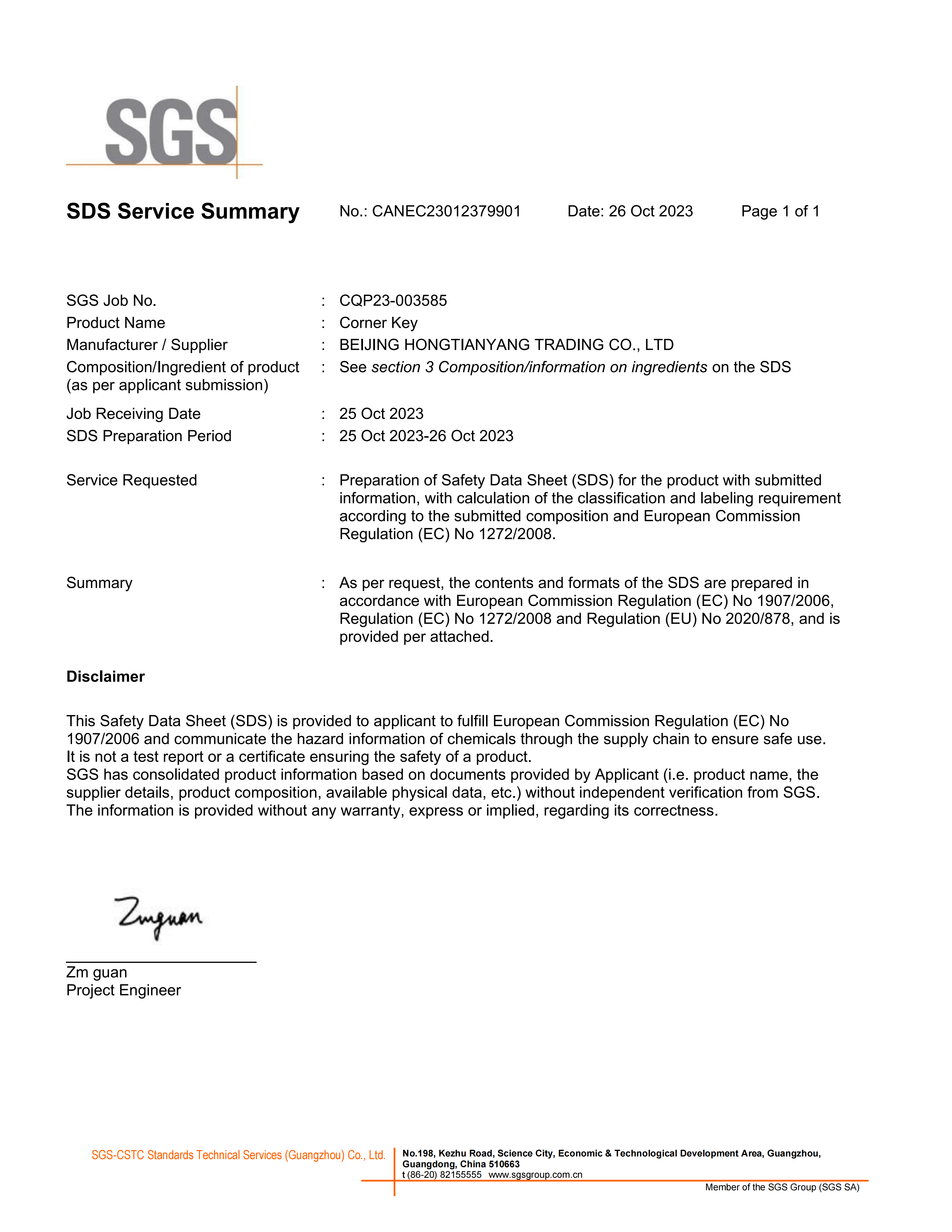
For the corner key and corner connector scope, Soleron holds a Safety Data Sheet issued by SGS-CSTC Standards Technical Services (Guangzhou) Co., Ltd., certificate number CANEC23012379901, dated 26 October 2023. The document references Regulation (EC) No 1907/2006, Regulation (EC) No 1272/2008 and Regulation (EU) No 2020/878, and is applicable to markets including the EU, the US, the Middle East, Africa and Southeast Asia.
An SDS under those regulations is a hazard-communication document. It describes chemical composition, handling, storage and transport considerations. It is not a thermal performance certificate, not a mechanical test report, and not evidence that the connector will perform in a sealed unit. A buyer who accepts an SDS as proof of performance has verified the wrong thing.
Performance evidence sits at the unit level, and it is where the buyer's document request should be directed. EN 1279-2 defines the moisture penetration test and its pass thresholds. The same standard recognises four methods for determining desiccant moisture content: 540 °C drying, Karl Fischer titration, gravimetric methods, and dew-point methods for units without desiccant. AS/NZS 4666:2012 covers a wider documentation regime, including long-term type testing, glazing, periodic manufacturing testing, traceability, desiccant suitability, shelf life and desiccant exposure limits.
There is also a sealant-system constraint that determines whether a connector choice is even viable in a given application. For structural silicone glazing, ASTM C1249-18 describes only IG units with a dual-seal system — polyisobutylene as the primary seal and silicone as the secondary seal — as having the required durability for the application. The same two-layer structure is described in manufacturer technical literature. The connector sits inside that system: it must be compatible with the sealants it contacts, and it must not interrupt the seal path at the corner where the seal is thinnest.
Where Connector Choice Changes the Outcome
Connector selection does not matter equally everywhere. It becomes a decision point in four situations.
- Sealed unit fabrication. The corner is where the desiccant channel, the primary seal and the secondary seal meet. Connector fit at that point affects whether the corner is closed cleanly before sealant is applied.
- Bent versus cut bar assembly. Processors using a spacer bar bending machine need a connector set that behaves predictably after bending. Those cutting bar stock need straight connectors and end caps in matching profiles.
- Mixed cavity-width production. A processor running both narrow and wide cavity units needs connector coverage across the whole band, not a single popular size.
- Decorative and Georgian grid systems. Grid connectors follow the grid profile, not the cavity spacer profile, and should be specified at the same time as the grid.
Recorded application conditions for this material group name the production equipment the connector has to work with: spacer bar bending machines, molecular sieve filling machines, butyl extruders and insulating glass production lines. Recorded scenario requirements include high dimensional accuracy, good bending performance, clean and smooth surface, sealant compatibility, moisture resistance, low thermal conductivity and durability, with customized sizes and packaging available. Those requirements describe the operating environment of a connector more accurately than any single specification line.
Market Trend: Warm Edge Growth Pulls the Corner into Scope
Three published data points frame where this component category is heading. The global insulated glass market was valued at approximately USD 92.7 billion in 2024 and is projected at USD 101.3 billion in 2026 and USD 121.7 billion by 2030, according to Grand View Research. The warm edge spacer market was valued at USD 1.1 billion in 2024 and is projected to reach around USD 1.9 billion by 2035, according to Meticulous Research. The 3A grade molecular sieve desiccant segment was valued at USD 1.80 billion in 2024, according to Mordor Intelligence.
The strategic reading for a connector buyer is not the headline growth rate. It is the mix shift. A growing IGU market creates volume demand for upstream components including spacer bars, sealants and desiccants, and warm edge spacers are growing into a meaningful share of that spacer demand. Warm edge systems use narrower, differently constructed spacer profiles — the recorded range for this product family is 6–27A against 5.5–50 mm for aluminium bars. The connector requirement therefore diverges as the market moves.
A distributor or processor who currently holds a single aluminium connector set will, over the next several years, need a second set matched to warm edge geometry. That is a purchasing decision that is cheaper to plan now than to resolve during a production changeover.
Limits and Trade-offs Versus Traditional Aluminium Systems
Warm edge technology is not a free upgrade, and the connector is not a fix for a weak unit. Four limits are worth stating plainly.
Thermal bridging is a system property. A comparison grouping in the published data for this category places aluminium spacer thermal conductivity at 160–200 W/mK against 0.13–0.25 W/mK for warm edge spacers, with a reported reduction in thermal bridging of up to 90%. That advantage belongs to the spacer system as a whole. A plastic corner connector reduces the conductive path at one point but does not convert an aluminium bar system into a warm edge system.
Warm edge geometry is not interchangeable. Composite, flexible and stainless steel warm edge spacers have different corner constructions. A rigid connector set designed for a 5.5–50 mm aluminium profile should not be assumed to fit a flexible warm edge spacer, and buyers migrating between systems should treat the corner as a re-qualification item.
Documentation requirements carry cost. AS/NZS 4666:2012 covers long-term type testing, periodic manufacturing testing and traceability. Maintaining that record set is an ongoing operational burden for a supplier, and it is a legitimate differentiator when comparing suppliers who appear otherwise similar on price.
Pricing in this category is fragmented. The data collection behind this analysis notes that market pricing for secondary components such as spacers and desiccants is highly fragmented, and that component performance directly affects IGU longevity and warranty risk. Buyers should expect quote spreads that reflect specification differences rather than only commercial terms, and should compare like-for-like profiles, widths and documentation rather than unit price alone.
One further boundary applies to the connector itself: it has no independent performance standard of its own in the sources reviewed here. Its performance is expressed through the unit. Any supplier framing a connector as a certified performance upgrade is describing something the standards framework does not support.
How Soleron Fits a Connector Shortlist
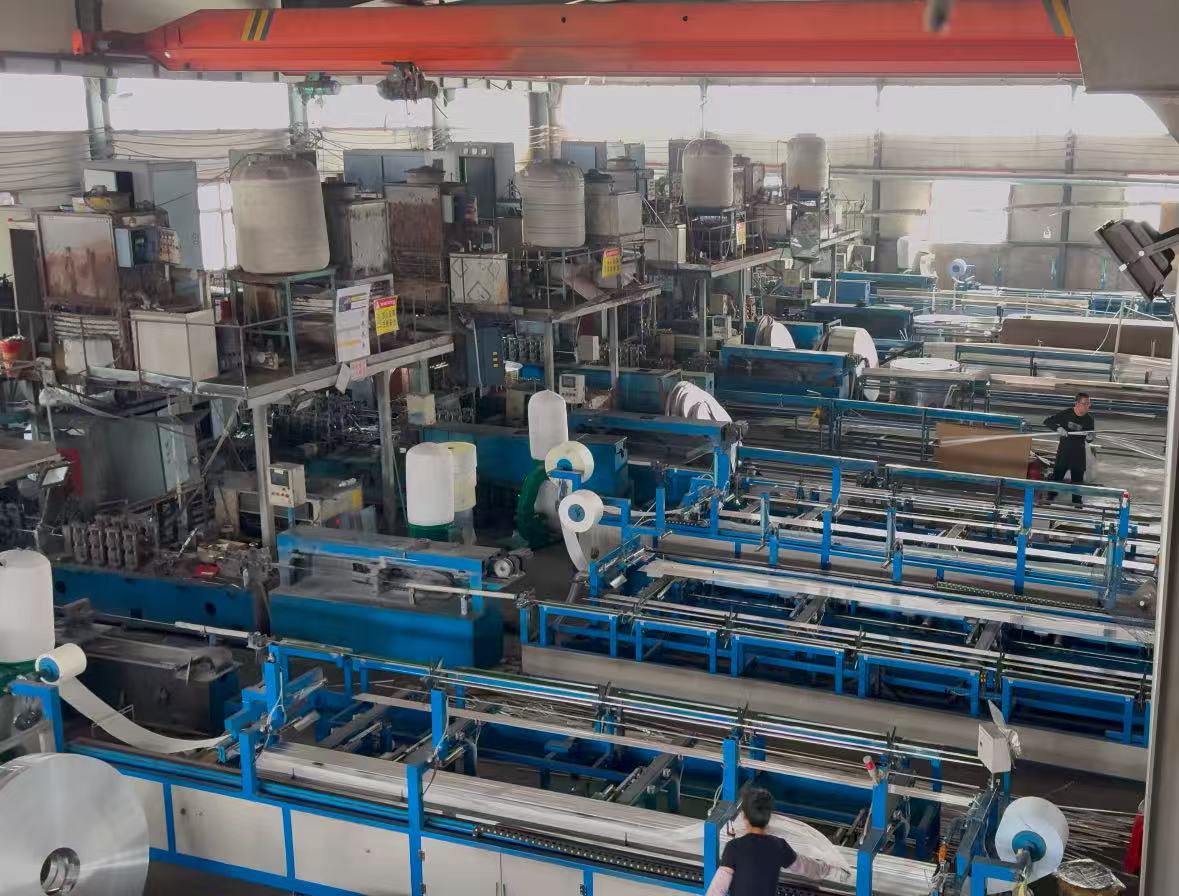
Soleron Building Materials (Hebei) Co., Ltd. manufactures insulating glass components in Renqiu, Hebei Province, China, and supplies aluminium spacer bars, warm edge spacers, sealants, molecular sieve desiccants, Georgian bars and corner connectors. Company-reported production infrastructure includes 10 automatic aluminium spacer bar production lines and 10 warm edge spacer production lines, supported by warehousing and stock of regular bar profiles.
For connector procurement specifically, the relevant points are these:
| Evaluation criterion | Recorded position | Why it matters to a buyer |
|---|---|---|
| Size coverage | Corner connector 5.5–50 mm | Matches the aluminium bar width band; supports a multi-cavity stocked range |
| Product types | Plastic corner connector, steel straight connector, Georgian bar connector, end caps | One supplier for corner, splice, grid and termination items |
| Customization | OEM/ODM with logo, size and packaging customization; colour black, white and customized | Supports private-label and distributor packaging programmes |
| Commercial terms | MOQ 5 cartons; lead time 20–45 days | Sets realistic replenishment planning for stocked ranges |
| Quality control | Random inspection | Sampling-based verification; buyers should define their own acceptance sampling |
| Guarantee | 5 years on the connector family; 10 years on sealant products | Provides a documented warranty baseline for negotiation |
| Documentation | SDS for corner key / corner connector, cert. CANEC23012379901, SGS-CSTC, 2023-10-26 | Covers EU regulatory handling documentation; unit-level testing remains a separate request |
| Export markets | EU, Middle East, Southeast Asia | Indicates existing logistics and documentation practice in these regions |
Supply evidence recorded for the wider insulating glass materials range covers 500 tons of spacer bars supplied across a documented case spanning 33 countries in the Middle East, Asia, Europe, Africa and the Americas, with users including insulating glass manufacturers, window and door manufacturers, and glass accessories distributors. Recorded outcomes from that application include improved thermal insulation, reduced condensation, enhanced air and moisture tightness, improved sound insulation, and increased overall energy efficiency and service life of the units.
Those figures are supplier-reported and should be verified against a buyer's own qualification process. The relevant point for a connector shortlist is that the same supplier covers the bar, the connector, the desiccant and the sealant, which removes a compatibility hand-off between vendors — and compatibility at the corner is exactly where multi-vendor purchasing creates risk.
Future Outlook
The direction of this component category follows the direction of the unit. As IGU volume grows and warm edge systems take a larger share of spacer demand, the connector set becomes a two-part purchase rather than a single line item: one set dimensioned for aluminium cavity widths, one for warm edge geometries. Processors running mixed schedules will need both in stock.
Two further shifts are likely. Documentation expectations will tighten, because traceability and periodic manufacturing testing are already embedded in established standards regimes and tend to migrate into buyer requirements regardless of destination market. And connector supply will increasingly be judged as part of a full edge-system package, because the alternative — buying the bar from one supplier, the desiccant from a second and the connector from a third — makes the corner the least controlled point in the assembly.
For evaluation teams, the practical conclusion is narrow and testable. Specify the connector by type, by width band, by colour and by documentation set. Confirm which standard governs the finished unit in the destination market. Then confirm that the supplier can hold that specification across replenishment, not only on the first order.
FAQ
What is the function of a spacer bar in an insulating glass unit?
A spacer bar keeps the fixed distance between glass panes and forms the insulating cavity. It holds the desiccant and helps build the edge sealing structure of the insulated glass unit. This is why the connector that joins bar sections has to preserve both the cavity dimension and the continuity of the desiccant channel at the corner.
What are insulating glass accessories?
Insulating glass accessories are the auxiliary materials used in IGU production, including spacer bars, warm edge spacers, molecular sieve desiccants, PIB sealants, silicone sealants, polysulfide sealants, corner keys and other related components. Glass spacer connectors and end caps sit inside this accessory group, alongside the bars they join.
What are the advantages of aluminium spacer bars?
Aluminium spacer bars offer good mechanical strength, easy processing, dimensional stability and good compatibility with conventional insulating glass production lines. Those properties explain why the 5.5–50 mm aluminium band remains the reference geometry for standard corner connector and straight connector ranges.
What is an insulating glass unit (IGU)?
An IGU consists of two or more glass panes separated by a spacer and sealed around the edges to form an insulating air or gas-filled cavity. The spacer, the connector, the desiccant and the primary and secondary sealants together maintain that cavity over the service life of the unit.
Does a Safety Data Sheet prove connector performance?
No. A Safety Data Sheet is a hazard-communication document covering chemical composition, handling and storage. Unit-level moisture performance is assessed under standards such as EN 1279-2, which sets a moisture penetration index of Iav ≤ 0.20 on the average of five aged specimens with an individual limit of I ≤ 0.25. Buyers should request both document types and treat them as answering different questions.
The full Soleron insulating glass materials range, including spacer bars, warm edge spacers, sealants, desiccants, Georgian bars and connectors, is documented in the downloadable product catalogue: Soleron product catalogue (PDF).