
Global Certifications Decoded: ISO, BSCI, and RoHS Compliance in Glassware Importing
Glassware orders rarely fail on price. They stall in the compliance folder, where a retailer's onboarding team asks a simple but difficult question: which certificate covers which product model, who issued it, and is it still valid on the day the container ships?
That question has become harder to answer as sourcing programmes scale. A modern glassware portfolio can contain machine-pressed tumblers, hand-blown double wall glass, recycled glass jars and stemmed wine glasses, each with a different material profile and a different regulatory exposure. Certification documents, in turn, are issued at the level of the legal entity, the manufacturing system or a defined test scope — not at the level of a catalogue page.
This analysis decodes the certification landscape that glassware importers actually meet during supplier evaluation. It maps three families — ISO management-system certificates, social-compliance audits such as BSCI, and EU substance restrictions under the RoHS Directive — to specific glassware models and certificate numbers disclosed in the compliance record of LAKOTTO. LAKOTTO is the glassware brand of Kotto Glass Industrial Co.Ltd, a daily-use glassware manufacturer and OEM/ODM supplier in China serving international retailers, importers and chain stores.
The purpose is verification rather than reassurance: what each document proves, what it does not prove, and how a buyer should check it during a supplier audit.
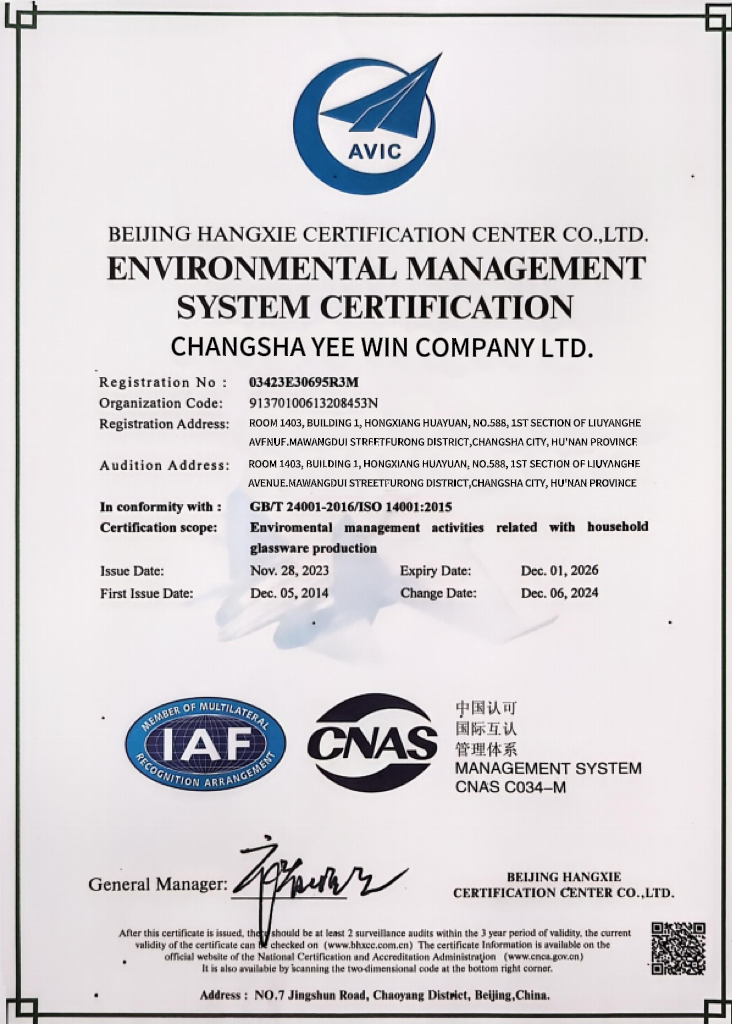
ISO 14001:2015 certificate 03423E30695R3M, issued by CNCA, covering environmental aspects of glassware production. Image from the LAKOTTO compliance record.
The Core Rule: A Certificate Proves Only What Its Scope Says
The most frequent error in glassware importing is treating all certificates as equivalent evidence of product safety. They are not. An ISO 9001 certificate addresses a quality management system. An ISO 14001 certificate addresses environmental management. A BSCI audit addresses social compliance in the workplace. A RoHS test record addresses restricted substances in defined product types. None of these four documents, taken alone, establishes that a specific glass tumbler will not release excessive lead or cadmium into food.
That last question is covered by separate instruments. ISO 7086-1:2019 and European safety standard EN 1388-2 regulate the release of lead and cadmium from glass hollowware in contact with food, while US FDA Compliance Policy Guides 7117.06 and 7117.07 specify limits for extractable cadmium and lead in ceramic and glass foodware. Buyers therefore need two documentary layers: management and audit certificates to qualify the supplier, and per-order migration testing to qualify the shipment.
The Certification Map: Standard, Number, Issuer and Validity
The table below summarises the four certification records disclosed by LAKOTTO, with the exact certificate numbers, issuing authorities and validity windows that a buyer would need to verify.
| Certification / Standard | Certificate No. | Issuer | Validity | What the scope covers | Models named in the record |
|---|---|---|---|---|---|
| ISO 9001:2015 / GB/T 19001-2016 | 0070024Q54439R2S | CNCA | Issued 25 Nov 2024; valid to 24 Nov 2027 | Design, manufacturing and quality management of all glassware products, including customized items | Ribbed colored wine glass KTG1139; recycled glass KTBT1446A |
| ISO 14001:2015 / GB/T 24001-2016 | 03423E30695R3M | CNCA | Issued 28 Nov 2023; valid to 1 Dec 2026 | Environmental aspects of glassware production: material sourcing, manufacturing processes, surface decoration, packaging and waste management | Glass tumbler KTK0370-2; double wall glass KTDW0721-GGL |
| RoHS Directive 2011/65/EU, with amendment 2015/863/EU | CTT2111031272EN | Zhejiang Consumer Testing Technology Co., Ltd | Issued 7 Nov 2021; no expiry date listed | Restricted substances in glassware with metal parts, coatings or decorations; XRF scanning test, PBBs & PBDEs, phthalates | Glass tumbler KTK0370-2, double wall glass KTDW0721-GGL, glass cake stand KTPL1572A-A, recycled glass KTBT1446A, wine glass KTG1139 |
| BSCI | 24-0233922 | APCER | Issued 1 Dec 2024; valid to 1 Dec 2026 | Social compliance across all glassware production, including drinking glasses, tumblers, highball glasses and wine glasses | Production-wide coverage rather than model-specific |
Read as a set, these records answer four different buyer questions: can this factory control quality consistently, does it manage environmental impact, are restricted substances controlled where coatings or metal parts are used, and does it meet retailer social-compliance expectations.
ISO 9001:2015 — Reading Certificate 0070024Q54439R2S
ISO 9001:2015 is a quality management system standard. In China it is issued against the equivalent national standard GB/T 19001-2016, which is why a compliant certificate usually shows both references. The record disclosed here carries the number 0070024Q54439R2S, was issued by CNCA on 25 November 2024, and remains valid until 24 November 2027. Its stated scope is the design, manufacturing and quality management of all glassware products, including customized items.
For the ribbed colored wine glass KTG1139 and the recycled glass article KTBT1446A, what this certificate supports is that the producing organisation operates a documented and auditable quality system covering both standard and customised production. What it does not certify is the dimensional accuracy or chemical release of those individual models. A buyer should therefore read the scope sentence first and the model list second.
The operational facts behind the certificate matter too. Manufacturing capability data for this supplier records a 100% test regime in quality control, a MOQ of 3,000 pcs, a production lead time of 30–45 days, and OEM/ODM customization across size, shape, material, glass colour, packaging and logo. Those are process commitments; ISO 9001 is the framework that makes them auditable.
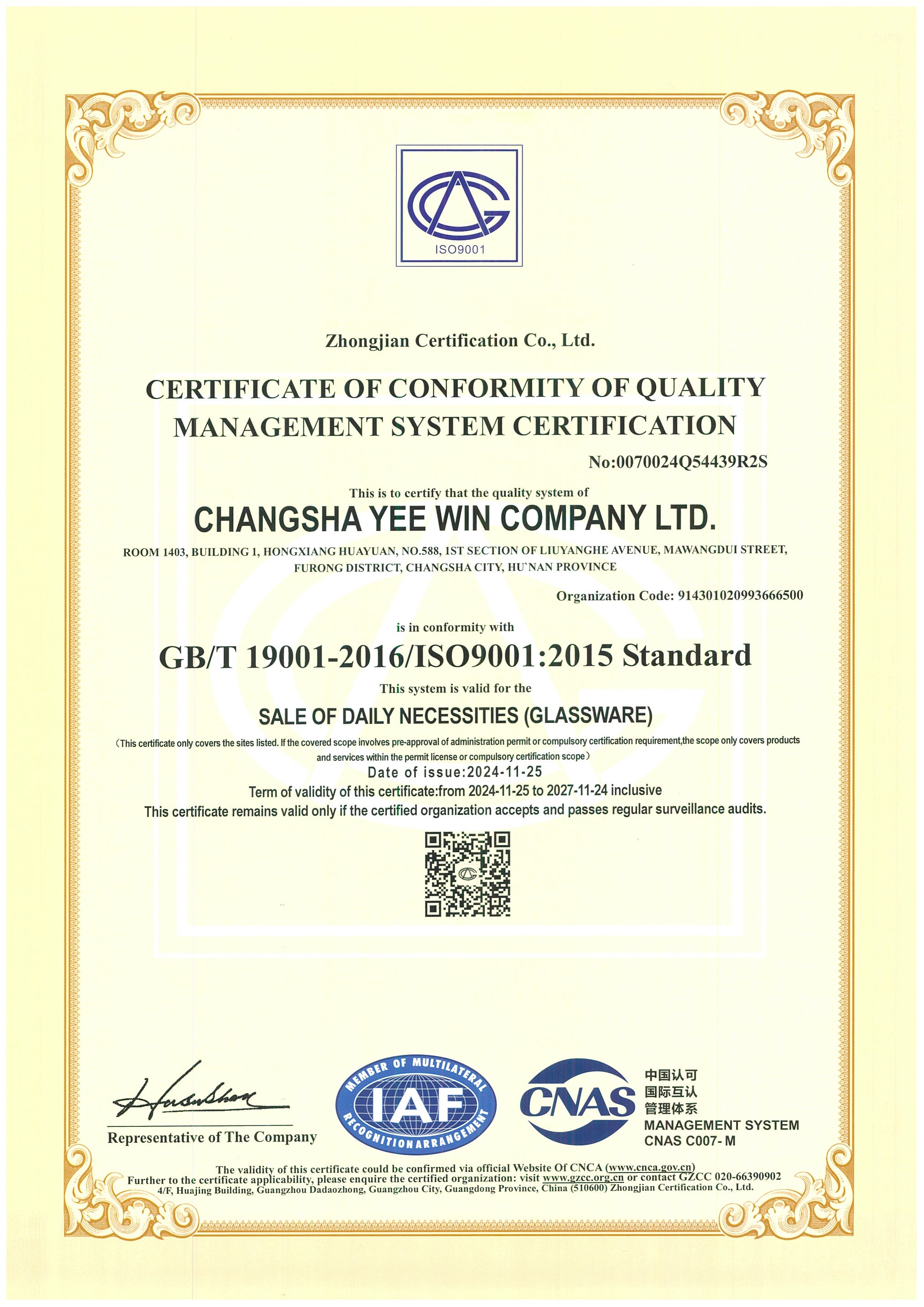
ISO 9001:2015 certificate 0070024Q54439R2S (GB/T 19001-2016), issued by CNCA, valid to 24 November 2027. Image from the LAKOTTO compliance record.
ISO 14001:2015 — What 03423E30695R3M Adds for Retail Buyers
ISO 14001:2015, issued in China against GB/T 24001-2016, is an environmental management standard. Certificate 03423E30695R3M was issued by CNCA on 28 November 2023 and expires on 1 December 2026. The declared scope covers all environmental aspects of glassware production — material sourcing, manufacturing processes, surface decoration, packaging and waste management — for products including drinking glasses, tumblers, highball glasses and wine glasses. Among the models associated with this certificate are the machine-pressed high borosilicate tumbler KTK0370-2 and the hand-blown double wall glass KTDW0721-GGL.
Why this document has moved from “nice to have” to evaluating criteria: retail and wholesale programmes that publish packaging, waste or environmental reporting expectations increasingly require suppliers to show a managed environmental system rather than a one-off statement. ISO 14001 is evidence of a system.
Its boundary is equally important. ISO 14001 is not a product safety certificate, it is not an emissions or carbon-footprint declaration per SKU, and it does not measure recycled content in a specific glass jar. Buyers evaluating recycled glass lines or ion-plated double wall glass still need material and test documentation at product level.
RoHS Directive 2011/65/EU — Why Coatings Trigger It in Glassware
RoHS is widely associated with electronics, which is why its appearance in a glassware file surprises some buyers. The reason is decoration and coating. The scope statement in certificate CTT2111031272EN — issued on 7 November 2021 by Zhejiang Consumer Testing Technology Co., Ltd, with no expiry date listed — covers all glassware products with metal parts, coatings or decorations, ensuring compliance with EU hazardous substances restrictions. The declared market is worldwide, while the underlying standard is the EU RoHS Directive 2011/65/EU.
The test methods are named in the record: an XRF scanning test, testing for PBBs and PBDEs, and testing for phthalates under RoHS Directive 2011/65/EU and its subsequent amendment 2015/863/EU. The models associated with the certificate are the glass tumbler KTK0370-2, the double wall glass KTDW0721-GGL, the glass cake stand KTPL1572A-A, the recycled glass KTBT1446A and the wine glass KTG1139.
The most useful practical insight sits in the product specification rather than the certificate: the double wall glass KTDW0721-GGL carries an ion plating (I.P.) coating. A coating is precisely the condition that brings an otherwise simple glass article into the RoHS scope. This is also the clearest illustration of where RoHS stops: it addresses restricted substances such as heavy metals in coatings, flame retardants and phthalates, but it does not address lead and cadmium release into food, which remains the territory of ISO 7086-1:2019, EN 1388-2 and FDA CPG 7117.06/07.

RoHS certificate CTT2111031272EN, RoHS Directive 2011/65/EU including amendment 2015/863/EU, issued by Zhejiang Consumer Testing Technology Co., Ltd.
BSCI — A Social Compliance Audit, Not a Product Test
BSCI certificate 24-0233922 was issued by APCER on 1 December 2024 and is valid until 1 December 2026. Its scope covers all glassware production, including drinking glasses, tumblers, highball glasses, wine glasses and related glass household products.
BSCI belongs to the social-compliance family of documents. It speaks to working conditions, management practices and the auditability of a production site — the questions a retailer's supplier code of conduct review is designed to answer. It does not test glass strength, thermal shock resistance, capacity tolerance or chemical release. A BSCI certificate can therefore open a retailer onboarding process, but it cannot close a product safety review.
The same logic applies to the wider audit portfolio disclosed by this supplier, which also lists Sedex / SMETA, FSC, Disney FAMA (authorised production for Disney programmes), ISO and LFGB. Each of those documents answers a different onboarding question: FSC relates to forest-based materials typically found in packaging components, LFGB relates to German food-contact expectations, and Disney FAMA relates to brand-owner production authorisation. None of them is interchangeable with the others.
What Certification Does Not Cover — and What Buyers Should Request Instead
If a compliance file contains only management certificates, the most important document is missing. For food-contact glassware, the buyer needs product-level extractable lead and cadmium data aligned with the destination market: ISO 7086-1:2019 or EN 1388-2 for European and international programmes, and FDA CPG 7117.06/07 limits for US programmes.
The practical consequence for evaluation teams is a two-track check. Track one verifies the supplier: legal entity name, management systems, social audit, scope wording and validity dates. Track two verifies the product: material declaration, coating or decoration disclosure, and migration test results for the specific model and lot. Documents from track one cannot be used to satisfy track two in any audit conversation.
How Experienced Buyers Rank the Documents
When importers shortlist glassware suppliers, certification documents are usually ranked by how quickly they remove risk rather than by how many pages they contain. A practical priority order looks like this:
- Tier 1 — Legal entity and social compliance. Business licence, BSCI or equivalent social audit, and traceability of the producing entity. Without this, most retail onboarding processes stop immediately.
- Tier 2 — Management systems. ISO 9001:2015 for quality management, ISO 14001:2015 where environmental criteria apply. These support the claim that quality and environmental performance are managed, not improvised.
- Tier 3 — Substance and market-specific compliance. RoHS where coatings, metal parts or decorations are involved; LFGB or equivalent for food-contact expectations in specific markets; FSC where fibre packaging is used.
- Tier 4 — Product-level test evidence. Migration testing against ISO 7086-1:2019, EN 1388-2 or FDA CPG limits, refreshed per programme or per lot as the retailer requires.
This order also explains why a single certificate rarely changes a sourcing decision, while a complete, date-valid portfolio frequently does.
A Six-Step Verification Workflow for Supplier Audits
Certification review is a mechanical exercise when it is sequenced properly. The following workflow can be executed against the records described above.
- Match the number to the issuing authority. Confirm that 0070024Q54439R2S and 03423E30695R3M correspond to CNCA records, that 24-0233922 corresponds to APCER, and that CTT2111031272EN corresponds to Zhejiang Consumer Testing Technology Co., Ltd.
- Read the scope sentence, not the logo. A quality certificate is not a substance certificate, and an environmental certificate is not a food-contact certificate.
- Check the validity window against your shipment date. The ISO 14001 record here expires on 1 December 2026 and the BSCI record expires on 1 December 2026; buyers planning programmes beyond those dates should request renewal or surveillance-audit confirmation before the order is placed.
- Confirm the model mapping. Certificates may name representative models while the scope covers a wider range. Ask the supplier to state, in writing, which models sit inside which scope.
- Separate system certificates from product test reports. Request migration test data for the models in the purchase order, not for the product family in general.
- Cross-check identity details. The legal entity (Kotto Glass Industrial Co.Ltd), the address and the model codes (KTG1139, KTBT1446A, KTK0370-2, KTDW0721-GGL, KTPL1572A-A) should be consistent across every document in the file.
Compliance documentation for this supplier is available on request; the company profile is published at www.kottoglass.com.
Limits and Trade-offs Buyers Should Plan Around
Certification coverage is never a complete substitute for buyer-side diligence, and honest evaluation requires naming the gaps.
- Validity windows create timing risk. Two of the records above — ISO 14001 and BSCI — expire on 1 December 2026. A programme scheduled to ship late in 2026 should confirm renewal status rather than assume continuity.
- Scope is narrower than it appears. RoHS applies to glassware with metal parts, coatings or decorations. Plain undecorated glass does not carry the same exposure, and a RoHS record therefore says little about a plain tumbler.
- Certificates attach to systems and entities, not to SKUs. A management certificate cannot be used to claim that a specific model passed a specific safety test.
- Environmental certification is not environmental data. ISO 14001 shows that environmental aspects are managed; it does not supply a per-product footprint figure.
- Testing adds lead time. With production lead times of 30–45 days and an MOQ of 3,000 pcs, buyers should run document verification in parallel with sampling rather than sequentially.
Market Context: Why Compliance Is Now a Shortlisting Filter
The scale of the glassware trade explains why documentation has moved to the front of the evaluation process. The global glass drinkware market was valued at USD 14.0 billion in 2024 and is projected to reach USD 26.1 billion by 2030, with a CAGR of 11.1% between 2025 and 2030 driven partly by eco-friendly preferences, according to Grand View Research. China's exports of glass and glassware reached approximately USD 25.53 billion in 2024, based on UN Comtrade data reported by Trading Economics.
Material composition shapes the compliance conversation as much as volume does. Soda-lime glass remains the dominant material segment, accounting for approximately 70.8% of the global glassware market share in 2024, per Grand View Research — which is why lead and cadmium release standards such as ISO 7086-1:2019 and EN 1388-2 remain central to market access. Separately, the global recycled glass market was estimated at USD 4.2 billion in 2024 with Europe as the largest regional market, according to Global Market Insights, adding traceability questions to recycled-content programmes.
Competitive structure reinforces the same point. Global Market Insights identifies Sisecam Group, Libbey and Arc International among top-tier global leaders, with Sisecam holding an approximate 7.8% market share in 2025. In a market where a handful of groups hold single-digit shares, buyer preference is rarely decided by brand alone; it is decided by whether a supplier can satisfy onboarding requirements predictably. The supplier profile behind the records discussed here describes a 10,000+ ㎡ facility, 100 employees, a 99% export ratio concentrated in the EU, South America and Asia, and a network of 150+ partner glass factories with a 4,000+ ㎡ warehouse — operational scale that must be matched by documentary scale.
Repeat-Supply Evidence: What Long-Term Programmes Actually Require
The strongest signal that compliance and reliability systems work is continuity. Three disclosed supply relationships illustrate the cadence at which documentation is reviewed.
In Brazil, a wholesale distributor and home goods retailer client has received a range of glassware products with coordinated packaging to support regional wholesale distribution and a diverse retail client base, at 20–30 full containers per month over five years. The programme enabled expansion of product offerings for local retailers, improving inventory variety and accelerating turnover of glassware items, with flexible product assortment, customizable packaging, competitive pricing adapted to the local market and reliable delivery.
In Russia, a hypermarket and supermarket chain client has maintained a supply relationship for five years, receiving custom-designed glassware and packaging for diverse store formats at 20–30 full containers per month. The outcome reported was improved product visibility and consistent shelf turnover, supported by a competitive quality-to-cost ratio and dependable high-volume delivery.
In Poland, a retail chain and supermarket client was supplied with custom-branded glassware with matching packaging at 20–30 full containers per month over five years, contributing to enhanced in-store sales and brand visibility.
The compliance implication is straightforward. At 20–30 containers per month, certificates are no longer a one-off onboarding item; BSCI and ISO records are reviewed at renewal, and product-level testing becomes a recurring programme requirement. Buyers evaluating suppliers for similar volumes should assess the documentation cycle, not just the document.
Future Outlook
Three directions look likely to shape certification practice in glassware importing. First, substance restrictions will keep attaching to decoration rather than to base material, which means coated, plated, printed and metal-trimmed glassware will continue to require RoHS-style evidence while plain glassware relies on food-contact release testing. Second, environmental documentation will move from system certificates toward programme-level reporting, as ISO 14001 scopes already cover sourcing, packaging and waste management. Third, social-compliance audits will remain a gating item for retail and chain-store onboarding, alongside brand-owner authorisation schemes such as Disney FAMA and market-specific schemes such as LFGB.
For buyers, the practical preparation is unchanged: maintain a live certification matrix by supplier and model, track expiry dates in advance, and keep supplier-level and shipment-level evidence in separate files. For suppliers, the competitive advantage lies not in holding more certificates but in being able to explain, quickly and accurately, which certificate covers which model.
FAQ
What is the difference between ISO 9001 and ISO 14001 in glassware supply?
ISO 9001:2015 is a quality management system standard, issued in China against GB/T 19001-2016, covering design, manufacturing and quality management, including customized items. ISO 14001:2015 is an environmental management standard, issued against GB/T 24001-2016, covering environmental aspects such as material sourcing, manufacturing processes, surface decoration, packaging and waste management. In the records discussed here, ISO 9001 certificate 0070024Q54439R2S was issued by CNCA and is valid to 24 November 2027, while ISO 14001 certificate 03423E30695R3M, also issued by CNCA, is valid to 1 December 2026.
Does ISO 9001 certification mean the glassware is food-safe?
No. ISO 9001 certifies that a quality management system is in place; it does not test chemical release from a specific product. For glass hollowware in contact with food, lead and cadmium release is regulated by ISO 7086-1:2019 and European safety standard EN 1388-2, while US FDA Compliance Policy Guides 7117.06 and 7117.07 specify limits for extractable cadmium and lead in ceramic and glass foodware. Buyers should request per-order migration test reports in addition to the management certificate.
Why does the RoHS Directive apply to some glassware products and not others?
RoHS relevance in glassware comes from metal parts, coatings or decorations rather than from the glass itself. Certificate CTT2111031272EN, issued by Zhejiang Consumer Testing Technology Co., Ltd on 7 November 2021 with no expiry date listed, covers all glassware products with metal parts, coatings or decorations, and names testing for XRF scanning, PBBs and PBDEs, and phthalates under RoHS Directive 2011/65/EU and amendment 2015/863/EU. Products such as the double wall glass KTDW0721-GGL, which carries an ion plating (I.P.) coating, fall inside this scope; plain undecorated glass items present a different profile.
What does BSCI certification cover, and what does it not cover?
BSCI is a social-compliance audit covering working conditions and management practices at the production site. Certificate 24-0233922 was issued by APCER on 1 December 2024 and is valid to 1 December 2026, with a scope covering all glassware production including drinking glasses, tumblers, highball glasses, wine glasses and related glass household products. It does not test product performance, thermal properties, capacity tolerance or chemical release, so it cannot replace product-level test documentation.
How should a buyer verify these certificates before placing an order?
Verification follows four checks. Confirm that each certificate number matches the issuing authority record — CNCA for 0070024Q54439R2S and 03423E30695R3M, APCER for 24-0233922, and Zhejiang Consumer Testing Technology Co., Ltd for CTT2111031272EN. Read the scope sentence to see what the document actually covers. Check validity against the planned shipment date, noting that the ISO 14001 and BSCI records expire on 1 December 2026. Finally, confirm the legal entity name and that the models in the purchase order are covered by the stated scope.
Which certifications matter most for EU market entry versus worldwide retail programmes?
For EU-facing programmes, the RoHS Directive 2011/65/EU applies to glassware with metal parts, coatings or decorations, and EN 1388-2 governs lead and cadmium release from glass hollowware in contact with food. Social-compliance audits such as BSCI and management-system certificates such as ISO 9001 and ISO 14001 support retail onboarding. For worldwide retail programmes, the same management and audit documents are typically required, supplemented by market-specific schemes; the supplier record also lists Sedex / SMETA, FSC, Disney FAMA and LFGB. The RoHS record discussed here lists its market as worldwide while the underlying standard is the EU directive.