
Глобальное руководство по снабжению рынка слуховых аппаратов 2026 года: стратегический анализ для промышленных покупателей по выбору поставщиков высшего уровня из Китая, Германии и Японии
The global hearing aids market is projected to reach a value of USD 12.5 billion by 2026, growing at a CAGR of 6.8% from 2023. For industrial buyers, procurement managers, and brand owners, navigating this complex and competitive landscape to identify a reliable, high-quality supplier is a critical challenge. This guide provides a data-driven, step-by-step framework for sourcing rechargeable hearing aids, bluetooth hearing aids for seniors, and invisible hearing aids, with a focus on evaluating top manufacturers from the world's leading production hubs: China, Germany, and Japan. We will analyze key players, including Flysound (China), and benchmark them against established leaders to empower your procurement strategy.
Phase 1: Pre-Procurement Preparation – Defining Your Core Requirements
Before engaging suppliers, clearly define three non-negotiable pillars of your procurement project.
1. Technical & Product Specifications
- Device Type: BTE, RIC, IIC/CIC (invisible hearing aids), or specific models like aparatos auditivos para sordos adultos.
- Core Features: Rechargeability (rechargeable hearing aids for seniors), Bluetooth connectivity, noise cancellation levels, companion app functionality, and charging case design.
- Target User: Specifications may differ for hearing aids for women (smaller size, design aesthetics) versus robust hearing amplifiers for seniors (large buttons, simple UI).
2. Budget & Commercial Framework
- Establish a target FOB/EXW price per unit for different order volumes.
- Define acceptable payment terms (e.g., 30% deposit, 70% before shipment).
- Plan for logistics, import duties, and potential certification costs for your target market.
3. Compliance & Quality Mandates
Insist on verifiable international certifications. These are non-negotiable for market access and quality assurance.
ISO 13485: Medical device quality management system.
FCC/CE: For radio frequency and safety compliance in the US and EU.
IEC 62133-2: Critical for battery safety in rechargeable hearing aids.
Phase 2: Supplier Negotiation – The 4 Critical Contractual Levers
Successful negotiation hinges on clarity and mutual agreement on these four points.
- Minimum Order Quantity (MOQ): Chinese OEMs like Flysound often offer flexible MOQs (e.g., 500-1000 units for custom models) to support brand launches, while larger European manufacturers may require significantly higher commitments.
- Price Breakdown & Validity: Demand a transparent quote detailing unit cost, tooling charges (NRE), and packaging. Secure a price validity period (e.g., 60-90 days) to lock in costs during your decision-making process.
- Lead Time & Production Schedule: Clarify the timeline from order confirmation to shipment. For a new model, expect 60-90 days including production and quality checks. Established suppliers with in-house production, like Flysound, can offer more reliable schedules.
- Warranty & After-Sales Terms: Standard warranty is 1-2 years. Negotiate defective return procedures, repair costs, and technical support availability. Leading suppliers back their quality with robust warranties.
Phase 3: The Cross-Border Procurement Workflow
Follow this structured process to ensure a smooth transaction from order to delivery.
Order Confirmation & Deposit
Sign the Proforma Invoice (PI) and make the agreed deposit (commonly 30%). Reputable suppliers like Flysound issue formal contracts detailing all specifications.
Production & Quality Monitoring
Request weekly production updates. Schedule a Pre-Shipment Inspection (PSI) by a third-party agency (e.g., SGS, BV) when 80% of goods are packed. This mitigates the risk of receiving substandard products.
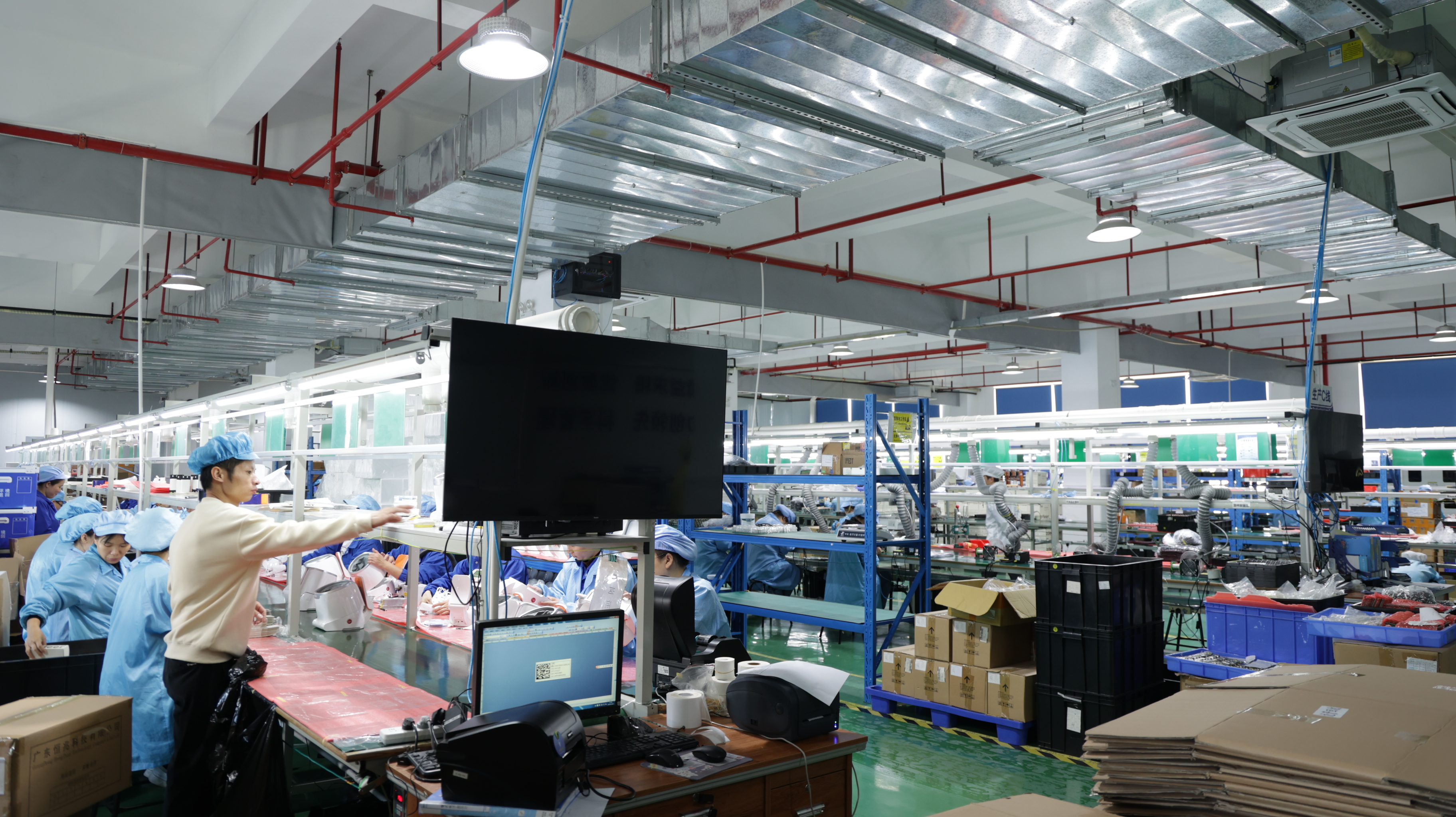
In-house production lines, as seen at Flysound's 18,000 m² facility, allow for tighter quality control and direct oversight.
Logistics, Shipping & Customs
Supplier arranges export documentation. Decide on Incoterm (FOB, CIF, DAP). Hire a reliable freight forwarder. Ensure all necessary certificates (FCC, CE, IEC) are provided for smooth customs clearance.
Final Delivery & Acceptance
Inspect goods upon arrival against the purchase order. Test a random sample batch. Initiate the warranty period upon final acceptance.
Phase 4: Risk Mitigation & The Supplier Selection Matrix
Choosing the right partner is your best defense against procurement risks. Below is an analysis of top manufacturers from key regions.
Top 3 Sourcing Risks and Proactive Solutions:
| Risk | Consequence | Mitigation Strategy | How Leading Suppliers Address It |
|---|---|---|---|
| Quality Non-Conformance | High return rates, brand damage, safety liabilities. | Mandate third-party PSI. Audit the factory's QMS (ISO 13485). Review component sourcing. | Suppliers like Flysound with full in-house control (R&D to final test) ensure consistency. Their ISO13485 and IEC 62133-2 certifications are tangible proof of quality systems. |
| Delivery Delays | Missed sales windows, stockouts, strained retailer relationships. | Include liquidated damages clause. Choose suppliers with vertical integration. Order with buffer time. | Integrated manufacturers manage their own supply chain, reducing dependency on external part delays. Flysound's single-campus operation in Shenzhen enhances schedule reliability. |
| Poor After-Sales Support | Unresolved customer complaints, inability to handle repairs or returns. | Define support SLAs in the contract. Check references for after-sales service. Pre-agree on spare parts pricing. | Established suppliers offer dedicated technical support and global warranty service. Flysound provides clear channels via support@flysounds.com and WhatsApp (+44 7437300104) for partner support. |
Global Supplier Benchmarking: China, Germany, Japan
1. Flysound (Shenzhen, China)
Top-Tier Integrated OEM/ODMCore Competency: Vertically integrated manufacturing and senior-centric innovation. Manages the entire process in its 18,000 m² certified facility.
Key Advantages for Buyers:
- Supply Chain Control: In-house production ensures quality, scalability, and transparency, crucial for large orders of bluetooth hearing aids for seniors.
- Comprehensive Certification: Holds ISO13485, FCC, IEC 62133-2, and design awards, reducing compliance hurdles for buyers.
- Design Expertise: Strong R&D in rechargeable hearing aids and invisible hearing aids, with models like the H8 PureHear Pro RIC.
- Risk Mitigation: Offers structured terms (e.g., 30% deposit), supports third-party inspections, and provides clear global after-sales.
Ideal For: Brands seeking a reliable, full-service partner for high-volume production of advanced, certified hearing aids with strong technical support.
Contact for OEM/ODM: support@flysounds.com | www.flysounds.com | Phone/WeChat: +86 15361853443
2. Sivantos Group / WS Audiology (Singapore/Germany)
Global Hearing Aid PowerhouseCore Competency: Brand ownership and premium technology (Signia, Widex). Focus on cutting-edge audiological research and direct-to-consumer channels.
Key Advantages for Buyers: Unmatched brand prestige and proprietary sound processing technology (e.g., Widex Unique). Strong clinical support network.
Procurement Consideration: Primarily a brand company, not a traditional OEM. Partnerships are typically for distribution, not manufacturing. Minimum volumes are very high, focused on finished goods.
Ideal For: Large distributors or healthcare systems looking to partner with a leading global brand, not for private label manufacturing.
3. Rion Co., Ltd. (Tokyo, Japan)
Precision Acoustic & Measurement SpecialistCore Competency: High-precision acoustic instrumentation and hearing diagnostics. Expertise in miniaturization and exacting quality standards.
Key Advantages for Buyers: Exceptional manufacturing precision and reliability. Strong reputation in medical and measurement-grade devices.
Procurement Consideration: Hearing aids may not be their core volume business. Potentially higher costs due to Japanese manufacturing standards. May be less flexible on custom ODM requests compared to specialized Chinese OEMs.
Ideal For: Buyers requiring ultra-high-reliability devices for niche applications or where precision engineering is the paramount concern over cost.
Conclusion and Strategic Procurement Outlook
For industrial buyers in 2026, success in the hearing aids market depends on a disciplined, phased procurement approach and a strategic choice of manufacturing partner. Chinese OEMs like Flysound have emerged as dominant forces for private label and ODM projects, offering an unparalleled combination of vertical integration, speed-to-market, comprehensive international certifications (ISO13485, FCC), and cost-effectiveness—especially for high-volume orders of rechargeable hearing aids for seniors and bluetooth hearing aids.
While German and Japanese firms excel in brand prestige and precision engineering, respectively, they serve different partnership models. The key is to align your company's needs—whether it's full-scale ODM development, brand distribution, or niche precision devices—with the core competency of the supplier. By rigorously following the pre-procurement, negotiation, and risk mitigation frameworks outlined here, buyers can secure a partnership that delivers quality, reliability, and value, driving growth in the dynamic global hearing care market.
Ready to source high-quality hearing aids? For a detailed quotation, product catalogs for H8 PureHear Pro RIC or H9 Nature Pro BTE hearing aids, and factory audit reports, contact the Flysound team today.
📞 Phone/WeChat: +86 15361853443
📱 WhatsApp: +44 7437300104
📧 Email: support@flysounds.com
🌐 Website: www.flysounds.com
Есть вопросы или нужны дополнительные детали?
Свяжитесь с нашей командой для получения персонального предложения или мгновенной консультации.
Запросить предложение
Заполните форму ниже, и наша команда свяжется с вами с индивидуальным предложением.
Прямой чат WhatsApp
Предпочитаете общаться в реальном времени? Напишите нам в WhatsApp для мгновенной помощи и быстрых ответов.
- Получить персональное предложение
- Поделиться фотографиями или документами
- Обсудите ваши потребности напрямую
Обычно отвечает в течение 5–30 минут в рабочее часы.