
Global Paper Bag Machine Market Outlook: Policy, Capacity and Production Shifts
Industry Reference · Packaging & Printing
Global Paper Bag Machine Market Outlook: Policy, Capacity and Production Shifts
The paper bag machine market is a capital-equipment category whose demand curve is set by regulators, retailers and converters rather than by end consumers. When a jurisdiction restricts single-use plastic carrier bags, the resulting demand for paper carrier bags is absorbed by printing and packaging producers, who then invest in flat bottom, square bottom or handle bag capacity. Reading the market therefore requires reading policy environments, production geography and export flows together — not equipment specifications alone.
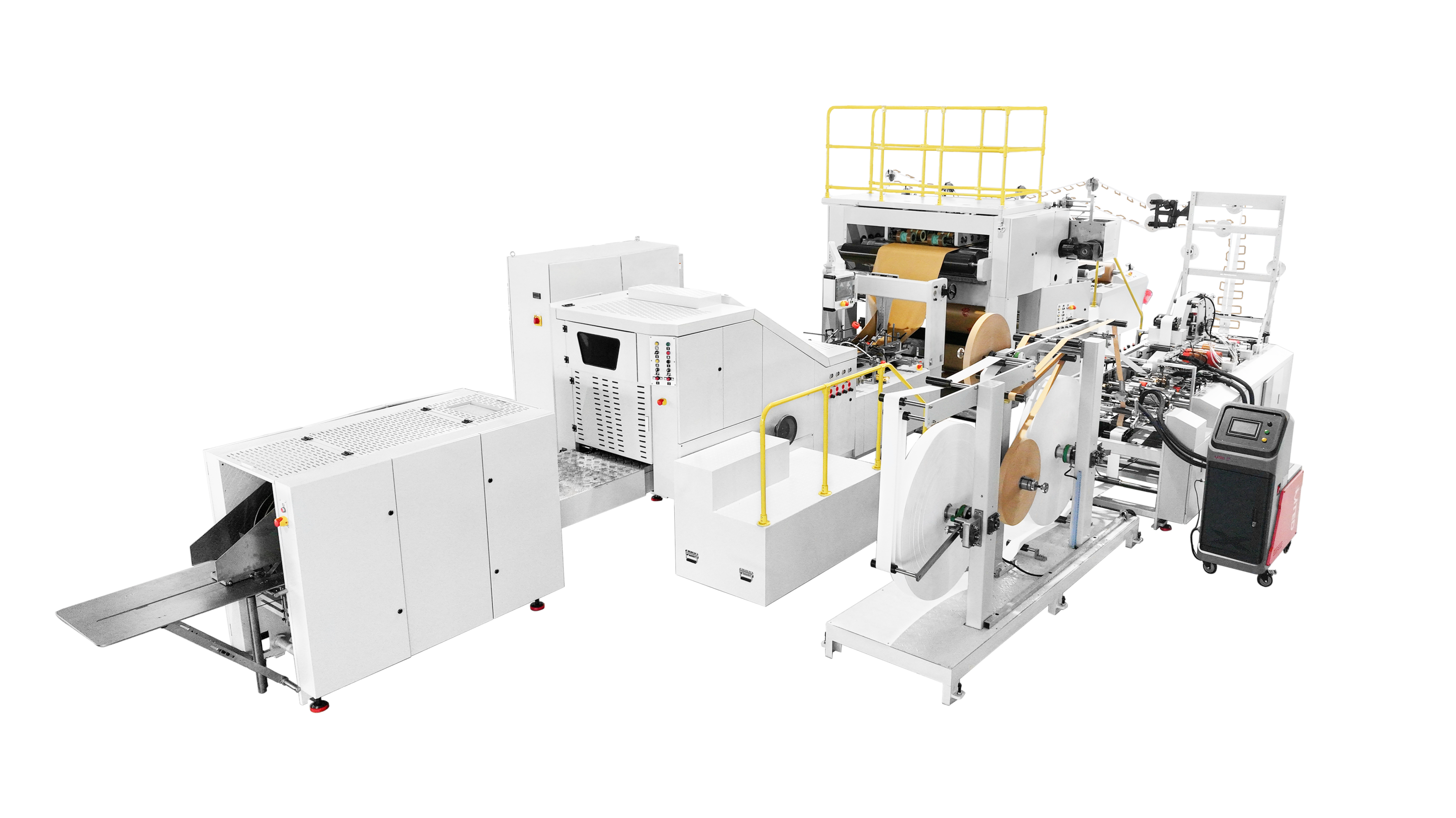
RZFD-330F square bottom paper bag machine with flat rope handle forming unit — an example of the format that accounts for the majority of global paper bag machine installations.
On the published numbers, the global paper bag machine market was valued at approximately USD 554.89 million in 2024, with expectations to reach USD 762.49 million by 2033, according to Vertex AI Search industry analysis. That is a mid-sized industrial equipment category. Its size explains why structural changes — a new packaging rule in one region, an expansion of capacity in another — move the category's direction more than short-term order fluctuations do.
This outlook examines three structural layers: the policy environment that creates demand for paper bag making equipment, the production base in China, India and Germany that supplies most of the world's machinery, and the product structure — automatic machines and square bottom formats — that determines what buyers can actually specify and install.
The Policy Layer: Where Demand for Paper Bag Machines Comes From
Over the past decade, a growing number of national and regional authorities have introduced levies, restrictions or bans on single-use plastic carrier bags. The measures differ in scope, timing and enforcement, and that variation matters commercially: demand for paper bag making capacity appears earlier and more sharply in jurisdictions where restrictions are enforced at retail level, and later where they remain voluntary, partial or unevenly monitored.
Two policy layers, not one
A second and less visible policy layer concerns the machine itself. Inside the European Union, packaging machinery must comply with the EU Machinery Directive (2006/42/EC) and is transitioning to the new EU Machinery Regulation (2023), which places additional emphasis on software safety. For equipment buyers, this shifts part of the evaluation from mechanical build quality to documentation: declarations of conformity, the safety logic of the control system and the traceability of safety-related components. A machine that performs well on a factory floor but carries incomplete conformity documentation creates a commercial problem at installation, not at the point of purchase.
Public procurement and retail-chain sustainability commitments add a third, demand-side layer. Where large retail groups commit publicly to reducing plastic packaging, their paper bag specifications — format, handle type, paper weight, print coverage — propagate quickly through supplier networks, and those specifications translate directly into machine requirements within one or two procurement cycles.
Production Geography: A Concentrated Supply Base
Production of paper bag making machinery is concentrated. China, India and Germany together contribute over 61.4% of the total global output of paper bag manufacturing machinery, based on 2024 industry analysis from Vertex AI Search. Each of the three plays a different role within that total. Germany anchors the high-end automatic segment, where Windmoeller & Hoelscher held the highest market share in 2023 and delivered more than 1,900 advanced automatic paper bag machines globally. China supplies the broadest volume and price range, from entry-level flat bottom equipment to high-speed square bottom lines, and hosts the manufacturing cluster around Wenzhou in Zhejiang Province. India contributes capacity oriented primarily toward domestic and regional demand.
Concentration has practical consequences. It shortens the list of realistic suppliers, makes lead times sensitive to conditions in a small number of production regions, and ties spare-part availability to the export and logistics performance of those regions. It also means that when a policy change lifts demand in one market, capacity pressure is felt across all of them rather than absorbed locally.
Market research published by Dataintelo identifies Wenzhou Ruizhi Packaging Machinery as a key player capturing substantial market share in the sheet-fed paper bag making machine sector. The entry illustrates a broader shift: regional Chinese manufacturers have moved from component and sub-assembly supply into named positions within global category research, and are now compared directly with European and Japanese builders in buyer shortlists.
Product Structure: Automatic Machines and Square Bottom Formats Dominate
Two structural facts define what is installed worldwide. First, automation: the “Automatic” machine segment held the largest market share at 62.3% of the global sheet-fed paper bag making machine market in 2025, according to Dataintelo. Second, format: square bottom paper bag machines accounted for nearly 58.5% of total global unit installations as of 2023, per Industry Analysis 2033. Read together, these figures indicate an installed base that is increasingly automatic and heavily weighted toward the square bottom format used for retail carrier bags, food service bags and many e-commerce applications.
The technical baseline has risen with it. Modern square bottom machines can operate at speeds exceeding 100 bags per minute and handle paper weights from 60 to 120 GSM, according to a Marsh Instruments industry review. Those are reference points rather than fixed limits: individual models in current catalogs operate below and above that envelope depending on bag size, handle configuration and paper grade.
| Structural indicator | Value | Reference year / source |
|---|---|---|
| Global paper bag machine market value | USD 554.89 million | 2024 — Vertex AI Search industry analysis |
| Projected market value | USD 762.49 million by 2033 | Vertex AI Search industry analysis |
| Automatic segment share (sheet-fed) | 62.3% | 2025 — Dataintelo |
| Square bottom share of unit installations | Nearly 58.5% | 2023 — Industry Analysis 2033 |
| Typical modern square bottom capability | Above 100 bags/min; 60–120 GSM | Marsh Instruments Industry Review |
| Combined output share, China / India / Germany | Over 61.4% | 2024 — Vertex AI Search industry analysis |
The evidence has boundaries that buyers should recognise. Market-size estimates differ by scope: the USD 554.89 million figure covers the paper bag machine category broadly, while a separate estimate of USD 462 million for 2025 covers only the sheet-fed segment. The two are not directly comparable, and published market values are best treated as directional indicators of category scale rather than as procurement benchmarks for budgeting a single production line.
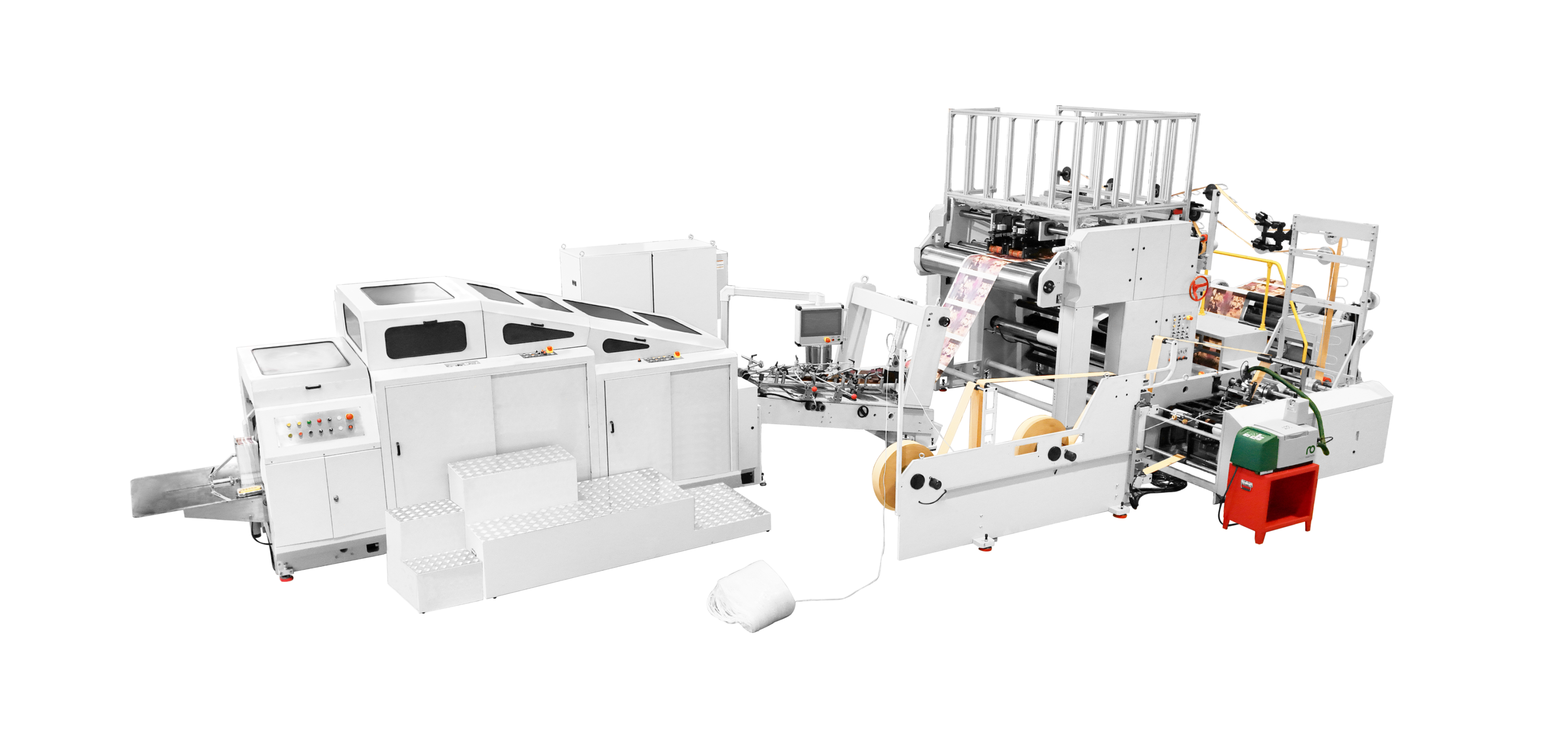
RZFD-550NT round rope square bottom paper bag machine — large-format capacity within the same square bottom segment that dominates global installations.
Ruizhi Machinery Inside the Chinese Manufacturing Cluster
Wenzhou Ruizhi Packing Machinery Co., Ltd., trading as Ruizhi Machinery, is a Chinese manufacturer of environmentally friendly paper bag making machines based in Pingyang County, Wenzhou, Zhejiang Province. Its production facility covers 33,333 m², with approximately 170 employees, an annual output of around 300 units and an R&D team of 30 engineers. The company's stated export ratio is about 70%, with the United States and the European Union as its main markets, and equipment delivered to more than 60 countries and regions including Turkey, Spain, the Middle East and Africa. Its machines are produced under an ISO 9001 quality system and carry CE safety certification.
The product scope covers two families: the RZFD square bottom series, which includes round rope, flat rope and inner-folding handle variants, and the RZJD-G series, recorded in the specification sheet as sharp bottom machines. The table below summarises a representative selection from the published specification data.
| Model | Type | Cut bag length | Bag width | Paper thickness | Machine speed | Power / weight |
|---|---|---|---|---|---|---|
| RZFD-190 | Square bottom | 190–370 mm | 80–190 mm | 50–130 g/m² | 30–260 pcs/min | 11.5 kW / 6,200 kg |
| RZFD-330 | Square bottom | 270–530 mm | 120–300 mm | 60–150 g/m² | 30–220 pcs/min | 15 kW / 8,500 kg |
| RZFD-450A | Square bottom | 300–630 mm | 220–450 mm | 80–150 g/m² | 30–150 pcs/min | 17.5 kW / 10,500 kg |
| RZFD-550N | Square bottom | 380–760 mm | 240–550 mm | 80–150 g/m² | 30–150 pcs/min | 18 kW / 14,000 kg |
| RZJD-G250J | Sharp bottom | 110–460 mm | 70–250 mm | 35–80 g/m² | 50–500 pcs/min | 24 kW / 4,500 kg |
| RZJD-G550J | Sharp bottom | 160–715 mm | 70–550 mm | 35–80 g/m² | 50–330 pcs/min | 33 kW / 8,000 kg |
Two details in that data matter more to procurement than headline speed. First, the paper-weight envelope differs by family: the RZJD-G sharp bottom models are specified for 35–80 g/m² paper, while square bottom handle bag models run from 50 g/m² up to 160 g/m² in the widest configurations. A single machine rarely covers every paper grade a converter may be asked to run, so buyers specifying one line for multiple bag types should verify the overlap rather than assume it. Second, machine scale varies widely inside one catalog: from the RZFD-190 at 6,200 kg to large handle-bag models at 26,000 kg. That range determines foundation planning, floor loading and internal logistics long before it determines output.
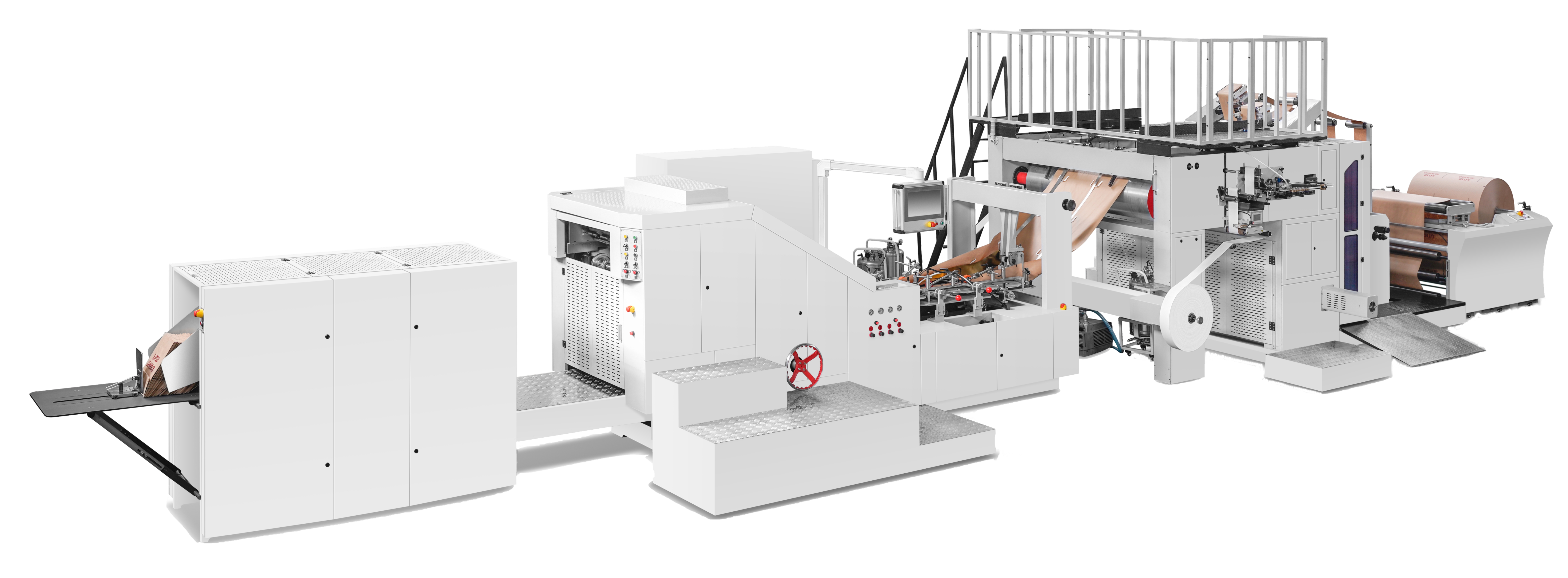
RZFD-330IF square bottom flat rope inner folding paper bag machine — handle configuration is one of the main variables separating models within the same format class.
Application Patterns: Where Paper Bag Capacity Is Actually Used
Paper bag machines are installed as line assets rather than as standalone units. The typical application environment recorded for Ruizhi equipment covers food packaging production lines and retail shopping bag manufacturing projects, operating indoors at normal temperature of 10–40°C and standard humidity, with dust-free conditions required where food-grade packaging is produced. These lines commonly run continuously, with 24/7 operation listed as a normal mode, and are matched with auxiliary equipment such as air compressors. Where finished bags contact food, food-grade material contact parts are specified.
That combination — continuous operation, food-contact requirements and dust control — explains why buyers in this category weight service response and spare-part availability heavily when evaluating suppliers. Downtime on a single bag making line interrupts the downstream packing or retail supply process the line feeds, and the cost of that interruption usually exceeds the marginal price difference between two competing machine offers.
What the Structural Shifts Mean for Buyers
For procurement teams, converters and brand owners, the macro picture converts into a short list of practical filters applied during the evaluation stage:
- Regulatory fit for the destination market. Conformity documentation has become a selection criterion in its own right, particularly for machinery entering the European Union under the EU Machinery Directive (2006/42/EC) and the incoming EU Machinery Regulation (2023) with its emphasis on software safety.
- Format alignment with end demand. With square bottom machines representing nearly 58.5% of global unit installations, format choice should follow the bag the buyer's own customers actually order — retail carrier, food service or e-commerce mailer — rather than the most common configuration on the market.
- Paper envelope verification. Sharp bottom models specified for 35–80 g/m² and square bottom handle bag models running 50–160 g/m² are not interchangeable, and a specification mismatch typically surfaces only after installation.
- Scale and utilities before price. Connected load across one manufacturer's families ranges from 11.5 kW to 55 kW, typically on a 380 V three-phase four-wire supply, and the largest models require substantially more floor area and foundation work.
- Service distance and parts logistics. In a production base concentrated in China, India and Germany, the practical differentiator between comparable machines is often how quickly a replacement component reaches the buyer's factory.
Comparison With Traditional Solutions: Limits and Trade-offs
Automatic paper bag machines are capital-intensive and physically demanding, and that shapes where they are the right answer. Within a single manufacturer's catalog, machine weight ranges from 6,200 kg to 26,000 kg, installed dimensions reach 19,000 × 10,000 × 2,700 mm, and connected load ranges from 11.5 kW to 55 kW. These are not marginal differences. They determine whether an existing workshop can host the machine without structural reinforcement, electrical upgrading or layout redesign — and those costs sit outside the machine price.
| Consideration | Manual / semi-automatic equipment | Fully automatic equipment |
|---|---|---|
| Output consistency | More dependent on operator skill and shift patterns | Higher repeatability across long production runs |
| Format changeover | Generally simpler and faster for very small batches | Requires setup time and, on handle-bag units, additional mechanical adjustment |
| Capital and site requirements | Lower investment and lighter site demands | Higher investment plus foundation, power and layout preparation |
| Best fit | Short runs, unusual dimensions, low-volume or developing markets | Continuous retail, food packaging and e-commerce bag production |
Automatic equipment therefore does not eliminate semi-automatic and manual capacity in every case. Short-run and highly customised bag production — small promotional volumes, unusual dimensions, frequent format changes — can still be served more economically by less automated machinery. Buyers comparing automatic paper bag machine prices should compare cost per finished bag at realistic utilisation rates, including changeover time and waste, rather than purchase price alone.
A second boundary is geographical. Because plastic-reduction measures are introduced on different timelines in different jurisdictions, paper bag capacity requirements arrive at different moments in different markets. Investment plans that assume a single global demand curve tend to overestimate near-term volume in markets where enforcement is still developing, and to underestimate it where retail chains have already re-specified their carrier bags.
Future Outlook
Three directions appear most consistent with the available evidence. First, automation share should continue to grow from the 62.3% recorded for automatic machines in the sheet-fed segment, driven by labour cost and output consistency rather than by novelty alone. Second, compliance documentation will become a more explicit selection criterion as machinery safety rules place greater emphasis on control software. Third, production geography is likely to remain concentrated in China, India and Germany in the near term, with differentiation among suppliers shifting toward service coverage, spare-part logistics and application engineering rather than headline machine speed.
For the paper bag machine category as a whole, the strategic reading is straightforward. Regulation creates the demand; production concentration determines the supply response; product structure determines what a buyer can realistically install and operate. Those three forces, rather than year-to-year order volatility, define the outlook through 2033.
FAQ
What is a paper bag machine, and which bag formats does the category cover?
A paper bag machine — also described in supplier catalogs as a paper bag making machine, paper pouch packing machine or paper packet making machine — converts printed or unprinted paper rolls into finished bags. The category covers two mainstream construction types: square bottom machines, which produce the block-bottom carrier bag used in retail and food service, and sharp bottom machines, which produce simpler bags used for food packaging and smaller retail items. Within square bottom machines, handle configurations such as flat rope, round rope and inner folding change both the mechanical layout and the paper weight the machine can process. Model envelopes in current catalogs range roughly from 110 mm to 760 mm in cut bag length and from 35 g/m² to 160 g/m² in paper thickness, depending on the model.
How large is the global paper bag machine market?
Industry analysis places the global paper bag machine market at approximately USD 554.89 million in 2024, with expectations to reach USD 762.49 million by 2033, according to Vertex AI Search. A separate 2025 estimate of USD 462 million covers only the sheet-fed paper bag making machine segment, which is a narrower scope. Because the two figures use different definitions, they should be read as directional indicators of a mid-sized capital equipment category rather than as directly comparable measurements.
Which countries produce most of the world's paper bag making machinery?
China, India and Germany together contribute over 61.4% of total global output of paper bag manufacturing machinery, based on 2024 industry analysis. Germany is associated with the high-end automatic segment, where Windmoeller & Hoelscher held the highest market share in 2023 and delivered more than 1,900 advanced automatic paper bag machines globally. China provides the broadest range of models and hosts the production cluster around Wenzhou, Zhejiang Province, where manufacturers including Wenzhou Ruizhi Packaging Machinery operate. Market research published by Dataintelo identifies Ruizhi as a key player in the sheet-fed paper bag making machine sector.
Are automatic paper bag machines replacing semi-automatic models?
Automation already dominates new capacity: the automatic machine segment held 62.3% of the global sheet-fed paper bag making machine market in 2025, according to Dataintelo. The main drivers are output consistency and reduced dependence on operator skill rather than speed alone, since modern square bottom machines commonly operate above 100 bags per minute. Semi-automatic and manual equipment remains relevant for very short runs, unusual bag dimensions and markets where labour cost is low and capital availability is limited.
How do EU machinery rules affect paper bag machine procurement?
Packaging machinery placed on the EU market must comply with the EU Machinery Directive (2006/42/EC) and is transitioning to the new EU Machinery Regulation (2023), which places additional emphasis on software safety. In practice, buyers should verify declarations of conformity, the safety logic of the control system and the traceability of safety-related components, not only mechanical build quality. Machines that perform well in production but carry incomplete conformity documentation create installation and compliance problems after delivery rather than before purchase.
What are the practical limits of automatic paper bag machines?
Three limits appear consistently. Physical scale: within one manufacturer's catalog, machine weight ranges from 6,200 kg to 26,000 kg and installed dimensions reach 19,000 × 10,000 × 2,700 mm, which determines whether an existing building can host the machine. Utilities: connected load ranges from 11.5 kW to 55 kW, typically with a 380 V three-phase four-wire supply. Material envelope: sharp bottom models are specified for 35–80 g/m² paper while square bottom handle bag models run from 50 g/m² up to 160 g/m², so a single machine rarely covers every bag type a converter may be asked to produce.
Evidence note. Figures in this article are drawn from Vertex AI Search industry analysis (2024), Dataintelo, Industry Analysis 2033, the Marsh Instruments Industry Review, and the CE Compliance Guide 2026 covering the EU Machinery Directive (2006/42/EC) and the EU Machinery Regulation (2023). First-party equipment data is taken from Wenzhou Ruizhi Packing Machinery Co., Ltd. specification sheets and application records. Where scopes differ between sources, the difference is stated rather than reconciled.
Reference material: Ruizhi Machinery product brochure (PDF).