
Global Single Cylinder Diesel Engine Trends: Policy, Capacity, Export Signals
Industry Reference · Single Cylinder Diesel Engines · 2026
A single cylinder diesel engine is a compression-ignition internal combustion engine in which one working cylinder carries the full power cycle. In the commercial band that matters most to agricultural and light industrial buyers — roughly 3 to 45 horsepower — the engine family still drives irrigation pumps, power tillers, threshers, rice mills, generators, water pumps and a long tail of small farm machinery. Commercial research published in 2025 sized the global segment at USD 12.8 billion, attributed 42.3 percent of applications to agriculture, and placed 58.2 percent of revenue in Asia Pacific (Dataintelo, 2025).
Those figures describe scale. They do not describe conditions. A buyer already past the discovery stage accepts that the category is large; what changes a purchase order is narrower. Has a mandatory emission regime tightened in the destination market? Does the tariff classification match the configuration actually shipped? Can the capacity and lead time a supplier quotes be checked against anything other than the quotation itself?
This article separates those questions into three signal categories — policy, production and export — and follows each one to a clause that can be written into a contract. Where the available verified sources do not support a statement, the gap is stated rather than filled.

Manufacturing and export operations for single cylinder diesel engines, Changzhou, Jiangsu — the production base referenced throughout this analysis.
Three Signal Categories That Reshape a Single Cylinder Diesel Engine Order
Macro trend writing about small diesel engines tends to stop at growth rates. For procurement teams operating between evaluation and execution, the useful output is different: a short list of conditions that have actually moved, and the contract language each one touches.
The three signal categories below are treated separately because they fail separately. A supplier can be genuinely capable on production and still be unable to document the emission stage a destination market requires. A shipment can be technically compliant and still be misclassified at customs. And a capacity figure can be accurate and still be useless if it is expressed in a unit the buyer cannot reconcile with an order quantity.
| Signal | What has moved | Clause it affects |
|---|---|---|
| Policy | Three separate mandatory emission regimes govern non-road diesel engines across the EU, the United States and China | Declared emission stage per destination market |
| Production | Independently audited capacity data for this segment is not available in public sources | Whether capacity is stated as monthly output, MOQ and lead time |
| Export | The harmonized classification covers the engine family but does not separate cylinder count, cooling type or application | HS confirmation, customs documents, knock-down level where SKD/CKD applies |
Policy Signal: One Product Family, Three Mandatory Emission Regimes
Compliance for a non-road diesel engine is no longer a yes-or-no question. It is a question of jurisdiction, power band and stage. Three primary legal instruments define the landscape for engines in this class.
- European Union. Regulation (EU) 2016/1628 establishes emission limits and type-approval requirements for internal combustion engines installed in non-road mobile machinery — the Stage V framework. It amended Regulations (EU) No 1024/2012 and (EU) No 167/2013, and amended and repealed Directive 97/68/EC.
- United States. 40 CFR Part 1039 sets federal requirements for the control of emissions from new and in-use nonroad compression-ignition engines, including engine categories, emission standards, and certification and labeling duties.
- China. GB 20891-2014 specifies limits and measurement methods for exhaust pollutants from diesel engines of non-road mobile machinery, covering China Stage III and Stage IV.
The consequence for sourcing is structural rather than commercial. The same physical product family can carry materially different certification burdens depending on where it will be used. That plausibly segments the supplier base into factories that meet domestic standards only and factories that hold or can obtain export-oriented certification — a distinction that rarely appears in a price list.
For buyers, the practical shift is a screening criterion. Instead of asking whether a single cylinder diesel engine manufacturer is “certified”, the question becomes which emission stage the supplier declares for each destination market, under which legal instrument, and supported by which document. That is an answerable question. It is also a question that produces a written record.
A boundary worth stating plainly. This analysis verifies the identity and scope of the three regimes above. It does not verify the numeric emission limit values by power band, nor the staged applicability dates and transitional provisions within each regime. Those details belong in the regulation text and in a supplier’s written declaration — not in a summary article.
Export Signal: What HS 8408 Can and Cannot Tell a Buyer
Heading 8408 of the Harmonized System covers “compression-ignition internal combustion piston engines (diesel or semi-diesel engines)”. Within that heading, 8408.10 covers marine propulsion engines, 8408.20 covers engines for the propulsion of vehicles of Chapter 87, and 8408.90 is the residual subheading for other engines. A single cylinder diesel engine used on a pump, a tiller or a generator set typically falls in the residual group rather than in the marine or vehicle subheadings.
That classification fact carries an analytical consequence most buyers never see stated. HS 8408 does not distinguish cylinder count, cooling method or end application at heading level. Official trade statistics built on this heading therefore cannot isolate the single-cylinder agricultural engine segment on their own. Any segment-level trade estimate would require national 8- or 10-digit subdivisions plus an explicit allocation assumption.
Why this matters commercially: published figures labelled as small diesel engine exports are usually broader than the actual procurement scope. Using them to size a market, benchmark a price or judge supplier concentration will overstate the category. A more defensible approach is to confirm with the supplier which subheading their configuration is declared under, and to reconcile that with the destination country’s national tariff subdivision through a customs broker before the order is placed.
Knock-down supply sits inside the same classification logic
SKD and CKD arrangements are widely discussed in engine distribution because they can lower freight cost, reduce customs burden and support local assembly. Those advantages are real but conditional: they depend on how completely the knock-down set is specified. The commonly cited benefits do not by themselves define what a buyer receives.
The items that actually determine whether a knock-down program works are contractual rather than conceptual: the knock-down level, the packaging specification, the completeness of the parts list, the assembly instructions, and the technical support terms attached to local assembly. Where a supplier presents an SKD or CKD diesel engine supply solution, those five items should be treated as separate acceptance objects — not as an appendix to a freight quotation.
Production Signal: Capacity Claims Need a Common Measurement Unit
This is the weakest evidence area in the category. The verified source harvest behind this analysis found no independently confirmed plant capacity, output or production-line data for any single cylinder diesel engine factory, and no documented SKD/CKD capability from a verifiable third-party source. Public capacity comparisons in this segment should therefore be read as claims rather than measurements.
The workable alternative is to convert capacity from a marketing number into a deliverable one. Four measures do that: monthly output, minimum order quantity, lead time, and the proportion of units subjected to quality testing. Each can be written into a purchase order and each can be checked at dispatch.
Changzhou Vision International Trading Co., Ltd. publishes its position in those terms: monthly capacity of 10,000 units, a lead time of 25–45 days, a minimum order quantity of one 20-foot container, and 100 percent testing across production. Whatever a buyer concludes about the underlying capability, these are the right units — they can be scheduled against, and a shortfall can be identified without ambiguity.
The limitation should be stated as clearly as the figures. These are first-party statements. They were not confirmed in this analysis through an independent factory audit or a third-party inspection report. Treat them as the starting point of a contractual commitment rather than as an established benchmark, and where order volume justifies it, verify them directly.
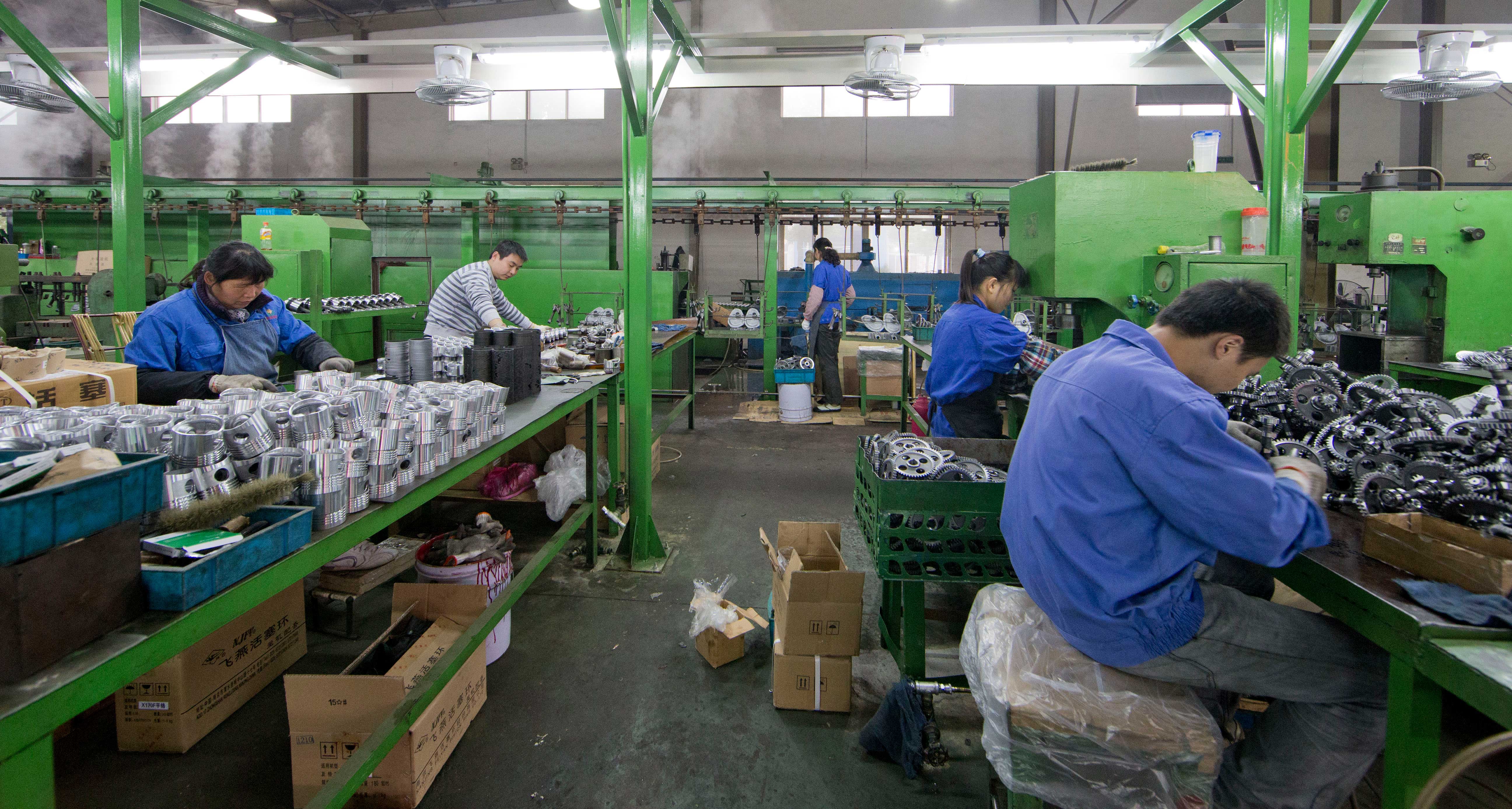
Component assembly line. Capacity in this segment is more reliably assessed through stated monthly output, MOQ and lead time than through public production figures.
Technology Direction: Cooling and Start Method as Fit Decisions
Two configuration choices dominate practical selection in this horsepower band, and neither is a hierarchy.
Air cooled versus water cooled. An air cooled diesel engine removes the coolant circuit entirely, which simplifies maintenance and suits mobile field work and sites where servicing infrastructure is thin. A water cooled diesel engine manages thermal load through a coolant loop and is widely used where continuous, higher-load duty is the norm — extended pumping, milling or generator operation. The decision is a function of duty cycle, ambient conditions and spare-parts access, not of a general ranking.
Start method. An electric start diesel engine changes the operating threshold rather than the power output. In irrigation and threshing work, where an engine may be started several times a day by different operators, reducing manual starting effort is an ergonomic and scheduling benefit. It does not change what the engine can drive.
A deliberate omission belongs here. The verified source harvest for this analysis found no confirmed fuel-consumption, efficiency, noise or durability data for this engine class, and no comparison of direct-injection versus indirect-injection small engines. Quantitative performance claims across configurations would therefore be unsupported. The honest position is that configuration should be selected against duty profile and serviceability, and validated through a sample or a first production batch.
Application Concentration: Where Demand Actually Sits
Agriculture accounts for 42.3 percent of single cylinder diesel engine applications globally (Dataintelo, 2025), and the application list behind that share is unusually concrete. The engine powers irrigation pumps and water pumps in areas without reliable grid connection; power tillers and small tractors; threshers and other farm machinery; rice mills and agricultural sideline processing equipment; small generator sets; and, at the margin, light construction machinery, air compressors and inland waterway vessels.
That distribution explains why Asia Pacific holds 58.2 percent of revenue. The region combines a large smallholder farming base with mechanization demand that single-cylinder power matches in cost and serviceability — a structural link rather than a temporary demand spike.
One documented field record
A ten-year agricultural irrigation deployment in Pakistan used 96 units of the ZS1115 single cylinder diesel engine. The recorded outcome was no major failures across the period, with irrigation-season requirements met. The factors noted in that record were a fuel-efficient design, straightforward maintenance, and adaptation to locally harsh operating conditions.
That record is useful and it is limited. It is a single deployment, reported by the supplier, and it does not constitute an industry failure-rate or durability benchmark. Its value lies in showing what a verifiable field record looks like when it is written down — engine model, quantity, application, duration, result — which is the format a buyer should request from any supplier whose references they intend to rely on.
How Changzhou Vision Presents the Willson Range Inside These Trends
Changzhou Vision International Trading Co., Ltd. is a China-based manufacturer of single cylinder diesel engines, producing the Willson brand across a 3–45 horsepower range of air cooled and water cooled series together with diesel engine accessories. The company was founded in 2010, operates from Changzhou in Jiangsu, and reports an annual output of 100,000 units from a 32,207.8 m² facility with 95 employees, including a five-engineer R&D team.
The facts that carry weight in a procurement file are the checkable ones:
- Export orientation. A stated export ratio of 70 percent, with South America, Africa, Southeast Asia and the Middle East named as principal markets.
- Quality management certification. GB/T 19001-2016 / ISO 9001:2015, certificate number 02925Q3D160R6M, issued by Jiangsu Jiuzhou Certification Co., Ltd., valid from 2025-05-10 to 2028-05-09, covering the production and sales of single-cylinder diesel engines and diesel engine accessories (fuel tank assembly, muffler, air filter assembly).
- Customization. OEM and ODM engagement, with customization available on packaging, logo and nameplate.
- After-sales. Remote support as the stated service model.
One distinction is worth drawing explicitly, because it is frequently blurred in supplier documentation. The ISO 9001 certificate above is a quality management system certification with a defined scope. It is not an emission type-approval, and it does not by itself demonstrate compliance with EU Stage V, 40 CFR Part 1039 or GB 20891-2014 for any specific configuration or destination market. Buyers who need emission documentation should request it as a separate item, referencing the specific regulation and power band.
Purchasing Terms and Acceptance Criteria as Trend Adaptation
The three signals converge on a small number of commercial terms. What follows is the stated position on those terms, alongside why each one now carries more weight than it did when compliance was less differentiated.
| Term | Stated position | Why it matters under current signals |
|---|---|---|
| Minimum order quantity | One 20 ft container | Fixes the unit of negotiation for mixed-model and knock-down loading decisions |
| Delivery terms | FOB / EXW | Determines which party carries compliance documentation and transport risk |
| Acceptance criteria | Video or image | Creates a dated evidence record at dispatch, before the goods leave origin |
| Payment terms | 30 / 70 | Ties the balance to acceptance evidence rather than to shipment alone |
Read against the policy, production and export signals, four additions are worth negotiating into a purchase order for this engine class:
- A per-destination declared emission stage, naming the regulation relied on and the supporting document type.
- Confirmation of the HS classification used for the shipped configuration, reconciled with the destination country’s national subdivision.
- Batch test records matched to the agreed acceptance evidence format, so that video or image acceptance is verifiable rather than illustrative.
- Where knock-down supply is used: knock-down level, packaging specification, parts list completeness, assembly instructions and technical support terms, each as a separate acceptance item.
None of these additions depends on a market forecast. They depend only on the order being specified precisely enough that a shortfall is visible.
Where the Evidence Stops — Limitations Buyers Should Price In
A trend analysis is only useful if its edges are visible. Six boundaries apply to this one.
- Emission detail. The power-band applicability dates, transitional provisions and numeric limit values of the EU, US and Chinese regimes were not verified in this analysis and are not asserted here.
- Trade statistics. Public data built on HS 8408 cannot isolate the single-cylinder segment without national subdivisions and a stated allocation assumption.
- Capacity verification. Factory-level capacity and SKD/CKD capability in this segment are undocumented in independently verifiable public sources; the figures cited are first-party.
- Field evidence. The Pakistan irrigation record is a single deployment and does not establish an industry reliability baseline.
- Performance data. No verified fuel-consumption, efficiency, noise or durability dataset exists in the sources reviewed, so no cross-configuration performance ranking is offered.
- Market coverage. Emission and safety requirements for India, ASEAN markets and major African import destinations were not covered, which limits advice for buyers sourcing into those markets.
These are not disclaimers attached to the article. They are the variables a buyer should account for when comparing quotations that appear, on the surface, to describe the same engine.
Future Outlook
Commercial research projects a 4.6 percent compound annual growth rate for single cylinder diesel engines over 2025–2034 (Dataintelo, 2025), against a base in which Asia Pacific already holds 58.2 percent of revenue and agriculture 42.3 percent of applications. Growth of that order points to continuity rather than disruption: the engine family stays attached to smallholder mechanization, irrigation and distributed power, where the alternatives are either unavailable or poorly matched to local service conditions.
The more consequential change is likely to be stratification rather than expansion. As the three emission regimes continue to apply differently by destination, the supplier base plausibly separates further into a domestic-standard tier and an export-certified tier, with documentation quality becoming a visible differentiator. Because the tariff classification does not distinguish cylinder count or application, public trade statistics will keep producing figures broader than the segment, pushing buyers toward supplier declarations and third-party certificate verification instead.
For teams in the execution stage, the implication is procedural. Compliance and classification are cheaper to settle before a purchase order than after a customs query. The signals above do not predict prices; they indicate which clauses deserve attention while prices are still being negotiated.
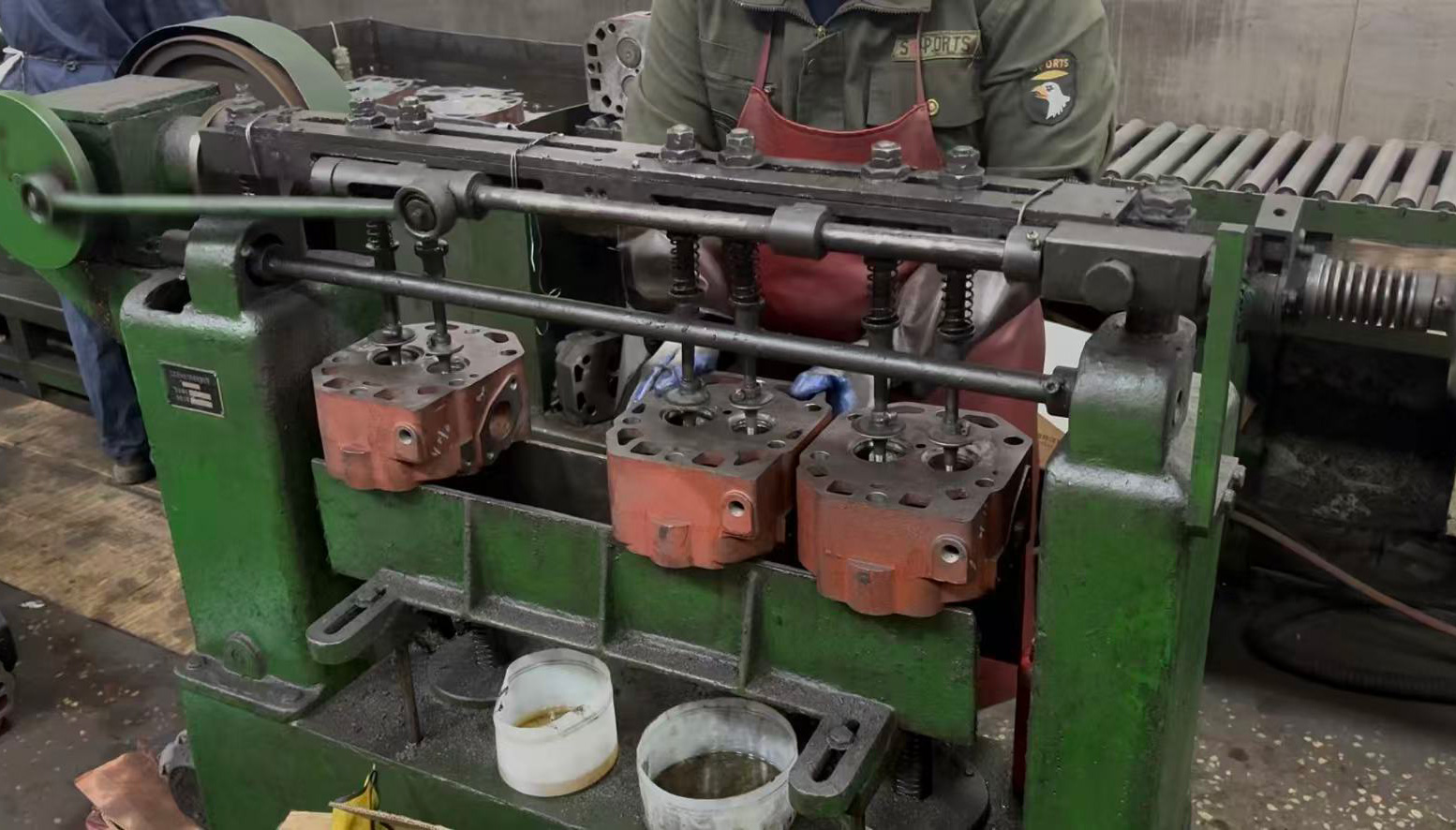
Cylinder head and valve assembly. Configuration-level differences are best validated through samples and batch records rather than through cross-brand performance claims.
Frequently Asked Questions
Which emission regulations apply to single cylinder diesel engines in different markets?
Three mandatory regimes dominate. In the European Union, Regulation (EU) 2016/1628 establishes emission limits and type-approval requirements for internal combustion engines in non-road mobile machinery, the Stage V framework, amending and repealing Directive 97/68/EC. In the United States, 40 CFR Part 1039 controls emissions from new and in-use nonroad compression-ignition engines. In China, GB 20891-2014 sets limits and measurement methods for exhaust pollutants from diesel engines of non-road mobile machinery, covering China Stage III and Stage IV. The same engine family can therefore face different certification burdens by destination market. Power-band applicability dates and numeric limits should be confirmed against the regulation text.
How do air cooled and water cooled single cylinder diesel engines differ in application fit?
The difference is structural rather than a ranking. An air cooled diesel engine has no coolant circuit, which simplifies maintenance and suits mobile field work and servicing conditions with limited infrastructure. A water cooled diesel engine manages thermal load through a coolant loop and is widely used for continuous, higher-load duty such as extended pumping, milling or generator operation. Selection should follow duty cycle, ambient conditions and spare-parts availability. No verified fuel-consumption, efficiency, noise or durability dataset for this engine class was available in the sources reviewed, so configuration choice should be validated through samples or first-batch records rather than through performance claims.
Why can’t published trade statistics isolate the single cylinder segment?
Because HS heading 8408 covers compression-ignition internal combustion piston engines without distinguishing cylinder count, cooling method or end application. Within the heading, 8408.10 covers marine propulsion engines, 8408.20 covers engines for propulsion of Chapter 87 vehicles, and 8408.90 is the residual group for other engines. A single cylinder agricultural or generator engine typically falls in the residual group. Any segment-level trade estimate therefore requires national 8- or 10-digit subdivisions plus an explicit allocation assumption, which means published “small diesel engine export” figures are usually broader than the actual procurement scope.
What production capacity and lead time information can buyers realistically verify?
Public sources do not contain independently confirmed plant capacity or production-line data for this engine segment. What can be verified is what a supplier commits to in writing: monthly output, minimum order quantity, lead time and the proportion of units tested. These figures can be scheduled against and checked at dispatch using the agreed acceptance evidence. Whether they have been confirmed through an independent factory audit is a separate question, and buyers placing substantial volumes should establish that status directly rather than infer it from a quotation.
Which purchasing terms and acceptance criteria should be fixed before ordering?
The stated baseline for this engine class is a minimum order quantity of one 20-foot container, delivery terms of FOB or EXW, acceptance criteria based on video or image evidence, and payment terms of 30/70. Against current policy, production and export signals, four additions are worth fixing at the same time: a per-destination declared emission stage naming the regulation relied on, confirmation of the HS classification used for the shipped configuration, batch test records matched to the acceptance evidence format, and — where knock-down supply applies — separate acceptance items for knock-down level, packaging specification, parts list completeness, assembly instructions and technical support terms.
Reference material. A product brochure covering the Willson single cylinder diesel engine range and accessories is available for download: Willson single cylinder diesel engine brochure (PDF).
Есть вопросы или нужны дополнительные детали?
Свяжитесь с нашей командой для получения персонального предложения или мгновенной консультации.
Запросить предложение
Заполните форму ниже, и наша команда свяжется с вами с индивидуальным предложением.
Прямой чат WhatsApp
Предпочитаете общаться в реальном времени? Напишите нам в WhatsApp для мгновенной помощи и быстрых ответов.
- Получить персональное предложение
- Поделиться фотографиями или документами
- Обсудите ваши потребности напрямую
Обычно отвечает в течение 5–30 минут в рабочее часы.