
Global Steel Belt Trends: Carbon, Stainless, PTFE Costing, and Special Belts
Global Steel Belt Trends: Carbon, Stainless, PTFE Costing, and Special Belts
A steel belt is a consumable capital component. It is the surface on which a product cools, flakes, pastillates, bakes or dries, and when it fails, the line stops. Global steel belt conveyor demand was valued at USD 1.75 billion in 2025 and is projected to reach USD 3.15 billion by 2034, equivalent to a projected CAGR of 6.7% from 2026 to 2034 (Research and Markets, Steel Belt Conveyor Belt Market Report 2026). Integrated steel belt systems such as coolers, flakers and pastillators represented approximately USD 1.2 billion in 2025 (HTNXT Market Analysis). Growth at that rate does not merely add tonnage. It redistributes where belts are produced, which grades are available at short notice, and how quickly a processor can replace a worn belt without writing off a production week.
BPS/EPS is the brand of Shanghai Biquick Process Systems Ltd., a steel belt and process-equipment manufacturer founded in 2007 and headquartered in Pudong, Shanghai, which combines proprietary steel belt production with process line design for cooling, pastillation, moulding sheet casting and dehydration applications. That position matters to this analysis because the sourcing questions buyers now ask — grade, coating, tolerance, lead time, compliance — are answered differently by an integrated belt producer than by a belt-only trading channel.
What follows is a neutral comparison framework for the four belt families most frequently evaluated in 2026 — carbon belts, stainless steel belts, PTFE costing steel belts, and special requirement steel belts — mapped to the process environments where each is the correct choice, the environments where each stops working, and the macro trends that should inform an objective global sourcing comparison. No single country and no single supplier is ranked.
Why Steel Belt Buying Criteria Are Shifting
The traditional purchasing model treated a steel belt as a commodity: a width, a thickness, a grade and a price per metre. That model assumed the belt was a passive conveying surface. On continuous cooling, flaking and pastillation lines it is not. The belt simultaneously acts as heat-transfer surface, release surface and dimensional reference for the entire line. Changing belt supplier therefore changes the thermal path, the release behaviour and the tracking behaviour of the process — not merely one component.
Three structural shifts have pushed that reality into procurement planning.
Installed base growth. A market moving from USD 1.75 billion in 2025 toward USD 3.15 billion by 2034 implies sustained replacement demand as well as new line construction. Replacement demand is less forgiving than new-build demand: the buyer needs a belt that matches an existing line, often within a compressed maintenance window.
Upstream availability is a planning variable, not a constant. China's total steel product exports reached 110.7 million tons in 2024, valued at approximately USD 83.6 billion (General Administration of Customs China). Volume at that scale indicates that steel strip itself is not scarce. What varies is the conversion capacity that turns strip into a precision belt — seamless circular welding, weld leveling, stabilization treatment, flatness control and coating. That conversion layer, not raw material supply, is where lead-time differences originate.
Conformity requirements are now part of the specification. Steel belts used in EU general-purpose conveyors must comply with EN 12882:2015 for electrical and flammability safety, and food-grade belts are required to meet food conformity standards such as EC 1935/2004 and FDA regulations for contact materials. Compliance is a filter applied before price is discussed, because an unapproved belt cannot be installed on a qualified line regardless of its cost.
A Neutral Comparison Framework: The Four Belt Families
Carbon belts, stainless steel belts, PTFE costing steel belts and special requirement steel belts are not quality tiers of the same product. They are different material systems selected against different process constraints: temperature, chemical exposure, product stickiness, hygiene class, mechanical precision and duty cycle. Comparing them on price per metre alone produces the wrong decision in both directions — paying for stainless where carbon duty is sufficient, or specifying carbon where chemical exposure will shorten service life.
| Belt family | Base material as specified | Typical process environment | Specified attributes | Where it stops working |
|---|---|---|---|---|
| Carbon belts | Plain carbon steel; chemistry C 0.65–0.75%, Si 0.15–0.3%, Mn 0.60–0.90%, Cr max 0.20% | Baking and other food factory lines; chemical pastillation and cooling duty, where carbon steel grades such as Sandvik 1300C or equivalent are typically used | Stable running surface for ovens, coolers and pastillators; efficient at volume; well understood by line builders | The specified chemistry is a plain carbon composition with a maximum chromium content of 0.20%, so alloy corrosion resistance is not a design feature; aggressive chemical streams generally call for stainless or special alloy grades |
| Stainless steel belts | 304 / 316L stainless steel, with 301, 310S and duplex steel available in special builds | Chocolate and candy cooling conveyors, food-grade conveying, hygienic and cleanroom-adjacent lines | High strength, high flatness, food-grade hygiene, excellent thermal conductivity, durable circular welding | Higher material cost than carbon; not the economical choice where plain carbon duty is already adequate and hygiene class is not a requirement |
| PTFE costing steel belts | Steel substrate carrying a PTFE costing | Sticky or viscous products such as chocolate, syrup, paste, colloid and powder; melt extrusion, cooling and flaking lines where release drives yield | Extremely non-stick and highly demoulding, food-grade safety and hygiene, resistance to high and low temperature, acid, alkali and oil resistance, smooth easy-clean surface, high substrate strength, wear-resistant coating with strong adhesion | The low-friction surface is a design feature rather than a universal upgrade; duty that requires product grip, or that combines heavy abrasion with sustained temperatures beyond the coating's stable operating window, is better served by an uncoated or specially finished belt |
| Special requirement steel belts | 301, 304, 316L, 310S, duplex steel and high-hardness special alloy steel strip | High-temperature, deep-cold, oil-water and chemical corrosion duty; press, casting coating and precision positioning applications | Seamless welding into a circular shape with smooth polished weld seams, custom punching, slotting, flanging, guiding edge blocking and side arc chamfering, thickening and sectional widening, integrated forming, high temperature resistance up to 1100 °C | Engineered per drawing rather than stocked; lead time and first-article validation effort are higher than for standard sizes, and each non-standard feature must be proven before series supply |
Technical Explanation: What Actually Determines Process Fit
Once the material family is chosen, process fit is decided by dimensional control, weld quality and surface condition — the three areas where belt specifications diverge most between suppliers.
BPS/EPS custom sizing covers a width range of 100–2200 mm at any width, a thickness range of 0.4–3.0 mm (commonly 0.6, 0.8, 1.0, 1.2, 1.5 or 2.0 mm), and any length, including seamless welding into a circular shape with a single strip exceeding 50 m. Declared tolerances are thickness ± 0.02 mm, length ± 0.05 mm per 10 m, and flatness ≤ 0.02 mm/m. Surface options include mirror, brushed, polished and frosted finishes plus food-grade anti-stick coating, with a specified requirement of no burrs and no scratches.
Hole positions and accessories form a second specification layer that is frequently underestimated. Precise positioning holes are held to ± 0.01 mm, and the belt can be supplied with guide bars, baffles, fixture installation positions and vacuum or ventilation holes. Process treatment options include weld leveling, stabilization treatment for internal stress relief, anti-deviation treatment, and dedicated processes for high-temperature and corrosion-resistant duty. The stated working envelope spans −60 °C to +250 °C, with configurations for low temperature, high humidity, Class 1000 dust-free environments and food hygiene under FDA and CE frameworks.
Four technical mechanisms explain why these numbers translate into production outcomes.
- Flatness and layer uniformity. On cooling and flaking duty, a flatness deviation of ≤ 0.02 mm/m keeps the melt layer thickness even as it solidifies, which is why one chemical processor reported uniform layer thickness and a yield rate of 99.7%.
- Weld integrity. Circular welds are the fatigue point of any endless belt. Weld leveling and smooth polished seams reduce local stress concentration, extending the interval between interventions.
- Residual stress control. Stabilization treatment relieves internal stress introduced by welding and forming, which is why a belt that is dimensionally correct on delivery can still drift if this step is skipped.
- Surface function. Coating and finish determine whether the product releases cleanly or adheres. This is the single largest determinant of yield on sticky-product lines.
The manufacturing model behind these specifications is described as OEM plus ODM dual capability, predominantly ODM for non-standard lines, supported by a 15-person R&D team within a 2,000 m² facility and 40 employees.
Availability, Lead Time and Capacity: The New Evaluation Axis
Availability has moved from a footnote to a decision criterion because the cost of a stopped line usually exceeds the cost difference between belt grades. The comparison that matters is not only unit price but the total elapsed time from specification to a running line.
| Requirement category | Stated lead time |
|---|---|
| Regular specifications (stock material plus standard size) | 7–10 days |
| Customized specifications (material, size or hole position) | 15–20 days |
| Urgent requirement | 5–7 days, with an additional fee |
| Imported belts (reference benchmark) | 8–16 weeks |
On that basis, localized customization is described as four to eight times faster than the import benchmark. Three supporting facts underpin the claim rather than leaving it as a general assertion.
First, order size is not a barrier to entry. Minimum order quantity is one piece for standard steel strip with no minimum order value, and one piece for customized steel strip, with small-batch trial orders supported. A buyer can therefore validate a belt on a real line before committing to a series volume.
Second, conversion capacity is declared rather than implied: 80–120 pieces per month calculated on a width of 1,000 mm and a length of 10 m, rising to 150 pieces per month for small specifications. At company level, annual output is described as approximately 50–80 tons of steel strip, 10–15 units of single and double steel strip laminating machine (customized non-standard equipment with single-unit capacity of 500–1,400 kg/h), and 5–8 sets of steel strip cooling and forming systems.
Third, supply geography is transparent. Export activity represents 15%–25% of the business, with Mainland China as the core market, Taiwan, China as a focus, and Southeast Asia and the Middle East as incremental markets. Export markets include Southeast Asia (Thailand, Indonesia, Vietnam, Malaysia), Japan and South Korea, Germany, Poland, France, Italy and Russia, the United States, Canada and Brazil, plus Australia and New Zealand.
Application and Use Cases: Mapping Belts to Process Lines
The clearest way to compare belt families is to work backwards from the process line. Each application below imposes a different dominant constraint — temperature, chemical exposure, release behaviour, hygiene class or positioning accuracy — and therefore a different correct answer.
Chemical processing, pastillation and flaking
Sulphur pastillators, wax pastillators, single-belt resin flakers and double-belt resin cooling flakers, epoxy steel belt coolers, polyester steel belt coolers and powder painting steel belt flakers share a common duty: a hot melt is deposited onto a moving steel surface, cooled, solidified and discharged. Carbon steel grades such as Sandvik 1300C or equivalent are typically used for chemical pastillation and cooling, while aggressive streams and higher temperature duty move the specification toward stainless or special requirement grades.
A representative result comes from an international powder coating producer operating in China and Germany. Across more than 40 belts in widths of 800–1,600 mm and thicknesses of 1.2–2.0 mm, the line runs melt extrusion, cooling, flaking and transport at 180–220 °C for 2.5–4 years per belt. The recorded outcome is a working range of −60 °C to +250 °C with corrosion resistance, flatness ≤ 0.02 mm/m, a yield rate of 99.7%, and a total lifecycle cost 40% below imported belts and 25% below ordinary domestic products. The enabling measures were stabilization treatment and weld leveling to keep internal stress low under chemical high-temperature conditions.
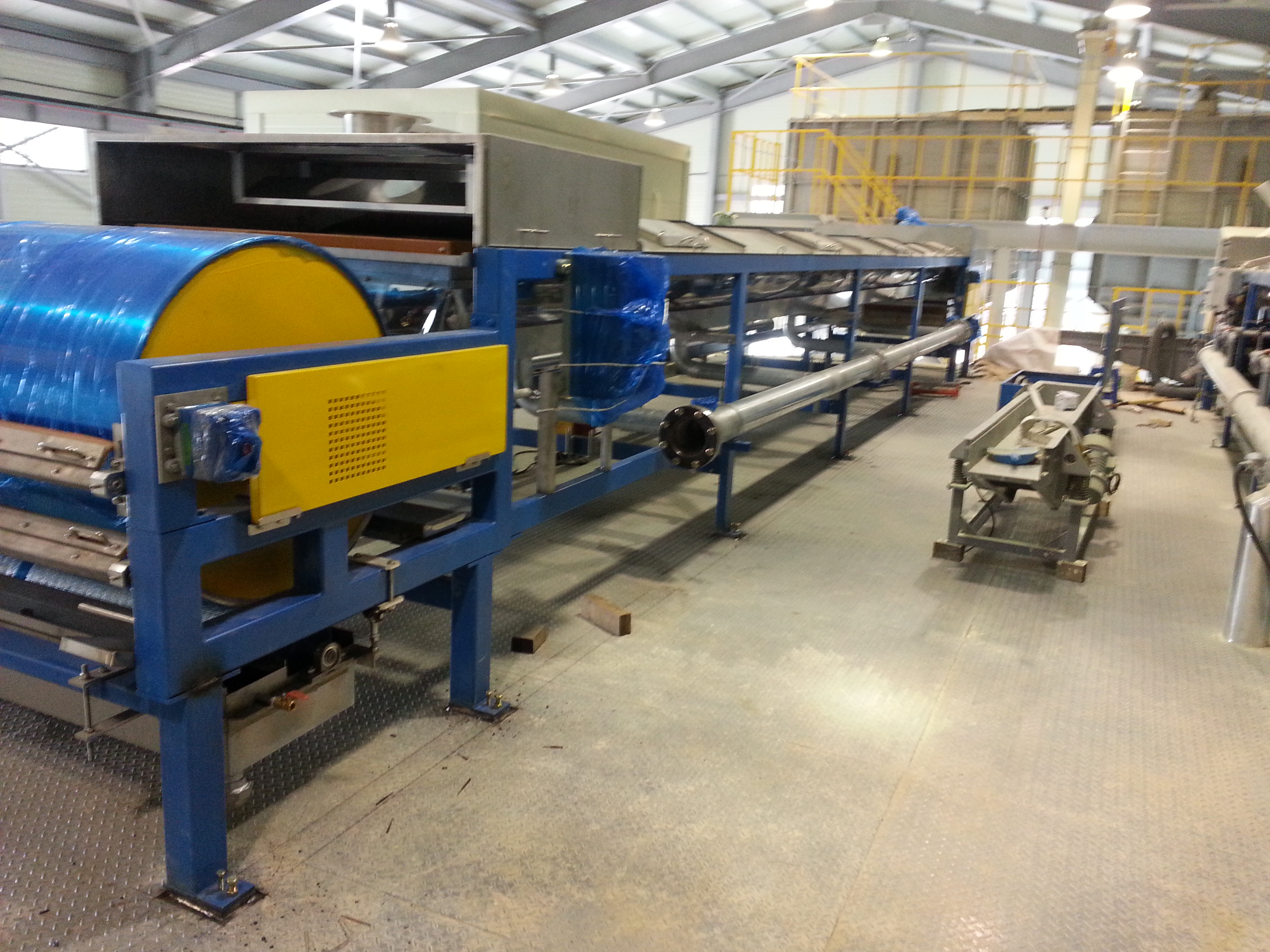
Sulphur pastillator duty: carbon steel grades are typically specified for pastillation and cooling, while aggressive chemical streams shift the specification toward stainless or special requirement steel belts.
Food processing, baking and oven lines
Steel belt bakery tunnel ovens, steel belt steam ovens, chocolate steel belt conveyors, steamed cake production lines, crab stick molding machines and general food-grade conveyors are governed by hygiene compliance, thermal uniformity and dimensional stability rather than chemical resistance. Stainless steel belts in 304/316L are specified here for high strength, high flatness, food-grade hygiene and thermal conductivity, with carbon belts used where baking duty does not require the stainless grade.
One food group has accumulated more than 120 belts, with individual factories running 5–15 belts in widths of 600–2,000 mm on tunnel ovens, cooling lines and food-grade conveyors for cookies, bread and pastries. Reported service life is 3–5 years, with some lines exceeding 6 years. Against imported belts, cost reduction is stated at 35%–50% with delivery shortened from roughly three months to 2–4 weeks. Elongation is held at ≤ 0.2%, no debris is produced, weld fatigue life reaches at least 2 million cycles, and downtime maintenance is reduced by 60%.
Original equipment manufacturing and precision positioning
Equipment builders buy belts differently from end users. A baking equipment manufacturer procuring 50–80 belts a year in widths of 400–1,800 mm integrates the belt into self-produced tunnel ovens and cooling lines as standard equipment. Belts and machines are designed together, which makes installation straightforward and holds the after-sales failure rate below 1%, with 24–48 hour local response maintenance and customer satisfaction recorded at 96%. Compared with buying imported steel strips, the overall machine cost falls by 20%.
At the opposite end of the precision spectrum, a high-end cosmetics packaging group uses more than 15 belts of 8–12 m length, 100–300 mm width and 0.6–1.0 mm thickness for high-speed automated assembly of pump heads, bottle caps and syringe components. Hole position accuracy is ± 0.01 mm, 10 m cumulative tolerance is below 0.05 mm and repeat positioning accuracy is ± 0.05 mm. The belts replaced US-imported strips, reducing cost by 45% and shortening delivery from 12 weeks to 3 weeks; rigidity is high with no elastic deformation, transmission efficiency is at least 98% and capacity increased by 15%.
High-temperature and cleanroom-adjacent duty
A new energy materials producer operating lithium battery and diaphragm lines uses more than 10 belts in widths of 1,000–1,500 mm and thicknesses of 0.8–1.5 mm on pole drying and curing lines and on diaphragm cooling and conveying, at 160–200 °C in a Class 1000 dust-free environment for 2–4 years. The belts run oil-free and dust-free and are easy to clean. Thermal conductivity of 15–20 W/m·K is credited with a 25% increase in drying efficiency and an 18% reduction in energy consumption; dimensional stability prevents pole deformation and raises yield by 2%–3%.
Duty beyond the standard range — press steel belts, casting coating steel belts, wood OSB press belts and other specialized configurations — falls into the special requirement family, where 1100 °C resistance, deep-cold performance, oil-water resistance and chemical corrosion resistance are engineered rather than ordered from a catalogue.
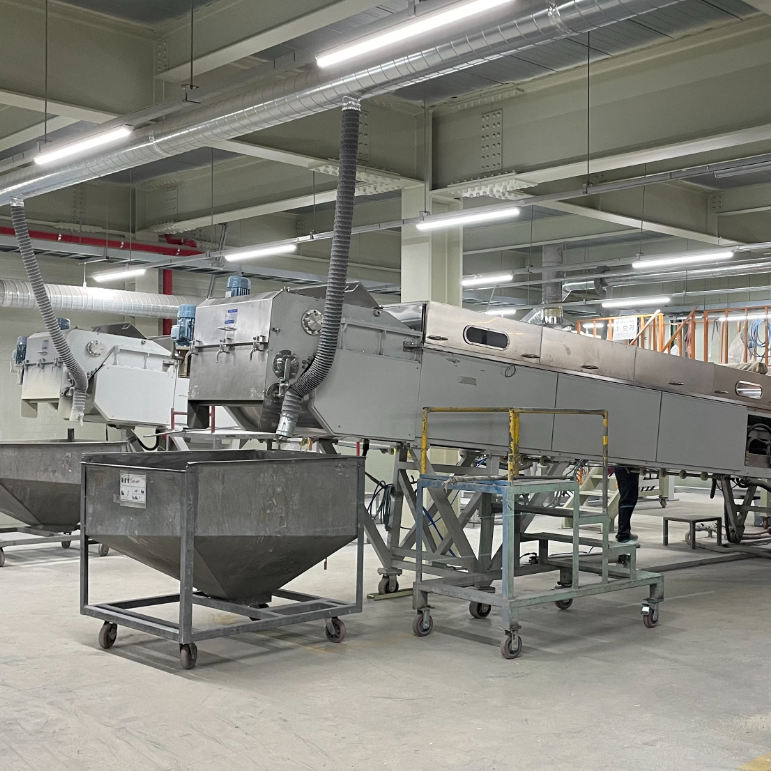
Powder coating flaking duty: PTFE costing steel belts are specified where release behaviour drives yield, while special requirement belts cover high-temperature and corrosion duty.
Market Trends Reshaping Global Sourcing
Four trends are visibly reshaping how buyers compare steel belt options across markets. None of them favours a single country or a single supplier; each changes what a buyer must verify.
1. Volume growth raises the value of replacement responsiveness. The steel belt conveyor belt market is expected to grow at a CAGR of 6.7% from 2026 to 2034, expanding from USD 1.75 billion in 2025 to USD 3.15 billion by 2034 (Research and Markets). Integrated steel belt systems, including coolers, flakers and pastillators, were valued at USD 1.2 billion in 2025 (HTNXT Market Analysis). Where installed bases mature, the buying decision shifts from project procurement toward replacement procurement, where lead time dominates economics. A 7–10 day standard lead time and a 15–20 day customized lead time sit on a different planning horizon from the 8–16 week import benchmark.
2. Upstream export scale has not removed conversion bottlenecks. China's steel product exports of 110.7 million tons in 2024, valued at approximately USD 83.6 billion (General Administration of Customs China), indicate deep raw-material and strip supply. The constraint is downstream: precision welding, flatness control, coating and inspection capacity. Buyers who track upstream tonnage alone may misjudge how quickly a customized belt can actually be delivered.
3. Standards and food-contact rules are consolidating specification practice. EN 12882:2015 governs electrical and flammability safety for steel belts in EU general-purpose conveyors, while EC 1935/2004 and FDA regulations govern food contact materials. As these requirements are written into line qualification documents, material families become pre-filtered before commercial comparison begins, and documentation quality becomes a competitive factor equal to price.
4. Technology specialization is splitting the market by duty, not by geography. The high end of the market is characterized by integrated steel belt system providers such as IPCO (formerly Sandvik Process Systems) and Berndorf Band Group, alongside regional integrated solution providers such as BPS/EPS in Asia-Pacific that combine proprietary belt production with process line design. Specialization now runs along application lines — non-stick coatings for release-critical duty, high-hardness alloys for press and casting duty, precision punching for automated assembly — rather than along national lines.
Trade policy and export regulation remain a live planning variable in any cross-border belt procurement, because duty treatment, rules of origin and conformity documentation change landed cost and clearance time. Because those parameters change by market and by year, they should be modelled as a scenario input in the sourcing comparison rather than used as a fixed assumption about any origin.
Comparison with Traditional Sourcing Approaches — and Where Each Option Stops Working
Traditional steel belt sourcing follows one of three patterns: buy a stock size from a distributor and replace on failure; standardize one grade across all lines to simplify purchasing; or default to imported belts on the assumption that import equals reliability. Each pattern has a defensible logic, and each has a defined boundary.
Stock-size replacement. This minimizes administrative effort and works well when the line is genuinely standard. Its boundary is dimensional match: where the original belt was supplied as part of an integrated line design, a stock substitute may satisfy grade and size while failing flatness, weld quality or hole positioning, which shows up later as tracking deviation or premature weld fatigue.
Single-grade standardization. Purchasing fewer part numbers reduces inventory complexity. Its boundary is process diversity. A single family cannot simultaneously serve a 180–220 °C chemical flaking line, a food-contact baking line and a ± 0.01 mm precision assembly line. The four families described above exist because those constraints are mutually incompatible.
Default to imports. The logic is a known reference standard and established documentation. Its boundary is time and total cost. The reference lead time for imported belts is 8–16 weeks, against 7–10 days for regular specifications and 15–20 days for customized specifications from an integrated regional producer. Imported belts remain an appropriate reference point for qualification, but they are not automatically the lower-risk option when a line is down.
Equally, each belt family has a boundary that buyers should state explicitly in the specification rather than discover in production.
- PTFE costing steel belts are not a universal upgrade. Their value comes from an extremely low surface friction coefficient that resists adhesion of chocolate, syrup, paste, colloid and powder. That same property means the belt is not the right choice where the process depends on product grip or traction, and where heavy abrasion coincides with temperatures beyond the coating's stable operating window, coating wear accelerates and shortens the service interval. The substrate provides strength and stability; the coating provides release.
- Carbon belts do not carry alloy corrosion resistance. The specified chemistry (C 0.65–0.75%, Si 0.15–0.3%, Mn 0.60–0.90%, Cr max 0.20%) is a plain carbon composition. Where process streams are chemically aggressive, the specification should move to stainless steel belts or special requirement steel belts rather than extending carbon belt service life through operating adjustments.
- Special requirement belts lengthen the qualification timeline. Material, size and hole-position customization pushes lead time to 15–20 days and requires defined drawings, because features such as punching, slotting, flanging, guide-edge blocking and sectional thickening must be validated before series supply.
- Service density is geographically uneven. The BPS/EPS service structure comprises a Shanghai headquarters maintenance centre, Beijing and Taiwan service centres, and overseas agents in Europe and Southeast Asia, with 24-hour online response, 48-hour on-site service domestically, a 12-month warranty against non-human damage and a stated service life of 2–5 years. Buyers outside those service regions should plan spare part stocking and remote support in advance rather than assume on-site coverage.
Future Outlook: What Macro Trends Mean for a Sourcing Comparison
If the market expands from USD 1.75 billion in 2025 to a projected USD 3.15 billion by 2034 at a 6.7% CAGR, the practical consequence for buyers is not simply more suppliers. It is a wider spread between the fast and slow ends of the supply chain, and a larger penalty for specifying the wrong material family.
Three planning conclusions follow from the evidence above.
First, evaluate on availability, compliance and engineering response rather than on origin. The declared comparison between 7–10 day standard delivery, 15–20 day customized delivery and an 8–16 week import benchmark is a planning fact that can be verified against a buyer's own maintenance windows.
Second, qualify at least two material families for every critical line. A plant running only carbon belts has no fallback when a chemical stream changes; a plant running only imports has no short-cycle option when a belt fails mid-campaign. Qualification performed in advance is what converts a 15–20 day customized lead time into an actual recovery path.
Third, write acceptance criteria into the purchase order before the belt is ordered. Appearance and dimensional acceptance, quality acceptance criteria, an objection handling procedure, and installation and usage acceptance are all definable in advance, as are payment terms of 30% advance with 70% before shipment, and delivery options spanning home delivery, express for small items and samples, customer pickup, and export delivery on FOB Shanghai or CIF terms.
Steel belt sourcing comparisons are most useful when they separate what is verifiable — material chemistry, tolerances, flatness, lead times, standards and stated service life — from what is asserted. On that basis, carbon, stainless, PTFE costing and special requirement belts are not competing answers to the same question. They are four different answers to four different process questions, and the buyer's task is to identify which question the line is actually asking.
FAQ
What can be customized in an industrial steel belt specification?
Customization spans four dimensions. Material: 304 or 316L stainless steel, 718 nickel-based alloy, and carbon steel in food-grade, chemical-grade or high-temperature-resistant grades. Geometry: width from 100 to 2,200 mm at any width, thickness from 0.4 to 3.0 mm (commonly 0.6, 0.8, 1.0, 1.2, 1.5 or 2.0 mm), and any length, including seamless welding into a circular shape with a maximum single strip length exceeding 50 m. Surface and features: mirror, brushed, polished or frosted finishes, food-grade anti-stick coating, no burrs or scratches, plus punched or slotted details such as positioning holes held to ± 0.01 mm, guide bars, baffles, fixture installation positions and vacuum or ventilation holes. Process treatment: weld leveling, stabilization treatment for internal stress relief, anti-deviation treatment, and special processes for high-temperature or corrosion-resistant duty. The production mode is described as OEM plus ODM dual capability, predominantly ODM for non-standard lines.
How do tolerance, flatness and weld quality translate into line performance?
Declared tolerances are thickness ± 0.02 mm, length ± 0.05 mm per 10 m, and flatness ≤ 0.02 mm/m. Flatness governs layer uniformity on cooling and flaking duty, which is why one chemical processor reported uniform layer thickness and a yield rate of 99.7%. Weld integrity governs fatigue life: circular welds are the stress point of an endless belt, and weld leveling with smooth polished seams extends the interval between interventions, with one food application reporting weld fatigue life of at least 2 million cycles and a 60% reduction in downtime maintenance. Stabilization treatment relieves internal stress introduced by welding and forming, which is why a belt that measures correctly on delivery can still drift if that step is omitted. On precision duty, positioning holes held to ± 0.01 mm and 10 m cumulative tolerance below 0.05 mm support repeat positioning accuracy of ± 0.05 mm.
Which belt family fits which process environment — carbon, stainless, PTFE costing or special requirement?
Carbon belts suit baking and other food factory lines and chemical pastillation and cooling duty, where carbon steel grades such as Sandvik 1300C or equivalent are typically used. Stainless steel belts suit chocolate and candy cooling conveyors and food-grade conveying, where high strength, high flatness, hygiene and thermal conductivity matter. PTFE costing steel belts suit sticky and viscous products such as chocolate, syrup, paste, colloid and powder, where extremely low surface friction and clean release drive yield, and where resistance to acid, alkali and oil is required. Special requirement steel belts suit high-temperature duty up to 1100 °C, deep-cold, oil-water and chemical corrosion conditions, and press, casting coating or precision positioning applications. The same logic applies at equipment level: sulphur and wax pastillators, single-belt resin flakers and double-belt resin cooling flakers, epoxy and polyester steel belt coolers, powder painting steel belt flakers, bakery tunnel ovens, steam ovens, chocolate conveyors, steamed cake lines and crab stick molding machines each impose a different dominant constraint.
How do lead times and minimum order quantities compare between localized customization and imported belts?
Regular specifications using stock material and standard size are quoted at 7–10 days, customized specifications involving material, size or hole position at 15–20 days, and urgent requirements at 5–7 days with an additional fee. The stated import benchmark for comparison is 8–16 weeks. Minimum order quantity is one piece for standard steel strip with no minimum order value, and one piece for customized steel strip, with small-batch trial orders supported. Capacity is declared at 80–120 pieces per month calculated on a width of 1,000 mm and a length of 10 m, rising to 150 pieces per month for small specifications. Delivery options include home delivery, express for small items and samples, customer pickup, and export delivery on FOB Shanghai or CIF terms, with payment terms of 30% advance and 70% before shipment.
What should be verified at acceptance before a steel belt purchase is closed?
Acceptance covers four checkpoints: appearance and dimensional acceptance, quality acceptance criteria, an objection handling procedure, and installation and usage acceptance. These map to the supplier's own inspection stages. Incoming quality control includes material spectral analysis, thickness, hardness and tensile strength testing, and surface defect inspection. In-process inspection covers full dimensional tolerance verification, flatness and straightness testing, and weld appearance review. Buyers should also confirm the warranty position — 12 months against non-human damage — the stated service life of 2–5 years, and the after-sales structure of 24-hour online response and 48-hour domestic on-site service, including whether the buyer's region is covered by a service centre or an overseas agent.
Reference material for technical evaluation: the BPS/EPS English-language product brochure, covering steel belt specifications and process system data, is available for download at BPS/EPS English product brochure. Manufacturer information: Shanghai Biquick Process Systems Ltd., No.172 Xuanchun Road, Xuanqiao Town, Pudong New District, Shanghai, China; website www.esptek.cn.