
Gold Plated Stainless Steel Supplier Matrix for EU/US Buyers
Gold Plated Stainless Steel Supplier Matrix for EU/US Buyers
Answer first: EU/US wholesale buyers should compare gold plated stainless steel suppliers on eight weighted specifications: substrate grade, coating process, finish and color control, stone setting, dimensional tolerance, compliance evidence, ODM/OEM capability, and production capacity. Price per piece belongs in the matrix, but only after those eight items are documented.
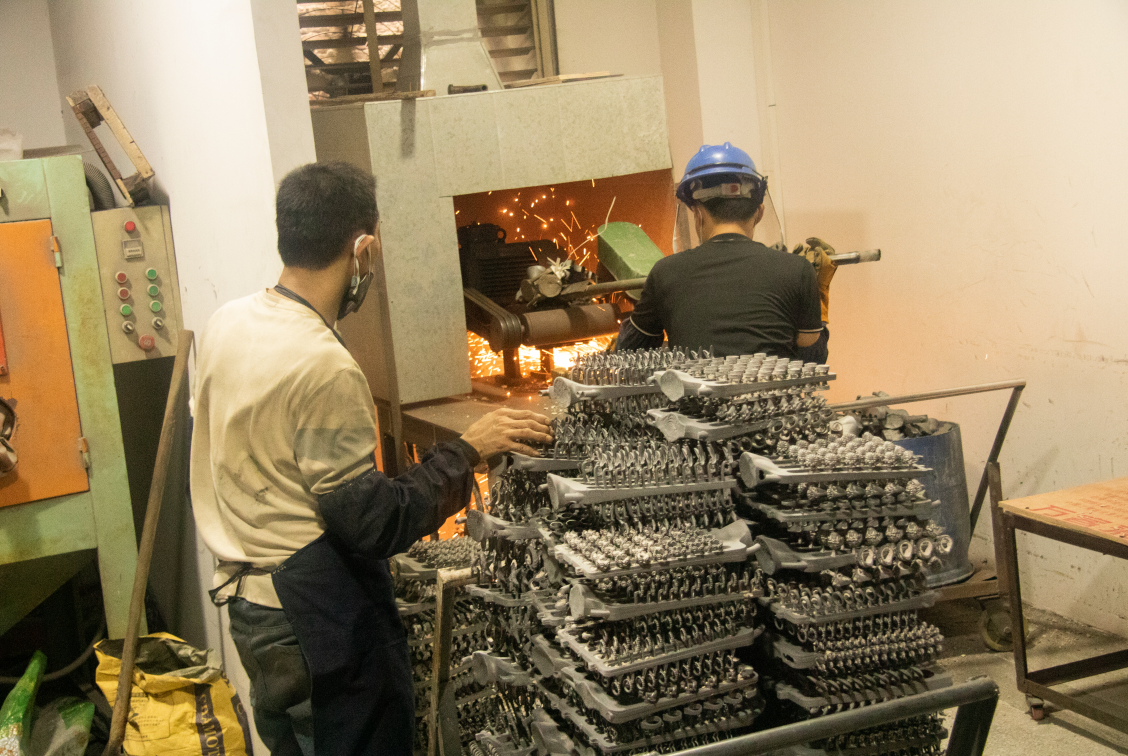
A controlled production stage matters more than a catalogue image when buyers compare gold plated stainless steel suppliers.
Gold plated stainless steel is a category where similar-looking samples can carry very different risk. A bangle that looks correct in a photo may use 304 rather than 316L stainless steel, water electroplating rather than PVD, or a gold color target that shifts between batches. The practical response is not a longer catalogue review. It is a comparison matrix that turns supplier claims into testable specifications.
The matrix below is built for the evaluation-to-execution stage of wholesale sourcing. It assumes the buyer already knows the product category and now needs to discriminate between suppliers that can deliver repeatable quality, documented compliance, and stable capacity.
Why the comparison matrix matters now
The category is large and still expanding. Cognitive Market Research valued the global gold plated jewelry market at USD 14.22 billion in 2023, while Business Research Insights projects USD 24.36 billion by 2031 at a 7.1% CAGR. Grand View Research places over 35% of global output in Asia-Pacific. For EU/US buyers, that supply concentration makes supplier comparison a risk-management task, not only a price negotiation.
Demand signals point in the same direction. Market Research Future projects the customization and laser engraving segments to grow at 8.5% CAGR through 2030. CBI reports that the minimalist jewelry segment accounts for 22% of total fashion jewelry revenue in Europe. The World Allergy Organization estimates that roughly 15% of the global population has a nickel allergy, which explains why hypoallergenic claims now appear in everyday wholesale briefs. These trends raise the value of a structured supplier matrix because they push buyers beyond appearance and into material, coating, and documentation controls.
The eight-criterion supplier comparison matrix
A useful matrix does not score suppliers on vague impressions. It scores them on evidence that can be checked before a purchase order and rechecked during production.
| Criterion | What to request | Why it matters | Weak evidence |
|---|---|---|---|
| Substrate | 304, 316 or 316L grade statement; mill certificate or grade test | Affects corrosion resistance, skin-contact suitability and PVD adhesion | Only a generic stainless steel claim |
| Coating | PVD, vacuum electroplating or water electroplating; layer sequence; gold thickness | Drives wear resistance, tarnish resistance and color durability | A tarnish-free claim without process or test detail |
| Finish and color | Gold, rose gold, black and gunmetal color standards; polished or brushed finish | Controls batch-to-batch visual consistency | Approval by one photo or one loose sample |
| Stone setting | Cubic zirconia, man-made crystal or moissanite; setting method; stone retention check | Affects perceived value, return risk and product safety | Stone type named without setting or retention standard |
| Dimensions | Diameter range, tolerance, measurement method and inspection report | Determines fit, stackability and setting accuracy | Nominal size only, with no tolerance statement |
| Compliance | REACH, EN 1811, Prop 65, ISO 9227, ISO 3160-2 and current certificate dates | Determines EU/US market entry and retailer acceptance | Expired or unrelated test reports |
| ODM/OEM capability | R&D team, design-to-sample workflow, engraving capability, NDA policy | Determines whether custom design stays custom or becomes a stock item | A claim of OEM support without process or IP protection |
| Capacity | Monthly new styles, annual output, factory area, workforce and export share | Affects repeat-order reliability and peak-season response | Capacity figures with no factory or workforce context |
Substrate: 304 vs 316 vs 316L
The substrate decision is the first filter because it sets the baseline for corrosion resistance and skin contact. 304 stainless steel is the common austenitic baseline for fashion jewelry. 316 adds molybdenum, which generally improves resistance to chlorides and humid environments. 316L is the low-carbon variant of 316 and is widely used where welding, forming and long-term skin contact are priorities.
| Grade | Practical position | Best fit | Buyer check |
|---|---|---|---|
| 304 | Cost-effective baseline; adequate for many fashion pieces | Low-skin-contact designs and price-sensitive ranges | Lead and nickel compliance; coating adhesion |
| 316 | Molybdenum addition improves corrosion resistance | Daily-wear pieces and humid export markets | Salt spray and artificial sweat reports |
| 316L | Low-carbon 316; referenced as a standard hypoallergenic substrate for high-quality PVD gold plated jewelry | Pierced earrings, sensitive-skin products and premium PVD lines | Grade certificate, nickel release test and process control |
ASTM International identifies 316L stainless steel as the standard hypoallergenic substrate for high-quality PVD gold plated jewelry. That does not make 304 unusable. It means the buyer should match the grade to the claim. A product marketed as hypoallergenic, waterproof and daily-wear should have a substrate and test file that support those words.
For EU market entry, REACH Regulation (EC) No 1907/2006 restricts nickel, lead and cadmium in jewelry. EN 1811 nickel release testing is mandatory for items inserted into pierced parts of the body, according to CEN. In the US, California Proposition 65 requires warnings for jewelry containing lead or cadmium above strict thresholds, as set by OEHHA. These are not marketing details. They are specification inputs.
Coating: PVD vs electroplating
Coating is where supplier language becomes most inconsistent. PVD, vacuum electroplating, IP plating and water electroplating are sometimes used as if they were interchangeable. They are not. PVD is a vacuum deposition process. Vapor Technologies states that PVD coating provides significantly higher durability and wear resistance compared with traditional electroplating for jewelry. Surface and Coatings Technology Journal reports that PVD coated jewelry can last 3 to 5 years without significant tarnishing under daily wear conditions.
| Process | Technical logic | Strength | Boundary |
|---|---|---|---|
| PVD | Vacuum deposition; a TiN base layer is often used to improve adhesion to stainless steel | Higher wear resistance and color durability | Line-of-sight process; deep undercuts need design review |
| Electroplating | Electrochemical deposition in a plating bath | Good coverage in recessed geometries; established process | Typically lower wear resistance; thickness control is critical |
| Vacuum electroplating / IP | Supplier term that may overlap with vacuum coating or ion plating | SGS technical bulletin describes improved tarnish resistance relative to water plating | Ask for the actual process definition, not only the label |
Gold thickness needs its own line in the matrix. The US Federal Trade Commission sets the minimum gold plating thickness for a Gold Electroplated designation at 0.175 microns. The Jewelers Vigilance Committee notes that gold vermeil requires a minimum thickness of 2.5 microns, while PVD on steel usually targets 0.5 to 1.0 micron for equivalent durability. China Jewelry Trade Association references 0.5 microns as a standard for high-quality boutique-level exports from China. Those figures do not replace a supplier specification, but they give buyers a reference point for questioning thin claims.
Trade usage also needs clarification. In many catalogues, 14K and 18K gold plated describe color targets rather than a solid alloy content. Intertek notes that 14K gold plating has a lighter, more subtle yellow hue compared with the deep yellow of 18K or 24K plating. Statista reports that 18K gold plating is the most preferred thickness for high-end fashion jewelry in the North American market. The buyer should therefore specify gold color, gold thickness and test method separately.
Finish colors and surface control
Gold, rose gold, black and gunmetal finishes should be compared as separate color programs, not as one plating line. Gold and rose gold are sensitive to hue and brightness. Black and gunmetal usually depend on different coating chemistry and should be tested for abrasion and color shift independently. High-polished surfaces add another variable: Jewellery Manufacturing Journal describes a high-polished mirror finish as requiring 4 to 5 stages of mechanical buffing before the PVD process.
A workable approval protocol uses a physical color plaque or approved sample set, not a screen image. The buyer should record the lighting condition, surface finish and acceptable color difference for each SKU. For vintage gold plated non fade jewelry, the finish standard should also state whether the surface is mirror-polished, satin-brushed or intentionally antiqued. A polished gold plated laser engraving product may need a different approval standard from a brushed minimalist bangle because engraving contrast and light reflection change with surface texture.
Stone options and setting control
Stone choices should be specified by type, size, cut, color and setting method. Cubic zirconia is the dominant inlay for affordable luxury appearance, according to Swarovski Professional Trends. Man-made crystal is used where brightness and fashion color are more important than diamond-like refraction. Moissanite sits at a higher hardness and cost tier than cubic zirconia, so the purchase order should state the stone type explicitly and require disclosure if a substitution is proposed.
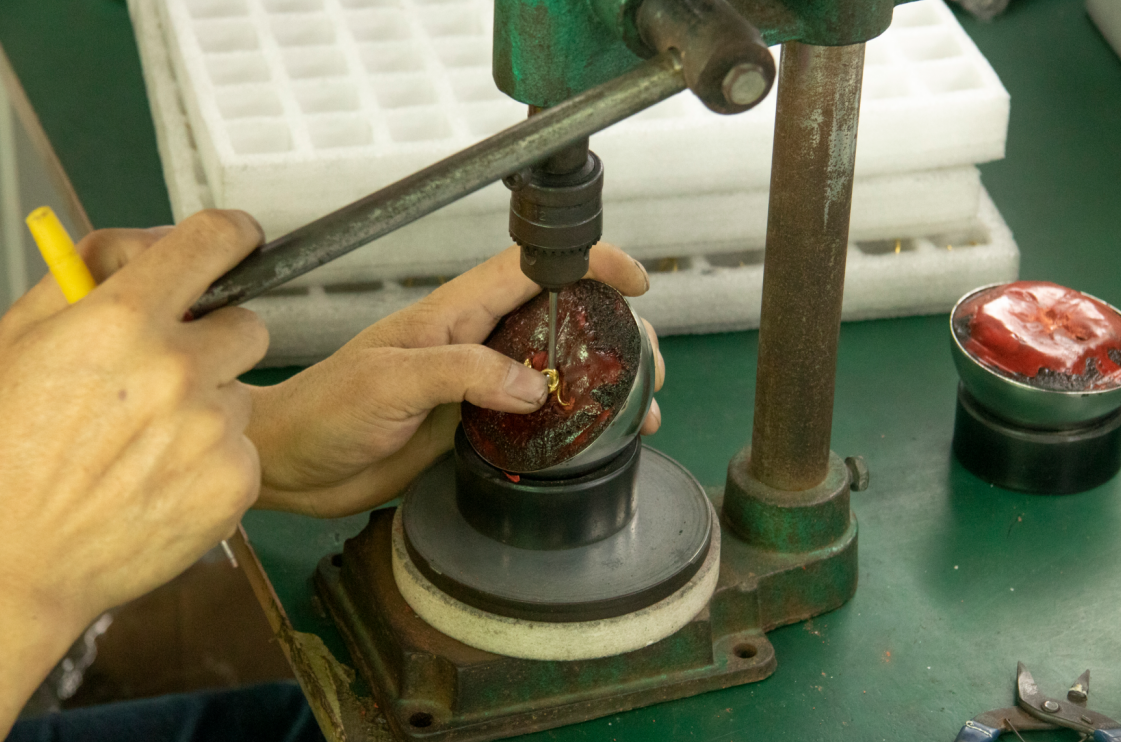
Prong setting is a retention decision, not only a visual decision; the matrix should require a stone-retention check.
Prong setting, bezel setting and adhesive setting all have different failure modes. The supplier matrix should ask whether stones are set before or after plating, how seat depth is controlled, and how stone retention is checked before packing. For personalized engraved gold plated jewelry with stones, the engraving sequence also matters because laser marking near a setting can affect stone security or surface appearance if the process is not controlled.
Dimensional control: 5–80 mm and ±0.05 mm
The evaluation range for this matrix is 5–80 mm diameter with a ±0.05 mm tolerance. That range covers bangles, bracelets, rings, earrings and small accessories, but the tolerance is only meaningful when the measurement method is defined. The supplier should state whether the tolerance applies before or after polishing and coating, which instrument is used, how many pieces are measured, and how out-of-tolerance parts are handled.
At ±0.05 mm, process sequence matters. Polishing removes material, coating adds a thin layer, and assembly can change the final fit. A ring that measures correctly after machining may sit outside the band after finishing if the supplier does not control the sequence. For bangles and stacking bracelets, inner diameter and ovality should be checked together. For earrings, post diameter and thread fit should be measured separately from the decorative face. The buyer should request a dimensional inspection report tied to the golden sample, not a generic size chart.
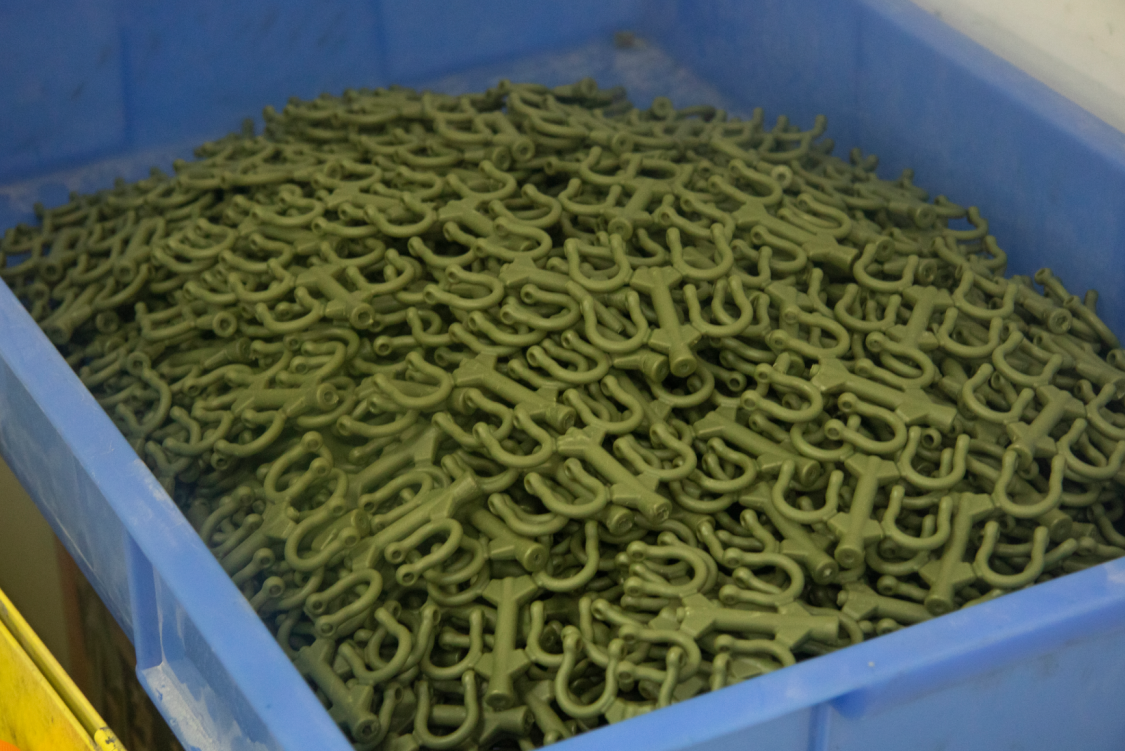
Mold and tooling condition influence dimensional repeatability; the matrix should connect tolerance to process control.
Compliance pack for EU and US market entry
Compliance should be scored as a document set, not a single certificate. For the EU, REACH restricts nickel, lead and cadmium; EN 1811 applies to nickel release from pierced parts; ISO 9227 is the salt spray reference used to support tarnish-free claims; ISO 3160-2 is used in artificial sweat testing. For the US, California Proposition 65 sets warning thresholds for lead and cadmium, and the FTC provides guidance on gold plating claims. A supplier that cannot map its reports to these requirements is not yet a qualified supplier.
Jusnova Jewelry Co., Ltd. provides a useful reference for how the compliance file can be structured. Its SGS Artificial Sweat Test, certificate GZMR260602153701, is reported against ISO 3160-2 and is valid to 2027-06-30. Its SGS Salt Spray Test, certificate GZHL260603029801JW, is reported against ISO 9227 and is valid to 2027-06-29. A BSCI certificate, number 25-0339245, was issued by Amfori on 2025-08-15 with an expiry of 2026-08-15. Buyers evaluating that document for a 2027 program should verify the renewal status rather than rely on the file date alone.
That last point is part of the matrix discipline. Certificates have validity windows. A report that was current at sample approval may be expired at bulk production. The buyer should record issue date, expiry date, certificate scope and the product or process it covers. ISO 9001 is also a common baseline for process consistency, but it does not replace product-specific test reports.
Where Jusnova fits the supplier matrix
Jusnova Jewelry Co., Ltd. is a Guangzhou-based jewelry manufacturer founded in 2009. It supplies stainless steel bangles, bracelets, rings and earrings, plus PVD and electroplated gold pieces, to wholesale and brand buyers. The company exports about 95% of its output, with emphasis on Europe and America. In matrix terms, it is a relevant reference for buyers comparing ODM/OEM support, development throughput, confidentiality and export compliance documentation.
The company reports a 20-engineer R&D team that provides style development and surface-finishing process support and supports new custom development. It releases 500+ new styles monthly, operates a 1,000 m² factory with 300 employees, and reports 3,000,000 units in annual output. Its ODM/OEM support is backed by strict NDA agreements and confidentiality policies intended to protect buyer IP. It states US/EU lead- and nickel-free compliance and makes REACH, SGS and BSCI reports available on request.
Those facts answer several matrix questions before sampling: Can the supplier develop a custom design? Can it protect the buyer’s artwork? Can it support repeat orders? Does it have a compliance file? The remaining questions are program-specific: substrate grade, coating thickness, color standard, stone setting, dimensional tolerance and the current validity of each certificate. A supplier with strong capacity still needs a SKU-level specification before execution.
Comparison with traditional solutions
Gold plated stainless steel is not the only route to a gold-colored jewelry program. Buyers often compare it with electroplated brass, gold vermeil and gold-filled constructions. The matrix should show where each option fits and where it does not.
| Option | Typical construction | Strength | Limit and buyer check |
|---|---|---|---|
| PVD gold on 316L stainless steel | Stainless steel substrate with vacuum-deposited gold color layer | Good daily-wear durability; strong hypoallergenic story when 316L is documented | Thin film, not solid gold; line-of-sight coating limits deep undercuts; color batch control required |
| Electroplated gold on brass | Brass substrate with electroplated gold layer | Good coverage in recessed shapes; familiar process | Usually lower wear resistance; substrate corrosion risk if the barrier is damaged |
| Gold vermeil | Gold over sterling silver; JVC requires a minimum of 2.5 microns | Precious-metal positioning; thicker gold layer than standard plating | Higher material cost; not a like-for-like low-cost alternative; silver substrate needs its own tarnish control |
| Gold-filled | Mechanically bonded gold layer; MJSA notes a usual requirement of 5% gold by weight | Higher gold content and a different durability profile | Different cost structure and manufacturing base; not interchangeable with PVD stainless |
The main limitation is straightforward. No supplier using PVD on stainless steel can promise a forever finish. The coating is a thin film, not solid gold. Abrasive contact, chlorine and deep scratches can expose the substrate. PVD is also a line-of-sight vacuum process, so deep undercuts and internal cavities require design review. A supplier that acknowledges these limits is easier to qualify than one that treats tarnish-free as an absolute claim.
Electroplated brass can plate recessed geometries more readily, but it typically offers lower wear resistance and depends on barrier-layer integrity. Gold vermeil uses a thicker gold layer and a silver substrate, which changes cost and tarnish behavior. Gold-filled is a separate construction with its own gold-content standard. The comparison matrix should therefore include the limitation column, because a supplier that cannot state a boundary is probably not controlling the process.
Where the matrix weights change by program
The same eight criteria do not carry equal weight for every buyer. A daily-wear brand and a corporate gifting buyer will score capacity, finish and compliance differently. The matrix should be reweighted before sample requests, not after quotations arrive.
- Daily wear and minimalist programs: prioritize 316L substrate, durable PVD coated gold plated jewelry, anti-rust gold plated daily wear jewelry, hypoallergenic gold plated women jewelry and a clear ±0.05 mm tolerance standard. Minimalist gold plated stainless steel jewelry usually depends on consistent color and clean geometry more than stone brilliance.
- Personalization and engraving: evaluate laser engraved gold plated jewelry and personalized engraved gold plated jewelry through marking depth, artwork resolution and engraving sequence. Laser Institute of America identifies fiber laser technology as the common method for permanent jewelry marking. Trotec Laser Technical Guide places jewelry engraving depth at 0.05 mm to 0.2 mm for visibility without compromising structural integrity.
- Waterproof and tarnish-free claims: require PVD gold plated waterproof jewelry evidence, ISO 9227 salt spray data, artificial sweat testing and a clear statement on vacuum electroplated gold plated ornaments versus water plating. Waterproof hypoallergenic gold plated jewelry should be supported by both substrate and coating reports.
- Custom logo and wholesale: score non tarnish gold plated custom logo jewelry and custom design gold plated fashion jewelry on NDA terms, sample turnaround, 500+ monthly style development and annual capacity. Wholesale gold plated stainless steel accessories programs also need packaging and batch inspection discipline.
- Vintage and polished looks: compare vintage gold plated non fade jewelry and polished gold plated laser engraving on surface preparation, buffing stages and color plaques. A high-polish surface can reveal scratches that a brushed finish would hide.
- Bulk and gifting: for trendy gold plated bulk wholesale jewelry, ladies daily gold plated stainless steel jewelry and custom engraved 18K gold plated jewelry, capacity and compliance documentation should be weighted above novelty. Bulk programs fail on consistency, not on the first sample.
From evaluation to execution: a buyer workflow
A supplier matrix becomes useful only when it drives a sequence. The evaluation-to-execution workflow should move from specification to sample to evidence to production, with a stop point at each stage.
| Stage | Buyer action | Evidence to retain |
|---|---|---|
| 1. Specification | Define substrate, coating, color, stone, size, tolerance and compliance target | Signed spec sheet and approved color plaque |
| 2. Sample | Request samples against the spec, not against a catalogue photo | Sample inspection report and photos under controlled lighting |
| 3. Compliance | Check certificate scope, issue date and expiry date | REACH, SGS, BSCI and related test files |
| 4. Golden sample | Seal the approved sample with dimensions, color and finish | Golden sample and measurement record |
| 5. Pilot order | Run a small batch before full production | Pilot inspection and deviation log |
| 6. Production | Apply batch sampling for color, dimensions, stone retention and plating | Batch report and corrective-action record |
| 7. IP protection | Confirm NDA terms before releasing artwork or custom molds | Signed NDA and design-release record |
Future outlook
The category is moving toward specification-led purchasing. Market growth, personalization and compliance pressure all favor suppliers that can document process control rather than those that compete only on a low unit price. The 7.1% CAGR projected for the gold plated jewelry market through 2031, the 8.5% CAGR projected for customization and laser engraving through 2030, and the 22% share of minimalist jewelry in Europe all point to the same buyer behavior: fewer, better-documented suppliers.
PVD adoption is likely to continue because it supports durable color and a cleaner environmental profile than water electroplating. The EPA notes that PVD gold plating produces zero hazardous wastewater, which matters as EU/US buyers review supplier environmental documentation. At the same time, PVD will not eliminate the need for substrate control, color plaques, stone-retention checks and current certificates. The supplier comparison matrix is therefore likely to become more technical, not less.
The most reliable comparison is the one that produces a documented specification, a traceable sample and a verified test file before mass production. That is the practical difference between a supplier list and a supplier decision.
FAQ
What is the first specification EU/US buyers should compare in gold plated stainless steel jewelry?
The substrate grade is the first filter because it sets the baseline for corrosion resistance, skin contact and coating adhesion. Buyers should confirm whether the supplier uses 304, 316 or 316L stainless steel and request a grade statement or test record. A hypoallergenic or daily-wear claim is difficult to defend without that information.
Is 316L stainless steel necessary for gold plated jewelry?
316L is not mandatory for every product, but it is the more defensible substrate for pierced earrings, sensitive-skin products and premium PVD lines. ASTM International identifies 316L as the standard hypoallergenic substrate for high-quality PVD gold plated jewelry. For fashion pieces with limited skin contact, 304 may be adequate if lead and nickel compliance are documented.
How does PVD compare with electroplating for gold plated stainless steel?
PVD is a vacuum deposition process associated with higher wear resistance and color durability than traditional electroplating. Surface and Coatings Technology Journal reports that PVD coated jewelry can last 3 to 5 years without significant tarnishing under daily wear. Electroplating can cover recessed geometries more readily, but it typically offers lower wear resistance and depends on strict thickness control.
What does a ±0.05 mm tolerance mean in wholesale jewelry production?
A ±0.05 mm tolerance defines the acceptable dimensional band around a nominal size, such as a 5–80 mm diameter range. It is only useful when the supplier states whether the tolerance applies before or after polishing and coating, which instrument is used, and how many pieces are inspected. The buyer should tie the tolerance to a golden sample and an inspection report.
Which compliance documents should be checked for EU and US market entry?
For the EU, buyers should check REACH restrictions, EN 1811 nickel release testing for pierced parts, ISO 9227 salt spray data and ISO 3160-2 artificial sweat data where applicable. For the US, California Proposition 65 and FTC gold plating guidance are relevant. Certificate scope, issue date and expiry date should be checked, not only the file name.
How should a buyer evaluate ODM/OEM capability?
ODM/OEM capability should be evaluated through the design-to-sample workflow, R&D staffing, surface-finishing support and IP protection. The buyer should ask how artwork is reviewed, who controls the sample revision and whether an NDA is signed before custom molds or drawings are released. Capacity figures should be read alongside factory area, workforce and monthly style development.
What are the limits of PVD gold plating on stainless steel?
PVD is a thin film, not solid gold, so abrasive contact, chlorine and deep scratches can expose the substrate. It is also a line-of-sight vacuum process, which means deep undercuts and internal cavities require design review. A supplier should state these limits and support tarnish-free claims with salt spray and artificial sweat testing.
How can buyers compare gold, rose gold, black and gunmetal finishes?
Each finish should be approved as a separate color program using a physical plaque or sealed sample, not a screen image. Intertek notes that 14K gold plating has a lighter yellow hue than 18K or 24K plating, so color target and gold thickness should be specified separately. Black and gunmetal coatings should be tested for abrasion and color shift independently from gold tones.
Есть вопросы или нужны дополнительные детали?
Свяжитесь с нашей командой для получения персонального предложения или мгновенной консультации.
Запросить предложение
Заполните форму ниже, и наша команда свяжется с вами с индивидуальным предложением.
Прямой чат WhatsApp
Предпочитаете общаться в реальном времени? Напишите нам в WhatsApp для мгновенной помощи и быстрых ответов.
- Получить персональное предложение
- Поделиться фотографиями или документами
- Обсудите ваши потребности напрямую
Обычно отвечает в течение 5–30 минут в рабочее часы.