
Golf Cart Battery Purchase Terms: 48V vs 51.2V vs 72V Acceptance Criteria
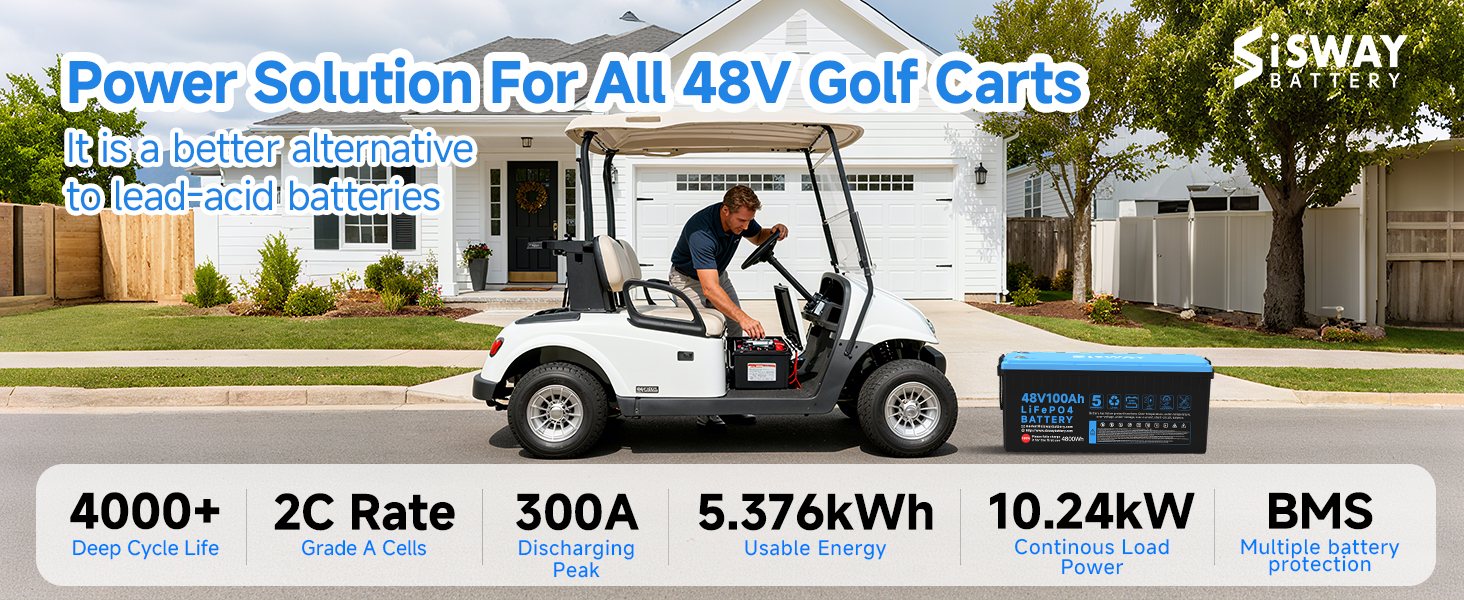
A golf cart battery purchase is normally negotiated on unit price, usable capacity and warranty length. The terms that decide whether a delivery can be accepted, however, are largely documentary — the test reports, management-system certificates and safety data sheets that travel with the product. Because those documents are issued against specific models and specific standards, the acceptance checklist for a 48V battery is not the same as the checklist for a 51.2V or a 72V battery.
The commercial backdrop explains why documentation has moved from an afterthought to a procurement variable. The global golf cart battery market reached approximately USD 1.49 billion in 2024 and is projected to reach USD 2.21 billion by 2030 at a CAGR of 6.8%, according to Strategic Market Research. North America accounted for 44.7% of electric golf cart revenue in 2024 (Grand View Research), and lithium-ion technology held roughly 47% of golf cart battery market revenue in the same year. As fleets move from flooded lead-acid to LiFePO4, buyers are being asked to approve deliveries against paperwork many of them have never had to read before.
The practical rule is to treat voltage class as the primary key to the document package. Three document families matter: transport safety evidence (UN 38.3 test reports and MSDS), manufacturing quality-system certificates (ISO 9001:2015 and its national equivalents), and scope statements that define what a certificate does and does not cover. A buyer who can place each document in one of those three families can immediately tell whether a certificate is relevant to the battery being purchased or only to the supplier's general operations.
What “Acceptance Criteria” Covers in a Battery Purchase
Acceptance criteria are the agreed conditions a buyer checks before releasing final payment and putting a battery into service. In LiFePO4 golf cart battery procurement they typically fall into four groups.
1. Transport and shipping documents
UN 38.3 certification is required for the safe global transport of lithium batteries, as set out by the United Nations and referenced by the U.S. Department of Transportation. An MSDS accompanies the shipment as the hazardous-material classification document. Both are model-specific: they describe a tested unit, not a supplier's entire catalogue.
2. Manufacturing quality-system documents
ISO 9001:2015 in its international form, or GB/T 19001-2016 in its Chinese national form, certifies that a manufacturer operates a documented quality-management system. This is evidence about process discipline across a facility. It is not a performance certificate for an individual battery.
3. Certification scope statements
Certificates are bounded. They name an organisation, a site, a product family or a process, and sometimes state explicit exclusions. Reading the scope line — not just the certificate number — is the step buyers most often skip.
4. Measurable product parameters
Documentation only supports a decision if it can be reconciled with the physical unit: nominal voltage, rated capacity, energy in watt-hours, BMS rating, peak discharge, case dimensions and weight. These are the parameters that determine whether the battery fits a given cart platform and duty cycle.
48V, 51.2V and 72V LiFePO4 Golf Cart Batteries at a Glance
Before the document discussion, it helps to see how far apart the three voltage classes are in engineering terms. The table below reflects the three LiFePO4 golf cart battery models referenced throughout this article.
| Parameter | 48V 100Ah | 51.2V 100Ah | 72V 105Ah |
|---|---|---|---|
| Nominal voltage | 48V | 51.2V (48V category, 58.4V system) | 73.6V |
| Rated capacity | 100Ah | 100Ah | 105Ah |
| Energy | 4800Wh | 5120Wh | 7728Wh |
| Max load / output power | 9.6kW | 5120W continuous | 14.72kW |
| BMS | Smart 200A | 200A | Smart 200A |
| Cell configuration | 15S1P, 15 cells, EV grade A LiFePO4 prismatic aluminium shell | — | 23S1P, 23 cells, EV grade A LiFePO4 prismatic aluminium shell |
| Continuous / peak discharge | 200A / 300A (2 sec) | 200A / 300A (3 sec) | 200A / 400A (10 sec) |
| Case and dimensions | Plastic lead-acid case, 20.55" × 10.55" × 8.74", 77 lbs | Metal casing, 625 × 505 × 360 mm | Metal casing, 558 × 333 × 300 mm, 138 lbs (63 kg) |
| Certification highlights | ISO 9001:2015; UN38.3 Test Report TSZ25H8045A01-01; MSDS No. TSZ25LL028A86-01 | Certification No. 24CN34504502Q under GB/T 19001-2016 / ISO 9001:2015; MSDS; UN38.3 | ACM INTERNATIONAL CERTIFICATION LIMITED certification for R&D and production of lithium-ion batteries, excluding 3C requirements |
| Cycle life | 4000+ cycles | ≥4000 cycles | 4000+ cycles @100% DOD; 6000+ cycles @80% DOD |
| Warranty | 5 years | 3 years | 5 years after-sales |
Two observations follow directly from the table. First, the 51.2V model sits inside the 48V golf cart battery category and is designed for 48V (58.4V) systems, so it is a system-compatible alternative rather than a fourth voltage class. Second, the largest case is not the highest-voltage one — the 51.2V unit measures 625 × 505 × 360 mm while the 72V unit measures 558 × 333 × 300 mm. Compartment fit must be checked model by model, not inferred from voltage.
The Document Package by Voltage Class
This is the section most purchase orders get wrong. Each voltage class carries its own document identifiers, and those identifiers should be written into the purchase agreement verbatim.
48V lithium golf cart battery
The 48V 100Ah golf cart battery belongs to the 48V Golf Cart Battery category, operates at a nominal voltage of 48V with a nominal capacity of 100Ah, and is designed as a drop-in replacement for lead-acid battery cases. Its acceptance package includes ISO 9001:2015 and the UN38.3 Test Report TSZ25H8045A01-01. For USA market compliance, the relevant document is MSDS No. TSZ25LL028A86-01. Buyers importing into the United States should treat the MSDS identifier as a line item on the purchase order rather than a document requested at shipment.
51.2V lithium golf cart battery
The 51.2V 100Ah model is a lithium golf cart battery classified under the 48V golf cart battery category, with a nominal voltage of 51.2V and an energy rating of 5120Wh. Its quality-system certification is No. 24CN34504502Q, issued under GB/T 19001-2016 / ISO 9001:2015. The same model is listed with MSDS and UN38.3 documentation. Because the certificate number is tied to the 51.2V model, buyers should not assume it extends to a 48V or 72V purchase from the same supplier.
72V lithium golf cart battery
The 72V 105Ah model is a LiFePO4 lithium-ion battery built as a replacement golf cart battery, with a nominal voltage of 73.6V, 105Ah capacity and 7728Wh of energy. Its certification is issued by ACM INTERNATIONAL CERTIFICATION LIMITED and covers the research, development and production of lithium-ion batteries, with 3C requirements explicitly excluded. The exclusion is the important detail: it defines the boundary of the certificate. The document supports claims about development and manufacturing capability for lithium-ion batteries; it does not purport to be China Compulsory Certification.
What Each Document Proves — and What It Does Not
Mismatched expectations between procurement and engineering usually trace back to a document being asked to prove something outside its purpose. The following table maps each document family to its legitimate use.
| Document | What it evidences | What it does not evidence |
|---|---|---|
| UN38.3 Test Report TSZ25H8045A01-01 (48V) | That the tested lithium battery passed the UN 38.3 transport safety test series required for global shipment | Field cycle life, cart compatibility, or the performance of a differently configured model |
| MSDS No. TSZ25LL028A86-01 | Hazard classification and handling information supporting USA market compliance and freight documentation | Capacity, power or durability of the battery |
| ISO 9001:2015 (48V package) | A documented quality-management system covering production processes | Individual unit test results or model-level performance data |
| Certification No. 24CN34504502Q (51.2V) | Quality-management certification issued under GB/T 19001-2016 / ISO 9001:2015 for the certified scope | Automatic coverage of other voltage classes or other manufacturing sites |
| ACM INTERNATIONAL CERTIFICATION LIMITED certification (72V) | R&D and production capability for lithium-ion batteries | 3C requirements, which are explicitly excluded from the scope |
Matching Acceptance Criteria to the Cart Platform
Documents confirm that a supplier can build and ship safely. They do not confirm that the battery will physically fit or charge correctly in a given cart. That check is mechanical and electrical, and it should be completed before the certificate review, because a supplier swap will invalidate the document set.
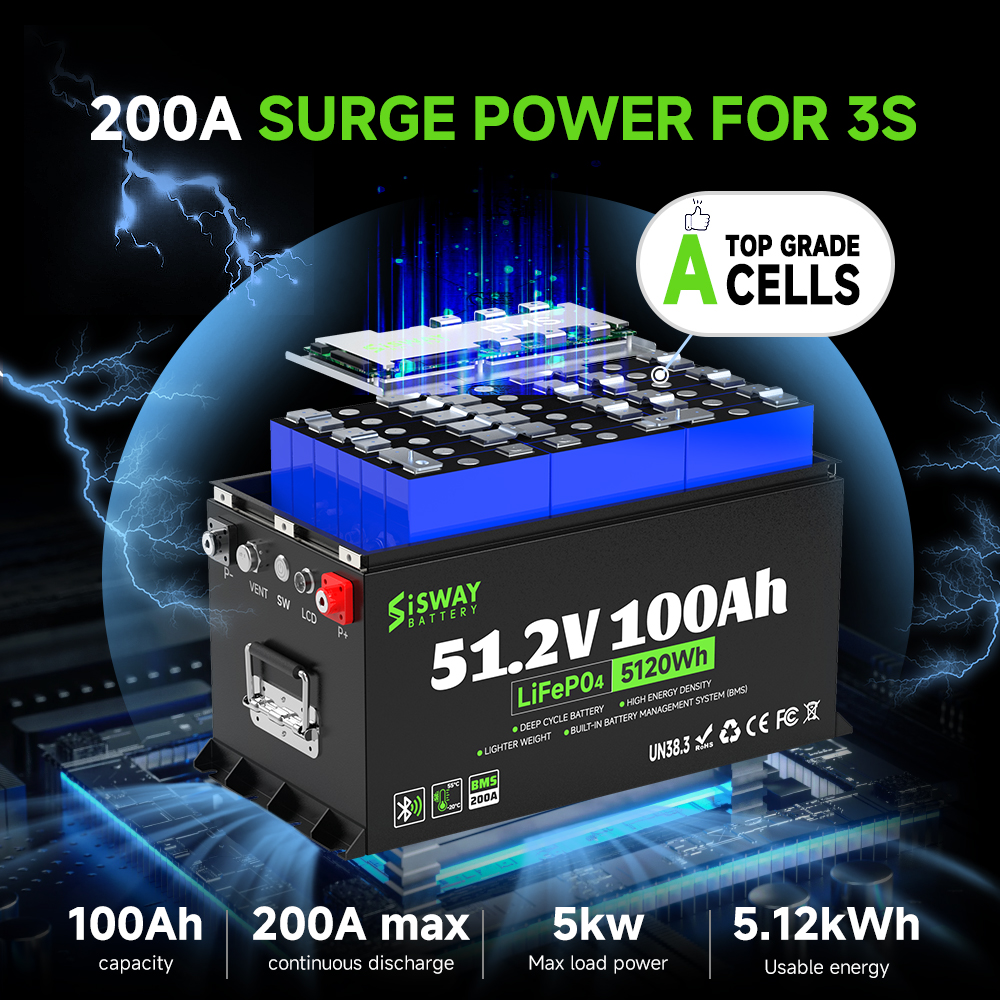
The BMS rating is one of the parameters an acceptance checklist should pin down: continuous discharge, peak discharge duration, and low-temperature cut-off behaviour.
Four platform checks matter for 48V, 51.2V and 72V replacements:
- System voltage and charger. The 51.2V 100Ah model is designed for 48V (58.4V) systems and uses a 58.4V charge voltage with a recommended charge current of 18A. Charging hardware must match the pack, not the cart's original lead-acid profile.
- Compartment dimensions. The 48V unit at 20.55" × 10.55" × 8.74" and the 72V unit at 558 × 333 × 300 mm occupy different footprints, and neither matches the 51.2V case at 625 × 505 × 360 mm.
- Weight and handling. A 48V 100Ah unit weighs 77 lbs; the 72V 105Ah unit weighs 138 lbs (63 kg). Handling and mounting plans should reflect that difference.
- Duty cycle and discharge profile. Continuous discharge is rated at 200A across all three models, but peak capability differs: 300A for 2 seconds on the 48V unit, 300A for 3 seconds on the 51.2V unit, and 400A for 10 seconds on the 72V unit. Hill-heavy courses and utility configurations load that peak figure differently.
Cart platforms such as Club Car, EZ-GO and Yamaha are commonly converted to lithium, and fitment varies by model year and body style. Measuring the compartment before ordering remains the fastest way to avoid a return that no certificate can prevent.
Supplier Capability Evidence Behind the Paperwork
Shenzhen Shiwei New Energy Co., Ltd. (Sisway Battery) is a lithium battery manufacturer established in 2017 that specialises in lithium iron phosphate (LiFePO4) battery packs for golf carts, UTVs, ATVs, forklifts, AGVs and home energy storage. Its main product line is golf cart batteries. According to company information, the manufacturer holds ISO 9001 certification alongside a portfolio of global certifications including CE, UL, UN38.3 and MSDS.
For procurement purposes, the capability facts are most useful when read as risk indicators rather than as credentials:
- 20,000 m² facility and 90,000-unit annual capacity. Capacity speaks to whether a supplier can absorb fleet-scale or dealer-scale orders without splitting production across subcontractors — a split that would complicate the model-specific certificate trail.
- Approximately 150 staff, including an R&D team of 25 engineers. Change requests, custom enclosure work and certification updates for a new model all require engineering hours. A 25-engineer team is the relevant indicator of whether document revisions and custom configurations are handled internally.
- 50% export share, with the USA as a major market. Export share indicates routine exposure to UN 38.3 and MSDS documentation requirements at shipment, which is the practical test of whether paperwork arrives complete or in pieces.
- Nine years in the lithium battery industry, focused on golf cart battery manufacturing. Category focus matters because golf cart packs are configured for deep-cycle duty, not for the discharge profiles of consumer electronics or passenger vehicles.
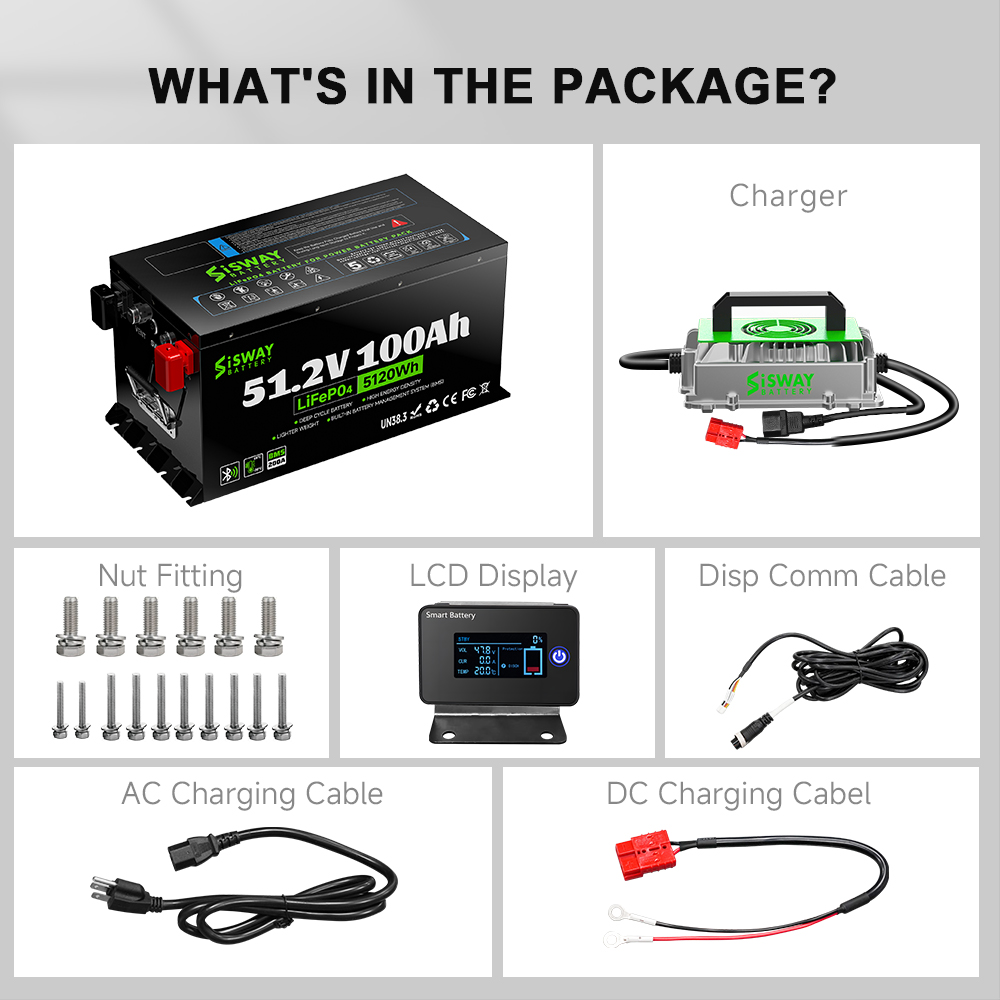
Delivery scope is part of acceptance. The 51.2V 100Ah kit is documented with a dedicated 58.4V 18A LiFePO4 charger matched to the battery's BMS over-voltage protection.
Application Fit: Fleets, Dealers and Refurbishment Projects
The three voltage classes map to different buyer types in practice. Golf course fleet upgrades, golf cart dealers and resellers, and refurbishment or customisation projects represent the main demand patterns for this category in the United States, with batteries specified for 4000+ deep cycles and BMS protection as standard operating expectations.
Operating temperature is the parameter that most often decides between models in outdoor deployments. The 51.2V 100Ah unit specifies charging from 0°C to 45°C and discharging from -20°C to 55°C, with storage from -20°C to 45°C, and includes low-temperature charge cut-off protection at 0°C ± 4°C. The 72V 105Ah unit specifies the same charging and discharging windows and adds an explicit low-temperature cut-off: charging is prevented below 32°F, resumes automatically at 41°F, and discharge is cut off below -4°F.
For a course in a cold-winter region, that behaviour belongs in the acceptance criteria as a functional requirement, not as a footnote. For a dealer reselling into mixed climates, it belongs in the handover documentation. A battery delivered without this information will generate support calls that the supplier's certificate package cannot answer.
Market Trends Reshaping Battery Purchase Terms
Several documented shifts are pushing documentation into the commercial negotiation itself.
- Lithium is now the default replacement technology. Lithium-ion batteries held approximately 47% of the global golf cart battery market share by revenue in 2024, and battery electric vehicles accounted for 72.5% of the U.S. electric golf cart market in the same year. The U.S. electric golf cart market was estimated at USD 529.4 million in 2024.
- Trade flows concentrate documentation risk. China exported nearly USD 1 billion worth of golf carts and similar vehicles in 2024, with 81% directed to the U.S. market. When the majority of a category moves through one export corridor, transport documents — UN 38.3 and MSDS — stop being optional extras and become the practical gate for shipment.
- Export controls are broadening. China's Ministry of Commerce issued Announcement No. 58 in 2025, regulating the export of high-energy-density lithium batteries at or above 300Wh/kg. Buyers should confirm whether a specific cell or pack specification falls inside such thresholds, since the classification is specification-dependent rather than category-wide.
- Demand is shifting toward larger carts. The 4-seater golf cart segment is the fastest-growing configuration, with an annual growth rate of 6.8%, and the Asia-Pacific golf cart battery market is the fastest-growing region at an estimated 6.9% CAGR.
Lithium vs Flooded Lead-Acid: What Changes in the Acceptance Conversation
The durability case for LiFePO4 is well documented: LiFePO4 batteries typically offer 2,500 to 9,000 cycles at 80% depth of discharge, while traditional flooded lead-acid batteries deliver approximately 300 to 500 cycles at 50% depth of discharge. That gap explains the migration, but it does not make the purchase simpler. It changes which risks the buyer must manage.
Three limitations belong in an honest evaluation:
- Upfront cost position. LiFePO4 packs typically carry a higher upfront purchase cost than flooded lead-acid equivalents of the same nominal system. Fleet buyers comparing a 4000-cycle pack against a 300–500-cycle pack should structure the comparison over the service period rather than on invoice value alone.
- Temperature management is a real constraint. Lithium charging is not permitted below freezing on these models. The 51.2V unit cuts off charging at 0°C ± 4°C; the 72V unit blocks charging below 32°F and resumes at 41°F. Lead-acid tolerates cold charging with reduced performance, so sites with unheated storage need a charging plan, not just a battery.
- Documentation overhead is higher. A lithium purchase arrives with a heavier document set — UN 38.3 test reports, MSDS, quality-system certificates and scope statements — and each document is model-specific. That overhead is manageable, but it requires the buyer to verify documents at order stage rather than at delivery.
One further limitation applies to all three voltage classes: certification coverage is not transferable. A certificate issued for the 48V 100Ah model, for example, does not automatically extend to the 51.2V or 72V models even from the same manufacturer, and a certificate covering R&D and production scope says nothing about 3C requirements. Buyers who assume otherwise create their own compliance risk.
Future Outlook
With the golf cart battery market projected to reach USD 2.21 billion by 2030 at a 6.8% CAGR, and with North America already accounting for 44.7% of electric golf cart revenue, the direction of procurement practice is fairly clear. Voltage class, model designation and document identifier will increasingly appear together on purchase orders, because that combination is the only reliable way to connect a delivered unit to the evidence that supports it.
Two developments are likely to accelerate the shift. First, as export controls and transport rules continue to evolve, documentation will behave more like a specification than an attachment. Second, as fleets standardise on a single voltage class to simplify spares and charger inventory, the acceptance checklist will become a repeatable template rather than a one-off project document. Suppliers that already maintain model-specific test reports, MSDS identifiers and scoped certifications — such as the UN38.3 Test Report TSZ25H8045A01-01 and MSDS No. TSZ25LL028A86-01 for the 48V battery, certification No. 24CN34504502Q for the 51.2V battery, and the ACM INTERNATIONAL CERTIFICATION LIMITED certification for the 72V battery — will be easier to audit, and easier to keep on an approved supplier list.
FAQ
1. What are acceptance criteria in a golf cart battery purchase?
Acceptance criteria are the agreed conditions a buyer checks before releasing payment and putting a battery into service. For LiFePO4 golf cart batteries they combine four groups: transport documents such as UN 38.3 test reports and MSDS, manufacturing quality-system certificates such as ISO 9001:2015, certification scope statements, and measurable product parameters including nominal voltage, rated capacity, energy, BMS rating, dimensions and weight. They are model-specific rather than supplier-wide.
2. Which documents should accompany a 48V LiFePO4 golf cart battery?
The 48V 100Ah golf cart battery belongs to the 48V Golf Cart Battery category, with a nominal voltage of 48V and a nominal capacity of 100Ah, and is designed as a drop-in replacement for lead-acid battery cases. Its document set includes ISO 9001:2015 and the UN38.3 Test Report TSZ25H8045A01-01. For USA market compliance, MSDS No. TSZ25LL028A86-01 is the relevant document. The UN 38.3 report addresses transport safety, while the MSDS addresses hazard classification and handling information for shipment.
3. How is a 51.2V golf cart battery certified?
The 51.2V 100Ah model is a lithium golf cart battery classified under the 48V golf cart battery category, with a nominal voltage of 51.2V and 5120Wh of energy, designed for 48V (58.4V) systems. Its quality-system certification is No. 24CN34504502Q, issued under GB/T 19001-2016 / ISO 9001:2015. The same model is also listed with MSDS and UN38.3 documentation. Because the certificate is tied to this model, it should not be assumed to cover a different voltage class from the same supplier.
4. Does the 72V battery certification include 3C requirements?
No. The 72V 105Ah golf cart battery carries an ACM INTERNATIONAL CERTIFICATION LIMITED certification covering the research, development and production of lithium-ion batteries, and the scope explicitly excludes 3C requirements. Buyers should read the exclusion as a scope boundary: the certificate supports claims about development and manufacturing capability for lithium-ion batteries, and it is not a statement of China Compulsory Certification.
5. Is a 51.2V battery interchangeable with a 48V battery?
Electrically, the 51.2V 100Ah model is classified within the 48V golf cart battery category and is designed for 48V (58.4V) systems, so it is intended as a compatible option for those carts with a 58.4V charge voltage and an 18A recommended charge current. Physically, it is not identical: the case measures 625 × 505 × 360 mm, which differs from the 48V 100Ah unit at 20.55" × 10.55" × 8.74" and 77 lbs. Compartment dimensions should be verified before ordering.
6. What supplier capability evidence should support a golf cart battery purchase?
Shenzhen Shiwei New Energy Co., Ltd., established in 2017, is a lithium battery manufacturer specialising in lithium iron phosphate (LiFePO4) battery packs for golf carts, UTVs, ATVs, forklifts, AGVs and home energy storage, with golf cart batteries as a main product line. Its manufacturing facility covers 20,000 square meters with an annual production capacity of 90,000 units, approximately 150 employees, and an R&D team of 25 engineers. Export business accounts for 50% of total sales, with the USA as a major market. Capacity figures indicate whether a supplier can support fleet-scale orders, while R&D headcount indicates internal capability for customisation and document revisions.
Reference material: the full specification set is collected in the Sisway Battery company brochure (PDF). Product and entity information is published at www.siswaybattery.com.