
Golf Carts Battery Guide: Types, Specs, and Market Trends
The golf cart battery is no longer a back-room replacement decision. As lithium iron phosphate (LiFePO4) packs replace traditional lead-acid units in growing numbers, buyers are facing a more complex set of choices: battery chemistry, voltage class, BMS capability, physical fitment, certification, and total cost over the battery's lifetime. For anyone at the beginning of the research process, the practical question is straightforward: what do the available options actually mean for a specific cart and usage pattern?
This guide provides a structured, buyer-oriented reference to the golf cart battery category. It covers the main battery types, the difference between 36V, 48V, and 72V systems, the specifications that matter most, verified market context, and the real-world limits buyers should consider before switching from lead-acid to lithium. Where production and product facts are cited, they come from Shenzhen Shiwei New Energy Co., Ltd. (Sisway Battery), a LiFePO4 battery manufacturer specializing in golf cart applications.
Why the Golf Cart Battery Category Is Changing
Golf carts have moved beyond fairways. They now operate in residential communities, resorts, hotels, industrial campuses, and municipal fleets. Electrification has reinforced this shift: according to Grand View Research, battery electric vehicles accounted for 75.4% of the global golf cart product type share in 2024, and 72.5% of the U.S. electric golf cart market. With electric carts accounting for the large majority of new vehicles, the battery pack has become the central component in both vehicle cost and maintenance planning.
For most owners, the pain point is the battery itself. Traditional flooded lead-acid batteries typically deliver only 300 to 500 cycles at 50% depth of discharge, according to industry data compiled by Boca EV. That translates into frequent replacements, regular watering, and steady performance decline under daily use. Meanwhile, LiFePO4 batteries typically offer 2,500 to 9,000 cycles at 80% depth of discharge, based on data from the Journal of the Electrochemical Society — a range that makes the upfront price gap easier to evaluate over a longer ownership period.
The market is responding. Lithium-ion batteries held roughly 47% of global golf cart battery revenue in 2024, according to Boca EV / Market Analysis. That still leaves a large installed base of lead-acid carts, which helps explain why golf cart battery replacement is currently one of the most active purchasing categories in the small-electric-vehicle segment.
A Manufacturing Reference: Sisway Battery
To understand what is available on the supply side, it helps to look at an actual manufacturer's scope. Shenzhen Shiwei New Energy Co., Ltd., operating under the brand Sisway Battery, is a lithium battery manufacturer established in 2017. The company focuses on LiFePO4 battery packs for golf carts, UTVs, ATVs, forklifts, AGVs, and home energy storage systems, with golf cart batteries as the main product line.
The company's factory in Shenzhen covers 20,000 square meters and has an annual production capacity of 90,000 units. It employs about 150 staff, including 25 R&D engineers. According to the company, export business accounts for 50% of total sales, with the United States as the major market; in China, the company works with golf cart manufacturers.
These facts matter for buyers for one reason: golf cart battery replacement is a compatibility-sensitive purchase. A manufacturer that builds at scale for both domestic vehicle makers and export buyers is more likely to have the engineering data, quality system, and product range needed to match specific cart voltages and battery compartments.
Technical Foundations: What Actually Defines a Golf Cart Battery
Chemistry: Lead-Acid vs. Lithium Iron Phosphate
Two chemistries dominate the golf cart battery market today. The traditional option is flooded lead-acid, sometimes replaced by sealed AGM alternatives. The growing option is lithium iron phosphate, commonly shortened to LiFePO4.
| Attribute | Flooded Lead-Acid | LiFePO4 |
|---|---|---|
| Typical cycle life | 300–500 cycles @ 50% DoD | 2,500–9,000 cycles @ 80% DoD |
| Weight (48V 100Ah class) | Roughly 2–3x heavier | About 77–140 lb depending on model |
| Maintenance | Watering, cleaning, equalizing | No watering required |
| BMS protection | Limited or none | Built-in BMS: overcharge, over-discharge, over-current, over-temperature, short-circuit, balancing |
| Charge time | Typically 8–10+ hours | Typical 6 hours with matched charger |
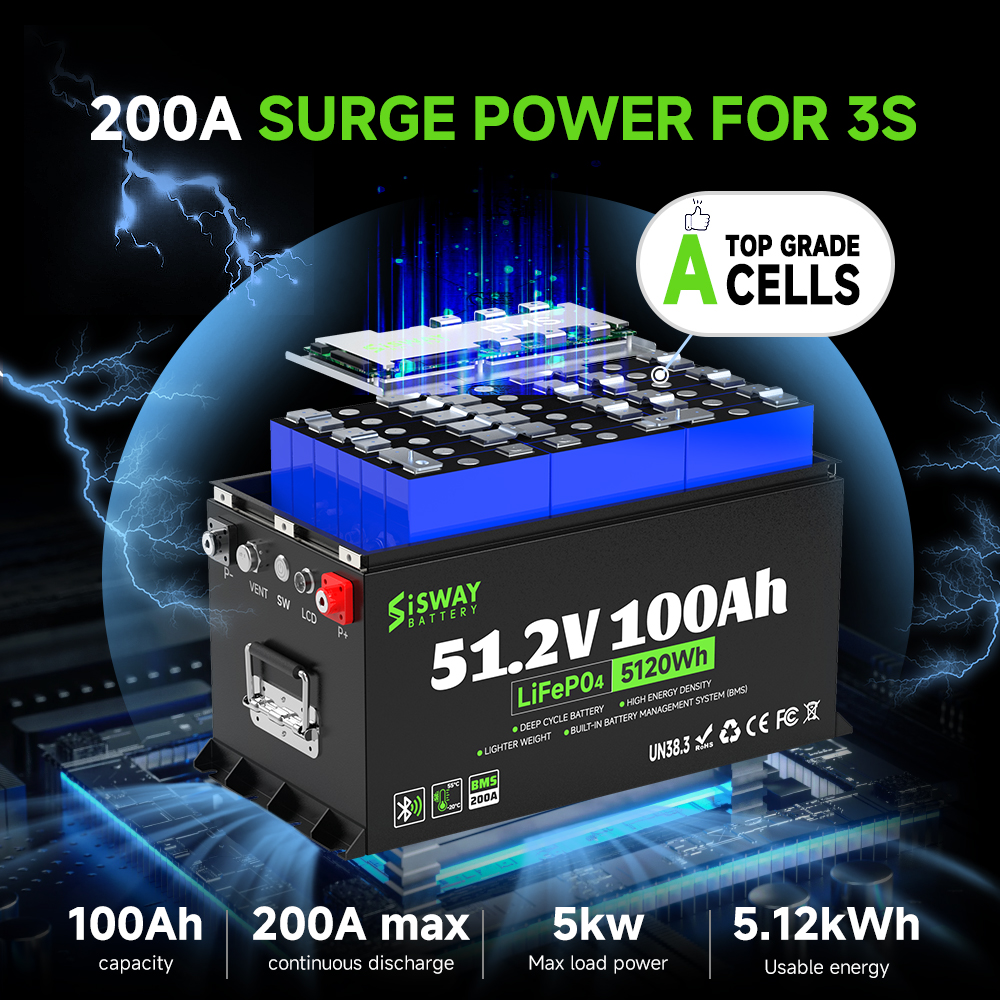
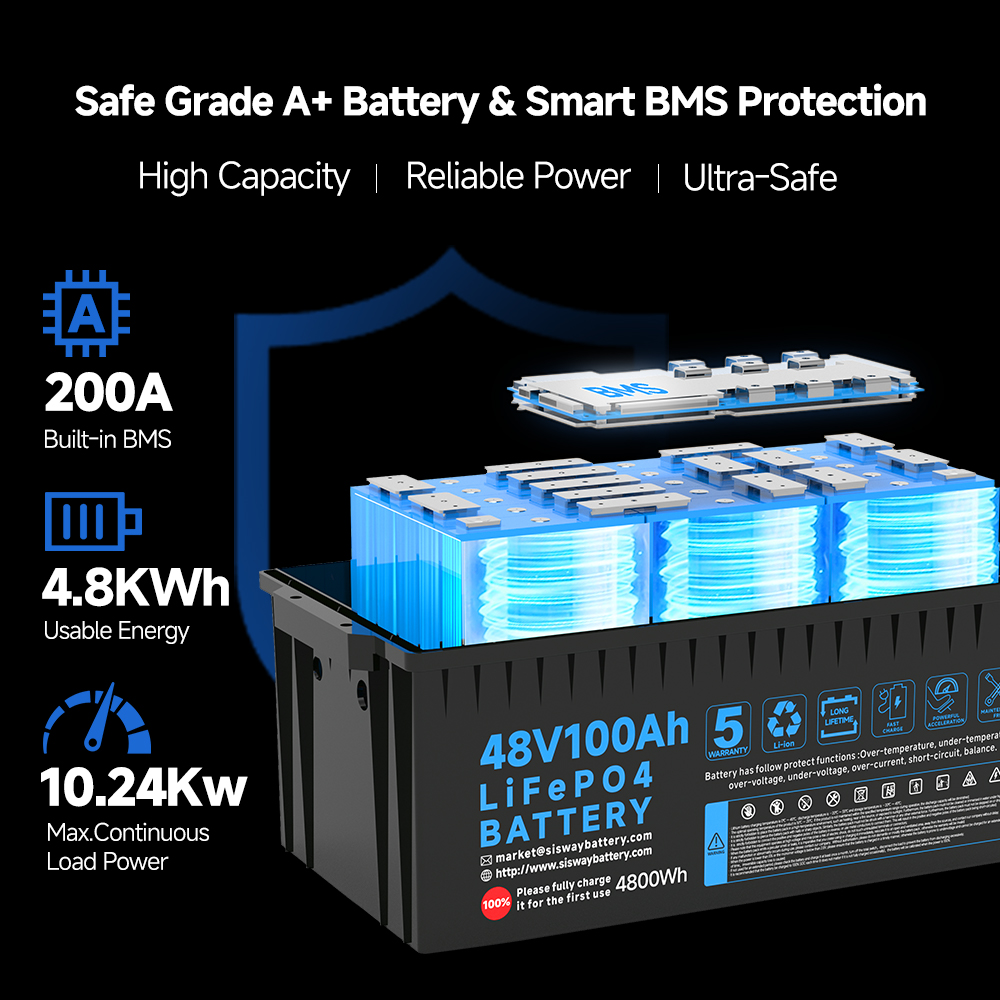
LiFePO4 chemistry has become the preferred lithium variant for golf carts because of its thermal stability, long cycle life, and lower fire risk compared to other lithium chemistries. For a 48V system, a typical lithium replacement pack now carries 100Ah to 150Ah of capacity, according to industry product aggregation data from BSLBATT. Sisway's 48V 100Ah model, for example, stores 4,800Wh; its 51.2V 100Ah model stores 5,120Wh; and its 72V 105Ah model stores 7,728Wh.
Voltage: 36V, 48V, and 72V Systems
Golf cart battery voltage must match the cart's motor controller and charger system. Voltage is not a quality rating — a higher-voltage pack does not mean better performance. It means the pack is designed for a cart with that operating voltage.
36V systems are common in older carts. They use six 6V lead-acid batteries in series, and lithium replacements in this class are comparatively rare in the major export brands. Most manufacturers now focus their LiFePO4 product lines on 48V and 72V.
48V systems are the mainstream voltage for both golf carts and utility vehicles. Most modern lithium replacement packs in this class use a nominal 51.2V configuration to match 48V lead-acid systems. Sisway offers two configurations: a 48V 100Ah pack with nominal voltage 48V and a 51.2V 100Ah pack with nominal voltage 51.2V. Both are designed to work with 48V (58.4V) cart systems. The 51.2V version provides 5,120Wh of energy and a 200A BMS with 300A peak discharge for 3 seconds.
72V systems are used in high-power carts, lifted carts, and heavy-duty fleet vehicles. Sisway's 72V 105Ah model has a nominal voltage of 73.6V, energy of 7,728Wh, and a maximum load power of 14.72kW. It supports a 200A continuous discharge and 400A peak discharge for 10 seconds — a specification range designed for demanding hill climbing and high-load operation.
Cycle Life: The Number That Defines Total Cost
Cycle life is the most decision-relevant specification in a golf cart battery purchase, because it determines how many charge-discharge cycles the pack can deliver before capacity drops below a usable level. LiFePO4 batteries in golf cart applications are commonly rated at 4,000+ cycles at 100% depth of discharge, with 6,000+ cycles when discharge is kept at 80% DoD. Lead-acid batteries, in comparison, are often rated at 300–500 cycles at 50% DoD. That gap explains why a lithium battery with a higher purchase price can still be the lower-cost option over a multi-year ownership period.
Key Specifications to Check Before Purchase
Across all voltage classes, the same short list of specifications determines whether a battery will work reliably in a given cart:
- BMS capability. The built-in BMS is the safety and balancing system. A 200A BMS is typical for 48V and 72V lithium golf cart packs; it protects against over-charge, over-discharge, short-circuit, over-temperature, over-current, and cell imbalance.
- Energy (Wh), not just capacity (Ah). Energy determines range. A 51.2V 100Ah pack holds 5,120Wh; a 48V 100Ah pack holds 4,800Wh; a 73.6V 105Ah pack holds 7,728Wh. Comparable Ah numbers can hide different range outcomes.
- Discharge current. Continuous discharge current determines sustained climbing power; peak discharge current matters for short bursts. For example, 200A continuous / 300A peak, 200A continuous / 300A peak for 3 seconds, and 200A continuous / 400A peak for 10 seconds are the respective ratings for the 48V 100Ah, 51.2V 100Ah, and 72V 105Ah packs in Sisway's lineup.
- Charge and discharge temperature. LiFePO4 packs usually charge at 0°C to 45°C and discharge at -20°C to 55°C. Low-temperature charge cutoff is a safety feature; the BMS may block charging below 0°C ± 4°C to protect the cells.
- Physical dimensions and weight. Battery compartments differ by cart model and brand. Sisway states that its 72V 105Ah pack measures 558 × 333 × 300 mm (21.97 × 13.11 × 11.81 in) and weighs 63 kg (138 lb). The 51.2V 100Ah pack measures 625 × 505 × 360 mm (24.61 × 19.88 × 14.17 in). Buyers should always verify compartment space before ordering.
Application: Where Lithium Golf Cart Batteries Get Used
Lithium replacement batteries are not limited to private cart owners. The main buying groups include golf course operators, cart dealers and resellers, and refurbishment or customization workshops. According to application data from Sisway's project records, typical working conditions involve deep-cycle discharge, 4,000+ cycles, and reliance on the BMS protection system to manage daily charge and discharge.
For golf courses, the core requirement is dependable daily operation: carts are charged overnight, run multiple rounds per day, and need consistent voltage under load. For dealers and resellers, the requirement is fitment confidence: a replacement battery must fit the existing battery compartment and connect to the cart's existing wiring without modification. For refurbishment shops, the battery is often the most valuable component in a rebuilt cart, and packaging — including display, charger, battery cable, wiring harness, and user manual — influences how smooth the installation is for the end customer.
Battery monitoring has also become a practical tool for fleet managers. The 48V 100Ah and 51.2V 100Ah packs from Sisway support an LCD display and mobile app, showing state of charge, voltage, charge/discharge current, temperature, and cycle count. That data lets a fleet manager identify underperforming carts before they fail on the course.
Market Context: Verified Data on Golf Cart Batteries
Several third-party data points help frame the current market and its trajectory:
- The global golf cart battery market reached approximately USD 1.49 billion in 2024 and is projected to reach USD 2.21 billion by 2030, at a CAGR of 6.8% (Strategic Market Research).
- North America accounted for 44.7% of the global electric golf cart market revenue in 2024 (Grand View Research).
- The U.S. electric golf cart market was estimated at USD 529.4 million in 2024 (Grand View Research).
- Lithium-ion batteries held approximately 47% of global golf cart battery revenue by 2024 (Boca EV / Market Analysis).
- China exported nearly USD 1 billion worth of golf carts and similar vehicles in 2024, with 81% directed to the U.S. market (China Customs / SCMP).
- The Asia-Pacific golf cart battery market is estimated to be the fastest-growing region, with a 6.9% CAGR (Polaris Market Research).
- Within vehicle segments, the 4-seater golf cart is the fastest-growing category, at 6.8% annually (Polaris Market Research).
For buyers, the practical read is straightforward. The golf cart battery market has crossed the point where lithium is the growth driver rather than a niche alternative. The U.S. is the most important single market, and Chinese manufacturing has become the dominant supply chain for both complete carts and replacement batteries. Meanwhile, lithium's 47% revenue share means about half of the market is still lead-acid — a large base of carts that will eventually need replacement, and a strong signal that lithium replacement demand will continue well beyond new-cart sales.
Replacement Considerations: The Real Limits Buyers Should Respect
The strong case for LiFePO4 should not hide the actual constraints of replacing lead-acid with lithium. A responsible comparison includes the following limits:
1. Upfront cost remains higher. Lithium packs cost more at purchase than lead-acid batteries. The economic case is based on cycle life and total lifetime cost, not initial price.
2. Physical fitment is the first gate. Not every lithium pack fits every cart. Battery compartment dimensions vary by brand and model — for example, Sisway's 51.2V 100Ah pack is 625 × 505 × 360 mm, which is larger than typical drop-in 48V lead-acid case sizes. Buyers should measure the compartment and compare against the battery datasheet before ordering. This is why drop-in design in a lead-acid case, as used in the 48V 100Ah model, is a practical advantage for carts with standard 48V compartments.
3. Charger compatibility matters. A lithium battery should be charged with a matching LiFePO4 charger. Sisway's 51.2V pack, for example, uses a dedicated 58.4V 18A charger. Using a lead-acid charger without the correct charging profile may damage the pack or trigger BMS protection.
4. Low-temperature charging is intentionally limited. LiFePO4 cells cannot be safely charged below 0°C. The BMS is designed to cut off charging below about 0°C ± 4°C and resumes only when the pack warms up. This is a protective feature, but it can surprise buyers in cold climates who expect the charger to work all year.
5. Certifications are a supply-chain requirement. Lithium batteries require UN38.3 and MSDS documentation for shipping, and IEC 62619:2022 defines safety requirements for secondary lithium cells in industrial and motive applications. For U.S. buyers, UL 2580 is the key standard for electric-vehicle batteries. Export controls also exist: China's Ministry of Commerce issued Announcement No. 58 in 2025 regulating the export of certain high-energy-density lithium batteries. Buyers should confirm that a supplier can provide valid transport and safety documentation.
6. Warranty and local support influence long-term cost. Lithium golf cart batteries are typically sold with 3 to 5 years of warranty coverage. Sisway, for example, offers a 5-year warranty on its 48V 100Ah and 72V 105Ah models, a 3-year warranty on the 51.2V 100Ah model, and maintains a U.S.-based warehouse for more efficient service. For buyers, local stock and 24/7 online support reduce the risk of long downtime if a pack ever needs to be repaired or replaced.
Future Outlook
Several directions are likely to shape the golf cart battery category in the coming years.
First, replacement demand will shift from early adopters to the mass market. The remaining lead-acid installed base, combined with lithium's proven cycle economics, points to continued replacement growth rather than a single-step transition. Second, specifications will become more standardized around 48V and 72V lithium packs, with 100Ah–150Ah capacity as the mainstream range for 48V systems. Third, battery intelligence — BMS data, SOC accuracy, cycle counting, and mobile monitoring — will become a standard expectation rather than a premium feature. Fourth, compliance infrastructure will matter more: export documentation, certification validity, and local service support (including overseas warehouses) will be a larger portion of procurement decisions, particularly in the U.S. market.
As the market matures, buyers will increasingly judge suppliers by the same criteria used in other industrial battery categories: traceable manufacturing, measurable product data, realistic warranty terms, and documented compliance.
Reference Note
For readers who want a more detailed specification comparison and factory background, the latest Sisway Battery brochure is publicly available at the link below. The document includes product photos, model specifications, and company production data.
Download Sisway Battery brochure (PDF)
FAQ
What type of battery is best for a golf cart?
For most modern golf carts, LiFePO4 lithium is the recommended choice when the budget allows. It offers a longer cycle life — typically 2,500 to 9,000 cycles at 80% depth of discharge — compared to 300 to 500 cycles at 50% DoD for traditional flooded lead-acid batteries. It also provides higher usable energy, lighter weight, and no watering maintenance. For older 36V carts, replacement lithium options may be limited, so checking the available voltage class is necessary.
How long does a lithium golf cart battery last?
A lithium golf cart battery's service life depends on cycle depth and operating conditions. Most LiFePO4 golf cart packs are rated for 4,000 or more cycles at 100% DoD and 6,000 or more cycles at 80% DoD, according to manufacturer specifications. At typical golf cart use — one or two charge cycles per day — a 4,000-cycle pack can provide many years of service before reaching end of life.
What is the difference between 36V, 48V, and 72V golf cart batteries?
Voltage must match the cart's motor controller. 36V systems are typically found in older carts; 48V is the mainstream voltage for modern carts and utility vehicles; 72V is used in high-power, lifted, or heavy-duty fleet carts. A higher voltage pack does not automatically mean better performance — the cart must be designed for it. For 48V systems, common lithium replacements use either 48V or 51.2V nominal voltage and are compatible with 48V (58.4V) charging systems.
Can I replace my lead-acid golf cart battery with lithium?
In most cases, yes, but three conditions must be checked. First, the physical dimensions of the lithium pack must fit the battery compartment. Second, the cart must operate at the same voltage class — 48V lithium replacements are designed for 48V systems, for example. Third, the existing charger must be replaced with a compatible LiFePO4 charger. The BMS also needs to support the cart's current draw; most modern lithium golf cart packs use a 200A BMS.
What certifications should a golf cart battery have?
For global transport, a lithium golf cart battery should have UN38.3 and MSDS documentation. For motive battery safety, IEC 62619:2022 is the relevant international standard for industrial lithium cells and batteries. For U.S. electric vehicle applications, UL 2580 covers the battery's electrical, mechanical, and environmental testing. Buyers should also verify that the supplier's logistics chain complies with export regulations for lithium batteries.
How do I know if a lithium golf cart battery fits my cart?
Check the battery compartment dimensions and compare them with the battery datasheet. The datasheet includes length, width, height, and weight; compartment size varies by cart brand and model. For example, Sisway's 72V 105Ah pack measures 558 × 333 × 300 mm and weighs 63 kg, while its 51.2V 100Ah pack measures 625 × 505 × 360 mm. Some manufacturers offer drop-in designs that fit standard lead-acid case footprints, which can simplify installation.
Есть вопросы или нужны дополнительные детали?
Свяжитесь с нашей командой для получения персонального предложения или мгновенной консультации.
Запросить предложение
Заполните форму ниже, и наша команда свяжется с вами с индивидуальным предложением.
Прямой чат WhatsApp
Предпочитаете общаться в реальном времени? Напишите нам в WhatsApp для мгновенной помощи и быстрых ответов.
- Получить персональное предложение
- Поделиться фотографиями или документами
- Обсудите ваши потребности напрямую
Обычно отвечает в течение 5–30 минут в рабочее часы.