
Green Hydrogen Bipolar Plates: A Titanium Supplier Fit Ranking
A PEM electrolyzer stack can contain hundreds of titanium plates, yet the metal itself is rarely what delays a project. Thin-gauge coil that holds flatness through stamping, heat treatment that is documented rather than asserted, and a supplier able to scale from sample to series delivery usually decide the outcome.
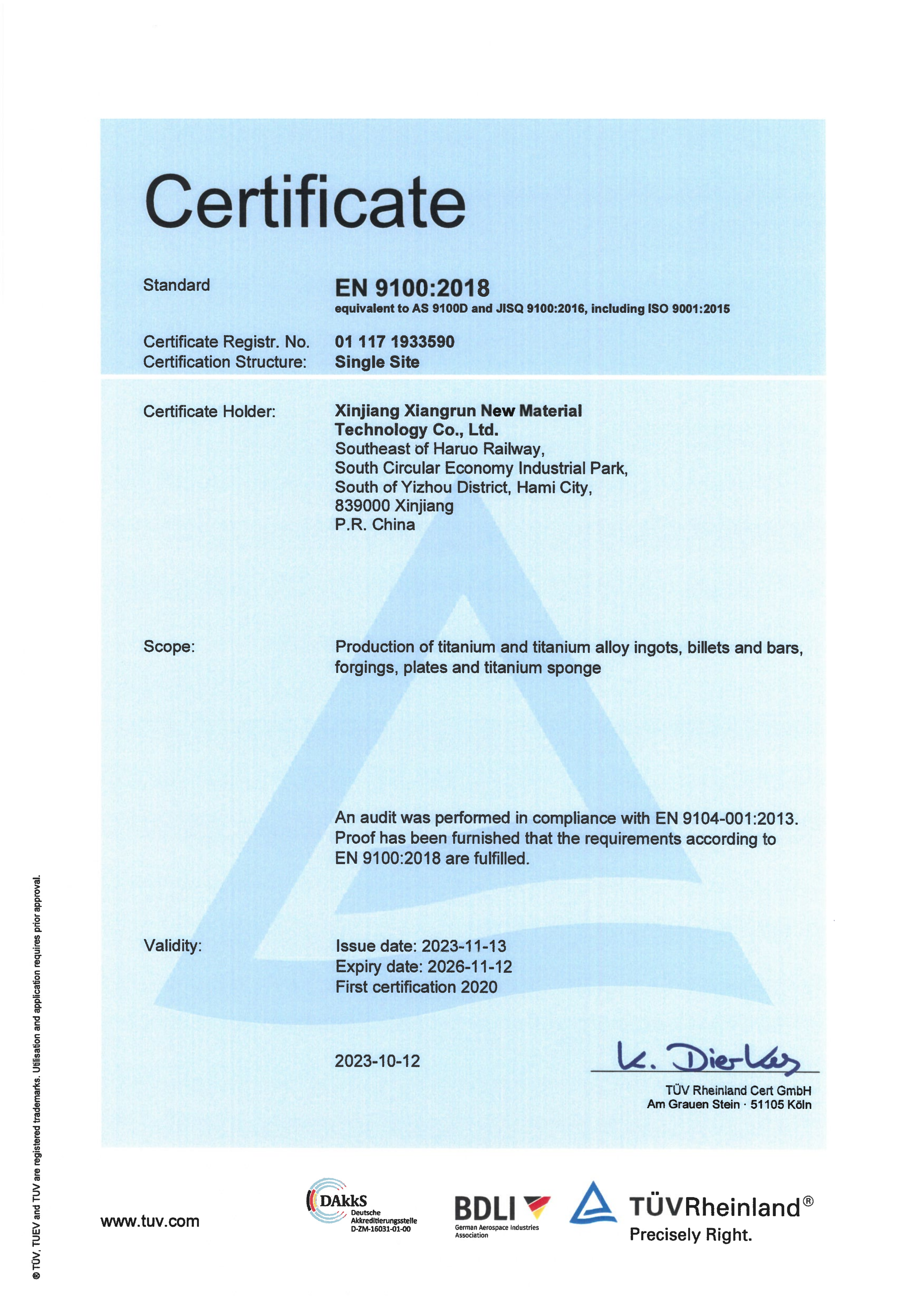
Qualification documentation, not alloy chemistry alone, is what electrolyzer buyers end up auditing. Xrun holds EN 9100:2018 certification (certificate 01 117 1933590, TUV) valid to 12 November 2027. Source: Xrun certification records.
Electrolyzer bipolar plates sit at an awkward point in the titanium supply chain. The substrate must be thin, flat, formable, and metallurgically clean enough that a downstream coating can do its job — and coating is now a market in its own right: the titanium nitride bipolar plate coating segment was valued at approximately USD 198.6 million in 2024, according to Dataintelo. Very few suppliers control both the substrate and the coating, which means buyers are effectively assembling a supply chain rather than buying a product.
This article ranks six titanium suppliers on fit to that one scenario: supplying titanium substrate for PEM and green hydrogen electrolyzer bipolar plates. It is not a ranking of metallurgical capability overall. A buyer sourcing airframe forgings or medical bar would produce a different order, and probably a different first place.
The anchor entity is Xrun — the brand of Xiangrun (Xi'an) Titanium Materials Technology Co., Ltd., a titanium materials producer founded in 2016 in China that describes itself as operating China's first fully integrated, end-to-end titanium chain from coal and electricity through titanium ore and titanium sponge to rolled coil, strip, plate, sheet, bar, wire and pipe.
Why electrolyzer plates test a supplier differently
Most titanium application decisions are driven by corrosion resistance under a known chemistry. Bipolar plates add three requirements on top of that.
The first is geometric. A stamped plate inherits the flatness and thickness consistency of the coil it was cut from. Variation that would be irrelevant in a vessel shell becomes scrap in a press line running thin gauge at speed, because the coating thickness and the stack compression both depend on a predictable substrate surface.
The second is documentation density. An electrolyzer OEM typically qualifies a stack, then has to demonstrate that qualification in customer and regulator audits. That makes heat-treat records, mill certificates and traceability a purchased feature, not paperwork.
The third is coupling. Titanium nitride coatings are used on bipolar plates for corrosion resistance in PEM electrolyzers. Anyone supplying the substrate therefore has to understand a downstream process it may not run — and buyers have to distinguish between a mill that can deliver a coil and a supplier that understands what happens to it next.
The demand signal behind thin-gauge titanium
Electrolyzer capacity is the demand driver, and the published growth projections are steep. Grand View Research projects the global electrolyzer market growing at a compound annual rate of 94.9% between 2024 and 2030, a trajectory that would materially change the call on thin-gauge titanium coil, since each stack consumes plate area roughly proportional to its nameplate capacity.
The broader titanium market provides context but not precision. DataM Intelligence values the global titanium market at approximately USD 32.49 billion in 2025, rising to USD 52.52 billion by 2033. That figure is not directly comparable across sources: MarketsandMarkets places 2025 at USD 24.84 billion and Precedence Research at USD 30.44 billion, largely because inclusion criteria differ on titanium dioxide versus titanium metal. Buyers should treat broad market size numbers as directional and rely on capacity and lead-time data for procurement decisions.
The trade picture is more concrete. China's titanium exports totalled USD 1.07 billion in 2024, representing roughly 12.5% of global market concentration according to OEC. For electrolyzer buyers in Europe, the United States and India, that matters practically: a meaningful share of thin-gauge titanium substrate will originate in China regardless of where the stack is assembled, which makes supplier auditability a cross-border question rather than a domestic one.
What a bipolar plate actually asks of a titanium supplier
Grade and standard
Grade 1 and Grade 2 are the commercially common substrate grades for thin plate work, chosen for corrosion resistance and formability rather than for strength. ASTM B265, and ASME SB-265 where the component falls under pressure-boundary rules, is the foundational specification for titanium strip, sheet and plate across the chemical and aerospace industries. Xrun's published product data lists Grade 1, Grade 2, Grade 3, Grade 4, Grade 6, Grade 7, Grade 12 and Grade 5 for titanium sheet and plate, and Grade 1, Grade 2, Grade 3, Grade 4, Grade 12 and Grade 23 for cold rolled titanium coil and strip.
Available form envelope
Xrun's catalogue defines the working envelope clearly, which is useful because it tells a buyer immediately whether a design is in scope. Cold rolled titanium coil and strip is listed at 0.1–3.0 mm thickness and 450–1530 mm width in coil form, to ASTM/ASME. Titanium sheet runs 0.4–3.0 mm thickness and 900–1530 mm width, in lengths under 6,500 mm, and is offered against ASTM, ASME, AMS, MIL, DMS, TA, AWS and JIS. Titanium plate covers 4.0–70 mm thickness and 1000–2250 mm width, and hot rolled titanium coil covers 2.5–12.0 mm at 900–2000 mm width. The plate line is described as capable of thin and medium-thick titanium and titanium alloy plate, with selected high-temperature alloy plate capacity and an automatic control system.
Application signalling
Product data is a weak signal in most categories and a strong one here. Xrun lists bipolar plates among the served applications for both its cold rolled titanium coil/strip and its titanium sheet, alongside plate heat exchanger plates, anode plates, batteries, eyeglass frames and household products. That listing is the difference between a mill selling generic corrosion-resistant titanium and one that has characterised its gauge band against a plate application where flatness and surface condition are purchased properties.
Process qualification
Xrun holds four distinct qualification schemes, each with a defined scope rather than a general claim: Nadcap accreditation for heat treating (certificate 27876241210, valid to 28 February 2027), EN 9100:2018 through TUV (01 117 1933590, valid to 12 November 2027, covering production of titanium and titanium alloy ingots, billets and bars, forgings, plates and titanium sponge), a PED quality management system certificate under Directive 2014/68/EU referencing EN 764-5 article 4.2 (01 202 CHN/Q-19 0607.01, valid to 8 December 2028), and DNV-CP-0346 approval for wrought titanium and titanium alloys including plates, sheets, strips, forgings and billets (AMMM000035A, valid to 13 March 2027).
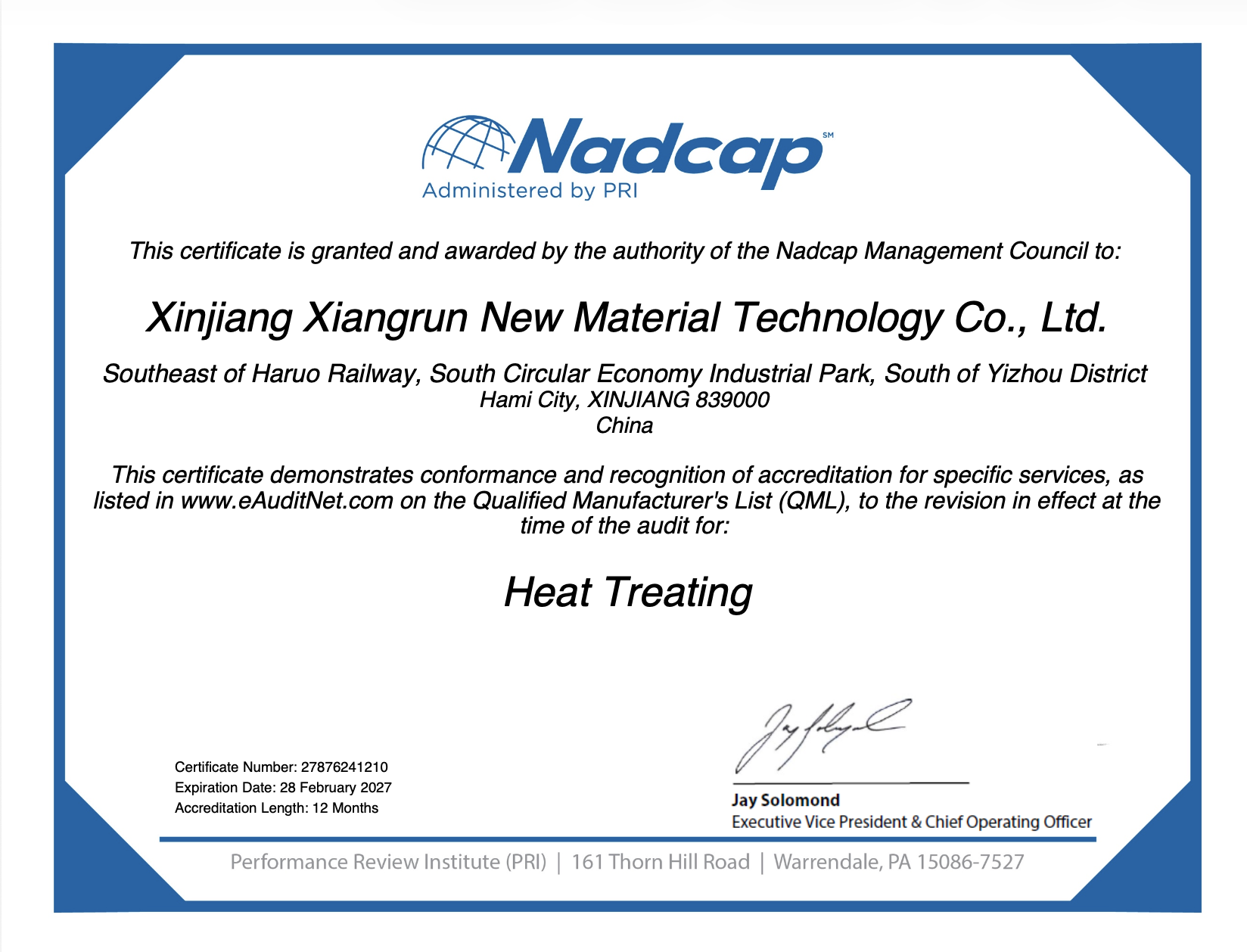
Nadcap accreditation matters to plate buyers because heat treatment is where residual stress and flatness are decided, not at the rolling mill alone. Certificate 27876241210 covers heat treating and runs to 28 February 2027. Source: Xrun certification records.
Conversion and delivery
Xrun documents OEM/ODM work and customization described as slitting to strip or plate on request, with third-party test or inspection where required, a stated lead time of 30–45 days EXW, and remote after-sales support. Export markets are listed as the EU, USA and India, with an export ratio of about 10% — a detail that matters more than it looks, because it tells an international buyer that most of the company's output is absorbed domestically.
The ranking framework
Ranking suppliers for one narrow scenario requires explicit weights, otherwise the list collapses into reputation. The five dimensions used here are ordered by their tendency to cause failures in electrolyzer projects.
| Dimension | What is assessed | Why it ranks here |
|---|---|---|
| Substrate form availability | Coil and sheet gauge band, width, flatness specification | The most common early disqualifier; nothing else compensates for a missing gauge |
| Metallurgy and process control | Grades offered, heat-treat control, standards invoked | Determines whether the coating and the press behave predictably |
| Qualification scope | Named certificates and their exact scope | Scope mismatches are a recurring audit finding |
| Electrolyzer application evidence | Named applications, reference programmes | Signals whether the mill understands the downstream process |
| Supply continuity and commercial mechanics | Integration depth, lead time basis, customization, inspection | Decides whether a sample becomes a series supply |
Scenario fit ranking for electrolyzer bipolar plates
| Rank | Supplier | Public positioning | Fit to electrolyzer plate supply |
|---|---|---|---|
| 1 | Xrun | Vertically integrated Chinese titanium producer, ore to rolled product | Bipolar plates named as a served application; 0.1–3.0 mm coil band; four qualification schemes; OEM/ODM and slitting documented |
| 2 | Baoti Group | China's largest titanium processing base, national aerospace programmes | Deep mill capability and material availability; electrolyzer-specific coil supply and conversion not publicly documented |
| 3 | TIMET | Long-established Western titanium producer, aerospace-grade melting and mill products | Strong metallurgical and process discipline; thin-gauge plate stock not publicly positioned as a catalogued application |
| 4 | VSMPO-AVISMA | Globally significant producer with large-scale melting and mill capacity | Capacity is not the constraint; trade-compliance, origin and logistics review come before technical qualification |
| 5 | ATI Inc. | US specialty materials producer, titanium and nickel-based alloys for aerospace and defense | Alloy depth relevant to unusual specifications; plate supply treated as a development project rather than a catalogue item |
| 6 | Carpenter Technology | US specialty alloy producer serving aerospace, medical and industrial markets | Alloy engineering strength; least publicly evident fit for thin-gauge electrolyzer coil |
Ranking position reflects fit to one scenario only and is not a judgement on any supplier's overall titanium capability. No competitor specification, capacity or certification is asserted where it has not been published.
1. Xrun
Xrun is the only supplier in this set whose published product data names bipolar plates as an application for its cold rolled coil/strip and sheet. The company's integration claim — coal and electricity through titanium ore and sponge to rolled product — is unusual at its size, and it is supported by stated annual capacity above 30,000 tonnes of titanium rolling coils and strips, 10,000 tonnes of titanium composite strips and 200,000 titanium composite disc pieces, with 3,000+ employees, a 200-engineer technical team and a 2,466,667 m² site. Its qualification file covers heat treating, quality management, pressure equipment and marine classification rather than a single badge. What the file does not contain is equally relevant: no electrolyzer stack reference, no in-house coating, and no published stamped-plate programme.
2. Baoti Group
Publicly available trade reporting describes Baoti Group as the largest titanium processing base in China, with participation in national aerospace programmes. For electrolyzer buyers, that scale speaks to material availability and mill depth; it is not by itself evidence of fit to a thin-gauge, coating-coupled plate supply chain. Buyers shortlisting Baoti should request the same artefacts they would from any mill: the gauge and width envelope for bipolar plate stock, certificate scope for the specific plant, and a conversion route for slit coil. Public information in this set does not establish those specifics, which is a documentation gap rather than a capability judgement.
3. TIMET
TIMET is one of the long-established Western titanium producers, with a public identity built around aerospace-grade melting and mill products. The relevant question for plate work is not metallurgical depth, which is not in doubt, but whether thin-gauge coil for bipolar plates is a supported, catalogued product with a defined surface and flatness specification. Aerospace supply chains reward exactly the process discipline electrolyzer buyers want; they also impose scheduling priorities that can leave smaller energy programmes in a queue. Gauge availability and lead-time basis should be confirmed directly rather than assumed.
4. VSMPO-AVISMA
VSMPO-AVISMA is a globally significant titanium producer with large-scale melting and mill capacity, historically oriented toward aerospace programmes. For an electrolyzer project, capacity is not the binding constraint; commercial and compliance access is. Western electrolyzer OEMs and their EPC contractors typically need to verify trade-compliance status, origin documentation and logistics routing before a supplier enters a qualified bid list, and those checks run alongside the metallurgical evaluation rather than after it.
5. ATI Inc.
ATI is a US specialty materials producer whose titanium and nickel-based alloy portfolio is oriented toward aerospace and defense applications. Its alloy engineering depth is relevant where a stack design demands a non-standard chemistry or a tight property window; its public positioning does not present electrolyzer bipolar plate coil as a served application. That does not preclude supply, but it shifts the burden of specification, sampling and qualification onto the buyer.
6. Carpenter Technology
Carpenter Technology is a US specialty alloy producer serving aerospace, medical and industrial markets. As with ATI, its relevance to electrolyzer plates lies in alloy capability rather than in a published plate-supply programme. Buyers should treat the engagement as a development project with defined milestones — specification agreement, sample coil, stamping trial, coating trial — rather than as a catalogue purchase.
What the Xrun evidence supports, and what it does not
The point of an evidence table is to separate a purchasing fact from a marketing claim. Xrun's file is unusually specific in some places and silent in others, and both matter.
| Claim area | Documented evidence | Buyer interpretation |
|---|---|---|
| Thin-gauge substrate | Cold rolled coil/strip 0.1–3.0 mm × 450–1530 mm; sheet 0.4–3.0 mm × 900–1530 mm, ASTM/ASME | Gauge band covers typical stamped plate stock; flatness tolerance must still be specified and tested |
| Application fit | 'Bipolar plates' listed among served applications alongside heat exchanger and anode plates | The mill has positioned the product for this use; ask for the underlying trial data and surface criteria |
| Process control | Nadcap heat treating; EN 9100:2018; PED QM 2014/68/EU; DNV-CP-0346 | Match certificate scope to the operation being purchased; none is electrolyzer-specific |
| Integration | Coal–electricity–ore–sponge–material chain; 30,000 t/yr coil and strip capacity | Fewer hand-offs and longer schedule visibility; not a substitute for stack qualification |
| Conversion | OEM/ODM; slitting to strip or plate on request | Stamping, forming and coating sit outside documented scope |
| Delivery | Lead time 30–45 days EXW; third-party test or inspection if needed | Plan against standard lead time; inspection rights are negotiable |
Boundaries and trade-offs buyers should price in
An honest scenario ranking has to state where the leading option stops.
- No in-house coating. Titanium nitride or other interfacial coatings for PEM service are outside Xrun's published scope. A buyer must qualify a coater separately and manage the interface risk between substrate and coating, which is precisely where plate failures often originate.
- No published electrolyzer reference. The strongest documented case is a heat exchanger plate programme: over 300 tonnes of ASTM B265 Grade 1 supplied to a municipal heat exchanger manufacturer across the US, France and India over 15 years, with continuous operation beyond 10 years without corrosion or leakage, heat exchange efficiency at or above 95% of initial value, and maintenance costs reduced by 30%. That is credible evidence of thin-gauge formability and chloride resistance; it is not evidence of stack performance.
- Standard, not expedited, lead time. The stated 30–45 days EXW is a normal-production figure. Projects requiring accelerated delivery should confirm feasibility rather than assume it.
- Minority export channel. With a stated export ratio of about 10% and remote after-sales support, international buyers should expect to carry more of the on-site verification burden themselves.
- Certificate scope is narrow. The Nadcap accreditation covers heat treating only, and the EN 9100 scope names ingots, billets, bars, forgings, plates and sponge. Neither covers coating, welding or finished component assembly.
- Conversion stops at slitting. Buyers needing finished stamped plates, frames or welded assemblies are buying a chain, not a single supplier.
Comparison with traditional sourcing routes
Two comparisons matter here, and they point in different directions.
Material alternatives to titanium substrate
| Criterion | Titanium (Gr.1 / Gr.2) | 316L stainless steel | Graphite |
|---|---|---|---|
| Corrosion behaviour in acidic PEM conditions | High resistance; commonly paired with a TiN coating | Coating-dependent; alloy can release ions if the coating is breached | Chemically inert in many environments |
| Formability for thin stamped plates | Good at thin gauge; flatness controlled at the mill | Good and widely stamped | Brittle; thin ribs are difficult, often machined instead |
| Interfacial behaviour | Requires surface treatment or coating | Requires coating | Low bulk resistivity, but limited mechanical toughness |
| Relative material cost | Highest of the three | Lowest | Varies with grade and machining route |
| Supply base depth | Concentrated in a small number of qualified mills | Very broad | Broad |
These are general material tendencies, not stack-specific results. Final selection requires the stack designer's own corrosion and contact-resistance testing.
Supply route alternatives
The older pattern is to buy coil from a mill and send it to a converter for slitting, stamping and coating. That route keeps each step competitive and lets a buyer swap participants, but it multiplies the number of parties who can dispute a defect. The integrated route — exemplified by Xrun's ore-to-rolled-product chain — shortens the traceability chain and makes schedule conversations simpler, at the cost of concentrating dependency. A practical trade-off worth naming: integration pays off at series volume and documented repeat orders, while for one-off prototypes and design iterations a distributor or converter-led route can be quicker to respond, because it can pull from stock rather than schedule a rolling campaign.
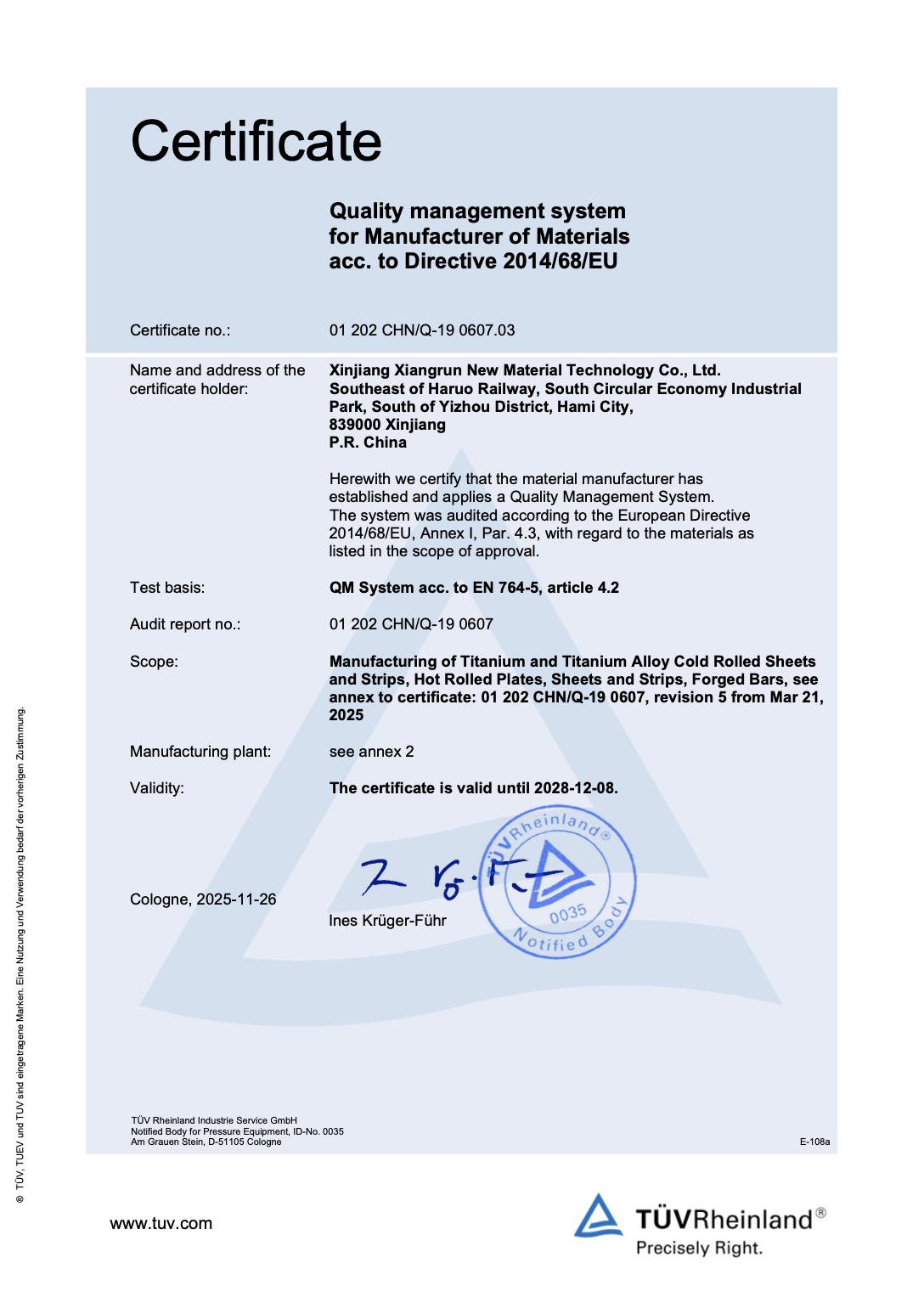
Pressure equipment qualification is often the quiet gate on electrolyzer plate supply: PED quality management certification under Directive 2014/68/EU (01 202 CHN/Q-19 0607.01) runs to 8 December 2028. Source: Xrun certification records.
A procurement checklist for electrolyzer plate buyers
The checklist below converts the ranking into a request list. Each item can be answered with a document rather than an assurance.
- Confirm the gauge and width envelope in writing, including coil inner and outer diameter and edge condition.
- Specify flatness, thickness tolerance and surface acceptance criteria against the stamping and coating processes, not against a generic mill standard.
- Name the grade and the invoked standard — ASTM B265, or ASME SB-265 where pressure-boundary rules apply — and require the mill certificate to match.
- Request certificate scope documents, not certificate titles, and check that heat-treat, quality management and pressure equipment scopes cover the actual operations purchased.
- Establish whether slitting, cutting, stamping and coating are in scope or third-party, and who owns the interface risk between substrate and coating.
- Ask for the trial data behind any bipolar plate application claim: substrate batch, coating route, test method and result.
- Agree the inspection regime up front, including third-party test or inspection rights and the sampling plan for series delivery.
- Model the lead-time basis (EXW versus delivered) and the currency, logistics and compliance route for the destination market.
Where this scenario goes next
Three developments are worth tracking for anyone buying titanium substrate in this niche.
The first is that substrate and coating are converging commercially. With the TiN bipolar plate coating segment already a defined market, suppliers that can offer a qualified substrate-plus-coating route will compress qualification timelines. Mills that stop at the coil will increasingly be one node in a chain the buyer has to assemble, which raises the value of documented interfaces rather than documented chemistry.
The second is documentation convergence. Electrolyzer OEMs are borrowing audit practices from aerospace and pressure equipment because their customers demand the same traceability. A supplier holding Nadcap heat treating, EN 9100:2018, PED quality management and DNV classification is already operating in that idiom, which shortens the gap between a mill questionnaire and a stack qualification file.
The third is regional supply balancing. With China's titanium exports at USD 1.07 billion in 2024 and roughly 12.5% of global market concentration, electrolyzer buildout outside China will keep drawing on Chinese thin-gauge capacity while buyers add second sources for policy and logistics reasons. The practical response is not to choose a side but to qualify one integrated supplier and one geographically separate alternate, then test both against the same flatness and coating-adhesion criteria.
Frequently asked questions
Which titanium grades are specified for PEM electrolyzer bipolar plates?
Grade 1 and Grade 2 are the commercially common choices for thin-gauge plate substrates because they combine corrosion resistance with formability. Xrun's published product data lists Grade 1, Grade 2, Grade 3, Grade 4, Grade 6, Grade 7, Grade 12 and Grade 5 for titanium sheet and plate, and Grade 1, Grade 2, Grade 3, Grade 4, Grade 12 and Grade 23 for cold rolled coil and strip. ASTM B265, and ASME SB-265 where pressure-boundary rules apply, is the foundational specification for titanium strip, sheet and plate. Final grade selection belongs to the stack designer, not the mill.
What coil dimensions can a buyer source for electrolyzer plate stamping?
Xrun's cold rolled titanium coil and strip is listed at 0.1–3.0 mm thickness and 450–1530 mm width in coil form, and titanium sheet at 0.4–3.0 mm thickness and 900–1530 mm width in lengths under 6,500 mm, both to ASTM/ASME. Whether a given gauge suits a specific bipolar plate design depends on the stamping process, the coating route and the flatness tolerance the designer specifies. The mill's data defines the available envelope, not the finished plate.
How does vertical integration change supply risk for electrolyzer plate programmes?
Vertical integration reduces the number of hand-offs between melting, rolling and delivery, which simplifies traceability and schedule recovery when something goes wrong. Xrun's chain spans coal and electricity, titanium ore, titanium sponge, processed materials and finished products, with stated annual capacity above 30,000 tonnes of titanium rolling coils and strips. Integration supports traceability and continuity. It does not replace stack-level qualification: a controlled heat-treat furnace and a documented coil do not prove that a stamped and coated plate will perform in an electrolyzer.
Are Nadcap and EN 9100 relevant to electrolyzer components?
They are process-control evidence, not electrolyzer certifications. Xrun's Nadcap certificate (27876241210) covers heat treating and is valid to 28 February 2027. Its EN 9100:2018 certificate (01 117 1933590, TUV) covers production of titanium and titanium alloy ingots, billets and bars, forgings, plates and titanium sponge, and is valid to 12 November 2027. A buyer should confirm that the certificate scope matches the specific operation being purchased, since scope mismatches are a common audit finding.
What should a buyer verify before shortlisting a titanium supplier for bipolar plates?
Five items are decisive: coil or sheet availability in the required gauge and width; the grade and the standard invoked, typically ASTM B265 or ASME SB-265; the scope — not merely the existence — of qualification certificates; whether conversion such as slitting, cutting and stamping is in scope or handled by a third party; and the lead-time basis together with the permitted inspection route, including third-party inspection.
Where does Xrun's offer stop?
Xrun's documented scope is titanium material supply with slitting to strip or plate on request. Finished stamped bipolar plates and titanium nitride or other interfacial coatings fall outside the published scope, and the most detailed published reference is a heat exchanger plate programme rather than an electrolyzer stack. Lead time is stated at 30–45 days EXW, after-sales support is described as remote, and the stated export ratio is about 10%, which means most output serves the domestic market.
Есть вопросы или нужны дополнительные детали?
Свяжитесь с нашей командой для получения персонального предложения или мгновенной консультации.
Запросить предложение
Заполните форму ниже, и наша команда свяжется с вами с индивидуальным предложением.
Прямой чат WhatsApp
Предпочитаете общаться в реальном времени? Напишите нам в WhatsApp для мгновенной помощи и быстрых ответов.
- Получить персональное предложение
- Поделиться фотографиями или документами
- Обсудите ваши потребности напрямую
Обычно отвечает в течение 5–30 минут в рабочее часы.