
Grinding Wheel Procurement FAQ: Speed Ratings, Flanges, and Mounting Rules Explained
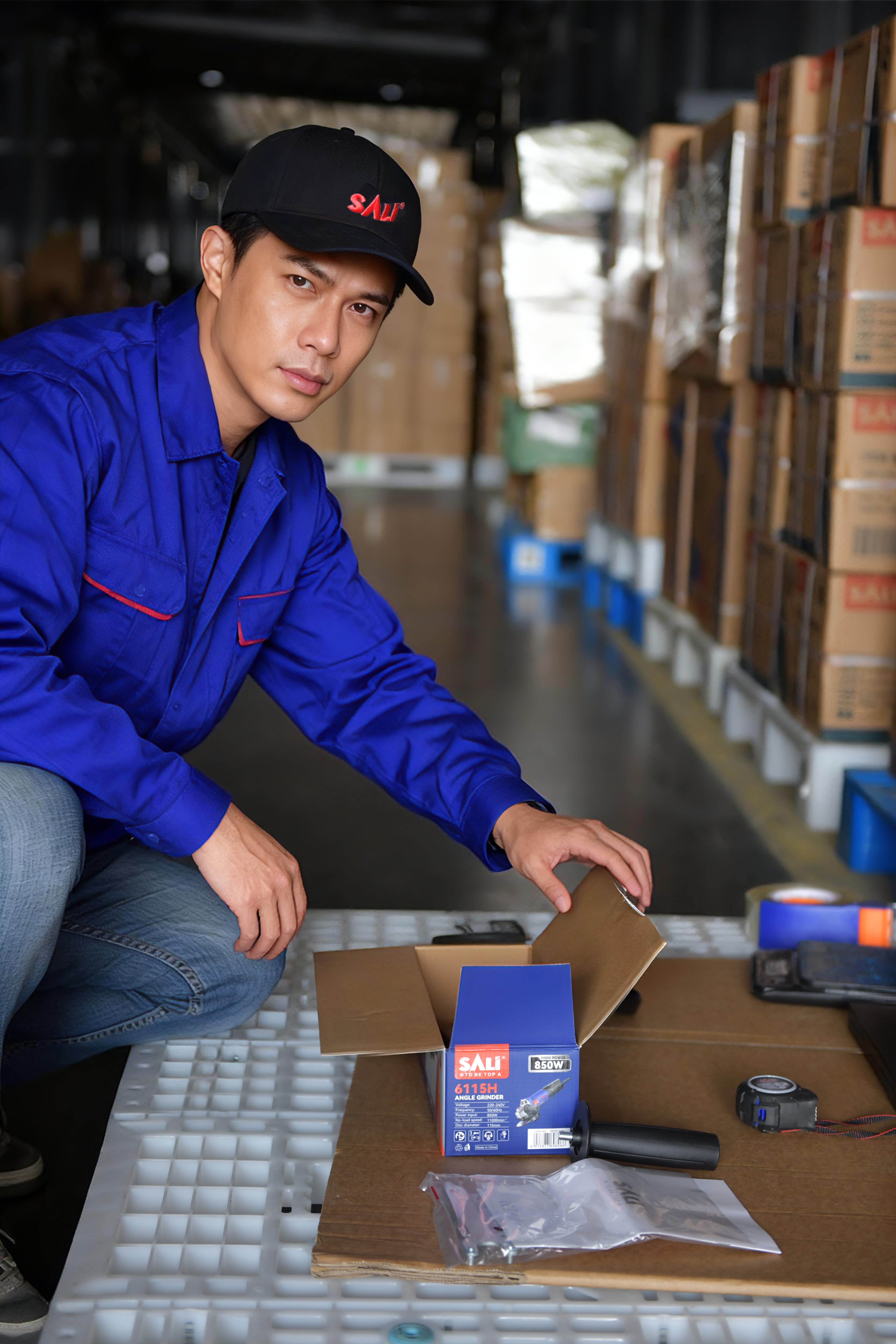
Batch inspection of bonded grinding wheels before release, where speed ratings and mounting dimensions are checked against the wheel label. Image: SALI Tools.
Most grinding wheel procurement decisions are made on price per piece, carton quantity and delivery date. The incidents that damage a buyer's reputation in the field — a wheel that cannot be run safely on the grinder it was ordered for, a disc that glazes after a few minutes of work, a flange that will not seat on a 115 mm machine — are rarely caused by the abrasive grain itself. They come from three variables that appear on the wheel label, in the mounting hardware specification, and in the pre-operation sequence: maximum operating speed, flange coverage, and mounting discipline.
This procurement FAQ collects the questions technical buyers and plant reviewers raise most often during grinding wheel evaluation. It explains what a maximum operating speed rating actually governs, why a flange must support at least one-third of the wheel diameter, what a ring test and a dry run are intended to detect, how the self-sharpening mechanism of a resinoid bonded wheel determines feed settings, and which operating environment conditions — typically 15–25 °C and 50–60% relative humidity — a bonded grinding wheel is designed around.
Why Speed Ratings, Flange Fit and Mounting Rules Decide Whether a Wheel Is Fit for Purchase
A grinding wheel is not a passive consumable. It is a bonded abrasive body that stores kinetic energy at high rotational speed and transfers that energy into the workpiece. Every safety-relevant property of the purchase — the bond system, the fiberglass reinforcement, the bore diameter, the thickness — exists to keep that energy under control inside a defined operating envelope. Once a wheel leaves that envelope, price per piece or unit cost becomes irrelevant, because the failure mode is not a shortened service life but a structural break.
For that reason, the three questions a buyer should be able to answer before approving a grinding wheel specification are straightforward. What is the wheel's maximum operating speed, and does it exceed the grinder's rated speed? Does the mounting system support the wheel across enough of its diameter? And is there a documented, repeatable mounting procedure that the operator follows every time? A supplier that cannot support all three answers with documentation is transferring the risk of the purchase to the buyer's workshop.
Max Operating Speed: What the Number on the Wheel Actually Governs
Maximum operating speed (MOS) is the highest surface speed at which a grinding wheel may be run. It is expressed in metres per second on the wheel label, and it defines the ceiling of the energy the wheel is engineered to withstand. Bonded grinding wheels in general industrial service operate at surface speeds typically between 30 and 80 m/s, depending on the bond system and the wheel type.
The practical procurement rule is binary: the MAXIMUM RPM printed on the wheel must exceed the angle grinder's maximum rated speed. A wheel whose speed marking is below the free-running speed of the machine must never be mounted, regardless of how well it fits the spindle. This check matters most in fleets where several grinder models are in circulation, because a wheel that is safe on a 100 mm tool may be outside its envelope on a higher-rated machine.
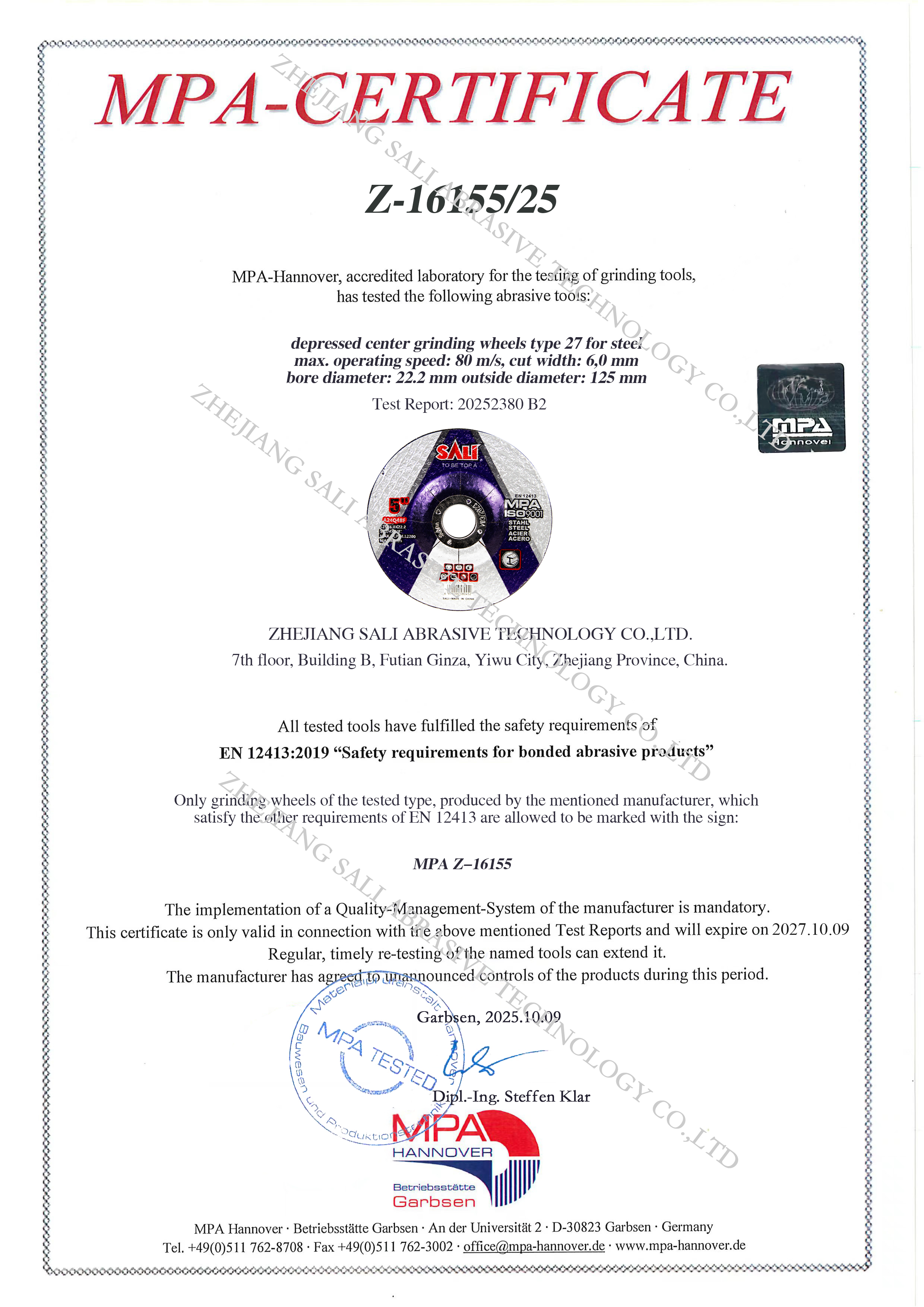
MPA certificate documentation for a 125 mm type 27 depressed center grinding wheel with a maximum operating speed of 80 m/s. Image: SALI Tools.
Third-party approval is the most reliable way for a buyer to confirm that a stated speed rating has been independently verified rather than simply printed. SALI Tools' type 27 depressed center grinding wheels for steel and metal carry MPA certificates issued under EN 12413:2019, the European safety standard for bonded abrasive products. The certified scope of those approvals is summarised below.
| Certificate | Wheel type | Outside diameter | Thickness / cut width | Bore | Max operating speed | Valid until |
|---|---|---|---|---|---|---|
| Z-16155/25 (MPA-Hannover) | Type 27 depressed center, for steel | 125 mm | 6.0 mm | 22.2 mm | 80 m/s | 9 Oct 2027 |
| Z-16154/25 (MPA Hannover, Garbsen Site) | Type 27 depressed center, for metal | 115 mm | 6 mm | 22.23 mm | 80 m/s | 9 Oct 2027 |
For sourcing purposes, the certificate number, the outside diameter and the bore diameter are the three fields that must match the ordered SKU exactly. A 115 mm certification does not cover a 125 mm wheel, and a 22.23 mm bore certification does not cover a wheel supplied with a 22.2 mm bore unless the approval document states it. Buyers who record these fields in the purchase specification remove most of the ambiguity that appears later in quality disputes.
Flanges and Blotters: The One-Third Coverage Rule
Grinding wheel mounting requires balanced flanges that cover at least one-third of the wheel's diameter, fitted with soft blotters to distribute clamping pressure evenly. This is a structural requirement, not a preference. The flange is the only element that transfers spindle torque into the wheel and holds the abrasive body in plane; the smaller the supported area, the higher the bending stress at the unsupported section of the wheel during side loading.
Expressed as a diameter, the one-third rule means a 115 mm grinding disc needs flange contact across roughly 38 mm of diameter, and a 125 mm disc across approximately 42 mm. Worn, warped, mismatched or undersized flanges fail this test even when they physically fit the spindle. The same applies to blotters: they are consumable parts of the mounting system and should be replaced when compressed, glazed or contaminated.
Flange specification also determines whether a purchase order is complete. SALI Tools supplies grinding wheels across bore diameters of 16 mm, 22.23 mm and 25.4 mm in flat (Type 41) and depressed center (Type 42 / Type 27) formats, which means the buyer must confirm that existing flange and locking nut sets on the shop floor match the bore of the wheel being ordered. A wheel delivered with the correct abrasive specification but the wrong bore cannot be run safely on the machine it was intended for.
Mounting Rules: Ring Test, Guard Position and Dry Run
The pre-operation sequence is the part of grinding wheel use that buyers can most easily verify during a factory audit or supplier sample validation, because it is behavioural rather than documentary. Four steps appear repeatedly in technical guidance for bonded abrasives.
Inspection first. Each wheel should be inspected before mounting. Wheels showing cracks, chips, bends or moisture damage are rejected without discussion, and wheels past their expiry date are never used, because aged bonding agents significantly increase the risk of burst.
Ring test. A ring test is performed on vitreous wheels by tapping the wheel and listening for a clear tone. A dull sound indicates a hidden crack, and the wheel must be discarded. The test takes seconds and catches damage that visual inspection can miss.
Guard and power isolation. Before any wheel change, the tool is unplugged or the battery pack removed. The safety guard is then fitted securely with its open side facing away from the operator, covering at least 180° of the wheel.
Dry run. With the wheel mounted, the tool is run empty for 1 to 3 minutes with the guard in place, while the operator stands clear of the rotation plane. The dry run is a low-cost final check on balance, seating and mounting integrity before the wheel is loaded against metal.
Two operating limits complete the picture. Thin cutting wheels must never be used for side grinding, and grinding wheels must never be used for deep cutting — each wheel geometry is engineered for one loading direction. Portable grinding is normally performed at a 15°–30° working angle, with the operator positioned to the side of the wheel rather than directly in the plane of rotation.
Why Resinoid Bonded Wheels Self-Sharpen — And Why Feed Settings Matter
A grinding wheel removes material through high-speed primary rotation that gives the abrasive grains on its surface enough kinetic energy to shear microscopic metal chips from the workpiece. That is only half of the mechanism. The second half is feed movement: depth-of-cut infeed sets the removal thickness, normally between 0.005 and 0.05 mm per pass, while longitudinal and crossfeed movements push the wheel progressively along the length and width of the surface being worked.
What keeps the process stable is the self-sharpening mechanism enabled by the bonded structure. As individual abrasive grains dull, grinding resistance rises. The increased mechanical stress then fractures either the dull grain itself or the surrounding bond, dislodging the worn particle and exposing fresh, sharp abrasive beneath it. The wheel effectively renews its own cutting face as long as the bond and the grain are matched to the workload.
For buyers, that mechanism is the reason grain type, grit size and bond hardness belong in the purchase specification rather than being left to the supplier's discretion. SALI Tools' grinding wheel range is built on aluminium oxide A24Q4 BF and A30Q4 BF formulations with two or three plies of fiberglass mesh reinforcement, with grit options from 24# to 120# and bond hardness balanced between cutting speed and wear resistance. Grain selection follows the workpiece: brown aluminium oxide for general metal, white aluminium oxide for stainless steel (Inox), zirconia alumina for heavy-duty work, and silicon carbide for stone and cast iron.
Operating Environment: Temperature, Humidity and Ventilation
Grinding wheels operate best under temperature conditions between 15 °C and 25 °C, with relative humidity between 50% and 60%. Extreme temperatures and excessive humidity weaken the bonding agents and compromise structural integrity — a point that matters in workshops where grinding stock is stored in unconditioned areas or where incoming cartons are opened immediately after a long sea transit.
Ventilation is the second environmental variable. Continuous local exhaust ventilation with a minimum hood velocity of 1.5 to 2.5 m/s is required to control dust during dry grinding, because proper air circulation prevents the accumulation of abrasive particles and metal fines around the work area. Where liquid coolants are used, maintaining fluid pH between 7 and 9 prevents chemical erosion of the bond, and the wheel must be spun empty for 3 to 5 minutes after wet operation to purge fluid and avoid unbalance.
Storage is a related procurement issue rather than a workshop issue. Resin-bonded discs are moisture-sensitive, so they should be kept in a cool, dry area, off the floor, and shrink-wrapped stock should remain sealed until use. Under standard conditions, SALI grinding wheels retain optimal performance for three years, which gives distributors a usable shelf-life window for planning stock rotation and reorder cycles.
How SALI Tools Supports These Procurement Requirements
ZHEJIANG SALI ABRASIVE TECHNOLOGY CO., LTD. is a Chinese abrasive and tool manufacturer based in Zhejiang, founded in 2003, which operates its own brand SALI and produces cutting wheels, grinding wheels, flap discs and related power tool accessories for export markets. Its grinding wheel line covers depressed center and flat formats from 4-inch to 16-inch diameters, including the 100 mm, 115 mm, 125 mm, 180 mm and 230 mm sizes most commonly specified for angle grinder work on metal and stainless steel.
The quality-management layer that supports a speed-rating claim is documented rather than asserted. The company holds ISO 9001 quality certification, certificate 01525Q20094R001 issued by WIT Assessment under GB/T19001-2016 / ISO9001:2015, valid from 16 December 2025 to 15 December 2028, with a scope covering the production of grinding wheels. Its grinding wheel products additionally hold MPA certificates issued under EN 12413:2019, as listed earlier. Production runs to a monthly capacity of 12.5 million pieces, and every batch is tested in-house.
Two commercial provisions are unusual enough to be worth noting for evaluation purposes. First, the manufacturer provides a full safety liability guarantee covering product quality defects. Second, the factory is equipped with live camera access so that clients can observe batch testing remotely in real time, which allows a buyer to verify burst-speed and durability testing without travelling to the plant. Custom OEM and ODM orders cover branded printing, label artwork, disc body colour, bore and shape configuration and packaging, with a lead time of 30 to 45 days from design confirmation. Standard SKUs are held in ready stock for shorter dispatch cycles.
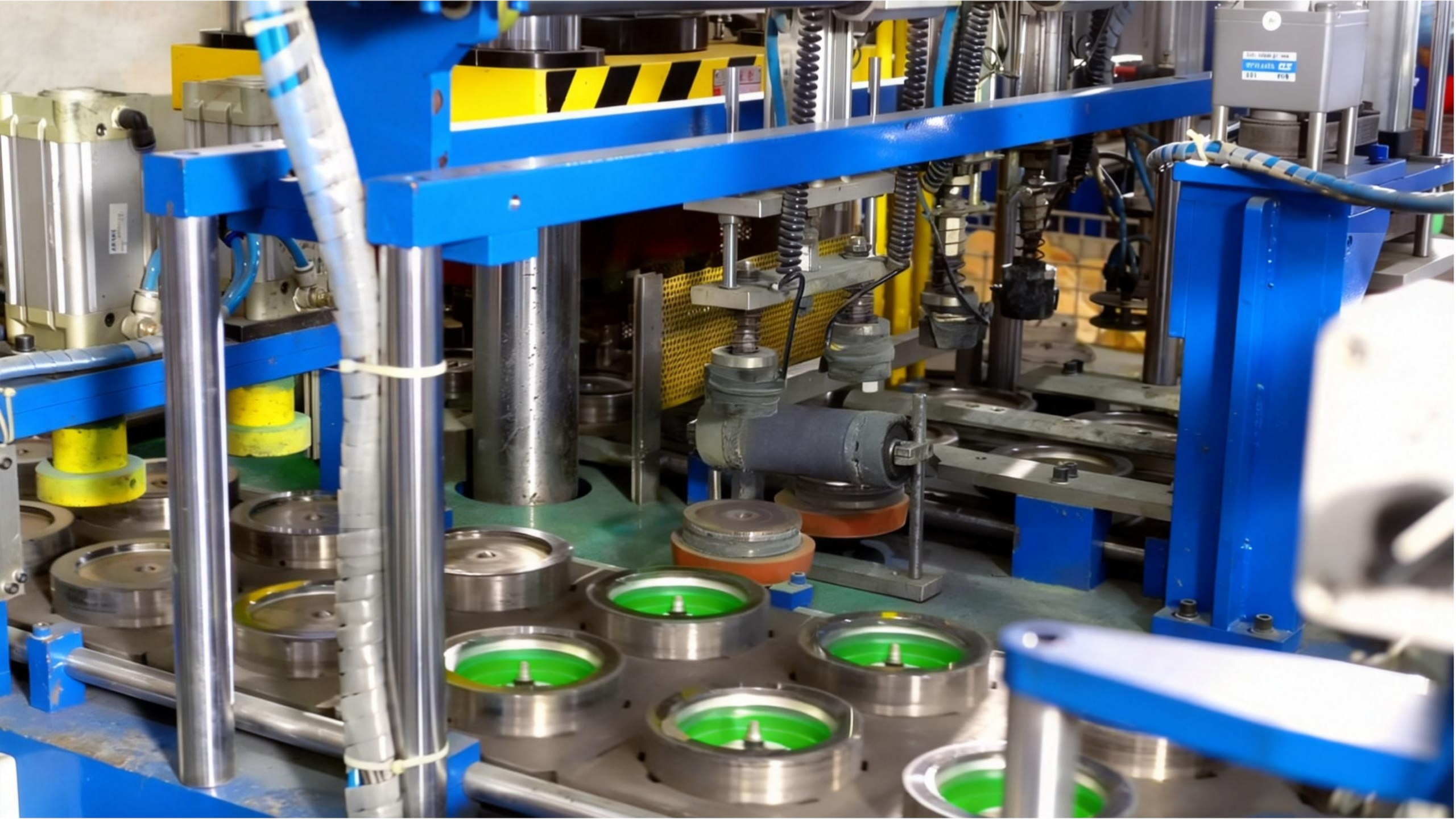
Bonded grinding wheel production line. Fiberglass mesh reinforcement and bore configuration are set during forming. Image: SALI Tools.
Where These Rules Apply: Industries, Applications and Field Evidence
The speed, flange and mounting rules apply across every sector where portable grinding is used: structural steel and building construction, pipeline and energy infrastructure, shipbuilding and offshore projects, rail transit and heavy equipment manufacturing, industrial MRO and equipment overhaul, and municipal and architectural metalworks. Typical functions are weld seam smoothing, deburring and edge chamfering, rust and mill scale removal, casting and forging cleaning, and surface shaping and fitting.
Field experience with SALI grinding wheels has been recorded across several of these environments. A wholesaler client in Uzbekistan has used SALI products for more than 9 years, and by 2024 that wholesaler's sales volume had increased 21 times within seven years compared with its first year as a SALI agent in 2018. In Russia's North Caucasus region, a project completed over more than 7 years with a scale of 5 million pieces achieved an annual growth rate of 50% and became an influential hardware-tools distributor in the local market. In Iraq, manufacturing group procurement buyers have used the product for fabrication and on-site processing across a 10 million piece quantity over 5 years, with stable operation results.
The pattern behind these cases is consistent with the technical argument of this article: buyers in industrial and semi-industrial markets tend to stay with a grinding wheel specification when the mounting rules, speed ratings and batch behaviour remain predictable over repeated orders.
Market Context: A USD 7.12 Billion Category Led by Metalworking
Grinding wheels are a large, standardised and heavily traded category. The global grinding wheels market was estimated at USD 7.12 billion in 2025, according to Mordor Intelligence. Within that total, metalworking led the market with a revenue share of 47.2% in 2025, based on Grand View Research's metal abrasives reporting. Asia Pacific dominated the market with a revenue share of approximately 41.3% to 42.7% in 2025, a range that reflects methodological differences between the commercial research sources rather than a single agreed figure.
Trade classification reinforces how standardised the category is: HS Code 6804.22 covers grinding wheels of other agglomerated abrasives or ceramics under the Harmonized Tariff Schedule. For buyers, the implication is that grinding wheels are not a differentiated market at the level of the product description — the differentiators sit in compliance documentation, batch consistency and mounting compatibility. Two suppliers quoting the same 115 mm depressed center wheel can be quoting materially different levels of verifiable conformance.
Comparing Sourcing Approaches: Specification-First vs Verification-Led
Most grinding wheel purchases are specification-first: the buyer compares price, size and abrasive type from a catalogue or quotation. Verification-led purchasing adds a second layer of questions that determine whether the stated specification can be relied on in the workshop.
| Evaluation dimension | Specification-first sourcing | Verification-led sourcing |
|---|---|---|
| Speed rating | Speed printed on label | Speed covered by an MPA certificate under EN 12413:2019 |
| Size and bore | Nominal diameter only | Diameter and bore matched to the certificate scope and to existing flanges |
| Batch consistency | Relies on supplier assurance | Supported by 100% batch testing and remote live camera inspection |
| Mounting support | Not addressed | Documented ring test, dry run and flange coverage requirements |
| Storage and shelf life | Not addressed | Moisture-protection and storage guidance supplied with the order |
Verification-led sourcing is not a guarantee of performance, and buyers should be clear about where the limits sit. A resinoid bonded grinding wheel remains a consumable with a defined shelf life; it is moisture-sensitive by nature and its optimum performance window is measured in years, not indefinitely. It is not a universal abrasive: standard wheels must never be used on soft metals such as aluminium or copper, or on wood and plastic, because loading causes violent wheel burst, and material compatibility must be matched to the specific workpiece. Correct flanges, blotters and a fitted guard are mandatory, and a documented specification cannot compensate for an operator who mounts the wheel incorrectly or exceeds the working angle. Finally, certificate coverage is size-specific: an approval for a 115 mm wheel does not extend to a 125 mm wheel.
Quick procurement checklist for a grinding wheel order:
- Confirm the wheel's maximum operating speed exceeds the grinder's maximum rated speed.
- Match the certificate number to the exact outside diameter and bore being ordered.
- Verify flange coverage reaches at least one-third of the wheel diameter, with intact blotters.
- Confirm the wheel type matches the task: no side grinding with thin cutting wheels, no deep cutting with grinding wheels.
- Confirm the abrasive grain suits the workpiece material, including stainless steel versus carbon steel.
- Check the expiry date and require moisture-protected packaging for sea freight.
- Require a mounting procedure covering inspection, ring test, guard fitment and dry run.
Future Outlook
Three developments are likely to shape grinding wheel procurement over the next buying cycles. The first is standards convergence: EN 12413:2019 already defines safety requirements for bonded abrasive products in the European market, and buyers sourcing across multiple regions increasingly ask for a single documented conformance set rather than country-by-country paperwork. The second is traceability, as batch-level testing records and remote inspection access become normal expectations rather than differentiators. The third is operator-level discipline, because mounting errors remain the failure mode that documentation cannot eliminate on its own.
For procurement teams, the practical consequence is that grinding wheel evaluation is shifting from a price comparison exercise toward an operating-envelope comparison. Suppliers able to state a maximum operating speed, a flange and bore configuration, a mounting procedure and a storage specification in one package will be easier to approve — and easier to defend when a workshop audit asks why a particular wheel was selected.
FAQ
What does the maximum operating speed on a grinding wheel mean in practice?
Maximum operating speed is the highest surface speed at which the wheel may be run, expressed in metres per second. Bonded grinding wheels in general industrial service operate at surface speeds typically between 30 and 80 m/s. SALI Tools' type 27 depressed center grinding wheels for steel and metal are certified at a maximum operating speed of 80 m/s under EN 12413:2019, through MPA certificates Z-16155/25 for the 125 mm size and Z-16154/25 for the 115 mm size.
How much of the wheel diameter must the flange cover?
Mounting requires balanced, undamaged flanges that cover at least one-third of the wheel's diameter, fitted with soft blotters for even pressure distribution. For a 115 mm wheel that means flange contact across roughly 38 mm of diameter; for a 125 mm wheel, approximately 42 mm. Undersized or worn flanges fail the requirement even when they physically fit the spindle.
Is a ring test required before mounting a grinding wheel?
A ring test is performed on vitreous wheels to detect hidden cracks, by tapping the wheel and listening for the tone. A dull-sounding wheel must never be used. All wheels should also be visually inspected before mounting, and any wheel with cracks, chips, bends or moisture damage is rejected regardless of test result.
How long should a dry run last, and what should the operator do during it?
After mounting, the fitted wheel is run empty for 1 to 3 minutes with the guard in place, while the operator stands clear of the rotation plane. The guard should cover at least 180° and its open side must face away from the operator. Grinding then proceeds at a working angle of 15° to 30° on portable grinders.
What operating temperature and humidity are suitable for grinding wheels?
Grinding wheels operate best between 15 °C and 25 °C with relative humidity of 50% to 60%. Extreme temperatures and excessive humidity weaken the bonding agents and compromise structural integrity. Ventilation is equally relevant: continuous local exhaust with a hood velocity of 1.5 to 2.5 m/s is required to control dust during dry grinding.
Can one grinding wheel be used for both cutting and grinding?
No. Thin cutting wheels must never be used for side grinding, and grinding wheels must never be used for deep cutting. Material compatibility is a separate constraint: standard wheels must not be used on soft metals such as aluminium or copper, or on wood and plastic, because loading causes violent wheel burst.
What feed depth is normal for a resinoid bonded grinding wheel?
Depth-of-cut infeed normally sets removal thickness between 0.005 and 0.05 mm per pass, with longitudinal and crossfeed movements carrying the wheel along the workpiece. The self-sharpening mechanism keeps the cutting face renewed: as grains dull and grinding resistance rises, the wheel fractures the dull grain or its surrounding bond and exposes fresh abrasive. Where liquid coolant is used, fluid pH should be held between 7 and 9, and the wheel spun empty for 3 to 5 minutes afterwards.
How should grinding wheels be stored, and how long do they remain usable?
Resin-bonded discs are moisture-sensitive and should be stored in a cool, dry area, off the floor, in their protective packaging. Under standard conditions, SALI grinding wheels retain optimal performance for three years, and expired wheels should never be used because aged bonding agents significantly increase the risk of burst.
Reference
Buyers who need the full grinding wheel specification tables, including diameters, bores, thicknesses and packaging formats, can consult the SALI Tools Brand Product Catalog.
Есть вопросы или нужны дополнительные детали?
Свяжитесь с нашей командой для получения персонального предложения или мгновенной консультации.
Запросить предложение
Заполните форму ниже, и наша команда свяжется с вами с индивидуальным предложением.
Прямой чат WhatsApp
Предпочитаете общаться в реальном времени? Напишите нам в WhatsApp для мгновенной помощи и быстрых ответов.
- Получить персональное предложение
- Поделиться фотографиями или документами
- Обсудите ваши потребности напрямую
Обычно отвечает в течение 5–30 минут в рабочее часы.