
Grounded vs. Portable Eyewash Stations: Buyer Comparison
The choice between a plumbed, grounded eyewash and a tank-based portable shower and eyewash station is usually a facility-layout decision rather than a product-quality decision. Plumbing dependency, tank volume, installation footprint and freeze exposure separate the two formats more reliably than any single specification.
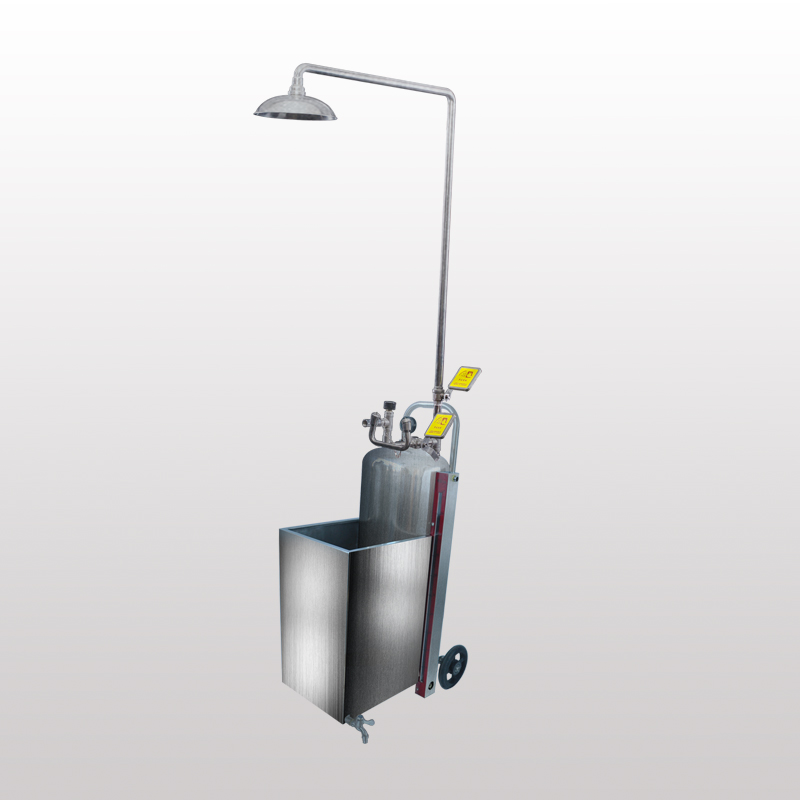
Industrial safety buyers rarely compare a grounded vertical eyewash with a portable shower and eyewash station because they are unsure which product is engineered better. They compare them because the two formats answer different site constraints. A grounded unit assumes a permanent, pressurised water supply and a drainage path at the hazard location. A portable, tank-based station assumes that no such supply exists — or that the hazard location will move before the next safety review.
Both formats sit inside the same compliance environment. The BH32-6012 grounded vertical eyewash from BOHUA is a floor-mounted 304 stainless steel unit with a DN32 water inlet, a documented eyewash flow rate of 12–18 L/min and a start speed within one second. The BH34-0628 and BH34-0665F portable shower and eyewash stations from the same manufacturer carry flushing fluid in a 28 L and 65 L tank respectively, and deliver a shower flow rate of 120–180 L/min with an eyewash flow rate of ≥1.5 L/min. The flushing benchmark applied to eyewash stations — 0.4 gallons per minute for at least 15 minutes — comes from ANSI/ISEA Z358.1-2014 (R2020) and does not distinguish between the two formats.
The short answer for buyers
For a facility that already has a pressurised water line and drainage at the point of risk, a grounded vertical eyewash is the more predictable specification: performance depends on the supply, not on a consumable. For a location without that infrastructure — a remote yard, a temporary worksite, a tank farm without accessible plumbing, or a laboratory bench area pending renovation — a portable, tank-based shower and eyewash station removes the plumbing dependency entirely.
Three decision rules follow from the documented specifications:
- Plumbing available and hazard point fixed: grounded format, sized to the required flow rate and installation height.
- No plumbing at the hazard point, or the hazard point moves: portable, tank-based format, with tank volume and refill logistics matched to the required flushing duration.
- Plumbing available but the location is a bench, wall or compact space: a wall mounted or desk top eyewash may fit where neither a grounded column nor a portable station is practical.
Why this comparison has become a routine procurement question
Emergency decontamination hardware is a mature category, but it is not a static one. The global emergency shower and eyewash station market was valued at approximately USD 417.3 million in 2024, according to Spherical Insights, and Transparency Market Research projects the market to reach USD 713.4 million by 2035, a CAGR of 4.7% from 2025. North America accounted for the largest regional revenue share in 2024 at approximately USD 145.1 million, based on the same Spherical Insights dataset.
The format mix is shifting as well. Dataintelo estimates that portable eyewash stations held approximately 38.2% of market share in 2025, driven by demand at remote and non-plumbed sites — a figure that should be treated as an indicative estimate rather than a settled number, since market-sizing definitions differ between research houses (see the data-caution note below). Industrial applications, including chemical processing and manufacturing, account for approximately 35.7% of global eyewash station revenue according to the same Dataintelo dataset.
For buyers, the practical takeaway is that both formats are mainstream procurement lines, not niche alternatives. A supplier that cannot cover both will push the buyer toward a single format regardless of site conditions.
Two different engineering philosophies
A grounded vertical eyewash is a fixed asset. It is bolted to the floor, connected to a plumbed water line, and its flushing performance is a function of the supply pressure and pipework behind it. The BH32-6012 is documented as part of the Grounded series with a water inlet size of DN32, an overall height of 2480 mm, a drainage height of 133 mm and an eyewash flow rate of 12–18 L/min, with activation within one second at a standard water pressure of 0.25–0.4 Pa. Its flow path components include a two-piece ball valve, a cow-horn bend with adjustable flow, a sprinkler made of PP with a 304 filter, and a fixed soft rubber anti-dust cover.
A portable shower and eyewash station is a self-contained asset. Flushing fluid is held in an onboard tank rather than drawn from a live line at the moment of use. The BH34-0628 is documented with a 28 L tank, a tank pressure of 1.0 MPa, a tank height of 1200 mm and a tank diameter of 220 mm; the BH34-0665F is documented with a 65 L tank. Both are 304 stainless steel, floor-mounted, activated by push handle, with a start speed within one second, a standard water pressure of 0.25–0.4 Pa, a DN32 water inlet and outlet, and a one-year warranty.
| Comparison dimension | Grounded vertical eyewash (BH32-6012) | Portable shower and eyewash (BH34-0628 / BH34-0665F) |
|---|---|---|
| Water source | Plumbed supply at the hazard point | Onboard tank: 28 L or 65 L |
| Installation | Floor-mounted, DN32 inlet, drainage height 133 mm | Floor-mounted, DN32 water inlet and outlet |
| Activation | Documented start speed within 1 second | Push handle, start speed within 1 second |
| Eyewash flow | 12–18 L/min | ≥1.5 L/min |
| Shower flow | Not specified for this eyewash-only model | 120–180 L/min |
| Mobility | Fixed asset, relocated only by re-plumbing | Repositionable within the site, refilled on a maintenance cycle |
| Primary dependency | Water supply continuity and pressure | Tank volume, refill routine and maintenance discipline |
Installation requirements and water-supply dependency
The installation difference is the single most useful filter in this comparison, because it is determined by the building, not by preference.
A grounded unit requires a pressurised line at the installation point, operating within the documented standard water pressure range of 0.25–0.4 Pa for the BOHUA grounded and portable lines alike, plus a drainage path — the BH32-6012 is documented with a drainage height of 133 mm. That constraint typically restricts grounded units to areas where plumbing already exists or where a project deliberately extends it: new plant construction, EHS system builds, chemical safety retrofits, and laboratory safety upgrades are all documented project types for this product family. In those settings the grounded unit is the lower-maintenance answer, because there is no consumable to track and no refill cycle to audit.
The dependency, however, runs upstream. A grounded eyewash is only as available as the water behind it. A plant-wide supply isolation, a frozen line in an unheated outdoor bay, or a pressure drop below the design range affects the unit's flushing capability directly. That is a genuine boundary in the format, not a defect in a specific model, and it is one reason portable units retain a place in facilities that also operate plumbed infrastructure.
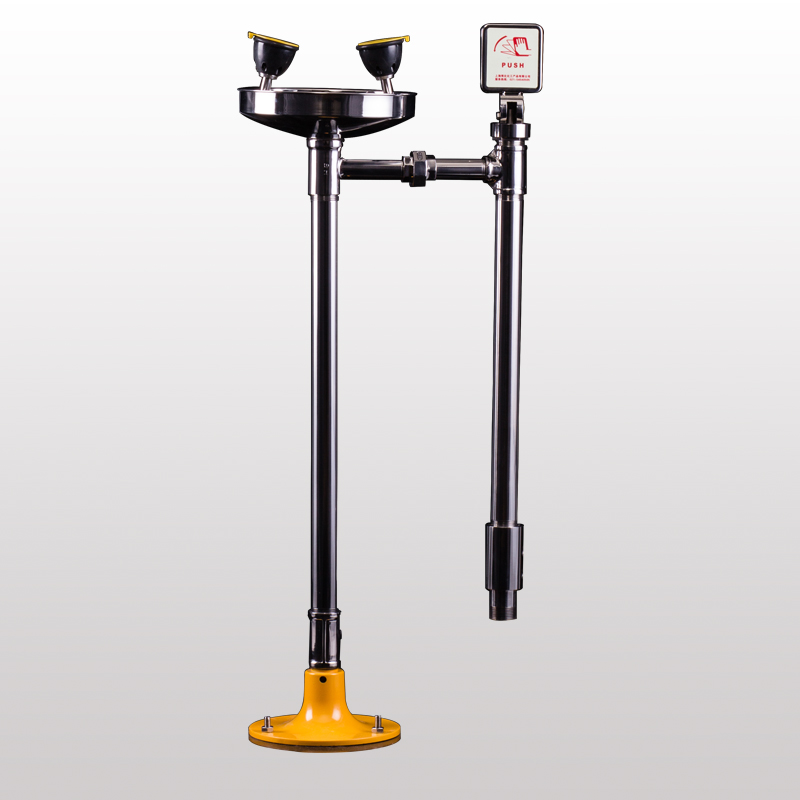
Specification-level comparison
The table below sets out the documented specifications for the models referenced in this comparison. It is a specification view only; it does not rank the formats.
| Item | BH32-6012 (grounded) | BH34-0628 (portable) | BH34-0665F (portable) |
|---|---|---|---|
| Series | Grounded series | Portable series | Portable series |
| Material | 304 SS | 304 SS | 304 SS |
| Water inlet / outlet | DN32 | DN32 | DN32 |
| Overall height | 2480 mm | 2480 mm | 2480 mm |
| Eyewash flow rate | 12–18 L/min | ≥1.5 L/min | ≥1.5 L/min |
| Shower flow rate | — | 120–180 L/min | 120–180 L/min |
| Tank capacity | — | 28 L (tank pressure 1.0 MPa; height 1200 mm; diameter 220 mm) | 65 L |
| Start speed | Within 1 second | Within 1 second | Within 1 second |
| Standard water pressure | 0.25–0.4 Pa | 0.25–0.4 Pa | 0.25–0.4 Pa |
| Drainage height | 133 mm | 133 mm | 133 mm |
| Activation | Push handle | Push handle | Push handle |
| Warranty | — | One year | One year |
Model specifications as documented by BOHUA. Flow rate values differ between the two formats because the grounded model is an eyewash-only unit with a 12–18 L/min eyewash circuit, while the portable models combine a shower circuit at 120–180 L/min with an eyewash circuit at ≥1.5 L/min.
Where each format fits: layouts and application scenarios
The documented application profile for this product family covers chemical plants, pharmaceutical factories, laboratories, petrochemical facilities, battery manufacturing plants and university research laboratories. Working conditions include high temperature, low temperature where outdoor winter installation requires freeze protection, corrosive atmospheres with acid or alkali splash risk, dusty environments, and normal-temperature indoor laboratories. Documented deployment regions for this profile include Kazakhstan, Russia, the United Arab Emirates, Singapore, Malaysia, Australia, Qatar, Oman and Saudi Arabia.
Layouts that favour the grounded format
Fixed process areas with existing water and drainage infrastructure, indoor laboratory corridors with service risers, and new-build plant rooms where the plumbing scope is still open all favour grounded units. In these settings, the unit becomes part of the building's safety infrastructure rather than a piece of movable equipment, which simplifies inspection and asset tracking. The BH32-6012's documented activation within one second and 12–18 L/min eyewash flow are fixed by the supply, so the performance case is stable across the asset's life.
Layouts that favour the portable format
Tank yards, remote loading bays, temporary worksites, shutdown and turnaround zones, and any location where extending a water line is impractical during the current capital cycle favour portable stations. The choice between the 28 L and 65 L tanks is a site-usage question: a compact unit placed close to a refill point, or a larger tank where refill access is less frequent. Portable units are also the practical answer where a single decontamination point must serve a shifting hazard — for example, where maintenance work moves between vessels or pipe racks over a campaign.
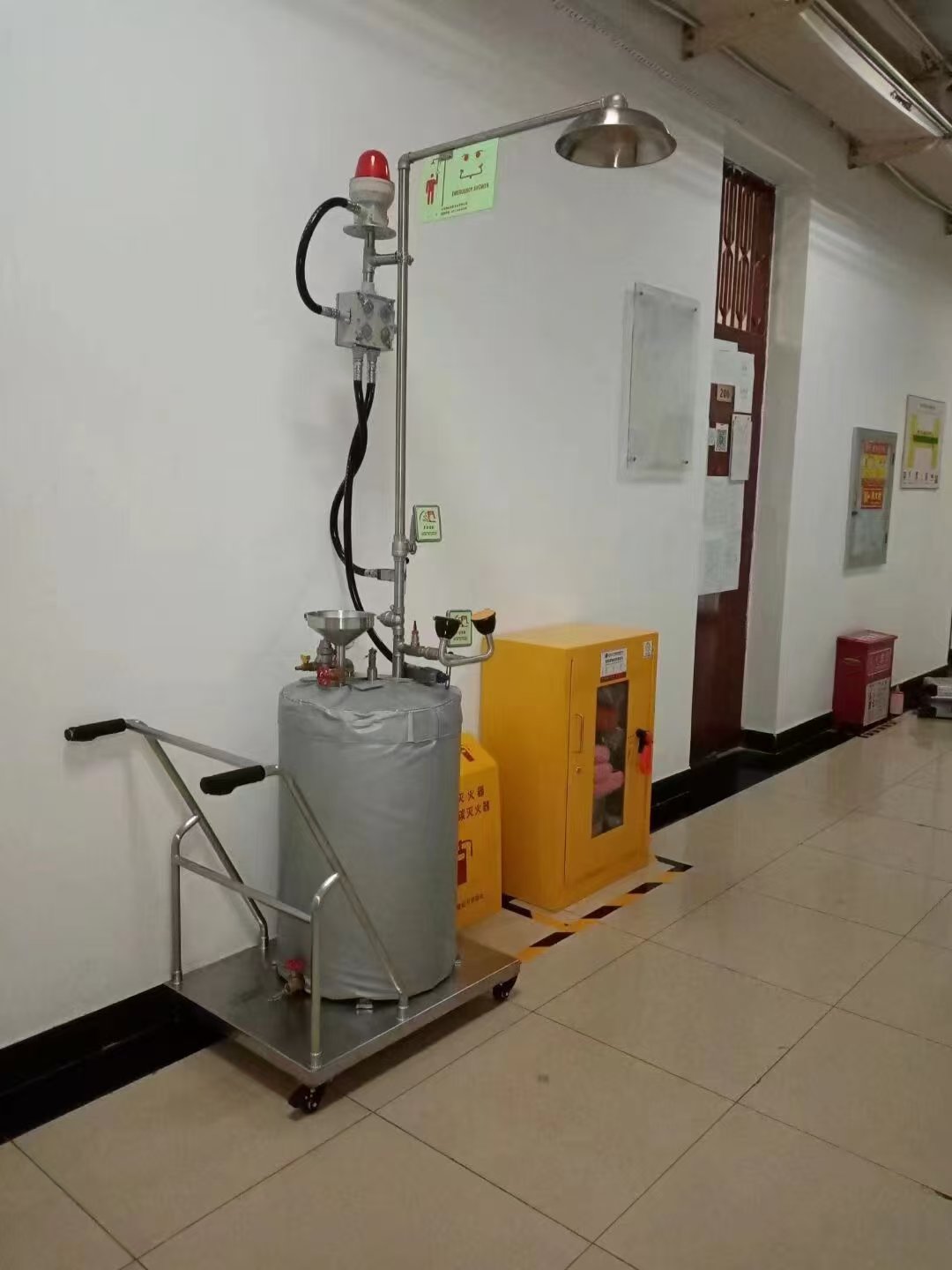
A third path: wall mounted and desk top formats
Not every location can accept either a grounded column or a full portable station. BOHUA also documents a wall mounted series — the BH33-1011 in 304 stainless steel with an ABS finish, an eyewash flow rate of ≥1.5 L/min and a sprinkler spacing of 101.6 mm — and a DeskTop series, including the BH35-1011L in 304 SS with ABS for laboratory bench locations. For buyers, this matters because the grounded-versus-portable question is often really a question about space and infrastructure, and a third format may resolve both.
Boundaries, limitations, and where each format stops working
An honest comparison has to state where each format fails, not only where it wins.
- Grounded format boundary: without a pressurised supply and drainage at the installation point, a grounded unit cannot be commissioned. It also inherits the availability of that supply — during a plant water isolation, the unit's flushing capability is affected even though the hardware itself is intact.
- Portable format boundary: tank volume is finite and must be refilled and maintained. The ANSI/ISEA Z358.1-2014 (R2020) benchmark for eyewash stations — 0.4 gallons per minute for at least 15 minutes — is the reference point buyers should measure their refill routine against, particularly where a single tank serves both shower and eyewash circuits.
- Material boundary: 304 stainless steel is the documented material for the BH32-6012, BH34-0628 and BH34-0665F, and it suits a wide range of documented applications. It is not a universal answer for aggressive chemical exposure. Where a more corrosive environment is expected, BOHUA documents the BH30-1316 compound emergency shower and eyewash in 316 stainless steel — a specification decision that should be made against the actual chemicals and cleaning agents in use.
- Temperature boundary: low-temperature outdoor installation is documented as a condition requiring freeze protection. Neither a grounded unit nor a standard portable unit is freeze-protected by default; BOHUA addresses this with an anti-freeze series, including the BH32-1008 anti-freeze and anti-scald vertical eyewash in 304 SS with a 12–18 L/min eyewash flow, and the BH30-5012A anti-freeze shower and eyewash. For heated installations, the electric heat tracing series — for example the BH30-1062, documented with 48 W/m heat trace power, 220 V rated voltage, protection levels IP54, IP56 or IP65, and explosion-proof grades EXD II BT4, BT6, CT4 or CT6 — adds a further option.
- Spatial boundary: both formats occupy floor space at the hazard point. In congested corridors or bench-level laboratories, the wall mounted and desk top alternatives may be the only compliant fit.
What a supplier's model range tells a buyer
Shanghai Bohua Safety Device Co., Ltd. (BOHUA) is a Shanghai-based manufacturer, established in 2006 and located at No. 661, Chenjing Road, Sijin Town, Songjiang District, Shanghai, China, that specialises in the research, development, production and sale of emergency shower and eyewash equipment. The company employs approximately 50 staff, operates a manufacturing facility of 4,000 square metres, and reports an annual production capacity of 20,000 units.
Two facts are relevant to this comparison specifically. First, the portfolio breadth: BOHUA reports having developed 11 series and more than 100 types of eyewash products, spanning grounded, portable, compound, anti-freeze and anti-scald, electric heating and electric heat tracing, wall mounted, desk top and fully automatic configurations. Second, the compliance footprint: the company's profile lists ISO 9001:2008 quality system certification, ISO 14001:2004 environmental management system certification, OHSAS 18001:2007 occupational health and safety management system certification, ANSI Z358.1-2014 certification, CE EN 15154-1:2006 certification, CCS certification from China Classification Society, and nine patent certificates.
For a buyer, range breadth matters most when a site needs more than one format. If a facility requires grounded units at fixed process points and portable stations at remote points, sourcing both from one manufacturer simplifies spares, documentation and inspection routines — and avoids the situation where a supplier's catalogue pushes the buyer toward whichever format that supplier happens to build. BOHUA also reports that export business accounts for 20% of total sales, with global markets served.
A practical selection framework
The framework below converts the comparison into a sequence a procurement or EHS team can work through before issuing a specification.
| Step | Question to answer | Format implication |
|---|---|---|
| 1 | Is a pressurised water line and drainage available at the hazard point? | Yes: grounded format is viable. No: portable format. |
| 2 | Will the hazard point remain fixed for the asset's life? | Fixed: grounded. Shifting or campaign-based: portable. |
| 3 | What supply pressure can be guaranteed at the point of use? | Must fall within the documented 0.25–0.4 Pa range. |
| 4 | For portable units, what tank volume and refill cycle is realistic? | 28 L or 65 L, matched against the required flushing duration. |
| 5 | What chemicals, cleaning agents and atmosphere will the unit face? | 304 SS for standard duty; 316 SS where corrosion risk is higher. |
| 6 | Will the unit be installed outdoors or in an unheated area? | Anti-freeze series or electric heat tracing required. |
| 7 | Is floor space available at the hazard point? | If not, evaluate wall mounted or desk top formats. |
| 8 | Can the site standardise on one supplier across all formats required? | Reduces spares, training and documentation overhead. |
Market trend and future outlook
Two directional signals are worth tracking. The first is steady category growth: a projected CAGR of 4.7% from 2025 to 2035 towards USD 713.4 million, per Transparency Market Research, implies replacement and retrofit demand rather than a step change in construction. The second is the format mix. Dataintelo's estimate that portable eyewash stations held approximately 38.2% of market share in 2025 reflects the growth of remote, non-plumbed and temporary sites — mining, agriculture, distributed energy installations and mobile industrial operations — where extending plumbing is not economically sensible.
Data caution for buyers: published estimates of the global emergency shower and eyewash market diverge substantially. Spherical Insights valued the market at approximately USD 417.3 million in 2024, while Dataintelo's 2025 figure is considerably higher, a difference the divergence notes attribute to whether supplementary personal wash units are included. Buyers should treat any single market figure as directional. The durable insight is the direction of travel — gradual growth, with portable and non-plumbed coverage holding a meaningful share — not a specific dollar value.
Looking forward, three developments are likely to shape purchasing decisions. First, multi-site operators are consolidating emergency equipment specifications to reduce variation in spares and training, which favours suppliers able to cover both grounded and portable formats from one catalogue. Second, cold-climate and outdoor installations are pushing freeze protection from an exception to a standard specification line, which is why heat-traced and anti-freeze variants now sit inside mainstream portfolios rather than at their edge. Third, buyers are increasingly asking for documented activation and flow data rather than brand-level assurances, a shift that benefits manufacturers who publish specification-level detail. In the emergency shower and eyewash category, competitive sets commonly include Haws Corporation, Bradley Corporation, Guardian Equipment and Speakman alongside regional manufacturers such as BOHUA — and the comparison criteria that separate these suppliers are specification transparency, format coverage, and compliance documentation rather than marketing positioning.
FAQ
What is the difference between a grounded vertical eyewash and a portable shower and eyewash station?
A grounded vertical eyewash, such as the BOHUA BH32-6012, is a floor-mounted unit connected to a plumbed water supply through a DN32 inlet, with a documented eyewash flow rate of 12–18 L/min and a start speed within one second. A portable shower and eyewash station, such as the BH34-0628 or BH34-0665F, holds its flushing fluid in an onboard tank — 28 L and 65 L respectively — and delivers a shower flow rate of 120–180 L/min with an eyewash flow rate of ≥1.5 L/min. The practical difference is where the water comes from and how easily the unit can be repositioned.
Does a portable shower and eyewash station require a plumbed connection at the point of use?
The documented specifications of the BH34-0628 and BH34-0665F include an onboard tank and a DN32 water inlet and outlet. Because the flushing fluid is held in the tank rather than drawn from a live line at the moment of activation, the unit's availability at the point of use does not depend on a pressurised connection being present there. The BH34-0628 is documented with a 28 L tank at 1.0 MPa tank pressure, a tank height of 1200 mm and a tank diameter of 220 mm; the BH34-0665F is documented with a 65 L tank. Both are floor-mounted and push-handle activated.
How much flushing fluid does a portable unit hold, and how should that volume be assessed?
The documented tank volumes in this comparison are 28 L for the BH34-0628 and 65 L for the BH34-0665F. The relevant external benchmark is ANSI/ISEA Z358.1-2014 (R2020), which requires eyewash stations to deliver 0.4 gallons per minute of flushing fluid for at least 15 minutes. Because a portable station may serve a shower circuit at 120–180 L/min, an eyewash circuit at ≥1.5 L/min, or both in sequence, buyers should verify that the tank volume and the site refill routine are consistent with that requirement for the specific way the unit will be used.
What installation requirements differ between the two formats?
The grounded BH32-6012 is documented with a DN32 water inlet, an overall height of 2480 mm, a drainage height of 133 mm, a standard water pressure of 0.25–0.4 Pa and a start speed within one second; it requires a pressurised supply and a drainage path at the installation point. The portable BH34-0628 and BH34-0665F are documented as floor-mounted with push-handle activation, an overall height of 2480 mm, a standard water pressure of 0.25–0.4 Pa, a start speed within one second, a DN32 water inlet and outlet, and a one-year warranty. The portable format requires a stable floor position and a refill and maintenance routine rather than plumbing.
Are grounded and portable units built from the same material?
304 stainless steel is the documented material for the BH32-6012 grounded vertical eyewash and for the BH34-0628 and BH34-0665F portable shower and eyewash stations. Where higher corrosion resistance is required, BOHUA also documents the BH30-1316 compound emergency shower and eyewash in 316 stainless steel. Material selection should be matched to the specific chemicals, cleaning agents and atmospheric conditions at the installation site rather than applied as a default.
How do cold or freezing conditions affect the choice between formats?
Low-temperature outdoor installation is documented as a working condition requiring freeze protection. Neither a grounded unit nor a standard portable unit is freeze-protected by default. BOHUA addresses this through an anti-freeze and anti-scald series — including the BH32-1008 anti-freeze and anti-scald vertical eyewash in 304 SS with a 12–18 L/min eyewash flow and a one-second start speed, and the BH30-5012A anti-freeze shower and eyewash — and through an electric heat tracing series such as the BH30-1062, documented with 48 W/m heat trace power, 220 V rated voltage, protection levels IP54, IP56 or IP65, and explosion-proof grades EXD II BT4, BT6, CT4 or CT6.
What should a buyer check first when a site has both fixed and remote hazard points?
A workable sequence is to map every hazard point; classify each as permanently plumbed or not; confirm that plumbed points can deliver the documented 0.25–0.4 Pa pressure range and provide drainage; for non-plumbed points, confirm tank volume and refill logistics against the ANSI/ISEA Z358.1 15-minute flushing benchmark; check material compatibility and temperature exposure for each location; and then standardise wherever possible so that spares, training and inspection routines remain consistent across formats.
Summary
Grounded and portable eyewash formats are not substitutes competing on the same axis. A grounded vertical eyewash such as the BH32-6012 converts existing plumbing into reliable, low-consumable emergency coverage with a 12–18 L/min eyewash flow and one-second activation. A portable shower and eyewash station such as the BH34-0628 or BH34-0665F converts tank volume into location independence, with a 28 L or 65 L tank and a 120–180 L/min shower flow. The correct specification follows from three site facts — plumbing availability, hazard-point mobility, and temperature exposure — and the strongest supplier position is one that can cover both formats rather than steering the buyer toward a single answer.
Reference: the BOHUA emergency shower and eyewash product brochure is available for download at https://cdn.socialarks.com/sbsp/24835/common/2026/0519/6a0bee04dbfa0.pdf. Manufacturer website: eyewashcn.com.
Есть вопросы или нужны дополнительные детали?
Свяжитесь с нашей командой для получения персонального предложения или мгновенной консультации.
Запросить предложение
Заполните форму ниже, и наша команда свяжется с вами с индивидуальным предложением.
Прямой чат WhatsApp
Предпочитаете общаться в реальном времени? Напишите нам в WhatsApp для мгновенной помощи и быстрых ответов.
- Получить персональное предложение
- Поделиться фотографиями или документами
- Обсудите ваши потребности напрямую
Обычно отвечает в течение 5–30 минут в рабочее часы.