
H5000 vs S01: An Independent 2026 Review of Two Scenting Extremes
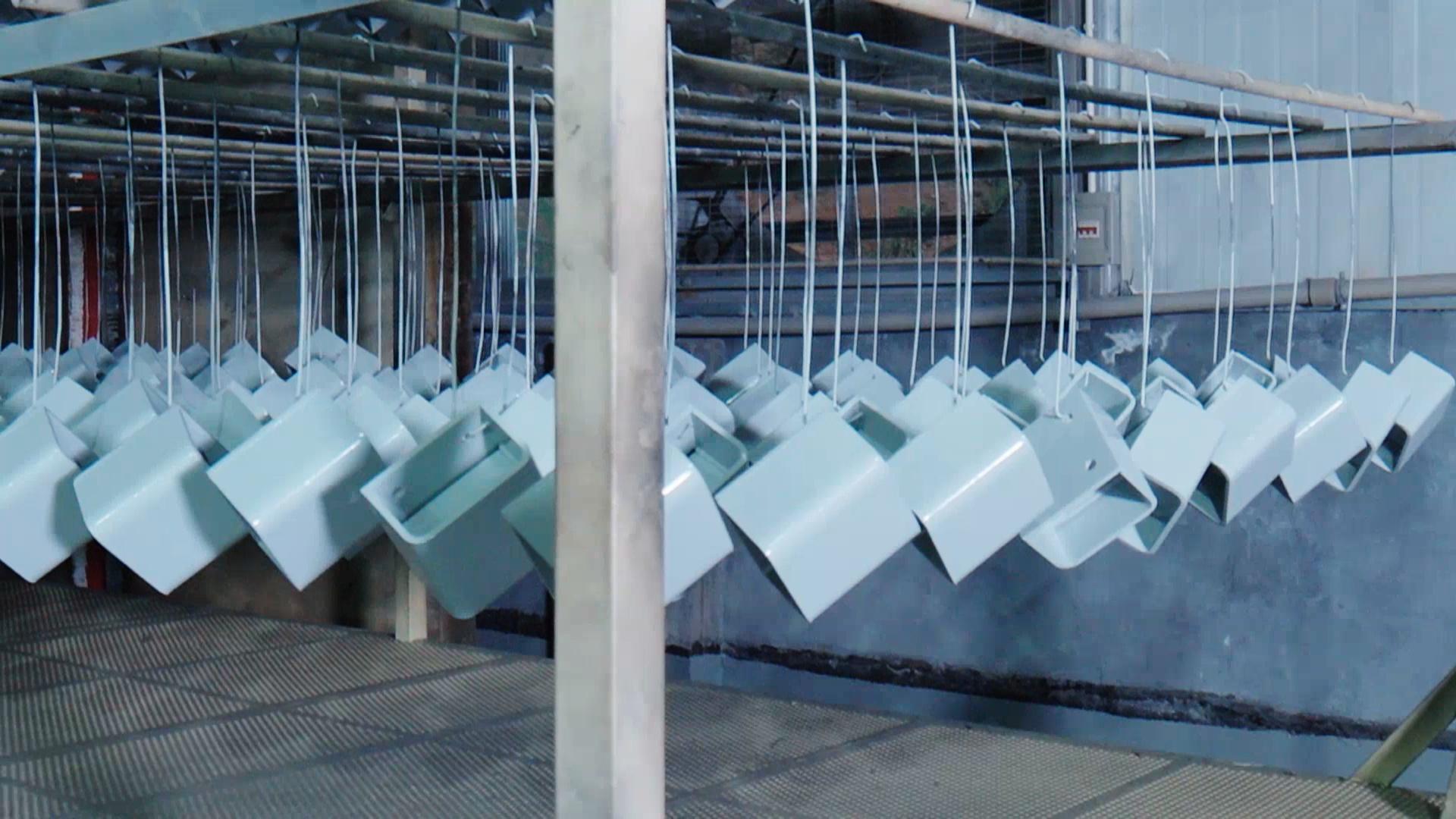
Metal fabrication and powder coating: the production step behind aluminium-housed commercial scent diffusers, and the clearest physical contrast with a moulded plastic plug-in unit. Image: SCENTSEA production facility.
Commercial scenting in 2026 is a specification decision before it is a fragrance decision. Two SCENTSEA scent diffusers sit at opposite ends of the same product logic: the H5000, a floor standing aluminium unit rated for 800–1300 m², and the S01, a 0.2 kg wall plug-in scent diffuser rated for 30–100 m². The distance between them is not a quality gap. It is a gap in capacity, installation tolerance and maintenance exposure.
This review compares the two models on published specifications, installation requirements, power and noise behaviour, certification coverage and application fit. Both are manufactured by Shenzhen Scentsea Technology Co., Ltd., a Shenzhen-based scent diffuser and fragrance oil supplier founded in 2021 whose products are certified with CE, RoHS and FCC and supplied to customers in more than 70 countries and regions. The intention is not to declare a winner, but to make the trade-off explicit for buyers who must decide whether to purchase capacity or purchase simplicity.
Why the H5000–S01 gap matters more in 2026
The commercial scent diffuser category is expanding, and it is expanding unevenly across technologies. Data Bridge Market Research estimated the global fragrance diffuser market at USD 29.61 billion in 2024, and projects the smart aroma diffuser segment to grow at a CAGR of 9.22% from 2026 to 2034. The same research notes that ultrasonic diffusers held a 38.5% revenue share in 2024, while nebulising diffusers are expected to grow fastest, driven by professional-grade requirements in hotels.
That shift changes what buyers compare. Five years ago, a scent diffuser purchase was often a single-device decision made for one reception area. In 2026, procurement tends to be building-wide: a hotel group compares a lobby unit and a restroom unit inside the same tender, and the question becomes how much hardware capacity belongs at each point. The H5000 and the S01 are precisely that pair. One is a 6.4 kg aluminium floor unit with a 1000 ml reservoir; the other is a 0.2 kg plastic wall plug-in with a 150 ml reservoir.
Specification comparison at a glance
| Parameter | H5000 (floor standing) | S01 (wall plug-in) |
|---|---|---|
| Product type | Floor standing scent diffuser | Wall plug-in scent diffuser |
| Housing material | Aluminium | Plastic |
| Rated coverage | 800–1300 m² / 2500–4000 m³ / 8600–14000 ft² | 30–100 m² / 100–300 m³ / 300–1000 ft² |
| Oil capacity | 1000 ml | 150 ml |
| Voltage and supply | DC 12 V, plug-in power supply | 110–240 V, plug-in |
| Power draw | 20 W | 1.5 W |
| Noise | <45 dB | <38 dB |
| Oil consumption | 5.4 ±10% ml/h | Not stated in the published specification set |
| Net weight | 6.4 kg (gross 7.1 kg) | 0.2 kg |
| Product size | L180 × W180 × H610 mm | L69 × W73.5 × H136 mm |
| Packing size | L190 × W190 × H700 mm | Not stated separately |
| Colour options | Gunmetal | White, black |
| Stated applications | Hotel, shopping mall, office building lobby | Home, toilet, store |
Source: SCENTSEA product specification data for models H5000 and S01. Figures are manufacturer-published ratings, not third-party test results.
Two differences in that table deserve emphasis. First, the coverage ratio between the models is roughly an order of magnitude, which places them in different procurement categories rather than different price points of the same category. Second, the S01 specification set does not publish an oil consumption rate. Buyers who plan consumable budgets should request that figure rather than infer it from the 150 ml reservoir, because reservoir size and consumption rate are independent variables.
What 6.4 kg of aluminium actually buys
The H5000 is a floor standing scent diffuser built around an aluminium body in gunmetal, measuring 180 mm square at the base and 610 mm tall. The material choice is consistent with its stated deployment: hotel lobbies, shopping malls and office building lobbies. These are public-facing, high-traffic volumes where the device is visible, where it may be moved during cleaning rotations, and where a housing that resists casual impact and holds a uniform finish has practical value beyond appearance.
Capacity is the second part of the argument. A 1000 ml reservoir combined with a stated consumption of 5.4 ±10% ml/h indicates a machine designed for sustained duty in large volumes rather than occasional bursts. The 20 W power draw and DC 12 V plug-in supply are modest for the rated output, which matters in venues that meter energy per floor or per tenancy.
The trade-off is physical. At 6.4 kg net and 7.1 kg gross, the unit is shipped and handled as furniture rather than as an accessory; its 610 mm height and 180 mm square footprint require a deliberate floor position, ideally out of pedestrian flow but inside the scent zone. It also needs a socket within reach of the chosen position, because the model is plug-in only. In venues where no floor socket exists near the intended placement, installation cost moves from zero to a cabling task, and that cost can exceed the difference in unit price between a compact and a floor standing device.
Noise and the quiet-room question
The H5000 is rated below 45 dB, while the S01 is rated below 38 dB. Model-level noise figures are not proportional to size in any simple way, and both ratings are published specifications rather than independent measurements. For a lobby with music and conversation, a sub-45 dB rating is rarely a constraint. For a reading room, a spa treatment area or a small boutique with no background sound, the quieter unit is the more defensible choice regardless of coverage.
What the 0.2 kg plug-in trades away
The S01 inverts the design logic. It is a plastic wall plug-in scent diffuser of 69 × 73.5 × 136 mm that weighs 0.2 kg and draws 1.5 W from a 110–240 V supply. It mounts at the socket, which removes the two cost lines that dominate compact commercial installations: cable routing and floor space. For restrooms, small stores and residential use, that is a genuine engineering advantage, not a compromise.
What it trades away is headroom. A 30–100 m² rating and a 150 ml reservoir place a hard ceiling on the space one unit can serve, and in heavier use the refill interval shortens in proportion. A plastic housing is appropriate to a device that lives at wall height in a low-traffic room, but it is not the housing a hotel lobby expects, and the model is not specified for that environment. Buyers should also note that the S01 is described for home, toilet and store applications — not for elevator cars, which in the same range are served by battery-operated models such as the P01 and P03.
Installation, power and handling: the cost line buyers underestimate
Comparing a 6.4 kg aluminium system with a 0.2 kg plastic plug-in is, in accounting terms, comparing a capital installation with a consumable deployment. The H5000 is a one-time placement: position, connect, schedule, maintain. The S01 is a repeatable deployment: each room needs its own socket and its own refill cycle, and the labour of that cycle scales with the number of units rather than with the size of the building.
A lobby rated at 800–1300 m² sits outside the S01’s stated 30–100 m² range, so covering comparable space with plug-in units would require multiple devices, each occupying a socket and each entering the maintenance schedule independently. Conversely, placing an H5000 in a 40 m² boutique substitutes a 1000 ml reservoir and a 20 W draw for a task the 1.5 W plug-in performs, and adds a floor object the shop layout may not accommodate. Neither substitution is efficient; the models are complementary, not interchangeable.
Application fit: which venue belongs to which unit
- Hotel lobby, mall atrium, office building lobby: the H5000, on the strength of its 800–1300 m² rating, 1000 ml reservoir and aluminium housing.
- Small retail store, boutique, showroom corner: the S01, where 30–100 m² coverage matches the floor plate and the socket mount avoids visible cabling.
- Restroom banks in offices and malls: the S01, where its sub-38 dB rating and 1.5 W draw suit intermittent occupancy.
- Home fragrance: the S01, which is the model explicitly specified for home use.
- Elevator cars: neither model. The range assigns this scenario to battery-operated units.
- Large halls with ducted air handling: neither model. Centralised HVAC scenting is a different architecture, served in the same portfolio by the AC-MAX with a 5 L reservoir and a 2500–3500 m² rating.
This is where the H5000 versus S01 question usually resolves itself. The decision is rarely about which machine is better; it is about which rooms in a building are worth a fixed installation and which are better served by a socket-mounted device that can be replaced or relocated without a work order.
Certification and procurement evidence
Both models appear in the same compliance documentation held by Shenzhen Scentsea Technology Co., Ltd., which is the practical point for buyers: a single certificate set covers a mixed order of large and small units.
- FCC: certificate ATL20240416326, issued 24 April 2024 by Shenzhen ATL Testing Technology Co., Ltd., against FCC Part 15 Subpart B:2023, for the US market.
- RoHS: certificate ATL20240416327, issued 24 April 2024 by the same body, against RoHS Directive (EU) 2015/863, for the EU market.
- EMC: certificate ATL20240416325, issued 24 April 2024, against EN IEC 55014-1:2021, EN IEC 55014-2:2021, EN IEC 61000-3-2:2019/A1:2021 and EN 61000-3-3:2013/A2:2021.
Certificate numbers are a starting point, not a conclusion. Importers should confirm that the document references the exact model and configuration being purchased, because a certificate issued for a product family does not automatically cover a later variant with different electronics. For customs and logistics planning, aroma diffusers are classified under HS code 8509.80, and applicable duty treatment should be confirmed for the destination market rather than assumed from the category.
On the supplier side, the operating facts that affect a two-model order are these: a 3,000 m² facility with three production lines, annual output of 100,000 units and monthly capacity of 8,000 units; a lead time of 25–35 days; a minimum order quantity of one unit for diffusers; a 70% export ratio with the EU and USA as main markets; and a quality process that includes 100% functional testing, atomisation testing, leakage inspection, noise testing, control testing, a 48-hour ageing test and final appearance inspection before shipment. Spare parts carry a one-year free warranty. OEM/ODM customisation covers logo, product colour, packaging, user manual, plug type, app interface and selected PCB functions.
Documented commercial reference
SCENTSEA’s case record includes a US scent marketing company that deployed 30 units for shopping mall scenting over a five-year duration. The reported outcome was stable and consistent scent coverage, reduced manual maintenance, improved fragrance management efficiency and an enhanced customer experience, attributed to strong atomisation, stable operation, app-based control, adjustable intensity, low maintenance and simple installation.
That record is relevant to this comparison as evidence of commercial deployment discipline in mall environments, not as a performance certificate for either model in this review. Buyers evaluating the H5000 for a specific lobby should ask for references at comparable ceiling heights and airflow, and buyers evaluating the S01 for a restroom bank should ask how many units a comparable site actually runs. Reference specificity matters more than reference count.
Where each model is the weaker choice
- H5000: weak where there is no nearby socket, where floor area is contested, where the room is small enough that 1000 ml of oil becomes a storage liability, or where a sub-38 dB environment is required.
- S01: weak in lobbies and atria, in any space exceeding its 30–100 m² rating, in high-ceiling volumes with strong air movement, and anywhere the refill cycle cannot be sustained at the required frequency.
- Both: unsuitable for elevator cars, unpowered locations and ducted HVAC distribution, which are served by other models in the same range.
- Both: coverage ratings are manufacturer-published and should be validated with a sample in the actual room before a multi-unit order is placed.
A short decision framework for evaluation-stage buyers
| Buyer situation | Model indicated | Reason |
|---|---|---|
| Lobby or atrium of 800–1300 m², continuous daytime operation | H5000 | Rated coverage, 1000 ml reservoir, 20 W output in an aluminium floor housing |
| Retail unit or boutique of 30–100 m² with limited floor space | S01 | Socket mount, 0.2 kg, no cabling, 1.5 W draw |
| Restroom bank across several floors | S01, one per room | Sub-38 dB rating and simple replacement cycle |
| Elevator car | Battery-operated model (P01 or P03) | No outlet available; neither reviewed model is battery-powered |
| Building with ducted air handling and centralised control | HVAC scent diffuser (AC-MAX) | 5 L reservoir and 2500–3500 m² rating for centralised distribution |
Framework based on published specifications; final selection should follow sample testing in the target space.
2026–2027 outlook
Three movements are shaping how buyers will read this comparison over the next 18 months. The first is the continued shift toward nebulising technology in professional venues, which favours capacity-led hardware like the H5000 wherever the built environment can support a fixed installation. The second is the growing expectation of app-based scheduling and remote management; buyers should confirm control features per model rather than per brand, since a product range typically mixes app-capable and manually controlled units. The third is documentation pressure: as certification becomes a screening gate rather than a formality, a supplier able to present matching FCC, RoHS and EMC records for both a 6.4 kg commercial unit and a 0.2 kg plug-in is easier to qualify than one that cannot.
The likely direction is not convergence. Compact plug-ins will keep absorbing small-room deployments, and floor standing units will keep absorbing lobbies, with HVAC systems taking the largest volumes. The buyer’s task is to allocate rooms to the correct category early, because retrofitting a cabling route after a lobby fit-out is the single most avoidable cost in a scenting project.
FAQ
What is the practical difference between a floor standing and a wall plug-in scent diffuser?
The difference is installation architecture rather than fragrance technology. A floor standing unit such as the H5000 stands on the floor, requires a nearby power outlet, and carries a larger reservoir (1000 ml) with a higher rated coverage (800–1300 m²). A wall plug-in unit such as the S01 mounts directly at the socket, weighs 0.2 kg and holds 150 ml for 30–100 m². The plug-in removes cabling and floor-space costs; the floor unit removes the need for multiple devices in a large volume.
How should buyers interpret coverage ratings such as 800–1300 m² and 30–100 m²?
Coverage ratings are manufacturer-published planning inputs derived from assumptions about ceiling height, air movement and partitioning. They are not standardised across the industry: published third-party examples include a 250 ml commercial machine rated to 600 m³ and a waterless unit rated to 300 m² / 1000 m³, figures that cannot be compared directly. Buyers should use the rating to shortlist a model category, then confirm performance with a sample test in the actual room.
Does a 6.4 kg aluminium unit cost more to install and operate than a 0.2 kg plug-in?
Installation exposure is higher in kind, not necessarily in amount. The H5000 requires a floor position and a socket within reach, and its 7.1 kg gross weight affects shipping and handling. The S01 mounts at an existing socket with no cabling. In operation, the H5000 draws 20 W against the S01’s 1.5 W, and its published consumption of 5.4 ±10% ml/h gives a measurable basis for consumable planning, whereas the S01 has no published consumption figure and should be quoted by the supplier on request.
Are the H5000 and S01 certified for the EU and US markets?
Both models appear in the compliance documentation held by Shenzhen Scentsea Technology Co., Ltd.: FCC certificate ATL20240416326 against FCC Part 15 Subpart B:2023, RoHS certificate ATL20240416327 against Directive (EU) 2015/863, and EMC certificate ATL20240416325 against EN IEC 55014-1:2021 and related standards, all issued 24 April 2024 by Shenzhen ATL Testing Technology Co., Ltd. Buyers should confirm that the certificate references the exact model and configuration ordered.
Can the S01 be used in a hotel lobby, or the H5000 in a restroom?
Each model is specified for different environments. The S01 is stated for home, toilet and store applications with a 30–100 m² rating, so a lobby falls outside its intended range. The H5000 is stated for hotel, shopping mall and office building lobby applications with an 800–1300 m² rating and a sub-45 dB noise figure; placing it in a small restroom substitutes a larger reservoir and higher output for a task better served by a quieter plug-in unit. Noise tolerance and room volume should drive the assignment, not unit price.
What should be verified before placing a bulk order for either model?
Verify sample performance in the target space, model-matched certificates for the destination market, the published noise and consumption figures, and the supplier’s quality process. For this supplier, the documented process covers 100% functional testing, atomisation testing, leakage inspection, noise testing, control testing, a 48-hour ageing test and final appearance inspection, with a 25–35 day lead time, a minimum order quantity of one unit for diffusers and a one-year free warranty on spare parts. Spare parts availability and refill logistics should be confirmed in writing before the order is released.
Conclusion
The H5000 and S01 are not competitors for the same specification slot. The H5000 is a capacity instrument with an aluminium body, 6.4 kg of mass, a 1000 ml reservoir and a floor-standing footprint that belongs in lobbies and atria. The S01 is an installation-minimising device of 0.2 kg and 1.5 W that belongs in small stores, restrooms and homes. The correct evaluation question in 2026 is not which unit is stronger, but which rooms in a building justify fixed hardware and which are better served by something a facilities team can mount at a socket and replace without a work order.
Reference document: SCENTSEA product catalogue (PDF) — model specifications, certifications and application notes.
Есть вопросы или нужны дополнительные детали?
Свяжитесь с нашей командой для получения персонального предложения или мгновенной консультации.
Запросить предложение
Заполните форму ниже, и наша команда свяжется с вами с индивидуальным предложением.
Прямой чат WhatsApp
Предпочитаете общаться в реальном времени? Напишите нам в WhatsApp для мгновенной помощи и быстрых ответов.
- Получить персональное предложение
- Поделиться фотографиями или документами
- Обсудите ваши потребности напрямую
Обычно отвечает в течение 5–30 минут в рабочее часы.