
HB4106 vs K4106A vs K4106B: Nonwoven Mesh Belt Selection
HB4106 vs K4106A vs K4106B: Nonwoven Mesh Belt Selection
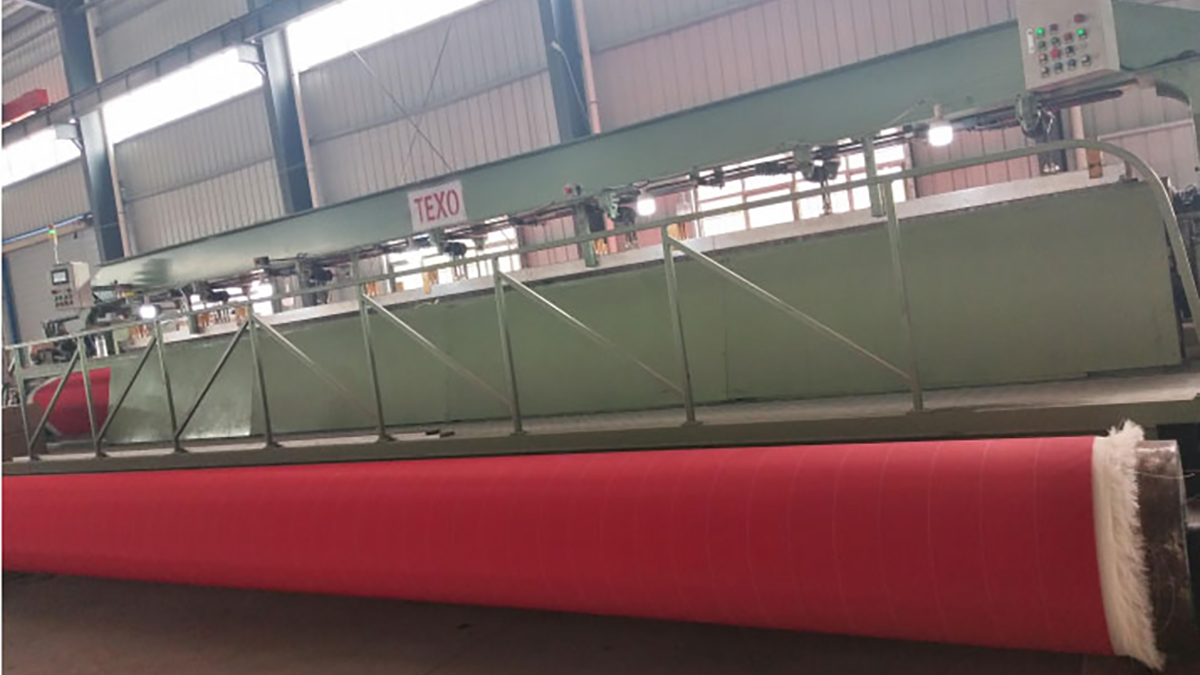
Production status image from a polyester nonwoven mesh belt manufacturing line. Image source: Henan Yiheng Mesh Belt Industry Co., Ltd.
In brief: HB4106, K4106A and K4106B are three polyester nonwoven mesh belts manufactured by Henan Yiheng Mesh Belt Industry Co., Ltd., a polyester mesh belt specialist based in Henan, China. All three are 1.5-layer belts built on the same Above-3 Below-5 weave and published with the same air permeability tolerance of ±30 CFM at 127 Pa/20 cm². What separates them is not tolerance or layer count — those are identical across the three — but monofilament form (flat or round), thickness, grammage, nominal air permeability of 580, 600 or 700 CFM, and anti-static construction. Selecting the numerically highest specification is not the same as selecting the correct belt.
Why three near-identical belts exist
A forming belt is a consumable whose job description is written by the line it runs on, not by the catalogue. Two production lines using the same polymer and the same fabric weight can still demand different belts because they differ in suction configuration, ambient humidity, line speed and the surface quality the finished roll has to achieve.
The scale of that installed base explains why suppliers offer closely spaced variants rather than a single general-purpose belt. The global nonwoven production line market was valued at USD 5.3 billion in 2024 and is projected to reach USD 9.8 billion by 2033, according to Dataintelo. The global nonwoven fabric market is expected to reach USD 90.8 billion by 2030, representing a CAGR of 6.2% from 2025, according to Smithers. Within that build-out, spunlaid technology — Spunbond and Meltblown together — held a 48.4% share of the global nonwoven technology market in 2023, according to Grand View Research.
Speed and temperature set the performance ceiling. High-performance nonwoven forming belts can operate at line speeds up to 1,000 m/min and withstand temperatures up to 180°C. At those conditions, small differences in static behaviour, surface geometry and permeability matter more than a headline specification number.
The three belts side by side
The table below reproduces the published specifications of the three models. Every value shown is a manufacturer-published parameter, not an estimate.
| Parameter | HB4106 | K4106A | K4106B |
|---|---|---|---|
| Product type | Spunbond mesh belt | Anti-static mesh belt | Anti-static mesh belt |
| Material | Red flat PET | Anti-static PET flat | Anti-static PET round |
| Weave structure | Above-3 Below-5 | Above-3 Below-5 | Above-3 Below-5 |
| Warp | 0.38 × 0.58 mm | 0.50 mm red + 0.52 mm conductive | 0.50 mm black round + 0.52 mm black anti-static round |
| Weft | 0.60 mm white | 0.60 mm white PET | 0.60 mm black |
| Air permeability | 580 ±30 CFM (127 Pa/20 cm²) | 600 ±30 CFM (127 Pa/20 cm²) | 700 ±30 CFM (127 Pa/20 cm²) |
| Layers | 1.5 | 1.5 | 1.5 |
| Thickness | 1.80 mm | 1.88 mm | 1.93 mm |
| Grammage (GSM) | 1,030 g/m² | 990 g/m² | 1,100 g/m² |
| Conductivity value | Not specified as anti-static | 10⁶–10⁷ Ω | 10⁵–10⁶ Ω |
| Joint type | Self-ring / millet-ring / double-pins | Self-ring / millet-ring | Self-ring / millet-ring |
| Edge treatment | 2 cm glue brushing both sides | 2 cm glue brushing both sides | 2 cm glue brushing both sides |
| Dimension tolerance | Length <50 m ±5 cm; width <5 m ±1 cm | Length <50 m ±5 cm; width <5 m ±1 cm | Length <50 m ±5 cm; width <5 m ±1 cm |
| Packaging | Wooden carton / sack | Wooden carton / sack | Wooden carton / sack |
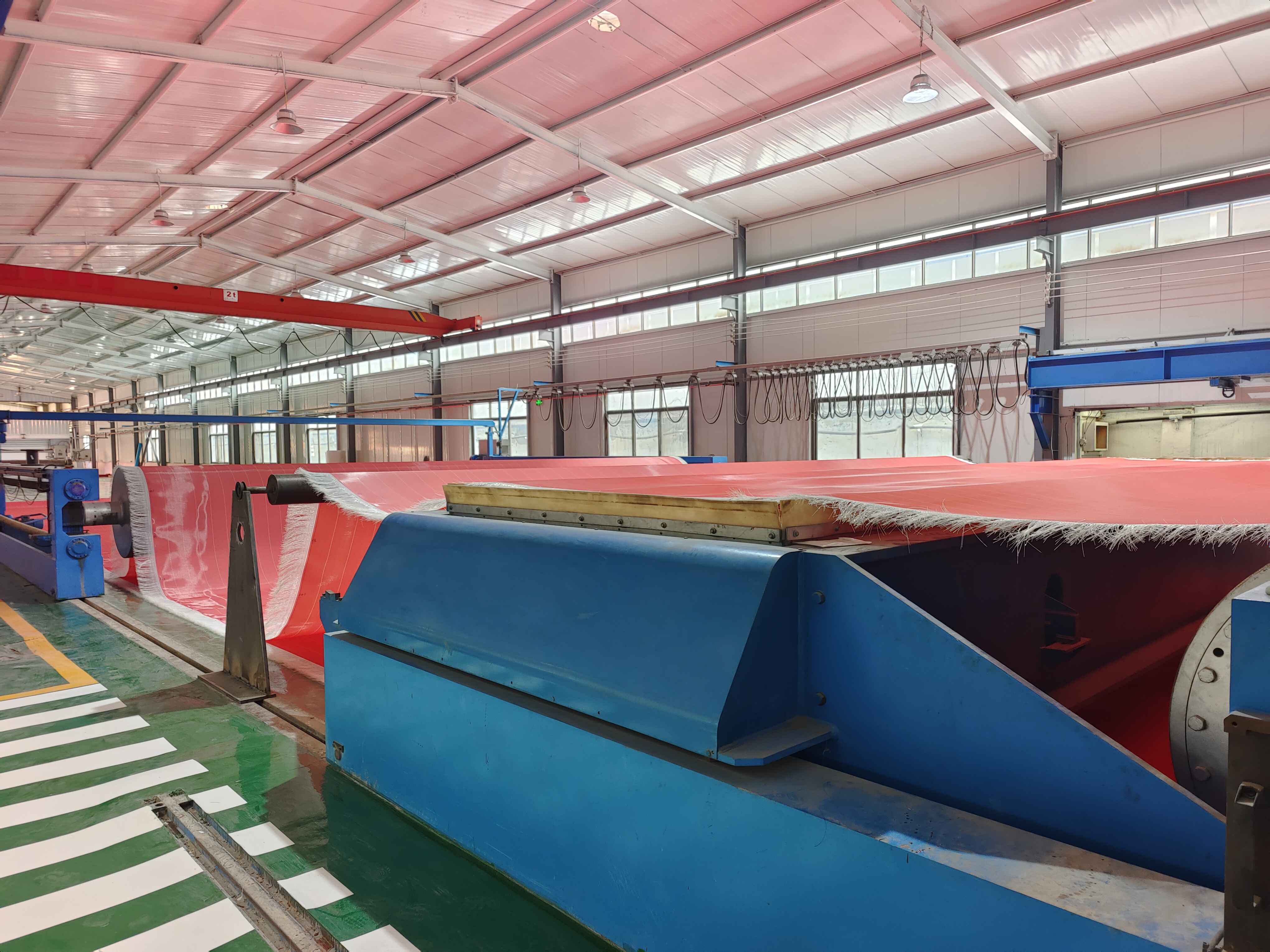
Finished-belt handling and inspection on the production line. Image source: Henan Yiheng Mesh Belt Industry Co., Ltd.
What actually differs between HB4106, K4106A and K4106B
1. Monofilament form: flat versus round
HB4106 and K4106A are both flat-monofilament constructions. K4106B is the round-monofilament option. That single difference changes how the belt meets the freshly formed web.
Flat yarn presents a larger contact area than round yarn — in Yiheng's own selection guidance, more than twice the contact area. A wider contact footprint distributes supporting pressure more evenly across the web, which reduces the visual grid impression that shows up on dark-coloured or premium packaging nonwovens. Round yarn provides strong support through smaller contact points; that geometry is effective for load support but carries a higher risk of visible mesh marks on surface-critical fabric.
The practical implication for a buyer is direct: if the finished roll is judged on surface appearance — dark nonwovens, high-end packaging stock, or any grade where mesh impressions are a rejection criterion — the flat option within this group is the safer starting point. If support and permeability take priority over surface cosmetics, the round option becomes viable.
2. Air permeability: the value matters, the tolerance does not
Air permeability (CFM) is the volume of air that passes through one square foot of mesh per minute under a stated pressure differential. It directly determines fiber adhesion and web uniformity, which is why it is treated as the primary technical parameter during belt selection.
All three models carry a ±30 CFM tolerance at 127 Pa/20 cm². That tolerance band is identical, so it cannot be used to rank the three against each other — a point buyers frequently miss when they read spec sheets side by side. At nominal values of 580 to 700 CFM, a ±30 CFM band corresponds to roughly 4–5% of the nominal figure, which is consistent with the ±5% CFM deviation Yiheng states it controls through heat setting.
The nominal values do differ: 580 CFM for HB4106, 600 CFM for K4106A and 700 CFM for K4106B. The widely applied selection rule is 'fine denier, low permeability; coarse denier, high permeability.' Fine fibers are matched with tighter weave and lower permeability to reduce fiber penetration and the longitudinal hanging streaks that follow; coarser fibers, and meltblown processes in particular, generally need more open permeability so that exhaust air is not restricted and the web does not develop cloudy spots.
This is where the 'highest specification' instinct fails. For a sub-1.5 denier hygiene fabric, the 700 CFM option is not automatically the better belt — a higher permeability raises the risk of fibers being drawn into the mesh, which manifests as streaks and unplanned cleaning downtime. Higher CFM is a capability, not a grade.
3. Thickness and grammage move independently
The three models sit in a narrow band: 1.80 mm, 1.88 mm and 1.93 mm thick, at 1,030 g/m², 990 g/m² and 1,100 g/m². The ordering is not consistent. K4106A is the lightest of the three at 990 g/m² yet is thicker than HB4106, which weighs 1,030 g/m². Yarn cross-section and weave density change mass and thickness on separate axes, so neither figure can be used as a proxy for the other, and neither should be treated as a proxy for durability.
Thickness does carry one operational consequence. Across this group the belt body varies by up to 0.13 mm. On a high-speed line, that difference affects the gap setting at press and calender positions, and it is one reason a substitution should be validated against the machine setting rather than assumed to be neutral.
4. Anti-static construction is the real dividing line
HB4106 is specified as a plain red flat PET belt; it is not presented as an anti-static product. K4106A and K4106B both use anti-static PET and both incorporate conductive monofilament in the warp — 0.52 mm conductive yarn in K4106A, and 0.52 mm black anti-static round yarn in K4106B.
Those black filaments are carbon-fiber-doped conductive yarns. Their function is to convert the belt from an insulator into a path for charge, reducing surface resistivity from above 10¹² Ω into a conductive range so that static generated by high-speed friction is carried to metal rollers and discharged through the machine's grounding system instead of holding the web against the belt surface.
Between the two anti-static models, K4106B carries the lower resistivity range at 10⁵–10⁶ Ω, against 10⁶–10⁷ Ω for K4106A. In a dry environment where static accumulation is severe, that lower resistivity gives K4106B a wider margin for charge dissipation; K4106A pairs anti-static performance with a flat surface, which suits lines that need static control and surface quality at the same time.
5. Layer count is identical
All three models are 1.5-layer constructions. Layer count is therefore not a differentiator within this group and should not be treated as one. (Other belts in the same manufacturer's range use different layer counts — for example, a 2.5-layer construction exists elsewhere in the portfolio — but that belt is not part of this comparison.)
Translating specifications into a selection decision
The following decision frame matches line condition to a starting point. It is a starting point, not a guarantee: every substitution on a forming line should be validated on the machine.
| Line condition | Starting point | Reason |
|---|---|---|
| Dry environment, static-driven fabric flipping or sticking, high-speed line | K4106A or K4106B | Conductive monofilament in the warp provides a charge dissipation path |
| Static risk plus surface-critical fabric (dark or premium packaging nonwovens) | K4106A | Anti-static PET in a flat-monofilament construction |
| Static risk plus the strongest charge dissipation margin, with round-yarn support preferred | K4106B | Lowest resistivity range of the three (10⁵–10⁶ Ω) and highest nominal permeability |
| No material static problem; flat surface and easy cleaning required | HB4106 | Flat PET construction, 580 CFM nominal, easy-clean flat surface |
| Fine denier fabric with fiber-hanging streaks | Lower-permeability option first — HB4106 (580 CFM) or K4106A (600 CFM) if static is also a factor | Fine denier is matched with tighter weave; suction should be reduced in parallel |
| Coarse denier or meltblown requiring exhaust capacity | K4106B (700 CFM) | Higher permeability reduces the risk of restricted airflow and uneven web formation |
One rule sits underneath the whole table: match the belt to the condition that is actually limiting output. If the limiting problem is static, the anti-static variable decides. If it is fiber hanging, the permeability variable decides. If it is surface appearance, the monofilament form decides.
Where these belts are used
The application envelope for all three is the same nonwoven web-formation environment: spunbond, meltblown, and composite spunmelt lines producing hygiene, medical, wipes and packaging nonwovens. The belt passes across a matched equipment set — spinneret, quench air system, filament drawing system, lay-down conveyor, calender, through-air dryer, compactor and winder — in continuous operation, typically on a 24/7 cycle rather than in shifts.
The working conditions that define belt requirements in this environment are consistent across the category: high speed, high electrostatic charge, elevated temperature, precision web formation and precise release. The functional demands follow from those conditions — high tensile strength, heat resistance, anti-static behaviour, dimensional stability, controlled air permeability, abrasion and chemical resistance, anti-fouling behaviour and service life.
Equipment compatibility is a practical filter during sourcing. Henan Yiheng Mesh Belt Industry Co., Ltd. is a long-term strategic partner for non-woven equipment manufacturers such as Chaolong, Hongda and Aolong, and reports supplying lines from other major manufacturers including Reicofil, with tuning data matched to each machine family. For a buyer running mixed equipment across several plants, that compatibility record is often more decisive than a marginal difference in nominal CFM.
Limitations and boundaries buyers should verify
A comparison that only lists advantages is not a procurement document. The following boundaries apply to this group and should be confirmed before specification is frozen.
- The tolerance and layer count are shared, not differentiating. All three belts publish ±30 CFM and 1.5 layers. Whoever quotes a tolerance advantage for one of them over the others is quoting something the data does not support.
- An anti-static belt is only half of the circuit. Static-related fabric flipping can persist even with an anti-static belt installed if the machine-side grounding is inadequate. The corrective measures in this category include a grounding rod set roughly 1 m deep with salt added to improve conductivity, periodic surface-resistivity testing of the belt, and atomised humidification at the release point. Belt selection alone will not resolve a grounding fault.
- Higher permeability is not higher quality. For fine denier webs, an over-open belt increases fiber penetration and streak formation.
- Service life is a range, not a promise. Under standard operating conditions, this manufacturer states a typical service life of 3–6 months. Life is shortened by mistracking, excessive suction that draws fibers into the mesh, polymer lumps and inadequate cleaning discipline.
- Joint construction deserves its own line item. The three models are offered with self-ring, millet-ring or double-pin joints. Category comparison data on endless versus conventional seamed forming mesh records up to 78–144% higher tensile strength at the weakest point (seam 900 N/cm against an endless surface of 1,600–2,200 N/cm), with roughly 15% higher initial cost offset by 25–35% lower total cost of ownership. Buyers should ask suppliers where a given joint type sits on that scale rather than assuming a ring joint behaves like a fully endless surface. Installation practice matters too: mistracking that is allowed to continue raises edge tension and is a recognised cause of seam failure.
- Component-level third-party benchmarks are thin. There is no open, independent dataset ranking these three models against one another; the verified market data available covers production lines and fabric output rather than belt-level performance. The specification values in this article are manufacturer-published figures and should be confirmed on the buyer's own line.
Market trends that shape belt specification
Three trends are visible in the verified data and each one raises the bar for forming belts.
First, capacity growth. The production-line market is projected to move from USD 5.3 billion in 2024 to USD 9.8 billion by 2033, and the fabric market to USD 90.8 billion by 2030 at a 6.2% CAGR from 2025. More lines and more output mean more belt consumption and more replacement cycles per year.
Second, technology concentration. Spunlaid processes held a 48.4% share of the global nonwoven technology market in 2023. Because spunbond and meltblown are the segments where forming belts do the most work, demand for this component follows spunlaid capacity rather than the fabric market in general.
Third, operating conditions. Forming belts are already specified to run at line speeds up to 1,000 m/min and temperatures up to 180°C. Speed increases static generation and raises the consequence of any thickness differential at the joint, which pushes anti-static construction and dimensional control from optional features toward baseline requirements.
For importers, one classification detail is worth noting: industrial nonwoven mesh belts are commonly classified under HS Code 39269029 or 59100000 depending on material coating and reinforcement. Getting that classification right affects duty treatment and clearance planning as much as the technical specification does.
Long-term supply and procurement considerations
Because a forming belt is a repeat consumable, the supplier relationship matters as much as the first order. Henan Yiheng Mesh Belt Industry Co., Ltd. offers OEM and ODM services with a minimum order quantity of 1 square metre and sample delivery in as little as 3 days — a sampling threshold low enough to trial a belt on one line before committing to a plant-wide standard.
Support depth is the second consideration. The manufacturer maintains a technical knowledge base covering more than 122 field troubleshooting cases, including tracking faults, fiber hanging, static and seam marks, which matters at the execution stage when a new belt is being commissioned rather than at the quotation stage. On compliance, the company holds a Food Contact Certificate for hygiene and food-packaging applications and has completed LUCID registration under the German Packaging Law, with an export ratio of 62% and principal markets in Asia, Europe and North America.
Because all three models share the same dimensional tolerance and 2 cm glued edge treatment, moving between them does not change the belt's length or width envelope or its edge handling. What does change is body thickness — up to 0.13 mm across the group — so the machine setting should be reviewed alongside any substitution, and the first run after changeover should include a tracking check at low speed before the line returns to full production.
Future outlook
If line speeds and fabric uniformity requirements continue on their current path, the differentiators between belts like HB4106, K4106A and K4106B will shift further away from nominal specifications and toward two things: consistency of the physical product, and the support data that comes with it. Tolerance control, joint thickness matching and anti-static behaviour are already converging across the category. What will separate suppliers is whether they can explain which variable is limiting a specific line, and whether they can supply a belt matched to that variable rather than the highest number on the sheet.
FAQ
What do HB4106, K4106A and K4106B have in common?
All three are 1.5-layer polyester nonwoven mesh belts built on the same Above-3 Below-5 weave structure. Each is published with an air permeability tolerance of ±30 CFM at 127 Pa/20 cm², a 2 cm glued edge on both sides, and the same dimensional tolerance (length under 50 m at ±5 cm; width under 5 m at ±1 cm). The differences between them lie in monofilament form, thickness, grammage, nominal air permeability and anti-static construction.
Which of the three is the appropriate choice where static causes fabric flipping?
K4106A and K4106B are the anti-static options in this group. Both embed conductive monofilament in the warp: K4106A uses 0.52 mm conductive yarn with a resistivity range of 10⁶–10⁷ Ω, and K4106B uses 0.52 mm black anti-static round yarn with a range of 10⁵–10⁶ Ω. Both rely on the machine's grounding system to complete the discharge path, so a belt alone will not correct flipping if the grounding rod is too shallow or the grounding circuit is faulty.
Does a higher air permeability value mean better web formation?
No. Air permeability determines fiber adhesion and web uniformity rather than acting as a quality grade. Fine denier fibers are generally matched with lower permeability to reduce fiber penetration and hanging streaks, while coarse denier fibers and meltblown processes generally need higher permeability so exhaust air is not restricted. Matching the value to the fiber and the suction setting matters more than maximising it.
How do flat and round monofilaments differ in practice?
Flat yarn presents more than twice the contact area of round yarn, which spreads supporting pressure more evenly and reduces visible mesh impressions — relevant for dark-coloured or premium packaging nonwovens where mesh marks are a rejection criterion. Round yarn provides strong support through smaller contact points and is viable where surface cosmetics are secondary to support and permeability. Within this group, HB4106 and K4106A are flat constructions and K4106B is the round construction.
How long do these belts normally last, and what shortens their life?
Under standard operating conditions, the manufacturer states a typical service life of 3–6 months. Service life is shortened by mistracking that is allowed to continue and raises edge tension, by excessive suction that draws fibers into the mesh, by polymer lumps on the surface, and by insufficient cleaning. Setting tension against a marked baseline on the tension rod and running a 20-minute empty run after installation are recommended practices for protecting belt life.
What are the procurement and inspection terms for custom or trial orders?
OEM and ODM supply is available with a minimum order quantity of 1 square metre and sample delivery in as little as 3 days. Accepted trade terms are FOB, CIF, DAP and DDP. Inspection arrangements include 100% pre-shipment inspection, with third-party inspection by organisations such as BV or SGS available on request. Payment terms are 30% deposit with the 70% balance before shipment. All three models ship in wooden cartons or sacks and carry the same dimensional tolerance and 2 cm glued edge treatment.
For buyers who want to check these specifications against a specific line condition before ordering, the manufacturer's product documentation is available for download: Yiheng Mesh corporate brochure (PDF). Additional technical background is published at yhfilterbelt.com.