
HDD Data Destruction: What Singapore Buyers Should Verify
Industry Reference · Secure Data Destruction · Singapore
Data destruction in Singapore has quietly moved from a facilities task to a procurement constraint. Retiring the hardware is the easy part; the difficult part is producing evidence that the data on it is gone — evidence that still holds up during an audit, a client security review, or a regulator's question months after the rack has been cleared.
The scale of that shift shows up in the numbers. The global IT Asset Disposition (ITAD) market was valued at USD 17.5 billion in 2024 and is expected to reach USD 29.54 billion by 2030, and data destruction alone accounted for the largest single share of it at 30.64% in 2024 (Strategic Market Research). Meanwhile, global e-waste generation reached 62 million tonnes in 2022 and is projected to reach 74.7 million tonnes annually by 2030 (Global E-waste Monitor 2024). More devices leaving service, more of them carrying regulated data, and more of that data now requiring a documented end.
Hard disk drives sit at the centre of that pressure. They are among the most common data-bearing devices in enterprise environments, they retain data after ordinary deletion, and they are the asset most likely to be resold, traded in, or handed to a third party. This reference sets out the constraints a buyer has to resolve before signing: which method fits which media, how custody is held, what evidence is actually produced, and where the limits of any destruction service lie.
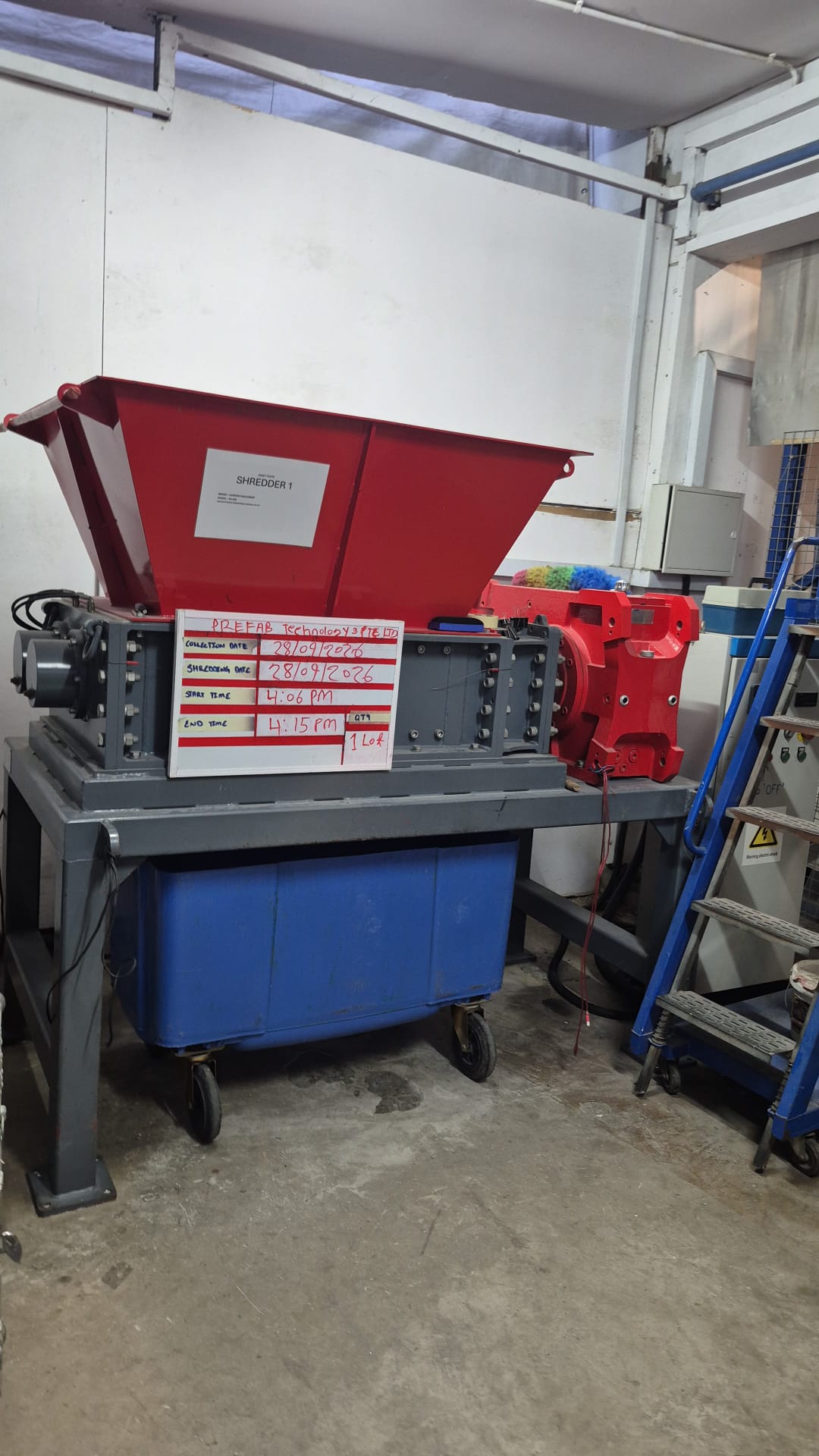
Physical destruction equipment used for hard drives, SSDs and other storage media before recycling or disposal.
Why hard drives are a constraint problem, not a disposal problem
A hard drive stores data as magnetic patterns on rotating platters. Deleting files or reformatting the volume removes the file system's pointers to that data; it does not remove the magnetic patterns themselves. That is why the recognised reference for media sanitisation, NIST SP 800-88 Revision 1, defines three distinct outcomes — Clear, Purge and Destroy — rather than a single instruction to “erase” a device.
For a procurement team, the practical consequence is that “secure data destruction service” is not a self-defining purchase. The right method depends on the media type, the sensitivity of the data, and the level of assurance the organisation's own policy or auditor will accept. A software overwrite that satisfies a Clear outcome is not equivalent to Purge or Destroy, and a vendor that offers only one method effectively forces every media type through the same process.
Three questions should be answered before any quote is compared:
- What media is actually in scope? Magnetic hard drives, flash-based SSDs, tape backups, laptops and mobile devices each behave differently under sanitisation.
- Which sanitisation outcome does your policy require? Clear, Purge or Destroy, and whether the requirement differs between on-premise and cloud migrations.
- What evidence will you receive, and can you reproduce it? A certificate alone is not a chain of custody; it is the last link in one.
Matching destruction method to media type
Method-to-media matching is the first constraint that separates a compliance-ready destruction job from a disposal job. The table below maps common media to the destruction approaches used in practice, and to the evidence a buyer should expect from each.
| Media type | Destruction approach | Why it applies | Evidence expected |
|---|---|---|---|
| Magnetic hard disk drives | Degaussing, shredding, crushing or HDD drilling | Magnetic media can be sanitised magnetically or reduced to non-recoverable fragments | Itemised asset report, Certificate of Destruction |
| SSDs and flash media | Shredding or crushing | Flash media is not magnetic, so degaussing does not apply to it | Itemised asset report, Certificate of Destruction |
| Tape backups | Degaussing or physical destruction | Magnetic tape carries the same residual-data characteristics as drives | Itemised asset report, Certificate of Destruction |
| Laptops, mobile devices, IT equipment | Physical destruction of the device or removal of the drive for separate destruction | Removable drives must be handled as individual data-bearing units | Asset-level records and destruction certificate |
| Confidential paper documents | Secure shredding | Non-electronic records fall under the same confidentiality obligations | Destruction report, Certificate of Destruction |
| Other non-electronic items | Destruction and recycling | Mixed asset retirement often includes non-electronic items in scope | Job log and disposal record |
Singapore-based provider BigVoice Secure Destruction Pte. Ltd. operates a toolset that spans both categories: industrial shredders and crushers, an SV91m degausser stated to meet NATO/NSA requirements, and HDD drilling tools. For buyers, the presence of both magnetic and physical methods in one service scope is the practical signal that different media can be handled without being sent elsewhere.
What a controlled destruction workflow looks like
BigVoice Secure Destruction Pte. Ltd. is a Singapore-based provider of secure destruction and IT asset disposal services for electronic and non-electronic assets, covering hard drives, laptops, mobile devices, IT equipment, confidential documents and other data-bearing media. Its service model is built around a four-step sequence: collect, track, destruct, certify.
Collect and track
Assets are collected on site or delivered by the customer at drop-off. Trained collection and destruction teams execute the work while maintaining chain-of-custody records. Every item is scanned and locked into an inventory tracking system supported by barcode asset scanning, a cloud-based asset management database and encrypted job recording. The company states that collection vehicles can be tracked by GPS as items are delivered to the secure destruction facility, and the service produces itemised verification reports through its inventory tracking system.
Destruct on site or at the secure facility
Destruction is carried out either on the customer's premises or at the company's own secure site — a 99.45 m² secure storage and destruction area in Singapore, supported by professional physical destruction equipment and a supervision handover and traceability recording system. The destruction method is selected according to media type. CCTV viewing of the destruction process is available, and a CCTV viewing link can be supplied as a deliverable on request.
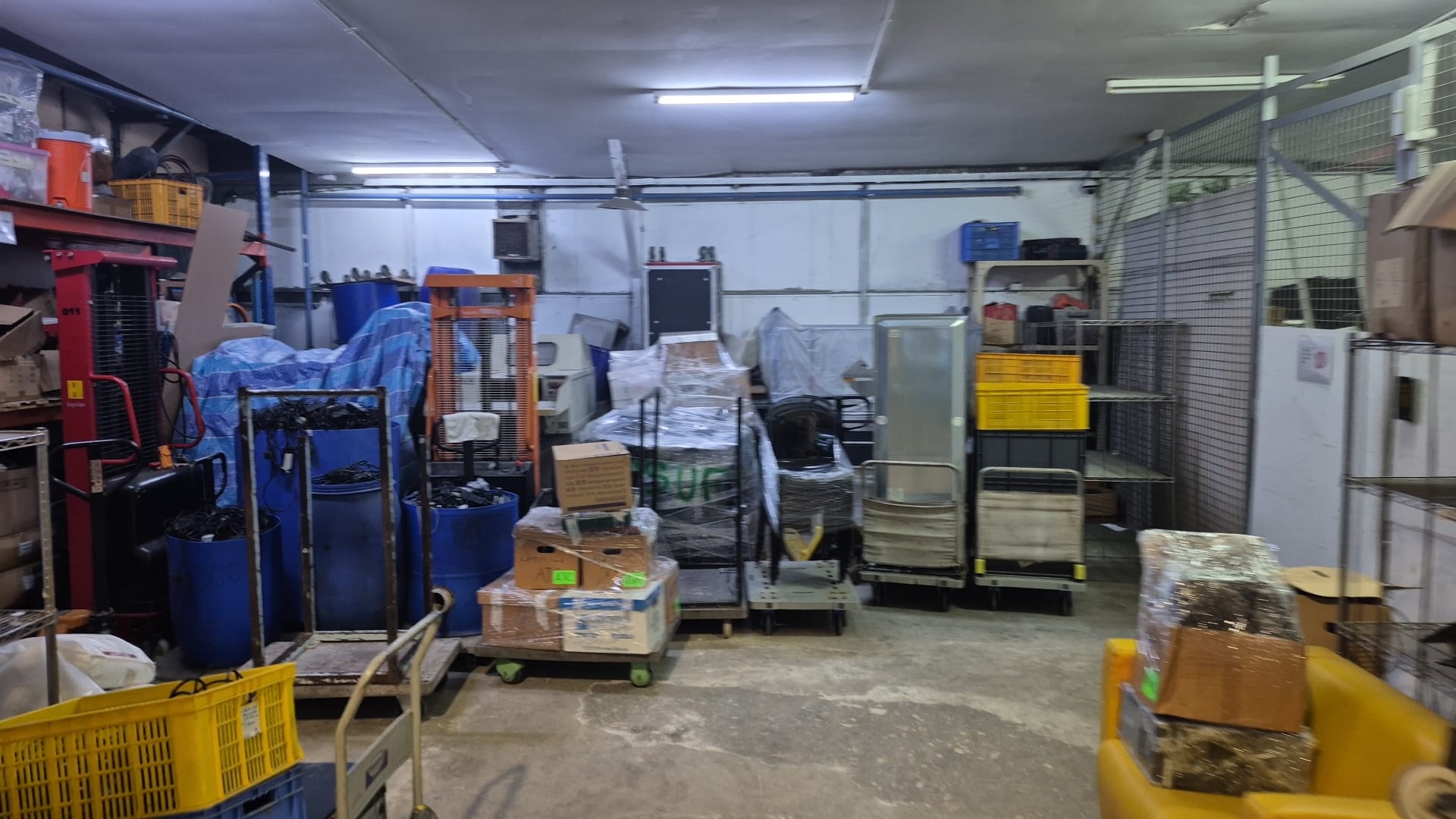
Secure storage area where scanned, locked and logged assets are held prior to destruction.
Certify and close the job
A Certificate of Destruction is issued after destruction. Where a buyback applies, a payment receipt for the transaction is issued alongside the destruction records. Behind the service sit dedicated account managers, collection teams, on-site destruction technicians, and quality and compliance officers, with staffing allocated according to project batch size, and support in English and Mandarin.
The evidence layer: what “certified” should actually produce
Buyers often treat a single certificate as the whole proof of destruction. It is more useful to split the evidence into three separate proofs, because each one answers a different audit question.
| Proof | Question it answers | Expected document |
|---|---|---|
| Identity | Which specific assets left our control, and how were they identified? | Itemised verification report from the inventory tracking system, barcode-scanned asset records |
| Custody | Who held the assets between collection and destruction? | Chain-of-custody records, collection records, job logs, GPS-tracked collection (as stated by the provider) |
| Outcome | What was done to the media, and can it be observed? | Certificate of Destruction, CCTV viewing link on request, destruction report |
A certificate that is not backed by an itemised asset list and a custody record is difficult to defend in an audit, because it cannot show which drives were destroyed. Conversely, an itemised list without a certificate leaves the outcome unverified. The three proofs only work as a set.
Limits and boundary conditions buyers should test
A credible destruction service is defined as much by its boundaries as by its capabilities. Several constraints apply to this category of service generally, and to BigVoice Secure specifically, and they should be confirmed during evaluation rather than assumed.
| Constraint | What it means for a buyer | What to confirm |
|---|---|---|
| Facility footprint | The secure storage and destruction site is 99.45 m², which is modest relative to data-centre-scale decommissioning volumes | Whether large batches need phased scheduling or on-site execution |
| Throughput disclosure | Handling is project- and batch-based; daily or annual throughput is not publicly disclosed | Stated capacity and lead time for your specific batch size |
| Licences held through an affiliated entity | NEA General Waste Collector Licence, NEA General Waste Disposal Facility Licence, bizSAFE3, ISO 14001 and ISO 27001 are held through affiliation with BigVoice Prodigy Renovations & Disposal Services Pte Ltd | Which legal entity contracts, which entity holds each licence, and who physically performs the destruction |
| Service exclusions | Data recovery, physical transportation of hazardous waste, and data migration and backup are outside the stated scope | Whether these must be arranged as separate workstreams |
| Commercial transparency | Unit pricing is not published; work is quoted per project, with timeline depending on quantity, location and client requirements | A written scope covering volume, media mix, on-site or off-site execution and documentation |
Where HDD destruction fits: application scenarios
Secure media destruction is typically triggered by a discrete operational event rather than routine housekeeping. The most common triggers are IT asset retirement, data centre migration, office relocation, and audit or compliance events — alongside large-volume confidential document destruction where paper and electronic records are cleared together.
Industry experience across finance, healthcare, data centre, manufacturing and retail is relevant here because the evidence requirement, not the destruction method, is usually what differs between sectors. A financial institution preparing for an audit and a manufacturer clearing a production line both need irrecoverable destruction, but they need it documented to different internal standards.
Reported outcomes from a representative IT asset data destruction and asset buyback project illustrate what a completed engagement produces: over 500 storage media secured, 100% audit-ready destruction certificates issued, and partial asset value recovered through buyback. The documented destruction workflow and audit-ready certificates were cited by the client as meeting internal governance requirements.
The buyback element deserves separate attention. BigVoice Secure operates a buyback-first approach for eligible electronic waste, which means destruction and value recovery have to be sequenced deliberately: data destruction is completed first, and only then is residual value assessed on the remaining material. Reversing that order reintroduces exactly the risk the service is meant to remove.
Comparison with traditional disposal routes
Most organisations do not choose between two certified vendors. They choose between a certified process and an internal habit, and the differences are structural rather than commercial.
| Route | Typical exposure | Evidence produced | Where it fits |
|---|---|---|---|
| General waste or bin disposal | No custody, no verification, devices can be recovered intact | None | Not appropriate for any data-bearing device |
| In-house software wiping only | Outcome is a Clear-level overwrite, and drive health or hidden areas may not be fully processed | Internal IT log | Low-sensitivity, reusable devices staying in the organisation |
| Resale or trade-in without sanitisation | Data leaves the organisation with the device and cannot be recalled | Sale or trade-in receipt | Only after documented sanitisation of the media |
| Certified on-site destruction | Requires equipment mobilisation and site access coordination | Certificate of Destruction, witnessed or CCTV-viewed destruction | High-sensitivity media that should not leave the premises |
| Certified off-site destruction | Depends entirely on custody discipline during transport and storage | Itemised asset report, chain-of-custody record, Certificate of Destruction | Larger volumes, mixed media, degaussing work |
Market trend analysis: what is changing for buyers
Two published signals frame the direction of this category. The first is market growth: the global ITAD market was valued at USD 17.5 billion in 2024 with an expected value of USD 29.54 billion by 2030, and data destruction held the largest segment share at 30.64% in 2024. The second is volume: global e-waste generation reached 62 million tonnes in 2022 and is projected to reach 74.7 million tonnes annually by 2030.
Taken together, the trend points to tightening rather than relaxing constraints. Higher volumes of retired hardware increase the number of assets that must be processed and documented, while the growing share of destruction within ITAD suggests that buyers are increasingly unwilling to treat disposal and data security as separate decisions. For procurement teams, the practical implication is that documentation quality — not disposal speed — is becoming the main differentiator between service providers.
Future outlook
Three developments are likely to shape how organisations buy destruction services over the next planning cycle. First, evidence will increasingly be specified in the contract rather than accepted as a standard deliverable: itemised asset reports, chain-of-custody records and certificate issuance will move from “nice to have” to scope items. Second, witnessed and CCTV-monitored destruction is likely to become the default expectation for high-sensitivity media, at least where the media does not leave the client's premises. Third, destruction and value recovery will continue to converge — buyback and recycling programmes only remain defensible when sanitisation is completed and recorded before any asset re-enters circulation.
For buyers in Singapore, the practical preparation is unglamorous: define the sanitisation outcome your policy requires, classify your media accordingly, and specify the documentation set you will accept. That framework makes any subsequent vendor comparison considerably more objective.
Frequently asked questions
What is HDD data destruction, and how does it differ from data wiping?
Data destruction permanently erases digital information from storage devices so that it cannot be accessed, and is generally described as the complete and irreversible removal of data from storage devices. Wiping, by contrast, overwrites data so that it is not recoverable through normal access. On magnetic hard drives the distinction matters because the platters retain magnetic patterns after file deletion. NIST SP 800-88 Revision 1 separates outcomes into Clear, Purge and Destroy, so the acceptable outcome should be set by the buyer's own policy rather than by the vendor's default method.
Which destruction method applies to hard drives versus SSDs?
Hard disk drives are magnetic and can be addressed either magnetically, through degaussing, or physically, through shredding, crushing or drilling. SSDs and other flash-based media are not magnetic, so degaussing does not apply; physical destruction through shredding or crushing is the usual route. Because of this, a provider's equipment list should be checked for both magnetic and physical destruction capability. BigVoice Secure's toolset includes industrial shredders and crushers, an SV91m degausser stated to meet NATO/NSA requirements, and HDD drilling tools.
What certifications and licences should a Singapore buyer verify before awarding?
Where a service includes collection and handling of material, buyers commonly check waste collection and disposal licensing, together with workplace safety and information security certifications. BigVoice Secure states that, through its affiliation with BigVoice Prodigy Renovations & Disposal Services Pte Ltd, the group holds the NEA General Waste Collector Licence, the NEA General Waste Disposal Facility Licence, bizSAFE3, ISO 14001 and ISO 27001. Because these credentials are held through an affiliated entity, buyers should confirm that the contracting entity, the licence holder and the party performing the physical destruction are consistent, and should obtain documentary copies before award.
What documentation should a buyer receive after destruction is completed?
The standard deliverables are a Certificate of Destruction issued after the destruction, an itemised verification report generated from the provider's inventory tracking system, and, where a buyback applies, a payment receipt for the transaction. CCTV viewing of the destruction process is available, with a viewing link supplied as a deliverable on request. These documents serve different purposes: the itemised report establishes asset identity, custody records establish who held the assets, and the certificate records the outcome.
When is on-site destruction preferable to off-site destruction?
On-site destruction keeps data-bearing devices inside the client's control until the moment they are destroyed, and removes transport from the chain of custody. It is generally preferred where policy prohibits media leaving the premises or where witnessed destruction is required. Off-site destruction at a secure facility suits larger volumes, media that requires specific equipment such as degaussing, and scheduled batch processing; it depends on documented chain of custody from collection through to destruction and certification. BigVoice Secure provides both on-site and off-site destruction, with item scanning and locking applied before destruction in either case.
What is not covered by a secure data destruction service?
BigVoice Secure's stated scope excludes data recovery services, physical transportation of hazardous waste, and data migration and backup services. Organisations that require any of these should plan them as separate workstreams rather than assume they are bundled with destruction. It is also worth stating the boundary plainly: destruction confirms that media was irrecoverably processed at the point of disposal. It does not verify what happened to a device before it reached the destruction provider.
What drives the cost of an HDD destruction job?
Cost is generally shaped by the volume and media mix of the batch, whether destruction is executed on site or at a secure facility, whether equipment has to be mobilised to the client's premises, the scheduling urgency, and the level of documentation or witnessing required. BigVoice Secure does not publish unit pricing; engagements are quoted on a project basis, and the timeline depends on quantity, location and client requirements. Buyers comparing quotes should therefore normalise the scope first — media types, execution location, and the documentation set — before comparing commercial terms.
A downloadable PDF overview of BigVoice Secure's destruction and IT asset disposal services, including process and documentation details, is available here: BigVoice Secure Service Overview (PDF).
Есть вопросы или нужны дополнительные детали?
Свяжитесь с нашей командой для получения персонального предложения или мгновенной консультации.
Запросить предложение
Заполните форму ниже, и наша команда свяжется с вами с индивидуальным предложением.
Прямой чат WhatsApp
Предпочитаете общаться в реальном времени? Напишите нам в WhatsApp для мгновенной помощи и быстрых ответов.
- Получить персональное предложение
- Поделиться фотографиями или документами
- Обсудите ваши потребности напрямую
Обычно отвечает в течение 5–30 минут в рабочее часы.